


 menu
The Chinese Communist Party
15
From Making Friends to Countering Threats: The Changing Contours of United Front Work in Hong Kong
Samson Yuen and Edmund W. Cheng
Introduction
Hong Kong has been a Special Administrative Region (SAR) of the People’s Republic of China since 1997. However, long before the semi-autonomous city was handed over from the British, the Chinese Communist Party (CCP), since its birth, had sought to establish its presence in the territory. The capitalist city, despite being a stark ideological opposite to the socialist ideal, has served as a useful and relatively safe haven for the CCP to conduct revolutionary and political work, and as a strategic outpost to communicate, interact and trade with the outside world. These activities strengthened the Party’s survival in its nascent years and have also enabled it to meet its political needs at different periods of time. Facilitating these activities is the idea of the united front, a Leninist invention that originally sought to unite all workers from non-socialist parties against the capitalist class. Adopted by the CCP to bring friends and sympathisers in line against its political opponents, and credited by Mao Zedong as one of the CCP’s ‘three great magic weapons’ (sanda fabao), united front work has been an – if not the most – important tool to expand and consolidate political influence in Hong Kong, both before and after the sovereignty handover. It has allowed the party-state to build up an extensive pro-Beijing following to ensure its dominion over the city. To a large extent, one could say that united front work was simply the ‘basis and starting point of various tasks’ for the local CCP (Loh 2010, 88).
Given the centrality of the united front in China’s policy towards Hong Kong, the topic has aroused substantial interest among scholars. Numerous studies have been published about the history of united front work in Hong Kong (Chan Lau 1999; Loh 2010), the target of such work (Chu 2010), the role of key united front actors (Burns 1990; Lee 2019), the strategies involved (Lam and Lam 2013) and its impact on local politics (Lo, Hung and Loo 2019). But despite their contribution to the field, these works have several limitations. First, these studies often put the attention on state actors that are formally responsible for carrying out united front work, usually the Central Liaison Office and its predecessor. This focus neglects the fragmented nature of China’s authoritarianism (Lieberthal and Lampton 1992; Mertha 2009) in that many local government actors are also actively involved in developing their line of united front work in Hong Kong. Second, these studies tend to adopt a state-centric perspective, portraying the united front as a top-down, hierarchical structure. Although they do recognise the relational nature of united front work, the analytical attention is tilted towards state actors and their policies, which understates their interaction with myriad social actors. Third, because of the clandestine nature of the united front, these studies have mostly relied on archival and anecdotal data, which makes the findings rather descriptive and unidimensional. This has undermined the actual scale, scope and rhythm of united front work on an empirical level.
This chapter seeks to unravel the dynamics of China’s united front work in post-handover Hong Kong. Based on publicly available reports and an original event dataset, we use a social network approach to delineate the changing landscape of the united front and the interactions between myriad state and non-state actors that are taking place under united front work. Besides showing the steady organisational proliferation of pro-Beijing social organisations, we also demonstrate their increasingly frequent interaction with the SAR government and different levels of government in mainland China. By doing so, we argue that united front work has become more decentralised and multilayered in its structure, and that its objective has been shifting from elite cooption to counter-mobilisation against pro-democracy threats.
Our findings seek not only to highlight the continual salience of united front tactics that the Leninist party-state relies on to control a peripheral territory, but also to cast it under a different analytical light. By utilising a rich set of event data that have not been explored by scholars, we are able to visualise and, to some extent, quantify united front work in a relational and temporal manner. Moreover, by showing the multitude of state and non-state actors involved in the united front, the results indicate that state power in post-handover Hong Kong does not solely belong to the remit of governmental institutions; it is increasingly exercised through the nexus between state and society.
The Political Art of Making Friends
The CCP’s united front work has a long history in Hong Kong. As soon as the Party was established in the early 1920s, it began to operate in the then British-ruled colonial city, using it as a revolutionary base to build up power against the Nationalist government. Although by the mid-1930s the Communist activities had almost come to a complete halt due to the Long March (Chan Lau 1999), Japanese invasion provided an opportunity for the Party to re-establish itself and expand its united front in the city (Loh 2010, 56–63). After the Party captured political power in the mainland, Hong Kong continued to serve as an important outpost. Despite its ideological aversion to imperialism, the CCP decided to leave Hong Kong in the hands of the British for strategic purposes. It adopted a policy known as ‘making full use of Hong Kong in the interest of long-term planning’ (changqi liyong, chongfen dasuan), which would remain in place for the next few decades until the handover (Loh 2010, 84). Under this policy, Hong Kong became both a window through which the CCP communicated and engaged with the outside world, and an ideological battlefield against the Guomindang (GMD) and the US-led ‘Free World’. The city’s unequivocal capitalism also provided a stable source of foreign currency and other essential supplies for the Leninist party-state to sustain itself through its economic turmoil and international sanctions.
To achieve these objectives and make full use of Hong Kong, the CCP developed an extensive united front that spanned a wide range of sectors. Apart from aligning with the working class, its traditional base of support, the party-state – represented by the New China News Agency (NCNA, also known as Xinhua) in the territory – cultivated supporters and friends among the capitalists, professionals and politicians, while extending its influence into education, media and cultural circles. This extensive united front, known locally as the ‘leftists’, was mobilised en masse during the 1967 riots due to the influence of the Cultural Revolution, when pro-Beijing groups organised a Struggle Committee to coordinate strike actions and violent protests against the colonial authorities (Cheung 2009). However, because of its increasing radicalisation, coupled with the hardline responses from the colonial authorities (Yep 2008), the leftists lost public sympathy. Many citizens instead opted to throw their support behind the colonial government. As a result, the united front was forced to go underground through the 1970s (Ma 2007, 35).
It was not until the negotiation of Hong Kong’s sovereignty in the 1980s that the united front re-emerged from the dark. After the Sino-British Joint Declaration was signed in 1984, the local CCP, led by the newly appointed head of the NCNA, Xu Jiatun, became very active in rebuilding the united front. Xu particularly focused on the tycoons, the business elites and the middle class in order to solicit their support for the 1997 handover (Chu 2010, 77–94; Loh 2010, 145–68). New political institutions, such as the Basic Law Drafting Committee and the Basic Law Consultative Committee, were established, not only for managing the transition but also for coopting social and professional elites under the CCP’s sphere of influence. Promises and assurances that Hong Kong would be reunited with China under ‘democratic reunification’ were also made to an emerging group of student activists and pro-democracy advocates to gain their support. Although the charm offensive was suspended by the Tiananmen crackdown in 1989, many elites soon realigned themselves with the party-state either because of the lure of the lucrative Chinese market or because of the guarantee of official appointments in the post-handover administration. Thereafter, pro-Beijing groups remained active in politics, occasionally mobilising against the electoral and legal reforms introduced by the last governor, Chris Patten (Ma 2007, 42, 131).
Two main features characterised China’s united front work in pre-handover Hong Kong. First, united front work was conducted under a relatively centralised system and through a hierarchical command-and-control structure featuring ‘statist corporatism’ (Lam and Lam 2013). The apparatus was directed at the top by the Central Foreign Affairs Leading Small Group headed by Premier Zhou Enlai, whose orders were implemented locally by the NCNA (Burns 1990). Although there were, at times, subtle tensions between central government agencies (e.g. Hong Kong and Macao Affairs Office) and the NCNA, and although personalistic features were salient in united front work, the united front apparatus was, to a great extent, centrally coordinated by a limited number of actors. Second, the primary objective of united front tactics in the pre-handover era was cooption. Given that the CCP did not enjoy any formal power in the colonial city, united front work needed to remain discreet and underground. Its scope had to be limited to building alliances with elites and masses through which to achieve the Party’s strategic objectives and to build up a significant base of social support after the handover. Even though the underground front mobilised in some particular instances, such as the 1967 riots or the Patten reforms, it generally refrained from participating openly in local politics. Making friends remained its principal task.
To some extent, these features are still relevant after the 1997 handover. On the one hand, united front work remains the precinct of the Central Liaison Office (CLO) of the Central People’s Government in the Hong Kong SAR, which has replaced the NCNA as a local Party branch since 2000. The CLO has expanded the size, operation and scope of work over the years. It has actively engaged with many social sectors and has assisted pro-Beijing political parties to campaign in elections. Its role has grown so significantly that Lee (2019) has characterised it as a quasi-ruling party. On the other hand, cooption still constitutes an important component of united front work. Business and professional elites continue to pack national political institutions (Wong 2012), namely the National People’s Congress (NPC) and the Chinese People’s Political Consultative Conference (CPPCC), which provide them with direct access to Beijing (Fong 2014). Mass line work has expanded substantially through a wide range of social organisations and residential associations, which enable penetration into the grassroots (Ma 2007, 151–3). Lam and Lam (2013, 322) argue that united front work in post-handover Hong Kong reflects ‘a more inclusionary version of state corporatism’, and relies on a variety of tactics that revolve around cooption, depending on ‘whether the central government regards its targets as friends, valuable potential co-optees or enemies’.
However, there have also been significant changes. First and foremost is that united front work has surfaced from the underground and become more conspicuous, even though the Party does not operate formally in the territory.1 The objectives of united front work have also diversified: rather than being limited to coopting supporters, the united front has become a crucial vehicle of electoral mobilisation for the pro-Beijing camp (Kwong 2007; Lo, Hung and Loo 2019). Moreover, pro-Beijing grassroots organisations have been increasingly involved in contentious activities against the political opposition, ranging from signature campaigns, to rallies in support of unpopular government policies, to counter-protests (Lee 2019, 10; Cheng 2020). In short, united front work has evolved from a transitional and preparational strategy in the colonial period into a routinised governing approach in the post-handover era. Nevertheless, although some of these changes have been captured by the existing scholarship, these works have largely followed the framework of statist-corporatism, focusing on the role of the CLO and its line of authority. This analytical lens has neglected the involvement of many central and local government agencies that are increasingly salient in the united front work in Hong Kong, and the relational dynamics of these state actors with social organisations. The secretive nature of united front work also means that we still know little about its scale, scope and rhythm, as well as the relative importance of different actors, on an empirical level.
Methods and Data
This chapter aims to delineate the dynamics of China’s united front work in post-handover Hong Kong using an original event-organisational dataset. Much of the data were extracted from the social organisation news section (shetuan xinwen) of Wenweipo (社团新闻), a state-owned newspaper and the CCP’s mouthpiece in Hong Kong. Since 2003, the section has reported events involving pro-Beijing social organisations as well as various governmental actors in mainland China and Hong Kong, providing an invaluable record of united front activities. We scraped the reports between 2003 and 2019 from the newspaper’s website using computer programming techniques. After removing the reports that had an unusually long length (which were likely to be long lists of names), we collected a total of 30,174 reports. Given that the large amount of data rendered manual coding impossible, we utilised the same computer program to identify the organisations present in each report, based on an organisational list that we prepared. The list consisted of 3,869 organisations, spanning five different types: 1) central Party agencies (e.g. United Front Department, Propaganda Department and Organisation Department); 2) local government agencies (i.e. agencies on or under the provincial level, including local united front bureaus); 3) Hong Kong government agencies (e.g. Chief Executive’s Office, Home Affairs Bureau, and Constitutional and Mainland Affairs Bureau); 4) the CLO and its various subdivisions; and 5) pro-Beijing social and political organisations (e.g. hometown associations and community organisations). The first four types were collected through government websites and the list of China’s administrative divisions, while the last was compiled through the lists of organisations from various pro-government signature campaigns.
The list allowed us to identify how many organisations, and which type of organisations, were present in a single report, each of which was assumed to represent an event.2 To analyse the co-occurrence of different actors, we excluded events that had fewer than two actors, leaving us with 14,503 events (on average, 853 events per year). Based on the assumption that events allow multiple organisations to interact with one another (and, therefore, perform united front work), we performed a co-occurrence analysis on the events, using the five different types of actors as analytical units. We only counted the co-occurrence of any two different types of actors as interactions, ignoring the co-occurrence of the same type.
Co-occurrence of different actors in each event does not always imply that these actors had built tangible and meaningful relationships through that event. After all, actors need not interact or mingle with one another even if they are attending an event together. However, co-occurrence helps to reflect the potentiality of interactions, which, we believe, offers a useful proxy to gauge the possible scale of united front activities, given the relational nature of such work. It also gives researchers a quantifiable basis to compare the volume of possible united front activities across time periods. To strengthen our co-occurrence analysis, we also collected the background data of the major pro-Beijing grassroots organisations in Hong Kong, based on the same list that we collated. We used Wisenews, online search engines and newspaper advertisements to find out their year of establishment, membership size and affiliated organisations. Finally, we relied on annual financial reports and participant observations to delineate the resources and activities of these grassroots organisations.
The Organisational Proliferation of the United Front
During the revolutionary era, the CCP’s united front involved an alliance of non-Party social forces, or, in some cases, secondary enemies, in order to defeat the Party’s primary enemies. This strategy often targeted the educated class and the nationalistic capitalists before the founding of the People’s Republic. However, once the party-state established formal state power and extended its tentacles into the peripheral territory, the strategy of united front work also needed to be adapted (U 2012). Since the CCP did not directly and formally exercise political power in the colonial enclave, it had to depend on a range of local intermediaries, primarily social organisations, to penetrate society and channel its influence. Moreover, under Mao Zedong’s indigenisation of Marxism–Leninism, which emphasised the principle of ‘mass line’ (qunzhong luxian), the united front apparatus in capitalist Hong Kong had to ensure close ties with the grassroots, rather than just the bourgeois professionals. These two strategic considerations laid the foundation for a multilayered and decentralised structure of the united front later in post-handover Hong Kong, even though it remained rather centralised and unitary for much of the colonial era (Burns 1990).
Given the changing state-society relations in post-handover Hong Kong discussed earlier, the united front’s operational dynamics and cooption targets have shifted accordingly. During the early post-handover period, the primary aim of the united front was to contain the contradiction between socialism and capitalism under ‘One Country, Two Systems’. To earn support from the capitalist class for ensuring stable transition and effective governance, business elites were thus the principal targets of cooption. Coopted business elites often gained representation in the national political institutions in the mainland as well as statutory bodies in the SAR. Nominations to different levels of people’s congresses and people’s political consultative conferences were mostly handled by the CCP’s United Front Department after taking into account advice from the Hong Kong and Macau Office and the CLO.3 In return, the capitalist class made use of its standing and influence in professional and business organisations to support the SAR government. However, the massive 1 July rally in 2003 against a proposed national security law prompted Beijing to adopt a more organised effort to control the territory. As the party-state saw the societal challenges as a form of national security threat, business alliances and underground operations were seen as insufficient for containing the pro-democracy opposition. The united front needed to expand its reach and deepen its penetration into the masses, much more so than it had done during colonial times, to strengthen the patriotic force.
The result has been a gradual shift from statist-corporatism to political clientelism, in which the majority of social organisations are no longer subsumed under the SAR government’s framework of governance but are instead leveraged by the CLO as vehicles to expand its influence at the grassroots. Lee’s (2019) recent study suggested that the uniqueness of clientelism in Hong Kong is that its political machine is adapted from the party-state’s united front infrastructure of indirect rule over Hong Kong. Under the new united front ecology, business elites become clients under the political patronage of the CLO, and they in turn sponsor social organisations and increase the dependency of the masses on the political machine.
After 2008, the CLO significantly expanded its internal structure and boosted its public visibility, not only to make friends but also to combat enemies. Its internal bureaus increased from nine to 25, which, in turn, are territorially divided according to district boundaries and functional roles (Lee 2017). Each regional bureau oversees several electoral constituencies. Further, its social work, external relations and public affairs bureaus are given the responsibility to unite business and grassroots associations, liaise with the local and mainland authorities regarding economic, educational and cultural exchanges, and supervise propaganda mouthpieces and pro-Beijing political parties. The united front’s organisational proliferation can be measured by its ability to coopt and revamp three types of social organisations, including local federations, hometown associations and non-governmental organisations (NGOs).
Figure 15.1 illustrates the hierarchical and relational structure of the united front apparatus for Hong Kong. The Central Committee’s Central Leading Group on Hong Kong and Macau Affairs commands at the top as the highest decision-making body on matters related to Hong Kong. Like other leading small groups, it is headed by a committee or standing committee member of the Politburo and is responsible for advising the Politburo on policy matters and coordinating policy implementation decisions. To ensure a chain of command and effective policy implementation, the heads of relevant Party departments and government committees serve as either deputies or members.
Established in 1958 and reshuffled in 2003, the Hong Kong – Macau Leading Small Group is one of many primary leading small groups within the Central Committee (Miller 2008, 3). The leading small group coordinates two important implementation bodies: 1) the United Front Work Department, a Party organ; and 2) the State Council’s Hong Kong and Macau Affairs Office (HKMAO), a government unit. The United Front Work Department is tasked with making loyal friends among a broad spectrum of social elites (Wang and Groot 2018, 570). Along with its provincial branches, it is responsible for vetting and recommending elites to be coopted into the national and local assemblies (i.e. the people’s congresses and consultative conferences). The HKMAO, meanwhile, is tasked with mobilising state resources to coordinate actions at local-level authorities. It also develops working relations with the SAR government and other business and professional organisations and elites in the semi-autonomous city.
In terms of hierarchy, the CLO is supposed to be half a level below the HKMAO, whose status is equivalent to a ministry. But, in terms of its status, the CLO could be as powerful as the HKMAO because its head was ranked as the Party secretary of the Hong Kong Work Committee, which is the highest-level Party organ in Hong Kong.4 Moreover, past leaders of the CLO were always members of the Central Committee who were members of the Central Leading Group and enjoyed access to the Politburo, and they also possessed extensive organisational and social connections in local society. As a result, the CLO has direct control of the leftist groups that have served as the subsidiaries or extended arms of the party-state since the founding of the People’s Republic. Apart from the old patriots, the CLO is also coopting an increasing number of grassroots social organisations to expand its patron–client networks with the support of pro-Beijing business elites. On the other hand, although the SAR government is supposed to be highly autonomous from the united front work organisations, in recent years its interactions with the mainland authorities and social organisations have also significantly increased, indicating the organisational proliferation of united front work.

Figure 15.1: The Structure of the United Front in Hong Kong.
Source: Author’s research.
Three types of social organisations are prioritised as targets under the post-handover united front. The first, and arguably most important, type of social organisations being coopted are Chinese hometown associations. Formed organically by people who share the same lineage or ancestral connections, hometown associations aim to provide mutual aid to Chinese migrants from the same places or bloodlines and to serve as their business networks. They have a long history in Hong Kong and Southeast Asia (Sinn 1997; Liu 1998). Most of the early hometown associations were county or city-based, serving migrants from different parts of Guangdong Province and coastal regions such as Xiamen, Quanzhou, Ningbo and Shanghai. In the post-handover period, particularly after 2003, many new hometown associations from lesser-known localities and regions have been established (see Figure 15.2). Many of these received support from the local governments of the respective region in the mainland, which sought to establish their economic and political clout in the semi-autonomous city. Meanwhile, a rising number of province-based ‘federations of hometown associations’, such as those representing Guangdong, Guangxi, Fujian and Hainan, have also been established to serve as an umbrella platform to consolidate the local-level hometown associations, which used to be disconnected from one another. They were often set up by established or nouveau pro-Beijing business and professional elites, who would, in turn, receive positions from national political institutions such as the NPC and the CPPCC.

Figure 15.2: The Growth of Hometown Associations in Hong Kong, 1984–2017.
Source: Annual reports and official websites.
The primary goal of these new umbrella platforms is to ensure better coordination and the building of ties among the pro-Beijing forces. Each of these federations claimed to have at least hundreds of thousands of members and dozens of city- or prefecture-based hometown associations. Federations of hometown associations constitute the top layer of each provincial community, whereas all lower-level associations within each province are designated as second- or third-layer member units. Leaders of the city or prefectural-level associations are often appointed as senior board directors, whereas leaders of associations at the county and village level become the rank and file directors. This arrangement has created a pyramid-like, multilayered and interconnected structure to bridge class, dialect and geographical divisions in each native-place community (Choi 2006). They are no longer simply welfare providers for migrants as they increasingly take on the function of an overt broker for united front work. For instance, the annual report of the Federation of Hong Kong Guangxi Community Organisations indicated that the hometown association was established under the support of the Guangxi Committee United Front Work Department to promote the spirit of ‘Love the Nation, Love Hong Kong’ and to consolidate the patriotic forces in Hong Kong.5
The second prime target in the united front strategy is the three local federations in Hong Kong Island, Kowloon and the New Territories, respectively. For instance, the Kowloon Federation of Associations was formed in 1997 and reportedly has 220,000 members, 191 affiliated associations and hundreds of community branches corresponding to different districts and neighbourhoods as of 2019.6 Members of these federations include women’s associations, youth groups, cultural societies, neighbourhood associations and mutual aid committees. The neighbourhood associations and mutual aid committees were formed by the colonial government in the 1970s to encourage public participation in neighbourhood affairs, help organise community activities and government campaigns, and offer advice on local matters (Ma 2007). Since the handover, while these committees are supposed to be self-governing and represent the interests of grassroots citizens, they have become heavily dependent on the funding and directives of the government through the Home Affairs Bureau (HAB). In this connection, it is not surprising that the successive secretaries of the HAB since 2007 have been former members of the two largest pro-Beijing parties in Hong Kong, even though most of the principal officials of the Hong Kong government did not previously have any Party affiliation. Each year, the HAB allocated tens of millions of dollars to these federations and their member associations, which would in turn organise a dizzying range of mega-cultural and community events to reach out to grassroots residents. As the opposition seldom apply for such funding (and would likely be rejected if they did), public resources have thus been effectively channelled into these pro-Beijing organisations and their extended arms.
The third target for cooption is the service-oriented NGOs, which advance the Party’s social reach through professional service provision. The New Home Association is a notable example. Established in 2010 and sponsored by numerous pro-Beijing tycoons, it has become highly competitive in the social work sector, which is a stronghold of the democratic opposition. With an enormous annual budget, the New Home Association has recruited hundreds of social workers to serve new immigrants from China and the grassroots. The one-stop services and extensive networks helped to establish a relationship of dependency between providers of patronage goods and their grassroots clients (Lee 2019). Often registered as charities, such social organisations serve as important intermediaries to build new ties in the community and advance the state agenda. Another example is the business chambers, which financed hundreds of exchange tours to China each year for students of different ages through groups such as the Future Star Federation of Students and the Hong Kong Youth Exchange Promotion Association. Their charity status ensures that donations from patrons are tax exempt. The SAR government is another major source of funding for these activities. A government audit report revealed that HAB spending for mainland exchange tours quadrupled from HK$26.4 million to HK$112.7 million between 2012 and 2017.
The organisational proliferation of the united front has created an extensive and multilayered patron–client network that is highly dependent on the party-state directives but less regulated by administrative protocols. Unlike in the late colonial and the early SAR period, many social organisations are no longer regulated by professional ethics and funding rules but are increasingly facilitated by relational networks and political connections. Hometown associations, federations of community organisations and serviced-oriented NGOs were either created on purpose or systematically revamped to serve political tasks. Their activities have also been increasingly subsumed under a united front logic, much unlike in the pre-handover period when they were organically set up as a social hub through which natives or co-workers could mingle and maintain connections with their community and professions. Meanwhile, although business elites continue to be a target of cooption, they are now expected to play a more proactive role in brokering organisational proliferation. Their most important function is not so much to offer their professional expertise, but to provide the financial resources and social networks in creating these organisations from scratch, managing the registration process, recruiting members, drafting the constitution, donating money and sponsoring properties to serve as office spaces.

Figure 15.3. Income Source of Representative Hometown Associations in Hong Kong, 2009–18.
Source: Annual financial reports of the Federation of Hong Kong Guangdong Community Organizations Ltd, Federation of Hong Kong Hubei Associations Ltd, Federation of Hong Kong Chiu Chow Community Organizations Ltd and Federation of Hong Kong Guangxi Community Organizations Ltd, 2009–18.
Figure 15.3 shows the size of donations and sponsorship as a proportion of total income of four representative hometown federations from 2009 to 2018. The size of their funding has dramatically increased over time, corresponding to the new united front initiative to proactively penetrate the grassroots. For example, the total income of the Guangdong federation increased from HK$15.2 million in 2009 to HK$29.9 million in 2018. Despite the overall increase, their main source of income remained dependent on donations. Take 2017 for example: on average, more than 68.6 per cent of their income came from donations from local tycoons or sponsorships from the HAB or district councils. In contrast, membership subscription and event income were highly insignificant and in 2017 accounted for only 6.5 and 11.3 per cent, respectively. Moreover, their large-scale events often incurred deficits. For example, for the Chiu Chow federation, both the Chiu Chow Festival and the Yu Lan Festival ran a deficit of HK$3.34 million and HK$0.99 million, respectively, in 2017. Overall, only the events in 2009 and 2010 for Guangdong, and those in 2012 for Chiu Chow, were in surplus. Hence, it is highly unlikely that these organisations would be able to sustain themselves under either the market model or the charity model. Given that their operations are highly dependent on the support of state apparatuses and pro-regime elites, they thus resemble social organisations in China more than conventional civil society organisations. What makes them different from the state-dependent model in mainland China is that they are not merely extended arms of the state but are horizontally connected through an extensive patron–client network and are often financed by patriotic business tycoons.
The Multilayered Structure of the United Front
To promote and coordinate the Party’s political agenda in Hong Kong, the CLO has become the organisational nexus to connect different levels of government in the mainland, the Hong Kong authorities and local social organisations. However, although its political role has been strengthened notably after the 2003 rally, it was not until the second decade of the SAR that this was materialised by a concerted policy directive with institutional implications (Cheng 2016). In 2008, a CLO ranking officer published an article in Study Times, the mouthpiece of the Central Party School, advocating the creation of a ‘second governing team’ to ‘fully, openly, and legally’ assist the SAR government.7 Although the official was relatively junior in the hierarchy, this publication has proven to be a reflection of top-level policy formation. This was partly revealed by the restructuring of the CCP’s Leading Small Group on Hong Kong and Macau Affairs in the same year. It also coincided with the appointment of Xi Jinping, then Politburo Standing Committee member, to head the leading small group in 2008, shortly before he became Party general secretary in 2012. During his tenure as the top policymaker on Hong Kong matters, Xi reportedly prescribed a more proactive approach and the mass line principle for pro-Beijing social organisations to participate in local affairs (Li 2019, 10).
Apart from a more active CLO, governmental actors from the mainland have also become increasingly involved in united front work. The most salient, perhaps, are different levels of local governments, ranging from the provincial to the street/prefecture level. To develop ties with fellow natives from their localities who live in Hong Kong for both economic and political objectives, local governments from across the mainland have been visibly active in encouraging native elites to establish hometown associations. As a result, local officials are frequently invited to Hong Kong as officiating guests for the various activities of these hometown associations, such as inauguration ceremonies and annual celebrations of key political dates. Their travel tours to their hometowns in the mainland are often accompanied by meetings with local government officials and learning sessions (Yuen 2021).
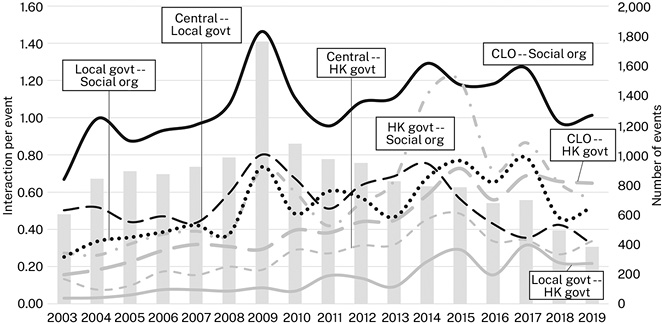
Figure 15.4. Interactions between State Agencies and Social Organisations in Hong Kong, 2003–19.
Source: Wenweipo.
Figure 15.4 shows the interaction between the five types of organisational actors as briefly discussed in the methods section. Overall, there have been increasing interactions between any two types of actors from 2003 to 2019. Interactions that involved social organisations were particularly frequent, and they all suddenly surged in 2009, which was likely because many new social organisations, particularly hometown associations, were established in that year, as suggested by Figure 15.2. The increased interactions between different levels of party-state institutions and social organisations also corresponds to the suggestion of a second ruling team run by the CLO to assist with the governance process.
The most visible trend in Figure 15.4 is the salient role of the CLO. Among its relationships, the most frequent interactions take place between the CLO and local social organisations. On average, the two types of actors have more than one interaction per event, which means that, for any one event, one expects to find more than one co-occurrence of the CLO and a local social organisation. The frequency of interactions is also growing. This pattern serves as a proxy to illustrate the organisational proliferation of social organisations through united front work. Recent studies show that leaders of social organisations tend to interact with CLO officials because these officials are responsible for nominating seats in national and regional people’s congresses and consultative conferences (Yuen 2021). Their business interests in the mainland are also better protected with these official titles, which explains why they are interested in being coopted and often try to use sponsorship of these social organisations and community events to strengthen their ties with mainland officials.
Another important trend concerns the increased interactions between local governments in the mainland and social organisations in Hong Kong, which indicates the former’s growing local presence. As noted earlier, local officials were frequently invited to Hong Kong as honoured guests in a wide range of activities, during which they could mingle with local actors. Interestingly, the line closely correlates with that between the CLO and local social organisations (a 0.82 correlation), even though the former has a lower magnitude. Conversely, interactions between central government agencies and local social organisations rose from 2003 to 2014 but dropped afterwards (only a 0.39 correlation with the interaction between CLO and local social organisations). One possible explanation is the gradual institutionalisation of the role of the CLO. After rapid expansion in the late 2000s, the CLO has become the primary nexus between mainland authorities and Hong Kong’s community actors. Local government officials needed to ‘go through’ the CLO when interacting with the local actors, as indicated by the high correlation. In comparison, the central government agencies have become less relevant in everyday united front work.
The third notable trend is the increasingly salient role of the Hong Kong government under the multilayered united front work. Interaction between the Hong Kong government and social organisations is not only rising, but also there was a sudden jump between 2013 and 2015. Similarly, there are also substantially more interactions between the CLO and the Hong Kong government. Those between central government agencies and the Hong Kong government, and those between mainland local governments and the Hong Kong government, have slightly increased as well. The ups and downs illustrate two operational dynamics of the united front. On the one hand, united front activities are driven by important events. The dramatic spike between 2013 and 2015 was most likely associated with the counter-mobilisation towards the Umbrella Movement in 2014. On the other hand, the SAR government has also taken a more proactive role to build ties with various community actors. In the late colonial and early post-handover period, it tended to adopt a consultative model that mainly regulated the funding source but gave organisational autonomy to grassroots actors. In the post-2008 period, it has played an increasingly active role in united front work by cultivating the grassroots networks.
The Counter-Mobilisation Tactics of the United Front
Counter-mobilisation is another new tactic of the pro-Beijing forces in post-handover Hong Kong, which reflects a change in both the targets and tactics of united front work. We consider counter-mobilisation as ‘a form of state mobilised contention that arises in response to a formidable threat to the prevailing order’ (Cheng 2020, 4). It is a common tactic used by hybrid or authoritarian regimes around the world (Robertson 2010; Hellmeier and Weidmann 2020). In Hong Kong, the rise of counter-mobilisation was set against the background of the increase in the scale and interval of protest events since 2003. The old united front tactic that emphasised building government–business alliances and grassroots networks were seen as inadequate for coping with these societal threats. This prompted the regime to proactively counteract the oppositional forces by relying on the pro-Beijing grassroots networks as the organisational basis. These networks have long been mobilised to support the pro-Beijing political parties during elections. Such experiences facilitated their swift mobilisation once the arena moved from institutional politics to street politics. Moreover, with the proliferation of patron–client networks between the state and social organisations, united front directives from above become easily channelled into pro-Beijing groups to perform counter-mobilisation.
The first massive counter-protest in post-handover Hong Kong occurred in 2010, when pro-Beijing political parties and social organisations took the lead to organise rallies in support of the Hong Kong government’s constitutional reform bill. Initiated by renowned public figures, the pro-government rally largely emulated the repertoire of pro-democracy protests and managed to create some level of social support for the passing of the bill. Inspired by the success, a number of pro-Beijing political groups were later established to follow the counter-mobilisation playbook. Notable examples include Caring Hong Kong Power, Voice of Loving Hong Kong and the Defend Hong Kong Campaign. Although some of their initiators and organisers were former personnel in various pro-Beijing social organisations, these political groups fashioned themselves as citizen-based organisations. They were also referred to as ‘satellite groups’ to indicate their network linkage but physical distance with the regime (Cheng 2020). The naming of their organisations reflected their loyalty and political beliefs, symbolising the idea that they were self-mobilised to take to the streets out of their love towards the nation and the city, which had been threatened by the chaos produced by pro-democracy activism.
This top-down initiative found a new life alongside the rise of pro-democracy protests and gradually evolved into a multilayered and decentralised network of counter-protests. Unlike electoral mobilisation, which is more institutionalised and regulated by electoral rules, counter-mobilisation is event-driven and situationally induced. Indeed, many of the counter-protest groups were established before or during the large-scale pro-democracy protests such as the Umbrella Movement in 2014 and the Anti-Extradition Bill Movement in 2019. For instance, in August 2014, a group known as the Alliance of Peace and Democracy, which brought together numerous pro-Beijing grassroots organisations, initiated a petition campaign that collected signatures from nearly 1,600 organisations and 1.8 million individuals in one month. It was followed by a march that claimed to have rallied 130,000 people. Our analysis of the signatories suggested that a wide range of grassroots organisations were involved – more than one-fourth were hometown associations, along with community organisations, resident associations, alumni groups, youth and women’s groups, as well as cultural and sports associations. This unprecedented parade of pro-Beijing forces would not have been possible without the pre-existing grassroots networks, indicating how the social capital cultivated through organisational proliferation can be readily activated in crisis situations.
Counter-protests against pro-democracy forces continued after the end of the Umbrella Movement with the main targets shifting to the pro-autonomy localist movements (Veg 2017). Meanwhile, grassroots organisations – such as the Alliance of Peace and Democracy and its member units – replaced the satellite groups as the new leading forces. This was likely because, first, satellite groups often adopted overly dramatic and coercive protest tactics that created embarrassment for the pro-Beijing camp; and, second, grassroots organisations have greater legitimacy because of their organic connections with the masses and are thus in a better position to appeal to their nationalistic sentiments.
The Anti-Extradition Bill Movement in 2019 further highlighted the role of pro-Beijing grassroots organisations in mobilising counter-protests. After the SAR government failed to suppress the movement through heavy-handed police tactics, and right before the central government put forward the official rhetoric of ‘stop violence and restore order’ on 7 August, pro-Beijing groups were swiftly mobilised. Two mass rallies were organised on 20 July and 3 August, respectively, to indicate that ‘a silent majority’ was in support of the government. In both protests, pro-Beijing grassroots organisations, particularly the hometown associations, became the core units of mobilisation. During the 20 July rally, which claimed a turnout of 310,000, we counted 75 grassroots organisations, 39 of which were hometown associations. In some cases, lower-level associations were tasked by their high-level associations to recruit a certain minimum number of protestors, which they had to fill by mobilising through their grassroots networks and social media tools. Participant observation at that rally also showed that these organisations often came in large groups, distinguished by large banners indicating their affiliations. Such practices have long been adopted during electoral mobilisation, which aimed to cultivate group solidarity, demonstrate organisational capacity and display loyalty to state directives.
However, it is important to note that the counter-mobilisation strategy is not always successful in curbing opposition, as reflected by the anti-extradition protests. Not only did the overwhelming public support for the protests make it difficult for counter-mobilisation to be effective, but also public outrage against police brutality meant that pro-Beijing forces could not come up with a rightful frame to justify their counteractions, unlike during the Umbrella Movement (Yuen and Cheng 2017). Moreover, the multilayered and diffused structure of counter-mobilisation implied that some of its frontline actions could not be properly restrained, as indicated by the 21 July Yuen Long incident. The landslide defeat of the pro-Beijing camp in the November 2019 District Council Election was also an indication that the grassroots penetration and social mobilisation of the pro-Beijing forces were not as effective as expected.
The drastic reform of the electoral system, which came after the introduction of the National Security Law in July 2020, represented an important turning point for China’s united front work in Hong Kong. Under the newly promulgated principle of ‘patriots ruling Hong Kong’, candidates for the Legislative Council are to be nominated by the Election Committee, a powerful body that until now elected only the chief executive. The Election Committee has also expanded from 1,200 to 1,500 members, with the inclusion of representatives of native-place associations in the third sector, as well as a new fifth sector that comprises Hong Kong members of the NPC and the CPPCC and representatives of Hong Kong members of relevant national organisations. The changes imply the promotion of key elites in the united front to official positions of power, unlike before when they could only wield informal influence on electoral matters.
In addition, any prospective legislative member, member of the Election Committee, or candidate for the chief executive has to be vetted by a separate screening committee. Meanwhile, although the overall seats increase from 70 to 90, the number of directly elected members fall from 35 to 20. Out of the 90 seats, 40 are now chosen by the Election Committee. The Legislative Council election held in December 2021 adopted this arrangement for the first time, leading to the landslide victory of the pro-Beijing camp, with many new faces elected as legislative members. While the long-term effects of the reform are still too early to tell, what is certain is that the united front is no longer simply an underground front.
Conclusion
As an integral component of China’s policy towards Hong Kong, united front work has been a widely researched topic among scholars. However, due to the opaque nature of such work, existing research has mostly relied on historical and anecdotal data, which makes it difficult to delineate the evolution of united front work in terms of its structure and objectives. This chapter is an attempt to fill this empirical gap. By making use of organisational reports and an original event dataset, we have shown how post-handover united front work, particularly since the mid-2000s, has involved a steady organisational proliferation of social organisations and increasingly frequent interactions between these social organisations, different levels of the mainland authorities and the Hong Kong government. The result is a more decentralised and multilayered structure of the united front apparatus, involving multiple state and social actors. Also witnessed are the shifting objectives of united front work. Rather than adhering to elite cooption, united front work has become more proactive in organising the pro-Beijing forces in the semi-autonomous territory and counter-mobilising against the pro-democracy opposition whenever opportunities arise. Due to the changing roles and relationships between the party-state and grassroots actors, and between the central and local governments, the governance model of post-handover Hong Kong has gradually shifted from regulatory statist-corporatism to collaborative political clientelism.
Our findings thus contribute to a better understanding of China’s united front work in a peripheral region over which it has yet to gain complete political control despite its sovereignty status. Although the findings are by no means completely new, they have provided empirical support to the perceived trend of increasing united front activities through the first two decades of the handover. More importantly, the findings have indicated that the remit of united front work is not limited to a conventional set of government organisations, such as the CLO or the United Front Work Department. The analytical scope should be broadened to include other governmental units, such as local governments in the mainland and the Hong Kong government. Moreover, because of the relational nature of united front work, analysts must focus on the interaction between these state actors and various social actors. In other words, the united front should be considered an extensive network comprising both state and social actors, rather than just an extended arm of the state.
References
Burns, John P. 1990. ‘The Structure of Communist Party Control in Hong Kong’. Asian Survey 30 (8): 748–65. doi.org/10.2307/2644496.
Chan, Lau, Kit-ching. 1999. From Nothing to Nothing: The Chinese Communist Movement and Hong Kong 1921–1936. Hong Kong: Hong Kong University Press. doi.org/10.1353/cri.2000.0071.
Cheng, Edmund W. 2016. ‘Street Politics in a Hybrid Regime: The Diffusion of Political Activism in Post-colonial Hong Kong’. China Quarterly 226: 383–406. doi.org/10.1017/S0305741016000394.
Cheng, Edmund W. 2020. ‘United Front Work and Mechanisms of Countermobilization in Hong Kong’. China Journal 83: 1–33. doi.org/10.1086/706603.
Cheung, Gary Ka-wai. 2009. Hong Kong’s Watershed: The 1967 Riots. Hong Kong: Hong Kong University Press.
Choi, Susanne Y. P. 2006. ‘Association Divided, Association United: The Social Organization of Chaozhou and Fujian Migrants in Hong Kong’. In Voluntary Organizations in the Chinese Diaspora, edited by Khun Eng Kuah-Pearce and Evelyn Hu-Dehar, 121–40. Hong Kong: Hong Kong University Press.
Chu, Cindy Yik-yi. 2010. Chinese Communists and Hong Kong Capitalists: 1937–1997. New York: Palgrave Macmillan. doi.org/10.1057/9780230113916.
Fong, Brian Chi Hang. 2014. ‘The Partnership between the Chinese Government and Hong Kong’s Capitalist Class: Implications for HKSAR Governance, 1997–2012’. China Quarterly 217: 195–220. doi.org/10.1017/S0305741014000307.
Hellmeier, Sebastian and Nils B. Weidmann. 2020. ‘Pulling the Strings? The Strategic Use of Pro-Government Mobilization in Authoritarian Regimes’. Comparative Political Studies 53 (1): 71–108. doi.org/10.1177/0010414019843559.
Kwong, Bruce Kam-kwan. 2007. ‘Patron–Client Politics in Hong Kong: A Case Study of the 2002 and 2005 Chief Executive Elections’. Journal of Contemporary China 16 (52): 389–415. doi.org/10.1080/10670560701314222.
Lam, Wai-man and Kay Chi-yan Lam. 2013. ‘China’s United Front Work in Civil Society: The Case of Hong Kong’. International Journal of China Studies 4 (3): 301–25.
Lee, Ching Yan. 2017. ‘Sai Wan Ruling Hong Kong, CLO Out of Darkness’ (西環治港, 中聯辦化暗為明). Hong Kong Economic Journal Monthly, March.
Lee, Eliza W. Y. 2019. ‘United Front, Clientelism, and Indirect Rule: Theorizing the Role of the “Liaison Office” in Hong Kong’. Journal of Contemporary China 29 (125): 1–13. doi.org/10.1080/10670564.2019.1704996.
Li, Xiaohui. 2019. Social Organisations in Hong Kong: Theory and Practice (香港社團: 理論與實務). Hong Kong: The Commercial Press. doi.org/10.12809/hkmj187855.
Lieberthal, Kenneth G. and David M. Lampton. 1992. Bureaucracy, Politics, and Decision Making in Post-Mao China. Berkeley: University of California Press.
Liu, Hong. 1998. ‘Old Linkages, New Networks: The Globalization of Overseas Chinese Voluntary Associations and Its Implications’. China Quarterly 155: 588–609. doi.org/10.1017/S0305741000050001.
Lo, Sonny Shiu-hing, Steven Chung-fun Hung and Jeff Loo Hai-chi. 2019. China’s New United Front Work in Hong Kong: Penetrative Politics and Its Implications. Singapore: Palgrave Macmillan. doi.org/10.1007/978-981-13-8483-7.
Loh, Christine. 2010. Underground Front: The Chinese Communist Party in Hong Kong. Hong Kong: Hong Kong University Press. doi.org/10.4000/chinaperspectives.5321.
Ma, Ngok. 2007. Political Development in Hong Kong: State, Political Society, and Civil Society. Hong Kong: Hong Kong University Press. doi.org/10.5790/hongkong/9789622098107.001.0001.
Mertha, Andrew. 2009. ‘Fragmented Authoritarianism 2.0: Political Pluralization in the Chinese Policy Process’. China Quarterly 200: 995–1012. doi.org/10.1017/S0305741009990592.
Miller, Alice. 2008. ‘The CCP Central Committee’s Leading Small Groups’. China Leadership Monitor 26: 1–21.
Robertson, Graeme B. 2010. The Politics of Protest in Hybrid Regimes: Managing Dissent in Post-Communist Russia. Cambridge: Cambridge University Press. doi.org/10.1017/CBO9780511921209.
Sinn, Elizabeth. 1997. ‘Xin Xi Guxiang: A Study of Regional Associations as a Bonding Mechanism in the Chinese Diaspora: The Hong Kong Experience’. Modern Asian Studies 31 (2): 375–97. doi.org/10.1017/S0026749X00014347.
U, Eddy. 2012. ‘Dangerous Privilege: The United Front and the Rectification Campaign of the Early Mao Years’. China Journal 68: 2–32. doi.org/10.1086/666579.
Veg, Sebastien. 2017. ‘The Rise of “Localism” and Civic Identity in Post-Handover Hong Kong: Questioning the Chinese Nation-State’. China Quarterly 230: 323–47. doi.org/10.1017/S0305741017000571.
Wang, Ray and Gerry Groot. 2018. ‘Who Represents? Xi Jinping’s Grand United Front Work, Legitimation, Participation and Consultative Democracy’. Journal of Contemporary China 27 (112): 569–83. doi.org/10.1080/10670564.2018.1433573.
Wong, Stan Hok-wui. 2012. ‘Authoritarian Co-optation in the Age of Globalization: Evidence from Hong Kong’. Journal of Contemporary Asia 42 (2): 182–209. doi.org/10.1080/00472336.2012.668348.
Yep, Ray. 2008. ‘The 1967 Riots in Hong Kong: The Diplomatic and Domestic Fronts of the Colonial Governor’. China Quarterly 193: 122–39. doi.org/10.1017/S0305741008000076.
Yuen, Samson. 2021. ‘Native-Place Networks and Political Mobilization: The Case of Post-Handover Hong Kong’. Modern China 47 (5): 510–39. doi.org/10.1177/0097700420934093.
Yuen, Samson and Edward W. Cheng. 2017. ‘Neither Repression nor Concession? A Regime’s Attrition against Mass Protests’. Political Studies 65 (3): 611–30. doi.org/10.1177/0032321716674024.
1 The CCP has not been formally registered as a legal entity in Hong Kong, even after the 1997 handover, and has not publicly declared local members.
2 Examples of events include ceremonies, banquets, exhibitions and meetings.
3 Chen Chu Chu (陳楚楚), ‘Demystifying the Rule of the HKMAO and CLO: Who Is Hong Kong’s Future Ruler?’ (解密「兩辦」治港: 誰才是香港未來的管治者?), Initium, 19 May 2020, theinitium.com/article/20200519-hongkong-the-liaison-office-new-boss/.
4 The Hong Kong Work Committee is the top Party branch in Hong Kong. It shares the same personnel as the Central Liaison Office, under the principle of ‘a single organisation, two signboards’ (yige jigou liangkuai paizi).
5 Federation of Guangxi Community Association, 2013 Annual Report of Federation of Guangxi Community Association (香港廣西社團總會2013年年報), 4.
6 Kowloon Federation of Associations, accessed 1 May 2023, 2019, klnfas.hk/tc/.
7 Cao Er Bao (曹二宝), ‘Governing Force in Hong Kong under the Condition of “One Country, Two Systems”’ (“一国两制”条件下香港的管治力量), Xuexi Shibao, 28 January 2008.
Previous Next



