


 menu
Ritual Voices of Revelation
Appendix I: A portrait gallery of poets
On coming to know the poets of Rote
The master poets, whose ‘voices’ are represented in this volume, are regarded by their communities as custodians of the knowledge of the ancestors. Although each recitation is a unique composition, these poets insist that they are transmitting the words that have been passed down to them from their ancestors—those who have gone before them. The formal semantic pairing of their words elevates and enhances this ancestral knowledge and the seriousness of their responsibilities.
As recognised custodians of knowledge, the particular poets who have contributed their knowledge to this volume carried out their responsibilities in a time of considerable social change and in response to my interventions and involvement with them. They were all aware of the changes that were occurring in their way of life and particularly determined that their knowledge be preserved and transmitted. Of all the poets in this volume, it was Stefanus Adulanu, ‘Old Meno’, who most clearly articulated his concern for the preservation of this knowledge and recognised that the tape recorder which I had brought with me on my first period of fieldwork in 1965–66 was the means for his knowledge be passed on to his grandchildren. His involvement was critical to the gathering of this Rotenese ‘knowledge of origins’.
It is important to emphasise that origin narratives are a critical component of an array of knowledge that Rotenese master poets preserve and transmit in their recitations. A larger component of this knowledge consists of mortuary compositions that I have described as ‘life-course’ compositions because they recount, in a standardised but imagined fashion, a life story intended to approximate the situation of different categories of deceased individuals. Each poet, depending on his skill and scope, has a repertoire of recitations, some of which may be origin narratives. While this volume is focused on these origin narratives, there remains a considerable collection of other compositions on which I continue to work.
The poets whose recitations are recorded and conveyed in the volume share a common goal in perpetuating their knowledge of ‘origins’. They are recognised as hataholi malelak: ‘persons of knowledge’. Their personal capacities and fluency in expressing this knowledge, in a canonical linguistic fashion, marks them as poets. Their special skills may have led some of them to become teachers or preachers while others have lived their lives as simple farmers and palm tappers. Each of these poets is a distinct individual in personality, background, interest and even in style of expression. This portrait gallery is intended to present these individual poets and to hint at their differences.
My close involvement with the poets who have contributed to this volume began during extended fieldwork on Rote—initially in 1965–66 and again in 1972–73. Most of the origin narratives from Termanu were gathered during my first field trip while those from Thie were gathered during short visits on both my field trips.
My initial involvement was, by no means, straightforward. My efforts involved a fraught learning process. When my wife and I had settled into the community at Ufa Len in Termanu, I began my efforts to learn spoken Rotenese—the dialect of Termanu—but from the time of my first recording, I was thrust into trying to understand the formal complexities and compositional subtleties of ritual language in parallelism whose competence was confined to a relatively small group of knowledgeable elders. This was a different task from learning ‘ordinary’ spoken Rotenese, but I was continually told by the elders that this was the only way to answer the questions about Rotenese culture that I had begun to ask.
I had brought with me to Rote an Uher tape recorder, an instrument that was new to the Rotenese of Ufa Len and which they named my ‘voice catcher’ (penangkap suara). This voice catcher was regarded as the appropriate vehicle for the recording of ritual language recitations and that became its primary purpose. It became an ‘attractor’ for the poets of Termanu. By the time that I visited Thie, I had gained in my language skills, and I was better prepared to record the various recitations I was offered.
My second intensive involvement with poets from Rote was in the ‘Master Poets Project’ which begun in 2006 with initial support from the Australian Research Council that was extended with additional funding. The ‘Master Poets Project’ involved bringing poets from all areas of Rote for a week’s recording session in Bali. The intention was to record compositions in parallelism across the entire chain of dialects on the island. In total, eleven recording sessions were held from 2006 to 2019 involving 28 different Rotenese poets. Origin narratives for both Termanu and Thie were recorded during this period along with the recitations of Genesis by poets from the domains of Landu and Ringgou.1
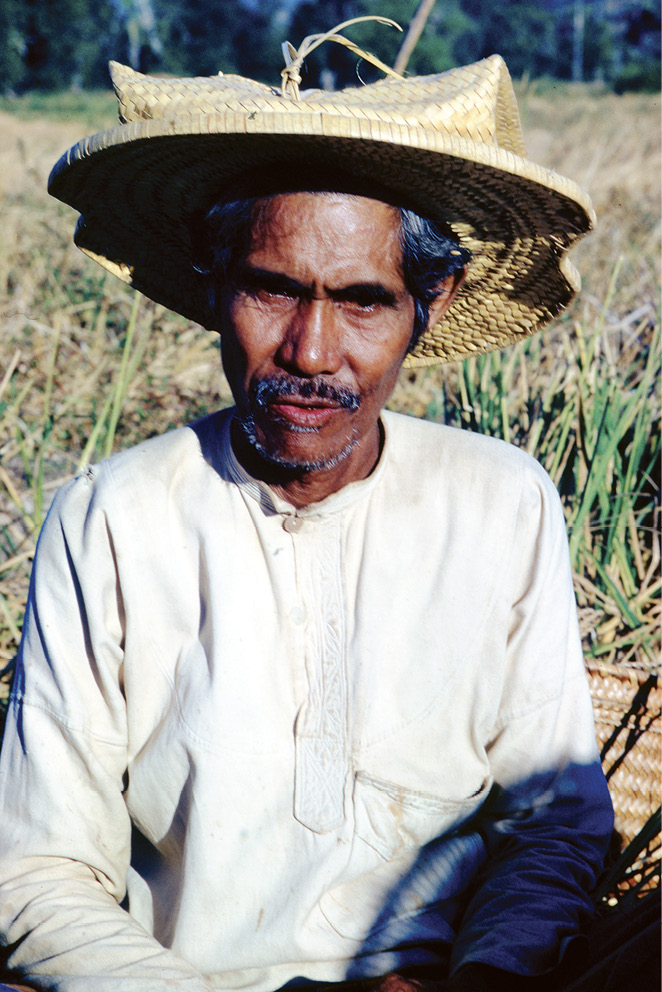
Petrus Malesi: Peu Malesi
The first poet to come forward to record for my Uher tape recorder was Peu Malesi. His first recitation was an origin narrative—a version of the origin of fire and of cooking. Peu Malesi’s recitation set in train an involved engagement that led to the gathering of most of the origin narratives of Termanu. His photograph is appropriately the first portrait for this gallery.
Peu Malesi was a frequent visitor to Ufa Len during my fieldwork in 1965–66 and again in 1972–73. He was the source of many recordings, most of which were mortuary rituals or ‘life-course’ compositions. Peu Malesi, who was a member of the commoner clan Dou Danga, always presented himself in a quiet manner. He rarely took part in the contentions and disputations that are a constant feature of Rotenese talk. Instead, he would wait to be called upon—as invariably, he was—and he would impart his comments in ritual language. One Rotenese called these interventions ‘The Voice of Malesi’, alluding to them like a radio broadcast heard on the Voice of Malaysia. This photograph is of Peu Malesi as he would often appear in Ufa Len in a traditional Rotenese hat and white shirt.
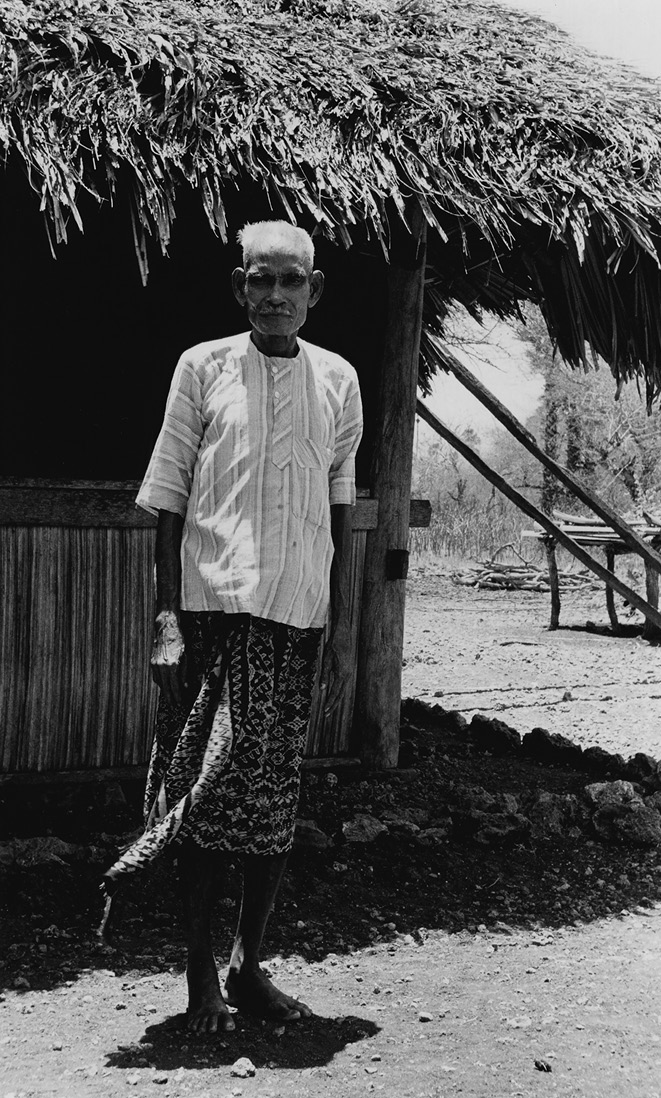
Stefanus Adulanu: ‘Old Meno’
The second portrait for this gallery is that of Stefanus Adulanu: ‘Old Meno’ (Meno Tua) as he was known. Old Meno was the Dae Langak (‘Head of the Earth’) in clan Meno, a position that derived from the first ancestor of Termanu, Pada Lalais. He did not know exactly when he was born but he could remember as a teenager the ravages of what was the ‘Spanish flu’ which swept the island. He had attended three years of local school, learned high Malay and was, for a considerable period during Dutch times, the scribe (juru tulis) for Termanu’s court. During my first visit, he continued to preside at Termanu’s court sessions.
The Manek as the traditional ‘Ruler’ of Termanu designated Old Meno to assist me in gathering Termanu’s oral history but Old Meno soon became my teacher in all matters Rotenese and my chief instructor in ritual language. He suffered a great deal from arthritis and generally kept close to his home, but he would also invite me to attend court sessions and when he was able, he attended ceremonies, mainly mortuary feasts, at which adjudication was often required to settle matters of inheritance. I particularly regret that I took only a few photos of Meno and none of these are in good quality. This is a photograph of Old Meno standing outside of his house in Ola Lain.
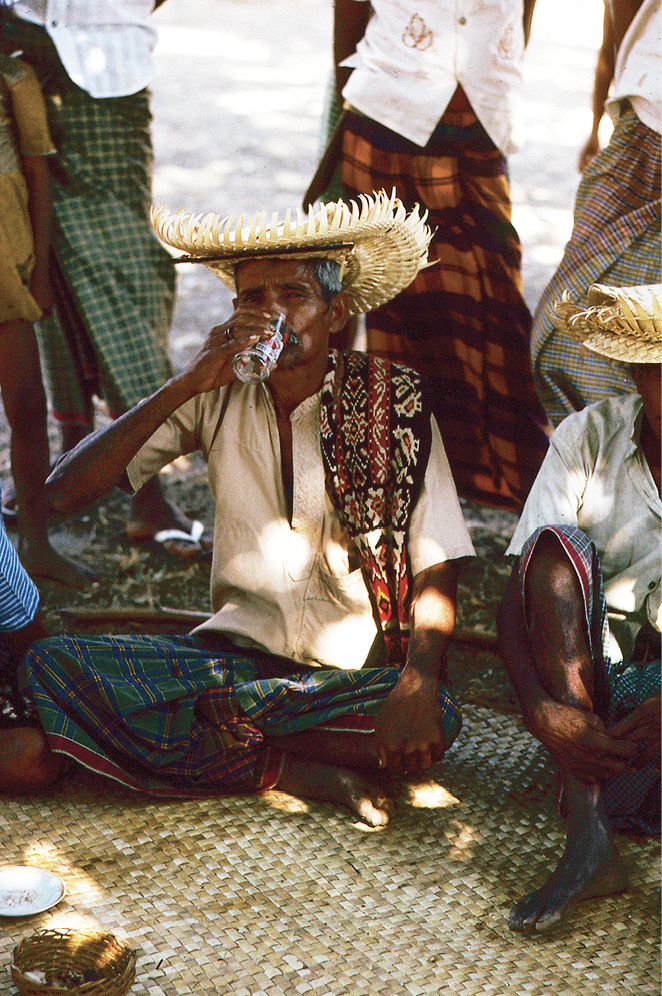
Eli Pellondou: Seu Ba’i
The third portrait is that of Eli Pellondou who was known as Seu Ba’i. Like Peu Malesi, Seu Ba’i was a member of clan Dou Danga but from a different branch. I first met him at Old Meno’s house in Ola Lain. He lived in Namodale on Termanu’s north coast and would come to Old Meno’s to listen to the recordings I had made and Old Meno’s recitations. Seu Ba’i was a recognised poet in his own right but was still learning from Old Meno.
Old Meno had died before I returned to Rote on my second field trip in 1972–73 and Seu Ba’i took over in trying to instruct me. He would give me his commentary on some of Old Meno’s recitations which he knew that I had recorded. He also provided me with an expanded and significantly altered version of a mortuary composition that Old Meno had recited for me.
Seu Ba’i was particularly critical of the dual names given to some of the characters in the origin narratives by other poets. He could be counted on to dispute such names with Peu Malesi who never seemed perturbed by Seu Ba’i’s judgments. In time, I learned that Seu Ba’i had brothers and cousins who were also noted poets and I was eventually able to record them as well. The photograph that I have used here is one of Seu Be’i seated on a mat and drinking lontar-gin, which the Rotenese call the ‘water of words.’
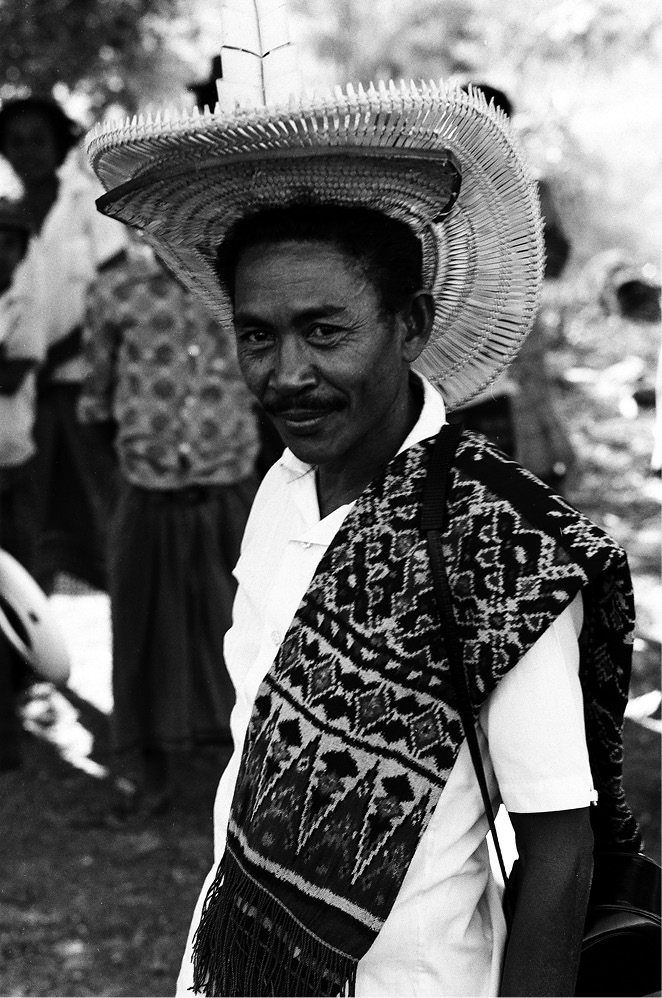
Esau Markus Pono: Pak Pono
The fourth photograph is of Esau Markus Pono who, in time, became my closest Rotenese friend and confidant. Our paths crossed briefly during my first field trip; so I only came to know him during my second period of fieldwork. Pak Pono lived in Hala, on the coast, and by the time we met, he had already gained a reputation as a noted preacher and an emerging poet. In planning the ritual to honour Old Meno, I visited Pak Pono in Hala and invited him to act as my ritual spokesman at the Tutus-ceremony2
From the late 1970s onwards, Esau Pono became my Rotenese ‘elder brother.’ He was involved in the filming I did on Rote with Tim Asch and visited Canberra in connection with that filming. He came to comprehend better than any Rotenese what I was trying to do in documenting Termanu’s traditions and as he learned more of what I had already recorded, he became my closest advisor on Termanu’s traditions.
When I began my ‘Master Poet Project’ in 2006 bringing poets to Bali to record their performances, Esau became a key member and continued to join each subsequent recording session until the ninth session in October 2014 when he was too ill to make the journey. We had collaborated for over 30 years, and we grew old together. I was able to compose a short chant that was read on my behalf at his funeral. Because a photograph of Pak Pono in his maturity is on the cover of this volume, I have chosen another photograph of him in his prime in 1973.
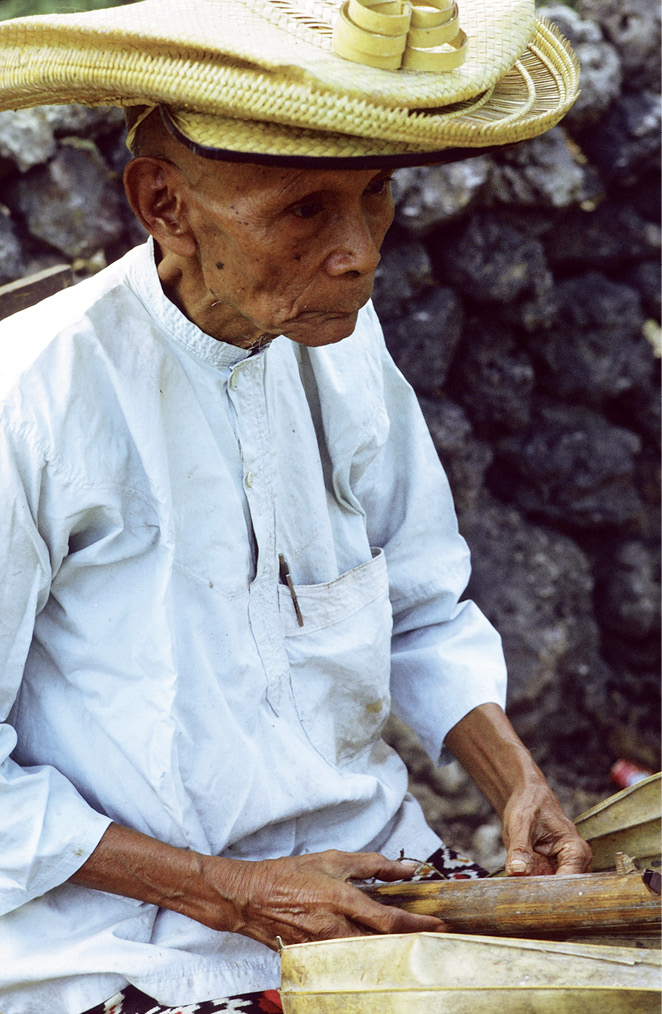
N.D. Pah: Guru Pah
The fifth portrait is of N.D. Pah known as Guru Pah. I visited Guru Pah at his home in Thie on just two occasions: the first visit toward the end of my initial fieldwork in 1965–66 and again in the middle of my second field trip in 1972–73. Compared to my unplanned, occasional and somewhat disorganised catch-as-catch-can recordings in Termanu, my recording sessions with Guru Pah were intense and were concentrated on origin narratives. Both of my visits were for about a week each. I stayed at Guru Pah’s house in Oe Handi sleeping each night on the resting platform under his roof. On each visit, there were ceremonies to attend—a funeral on the first visit and a wedding and a funeral on the second. On the first visit, all my recordings were from Guru Pah himself. On the second visit, Guru Pah invited his close colleague, Samuel Ndun, to join us and my recordings were from both men.
Guru Pah was slight and seemingly frail, but he had remarkable energy combined with enormous knowledge of the traditions of Thie. He was determined to impart to me as much as he could of that knowledge during my time with him. He was also a superb player of the sesandu—the traditional Rotenese bamboo zither with lontar leaf cover—and in the late afternoon and early evening, he would sit and play for himself. My photograph is of him on one of these occasions.
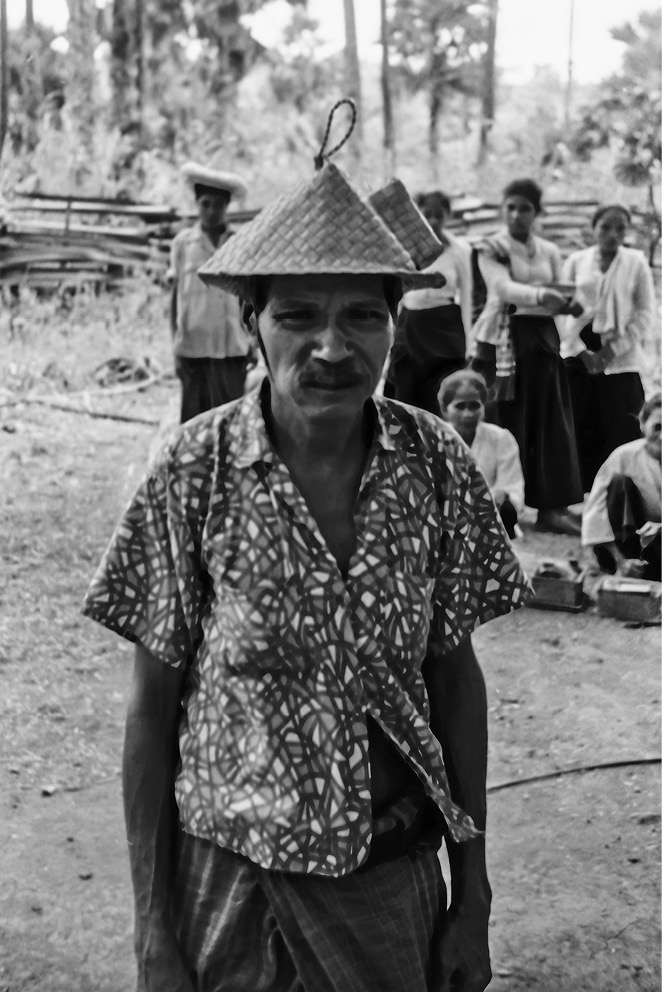
Samuel Ndun
The sixth portrait for this gallery is that of Samuel Ndun who joined Guru Pah during my second visit to Oe Handi in Thie. I know little of Samuel Ndun, other than what I learned in our brief time together. As a poet, his fluency was exceptional. Guru Pah’s acknowledgement of his compositions was an endorsement of his depth of knowledge. As a pair, they would take turns reciting and commenting on each other. Like Guru Pah, Samuel Ndun was both a poet and a preacher. At the wedding I attended during my visit, I overheard him ask the parents of the bride and groom whether they would like a traditional ceremony or a Christian ceremony. He was prepared to do either. The parents opted for a Christian ceremony. This photograph is my only photo of Samuel Ndun.
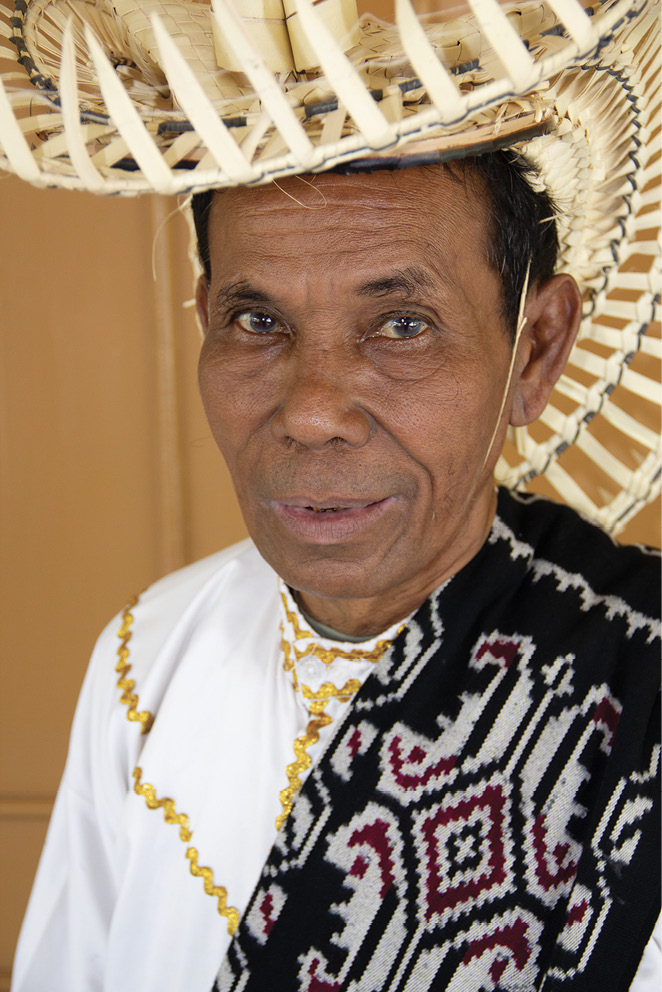
Jonas Mooy: Pak Jonas
The seventh portrait is that of Jonas Mooy from Thie. Jonas was a key participant in the ‘Master Poets’ sessions on Bali. He joined the fourth recording session in 2009 and then became a regular member for the 7th through the 11th sessions from 2011 and 2019. A schoolteacher, Pak Jonas was what might be considered a self-taught poet. He was constantly taking notes and was the only poet to do so in any sessions. He had excellent skills, but his recitations lacked the seemingly effortless fluency of some of the other poets. He reflected, however, on Rotenese traditions, saw connections between the traditions of the different domains and could, on several occasions, explain the meaning and implications of other poets’ compositions better than they could themselves. It was only after he had recited his version of the origin of seeds that I showed him Guru Pah’s version. He provided me with valuable exegesis on it clarifying it and making it more intelligible to me.
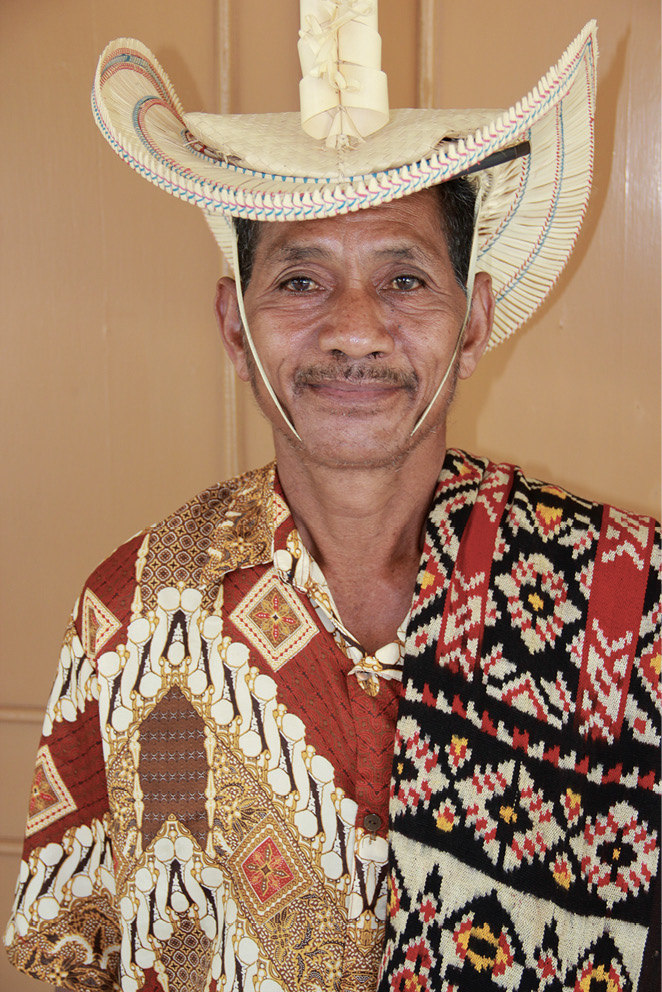
Yulius Iu: Pak Yulius
The eighth portrait is that of Yulius Iu from Landu. Pak Yulius was a participant at the 2nd and 7th sessions of the ‘Master Poets Project’. Before I encountered him, I was unaware of how widespread the use of ritual language in semantic parallelism was in Christian ceremonies in parts of eastern Rote.
Pak Yulius was a fluent and talented poet who specialised in Christian compositions. He was able to take any passage in the Bible and transform it into parallel verse. His ability and his compositions came as a revelation to me. But I was not the only one to be impressed. Pak Jonas Mooy met Pak Yulius during the seventh session and heard him perform. Pak Jonas immediately set out to follow Pak Yulius’ example and by the end of the week, with some preparation beforehand, Pak Jonas rendered his first Bible passage—the Judgement of Solomon—into traditional semantic parallelism. One of Pak Yulius’s finest compositions was his rendering of Genesis as an origin narrative.
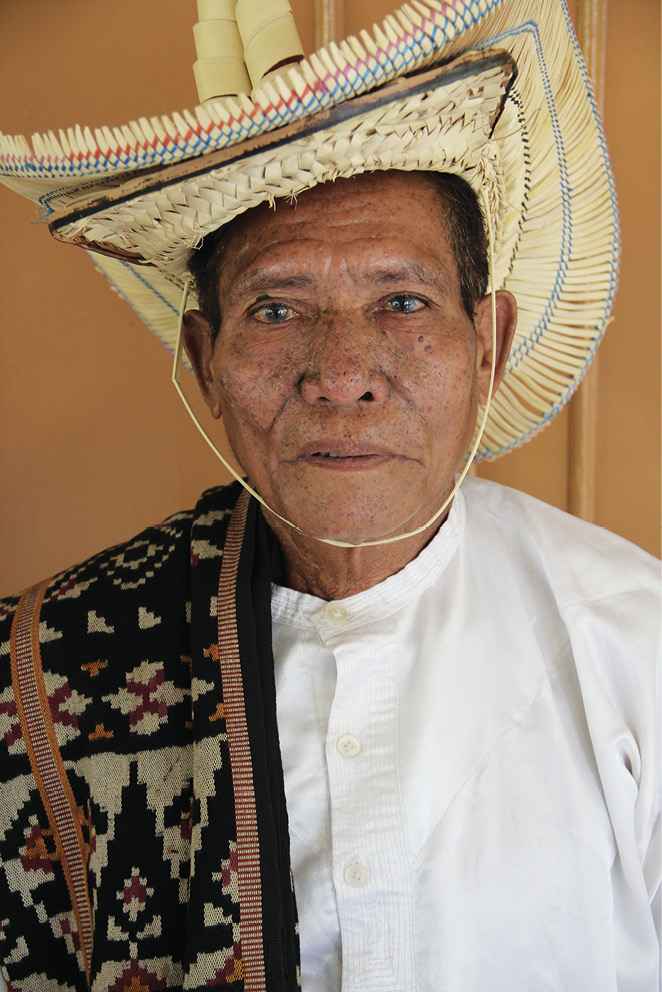
Anderias Ruy: Pak Ande
The appropriate ninth portrait in this gallery is of Anderias Ruy of Ringgou, a master poet who is widely acclaimed on Rote as one of the great performers of his time. When I began planning my ‘Master Poet Project’, I made a special trip to visit Pak Ande at his home and to invite him to join the initial session on Bali. He joined that session and continued thereafter as a participant at all recording sessions. He also took it upon himself to travel throughout Rote to identify other leading poets and to invite them to join particular sessions.
Pak Ande was both serious and intense: a poet with exceptional fluency and an immense repertoire combined with an extraordinary flair for performance. He would invariably come to Bali with a drum and would give a full recitation of certain compositions—mainly mortuary compositions—and then give the same recitation in a special initial-phrase-repeat style known as ‘bapa’ to the beat of the drum. He would never perform any recitation without a drink of native gin and would work himself into tears to perform some mortuary recitations.
Pak Ande’s compositions were dense and difficult to transcribe. My former PhD student, Dr Lintje Pellu, who would accompany the poets from Kupang, would work with him for hours struggling to get a proper transcription and some understanding of its meaning. For me, Pak Ande’s dialect of Ringgou was difficult to understand and it would take many hours to begin to comprehend his compositions even after they had been transcribed.
Virtually the whole of Pak Ande’s corpus of compositions remains to be translated into English.
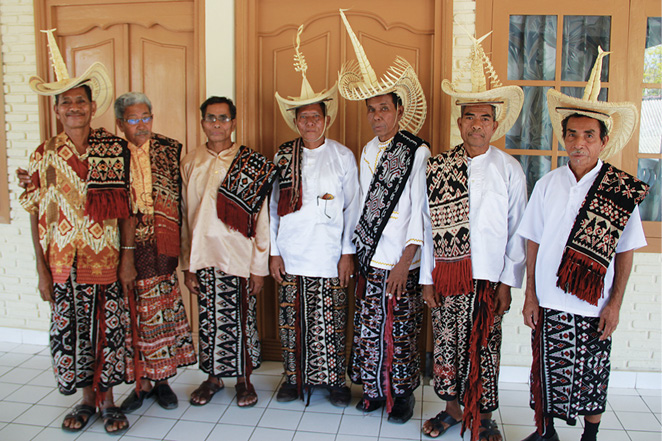
Note: From left to right: Yulius Iu from Landu, Esau Pono from Termanu, Kornalius Medah from Bilba, Ande Ruy from Ringgou, Jonas Mooy from Thie, Mateos Poij from Oepao and Hendrik Foeh from Oenale.
The ‘Master Poet Project’ developed its own traditions and one of these traditions was a photography session on the final day before departure. Individual photographs and group photographs were taken in all sorts of combinations.
For a final photograph, I include a group photograph from the seventh ‘Master Poets’ session on the 29th of October 2011. This is a photograph of seven Rotenese master poets, each from a different domain on Rote.
1 One regret in putting together this portrait gallery is that I did not take more photographs of the poets whom I recorded during my first field trip. It was often a trade-off between photos and recordings. Several of photographs in this gallery have already appeared in earlier publications.
2 For a discussion of this ceremony, see Fox, J.J. ‘To the Aroma of the Name: The Celebration of a Ritual of Rock and Tree’ in Explorations in Semantic Parallelism 2014: 295–311. Some years later with Tim Asch, I also recorded one of Pak Pono’s church services and analysed his sermon at that service: see Fox, J.J. ‘The Rotenese sermon as a Linguistic Performance’ in Explorations in Semantic Parallelism: 2014: 355–64.
Previous Next



