


 menu
Ritual Voices of Revelation
2
The metaphoric creation of a complementary world
A poetic introduction to the island of Rote
This is a study of a corpus of significant oral compositions from the island of Rote. As an introduction to these narratives and to the world they portray, it is appropriate to present the island of Rote and its traditions through the perspective of the poetic language used in their composition.
The poetic use of ritual language creates a world of metaphor and imagination.1 This dyadic language requires the use of complementary pairs and insists on their pervasive usage. Each pair in any composition creates a metaphorical link—a cultural correspondence—between two elements. In this way, the language of canonical parallelism builds a world of metaphorical correspondences.
It is possible to portray this metaphorical world as recounted in the narratives, particularly the origin narratives, of the Rotenese. It is a world set in the past at a time when the foundations of Rotenese culture were being fashioned, but it is also a world that reflects contemporary life, which poets take for granted and on which they base their compositions. An exegesis of these metaphoric correspondences provides a context for understanding the world of imagination that these extended narrative compositions expound.
The three realms of the cosmos
For the Rotenese, there are three realms to their cosmos. The first is Poin do Lain (‘The Heights or the Heavens’). This is the realm of the Sun or Moon (Ledo do Bulan), ruled by Bula Kai ma Ledo Holo, whose heavenly descendants—variously identified with the stars, thunder, lightning and rainbows—populate the origin narratives and whose genealogies are recited in them.2 Certain species of birds may belong to this sphere or are able to reach it.
The second of these worlds is the Ocean or Sea (Liun do Sain). The rulers of this realm are known by their titles, Danga Lena Liun ma Mane Tua Sain (‘Great Hunter of the Ocean and Great Lord of the Sea’). These rulers are archetypically male and are personified as Iuk ma Foek (‘Shark and Crocodile’). All the creatures of the Sea are members of their domain. This is a realm of great wealth, knowledge and power.
The third world, where the Lords of the Heavens and Sea first meet and interact, is the Earth: Dae Bafok ma Batu Poin (‘The Flat Land and the Pointed Rock’). In these origin narratives, this is a forested world but there is no mention of any human inhabitants. In fact, in these narratives, there is no account of the origin or creation of humans.3
The initial encounter of the rulers of the Heavens and the Sea
The origin narratives recount the first encounter between the son of the Sun and Moon and the Lord of the Sea. This encounter occurs in a hunt located on the Earth. This hunt is conducted with bow and blowpipe (kou//fupu)—implements that have long disappeared from Rotenese use. This hunt is rendered even more unusual by its object: the forest quest for wild pig and civet (bafi//kue). Joining efforts in this hunt is the first of many subsequent interactions between the rulers of the realms of the Heavens and the Sea.
When the hunt is successful, the son of the Sun and Moon is persuaded to descend into the ocean to join the Lord of the Sea to carry out the sacrifice of pig and civet. This leads to the discovery of the vast differences between the two realms. Houses in the Sea are magnificently constructed—‘decked with turtle shells and roofed with ray-fish tails’. The Sea is the original source of fire and the purveyor of all the civilised arts: cooking, herding, building, planting and weaving. The use of fire for cooking is highlighted; the taste of cooked food surprises the son of the Sun and Moon, who has previously eaten only raw meat. This contrast between ‘raw and cooked’—‘roasting with fire//boiling with water’—marks a defining contrast between the two realms and prompts the first exchange between the Heavens and the Sea.
To obtain fire and the tools to build a house, the Heavens must offer a daughter to marry the Lord of the Sea and, in exchange, the Heavens are given an array of essential cultural objects—all in paired combinations:
|
kapa//lilo |
water buffalo and gold |
|
kutu//una |
flint and fire-rubbing sticks |
|
bo//pa’a-bala |
bore and chisel |
|
funu ma-leo//sipa aba-do |
turning-drill and plumbline marker |
|
taka//tala |
axe and adze |
|
nesu//alu |
mortar and pestle |
|
lali//o’oko |
measuring basket and winnowing tray |
This first marriage exchange is the start of continuing relations between the Heavens and the Sea, which are recounted in successive origin narratives.
Humans are the ultimate beneficiaries of these relations, which contribute to the origins of cultural goods including the knowledge of fire and cooking, the tools for building a house, the seeds of rice, millet and other plants, the equipment and knowledge of weaving and dyeing as well as the procedures that define the cultural order. By implication, the civilising arts have come to the Rotenese from the Sea, but this bounty has often been mediated via the Heavens.
The origin narratives are intended to set forth the knowledge of these founding events. They convey all the elements of this ordered world. Thus, for example, the great effort, as elaborated in the narratives, to erect the first house is significant because a properly constructed house offers a template of the order of the cosmos and is reflected in the order of the island of Rote itself.
The recitation of these origin chants was once restricted and hedged with omissions. The silence was required to cover their darker aspects. Some chants can only hint at what lies at their core and gives them their full meaning. One of these silences—that which cannot be uttered—relates to attempts to build a house. When these attempts failed utterly, a crocodile had to be killed and its body used as a design for the structure of the house. Similarly, in the chant on the origin of tie-dyeing and weaving, the daughter of the Sun and Moon possesses the instruments for tying and weaving, but ‘Figure Shark’//‘Pattern Crocodile’ (Pata Iuk//Dula Foek) must be killed to obtain the designs and colour patterns for cloths that are dyed and woven. The Sea may be the source of all bounty but relations with the Sea and its creatures are fraught. Thus, too, the origin chants tell of the anger of the Heavens with the Sea, which results in great storms. Knowledge of the transgression of relations between the Heavens and the Sea is integral to the understanding of the origin narratives.
The island and its directional divisions
Rote is a small island at the south-western tip of the larger island of Timor in eastern Indonesia. In ritual language, its most common name is Lote or Kale (Lote do Kale). Lote, it is said, refers to the main body of the island, while Kale refers to the peninsular headland at its eastern end. Another frequently used name for the island is the simple set Lino do Ne (‘Silent or Tranquil’ or, perhaps more appropriately, ‘Silence and Tranquillity’, which designates a desired state of ritual quiet). These two names may be combined to create the longer formulaic name Lote Lino do Kale Ne (‘Lote the Silent or Kale the Tranquil’). Yet another variation of this name is Lote Lolo-Ei do Kale Ifa-Lima (‘Lote of the Outstretched Legs or Kale of the Cradled Arms’). This body posture—a required position at certain rituals and in burial—is a stance intended to express a state of ritual peace.4
The island of Rote is considered at rest in the sea with its ‘head’ in the east and its ‘tail’ in the west. Thus, in ritual language, eastern Rote is referred to by the set Dulu do Langa, which equates ‘east’ (dulu) with ‘head’ (langa). Similarly, western Rote is referred to by the set Muli do Iko, which equates ‘west’ (muli) with ‘tail’ (iko).
Several more complex names are based on these sets. Eastern Rote can be referred to as Dulu Oen ma Langa Daen (‘Water of the East and Land of the Head’). It is also called Timu Dulu ma Sepe Langa. Sepe is the light-red colour of a native dye and also of early dawn, while timu is an alternative term for ‘east’ in specific contexts, particularly in reference to the eastern monsoon wind (ani timu). A possible translation of Timu Dulu ma Sepe Langa might be ‘Easterly [or Dawn] in the East and Pink at the Head’. Western Rote is Muli Loloe Olin ma Iko Bekute Tasin (‘West Descending to its Estuary and Tail Sloping to the Sea’).
The set ki//kona forms a similar directional pair. Ki (‘north’) is also the term for ‘left’ and kona (‘south’) is also the term for ‘right’. The south is considered auspicious and regarded as a source of power.5
These various expressions convey an essential convention in all Rotenese ritual understanding. The island is like some creature—imagined as a crocodile—with its ‘head’ raised in the east and its ‘tail’ lowered to the west. A basic cosmological simplification asserts that east is always ‘up’ towards the sun and west is always ‘down’ towards the sea. The east is ‘superior’ (lena) to the west. South is superior to north.
Directionality is critical in ritual and social life. Traditional houses were always built to conform to the cosmological alignment of the island: with their ‘head’ turned to the east and ‘tail’ turned to the west. Graves, on the other hand, were oriented so the head of the deceased was turned to the west and the realm of the dead.
Metaphors for the passage of time: Days, nights and the seasons
‘Day’ (faik) and ‘night’ (leo’dae) form a set. ‘Day’ (faik) also forms a set with ‘sun’ (ledo); together they occur in varied formulae to indicate a particular time—invariably, a time in the past. Combined with the numbers ‘one’ and ‘two’ (esa//dua) and modified by terms (nuni//tebe) that specify a ‘true’ and ‘certain’ time, one such formula can be translated as follows:
|
Faik esa manunin |
On one certain day |
|
Ma ledo dua mateben |
And at a particular time. |
Another common formula that uses the set for ‘good’ and ‘fine’ (lada//lole) and another set for ‘inside’ and ‘interior/stomach’ may be translated:
|
Leo lole faik ia dalen |
As on this good day |
|
Ma leo lada ledok ia tein |
And as at this fine time. |
The spatial coordinates ‘east’ and ‘head’ (dulu//langa) are used in the formula for ‘dawn’ and ‘sunrise’ (huak//siluk) and are also associated with another set (timu dulu//sepe langa) that links ‘east’ (timu) with the reddening colour (sepe) of the sky. This combination of sets occurs in the following four lines that associate the chorus of morning birds with the early morning. Friarbirds and green parrots (koa//nggia) are also used metaphorically to refer to young girls, so these lines can also be taken to allude to the early morning activities of young women around the house:
|
Siluk ana mai dulu |
Morning comes to the east |
|
Ma huak ana mai langa |
And dawn comes to the head. |
|
Boe ma koa bei timu dulu-la |
Friarbirds in the dawning east |
|
Ma nggia bei sepe langa-la |
And green parrots at the reddening head. |
The set Sepe Langa//Timu Dulu (‘Reddening Head and Dawning East’) can also be used as a placename to indicate a site of importance in the east.
There are also formulae for the day at noon and the middle of the night. The formula for noon describes the sun at its zenith (tetu) and the day at its hottest (hana):
|
Ledo lek lama-tetu |
The sun is at the zenith |
|
Ma fai kapak lama-hana. |
And day is at its hottest. |
The dark of night is expressed by the dyadic set bolo-do//fati-lada and the deepening of night before the dawn is encapsulated in a formula of extension by the set of two and three (dua//telu) as in the following lines:
|
Te siluk bei ta dulu |
It is not yet daylight in the east |
|
Ma huak bei ta langa. |
And it is not yet dawn at the head. |
|
Besak-ka bolo-do neu dua |
Now the night is at its height |
|
Ma fati-lada neu telu. |
And the dark is at its peak. |
Life and livelihoods on Rote are marked by an extended dry season dominated by an east monsoon that generally begins in mid-April and continues until late November, when the short and irregular west monsoon takes shape bringing rains that fall intermittently through to February. The east monsoon (timu) forms a pair with the west monsoon (fak).
The time of transition from the east to the west monsoon is associated with the drying of the land and its grasses and plants:
|
Te timu lama-tua dulu |
When the east monsoon grows old in the east |
|
Ma fak lama-nalu langa |
And the west monsoon becomes long at the head |
|
Fo pila kumea letek-kala |
The red kumea grass on the hills |
|
Lama-dilu leu kalen |
Bends its heavy tops |
|
Ma nggeo kuku telas |
And the black kuku shrub in the underbrush |
|
Lama-sesu leu bu’un-na |
Breaks at the weight of its joints. |
The passage of time is reckoned in ‘months’ (bulak) and ‘years’ (teuk):
|
Teuk lakalaladik |
Years pass and pass |
|
Bulak lakaseseluk |
Moons change and change. |
On names and their significance
Knowing the name—the true or ‘standing’ name—of a person, place or object is an essential aspect of the knowledge of origins. This knowledge confers a form of power. Names are, however, perhaps the most elusive elements in ritual language. They all consist of dual elements. There are a staggering number of such names, both personal names and placenames. Often a clear distinction between the two is difficult to make.
Although names are supposed to be known, they are in fact a source of considerable contention. Poets dispute among themselves about proper names and judge one another’s knowledge according to their views of what should be the appropriate set of ritual names. A mistake in naming is considered a lapse in ritual competency. Yet, among this vast corpus of names, only a few are clear and unequivocal. These are generally the formal names of the domains of Rote.
Although some names consist of just two elements that form a single dyadic set,6 most names are composed of four or more elements. For personal names, a minimum of four elements (two pairs) is essential but often a third or even fourth element may be added to a name to indicate the origin place of the person named. The elements in such names can also be transmitted to form new pairs in a genealogical fashion following the paternal line.
Names are not always entirely intelligible or translatable, but the individual elements within these names frequently encode crucial information in a succinct—if not always unambiguous—form. In general, these elements are interpreted as allusions to: 1) past events, 2) places and their distinguishing features, 3) the status, rank or origin of characters, 4) the function of characters within chants, 5) occasionally their sex, 6) their genealogical relations to other characters in a chant, and often, and most importantly, 7) their ‘position’ within the spheres of the Rotenese cosmology. Despite their ambiguity, the lexical elements of most names may be interpreted as vehicles of multiple allusions. The traditions of ritual language are sufficiently elaborate to allow poets to make internal references to other compositions. Performance prompts internal referencing to other chants within the corpus and the impact of any ritual is increased by an awareness of such references.
Since most names are suggestive and only some of the elements of which they are composed are interpretable, these elements are subject to a variety of interpretations. This elusive quality of most names is of great importance in Rotenese speculation and of considerable interest. Names are frequently the subject of multiple folk-etymology and exegesis. Given this general interest, there are few names so opaque that they defy all Rotenese speculation.7
Names are often formulae with specific identification to a person or place but without further context. A context in which such names might make sense is left for interpreters to create. The fact that some names are old, unalterable formulae makes the need for their interpretation more compelling. This is another reason names frequently become counters in Rotenese argumentation. Names, it is assumed, should make sense. Despite difficulties in interpretation and translation, names are a critical and indispensable feature of ritual language.
The ritual names for the domains of the island
Politically, Rote is divided among 18 domains (nusak), each with its distinctive traditions.8 Most of these domains were established and given formal recognition by the Dutch East India Company in the seventeenth century. Despite various administrative changes to the island, these domains remain the basis for social and linguistic identity. Included among the domains of Rote is the tiny island of Ndao, which has a separate population with its own language and traditions but figures prominently in Rotenese ritual narratives.
In ritual language, the same dyadic set, ingu//nusa, which refers to the island as a whole, is used to designate its local domains. Each domain has a ritual name. In fact, each domain has several ritual names. Within each domain, most village areas, important fields and key landmarks have established ritual names. In many of the narratives that recount the distribution of specific ‘cultural items’—the knowledge of planting or the knowledge of weaving and dyeing—throughout the island, it is considered necessary to recite, in succession, the names of the places, chiefly the domains, that form the ‘path’ (dala//eno) along which this knowledge was transmitted.
The recitation of a succession of these significant placenames, which is equivalent to the recitation of a genealogy, constitutes a ‘topogeny’. In the ritual chants, topogenies are both frequent and essential. No poet who claims to possess knowledge can maintain his claim without demonstrating this knowledge, particularly by the recitation of a succession of names—as placenames or as genealogical names or ideally as a combination of the two.
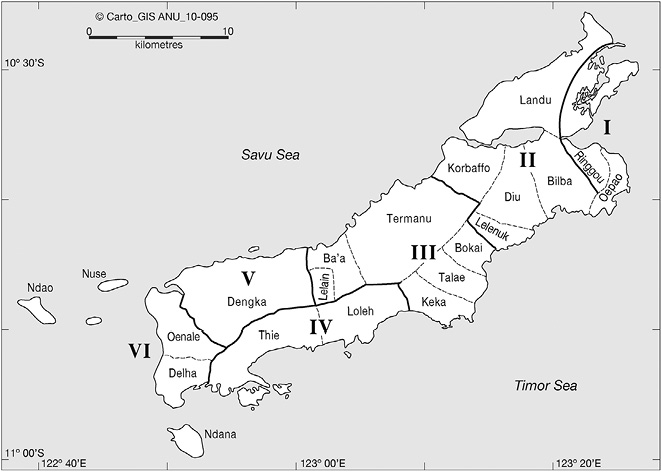
Map 2.1 The domains of Rote
The following is a list of the domains of Rote, from east to west, each with one of its more prominent ritual names.
The domains of Rote and Ndao
|
1. |
Landu |
Soti Mori ma Bola Tena |
|
2. |
Oepao |
Fai Fua ma Ledo So’u |
|
3. |
Ringgou |
Londa Lusi ma Batu Bela |
|
4. |
Bilba |
Pengo Dua ma Hilu Telu |
|
5. |
Diu |
Pele Pou ma Nggafu Lafa |
|
6. |
Lelenuk |
Lenu Petu ma Safe Solo |
|
7. |
Bokai |
Medi do Ndule |
|
8. |
Korbaffo |
Tunga Oli ma Namo Ina |
|
9. |
Termanu |
Koli do Buna |
|
10. |
Keka |
Tufa Laba ma Neë Feo |
|
11. |
Talae |
Pila Sue ma Nggeo Deta |
|
12. |
Ba’a |
Pena Pua ma Maka Lama |
|
13. |
Dengka |
Dae Mea Iko ma Oe Onge Muli |
|
14. |
Lelain |
Nggede Ke ma Donda Mamen |
|
15. |
Loleh |
Ninga Ladi ma Hengu Hena |
|
16. |
Thie |
Tada Muli ma Lene Kona |
|
17. |
Oenale |
Tasi Puka ma Li Sonu |
|
18. |
Delha |
Dela Muli ma Ana Iko |
|
19. |
Ndao |
Ndao Nuse ma Folo Manu |
There exists an abundance of folk exegesis that is called up in the interpretation of ritual names. Oepao is a small domain at the eastern end of the island. Its name is Fai Fua ma Ledo So’u (‘Day Lifts and Sun Appears’). On this name, there is general agreement. Oepao is the domain of the sunrise, the area from which it is first possible to observe the dawn. The neighbouring domain of Bilba has the name Pengo Dua ma Hilu Telu, which can be translated as ‘Turn Twice and Swerve Thrice’. Most interpretations of this name hinge on the changeability of Bilba. One interpretation suggests that the name alludes to the contrary nature of the people of Bilba, swinging from one extreme to another, from one allegiance to another; another sees in it an allusion to the continual changing of rulers and alliances in Bilba. Historically, Bilba has been an area of local revolt and internal dissension and, despite Dutch East India Company involvement on the island, it was suspected of an alliance with the Black Portuguese of Timor. Diu’s ritual name, Pele Pou ma Nggafu Lafa (‘Hang the Woman’s Sarong and Flutter the Man’s Cloth’), is no less elusive than that of Bilba. According to one exegesis, the name refers to the flying of a flag and the union of northern and southern parts of the domain—of Kana and Diu—to form the single unified state of Diu. Another of Diu’s ritual names, Diu Dulu ma Kana Langa, alludes to this relationship. According to another exegesis, a large segment of the population of Diu was supposed to have come as immigrants from Kuli in the domain of Loleh. At first, without permanent residences, where they hung their clothes was where they had their homes.
By comparison with these, Korbaffo’s name, Tunga Oli ma Namo Ina, which means literally ‘Follow the Estuary and Great Harbour’, is more transparently interpretable because it can refer to this domain’s wide natural harbour, approached through the estuary of Oenggae. Bokai’s name, Medi do Ndule, is also said to be based on some reference to the harbour of Bokai, but no-one can suggest a possible translation of its elements. Talae’s name, Pila Sue ma Nggeo Deta, means ‘Red Bracelet and Black Dip’. By one interpretation, this is an allusion to the fact that Talae produces most of Rote’s supply of betel or areca nut: ‘Red Bracelet’ alludes to ‘red lips’ while ‘Black Dip’ alludes to ‘blackened teeth’. Oenale, at the western end of the island, has a relatively unambiguous name, Tasi Puka ma Li Sonu (‘Sea Breaks and Waves Splash’), while Thie, Dengka and Delha combine, in their names, directional coordinates with other dyadic elements. Thie’s name links the set ‘south’ (kona)//‘west’ (muli) with what are said to be local placenames, Lene//Tada, to form the name Lene Kona ma Tada Muli (‘South Lene and West Tada’). Both Dengka’s and Delha’s names are based on the conventional equation of ‘west’ and ‘tail’. Dengka’s name is Dae Mea Iko ma Oe Onge Muli (‘Red Earth at the Tail and Flowing Water in the West’). This, like another of Dengka’s names, Dae Mea ma Tete Lifu (‘Red Earth and a Thousand Dams’), appears to be an allusion to this domain’s agricultural situation: red clay soil with no major rivers, only dozens of smaller sources of water whose flow must be diverted for irrigation. Delha’s name is simply Dela Muli ma Ana Iko (‘Dela in the West and Child and Small One at the Tail’).9
The assignment of ritual names is not confined exclusively to Rote.10 Rote lies in a chain of islands. The island of Savu, whose principal settlement is Seba, is located to the west and is known as Seba Iko ma Safu Muli (‘Seba at the Tail’//‘Safu in the West’). Ndao, a tiny island off the north-west coast of Rote, is Ndao Nusa do Folo Manu. Timor is referred to as Helok do Sonobai; this old expression equates the Helong people at the tip of Timor and on the island of Semau with those Timorese who were once united under a ruler known as Sonbai.
The town of Kupang on Timor has various names. It can be referred to as Kota Batu//Di Lilo (‘Walled Town’//‘Golden Pillars’), but a more playful designation is Si Seu ma So’e Dode (‘Tear, then Sew, Scoop, then Serve’), which sees the population of Kupang as living comfortably with minimal labour. The dyadic set Sina do Koli may refer to any Chinese settlement. Originally this set may have referred to the Chinese settlement at Atapupu on the central northern coast of Timor. Now the name Sina Dale do Koli Dae (‘Sina Interior’//‘Koli Land’) refers to the Chinese settlement in the town of Ba’a. Seen by some as a reference to an original homeland, any hospitable land beyond the sea is Sela Sule ma Dai Laka.11
The organisation of the domains
In ritual language, the dyadic set ingu//nusa can refer to any territory including the domains of the island. Ingu is ‘territory’ or ‘homeland’ and it also forms another set with leo, which refers to the ‘lineages’, ‘clans’ or, in some contexts, the ‘clan areas’ that constitute a domain. In Rotenese political history, each clan is said to have had its own territory centred on some walled redoubt. Nusa is the term for ‘island’ but can, like ingu, refer to a particular territory.
The lord or ruler of a domain is referred to by the set mane(k)//boko(k). Manek is the general Rotenese title for a ruler. The root of this term is mane (‘male’). The term mane occurs in the titles of key ritual figures and in the designation, in ritual expressions, for the Christian God, ‘The Great Lord Above’ (Mane Tua Lain).
In Rotenese domains, in addition to the ‘male’ ruler, there was the complementary ‘female’ ruler and, depending on size and composition, an array of clan lords. In Termanu, these clan lords were known as the ‘Nine Male Lords’ (Mane-Sio) because the domain was conceived of as a unity of nine clans. At the court in Termanu, there were other titles as well. All domains were divided between noble and commoner clans and different titles were also associated with these ranks.
Ritual language, however, gives little recognition to such political and social differentiation. Nobles, lords, headmen or anyone with rank can be referred to as lena//lesik. In direct address, these terms are reduplicated: lena-lena//lesi-lesik. This set occurs in other contexts in ritual language and always refers to that which is ‘more, extra, surpassing, overabundant’.
Similarly, ritual language does not make explicit reference to class distinctions, yet such distinctions are implicit throughout the chants, particularly in the use of names and titles. The dyadic set la’u//solu is used in various names to indicate a lowly origin.12 Heavenly names that use terms such as ‘sun’, ‘moon’, ‘star’ or ‘lightning’ indicate high origin.
Whereas ritual language neglects the apparatus of political relations, it possesses a considerable array of dyadic sets that express different aspects of social relations. The clans of a domain can be referred to by the dyadic set ingu//leo (‘land’//‘clan’), while settlements are designated nggolo//taduk, which literally indicates a ‘promontory’//‘redoubt’. Important relations, however, are expressed in terms of houses and their internal structures.
Rotenese clans or lineages are composed of ‘houses’ (uma). Although uma can apply to a single household, it also has a much wider connotation. It can denote a ritual group of lineal relatives who hold rights in common. A widow with sons rarely returns to the house of her father or brother. She will act as the head of the household until her sons are adults. In inheritance, the eldest son receives all his father’s ritual entitlements established with other groups through marriage whereas the youngest son inherits his father’s house and is ritually responsible for dealing with the spirits of the dead still associated with the house.
Houses figure prominently in ritual language. The single most important Rotenese origin narrative recounts the origin of the house and its complex ritual construction.13 Houses are referred to by the dyadic set uma//lo. Lo occurs in several sets but is confined to ritual language. It is possibly related to the word for ‘beam’ or ‘plank’, lolo. There are other ways of describing houses, in terms of either their inner fires or their ladders. Physically, houses are large, haystack-like structures with roofs thatched in lontar leaf or alang-alang grass that hangs nearly to the ground. They are always set lengthwise on an east–west axis. Beneath these immense sloping roofs, there is a ground-level receiving area in which there are placed four to six elevated platforms for sitting or reclining.
The traditional house was built on posts (di’i//ai) and in the receiving area there was a ladder—often the halved trunk of a tree with notches as steps—that led into the house itself. Inside, the house was divided into two sections: the man’s side or ‘outer’ section (uma deak) and the woman’s side or ‘inner’ section (uma dalek). The man’s side was always on the east; the woman’s side always on the west. On the woman’s side was the cooking fire and another small ladder that led up into a loft where food supplies and seed grain were stored. A man, when ill, retreated to the woman’s side of the house to restore his health; he was obliged to ask his wife’s permission to enter the loft.
There is a proliferation of dyadic sets in ritual language that refer to this structure (and assume an understanding of its various parts). In addition to the general dyadic set, ‘house’//‘home’ (uma//lo), a house may be referred to by a variety of its complementary parts: ‘two ridgepoles’//‘three crossbeams’ (to’a duak//sema teluk), ‘house-posts’//‘the tree-ladder’ (uma di//heda-ai), ‘house-posts’//‘home planks’ (uma di//lo ai) or the ‘upper house’//‘inner cooking fire’ (uma-lai//la’o dale). A grave is also conceived of as a kind of house and is thus referred to either as an ‘earth-grave’//‘tree-home’ (late dae//lo-ai) or as a ‘rock-grave’//‘tree-home’ (late batu//lo-ai).
Rotenese rituals of life and livelihood
Rituals are intended to convey the words of the ancestors. These rituals continually speak of Rote as though it were covered in fresh forests and thick woods (lasi//nula). Yet, Rote is sadly bare: a dry, eroded, windswept island. The forests that remain are confined to a few limited areas. The major concern of the Rotenese is with water. The Rotenese word for ‘water’ is oe. In ritual language, oe is a core term—one of a small number of other core terms that can combine with a wide variety of other terms, in contrast to a majority of words that have one or two required pairs.14 Thus, ritual language has the paired terms oe//dae for ‘water and land’, oe//ai for ‘water and tree’, oe//na’u for ‘water and grass(land)’ and oe//da(k) for ‘water and blood’.
A remarkable feature of Rotenese life is the people’s adaptation to these dry conditions through a reliance on the lontar palm (Borassus flabellifer Linn.; Rotenese: tua). The lontar palm is a solitary dioecious fan-leaf palm that flourishes by sending its roots deep into the island’s jumbled limestone soil. Rotenese livelihoods are heavily centred on the use of all the products of the lontar palm. From its crown, this palm yields a sweet juice that must be drunk immediately or cooked to produce a dark sugar syrup. This syrup, when mixed with water, makes a sweet sugar drink (tua hopo) that is consumed several times daily as the normal sustenance of most Rotenese. In the origin narrative that recounts the discovery of the lontar, its juice is described as kei-kei//keke’e (‘sweet and sour’). As a consequence, it is said that the Rotenese are a people who drink more meals than they eat. The syrup may be crystallised to form a brown rock sugar, fermented to make a beer or distilled to produce a delicately sweet gin. This native gin is called the ‘water of words’ and is regarded as an essential prompt for all poets before they can recite.15
The male lontar palm (tua manek) has hanging from its crown long, narrow and ithyphallic inflorescences; the female palm (tua fetok) carries dark round clusters of fruit. This tree, with its marked sexual differences, provides the Rotenese with an iconic model for many of their ritual metaphors. In ritual language, the lontar may be referred to as the ‘male’ and the ‘female’ (mane//feto) or as the ‘lontar’ and the ‘female’ (tua//feto). In ritual language, the verbs for tapping are pale//lenu or pale//seti; in ordinary speech, the verb is ledi.
Literally, in ritual language, a tapper ‘tends the male’ and ‘forces the female’. In practice, the male lontar is tapped more frequently than the female, hence in rituals, the male is identified with the species as a whole and the female becomes the marked category. Crucial to several dimensions of Rotenese symbolism is a distinction that is emphatically made within ritual language. Though the tapped juice might appear the same, if the juice comes from the male it is referred to as oe (‘water’ or ‘semen’) and if it comes from the female, it is dak (‘sap’ or ‘blood’). Thus, the formula in ritual language for this palm juice is tua oe//feto dak (‘lontar water’//‘female blood’).
With lontar utilisation at its core, the rest of the Rotenese economy is diverse in its pursuits. It consists of both ‘caring for the lontar’ and ‘attending to the earth’ (pei tua//papa dae). Rotenese agriculture is based on a complex system of dry fields (fu’a//mok or tina//osi), house gardens and irrigated orchards (osi//mamek). The most important crops are rice and millet (hade//betek). In ritual language, the cultivation of rice and millet is described as lele hade//o’oko bete. In the rituals, these two crops are of such importance that they epitomise all other ‘grain and seed’ (bini//ngges) and are given a personal ritual name: Doli do Lutu.
Rice and millet are first mentioned as cooked food in the initial origin narratives. In a subsequent narrative, these primary grains are associated with a ‘sea snail and crab’ referred to as Bole Sou//Asa Nao. These creatures of the sea are washed ashore at a ritual site, Tena Lai ma Mae Oe, at the eastern end of Rote and are then carried by a succession of women, each of whom endeavours to plant them in their named fields on the island.
In Termanu’s recitation of this origin narrative, the first woman to succeed in getting seeds to germinate and grow did so by receiving Doli do Lutu with great ceremony, offering them betel catkin and areca nut wrapped in specially decorated cloth. This woman, Fiti Nggoli//Lole Bako, planted Doli do Lutu in a field in Termanu whose ritual name reflected her own: Nggoli Kai Tio//Bako Bau Dale.16
Maize was introduced to Rote near the end of the seventeenth century and was assimilated to the existing native category of a high-stalked form of sorghum referred to as pela, which to this day is referred to in Indonesian as jagung Rote (‘Rotenese corn’). In Rotenese, sorghum is pela-hik (‘true pela’) while maize is pela-sina (‘Chinese pela’). Maize has long surpassed millet as a major subsistence crop while sorghum is still widely grown in particularly dry areas of the island.
Just as the rituals refer to rice and millet (hade//bete) as a pair, they also refer to millet and either sorghum or maize (bete//pela) as a pair. Although in some contexts it is unclear whether reference is made to sorghum or maize, some narratives are more explicit in referring to ‘the millet kernel’//‘the ear of maize’ (bete-pule//pela-po’o). There is in Termanu a specific narrative that links these two grains in recounting the origin of a certain kind of millet. According to this narrative, two notable personages requested seeds and grain (bini no ngges) from the Heavens but when they were not provided, they created their own seeds by pricking their hands and feet and allowing their blood to spill down and become millet and maize.
Rote has a mixed planting system with a variety of food crops. Collectively these different food crops are referred to as the ‘nine seeds and the eight kernels’ (pule sio//kale falu). Crops such as mung bean, pigeon pea, peanuts, sesame or other crops such as sweet potato, cassava and squash are not mentioned by name in the rituals. On the other hand, there are certain crops like rice and millet that have an iconic importance in the rituals. These are ‘taro and yams’ (tale//fia), ‘banana and sugar’ (huni//tefu), and coconut and areca nut (pua//no). The rituals also mention crops such as ‘onions and tobacco’ (laisona//modo-sina), which are grown together in specially separated gardens during the dry season. The rituals also refer to cotton but more as a product in the creation of clothing than as a planted crop.
Images of Rotenese livelihood activities: Herding, fishing and weaving
The Rotenese economy is also dependent on the keeping of livestock. Ritual language links pigs and chicken (bafi//manu)—animals that scavenge in the vicinity of the house and are, from time to time, fed the surplus of lontar palms. While it is possible to pair the ‘dog’ with either the pig or the chicken, there is a special set for ‘dog’ that pairs the Rotenese term for dog (busa) with the more common (Austronesian) term asu, thus: busa//asu.
The water buffalo (kapa) is an important source of wealth and prestige and, as such, is linked with gold (kapa//lilo). Bridewealth may be paid either in water buffalo or in its accepted equivalent, gold. Such bridewealth payments are referred to by the set fae tena//beli batu. Fae tena is a reference to livestock while beli batu is a reference to gold. Water buffalo can also be linked with goats/sheep in the compound set tena kapa//bote bi’i, which is a general expression for both large and small livestock.
The Rotenese keep both sheep and goats. A scrawny, wool-less breed of sheep (bi’i-lopo: literally, ‘trousered bi’i’) that reached the island via the Dutch East India Company has been assimilated into the category of goat (bi’i-hik: ‘true bi’i’). A person’s wealth is evident in the size of their herd. Herding or tending, based on verbs for ‘dividing and separating’, is expressed by the dyadic set lilo//tada. The gregariousness attributed to herd animals gives rise to a striking Rotenese metaphor: a lonely, isolated or abandoned person can be likened to ‘a lone buffalo’//‘an orphaned chick(en)’.
Offshore fishing is another important Rotenese livelihood activity and is chiefly a tidal fishing effort. The tides are classified in a monthly cycle according to the time and extent of their ebb. Stone fish-walls (dea//lutu) that extend into the sea are built at strategic locations along the shoreline. They are used as a kind of weir to trap fish in the ebbing tide. Most of this fishing is done by women with scoop nets (seko//ndai). Whereas men tap palms, women bring in the abundance of the sea.
In the origin narratives, fishing is of major significance, not just for economic reasons, but also because fishing—at the junction of land and sea—offers contact between the people of the Earth and the creatures of the Sea. The tidal shore is thus ritually pregnant with possibilities.
Weaving is—or once was—a complex activity of daily life whose beginnings are recounted in the origin narratives. Weaving requires the prior spinning of cotton and the elaborate dyeing of bundled threads before they can be woven. Women use a simple wooden cotton gin or rack (lolek) to remove seeds from the cotton and then spin it into threads using a simple spindle balanced on the base of a shell (ine). These processes are expressed in ritual language as complementary activities: ifa lolek//dipo ine. The tying (henge) of threads and the weaving (tenu) of cloth are presented as complementary activities: henge//tenu. The loom and its parts are similarly referred to by the dyadic set ati//selu (‘loom and shuttle’). Together these sets succinctly encode the weaving process whose origins derive from human involvement in the affairs of the Heavens and the Sea.
Metaphors and icons of the Rotenese life cycle
The dyadic set for ‘human being’ in Termanu is hataholi//daehena. In ritual language, persons are identified as male and female: the set for a man combines the terms for ‘adult man’ and ‘boy’, tou//ta’e, just as the set for a woman combines the terms for ‘woman’ and ‘girl’, ina//feto.
In ritual language, ‘father’ (ama) forms a set with ‘mother’s brother’ (to’o); ‘mother’ (ina) forms a set with ‘father’s sister’ (te’o). What Rotenese rituals assert is that a person is composed of two elements: the soft flesh and blood that one obtains from the mother’s brother through their mother and the bones and genealogical (literally: ‘hard’) name (nade) that come from the father. The coupling of father and mother’s brother, and of mother and father’s sister, is intelligible in these terms. Any bodily injury—even accidental self-inflicted injury—requires a payment of indemnification to the mother’s brother; any slur or insult to a person’s name, if proven, requires a different payment of indemnification to the genealogical group who share that line of names.
Personal naming adds yet another dimension to the Rotenese theory of persons. In the ritual language of Termanu, nade (‘name’) forms a set with tamok. In genealogical naming, a person receives the first element of their father’s binomial as the last element of their binomial. Their own first binomial element is (or was once) determined by divination. The traditional procedure was to drive a spear into a specific post in the house and, with outstretched arm reaching towards the spear’s point, to recite a litany of the names of the child’s ancestors on their mother’s and their father’s sides. When the proper name was reached, the fingertips would suddenly be able to touch the spear’s point. Rotenese Christians, rather than abandon genealogical naming, have instead adopted an additional system of Christian fam or ‘family’ names. In place of divination, they open the Bible at random to discover a clue to the name of a suitable ancestor. This ancestor, by divination, is the tamok. A portion of this ancestor’s name becomes the first part of a child’s full binomial name. The full ritual expression for name-giving is ‘to lift the nade (genealogical name)’ or ‘bring forth the tamok (ancestral name)’: fela-foi nade do bala-tola tamok.
A person’s ‘hard’ genealogical name is so fundamental that it should never be mentioned out of proper context for fear of insult to that person or some ancestor. As a result, in everyday life, a person is known by a ‘soft’ or ‘gentle’ name and many of these allude to the identity of the tamok. Individuals who share a tamok possess a special mutual bond, even though they may be in different lineages. They have a stake in defending their common ancestral name.
Ritual chants encompass all stages of the human life cycle, from birth, name-giving and hair-cutting ceremonies to courting, marriage and the succession of death rituals. One icon used in ritual language for a young man, particularly when he is ‘hunting’ for a woman, is ‘shark and crocodile’ (iu//foe) and these terms can be used as verbal forms in courting dialogue: a boy is said to come ‘sharking and crocodiling’.
Similarly, ritual language uses specific icons for young marriageable girls. They are compared to specific birds (koa//nggia) whose early morning singing and fluttering are supposed to be directed to attracting young men.17
As birds, girls are differentiated by status as either noble or commoner. The noble koa//nggia are associated with the sun and moon and are distinguished by particular markings:
|
Bulan koa ma ledon nggia |
Friarbird of the Moon |
|
Ma Ledon nggia |
And parrot of the Sun |
|
Nggia manutu lilok |
Parrot with golden throat |
|
Ma koa malali potak. |
And friarbird with gilt crest. |
By contrast, commoner koa//nggia are distinguished by size and referred to as the ‘lorikeet and oriole’ (nggia timu//koa kese). In ritual language, the search for a girl to marry is often described in archaic hunting terms. A boy must take up his ‘blowpipe and bow’ (fupu//kou) and set out on a ‘bird hunt’ for the koa//nggia.
When a boy eventually manages to ‘hunt’ his bride, her bridewealth must be negotiated and paid. The origin narratives recount the primal origin of bridewealth. From the beginning, these payments have been made in ‘gold and water buffalo’ (lilo//kapa) or ‘livestock and units of gold’ (fae tena//beli batu) and they continue to be calculated in these terms. Negotiations can go on at length and never entirely satisfy either side. However, there is a concluding phrase taken from the narratives that signals an end to negotiations even though not all that was wished for has been obtained. These four lines are as follows:
|
Dai te ta dai |
Enough or not enough |
|
O nai ta dai liman |
What’s in our grip is enough in our hand |
|
Ma no’u te ta no’u |
And sufficient or insufficient |
|
O nai kuku no’u nen. |
What’s in our fingers is sufficient in our grasp. |
The dyadic set tu//sao is ‘to marry and to wed’. The metaphor for the ceremony itself emphasises the physical transfer of the bride and her role in creating a path between two houses:
|
Soku Lisu Lasu Lonak |
They lift Lisu Lasu Lonak |
|
Ma lali Dela Musu Asuk. |
And they transfer Dela Musu Asuk. |
|
De lelete neu sao |
She bridges the path to marry |
|
Ma fifino neu tu. |
And she joins the way to wed. |
The narratives often go on to announce the pregnancy of the girl who has been transferred in marriage and chart the development of her pregnancy, particularly her cravings, because these are believed to reveal a child’s character. An example of such cravings is:
|
Su’un na nggeo lena |
Her breasts darken |
|
Ma tein na da’a fai. |
And her womb enlarges. |
|
Ana da’a fai bobongin |
She grows large to give birth |
|
Ma nggeo lena lalaen, |
And grows dark to bring forth, |
|
Te hu ana ta hapu bongi |
But she is unable to give birth |
|
Ma ana ta hapu lae. |
And she is unable to bring forth. |
|
Ana metu ape u’una |
She thirsts for assorted foods |
|
Ma ana ma siu dodoki. |
And she craves for odd bits. |
Some narratives run through a long list of these cravings to signal the birth of an unusual child. These cravings may, for example, include ‘tasty rice’//‘sweet palm juice’ (lada hadek//mina tuak), ‘goat’s lungs’//‘buffalo’s liver’ (bote ba//tena ate), ‘slices of turtle meat’//‘strips of dugong flesh’ (bia keak//lola luik) and ‘forest-bee jelly’//‘bumblebee larvae’ (fani-lasi ana//bupu-timu ana). Each of these cravings forces the husband to greater efforts to obtain the foods for his wife.
When eventually children are born, the formulaic expression for a boy is ‘a cock’s tail feathers and a rooster’s plume’ (popi koak//lano manuk); for a girl, the formula ke fetok//tai inak is less easy to translate. The expression refers to the special waistband that a girl wears (or used to wear) and can best be translated as ‘girdled girl and bound woman’.
The chant Ndi Loniama ma Laki Elokama, for example, describes the successive birth of, first, a boy and then a girl:
|
Boe ma ana bongi-na Solu Ndi |
She gives birth to Solu Ndi |
|
Ma ana lae-na Luli Laki |
And she brings forth Luli Laki |
|
Fo popi-koak Solu Ndi |
A cock’s tail feathers, Solu Ndi |
|
Ma lano-manuk Luli Laki. |
And a rooster’s plume, Luli Laki. |
|
Boe te ana bei boe bongi |
But she still continues to give birth |
|
Ma bei boe lae. |
And continues to bring forth. |
|
Lae-nala Henu Ndi, |
She brings forth Henu Ndi, |
|
De ke-fetok; |
She is a girdled girl; |
|
Ma lae-nala Lilo Laki, |
And she brings forth Lilo Laki, |
|
De tai-inak. |
She is a bound woman. |
In ritual language, life is consistently described as a journey. As such, life is a process of discovery even when the journey leads back to where it began. A search for wisdom and knowledge is part of this process and an essential feature of life. This quest is variously phrased in ritual language combining the paired verbs sanga//tunga. In its highest form, this search is described as ‘seeking for wisdom’//‘questing for knowledge’ (sanga ndolu//tunga lela). Personal encounters on the journey, particularly when arms and hands meet (tongo lolo//nda lilima), are frequent and instructive. Respect is accorded a person of knowledge and wisdom (hataholi malelak) whose life has been spent in learning from experience.
Journeying is a feature of life but continues in death. Mortuary rituals describe the life journeys of an array of chant characters who represent the deceased. These chant characters portray a formulaic set of possible categories: those who die young or those who die old, nobles and commoners, the rich and the poor, and especially those who die surrounded by family members and are succeeded by sons and daughters. These narratives frequently attribute a sudden death to an attack by malevolent spirits—‘craving spirits and grasping ghosts’ (nitu mana-tetenik ma mula mana-doko-doek)—who cause ‘dizziness in the head’//‘cramps in the stomach’ (langu-langak//mela-teik).
Just as the mortuary chants set forth the possible journeys of life, they also hint at the journey after death. Some of the most powerful mortuary chants give voice to the chant character who represents the deceased. This allows the deceased to address those who have gathered to mourn and to describe the final journey that is about to occur. In one such poignant exposition from the dead, the deceased instructs his family in how to use his wealth and to go on living and then announces his imminent departure:
|
Te au touk Ndi Lonama |
For I am the man Ndi Loniama |
|
Ma au ta’ek Laki Elokama |
And I am the boy Laki Elokama |
|
Na au tonang sanga sosokun |
My boat is about to lift |
|
Ma au balung sanga sasa’en |
And my perahu [boat] is about to rise |
|
Fo au ala u tunga inang |
For I am going to search for my mother |
|
Ma ala u afi te’ong |
And I am going to seek my father’s sister |
|
Nai muli loloe |
In the receding west |
|
Ma iko tatai. |
And at the tail’s edge. |
|
Fo au leo Dela Muli u |
For I go to Dela in the west |
|
Ma leo Ana Iko u. |
And I go to Ana at the tail. |
|
De se au tonang ta diku-dua |
My boat will not turn back |
|
Ma au balung ta lolo-fali |
And my perahu will not return |
|
Te dae saon doko-doe |
The earth demands a spouse |
|
Ma batu tun tai-boni |
And the rocks require a mate |
|
De se mana-sapuk mesan-mesan |
Those who die, this includes each person |
|
Mana-lalok basa-basan. |
Those who perish, this includes everyone. |
This passage ends with the restatement of a recurrent theme in Rotenese rituals: the inevitability of death. This notion is often combined with the metaphoric representation of humans as ‘orphans and widows’ whose journeys end in death. In almost any ritual recitation there is invariably a concatenation of different metaphors. In this passage, in addition to the idea of a journey to the west, the land of the dead, there is mention of the metaphoric search for a new ‘mother and aunt (father’s sister)’—a common theme in the quest for a permanent abode—and, at the same time, the acknowledgement of the Earth as ‘spouse and mate’. A pervasive metaphoric idiom in virtually all ritual recitations—a botanic idiom of relations—requires special exegesis.
The pervasive botanic idiom in ritual discourse
Rotenese relationships are expressed in a pervasive botanic idiom. The mother’s brother (to’o) ‘plants’ his sister’s children. These children are referred to literally as his plants, selek. From among the men who can be regarded as the mother’s brothers, one individual is designated as ‘trunk’ or ‘root’ (huk). This is the to’o-huk (the ‘trunk mother’s brother’ or, translated differently, the ‘mother’s brother of origin’). This man has charge over all his sister’s children, who are his ‘plants’. His duty is to perform the life-giving rituals that foster the growth of these plants. As such, the mother’s brother has the right to indemnification for any damage to his ‘plants’. In fact, if a person injures himself, he must pay compensation to his mother’s brother. And this relationship passes on for another generation: the mother’s brother (to’o-huk) becomes the ba’i-huk (the mother’s mother’s brother of origin) and he continues to have residual ritual rights in his sister’s children’s children.
As a consequence of these ideas of social relationships, the language of the rituals of the life cycle is so heavily couched in a botanic idiom that these rituals might be mistaken for agricultural ceremonies. The converse of this is also true. The plants, in agricultural rituals, are personified.
The botanic idiom is complex in that no one plant serves as a unique form of expression. In this elaborate semiology, a multitude of plants—or parts of plants—express different relations. Thus, in making a request for a girl in marriage, she is referred to as ‘grain’//‘seed’ (bini//ngges). The marriage party therefore comes not to ask for a woman but to seek ‘grain’//‘seed’. Formerly, in some domains, the marriage ceremony itself was performed over a coconut with the prayer:
|
No ia tadak lima |
This coconut has five layers |
|
Mbunu holu so’en |
The husk embraces the shell |
|
So’en holu isin |
The shell embraces the flesh |
|
Isin holu oen |
The flesh embraces the water |
|
Ma oen holu mbolon. |
And the water embraces the germ. |
|
De ela leo be-na |
So let it be |
|
Ana touk no ana inak ia. |
For this young man and woman. |
|
Ela esa holu esa |
Let one embrace the other |
|
Ma ela esa lili esa |
And one cling to the other |
|
Fo ela numbu non, ana dadi |
So that the shoots of the coconut may grow |
|
Ma sadu mbua, ana mori |
And the core of the areca palm may sprout |
|
Fo ela bonggi |
That she may give birth to |
|
Sio lai sio |
Nine times nine children |
|
Ma rae |
And that she may bring forth |
|
Falu lai falu |
Eight times eight children.18 |
A woman’s first child is described as her ‘eldest sprout’//‘first fruit’ (pule uluk//boa sosak). From the beginning of a child’s life, the rituals emphasise botanic growth: ‘budding’ and ‘sprouting’ (lea bu’u//tona kale). The performance of such rituals is made to coincide with the waxing of the moon, which, for the Rotenese, is believed to govern this growth. Children, and especially daughters, are said to grow up like quick-growing ‘rice’//‘millet’ (hade kase//bete lai). Daughters, as in the marriage ceremony, are most frequently represented by the paired icons of ‘coconut palm’//‘areca palm’ (no//pua). In the chants, a common refrain for a young girl is that she is:
|
Bei nula-nula no |
Still as unripe as a green-green coconut palm |
|
Ma bei sadu-sadu pua. |
And still as fresh as the shoots of the areca palm. |
Sons are represented as either ‘taros and tubers’ (tale//fia) or, more often, ‘banana and sugar cane’ (huni//tefu). There is a particularly poignant funeral chant for the death of a young son that speaks only of the grievous loss of ‘sugar cane’ and ‘banana’. A similar short chant, which could be mistaken as a prayer for agricultural increase, is in fact a plea for renewal and the continuation of sons:
|
Lole faik ia dalen |
On this good day |
|
Ma lada ledok ia tein na |
And at this fine time |
|
Lae: |
They say: |
|
Tefu ma-nggona lilok |
The sugar cane has sheaths of gold |
|
Ma huni ma-lapa losik. |
And the banana has blossoms of copper. |
|
Tefu olu heni nggonan |
The sugar cane sheds its sheath |
|
Ma huni kono heni lapan. |
And the banana drops its blossoms |
|
Te hu bei ela tefu okan |
Still leaving but the sugar cane’s root |
|
Ma huni hun bai. |
And the banana’s trunk too. |
|
De dei tefu na nggona seluk |
But the sugar cane sheaths again |
|
Fo na nggona lilo seluk |
The sheaths are gold again |
|
Ma dei huni na lapa seluk |
And the banana blossoms again |
|
Fo na lapa losi seluk. |
The blossoms are copper again. |
The Rotenese depend on the lontar palm for their livelihoods and therefore, not surprisingly, this palm is another prominent icon used in the Rotenese botanic idiom. Like a lontar palm, every person is composed of ‘semen or juice’//‘blood or sap’ (oe//dak). Juice dripping into a lontar-leaf bucket and collected provides the image of a social group. In Termanu, an extended family is referred to as ‘the spilling drops and dripping sap’ (titi-nosi//da-fa or tititik//nonosik).
Based on similar palm imagery, the lineages within a clan are referred to as nggi-leo//nggona-haik. Explicating this complex metaphor requires some exegesis. In the first part of this dyadic set, nggi refers to the long phallic inflorescences that hang from the crown of the male lontar palm. These inflorescences are squeezed—or, more correctly, in Rotenese terms, ‘circumcised’—and their tips slivered and then tied into a single bundle to produce the flow of juice (oe) that is caught in leaf buckets (haik) suspended beneath them. In the second part of this dyadic set, nggona refers to the ‘caul’ that envelops the child at birth. Nggi is linked to leo, which refers to a ‘lineage’ or some segment of a clan, and nggona is linked to haik, the leaf bucket that catches the juice dripping from the lontar. A contrived literal translation for this complex dyadic set would be the ‘lineage inflorescences’//‘birth-caul bucket’ (nggi-leo//nggona-haik).19 A similar but more explicit expression is ‘lineage inflorescences’//‘birth groups’ (nggi-leo//bobongik). Certain sets of large trees are repeatedly involved in poetic compositions. The first of these sets refers to two kinds of banyan or waringin tree (Ficus spp.): keka//nunu. These trees, with their many branches, form a cosmic tree setting out paths of life and death:
|
Sa Lepa-Lai nunun |
The waringin tree of Sa Lepa-Lai |
|
Ma Huak Lali-Ha kekan |
And the banyan tree of Huak Lali-Ha |
|
Keka maba’e faluk |
The banyan has eight branches |
|
Ma nunun mandana siok. |
And the waringin has nine boughs. |
|
De dalak ko sio boe |
These are the nine roads |
|
Ma enok ko falu boe |
And these are the eight paths |
|
Fo dala sodak nai ndia |
The road of wellbeing is there |
|
Ma eno mamates nai na … |
And the path of death is there … |
Keka or, more specifically, keka lasi (‘forest keka’; possibly Ficus rumphii) forms a pair with fuli-ha’a, the designation of another large hardwood tree, the molave (Vitex parviflora timoriensis). In the origin narratives, the wood of these two trees—‘the two-leaved keka-lasi and the three-leaved fuli-ha’a’—is cut and hewed to construct the main beams and poles of the first house of the Sun and Moon.
Another pair of large trees that serve as icons in Rotenese ritual poetry are the delas, a large, rough-barked tree with striking orange flowers (Erythrina spp.), and the nitas, a sizeable, smooth-barked tree with large pungent purple flowers (Sterculia foetida). Both trees flower at the height of the dry season and, in poetry, they mark places of prominence:
|
Solu Oebau nitan-na |
Solu Oebau has a nitas tree |
|
Nita mabuna hanas |
A nitas with blossoms of heat |
|
Ma Pota Popo delan-na |
And Pota Popo has a delas tree |
|
Dela makapako ledok. |
And delas with sun-like flowerbuds. |
Growth is an external flowering and an internal hardening. In the rituals of life, there is progress from seed to shoot, from shoot to mature plant and, eventually, to full-standing tree. Certain elders are described as ‘hard-cored’, ‘strong-willed’ trees and lineage relations can be expressed in terms of large, enduring trees or old, hard-cored palms. A clansman is ‘a jutting branch’ or ‘a descending leaf’ (ndana peuk//do laek). After death, important individuals were remembered by the ceremonial construction of a circle of smooth river stones arranged around a great tree (lutu tutus). Perhaps the most vivid of these images is the Rotenese metaphor for sociality: a dense, untouched forest where tree branches are intertwined and scrape against one another. This rubbing together is ideal Rotenese sociality.
Speaking as a quintessential quality
Speaking is at the core of Rotenese culture. Speeches, sermons and ceremonial presentations—taletelling, debate, repartee and argument—are all essential elements of sociality. Among Rotenese, talk never ceases. In a class society, however, with hierarchies of order, there are some constraints on speech. In gatherings, nobles speak more than commoners, men more than women and elders more than juniors; yet, commoners, women and youth, when given the opportunity, invariably display the same prodigious fondness for speaking.
Only in certain rituals is silence required. Yet, even these occasional ritual injunctions Rotenese find hard to observe. In ordinary situations, a lack of talk is an indication of distress. Rotenese repeatedly explain that if their ‘hearts’ are confused or dejected, they keep silent. Thus, the act of speaking is critical to all human engagement and, from an early age, every Rotenese engages in the rhetorical presentation of self.
The vocabulary for speaking in ritual language is both extensive and elaborate. In the lexicon of ritual language, there are no less than 25 different verbs for speaking, cajoling, requesting, stating, asserting and conversing.20 The dyadic sets that link the verbs for speaking are diverse and numerous, ranging from the general to the specific. Translating them appropriately in their different contexts is a daunting task. The most common recurrent dyadic set in the ritual language of Termanu pairs the verb ‘to talk, converse’ (kola) with the verb that implies a more purposive speech and thus can be translated as ‘to speak, assert, argue’ (de’a). This set is most frequently used in a semi-reduplicated form: kokola//dede’a. Another dyadic set for speaking links two verbs: fada, a general term meaning ‘to speak, say, declare’, with one that implies a pouring forth of words, nosi. (In other domains, though rarely in Termanu, the verb fada is paired with kola.) The paired verbs for asking or requesting, tata//teteni, also take a reduplicated form. An extended formula for speaking associated with women’s speech is selu (or ae) dasi//lole hala. I translate this recurrent formula as ‘to lift one’s voice’//‘to raise one’s words’. This formula, however, can be further expanded to lole lele hala//selu doko-doe dasi (‘to lift one’s words encouragingly’//‘to raise one’s voice coaxingly’). The variety of these sets and their recurrence throughout the entire corpus of ritual-language recitations are an indication of the fundamental importance of speaking for the Rotenese. It reflects a basic Rotenese understanding that the highest form of human interaction involves dialogue.
A philosophy of life and the cosmos
A large class of Rotenese ritual chants are concerned with the origins of Rotenese culture. These foundational chants recount the origins of fire and cooking, bridewealth and the objects given in bridewealth, and the house and the tools to construct the house. They also recount the origins of the patterns and implements used in weaving and dyeing and of the principal food crops on the island, particularly the seeds of rice and millet. All these chants are narrative in form and may once have formed part of a single account. Even in their present form, the fragments of this narrative—which are told separately on different ritual occasions—can be seen to relate to each other.
In these origin chants, Rote is the site of cosmological encounters between the Lords of the Heavens and the Lords of the Sea.
The Lords of the Heavens are Sun and Moon (Ledo//Bulan), whose children are the chief protagonists in the narratives. All heavenly elements are the descendants of the Sun and Moon. The Lords of the Ocean or Sea are ruled by Shark and Crocodile, whose realm includes all manner of sea creatures.
Whereas origin chants narrate the formative relations between the Lords of the Heavens and the Lords of the Sea, who gave rise to the foundations of Rotenese cultural life, the funeral chants offer personal perspectives on the course of life on Rote and, indeed, on life in general. Each chant is a set narrative that recounts the life of a particular ‘chant character’ leading from birth to death. Although each of these narratives differs in its telling in relation to the social position of the chant characters, the narratives as a whole are similar in their recourse to three recurrent themes. These themes are interwoven with one another and together convey a consistent message.
The first of these themes is that life is a journey. Life is a process of discovery even when that journey leads back to where it began. A search for wisdom and knowledge is part of this process and an essential feature of life.
A second emphatic theme is that there is no perfect order in the world. Acceptance of the world-as-it-is is essential wisdom. Thus, the most frequent refrain in all the funeral chants is the melancholy reiteration:
|
Tema ta nai batu poi |
Perfection is not of the earth |
|
Tetun ta nai dae bafok. |
Order is not of the world. |
This refrain has multiple levels of meaning, ranging from the humblest of instances—a torn cloth is no longer ‘whole’ (tema) and a post that falls over is no longer ‘erect’ (tetu); a forest that is felled is neither ‘erect’ nor ‘whole’—to the most general commentary on life itself. As such, depending on context, tema can be translated as ‘whole’, ‘integral’, ‘full’, ‘complete’ or ‘ordered’, whereas tetu can be translated as ‘erect’, ‘(up)right’ or ‘perfect’. In all contexts, there is a relationship between these two terms. In the Heavens, as part of a cosmic order, the moon waxes to fullness (bula temak) whereas each day the sun rises to the zenith (ledo tetu). Yet, while this heavenly structure may provide a model of order and perfection, it is not one that can be replicated on Earth. Disorder in the world is a condition of life.
Finally, consistent with this view of life is a third theme that asserts that the condition of life is to be an ‘orphan and widow’ (ana-mak ma falu-ina) in the world. This condition is described as ma-salak//ma-singok. Sala(k) carries with it the idea of being ‘mistaken, at fault, wronged’ but also ‘out of place’ or simply ‘displaced’, while singo(k) indicates ‘that which missed a target, has diverged, is divergent or off-course’. At a funeral, the bereaved are the ‘orphans wronged and widows displaced’ (ana-mak ma-salak//falu-ina masingok).
Being an ‘orphan and widow’ in the world implies a state of dependency—a dependency on others that requires a response. The funeral chants, in particular, admonish generosity to orphans and widows:
|
Fo ela neka lama kako bafa |
Let the rice basket overflow at the mouth |
|
Na dai ana-ma leo |
To be enough for a clan of orphans |
|
Ma bou lama lua fude |
And the lontar syrup jar run over with froth |
|
Na ndule falu-ina ingu. |
To be sufficient for a group of widows. |
Such admonitions are often figuratively expressed. In a botanic idiom, the following admonition calls forth a continuing, living generosity:
|
Te sadi mafa-ndendelek |
Do indeed remember |
|
Ma sadi masa-nenedak |
And do keep in mind |
|
Heo Ingu-fao baun |
The bau tree at Heo Ingu-Fao |
|
Ma Dolo Sala-Poi tuin na, |
And the tui tree at Dolo Sala-Poi, |
|
Bau naka-boboik |
A bau tree to care for |
|
Ma tui nasa-mamaok. |
And a tui tree to watch over. |
|
De tati mala bau ndanan |
Cut and take a branch of the bau tree |
|
Ma aso mala tui baen |
Slice and take a limb from the tui tree |
|
Fo tane neu dano Hela |
To plant at the Lake Hela |
|
Ma sele neu le Kosi |
And to sow at the River Kosi |
|
Fo ela okan-na lalae |
That its roots may creep forth |
|
Ma samun-na ndondolo |
And its tendrils may twine |
|
Fo ela poek-kala leu tain |
For shrimp to cling to |
|
Ma nik-kala leu feon, |
And crabs to circle round, |
|
Fo poek ta leu tain |
For it is not for shrimp to cling to |
|
Te ana-mak leu tain |
But for orphans to cling to |
|
Ma nik ta leu feon |
And not for crabs to circle round |
|
Te falu-ina leu feon. |
But for widows to circle round. |
In keeping with this botanic metaphor is the hope enunciated in another funeral chant:
|
Lena-lena ngala lemin |
All you great ones |
|
Lesi-lesi ngala lemin |
All you superior ones |
|
Sadi mafandendelek |
Do remember this |
|
Sadi masanenedak |
Do bear this in mind |
|
Fo ana-ma tua fude |
For orphans, the froth of cooking syrup |
|
Ma falu-ina beba langa la |
And for widows, the heads of leafstalks |
|
Tua fude dua kako na |
When the lontar froth spills over twice |
|
Kako kao mala sila |
Scoop it up for them |
|
Ma beba langa telu te na |
And when the stalk’s head droops thrice |
|
Te tenga mala sila |
Lop it off for them |
|
Fo ela-ana-ma bei tema |
Leaving orphans still intact |
|
Ma falu ina bei tetu |
And widows still in order |
|
Fo leo tema toe-ao lasin na |
Intact like a dense forest |
|
Teman losa don na |
Intact for a long time |
|
Ma tetu lelei nulan na |
And in order like a thick wood |
|
Tetun nduku nete na. |
Upright for an age. |
In 1965, when I had only just begun to comprehend the imagery of Rotenese ritual language, the poet Stefanus Adulanu—‘Old Meno’, as he was known—tried to explain the significance of the idea of ‘orphan and widow’. To provide me with this understanding, he interpolated his explanation into another funeral chant, Lilo Tola ma Koli Lusi, which he recited for me:
|
Se ana-mak? |
Who is an orphan? |
|
Na basang-ngita ana-mak |
All of us are orphans |
|
Ma se falu-ina? |
And who is a widow? |
|
Na basang-ngita falu-ina. |
All of us are widows. |
|
Fo la-fada lae: |
They speak of: |
|
Manu Kama dala dain |
Manu Kama’s road to Dain |
|
Ma Tepa Nilu eno selan. |
And Tepa Nilu’s path to Selan. |
|
Na basang-ngita ta enon |
All of us do not follow his path |
|
Ma basang-ngita ta dalan. |
And all of us do not follow his road. |
|
Sosoa-na nai dae bafak kia nde bena |
This means that on this Earth then |
|
Ana-mak mesan-mesan |
Each person is an orphan |
|
Ma falu-ina mesa-mesan. |
And each person is a widow. |
|
De mana-sapeo nggeok |
Those who wear black hats |
|
Do mana-kuei modok ko |
Or those who wear yellow slippers |
|
Se ana-ma sila boe |
They will be orphans too |
|
Ma falu-ina sila boe. |
And they will be widows too. |
In this explanation, death is the great leveller that leaves everyone bereaved. The expression ‘those who wear black hats or those who wear yellow slippers’, which dates from the time of the Dutch East India Company, is the formulaic designation for the Dutch (and Portuguese). As Old Meno has pointedly observed in these lines, there are different life pathways, but all result in the same end. All humans are ‘orphans and widows’.
1 I intentionally and pointedly refer to the parallel language of the Rotenese as a ‘ritual language’. It is more than just a form of elevated ‘ritual speaking’. This ‘ritual language’ is notably different to that of ordinary speech. It is a highly specialised language that only a few Rotenese eventually come to master. A detailed and extensive knowledge of specific and precise pairings is a critical feature of this ritual language. Much of its phrasing is formulaic and these formulae, like the pairs they comprise, must be learned. This means that those speakers who can use this language fluently and become recognised as the ‘poets’ or ‘chanters’ (manahelo) tend to be elders who are regarded as endowed with a capacity to convey the ‘words of the ancestors’. The language is thus formal, focused and highly specialised; its utterances are considered revelatory of an ancestral past and its performative use is primarily directed to ceremonial occasions. Among the Rotenese, the use of this ‘ritual language’ often overrides performative actions. Rotenese tend to orate rather than perform their rituals. (For this distinction between oration and ostension, see Fox 1979c.)
2 For a discussion of how these various narratives relate to one another, see Fox (2014: 219–28).
3 The Rotenese use two connectives for their pairs: do, which can be translated as ‘or’; and ma, which can be translated as ‘and’. In most compositions, however, these connectives are interchangeable.
4 A name for the island that has fallen into disuse with the conversion of the Rotenese to Christianity is Ingu Manasongo Nitu ma Nusa Manatangu Mula (‘The Land that Offers to the Spirits and the Island that Sacrifices to the Ghosts’).
5 These orientations and their associations are set forth in a number of traditional syllogisms: 1) Lain loa dae boe, tehu dano-ina nai lain, de lain loa dae (‘Heaven is as broad as the Earth, but there is a great lake in the Heavens, therefore Heaven is greater than Earth’); 2) Dulu nalu muli, tehu ledo neme dulu mai, de dulu bau lena muli (‘The east is as broad as the west, but the sun comes from the east, therefore the east is greater than the west’); and 3) Kona bau ki, tehu koasa neme kona, de kona bau lena ki (‘The south is as great as the north, but power comes from the south, therefore the south is greater than the north’). When, however, the Dutch exercised colonial rule over Rote, this ordering of the world was overturned, reversing the orders of symbolic primacy, making the north or left superior to the south or right. A symbolic syllogism recorded at the time emphasised this change: Ona bau i boe, te hu Koponi nai i, de i bau lena ona (‘The south [right] is as great as the north [left], but the company is in the north, therefore the north [left] is far greater than the south [right]’).
6 I have over many years compiled—and continue to compile—a Dyadic Dictionary for such pairs used in Termanu’s corpus of ritual texts. In this chapter, unless otherwise specified, I cite these dyadic sets in the dialect of Termanu. See Fox (2014) for a discussion of this Dyadic Dictionary, its network of semantic relations and the concatenation of dyadic sets in different dialects across the island of Rote.
7 Thus, for example, in the Rotenese chant Ana-Ma Manu Kama ma Falu-Ina Tepa Nilu—the oldest text of its kind, published early last century by the Dutch linguist J.C.G. Jonker, with notes but no translation (Jonker 1911: 97–102)—the woman, whose dual name is Silu Lilo//Huka Besi, marries a man whose dual name has triple elements, Kama Lai Ledo//Nilu Neo Bulan. The wife’s name includes the sets Silu//Huka (‘to bare, reveal’//‘to open, uncover’) and Lilo//Besi (‘gold’//‘iron’). Hence, a possible translation would be ‘Revealing Gold//Uncovering Iron’. In the case of the husband’s name, Kama Lai Ledo//Nilu Neo Bulan, it is difficult to venture a translation of Kama Lai or Nilu Neo, but the third element in this name is significant and revealing: Ledo//Bulan are ‘Sun’ and ‘Moon’. This third element identifies a place of origin and indicates the high ‘heavenly’ status for the husband and hence for his male child, whose name is Manu Kama//Tepa Nilu and who is the principal character in the chant. In accordance with Rotenese genealogical conventions, Manu Kama//Tepa Nilu takes his name from his father by coupling his new given name, Manu//Tepa—determined by divination—with the first part of his father’s name (Kama//Nilu). Thus, Kama Lai (Ledo)//Nilu Neo (Bulan) begets Manu Kama//Tepa Nilu. The father’s origin designation is no longer affixed to the son’s name.
8 The Rotenese boast that each domain on Rote has its own language. In effect this means that in addition to the considerable dialect variation that occurs, there exists a conscious effort among the Rotenese of different domains to distinguish themselves from one another.
9 What makes these names difficult to interpret is their combination of 1) unique sets, 2) unusual sets, and 3) conventional sets. Sets such as medi//ndule, tada//lene, ninga//hena or dela//ana occur only in names and only with reference to specific domains. Unusual sets are those that combine recognisable elements in ways that only appear to occur in names. The sets sue//deta, mea//onge and even kona//muli represent unusual combinations. By contrast, fai//ledo, pou//lafa, dae//oe and iko//muli are conventional sets used in dozens of combinations in ritual language. By no means are these sets confined to names alone. In some instances, the set combination of the elements in a name contravenes the standard procedure for the union of elements in complex formulae. Oli//namo (‘estuary’//‘harbour’) is a conventional set. Each element of this set should occur, in a similar position, in any formula in which it is used. However, in Korbaffo’s name, Tunga Oli ma Namo Ina (‘Follow the Estuary and Great Harbour’), Oli and Namo are not in a similar position and hence cannot be considered a proper pair. Other positioning would render the name Oli Tunga//Namo Ina* or Tunga Oli//Ina Namo*, both of which would be nonsensical.
10 When I first arrived on Rote, the chanter Peu Malesi used alliteration to name my ritual homeland as ‘America’//‘Africa’ (Amerika//Afarika), whereas later, the chanter Esau Pono identified my homeland, which he had visited, as ‘Australia Land’//‘Kangaroo Domain’ (Dae Australia//Nusa Kangaru). Years later, when the poets from Rote joined me for recording sessions on Bali, they coined the designation ‘Bali Land’//‘Gods’ Water’ (Bali Daen//Dewata Oen). The Portuguese and then the Dutch intruded into the world of the Rotenese. Claiming to come from the north-west, the lesser quadrants of the Rotenese four-quarter directional system, these newcomers became associated with sorcery and evil and were given the colours appropriate to the quadrants of their origin: yellow, green, blue and black. In ritual language, the designation for these foreigners that is still used in ritual language is Mana-Kuei-Modo//Mana-Se-peo-Nggeo (‘Those with Yellow Slippers’//‘Those with Black Hats’).
11 Some educated Rotenese see in the word Sela a reference to a possible earlier land of origin, the island of Ceram (Seram) in the Moluccas; others interpret this as a reference to Ceylon (Sri Lanka; Selan in Indonesian).
12 La’us is the ordinary-language word for a ‘commoner’ or the ‘common people’ as opposed to the noble class. Its root, la’u, forms the basis for words for ‘filth, ugliness, rot, and disease’. In ritual language, it occurs in the set hedi//lau (‘sickness and disease’).
13 For an extended discussion of the Rotenese house, see Fox (1993).
14 See Fox (1975; 2014: 149–80, 365–68) for an examination of the formal, networked properties of Rotenese ritual language.
15 See Fox (1977a) for a detailed discussion of the palm-centred economy.
16 This, according to the Rotenese of Termanu, was the beginning of rice and millet agriculture on the island. In the origin narratives of the domain of Thie, there is another telling of the gathering of Bole Sou ma Asa Nao, but it omits mention of Termanu, concentrating its attention on the principal localities of its own domain.
17 This formulaic bird pair, koa//nggia, embraces a variety of birds based on their Rotenese classification. The koa can refer to a particular honeyeater, the helmeted friarbird (Philemon buceroides), as well as to the olive-brown oriole or Timor oriole (Oriolus melanotis). The nggia can refer to several parrot and lorikeet species, of which there are many on Rote, among them the Eclectus parrot (Eclectus roratus) and the coconut lorikeet (Trichoglossus haematodus).
18 See Fox (1971c, particularly pp. 235–36). The Rotenese text comes from van de Wetering (1925). In 1973, I attended a marriage ceremony in Thie at which the presiding ritual chanter offered to perform the traditional coconut ceremony but was told instead to provide Christian prayers for the bride and groom.
19 One might expect this set to be nggi-haik//nggona-leo*. Such a formulaic arrangement might make clearer the relationship of inflorescences and leaf bucket, caul and lineage. Instead, this formula is based on a ‘crossover’ of dyadic elements of a kind that occurs in the construction of other complex sets or formulae. Another ritual-language expression for a ‘relative’ is tola-tunga//dudi-no. This is a difficult expression to translate literally and seems to involve a curious rearrangement of the ordinary-language term for relative, tola-no. Tola is the verb for ‘to penetrate, to force one’s way through’. According to the Rotenese, childbirth is a ‘bursting’ or ‘penetration’ of the womb (tola ndunuk). No is interpreted as the third-person singular of the inflected prepositional ‘to be with, to accompany’. In this expression, tola forms a set with dudi (‘to pass through, to slip through’), while no forms a set with the word ‘to follow’. Thus tola-tunga//dudi-no could be considered another ‘crossover’ where the expected arrangement for this set might more appropriately be tola-no//dudi-tunga*.
20 I examine the semantic network of these verbs of speaking in Fox (1974: 77–79; 2014: 141–43).
Previous Next



