


 menu
Struggle, Reform, Boom and Bust
1
Introduction
As I became further engaged in this process, I realised that it was also important to look back at the road we had travelled since independence and to mark out the significant events, the gains and losses that we had made, the results of decisions by governments and the impacts of national and global events. I realised that we needed to document the lessons we had learnt from the past and the mistakes to be avoided.
—Deputy Prime Minister Puka Temu (cited in Webster and Duncan 2010, Foreword)
1.1 Introduction
Much has changed in Papua New Guinea (PNG) since its independence in 1975. The economy is about four times as big. Income per person has grown only very slowly, but the population is more than three times the size it was at independence. In its half century of independence, PNG has experienced both booms and busts. The seventies and eighties were a period of relative stability, the nineties a decade of crises. A major boom began in the early noughties (2000s) and lasted almost a decade. This was followed by a long bust. Three other booms—one in the early eighties, one in the early nineties and one in the mid-tens (2010s)—were anticipated, but either ended quickly or did not eventuate at all, illustrating just how difficult the challenges of economic management are in this resource-rich country.
Commodity exports are now dominated not by coffee, copra, cocoa and copper as at independence but by gas and gold. Timber, palm oil and fish exports have also grown in importance. Domestic food and betel nut markets have expanded rapidly. People are much more connected, via the technological miracle of the mobile phone. The capital Port Moresby has been transformed and is now home to sprawling settlements and subject to traffic jams. Infrastructure and service delivery have worsened over large parts of the country, and some of the country’s social indicators are now among the worst in the world.
PNG has enjoyed macroeconomic stability, except in the nineties. This decade of crises was also a decade of reform, in which the government deregulated, liberalised and redesigned some of its key institutions.
While the nineties was PNG’s most intensive reform period, there have been important changes in economic policy throughout the post-independence period, not all of them linear. PNG moved from the pegged exchange rate regime it adopted at independence to a floating one in 1994, and then back to a peg in 2014, but without the convertibility that had been present till then. On the fiscal front, to smooth and save resource revenue, PNG created at independence, but then abandoned in the late nineties, the Mineral Resources Stabilisation Fund, then built up and ran down a set of trust funds in the noughties, before finally legislating a new but yet-to-be-operationalised sovereign wealth fund in 2015, after the long boom ended. The country has been through periods of trade liberalisation and protection, of fiscal austerity and expansion, and of privatisation and state-led development. Overall, Washington Consensus reforms have given way to growing nationalist sentiment. Resource policy has been alternately less and more friendly to investors.
We write this economic history of Papua New Guinea for two reasons. One, it will be the first in about 15 years. Earlier decades produced their own syntheses to summarise what had gone before, and those efforts need to be continued. Two, as economist John Williamson (2005, 45), of Washington Consensus fame, has written, ‘recognition of the importance of institutions was perhaps the key innovation in development economics in the nineties’. Institutions matter for the economy, and institutions are the outcome of political processes. Earlier economic histories of PNG have not linked economic performance and policies with politics and governance. This book attempts to.
In this chapter, the next section provides some introductory context and sets out our approach. The following four introduce the four periods on which the subsequent chapters are based. The final section concludes with a summary of the book’s main arguments.
1.2 Context, data, resources and approach
For those less familiar with Papua New Guinea, a little background. This section also explains the approach we take in this book, the data we use and the earlier research we build on.
1.2.1 An introduction to PNG
Papua New Guinea is an island nation located in the north of Oceania. It comprises the eastern half of New Guinea, the second largest island in the world, and hundreds of much smaller inhabited and uninhabited surrounding islands.
Papua New Guinea’s geography is as diverse as its people. The lowlands consist of a myriad of freshwater swamp and mangrove forests, savannah grasslands, wetlands and plantations, and are humid and malaria infested. Inland of the main New Guinea island are the Highlands, a highly populated, cooler, mountainous region comprising tropical rain forests and numerous fertile river valleys.
PNG is endowed with significant mineral and petroleum resources, the world’s third-largest forest and large tuna resources, but it also faces significant resource weaknesses, including its dispersed islands, inhospitable and unstable mountainous terrain, and mixed soil quality. Of a total landmass of 46.4 million hectares, 72 per cent is mountainous and 13 per cent swampy (Allen 1983, 215).
Archaeological evidence indicates that the first humans arrived on New Guinea about 45,000 years ago. Three distinct modes of production developed over time: hunting and gathering; the cultivation of root crops (the PNG Highlands was one of the first areas in the world to develop agriculture independently, around 7000 BC); and the raising of domestic pigs (Wesley-Smith 1989; Bourke 2009).
The estimate this book uses for PNG’s population in 2022 is 9.3 million. Some think the population is higher, but there has not been a reliable census since 2001, and even that might have involved undercounting (10.2).
PNG is the world’s most ethnolinguistically diverse country (UNESCO 2009), with over 820 indigenous languages and thousands of clans or tribes. ‘Papua New Guinean societies were small, fragmented and isolated. They remain largely so today’ (Allen 1983, 215). According to World Bank statistics, PNG is the least urbanised country in the world. Even in urban and certainly in rural areas, most Papua New Guineans identify closely with their clan or sub-clan, in what is called the wantok (one-talk) system.
Ninety-five per cent of the population is Christian; however, religious syncretism is prevalent. While English is an official language of PNG, the lingua franca is Tok Pisin—an English-based creole language. In the southern region of Papua, people often use the third official language, Hiri Motu, from the Austronesian language family.
The first European navigators came to New Guinea during the sixteenth century, but the impact of Europeans on the island was minimal for the next 300 years. As one report puts it:
The island of New Guinea was the last inhabited land area of any size to be explored systematically by the western powers. Unlike most developing countries that have had a four or five hundred year history of contact with outsiders, many areas of PNG have had less than a hundred, and, in the highlands, prolonged contact did not occur until after World War II. (World Bank 1982, 1)
European colonisation of PNG did not start until the late nineteenth century. The Dutch claimed the western half of New Guinea in 1828. The German Empire established a protectorate (German New Guinea) in the north-eastern part of what is now PNG in 1884, and soon thereafter in the same year the British Empire proclaimed a protectorate (British New Guinea) in the southern part of the main New Guinea island. In 1906, the British protectorate of Papua was formally transferred to the newly formed Commonwealth of Australia. In 1914, German New Guinea came under Australian military rule, and in 1921 Australia was given a mandate by the League of Nations to rule what was then called New Guinea. World War II deeply affected PNG. Japan took control of New Guinea, and over 100,000 Japanese surrendered there at the end of the war. In all, it is estimated that some 1.5 million foreigners came to PNG during the war years (Nelson 2009). In 1949, New Guinea was combined with Papua into a single territory under Australian rule and called Papua-New Guinea, then Papua and New Guinea and finally Papua New Guinea.
Australia ruled over its colony (earlier, two colonies) in a manner that defies simple judgement. Smallholders were supported to produce more (MacWilliam 2013), and Australia invested heavily in the decades prior to independence. Few colonies received so much aid or had so many expatriates relative to their population (Conroy 1976, 2–3). But this was a curse as well as a blessing: the heavy Australian influence pushed up prices, including wages, and led to over-regulation (Daniel and Sims 1986). Primary education and health were major foci, but a policy of uniform development, premised on a belief that independence was many decades away, undervalued the importance of education beyond primary. In 1975, only 846 children were enrolled in a high school (Gupta 1992, 178). The country’s first university was opened only in 1965, just 10 years before independence.
For most of the postwar period, it was expected that PNG’s independence would come much later than it did in 1975. There was even a flirtation with the idea that the colony, or at least Papua, would become part of Australia. But from the late 1960s, there was a rush to independence, with self-rule commencing in 1973 and Australia insisting on independence by 1975, something PNG achieved, despite significant domestic opposition and a flurry of secessionist movements (Denoon 2005; Abaijah and Wright 1991).
PNG developed its own constitution but inherited many of its institutions from Australia—more specifically, from Queensland, including the latter’s unicameral Westminster system. Elections are held every five years. Most members of parliament (MPs) represent districts. There were 89 district (or open) MPs until 2022, when the number was increased to 96. There is also one regional MP per province (who is now also the province’s governor). There were 20 provinces until 2012, and now there are 22.1
The 22 provinces are commonly grouped into four regions:
- The Highlands—referred to above, consisting of the provinces of the Southern, Eastern and Western Highlands, Chimbu, Hela, Enga and Jiwaka; home to approximately 39 per cent of the country’s population
- Momase—the northern provinces of Morobe, Madang and East and West Sepik; 26 per cent
- Southern—the six provinces in the south-east of the main island: Central, Gulf, Milne Bay, Oro, Western and the National Capital District; 20 per cent
- New Guinea Islands—the multitude of smaller islands to the east, dispersed among the provinces of East and West New Britain, New Ireland, Manus and the Autonomous Region of Bougainville; 15 per cent.
1.2.2 Data and resources
To write this history, we created a database of key economic variables going back to independence, something that had been missing. The PNG Economic Database is available online at devpolicy.org/pngeconomic. Basic trends in the data across the entire post-independence period are analysed in a companion paper (Howes, Fox et al. 2022), and a number of graphs sourced from the database are included in Annex B. For details on how the series was constructed, and what sources were drawn on, see the database.
We also, in this book, go well beyond the numbers to draw out the narrative and to tell the story in as interesting a way as possible. To this end, we draw heavily on the large, though by now out-of-date, volume of secondary material on PNG’s economy.
PNG’s pre-colonial economy is surveyed in Wesley-Smith (1989) and Gupta (1992). The country’s colonial economic history has been more extensively analysed than its post-independence counterpart. Histories of the colonial period include Nelson (1982), Griffin et al. (1979), Lātūkefu (1989) and Denoon (2005), with economic overviews provided by Gupta (1992), MacWilliam (2013) and Conroy (2023), and more detailed economic studies on specific topics by Denoon (2000), Epstein (1968) and Finney (1973) among others.
Policies at independence are discussed in detail in John Ballard’s 1981 edited volume, Policy Making in a New State: Papua New Guinea 1972–77. In the mid-eighties, three reviews of the PNG economy were written: Exchange Rate and Macroeconomic Policy in Independent PNG by Ross Garnaut, Paul Baxter and Anne Kreuger (1984); The Economy of PNG: An Independent Review by Raymond Goodman, Charles Lepani and David Morawetz (1985); and Foreign Investment in Papua New Guinea: Policies and Practices by Philip Daniel and Rod Sims (1986).
Academic Mark Turner’s Papua New Guinea: The Challenge of Independence (1990), journalist Sean Dorney’s Papua New Guinea: People, Politics and History since 1975 (1991), and economist Desh Gupta’s Political Economy of Growth and Stagnation in Papua New Guinea (1992), all published in the early nineties, provide broad and useful perspectives on PNG’s first 15 years of independence.
In 1997, another two overviews were published: John Connell’s Papua New Guinea: The Struggle for Development and Papua New Guinea: A 20/20 Vision edited by Ila Temu, both of which reflect on the first 20 years of independence.
A number of surveys and reflective pieces also appeared in the first decade of this century. Building a Nation in Papua New Guinea: Views of the Post-Independence Generation, edited by David Kavanamur, Charles Yala and Quentin Clements, was published in 2003. The 2007 book from the Bank of Papua New Guinea (BPNG) Money and Banking in PNG has a much wider coverage than the title suggests.2 John Waiko’s A Short History of PNG was published in 2007. Ron May’s edited 2009 volume, Policy Making and Implementation: Studies from Papua New Guinea, mainly covers the period up to 2000. Papua New Guinea’s Development Performance 1975–2008 is edited by Thomas Webster and Linda Duncan and was published by the National Research Institute (NRI) in 2010.
There has been a drop-off in social science writing on PNG since 2010. The 2022 volume edited by Stephen Howes and Lekshmi Pillai Papua New Guinea: Government, Economy and Society is the only survey since, with May (2022) and Lea (2023) other recent additions.
In addition to these major histories and overviews, there have been any number of reports, snapshots and analyses of the PNG economy. Collections from various annual ‘Waigani Seminars’ (3.1.2), as well as a range of Institute of National Affairs (INA), NRI, and ANU monographs are invaluable sources. The Australian aid agency published a series of annual reports on the PNG economy over the nineties (AIDAB 1990–94 and then, after a name change, AusAID 1995–2000).3 The Pacific Economic Bulletin published a survey on the PNG economy more or less every year from the mid-nineties to 2010, and many other interesting articles along the way. More recently, an ANU–UPNG team published an annual survey of the PNG economy between 2015 and 2019. There are now annual International Monetary Fund (IMF) reports and a growing number of World Bank and Asian Development Bank reports on the PNG economy. The Devpolicy Blog provides a rich catalogue of articles on many aspects of the PNG economy since 2010. On the political front, PNG Political Chronicles were published semi-annually or annually from 1967 to 1991 (and are collected in Moore and Kooyman 1998). More recent annual updates can be found in issues of the Asian Survey and Contemporary Pacific. Regular election reports are also available (Hegarty 1983; King 1989; Oliver 1989; Saffu 1996; May and Anere 2002; May et al. 2013; Haley and Zubrinich 2018).
1.2.3 Approach and structure
We could have followed the path navigated by Webster and Duncan (2010) and written this history along thematic lines, with separate chapters on fiscal policy, monetary policy and so on. However, the longer the period to cover, the harder that approach becomes to sustain. With now not 35 years but almost half a century of history to write about, separate chapters on separate topics would have involved too much repetition across chapters and would not have outlined in sufficient clarity the main arcs of the PNG narrative.
The four periods we use to structure the book are the seventies and eighties (1975–88), the nineties (1989–2003), the noughties (2004–13) and the tens (2014–22). These periods more or less define themselves.
The first is a period of ‘stability and low growth’ (BPNG 2007, 40). The stability of this period was superficial: growth was much slower than expected, and the period was storing up problems that would hinder development in the decades to come. We call it a period of ‘early struggles’.
Things changed drastically in 1989 with the closure, following violence, of the Bougainville copper mine, PNG’s largest. What followed was another decade of low average growth; but also a period of volatility, crisis and reform.
The third period was a boom. In exactly which year it began can be debated, but we chose 2004, the year in which government resource revenue started growing strongly. The last year of the boom was 2013, the year in which construction of PNG’s largest resource project to date, the PNG liquefied natural gas (LNG) project, was completed, and the year before a sharp fall in oil prices signalled the start of a prolonged resource revenue drought and decline in employment.
The fourth period, of weak economic growth and macroeconomic stability but also mismanagement, called by us the ‘quiet bust’, lasted from 2014 to 2022, which is where, by and large, this book ends.
Two chapters are devoted to each of the four periods. The first in each pair covers growth and the macroeconomy: that is, the growth record and the macroeconomic performance and policies of the period. The second examines each period’s policies and institutions: that is, the economic policies of the period (other than macroeconomic management ones, so focusing on structural policies such as trade and competition policy), as well as developments in politics and governance (the civil service, decentralisation, law and order, corruption, etc.).
This introduction and the three concluding chapters ensure that the history we are writing is more than the sum of its parts.
To facilitate cross-referencing of the same subject in different periods, we direct readers to specific sections and subsections via section and subsection numbers in parentheses, for example, for this section ‘(1.2.3)’. To avoid the repetition of graphs, we rely mainly on the figures in Annex B, which cover the post-independence period. Annex A provides some basic data on PNG politics and elections, and Annex C provides information on the country’s main resource projects.
Figure 1.1 starts the analysis by plotting gross domestic product (GDP) growth since independence. (GDP growth is always presented in this book in real terms, i.e. adjusted for inflation, as measured by the GDP deflator.4 Multi-year average growth rates are calculated by comparing end and start values only. In this and other graphs, the dotted vertical lines show the four periods.) The graph shows the slow growth of the eighties, the mini boom of the early nineties, the volatility of the nineties as a whole, and the higher but inconsistent GDP growth of this century. The susceptibility of the economy to shocks, positive and negative, is evident.
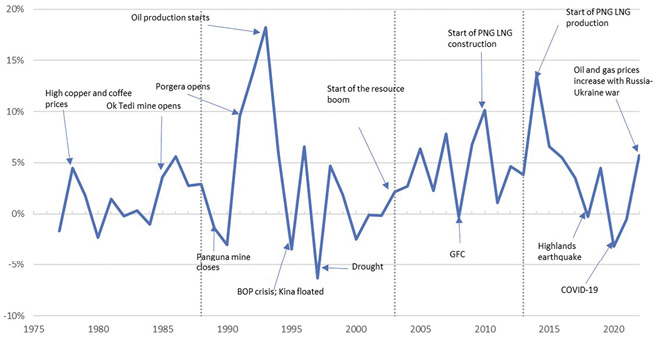
Figure 1.1: GDP growth, 1976–2022 (kina, constant prices)
Source: PNG Economic Database.
Questions around the accuracy of GDP data arise in all economies. In PNG, the National Statistical Office is weak, resulting in periods in which the Department of Treasury has actually been responsible for collecting GDP data. GDP does include an estimate of the value of the subsistence and informal economy, but it is out of date, updated annually by a fixed amount and no doubt wildly inaccurate. We also rely on other data, especially relating to formal sector (private and SOE) employment, which BPNG collects every quarter via a business survey. Most working adults are engaged in agriculture or other informal economic activities. However, there is little information on total employment and none on underemployment.
We rely heavily on analysis of ‘non-resource GDP’—that is, GDP excluding the value-added (output minus intermediate inputs) of the resource (mineral and petroleum) sector. Given the extensive foreign ownership of PNG’s large resource sector, and its enclave, capital-intensive nature, non-resource GDP is the best measure of national PNG economic activity. This measure does not ignore the resource sector; instead, it looks to the contribution it makes to the broader economy via spillover effects, such as through taxation.
Non-resource GDP per person is the basis for our categorisation of PNG’s economic history post-independence into four periods. The variable, plotted below in Figure 1.2 (as the solid blue line), traces the stagnation of the first period, the volatility of the second, the boom of the third and the bust of the fourth.
Figure 1.2 also shows the importance of distinguishing between total and non-resource GDP. Using the former (total GDP), PNG’s boom lasted until the pandemic of 2020. The latter (non-resource GDP) conveys the more accurate picture that the tens were difficult years economically.
Commodity prices are extremely important for understanding PNG’s economic growth. To track them, we construct an index of commodity export prices, shown in Figure 1.3. (Figure B12 shows separate indices for resource and non-resource [agricultural, marine and timber] commodities.) Prices for the commodities PNG exports (measured in US dollars, adjusting for inflation) fell until the early 2000s, but have since increased, and, despite a dip after the boom of the noughties, in 2022 reached a record level due to the war in Ukraine, which pushed up oil and therefore gas prices.
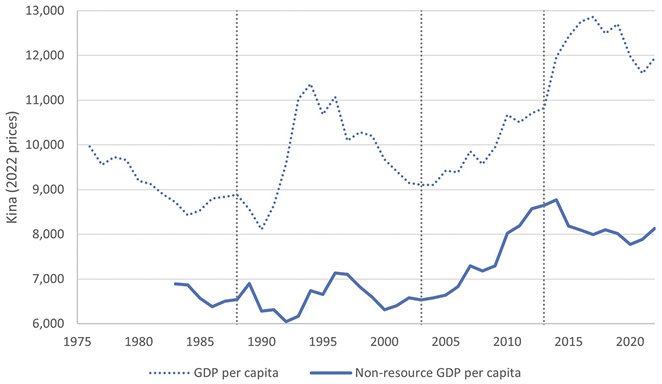
Figure 1.2: GDP and non-resource GDP per person, and the four periods of PNG’s economic history, 1976/1983–2022 (kina, constant prices)
Source: PNG Economic Database. The GDP constant prices series is provided in 2013 prices. It is then rebased to 2022 prices.
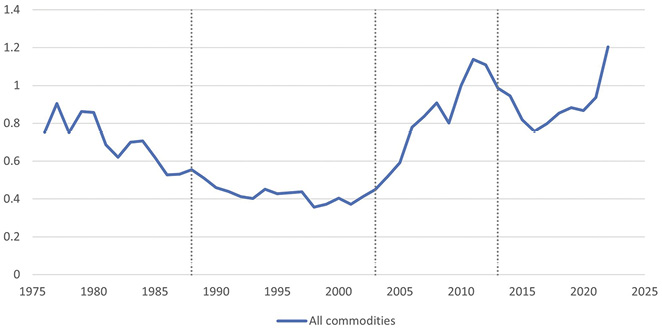
Figure 1.3: PNG commodity export price index (2010 = 1), 1976–2022
Source: See the notes to Figure B12.
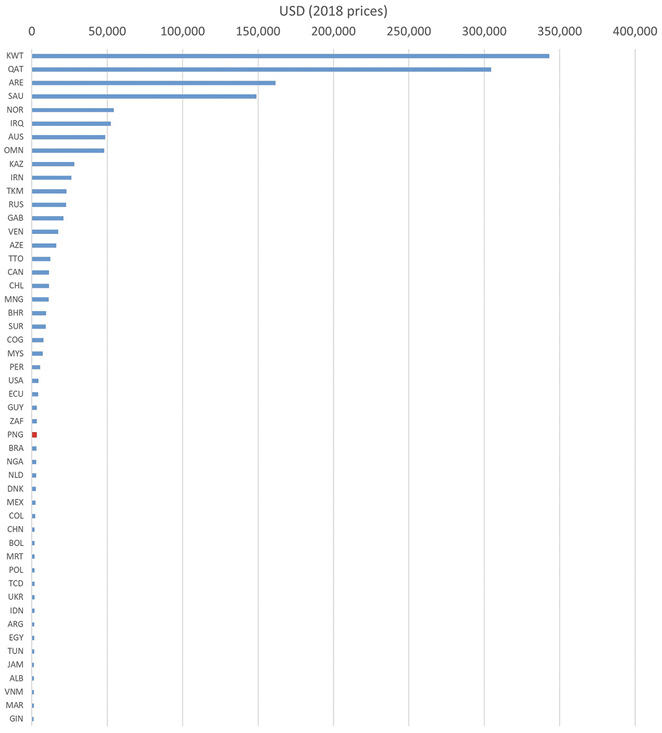
Figure 1.4: Estimated per person subsoil (non-renewable resource) asset value for 2018 in USD, the top 50 countries
Source: World Bank (2021b).
The vast majority of PNG’s commodity exports today are resource exports: gas, oil, gold, copper and nickel. Resource dependency—the share of the resource sector in the total economy—has grown from about 10 per cent in the early eighties to 32 per cent in 2022. When writing about PNG, it is easy to become mesmerised by the resource sector. Each project tells a compelling story, and many continue to believe that new resource projects are essential for progress in PNG. International estimates of resource wealth place PNG in 29th place in per person terms (Figure 1.4). But the country’s resource wealth is a fraction of countries in the Middle East, and of resource-rich developed countries like Norway, Australia and Canada. The estimate for PNG’s per person resource wealth is USD3,045 in 2018, only about 20 per cent more than its GDP that year. For all the attention PNG’s resource sector commands, it is important to keep it in perspective.
A brief summary of each of the four periods follows below to whet the reader’s appetite.
1.3 The seventies and eighties (1975–88)—early struggles
The story of the first 14 years, 1975–88, is told in Part I of the book, in Chapters 2 and 3. PNG came to independence with the ‘hard kina’ policy, which pegged the new PNG currency first against the Australian dollar, and then against a basket of currencies, with the aim of avoiding nominal devaluation. The no-devaluation stance had to be abandoned in the early eighties, but the kina was pegged until 1994.
The hard kina policy was introduced to promote confidence in a new currency, to provide a macroeconomic anchor and to constrain deficit financing. In these regards, the policy was a success: most of this period was characterised by low deficits and moderate inflation.
Behind this solid macroeconomic performance, however, lurked a number of disturbing developments. First, PNG emerged as a high-cost economy, in part because of a doubling of urban real wages between 1972 and 1975, something quite contrary to the emphasis at the time on equity and rural development. Second, defying the optimistic expectations at independence, economic growth was slow, cruelled by those high costs as well as heavy regulation and falling Australian aid and commodity prices. Slow growth was bad for the welfare of ordinary Papua New Guineans, made macroeconomic restraint a less tenable proposition going forward, and worsened law and order. However, there was little by way of economic reform over this period, with the exception of the deregulation of the financial sector. Third, though foreign exchange reserves did not run out until 1994, they fell over the seventies and eighties relative to imports, making a pegged kina policy more difficult to sustain.
Fourth, a distinctively Papua New Guinean political culture began to assert itself, one that was conducive to the stability of the country’s adopted Westminster political regime but not to development. Elections continued to be regularly held, but a political culture of clientelism and precarity became entrenched, with MPs elected on the basis of local issues and a high rate of turnover of MPs every election. More and more were attracted to politics, and, as the business interests of politicians grew, no distinction developed between the political and the business class. As parties weakened, politics became increasingly attractive, but as an arena for never-ending power contestation rather than for competing policies.
Fifth, corruption and law and order both emerged as serious problems. Sixth, government effectiveness weakened and service delivery standards started to decline. Seventh, PNG embarked on a program of radical decentralisation to its (then) 20 provinces. Whether or not this was a good idea, it proved to be unsustainable. A quasi-federal system with elected provincial MPs and premiers lasted until the nineties, but not beyond. The lack of an agreed, stable basis for sub-national governance in PNG remains to this day and handicaps the country’s efforts to deliver services and provide infrastructure.
In summary, Papua New Guinea’s first 14 years passed without major economic crisis. That itself must count as success. But the negative legacy of this foundational period was its subterranean trends.
1.4 The nineties (1989–2003)—volatility, crisis and reform
The second period, from 1989 to 2003, covered in Part II of the book, in Chapters 4 and 5, is the most action-packed of the four. Indeed, the nineties can appear bewildering in its quick succession of booms and busts, economic and political crises, prime ministers (six in all), and repeating episodes of reform and mismanagement. Three of the four times that PNG has turned to the IMF occurred in this period. So too did the country’s only insurgency.
Late 1988 marks the start of the Bougainville crisis—the violent uprising on the north-eastern island of Bougainville that permanently shut down the nation’s largest mine and revenue earner, and that led to a decade-long civil war.
The closing of the Bougainville copper mine was only the first of several shocks—negative and positive—to hit the PNG economy over the decade. Others include the withdrawal of Australian budget support over the course of the decade; new mineral and petroleum projects (causing GDP to grow in 1993 by 18 per cent—a record that has never since been matched); a drought and the East Asia crisis in 1997 (leading to GDP growth of –6 per cent, another record); and further falls in commodity prices.
Macroeconomic stability gave way over the nineties to extreme instability: inflation was regularly in double digits, the currency lost three-quarters of its value and twice the country ran out of foreign exchange. This is often blamed on fiscal indiscipline. However, while deficits were too high in some years, they were, on average, no higher than in the previous period. Other problems included the growing tendency to finance deficits domestically (including through the central bank) and a reduction in foreign aid, both of which made it harder to find the dollars needed to finance imports. The low level of foreign exchange going into the nineties reduced the margin for error. Monetary policy became less effective. A decline in confidence, on account of political instability and misbehaviour as well as the emergence of high inflation and depreciation, did not help either.
It is not surprising that the nineties is typically remembered as a decade of chaos and failure. Instability increased, corruption intensified and service delivery worsened.
Yet this period was also one of important reforms, many of them of the liberalisation-deregulation sort that were then popular worldwide as per the Washington Consensus. The country’s high minimum wage was abolished, prices and foreign investment were deregulated, the currency was floated, superannuation was restructured, the central bank was made independent, a program of tariff reduction was put in place, a value-added tax was introduced and decentralisation was overhauled. The nineties are such a dizzying period that they are difficult to generalise from, but if we were to take one lesson from that decade it would be that crisis and reform in PNG, as in many other countries, go together.
PNG transitioned in 1999 from a prime minister widely regarded as the worst economic manager in its history, Bill Skate, to one heralded as the best, Mekere Morauta. Despite the ability this demonstrated for self-correction, the Morauta government, though magnificent in reform, was unable to restore business confidence, and the overriding sentiment in the early 2000s was one of deep pessimism. In 2003, academic Henry Okole (2003, 62) wrote that PNG was in an ‘abyss of despair’ and that ‘everything resembles a shattered dream’.
1.5 The noughties (2004–13)—the boom
And then, around 2004, quite unexpectedly, everything changed. The economy started to grow again, and political stability returned. No doubt some of the earlier reform efforts did yield a growth dividend, but the most important cause of the unexpected take-off was the global commodity boom. Resource prices, which had fallen over the eighties and nineties, started increasing in 2003 and pushed PNG’s commodity price index to above levels last seen at independence (Figure 1.3). Record levels of revenue flowed into the PNG budget from a number of ‘revenue-ready’ resource projects (projects that yield high revenue for government when prices are high). This underpinned a massive expansion of economic activity and caused the kina at last to strengthen. The economy was further stimulated by deficit spending starting in 2009, and by the construction between 2010 and 2013 of the country’s biggest (by far) resource project yet, the PNG LNG project.
The boom, covered in Part III, in Chapters 6 and 7, generated a new optimism that now, at last, things were changing for the better. The return of macroeconomic and political stability helped. Inflation fell as the kina appreciated. On the political front, the country’s first prime minister Michael Somare returned to that position after an absence of almost 20 years and stayed in it from 2002 to 2011, forced out only by a long period of ill health. Peter O’Neill took over in controversial circumstances but stayed as prime minister until 2019, making him the country’s second-longest serving prime minister.
Unfortunately, the boom was mismanaged. In response to the acute fiscal stress of the nineties, the Morauta government had abolished the Mineral Resources Stabilisation Fund. This meant that there was no vehicle to save the large volume of resource revenue that was now flowing into government coffers. Temporary trust funds were established, but only for short-term savings, and by the end of the boom most of the amount saved earlier in the period had been spent, and, indeed, the government had started to borrow. PNG ran its largest deficits to date in 2013 and 2014 on the back of expectations that the good times were only just starting, with PNG LNG due to start operations in 2014. Earlier reform efforts, such as privatisation, were put on the backburner. Efforts to improve law and order and crack down on corruption were made but not sustained. There were huge increases in the funds given to MPs, and much spending was simply wasted.
The fall in oil prices in 2014, together with the ending of PNG LNG construction the year before, ended PNG’s longest boom. This was a period that showed that sustained, broad-based growth is possible in PNG, but also that the conditions for it—some combination of high commodity prices, revenue-ready projects and the construction of large resource projects—are demanding and have been in place for less than a quarter of the post-independence period.
1.6 The tens (2014–22)—the quiet bust
From 2014 to 2022, the period analysed in Part IV of the book, in Chapters 8 and 9, PNG experienced slow growth once again, with non-resource GDP growth not keeping up with population growth. GDP growth, of course, benefited from the massive PNG LNG project, which now makes up almost half of the country’s exports. But most of the revenue from that project has gone offshore.
The most obvious causes for the bust were the completion of the PNG LNG project, an absence of new resource projects and a massive shrinking of resource sector revenue, but the downturn was also accentuated by poor economic policy, particularly on the exchange rate front.
The O’Neill government was determined to avoid a crisis, and, in particular, not to have to turn to the IMF, as PNG had so frequently in the nineties. Facing acute fiscal stress, the government borrowed heavily (including, once again, from the central bank), cut expenditure and ran up arrears. At the same time, the Bank of Papua New Guinea, which had been given responsibility for the exchange rate in the reforms of the 2000s, ended the floating of the kina in 2014 to stem a rapid depreciation that had commenced with the conclusion of PNG LNG construction, declining resource revenues and excessive domestic borrowing. Since then, nominal depreciation has been constrained to the extent that, by 2022, the real exchange rate had recovered to above its end-of-boom high. To minimise the need for devaluation, BPNG discontinued the practice of current account convertibility and started rationing foreign exchange. From 2014 onwards, PNG businesses have listed foreign exchange shortages as one of their most important problems, frequently the most important.
High fiscal deficits have continued; however, now that foreign exchange rationing has been introduced, politicians no longer need to worry that too high a deficit will lead to a balance of payments crisis. The stability that PNG’s economic managers have engineered has undermined both economic growth and support for reform.
To his credit, O’Neill’s successor, James Marape, who came to power in 2019, called in the IMF to help with fiscal and exchange rate reform, but the reform program is timid, as it has to be absent any sense of a crisis.
There has also been a turn back towards nationalism and state-led development. This started under O’Neill and was intensified by Marape, whose chief slogan is ‘Take back PNG’. The shift away from the Washington Consensus reforms of the nineties is manifest both in the push to have national champions in the resource sector and in increases in tariffs. The shift, while real, has been tempered by pragmatism. A number of more radical policies, such as one to expand greatly the number of sectors reserved for national businesses, have been floated or even adopted but not implemented.
PNG’s economy was hit by the negative shock of the global pandemic in 2020. However, in 2022, commodity prices hit a record high, and government resource revenue and economic growth both increased, ending the quiet bust. At the time of writing, foreign exchange rationing continues, and business leaders still speak of a lack of confidence. The PNG economy is out of the bust, but not out of the woods.
1.7 Conclusion
The early struggles of the seventies and eighties, the volatility, crises and reforms of the nineties, the booming noughties and the quiet bust of the tens make PNG’s economic history extremely interesting to research, and, we hope, to read. The next four parts, comprising eight chapters, tell that story. The three concluding chapters in Part V contrast, compare and synthesise performance over the four periods (Chapter 10), and link PNG’s post-independence economic performance to its policy settings (Chapter 11) and institutions (Chapter 12).
As Chapter 10 notes, of the four periods, the third and fourth are opposites in terms of economic performance: the noughties were the best of times and the tens the worst. The first and second periods are opposites with respect to volatility: the eighties were PNG’s most stable period, the nineties the most volatile. The fourth is the most unusual in terms of macroeconomic outcomes, with its sustained fiscal deficits, huge current account surplus and collapse in imports, all in part due to it being the only period of currency non-convertibility.
While each period is distinctive, overall PNG’s post-independence development record has been disappointing. John Connell’s (1997, 317) conclusion two decades ago that ‘neither consistent growth nor sustainable development have been achieved’ since independence remains valid today. The last two periods have seen a slightly better performance than the first two; however, for the entire post-independence period, the growth rate of non-resource GDP per person has only averaged 0.4 per cent per year, and formal sector employment only 1.5 per cent, well below the population growth rate. PNG’s growth performance is not the worst in the world, but it is certainly well below average. Non-income indicators are alarmingly low by international standards and, in some cases, have worsened: In recent years, PNG has had the lowest rate of immunisation, the fourth-highest rate of child stunting and risk of premature death from non-communicable disease, and the seventh-lowest doctor–population ratio in the world.
Chapter 11 argues that managing the PNG economy is an intrinsically difficult task. A small, open, resource-dependent economy, it is prone to numerous shocks. It is also highly monopolistic, so liberalising policies may not increase welfare. For example, the liberalisation of interest rates in the eighties has led to exorbitant spreads. Even sensible policies have risks. Currency non-convertibility is very damaging for growth and encourages fiscal profligacy, but reintroducing convertibility may lead to a balance of payments crisis as it did, twice, in the nineties. Economic reforms may have a limited return because other constraints are binding and cannot be removed, such as insecurity. The current emphasis on economic stability means that reforms are less likely. And there is a lack of consensus around what reforms are appropriate, with a loss of support for Washington Consensus reforms, and more backing for nationalistic policies.
There are thus many difficulties for any would-be Papua New Guinean reformer. Nevertheless, reform is needed. Chapter 11 argues that the key current priority for macroeconomic reform is a permanent end to foreign exchange rationing. On the microeconomic front, policies that promote competition and market entry should be encouraged, but regulatory approaches, while inherently risky, may be needed where competition is weak. The informal economy is PNG’s key strength. It has benefited, and will continue to benefit, from a policy of benign neglect.
While the resource sector has grown at a decent rate, especially compared to the rest of the economy—leading to increasing resource dependency—the return from large resource projects has undoubtedly been disappointing. Resource sector policy has been subject to frequent and radical change over the post-independence period, but the reasons for the sector’s disappointing revenue performance need to be determined to guide future reforms in the sector.
Land reforms are regarded by some as PNG’s top challenge. Though there is a lack of consensus about which reforms should be pursued, none of the ones tried so far have worked, and insecurity of land title remains an important constraint on development. This is a case in which governance has trumped policy: until land administration improves, PNG’s land markets will remain overwhelmingly informal.
Finally, Chapter 11 argues for a return to the emphasis on equality present at independence, including gender equality, with a special emphasis on improving appalling vaccination and nutrition outcomes.
Reforms are needed for faster growth and better development outcomes. Whether or not they will be undertaken depends on deeper institutional factors, which are the subject of Chapter 12. It emphasises what it calls a pattern of ‘hyper-politics’: hyper or very local, popular and insecure politics, with weak parties, a constant contestation for power, and no clear distinction between the political and the business class. Hyper-politics has been conducive to political regime stability, but has not otherwise been supportive of development. The chapter also draws attention to PNG’s weak state, high levels of litigiousness and corruption, unsettled framework for decentralisation, and widespread insecurity, with both high crime rates and weak property rights. Business surveys suggest that, in general, these factors are as or more important as constraints to growth than any of the various policy deficiencies diagnosed in Chapter 11, several of which they help explain.
The idea that explanations for economic growth performance should be sought in the sphere of institutions (the ‘rules of the game’) has become accepted wisdom. There are, by now, a whole range of theories that explain economic performance in broadly institutional terms. We find very useful for the PNG case those theories that emphasise the damaging effects of dysfunctional politics on development, as well as the longstanding argument that security is important for development, noting that law and order topped the list of concerns for PNG businesses from 1982 to 2012, and that property rights are often tenuous. We argue on the basis of the evidence accumulated from our historical survey that PNG’s development outcomes can be explained by its hyper-politics and pervasive insecurity, and the feedback effects generated by the weak state and the low growth these two factors cause. Political regime stability provides a positive countervailing force, meaning that the constraints on development in PNG have led, not to collapse, but to a weak-state and low-growth equilibrium.
Simplistic arguments that resource wealth is a curse are not helpful, but it is true that PNG’s growth is not only low, but also increasingly resource dependent, and that, in terms of exports to GDP, PNG is now one of the most resource-dependent economies in the world. The various constraints to broad-based growth are less constraining of big resource projects. While positive as well as negative (Dutch disease) impacts of resource growth are evident in PNG, an increasingly resource-dependent economy is one in which a weak state becomes ever more important as a distributor of economic rents, and perhaps weaker as it is distracted from other policy challenges. It is probably also one that is even more prone to conflict. These feedback loops constitute Papua New Guinea’s institutional resource curse.
The picture painted of a hyper-political, insecurity trap is not an optimistic one, but traps are not for ever. However, we refrain from recommending any political or institutional reforms. Papua New Guinea will have to find its own way forward. Rather, the book concludes with five reflections on what this history has taught us, and what the future might hold.
First, the drop-off in academic writing on PNG’s economy over time is striking and unfortunate. This volume is only a partial corrective. Second, a lot of what we see in PNG is evident in other countries as well, especially in Africa. The book draws on these comparisons, but more international comparative work is needed to better understand the PNG economy. Third, development in PNG is much more difficult than it was at independence. That the optimism at independence was unfounded should make us sceptical about new aspirational statements, such as the goal of Vision 2050, published in 2009, to place PNG among the 50 countries with highest Human Development Index by 2050. Development challenges in PNG have intensified since independence. Optimism and hope are important, but not helpful if disconnected from reality.
Fourth, the prophets of collapse have also not seen their predictions vindicated. Many things have got worse, and there are certainly serious risks, but, so far, the pessimism of the doomsday merchants has been as misplaced as the optimism of PNG’s boosters. Fifth, in assessing the country’s prospects, too much weight is still given to the country’s resource potential. The growth of PNG’s resource sector has been quite respectable, yet overall economic growth has been slow. PNG’s longer-term outlook depends not on its subsoil assets but on the quality of its policies and, above all, its institutions.
Beyond this, divining what the future holds for PNG we leave for others. The nation is young and has embarked on a long journey. Whatever happens, the next five decades in Papua New Guinea’s post-independence economic history will surely be as interesting and as difficult to predict as the first five.
1 The provinces of Southern Highlands and Western Highlands were split into two in 2012 and the new provinces of Hela and Jiwaka, respectively, were created.
2 The book’s foreword indicates that it was written by Guy Kause and Jacob Weiss. However, the official author is the Bank of Papua New Guinea.
3 Including AIDAB (1990, 1991, 1992, 1993, 1994), Duncan, Warner and Temu (1995) and AusAID (1995, 1996, 1997, 1998, 2000).
4 An alternative method is to use CPI to deflate GDP. The issues involved in this choice and the implications are discussed in Howes, Fox et al. (2022).
Previous Next



