


 menu
Struggle, Reform, Boom and Bust
4
A decade of volatility
Prime Minister Sir Julius Chan stated in his Christmas address that 1994 was the most turbulent, painful and unpredictable of the nation’s nineteen years of independence. Most who witnessed the sudden change of government in August, the volcanic destruction of Rabaul in September, the dramatic collapse of peace talks on war-weary Bougainville in October, the ominous confrontations over provincial government reform, the confusion surrounding the giant Lihir gold project, and the multi-billion-kina environmental lawsuit against the operators of the Ok Tedi mine would agree. Affecting all of these issues and events was an unprecedented financial crisis, whose impact will be felt for some time. (Wesley-Smith 1995, 364)
4.1 Introduction
Our second period, 1989–2003, the nineties for short, was highly volatile. It began with the closure of PNG’s biggest mine, Panguna in Bougainville, due to civil strife, and was punctuated by the opening of other resource projects, by natural disasters and by poor economic management: the country twice ran out of foreign exchange reserves. The period contains the year with PNG’s highest economic growth rate (1993, 18 per cent) and with its lowest (1997, –6 per cent).
On average though, economic growth during the nineties, as in the eighties, was slow and, worse than the eighties, there was no expansion of formal sector employment opportunities outside of the government. The late 1990s and early 2000s was a particularly bad period for the economy.
If PNG’s politics gained its distinctive form in the eighties, in the nineties the financial sector took on its current form, one that was no more supportive of development, with the emergence of high spreads and profits, and a growing reliance on lending to government rather than the private sector.
Governance and service delivery worsened. Ross Garnaut (2000, 34) writes that the nineties were characterised by a ‘radical decline in the quality of government services, and grotesque corruption in public life’. And yet this was also PNG’s most reform-minded period, with three distinct reform programs, at the start, the middle and the end of the decade, supporting a mix of important homegrown and externally imposed policy and institutional changes.
Was the nineties, then, a decade of reform or one of decline? Our answer is both. The nineties was such a roller-coaster of a decade that it is useful to begin with a summary narrative. Subsequent sections examine this period’s growth record and macroeconomic policies and performance. The next chapter covers economic reforms, politics and governance.
4.2 A brief chronology
Between 1989 and 2003, the period covered by this and the next chapter, PNG had no fewer than six prime ministers.1 Rabbie Namaliu was elected prime minister after a vote of no confidence ended the government of Paias Wingti in 1988, just one year after the latter’s election by parliament following the 1987 general elections. After the closure of Panguna, the Bougainville copper mine—so important for government and export revenue—in May 1989, Namaliu’s government devalued the currency by 10 per cent in January 1990; negotiated with the International Monetary Fund (IMF) and the World Bank for financial support in the same year; and abolished the urban minimum wage in 1992, a reform that was earlier unthinkable, and that effectively deregulated the formal labour market.
The Bougainville crisis was to last right through the nineties, and, indeed, though peace was restored by the late nineties, the province’s political future is still unresolved. However, the economic crisis induced by Panguna’s closure was remarkably short lived as its dominant role in the economy was quickly replaced by new mines and oil projects. GDP growth went from marginally negative in 1989 and 1990 to double-digit positive in the next three years.
Paias Wingti became prime minister again after the 1992 elections. Anticipating a boom, he loosened fiscal policy and ignored the fact that foreign exchange reserves were low and falling. By mid-1994, reserves were at crisis levels, covering only two weeks of imports.
While the economic crisis was deepening, there was also, at the same time, and by complete coincidence, a change in government. In September 1993, to avoid having to face yet another vote of no confidence, Wingti had, cleverly he thought, resigned in secret and got himself re-elected in parliament the next morning, arguing that he should once again be protected by the post-election bar on votes of no confidence, which by then had been increased to 18 months (5.2.1). Opposition members were not impressed, went to the courts, and, in June 1994, just when the country’s balance of payments crisis was at its most serious, Wingti’s re-election was ruled invalid. Julius Chan, who had briefly been prime minister in the early eighties, was elected by his fellow members of parliament to replace the prime minister he had been deputy to.
Chan, who, ironically, had been finance minister to Wingti’s expansionary 1993 and 1994 budgets, now had no choice but to adopt emergency measures. He slashed spending, reversed his earlier tax cuts and implemented a 12 per cent devaluation in September 1994. When that did not turn things around, the next month the architect of PNG’s hard kina policy floated the currency. Chan also entered into negotiations with the World Bank and the IMF. The reform program jointly agreed to the next year was substantial, but also controversial.
In early 1997, politics intervened once more. Chan was consumed that year by controversy over military resistance to, and protests about, his plan to send foreign mercenaries into Bougainville (the so-called Sandline affair). In March, Chan had first to abort that plan and then resign while an inquiry was held. He returned to the position of prime minister in June, but lost both the prime ministership and his own seat at the 1997 elections.
William ‘Bill’ Skate emerged as the new prime minister. Many of his policies were reformist, but his administration was marred by corruption, scandals, instability, poor donor relations and severe financing problems. Drought and the Asian financial crisis in 1997, plunging confidence and extensive domestic (including central bank) deficit financing led to the exchange rate losing 30 per cent of its value in a single year (1998) against the US dollar. In the end, unable to fund his budget, running out of foreign exchange and facing mounting domestic and international criticism, Skate resigned in mid-1999 rather than face certain defeat in a vote of no confidence.
Skate’s departure led to the election as prime minister of Mekere Morauta, one of the ‘gang of four’2 of leading bureaucrats that emerged shortly after independence, and a former secretary of Finance and governor of the Bank of Papua New Guinea. Morauta had only become a member of parliament in 1997 but put himself forward just two years later as the man to rescue PNG at this time of crisis. In the three years before the next elections, he pushed through a comprehensive reform plan, including a third structural adjustment program. While his reforms did a lot of good, economic growth and macroeconomic stability remained elusive.
The 2002 elections ended Morauta’s tenure as prime minister. Indeed, three-quarters of MPs (though not Morauta himself) lost their seat—by far the highest turnover ever seen at an election, and perhaps a sign of the tough economic conditions. Michael Somare, PNG’s first prime minister, became prime minister once again, after a gap of some 17 years. The first sign of the boom that was to follow came the very next year when, for the first time in a decade, the currency gained in value. Then, in 2004, government revenue grew unexpectedly quickly, and PNG’s long boom was underway.
4.3 Economic growth
GDP growth was volatile during the nineties. However, after all the ups and downs, our key indicator of national economic activity, non-resource GDP per person, was no higher at the end than the start of the period, and formal sector employment was stagnant outside of the public service. Resource dependency grew and resource policy changed. There was a response to the depreciation of the real exchange rate in agriculture, but in most sectors growth was low. The banking sector shifted away from private to public sector lending and a large spread in lending and deposit rates materialised.
4.3.1 Volatile growth
Figure 4.1 shows both GDP and non-resource GDP growth rates over this period.
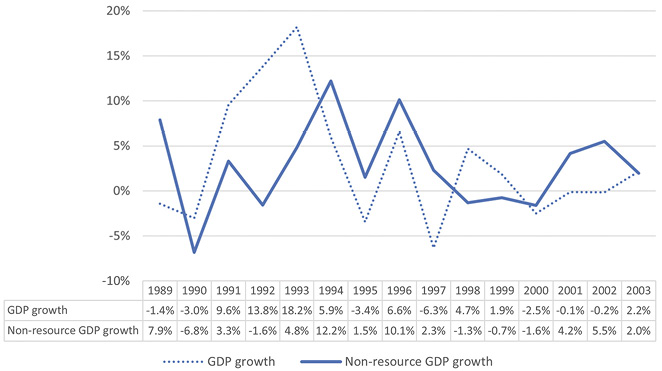
Figure 4.1: GDP and non-resource GDP growth, 1989–2003 (kina, constant prices)
Source: PNG Economic Database.
Commodity prices fluctuated over the course of this period, ending about where they started (Figure B12). Though timber prices boomed in the mid-nineties, the non-resource commodity price index declined by 40 per cent. Gold and copper prices were mainly stable, and oil prices rose over the decade. Commodity prices did better in kina terms due to currency depreciation (Figures B13 and B14).
The closure of the Panguna mine in May 1989 led to resource output falling in that year by 38 per cent, about 8 per cent of GDP. Ironically, resource revenue remained high (as it was the previous year’s profits that were taxed), so government revenue and expenditure did well, and non-resource GDP grew strongly. The next year, 1990, PNG’s sovereign wealth fund, the Mineral Resources Stabilisation Fund (MRSF), provided a partial buffer, but, even so, the government was forced to tighten its belt. Confidence took a hit, bank lending started to fall (Figure B32), and non-resource GDP growth was negative in 1990, barely positive in 1991 and negative again in 1992.
The resource economy quickly rebounded, and, in fact, PNG soon embarked on its biggest boom of the independence era. The small Misima gold mine opened in 1989, followed by the much larger Porgera gold mine the following year. The Kutubu oil fields began production in 1992. The resource sector almost tripled in size (in real terms) between 1988 (before the closure of Panguna) and 1993. GDP, after falling in 1989 and 1990, increased rapidly in the next four years (growing at 10, 14, 18 and 6 per cent in 1991 and the next three years). The 18 per cent growth in 1993 has never been equalled; nor has the 56 per cent growth over the four years. Oil production peaked almost immediately (in 1993), and resource output started to fall in real terms in 1994, though rising oil prices over the decade boosted the value of PNG’s resource exports. The resource economy expanded again in the late nineties, with the opening of the Lihir gold mine (1997) and additional oil fields in the Southern Highlands (1998).
Due to spillover effects from the resource sector, non-resource GDP also grew rapidly over the early nineties, though not by as much and with a lag—by 31 per cent between 1992 and 1996. The most important stimulus was the quadrupling of resource revenue in 1993 (after inflation)—a new post-independence record—just four years after Panguna was closed. Resource revenue stayed at this new high until 1997, after which it declined again with the Asian financial crisis.
The nineties was a decade of natural and economic shocks. A volcanic eruption on 19 September 1994 destroyed the town of Rabaul in East New Britain and displaced 45,000 people (Dinnen 1995a). Heavy rains in 1995 led to the collapse of Umi bridge in Morobe, halting food supply to five Highlands provinces and causing serious flooding in Momase and the Highlands. Drought and frosts in 1997 hurt rural food supply (Allen and Bourke 2001), and drought also took a toll on GDP (which fell by 6 per cent), as it forced the temporary closure of some mines. On 17 July 1998, the Aitape tsunami hit the West Sepik coast, killing upwards of 1,600 people.
The Asian financial crisis of 1997 resulted in a steep reduction in the global demand for commodities, reflected in both volume and prices. Log exports, which had boomed earlier in the decade, fell by more than half between 1997 and 1998 (Figure B8). Non-resource GDP growth was low in 1997, and negative in each of the next three years.
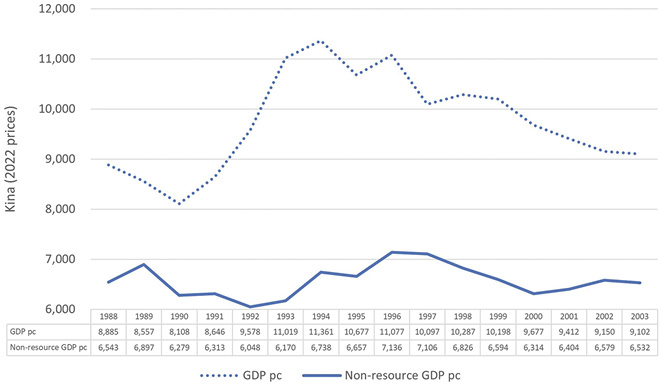
Figure 4.2: GDP and non-resource GDP per person, 1988–2003 (kina, constant prices)
Source: PNG Economic Database.
Non-resource GDP growth only modestly rebounded in the early 2000s. The business community supported Morauta as prime minister, but depreciation and inflation stayed high, and business confidence remained low. Adjusting for inflation, private sector wages fell on average by about 8 per cent per year between 1999 and 2002 (Blunch and Davies 2024).
GDP per person hit its maximum for the period in 1994, and non-resource GDP per person in 1996. Thereafter both declined. Non-resource GDP per person was almost exactly equal in the last year of this period, 2003, to the last of the previous period, 1988, while GDP per person was just 2.4 per cent higher (Figure 4.2).
This picture of economic stagnation is confirmed by the very slow growth in formal sector employment (Figure B16): 169,000 in 1988 and 184,000 in 2003. (These figures exclude the public service, in which growth was faster; see 5.2.2).
Stagnation is not what was expected from the nineties, a decade the country went into with ‘expectations of prosperity coming from gold, oil and natural gas development’ (Oliver 1998, 457). As discussed in the remainder of this chapter and the next, the difficulties of this period are explained by the negative shocks of the decade; the failure of the economic reforms undertaken to stimulate a broad-based, supply-side response; and economic and political mismanagement.
4.3.2 Sectoral developments
The closure of the Panguna mine notwithstanding, PNG became a more resource-dependent economy. Resource dependency exceeded 20 per cent for this first time in the nineties (Figure B3), reaching 24 per cent in 1993 (with the start of oil production) before falling and then rising again to 23 per cent in 2000 (with more oil and gold). On average, resource dependency for the period was 17 per cent, substantially up from the 10 per cent of the eighties (Table 10.3).
PNG more than doubled its gold exports over the nineties, and copper exports were about the same as in the eighties, thanks to Ok Tedi, Porgera and Lihir, and despite the closure of Panguna (Figure B10 and Table C1). Oil production—from the Highlands—peaked in its second year, but remained important over the decade, its share of resource exports falling from one-half in 1993 to 30 per cent a decade later (Figure B11).
Preparations began in the late nineties for two more resource projects: a nickel mine and processing plant in Madang on the northern coast; and a gas project, originally conceived to pipe gas from PNG to Australia. The nickel project commenced production in 2010, and the pipeline project was repositioned in the 2000s as a liquified natural gas project, and became the PNG LNG project, which started production in 2014 (6.2.2).
There were major shifts in resource sector policy, formalised through the Mining Act of 1992, the Petroleum Act of 1992 and the Oil and Gas Act of 1998. The main thrust of these legislative changes was to take the national government away from its policy of maximising its revenue take (2.2.3) towards one more focused on landowners and provincial governments—hardly a surprising move given that landowners had closed the Panguna mine, and that Bougainville was now engulfed in a civil war.3 The key reform was the Development Forum, first applied to Porgera. This innovation of the Namaliu government was actually in train before violence erupted at Panguna. At these fora, the national government is obliged to gain consent from (and therefore make concessions to) landowners and provincial governments before the grant of a license to a developer.
There were other changes as well over the course of the nineties reflecting the increased power of landowners, now described as PNG’s ‘most powerful pressure group’ (Saffu 1998f, 486). Formal procedures were laid down for how affected landowners were to be identified. Royalties were increased from 1.25 to 2 per cent of the value of output, creditable against corporate tax payments (Davis 1995). The share of royalties to go to landowners was increased, with the exact amounts to be determined by the relevant Development Forum. The share given to Porgera landowners was increased from 23 per cent at mine opening to 50 per cent in 1995 (Johnson 2012). A 2 per cent development levy was introduced for petroleum projects, to go to local and provincial governments. Landowners (and, for mining projects, provincial governments) were to be entitled to a minor equity share (about 2 per cent), to be gifted to them by the central government—a world first (Johnson 2012, 61). 4 The central government was now also expected to make infrastructure and business development grants to landowners and provincial governments. Landowners were also to be given preferential access to employment and related business opportunities. A tax credit system was introduced in the early nineties allowing developers to make local investments (the amount has ranged between 0.75 and 2 per cent of assessable income) in lieu of corporate tax payments. The Mineral Resources Development Corporation, which had originally been established in 1981 to hold the state’s share in resource projects, became responsible for holding in trust the equity held by landowners and provincial governments, and by that means has become over time a major investor in the PNG economy.5
By the end of what had been a turbulent decade, there was a sense that the frequently changing but generally more burdensome tax arrangements now in place had deterred new investment in the resource sector. As part of the reforms of the early 2000s (5.1.3), and following extensive analysis (an official tax review chaired by a former tax commissioner Nagora Bogan and an Asian Development Bank review specifically of resource taxation), the corporate tax rate for mining projects was reduced from 35 to 30 per cent, and for petroleum projects from 50 to 45 per cent for oil and 30 per cent for gas (Department of Mining 2003; Department of Petroleum and Energy 2005). The dividend withholding tax (only for mining projects) was reduced from 15 to 10 per cent, and the resource rents tax, the centrepiece of the government’s tax regime at independence, was abolished.6 A mining levy was introduced in 1999 to counter the windfall the industry had received due to the reduction of import duties as part of a tariff reform program (5.1.3), but this was largely phased out over the 2000s. The period in which losses could be carried forward was increased from seven to 20 years (Banks 2001, 37). A legislative commitment (through the Fiscal Stabilisation Act 2000) was made to not increase tax rates on projects after start up in return for companies agreeing to slightly higher tax rates—a far cry from the first Panguna agreement that authorised reviews every seven years (2.2.3).
Another focus for the decade was equity ownership. Prime Minister Paias Wingti was an early resource nationalist, and an early proponent of the idea that PNG was not benefitting enough from its big resource projects. The government had initially taken a 10 per cent stake in the Porgera gold project (with half of that for the provincial government and landowners), but Wingti, on becoming prime minister in 1992, demanded an increase to 30 per cent, and achieved 25 per cent, with the funds to be provided out of initial dividends. Around the same time, the government also took a share in the Lihir mine of 20 per cent, and increased its share in Ok Tedi from 20 to 30 per cent. These decisions were controversial at the time, but of little lasting consequence. Most resource stakes were sold over the course of the nineties through the sale of the state-owned Orogen company (5.1.3). There was also a push for the pipeline needed to bring oil from PNG’s new oil fields in the Highlands to the coast to be built and owned by a national consortium, but that was unsuccessful and the pipeline remained with the project developer (Brunton 1992).
The Fisheries Management Act was passed in 1994, and a 1995 domestication policy provided incentives for firms to set up tuna canneries. Two were established during this period—the first in Madang in 1994 and the second at Wewak in 2003—and the export of marine products grew rapidly (Figure B8). ‘Fisheries exports from the late 1970s to 1995 averaged 10 million kina annually. By 2002–3, exports reached 350 million kina, with direct employment growing from about 450 to around 6,000’ (Morauta 2005, 161).
The period was relatively good for agriculture, the share of which in non-resource GDP rose from about 20 per cent to about 30 per cent over the decade. Most traditional cash crops did not do well, but logging and palm oil saw strong growth, especially the latter. Agricultural production, including fresh food produce, was positively affected by exchange rate depreciation (BPNG 2007; McKillop, Bourke and Kambori 2009; Conroy 2023). Bourke (2005a, 7) noted that:
Villagers have responded [to exchange rate depreciation] by producing more food for sale in local and distant markets. Consequently the volume of locally grown food traded within PNG has increased rapidly, particularly since 1998. Fresh food generates significant income for rural villagers; in the mid 1990s it was second in value only to Arabica coffee and worth more than cocoa, betel nut, copra, oil palm and fish.
Manufacturing stagnated at 4 per cent of non-resource GDP. One might have hoped that it would benefit from depreciation as well as labour market deregulation (5.1.1), but the output response to the reforms of the nineties was constrained by growing crime and worsening infrastructure, not to mention a general lack of confidence.
4.3.3 The financial sector
The poor growth performance over the nineties is reflected in declining bank lending to the private sector. The ratio to GDP of loans outstanding to the private sector rose over the eighties but fell over the nineties. On the one hand, banks adopted ‘more cautious lending practices following the large losses incurred as a result of the uprising in North Solomons [Bougainville]’ (BPNG 2007, 137). On the other, loans to government seemed much less risky, and the government’s appetite for domestic borrowing grew. Lending to the private sector plummeted from 18 per cent of GDP in 1989 to only 7 per cent in 2003, while lending to the government increased from 2 to 6 per cent of GDP over the same period (Figure B32).
Interest rates on loans remained high after financial sector deregulation (3.1.2), but deposit rates fell from above 10 per cent to below 5 per cent by the end of the period, and have since fallen to close to zero (Figure B34). The spread between lending and deposit rates increased from around 2 percentage points to above 5 and then 10 by the end of the period, falling slightly to about 8 in 2022 (8.2.2). Related to this, PNG’s banks became much more profitable over the nineties (BPNG 2007, 196), and are now among the most profitable in the world (Jamaludin, Klyuev and Serechetapongse 2015).
Once they had the freedom to do so, banks reduced the rates they paid to savers on deposits for two reasons. First, limited competition in the sector meant that there was little incentive for banks to offer higher rates to savers or lower rates to borrowers. PNG is not an easy place to operate in, and, despite high profits, the number of banks fell over the nineties. Niugini-Lloyds exited in 1990 and Indosuez was bought by the Bank of Hawaii, which exited in 2001. By the end of this period, only four commercial banks were operating: ANZ; Westpac; Bank of the South Pacific, which bought the government-owned Papua New Guinea Banking Corporation in 2002 (5.1.3); and Maybank Malaysia, which entered in 1994 (BPNG 2007, 191). Second, because lending fell, there emerged over the decade an excess of deposits, which the banks ended up parking, unremunerated, with the central bank (Figure B36 and Section 4.4.4). Since banks were unable to get a return on the marginal deposit, they reduced their deposit rates.
There was a reduction not only in the number of banks over the nineties but also in their presence around the country (Figure B37). The number of branches increased slightly, but the number of banking agents plummeted from 400 in the mid-eighties to just 100 by the mid-nineties, ‘primarily because of insufficient business, though, in some cases, security concerns and misappropriation were cited as the reasons for closure’ (BPNG, 2007, 193).
The Port Moresby Stock Exchange (now PNGX Markets Limited) was opened in 1999. Only a handful of companies have ever been listed (at the time of writing 12, with only three added since 2009) and liquidity is extremely low.
The decline in lending and the growth in the interest rate spread were a frustration to politicians in the nineties. Julius Chan, finance minister in the early nineties, leaned on banks to reduce their interest rates and lend more, and threatened them with re-regulation (Callick 1993). He also pressured BPNG to reduce its policy rates. Bank Governor (and former finance secretary) Mekere Morauta publicly resisted this and was highly critical of Chan’s expansionary 1993 and 1994 budgets, leading to pressure on Wingti to sack Chan, which he did (the two were not on good terms in any case). Chan briefly became foreign minister before coming back as prime minister after Wingti was disqualified by the courts. He then removed Morauta from the position of central bank governor (Vatsikopoulous 1995).
4.4 The macroeconomy
This section examines the causes of macroeconomic instability in the nineties, arguing that it cannot only be blamed on high deficits. It then covers the floating of the exchange rate, the most important change in economic policy since independence; fiscal policy; and the emergence of excess liquidity, which has become a permanent feature of the PNG economy.
4.4.1 Macroeconomic instability
The nineties were characterised by high inflation and rapid currency depreciation. The average annual rate of depreciation against the US dollar was 9.3 per cent, compared to just 0.3 per cent in the previous period. The kina lost 17 per cent of its value in 1994, 30 per cent in 1998 and 18 per cent in 2001. There is a strong link in PNG from depreciation to inflation (Sampson et al. 2006). Inflation averaged 9.6 per cent, up from 6.4 per cent in the previous period, and was in double digits for seven of the 15 years in this period.
There were two occasions, one in 1994 and one that stretched across 1998 and 1999, when the country virtually ran out of foreign exchange.7 Domestic interest rates spiked during these crises, reflecting both government desperation and a collapse in confidence: the average lending rate increased from 10 per cent in 1994 to 15.4 per cent in 1995 and then from 10.6 per cent in 1997 to a stunning 20.2 per cent in 1998 (Figure B34).
Why did an economy that had been so stable become so crisis prone? There are, in fact, seven reasons. ‘Lost fiscal discipline’ (Chowdhury 2018, 162) is the cause normally mentioned, and certainly there were some high deficits in this period, especially in 1992 and 1993, the result of the expectations of good times to come that built up with the two new gold mines and the commencement of oil exports. In 1990, a boom that would bring a ‘massive injection of revenue’ (Dorney 1991, 115–16) was predicted. The 1993 budget, in particular, was presented as something different: ‘a revolutionary and aggressive approach’ and ‘a fundamental departure from traditional fiscal policies pursued in the past’, designed to address PNG’s slow growth (Department of Treasury 1992, 18–19). Taxes were cut in the 1993 budget and expenditure increased in both years (by 23 per cent after inflation over the two years). Mekere Morauta, PNG’s first finance secretary and then its central bank governor, described the budgets of these years as ‘the most disastrous and most inappropriate budgets since independence’ (Vatsikopoulous 1995).
However, the deficits of the nineties were not in fact particularly large relative to the stable eighties that had preceded it (Figure B27). The average deficit for the two periods is the same (Table 10.10), and the maximum deficits of 3.6 and 4.0 per cent in 1992 and 1993 are indistinguishable from the maximum deficits of the eighties (3.9 and 4.1 per cent in 1981 and 1982). Indeed, large deficits were impossible to sustain because they manifested themselves in a loss of reserves or a depreciation that required a prompt correction. Temporary, large deficits at the wrong time are part, but by no means the whole part, of the story of how the nineties became crisis prone.
Importantly, there was also a change in how those deficits were financed, with a switch from international to domestic financing. In 1976, 75 per cent of the government’s debt stock was foreign; the ratio was the same in 1989. However, by 1996, this ratio had fallen to 48 per cent. Commercial bank holdings of government debt increased rapidly, from PGK107 million in 1989 to PGK1.1 billion in 1996. The central bank also engaged in extensive and unprecedented deficit financing during this period, especially during the mid-nineties (Figure B35). The Central Banking Act as it then stood allowed limited deficit financing, but the limits were ignored.
There is a high propensity in PNG for government expenditure to be spent on imports. If that spending is financed by foreign borrowing, then the additional foreign exchange can be used to finance the additional imports. However, if that spending is financed by domestic sources, there is a mismatch, and it is more likely that any deficit would put pressure on foreign exchange reserves and/or the exchange rate.
This reliance on domestic financing was also responsible for the tendency for interest rates to spike over this period in crisis periods. This tendency appears at odds with the emergence of excess liquidity (4.4.4), but the small number of banks meant that the government debt market was not competitive. Banks knew when the government was desperate to borrow from them and priced their lending accordingly. Of course, inflation was very high during this period as well, often well in excess of 10 per cent, and this pushed up interest rates too.
Third, changes in aid made things worse. The reduction in aid—from 32 per cent of revenue in the eighties to 18 per cent in the nineties (Table 10.10)—meant not only less revenue, but also less foreign exchange to fund the high import content of government spending. The increased tying of aid to specific projects (4.4.3), and therefore purchases, also meant that aid was increasingly unavailable to boost foreign exchange reserves.
Fourth, there was less margin for error. The import cover provided by foreign exchange reserves had fallen over the eighties (2.3.3). This increased the risk that the next spending spree, or simply miscalculation, would lead to a balance of payments crisis. In the nineties, even during the resource-driven, high-growth years, foreign exchange reserves never provided more than three months of import cover and often less than two (Figure B22).
Fifth, monetary policy, the other instrument to influence aggregate demand, became ineffective (as explained in 4.4.4). Not surprisingly, with one less instrument at its disposal, the chances of a balance of payments crisis increased.
With the points made so far, it is interesting in hindsight to go back to the late seventies and early eighties. PNG’s fiscal position began to deteriorate in 1979.8 The counterpart of this was a reduction in foreign exchange reserves between 1979 and 1981 from five to three months of imports. The government response was to control expenditure and to restrain private sector credit (ToRobert 1982). With a bigger buffer to begin with, an increase in interest rates to reduce private sector demand (BPNG 2007, 125) and corrective fiscal measures, a balance of payments crisis was averted. From this perspective, it is hardly surprising that a decade later, with a much smaller buffer to begin with and without effective monetary policy instruments to deploy, an ill-timed kina-based fiscal expansion would have exhausted the country’s foreign exchange reserves.
Sixth, especially towards the end of the decade, political instability and erratic behaviour (and misbehaviour) eroded confidence. This is an especially important explanation for the second crisis that occurred when Bill Skate was prime minister.
Seventh, and completing our list of explanatory factors, in the context of an anticipated boom and expected currency appreciation (Booth 1995), the government worsened the situation for itself by relaxing foreign exchange controls in the early nineties. The central bank increased ‘the authority of authorised foreign exchange dealers (the commercial banks) to grant foreign exchange approvals’ (BPNG 2007, 132) and access ‘by residents and non-residents to offshore accounts’ (245). Low levels of confidence meant that, once a crisis hit, those who had dollars were reluctant to hand them over, and those who did not tried hard to get them.
4.4.2 Exchange rate policy and the balance of payments
In response to the closure of the Panguna mine, the government devalued the kina by 10 per cent in January 1990. Although there had been gradual real depreciation over the eighties (2.3.3), this was a much more explicit rejection of the hard kina ‘no depreciation’ policy.
It was not enough. By mid-1994, foreign reserves had been exhausted. There was another 12 per cent devaluation on 11 September 1994. But reserves continued to fall. The government temporarily suspended kina convertibility, and, the next month, on 4 October, Julius Chan, who, as finance minister, had introduced PNG’s hard kina policy, now, as prime minister, floated the currency.
The exchange rate regime that prevailed from late 1994 was a managed rather than a pure float. The central bank became the biggest player in the new foreign exchange market, and its decisions on how much foreign exchange to release into that market were crucial (King and Sugden 1997, 24). Nevertheless, the float was a massive reform, rightly labelled by Chan at the time as ‘the most important economic decision … since independence’ (cited in Chan 2010, 221). The next big change in exchange rate policy would not come until 2014 (8.3.1).
In 1989, one kina would buy 1.16 US dollars. By 2003, one kina would buy 28 US cents. The consequences were far-reaching. Expatriates became either too expensive to hire (if their salary was dollar denominated) or too poor to stay (if kina denominated) and the number of expatriate workers fell by half in just a couple of years (Duncan and Lawson 1997, 39). Foreign imports and services that had been within the reach of the elite or the middle class no longer were. With high inflation, the real adjustment in the exchange rate was much lower than the nominal adjustment, but nevertheless significant: in total about 30 per cent over the period (Figure B21).
While the real depreciation should have been a benefit to the economy,9 the kina’s fall was extremely unpopular, destabilising and bad for business confidence. The ‘overwhelming attitude’ of business to the devaluation was ‘negative’ (Duncan and Lawson 1997, 57). In his memoir, Chan (2016, 154) said he regretted floating the kina, commenting that ‘because we were such a small little fly, we ought not to have put our currency on an international market and made it the subject of daily speculation’. It is striking that one of the biggest falls in the currency came in 2001, under the reform prime minister Morauta and when PNG was in receipt of support from the World Bank and IMF. This speaks to Morauta’s inability to restore confidence, and also to the fickle nature of currency markets.
The depreciation did help the agricultural sector (4.3.2); however, it also imposed economic costs, including the loss of demand as foreign debt servicing costs increased, real wages fell and expatriates left (Duncan and Lawson 1997, 57). This last was a supply-side as well as a demand-side shock, with the departing workers taking with them skills and supervisory capacity that were not easily replaced.
The current account, that had been in deficit throughout the eighties, went into surplus in 1992 and stayed there for most of the period (Figure B19). This reflected the growth of resource exports and the associated repatriation of revenue. Exports that had been around 30 per cent of GDP in the eighties increased towards the end of the period to 40–45 per cent. Imports continued to average just below 40 per cent of GDP.
It is ironic that PNG’s two balance of payments crises came when the current account was in surplus. But the current account balance is a poor indicator of foreign exchange availability in PNG. With large resource projects, exports can exceed imports, but much of the revenue generated from those exports is unavailable for the financing of imports, as it is instead retained offshore to pay debtors and shareholders.
4.4.3 Fiscal policies
Adjusting for inflation, there was hardly any growth over this entire period in either government expenditure or revenue (Figure B24). With high inflation, real government salaries fell;10 therefore, fully adjusting for inflation, as we do, underestimates real government expenditure growth. Nevertheless, the picture is dire. Recall the aspiration of the eighties for 3 per cent real expenditure growth per year (2.3.1). In fact, in 1980, total real expenditure was PGK8.8 billion, in 1988 PGK8.6 billion and in 2003 PGK9.1 billion (all in 2022 prices).
With fiscal deficits in most years (Figure B27) and little economic growth, the debt/GDP ratio grew: from 24 per cent of GDP in 1988 to a maximum of 47 per cent in 2002 (Figure B28). The interest burden almost doubled after inflation. The salary bill was roughly constant in real terms with public service hiring (5.2.2) offsetting declines in the real wage. The development budget showed an increase, but at least part of this was aid from Australia formerly given as budget support (and spent through the recurrent budget) and now, as discussed later in this section, given through projects (and so part of the development budget). The increase in electorate funding (5.2.4) also benefited the development budget. Something had to give, and it was spending on recurrent goods and services, which was slashed (Figure 5.1). The cost of the Bougainville conflict added to the fiscal stress. In the early nineties, and then in the early 2000s, school fees were abolished; neither policy was sustained, and the pattern was repeated in the next two periods (7.2.2).
On the revenue side, there was little change in policies until the late nineties, when a value-added tax was introduced to replace the sales tax, and tariffs started to be cut (5.1.3). As part of the expansionary fiscal policies of the early nineties, the corporate tax rate was reduced in 1993 from 35 to 30 per cent, while the top marginal income tax rate was reduced from 45 to 28 per cent. This was referred to as a ‘“big bang” approach’ adopted to ‘move Papua New Guinea to amongst the lowest taxation regimes in the world’ (Department of Treasury 1992, 33–4). However, these changes had to be reversed as part of the subsequent stabilisation. By 1998, the top marginal income tax rate was actually 47 per cent.
With the economy becoming more resource dependent, the government got a lot more revenue from the resource sector in the nineties than in the eighties, with government resource revenue averaging 2.9 per cent of GDP from 1993 to 2003, compared to 1.7 per cent before the closure of Panguna. PNG’s sovereign wealth fund, the MRSF, continued to perform its stabilisation and saving function, and, by the late nineties, the fund’s balance was at a record level of 7 per cent of GDP (Figure B30). And then it was abolished.
In hindsight, it looks like the MRSF was cut down in its prime, but that is not how it appeared at the time. When the fund was established just before independence, it was envisaged that deficits would be kept low, and most financing would be offshore.11 It was reasonable then to assume that the decision of how much to borrow (to fund the deficit) would be independent from the decision of how much to save (through the MRSF). However, by the late nineties, given the fiscal stress the government was experiencing, the more that was saved, the more that needed to be borrowed. Moreover, with the cost of borrowing in the double digits and rising, and MRSF balances at BPNG earning a much more modest rate of interest (on average about 6 per cent), maintaining the MRSF was becoming increasingly expensive. By the end of the decade, the government was cash-strapped, accumulating arrears and struggling to pay its debts. The MRSF’s PGK677 million balance was viewed as an unaffordable luxury. With the blessing of the World Bank, the MRSF was abolished in 1999. What made sense as a short-term crisis response, however, meant that when a boom did come a few years later there was no mechanism with which to save revenue. Indeed, since it was abolished some 25 years ago, the MRSF has, despite various efforts (7.1.3), not been replaced.
While PNG’s fiscal position was helped by resource inflows over the decade, the situation was worsened by a change in aid policy. Australian aid had not kept up with inflation but it had grown over the eighties in nominal terms. Not so in the nineties. Australian aid was AUD338 million in 1999 and it did not exceed that value (even in nominal terms) until the Enhanced Cooperation Program started in 2004 (7.2.6). Moreover, Australia decided to shift away from budget support. The first Development Cooperation Treaty between Australia and PNG signed in 1989 agreed that budget support would be progressively replaced over the coming decade by program aid (aid in support of specific projects, planned together but controlled by Australia, and reported through but not injected into the PNG budget). Given the level of corruption in PNG—not to mention the war in Bougainville—this change seems inevitable,12 but it did make fiscal management difficult. Whatever the benefits of Australian aid projects (and they were mixed), shifting aid to projects reduced the revenue and foreign exchange available to government without reducing its responsibilities since, from the start, Australia has, with some minor exceptions, notably on road maintenance, refused to consistently fund core PNG government responsibilities, whether recurrent or capital.13
4.4.4 Monetary policy
The minimum liquid asset ratio (MLAR) was the main tool of monetary policy in the eighties (2.3.2). However, it lost its relevance in the nineties. The large purchases by banks of government bonds (4.3.3) meant that they far exceeded the MLAR even when the latter was increased. (Most bonds were counted as liquid assets even though they are typically bought and held, and there is no secondary market.)
Over the nineties, the Bank of Papua New Guinea turned to a number of new policies to influence banking behaviour. In 1998 it introduced a cash reserve requirement (CRR)—a percentage of commercial bank deposits that must be kept with BPNG. This was initially set at 10 per cent, but then to encourage bank lending reduced to 5 per cent in the following year, and then 3 per cent in 2003. However, as bank enthusiasm for private sector lending fell, the share of commercial bank deposits held at BPNG or as cash crossed 10 per cent in 1999 and showed no sign of falling when the CRR was reduced (Figure B36).
A policy lending rate, the Kina Facility Rate, was also introduced in 2001 (Figure B34), but it has also proved ineffective, as banks, flush with funds, have not needed to borrow from the central bank. Indeed, the problem of underlying excess liquidity has worsened since the nineties, as deposits have continued to grow faster than lending (6.3.2).
1 Acting prime ministers are not included in this total.
2 See footnote 19 in Chapter 3.
3 See Filer and Imbun (2009) for a comprehensive account of the reforms and their motivations.
4 The relevant legislation entitled the central government to take up to a 30 per cent share in any mining project, and a 22.5 per cent share in any petroleum project. Shares to other national stakeholders were to come out of these amounts.
5 Landowners do not have to work through the MRDC. Most do, but the Lihir landowners decided not to.
6 The 2000 (Bogan) review on tax reform had actually recommended that the resource rents or additional profits tax be increased and the mining levy discussed below in the text abolished. However, instead the mining levy was phased out and Somare abolished the additional profits tax. Since negotiations had already commenced on what would become the PNG LNG project, the additional profits tax was retained for it (Department of Petroleum and Energy 2005).
7 In August 1994, ‘foreign exchange reserves were negative at around USD160 million, covered by forward commitments in the interbank market’ (BPNG 2007, 244). In May 1999, ‘reserves were down to US$124 million (1.2 months of nonmineral imports), compared with US$ 194 million at end-1998’ (IMF 1999).
8 ‘Before 1979, the government had a deficit in the range of K15-25 million per annum … By any measure, the fiscal position was very strong and we had no balance of payments problem. In 1979, the fiscal position began to deteriorate. The deficit in 1979 mushroomed to K67 million and rose again to K78 million in 1980 … Moreover, by the time the problem was appreciated, the 1981 national budget was formulated at about the same level of deficit and difficulties were being encountered within that budget. In short, a major fiscal problem had emerged’ (ToRobert 1982, 149). In fact, the 1980 deficit was controlled to 1.0 per cent of GDP, but larger deficits re-emerged in 1982 and 1983.
9 This was certainly the expectation at the time. Minister of Finance Chris Havieta (1995, 9) said: ‘The medium to long term benefits of the Kina devaluation and float will be felt more strongly in the rural areas by farmers. At the same time, employment opportunities will become available to Papua New Guineans because job-creating industries will be attracted to employ local labour through a competitive and open economy.’
10 For example, there was a wage freeze in 1997 (AusAID 1999, 59) and only a 3 per cent salary increase in 1996 (AusAID 1997, 59).
11 In 1981, the central bank governor expressed the conventional wisdom of the day that ‘the budget deficit should not be much larger than the net amount of concessional financing that can be raised’ (ToRobert 1982, 149). The initial fiscal deficits were very low: 1.4, 1.1 and 1.2 per cent of GDP for 1976–78.
12 At, and not long after, independence, there were pushes, then resisted, for Australian aid to be tied to particular projects (Denoon 2005; Conroy 1980). Langmore (2014, 135) reports widespread support in PNG for this in the early nineties on the basis of a loss of confidence in the national government.
13 Garnaut (2000, 34) has argued that the switch weakened public service capacity, authority and morale.
Previous Next