


 menu
Struggle, Reform, Boom and Bust
7
The stalling of reform
We set up KPHL [Kumul Petroleum Holding Limited] after the Malaysian Petronas model so that we can use it as a vehicle to grow our LNG revenue and make PNG a Dubai or Kuwait of the Pacific …When there was talk of government change, we would run to Wapu [the KPHL CEO] and get cash to pay for MPs to keep the numbers.
—Ben Micah (2020), former minister for state enterprises
7.1 Economic policy
Ending the mobile telecom monopoly in 2007 had a transformational impact. But, overall, this period was characterised by a stalling of the Washington Consensus reforms of the nineties. Trade liberalisation was continued, but privatisation was abandoned. Once O’Neill became prime minister, the first signs emerged of a shift to a more state-led model of development. Land policy was a major focus of reform and contention over this period.
7.1.1 The mobile telecom revolution
In 2004, plans to sell a majority of Telikom PNG, the state-owned telecommunications monopoly—part of a broader, but largely unsuccessful push on privatisation in the early 2000s (5.1.3)—were put on hold in the face of union opposition. In December 2005, however, cabinet agreed to end the state-owned enterprise’s mobile phone monopoly. The Independent Consumer & Competition Commission (ICCC), which the Morauta government had established (5.1.3), was instructed to select two new licensees (Ofa 2011, 75).
Telikom protested these moves, and the government had second thoughts, but ICCC stuck to its mandate and, after a tender process, licenses were granted to two companies, Digicel and GreenCom, in March 2007 (Stanley 2008). GreenCom went into receivership before commencing operations. Digicel paid its license fee and launched in PNG in July 2007. The minister of public enterprises ordered that its license be revoked (Post-Courier 2007), but the courts overruled the minister. Digicel reportedly ‘secured 20,000 customers in its first three days of business’ (Marshall 2007), having already invested AUD170 million in its new network (Burke 2007). Domestic and international call rates were slashed, in some cases by more than 50 per cent (Batten, Gouy and Duncan 2009, 10). In the subsequent years, there was a transformational expansion in the number of mobile phone subscribers (Figure 7.1). Over time, Digicel grabbed almost the entire market, and Telikom was relegated to being a marginal player.
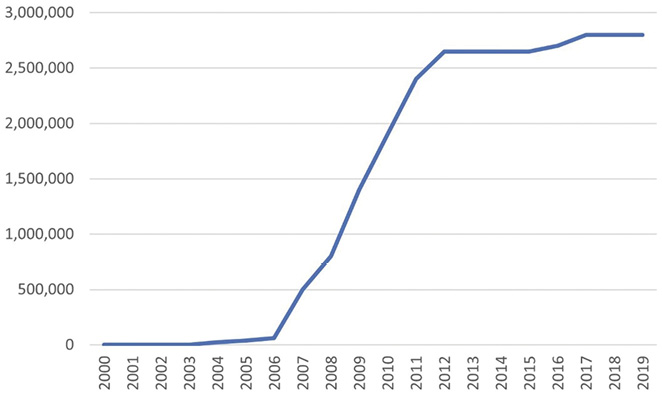
Figure 7.1: Mobile phones in use in PNG over time, 2000–19
Source: Watson (2022).
This is a clear case in which a Morauta-era reform paid rich dividends down the road. Earlier commitments to the World Trade Organization (WTO) made by PNG in the nineties (PNG had joined the WTO in 1996) might also have helped (Duncan 2011); however, without the ICCC, it is unlikely that Digicel would have been able to overcome the incumbent operator’s opposition. Three years later, in 2010, the government took responsibility for regulation of the internet and telecom sector away from the ICCC and gave it to a newly created specialised agency, the National ICT Authority (NICTA).
7.1.2 The stalling of reforms
While none of Morauta’s reforms were reversed by the Somare government that succeeded it, few of his reform plans were persevered with. Trade liberalisation is a notable exception. The initial tariff reform program ran from 1999 to 2006, and, while controversial at times, it was by and large implemented (5.1.3). A Treasury review in 2007 proposed a further round of tariff cuts, recommending 5 percentage point reductions every year until all tariffs were, at most, 15 per cent. This, too, was implemented, albeit with some delay; by 2015, the lowest rate was 10 per cent, the intermediate rate 15 per cent and the highest 30 per cent (Laveil 2019a, 10). In 2017, however, the tariff reduction program was suspended, and tariffs were increased that year and the next (9.1.3).
Another positive reform concerned international air travel, which had come to be dominated by a code-sharing arrangement between the state-owned Air Niugini and Qantas. In 2006, the government announced an ‘open air’ policy to increase competition (RNZ 2006), and in 2008 the ICCC allowed Airlines PNG (now called PNG Air) to code share flights with the Virgin Australia subsidiary, Pacific Blue. This increased competition and significantly reduced the cost of flying between Australia and PNG (Batten, Gouy and Duncan 2009, 13).1
However, other reforms were abandoned. There was no further privatisation. State-owned enterprise (SOE) reforms, discussed in the next section, did nothing to improve performance (ADB 2012a, 2014). When Morauta (2012a) briefly became minister for state-owned enterprises in 2011, he bemoaned the fact that:
Through a process of mutation IPBC [Independent Public Business Corporation]2 had become a major business empire full of ailing, under-performing businesses, trapped in a vicious circle—lack of capital, lack of management expertise, lack of commercial discipline, and lack of accountability.3
Forestry reforms were also shelved. In a 2003 speech delivered in the presence of the visiting Malaysian prime minister, Somare sent a very clear message by attacking the World Bank and reaching out to Malaysia for assistance specifically on forestry (McLeod 2003). World Bank involvement in forest policy reforms ended in 2005 (Filer 2017, 181) and amendments to the Forestry Act in 2007 made it easier for new forestry projects to get up (Filer 2017, 180)—amendments that, by reducing the amount of scrutiny new proposals would be subject to would open the door to PNG’s land grab scam (7.1.4).
In 2009, the PNG government released its Vision 2050 (National Strategic Plan Taskforce 2009). This was a homegrown (non-donor-funded) development strategy that had the aim of placing PNG among the 50 countries with highest Human Development Index by 2050. In 2010, a strategic development plan (Department of National Planning and Monitoring 2010) projected that PNG would grow at an average rate of 8.4 per cent over the next two decades. This plan also introduced the idea of economic corridors, of which 10 were proposed (Hangatt and Momoi 2011) in an aggressive, nationwide investment program. While these documents reflected the optimism of the late boom period, it is hard to detect many links from the 2050 plan, the 2030 one, or the five-year plans that continued to be produced to government policy, let alone economic outcomes.
7.1.3 Resource nationalism
There has always been a nationalistic streak to economic policymaking in Papua New Guinea based on apprehension around over-reliance on primary exports and an aspiration to be more involved in downstream processing. For example, phasing out ‘round log’ (or unprocessed log) exports has been a long held—so far thwarted, but still aspired to—goal, stretching back to independence (see Daniel and Sims 1986; Tukne 2022).
There is also a history of infant industry protection policy, with government support and protection being given or proposed to be given, over the years, to such industries as sugar, cement, rice and gold refining (see 2.2.2 and 9.1.3; Errington and Gewertz 2004; Laveil 2019a).
From the time he took office in 2011, Prime Minister Peter O’Neill shifted the dial on both nationalism and state intervention, starting in the resource sector. In 2013 a new SOE holding structure was announced that was then implemented over the next few years (Howell, Pertus and Sofe 2018; Fallon 2017). The IPBC was renamed Kumul Consolidated Holdings, and corporatised, signifying that the SOEs were no longer being prepared for privatisation but rather would stay under government ownership, and that state involvement in the economy was going to grow rather than shrink.4
In the resource sector, two new holding companies were created, Kumul Petroleum Holdings and Kumul Mineral Holdings (formerly Petromin), both to be taken out from under the IPBC umbrella, and to report directly to the prime minister, their sole shareholder. The PNG government has often taken equity stakes in resource projects, but this policy signified a shift to the creation of ‘national champions’ to identify and invest in future resource projects. The models were Malaysia’s Petronas and Indonesia’s Pertamina (Jackson 2022).
This policy had unexpected consequences for another policy domain, resource revenue stabilisation and savings. The story around the creation of a sovereign wealth fund (SWF) to replace the abolished MRSF is a complex one: useful overviews are provided by Osborne (2014) and Voigt-Graf and Sanida (2015). In summary, work on an SWF began in 2010 in anticipation of the large volumes of revenue expected to flow following commencement of the PNG LNG project. The Organic Law on the Sovereign Wealth Fund was certified in March 2012 under O’Neill, but largely reflecting work done under Somare’s reign as prime minister. At some point, the claim arose that proper legislative procedures had not been followed, and that the new SWF legislation was not in fact valid. The simple remedy would have been to repeat the process, this time properly. Instead, this claim was used as an opportunity to redraft the SWF legislation. It was not until September 2014 that new, substantially different draft SWF legislation was published, and July 2015 that it was passed.
There are numerous differences between the 2012 and 2015 Organic Law on the SWF (Voigt-Graf and Sanida 2015; Chand 2015).5 The key one is that the 2012 Act required all PNG LNG dividends to be paid into the SWF. This would mean no national petroleum champion. The 2015 Act, by contrast, required that all dividends distributed to government would go to the SWF, but said nothing about how it would be decided what proportion of dividends would be retained by any state-owned resource company and what proportion would be remitted to government revenue. By killing the 2012 SWF legislation and putting in place a much less stringent alternative several years later, O’Neill was able to keep his national resource champions project alive. The costs of this policy can be measured in terms of the subsequently significantly reduced flow of dividends to government (8.3.2). A final irony is that the 2015 SWF has never, in fact, been operationalised.
Another early move by O’Neill in the resource sector was to nationalise the Ok Tedi mine. O’Neill signalled in 2010 as treasurer (Gridneff 2010), and then in 2012 as prime minister in a Canberra Press Club speech (O’Neill 2012a), his dislike for the deal negotiated by Morauta that had seen BHP pass its majority stake in the environmentally damaging Ok Tedi mine not to the PNG government but to an independent Singapore-based bespoke trust, the PNG Sustainable Development Program (SDP) (5.1.3). O’Neill also in late 2012 banned Ross Garnaut—eminent Australian economist; active in PNG since before independence as an academic, public servant and then business executive; and at the time chair of SDP—from entry to PNG.
In September 2013, O’Neill introduced legislation, unanimously passed by the PNG parliament, that gave the PNG government full ownership of Ok Tedi (in place of its earlier minority share). The special circumstances of SDP meant that this expropriation was not seen as a broader threat to multinationals operating in PNG. The government also tried to get control of SDP itself, which by then had accumulated over USD1 billion in Ok Tedi profits, but that was blocked by the Singapore courts. After a long and expensive court battle that lasted to 2019, SDP is once more funding development projects in PNG, but Ok Tedi now operates under government ownership.
These early moves by O’Neill prefigured a broader shift to economic nationalism that would accelerate in later years (9.1).
7.1.4 Land reforms and controversies
Despite earlier efforts, there had been little progress with land reform since independence. A group of reformers led by the economist Charles Yala decided that something needed to be done, and, with high-level political support, convened a land summit in 2005. Customary landowners already had the right to form Incorporated Land Groups (ILGs), which they did typically to bargain with resource companies and loggers, and to lease land indirectly, via government, through the lease-leaseback arrangement (3.1.5 and 5.1.2). The proposal coming out of the land summit was to improve the transparency of the ILG process, and then to allow ILGs to register their collectively owned land, and then lease that land directly to developers, with the process providing a security that would enable the lease to be bankable (Chand 2017). Government policy since the early eighties had backed this type of reform, but there had been hardly any implementation for two decades, with attention from the World Bank in the nineties only making things worse (5.1.2).
There was real hope when the necessary amendments were passed in 2009. However, the legislation was not made effective until 2012, and that was only the first disappointment in the implementation of this reform program (9.1.5).
While the land reform program was designed to make it easier to access land for development, over the same period the government had to deal with a problem of land being too easily mobilised (Filer 2011, 2017). A commission of inquiry was established in 2011 into the grant of Special Agricultural and Business Leases (SABLs) based on the above-mentioned, longstanding ‘lease-leaseback’ arrangement, whereby landowning groups would lease their land to government for the government to lease it back to them to lease to developers (as SABLs).
The common complaint was that the process was too cumbersome to be impactful, but in the late noughties evidence started emerging that, in fact, the lease-leaseback mechanism was being used, in conjunction with the recently relaxed Forestry Act (7.1.2), for a land grab. The new leases involved some 5.2 million hectares—more than 10 per cent of the PNG landmass—and 72 SABLs (Filer 2017, 176), including several of more than 100,000 hectares each (Filer 2017, 172). Prior to this, according to one estimate, only 200,000 hectares had been made subject to lease-leaseback arrangements since independence (Kimas 2010, 36), so the new leases were of a completely different order of magnitude. The leases were meant to be, as their name suggested, for purposes that went beyond forestry, but their number and size gave rise to suspicions that they were being entered into without genuine landowner consent and had more to do with chopping down trees than with expanding agriculture. After the scale of the issue was made public by Paul Barker, head of PNG’s Institute of National Affairs, the resulting public outcry led to a commission of inquiry. This in turn resulted, in 2014, in the revocation of most of the SABLs the commission investigated, and a moratorium on any further use of the lease-leaseback arrangement (Filer with Numapo 2017, 266).6
One other land reform was also mooted during the boom period. While nearly all of PNG’s land belongs to customary owners, all subsoil assets belong to the state. A perennial sense that landowners are not getting enough from resource projects (even though their share has greatly increased, see 4.3.2), and an argument that state ownership of subsoil assets was inconsistent with customary ways (Donigi 2010) led to a bill brought first by a backbencher and then by the mining minister (in 2009 and again in 2011) to regard the ownership of subsoil assets as lying with the customary owners of the land under which these assets sit.7 This is not as radical as it sounds—in fact, it is a principle followed in the United States—but it was strongly resisted by resource companies (Callick 2011), who thought it would endanger their projects. In the end, Prime Minister O’Neill reassured them that this proposal would not be taken forward, first in 2011, and then, since the proposal had not gone away, again in 2016 (Blades 2011; Patjole 2016).
7.2 Politics and governance
The boom period saw a return to political stability, but not a fundamental change in political patterns. Funding for service delivery expanded, but the quality of service delivery did not necessarily improve. With more money, there was more scope for corruption. There were once again major decentralisation reforms, resulting in a shift of expenditure to the sub-national level, but reduced autonomy for provinces. Crime levels appeared to stabilise. Australia tried to come to the rescue at the start of the period with a new approach to aid and failed.
7.2.1 Politics
Michael Somare served as prime minister from 2002 to 2007 and then again from the 2007 elections. He was deposed in controversial circumstances in August 2011 when in hospital in Singapore (since March of that year), seriously unwell. His ousting—not through a vote of no confidence, but through one declaring the position of prime minister to be vacant—was, the courts ruled, illegal. However, the new prime minister, Peter O’Neill, leader of the People’s National Congress and former Somare minister, had the majority of MPs behind him. The stand-off became a serious political crisis: for a period the country had two prime ministers, two cabinets, and two heads of army and police commissioners (May 2022). Fortunately, the 2012 election intervened. When O’Neill’s party was returned with the highest number of MPs, questions about his legitimacy as prime minister disappeared8 and O’Neill went on to serve in that role until 2019.
There has been much discussion of why stability returned to PNG politics in the noughties. Turnover at the individual MP level remained high (at around the 50 per cent mark), but there clearly was a change at the macro level. One explanation is that it was simply luck. It is not that easy to muster the numbers to remove an incumbent prime minister mid-term, and, given that PNG has never seen more than one change in the position per parliamentary term, it is not surprising that, eventually, the country was to experience one or even two terms with no change.
But if the new-found stability was more than just luck, one theory is that legal changes—specifically the Organic Law on the Integrity of Political Parties and Candidates (OLIPPAC) passed under Morauta to strengthen political parties (5.2.1)—had tilted the playing field in favour of the incumbent. Early assessments were mixed.9 More recent analyses (Okole 2012; Kabuni et al. 2022) are on the sceptical side, arguing that MPs worked their way around the changes or simply ignored them. In any case, the Supreme Court declared much of Morauta’s political engineering legislation invalid in 2010 on account of it interfering with the freedom of MPs.
There is one aspect of OLIPPAC not struck down by the courts that has fostered political stability: Section 63, which gives the first chance to form government to the party emerging from the elections with the largest number of MPs (Howes and Kabuni 2022). More than 40 parties competed in the 2012 elections, and more than 20 returned at least one MP (Laveil 2022). Over the life of the parliament, MPs tend to join the party of the prime minister to be close to power. Because of this, the prime minister’s party will typically go into the election with by far the largest number of MPs, and therefore emerge with the largest number as well. The same party will then, because of Section 63, get the first (and typically successful) attempt at forming a government. The influence of Section 63 can be seen from the fact that the incumbent prime minister has been returned in the four elections from 2007 onwards. This is quite different to the pre-OLIPPAC era in which, after the period of Pangu dominance ended in 1982, the largest party usually did not provide the prime minister post-election (neither in 1987, 1992 nor 1997).
There were also other legal changes. After O’Neill won the 2012 elections, MPs extended, at his instigation, the grace period (wherein the prime minister at the start of his tenure cannot be subject to a vote of no confidence) from 18 to 30 months. They also reduced the minimum number of sitting days required each year from 63 to 40 (Kabuni 2018), doubled the number of MP signatures required to support a vote of no confidence to 22 and increased the period of notice for such a vote from a week to a month (RNZ 2015b). All these amendments were struck down by the Supreme Court in September 2015 as inconsistent with the democratic ethos of the constitution, but they doubtless assisted O’Neill while they were in place.
Another theory to explain PNG’s new-found political stability is that politicians have become more adept at hanging on to power. May (2022, Chapter 13) attributes Somare’s success between 2002 and 2007 to ‘the government’s control of parliamentary procedures, through a less than impartial speaker … dominance of parliamentary committees and adjournment of sittings’.
Finally, the economic boom itself contributed to first Somare’s and then O’Neill’s prime ministerial longevity. It was hard to mobilise members of parliament against the government when the economy was doing well, and increasingly large sums were going to MPs as electorate funding (7.2.4). As one MP put it, ‘so long as you have the money, you will master the numbers’ (cited in Mou 2016). The boom meant that the incumbent prime minister had the money.
The economic growth of this period might have fostered political stability, but, though many had argued stability was needed for growth, it is hard to see that it helped much. Perhaps it assisted with the successful negotiations for the complex PNG LNG project, but it did little if anything for the cause of better governance or broad-based growth. Even if unsuccessful, attempts to unseat the prime minister were still a major distraction.
Politics in PNG has been an almost exclusively male endeavour. The 1995 decentralisation law reserved two seats in each local-level government for women and put a women’s representative in each provincial assembly. Bougainville introduced a few reserved seats as part of its autonomy set up. But only 10 women have served in PNG’s first 11 parliaments (Table A3). In 2009, a plan was hatched to appoint a small number of women to the PNG parliament. This would have been allowed under the constitution, but it did not attract majority support (Sepoe 2021a). Then, after O’Neill became prime minister in 2011, a proposal was put forward to allow for the election of a fixed number of female MPs. The Equality and Participation Act was passed that very year. However, the enabling legislation to specify the size of this new class of female MPs failed to get the requisite support the following year, and this revolutionary initiative has been quietly forgotten (Sepoe 2021a).
7.2.2 Public services
After repeated failed attempts in the nineties (5.2.2), there was no further attempt to downsize the civil service. The multi-donor ‘Public Expenditure Review and Rationalization’ program (World Bank 2003), started in 2002, languished for a few years and was then disbanded. The number on the government payroll grew from 77,800 in 2002 to 100,500 in 2015 (Figure B16; figures are unavailable for all years).
Despite this growth, the structure of expenditure improved, with the ratio of salaries to total expenditure falling from 29 per cent in 2003 to 19 per cent in 2013. The interest burden also fell, increasing the room for operational and capital spending (Figure 9.1).
Service delivery should have improved during the boom with more and better resourced public servants. Unfortunately, much of the new funding was wasted. The trust funds (6.3.1), which at their height had a balance in excess of PGK3 billion, were an easy target. Money was regarded as spent once allocated to a trust fund (and typically deposited in a commercial bank), meaning there was little oversight of actual expenditure when it occurred. Funds were often given not to line departments but to the Planning Department, which had no experience in actually spending, as against allocating, money. Programs to rehabilitate school infrastructure and to support agricultural development were front and centre in terms of corruption allegations (Transparency International PNG 2010). According to one report, PGK49 million allocated to two provinces in 2019 for school buildings had simply gone missing (Wari 2016). According to former prime minister Morauta (2012b): ‘Billions of kina was parked by the last Government in trust accounts, and walked out, seemingly without trace.’
O’Neill introduced policies of free education and health. This was the fourth abolition of school fees, and it lasted to 2019; since then, school fees have again been introduced and eliminated (Walton and Hushang 2022.) Eliminating school fees gave a boost to school enrolments, but eliminating the ability of health centres to charge fees only made them even more cash-strapped and even less effective (Howes et al. 2014).
Easy money led to recklessness. The Solwara project was to be the world’s first deep-sea mining project. Despite the obvious risks, the PNG government decided in 2011 to take out a 30 per cent equity share, to be paid upfront, in cash (Nautilus Minerals 2011). Fortunately, it only ever bought 15 per cent, but that was PGK327 million, paid out in 2014 (Kero 2014). The project never got off the ground, and when Nautilus was liquidated in 2019, PNG realised it had lost its investment (about USD100 million) entirely (Filer, Gabriel and Allen 2020).
This period proved to be yet another in which the political and bureaucratic class could not get on. It ended with the sidelining (for the second time, after the reforms of the eighties, see 3.2.2) of the Public Services Commission (PSC). O’Neill was frustrated by the power given to the PSC by Morauta and Somare in the early 2000s in relation to senior appointments such as heads of departments (5.2.2), and so stripped the PSC of these powers via a constitutional amendment in 2013 that transferred them to a Ministerial Executive Appointments Committee (Howes and Bizhan 2024).
7.2.3 Corruption
The resource boom expanded the scope for corruption. In 2008, surveys in four urban centres found that over 80 per cent of the community believed that corruption had been increasing (ADB 2012b). Forty per cent of businesses claimed to be ‘highly affected’ or ‘very highly affected’ by official corruption (ADB and INA 2008).
Two major corruption scandals of the period involved the Department of Finance. In one, a commission of inquiry documented a process whereby the state would be sued and, no matter the spuriousness of the case, an out-of-court settlement reached. This scam cost the state up to PGK780 million (GoPNG 2009). In another, a protracted court process finally, in 2023, found prominent lawyer Paul Paraka guilty of charging for and receiving PGK162 million between 2007 and 2011 in fictitious legal fees (National Court 2019).
Corruption went right to the top. Back in the late eighties, the nation’s first prime minister, Michael Somare, had been found by the Barnett Commission (2.2.2) to have abused his position for personal gain: he had successfully lobbied in 1988 to get logging rights in his electorate for a company of which he was the majority owner (Masalai i tokaut 2006). In the noughties, Somare’s corruption became more blatant. A court in Singapore in 2016 heard that USD784,000 had been transferred to him from a couple (Singaporean residents, the husband a close Somare family friend) with funds from one of the period’s many poorly monitored trust funds, intended for a PNG government project initiated in 2008 to establish community colleges. The Singapore court found that the couple had paid a total of USD3.6 million in bribes and sentenced them to five to six years in jail for fraud and money laundering. There were multiple beneficiaries, but the agreement was, according to the husband, that ‘no one should take more than PM and son combined’ (Lasslett 2017).
Somare never faced charges for either the forestry or community college allegations, though, in early 2011, he was suspended from office for two weeks after being found guilty by the Leadership Tribunal on the minor charge of providing incomplete or late financial returns, from as far back as 1991 onwards (Gridneff 2011).
Somare’s reputation suffered little from these revelations.10 Indicative of the forgiving way in which those accused of corruption are treated in PNG, his status as the nation’s foremost national hero has only grown, especially since his death in February 2021.11
It was symptomatic of the changed attitude of politicians that the same Prime Minister Somare who had, in the eighties, attempted, albeit unsuccessfully, to make the rules against corruption stricter (3.2.3) now presided over efforts to weaken them. In 2006, amendments were passed that created stricter rules of evidence for Leadership Tribunal proceedings (Sangetari 2014, 14). Further changes—under the so-called ‘Maladina Amendment’ (Jackson 2010)—were pursued starting in 2009 to place time limits on investigations, to limit the ability of the Ombudsman Commission to freeze public funds, and to prevent those found to have breached the Leadership Code from being tried under criminal law (Fox 2010). Despite widespread protests in person and online, the proposed changes were brought into law; however, they were struck down by the Supreme Court when the Ombudsman Commission appealed them (Supreme Court 2013).
O’Neill came to power with serious corruption allegations hanging over him relating to the mismanagement of pension funds (5.1.3). However, to his credit, the new prime minister established Task Force Sweep in August 2011 to investigate corruption. Its 2012 report concluded that corruption was ‘systematic’ and ‘institutionalized’ and described PNG as a ‘mobocracy’ (Fox 2012). The taskforce had some success (May 2022, Chapter 14), most notably obtaining the conviction of Paul Tiensten, former planning minister, for misappropriation of PGK10 million of public funds (Kama 2014). His sentence in 2014 to nine-years imprisonment was the most severe given to a convicted public official since PNG’s independence. However, O’Neill disbanded the task force in 2014 after it began to investigate and lay charges against him (9.2.3).
7.2.4 Decentralisation
Booming government revenue was used to massively increase constituency funding for members of parliament. Such funds increased tenfold (even after adjusting for inflation) over this period (Figure A1). That increase came in its entirety in just a few years, between 2005 and 2008. It initially could not be sustained due to the GFC, but MP funding went back up to its 2007 level in 2013 when Peter O’Neill opened the borrowing taps. Large-scale MP funding is now a permanent feature of PNG public finance, through both the District Improvement Support Program (DSIP) for district (open) MPs and the Provincial Improvement Support Program (PSIP) for provincial MPs.
The District Development Authority (DDA) Act was an early O’Neill reform, introduced into parliament in late 2013 and passed in 2014. DDAs became the constitutionally endorsed vehicle for spending the large amounts of money now at MPs’ disposal; previously such expenditure was the responsibility of a committee rather than a statutory authority. This reform effectively converted PNG’s governance system into a four-tier one, with governments (elected or appointed) now at the national, provincial, district and local level. Not surprisingly, provincial MPs opposed the introduction of DDAs (Sowei n.d.), but they were outnumbered; they have since taken the matter to the courts.
Constituency funding and DDAs are polarising. Those who support them (including O’Neill 2006) argue that the bureaucracy is non-responsive, and that such mechanisms are vital to get more funds into rural areas. Opponents point to the wastefulness of constituency spending, the lack of accountability and the dangers associated with the politicisation of service delivery, which can, for example, lead to infrastructure being destroyed at election time (Duncan and Banga 2018; Auditor-General 2014).
There was also scope in the boom years to provide increased funding for provincial governments (Batten et al. 2009). New legislation in 200912 introduced a minimum share of non-resource tax revenue (6.57 per cent) that would be set aside in equalisation grants to go towards the non-salary recurrent costs of provincial governments (provincial capital and salary costs are fully covered by the central government). A small amount was earmarked for local governments as well. This reform resulted in an increase in central government grants to the provinces from PGK101 million in 2009 (one-fifth of provincial government revenue) to PGK280 in 2012 (one-third) (National Economic and Fiscal Commission 2012). Equalisation grants are certainly justified. A few provinces receive significant amounts of mining and petroleum revenue. The National Capital District receives more than half of the provincial allocation of GST revenue (5.1.3) and Morobe another third, leaving little for any other provinces. Own-source revenue is very modest, less than 10 per cent of all provincial revenue (Laveil 2024). However, a commitment to better-off provinces that they would not lose from the reforms meant that the move towards equalisation of provincial government revenue had to come at the expense of the central government, further contributing to fiscal stress once the boom was over.
This increased funding both to provincial governments and to districts led to an increase in the sub-national share of expenditure, which recovered in the noughties to around 30 per cent, its share in the eighties, after falling to 20 per cent during the nineties (Gouy n.d.).
While provincial governments saw their income go up, they also saw their autonomy diminished. DDAs were not the only new, competing sub-national power source. The Provincial Health Authorities Act 2007 took responsibility for health away from the provincial government and gave it to a statutory authority. Regardless of the merits of this exercise—and it was perceived that health services in particular had suffered as a result of decentralisation (Thomason and Kase 2009)—these authorities were run by boards appointed by the health minister in consultation with the province, not by the provincial governor or government. In the succeeding years, encouraged by the central government and donors alike, more and more provincial health authorities were established by the national government.
7.2.5 Law and order
A World Bank 2014 report found that, ‘at the national level, crime rates appear to have stabilized since year 2000’ (Lakhani and Willman 2014b, 5). This good news notwithstanding, the country’s reputation for crime was by now firmly cemented. The same report noted that ‘violence victimization rates in PNG are among the highest in the world’ (Lakhani and Willman 2014b, 1). In 2012, the ADB (2012b, x) noted that Port Moresby was rated as a ‘top five’ murder city worldwide, that the ‘crime rate is high, and the public perceives enforcement of law and order as weak’ and that ‘businesses [still] consider the poor law and order situation as the topmost constraint to doing business’.
Tribal conflict continued to rise in profile and severity, with the growing use of ‘high-powered weapons, local mercenaries (“hire-men”) and guerrilla tactics’ (Walton and Dinnen 2022, 92). The border with Indonesia was porous.13 In 2007, a border electorate MP complained that ‘money laundering, sales of illegal firearms, drug trafficking, human smuggling and other illicit activities were becoming common practices’ (Nelson 2009, 266).
In 2005, Haley and Muggah (2006, 50) undertook a survey on the basis of which they concluded that ‘inflated compensation demands [were] crippling local economies’ in some parts of the country; that ‘threats, intimidation and extortion with firearms are the most virulent form of violence in their community’; and that there was a link between the ‘weakness of the state and these high compensation payments’. One of their informants commented that ‘the law is weak so we must pay more in order to obtain peace’ (Haley and Muggah 2006, 50). On the positive side, local, hybrid responses proved effective in some areas (Dinnen, Porter and Sage 2010).
7.2.6 Foreign aid and relations with Australia
The story of aid to PNG crosses all four periods of our history but is particularly interesting in this period as it is the one in which Australia most actively tried to influence outcomes in PNG. To recap briefly, aid volumes declined in real terms from independence through to the end of the nineties. The first phase of Australian aid to PNG was one of (unconditional) budget support. This started with independence (or really with home rule in 1972) and was phased out over the nineties (4.4.3). Aid via projects or programs, as they were called, was phased in over the nineties to replace budget support and continues to this day. Australia helped finance the structural adjustment programs of the nineties, and its aid agency, AIDAB then AusAID, produced a number of economic reports on PNG over that decade. Overall though, there was little effort by Australia in the first almost 30 years of PNG’s independence to influence government decision-making. That all changed in 2004 with the introduction of the Enhanced Cooperation Program (ECP), agreed to in December 2003 (Joint Standing Committee on Treaties 2005), to be implemented for five years at a cost of AUD1 billion. Some 210 Australian police and 64 bureaucrats were placed in PNG, many in ‘in-line’ rather than advisory positions.
The ECP emerged from Australia’s successful stabilisation mission to Solomon Islands (RAMSI),14 which commenced in mid-2003, and, more generally, from a more pro-active international stance on the part of the US and its allies post-9/11. It also, if with a lag, responded to the sense of crisis in PNG at the end of the millennium (5.3). But the ECP was also born of a profound naivete and a failure to learn the lessons from the tenuous achievements of a decade of adjustment lending (5.1.4). Replacing advisers with in-line managers had merit (Pieper 2004; Howes 2015a), but Australia’s goal for the ECP of ‘improved economic and social governance to help boost economic growth and the quality of life’ (Australian Treasury 2004, 76) was unrealistic. The Australian Treasury revealed the extent of overestimation of its capability to influence events on the ground by its (supposedly realistic) declaration that ‘building up Papua New Guinea’s core institutions will involve at least a five year program of assistance’ (Australian Treasury 2004, 78).
From the start, PNG politicians viewed the ECP with mixed attitudes. Prime Minister Somare was against it on nationalistic grounds: unsurprisingly since he had been promoting self-reliance his entire political career. Even reformers such as Morauta (2005, 159) warned that ‘the ECP is widely seen as an Australian, not a Papua New Guinean initiative’ and would likely fail for that reason. The PNG public, however, weary of high crime levels, welcomed the Australian police force presence on the streets of Port Moresby (Squires 2004).
Whatever its merits and deficiencies, the ECP was a short-lived experiment. One MP, Luther Wenge, who likened the ECP to recolonisation, took the matter to the courts (as he had with PNG’s value-added tax, see 5.1.3), and in May 2005 PNG’s Supreme Court ruled that the immunities provided to Australian personnel serving under the ECP were unconstitutional (Chin 2005). Australia pulled most of its police and moved those remaining into advisory roles. Those in non-policing roles stayed on, but with increasingly limited leverage and in increasingly limited numbers as the diplomatic relationship between Australia and PNG soured.
Australia was unhappy that PNG had effectively called the ECP off. On the PNG side, Prime Minister Somare was offended in April 2005 when told to remove his shoes in a security check at Brisbane airport; Alexander Downer, Australia’s foreign minister, refused to apologise (McLeod 2005). Relations soured further over the extraordinary Moti affair, involving the Solomon Islands attorney general, Julian Moti, an Australian citizen. The Australian government saw Moti as provoking opposition to RAMSI in Solomon Islands, and went after him on spurious legal grounds, eventually thrown out by the Australian courts in 2011. Moti was arrested for extradition to Australia when visiting PNG in 2006, but Somare helped him escape back to Solomons, breaking several PNG laws along the way (as a subsequent official inquiry revealed) and antagonising Australia no end (Nelson 2007a; Rowlings 2011).
A second attempt at influence arose in this period in relation to the PNG LNG project, which Australia helped fund through its export credit agency, Export Finance Australia, in return for PNG agreeing to introduce a sovereign wealth fund (SWF). The champagne was opened at the Australian High Commission in Port Moresby when the SWF Act was passed in 2012—but prematurely, since that legislation was soon replaced by another, and not even the newer one has actually been implemented (7.1.3).
By then Australia’s brief attempt to exercise policy influence had come to an end. Prime Minister of Australia Kevin Rudd, following his election in 2007, went on a charm offensive, which helped to repair relations with PNG, but also ended any residual effort by Australia to encourage PNG to reform. In fact, Rudd’s election can be seen as the start of a new phase in Australia’s relations with PNG, in which power shifted from the former to the latter. A decisive change took place in 2013 when Rudd (briefly returned to the position of prime minister after losing it in 2010) negotiated with O’Neill the processing and settlement of Australian asylum seekers on Manus Island in PNG. In 2001 and 2002, when John Howard was Australia’s prime minister, PNG had also agreed to house asylum seekers on Manus while they were being processed. That arrangement, like the new one, was controversial, and Prime Minister Morauta was forced to sack his foreign minister for being publicly critical of it. The new arrangement was more far-reaching because now the asylum seekers were to be PNG’s indefinite responsibility (and a few remain on PNG to this day). PNG’s opposition leader Belden Namah challenged the constitutionality of the deal, and, in 2016, the Supreme Court of Papua New Guinea ordered the Manus processing centre be shut down,15 which it was in 2017.
By this time, PNG was increasingly viewed in Australian policymaking circles through a China lens (9.2.6). What mattered from this perspective was not whether Australia was having a beneficial impact on PNG but simply whether it was popular. While budget support was again provided in the most recent period, this time it came with less onerous conditions (8.3.5).
7.3 Conclusion
Anyone living in Port Moresby experienced the 2004–13 boom firsthand. A city that used to be easy to get around in became subject to long traffic jams. More positively, the city got (back) a cinema, and several new, modern shopping malls and new restaurants. Port Moresby benefited the most from the boom (though it also saw the biggest house price increases), but the rest of the country also saw increased demand for domestic produce and increased funds for both households and governments alike.
Of the four periods covered in this book, the third stands out in a positive way. For many key variables—non-resource GDP per person, government revenue, bank loans and deposits, and formal sector employment—the broad pattern is little, no or even negative growth in the first, second and fourth periods, and rapid growth in the third (10.12). The boom years were indeed good ones on a range of dimensions. Third-time prime minister Michael Somare (2010, 215), who had seen the bad times, said that PNG was ‘going through a period of resurgence’. Commentators adjudged the country to be ‘on the brink of success’ (Batten 2008). But the drivers were temporary—high commodity prices, revenue-ready projects and PNG LNG construction—and so the good times did not last. Moreover, the boom, and its mismanagement, exacted a toll on the country’s economy that had to be paid in subsequent years.
In the early boom years, funds were saved; however, given the nature of the trust funds they were put in, they were only saved for the short term. It was no surprise, then, that, in the late boom years, those short-term savings were spent; moreover, there was then too much borrowing. And much of the spending splurge was of low quality, symbolised by the USD100 million lost to the Nautilus deep-sea mining venture.
More saving of the resource boom proceeds would have slowed growth in the boom years but would have helped during the subsequent bust. Higher wages, house prices and a re-appreciated exchange rate also hurt the economy in later years.
The boom period also saw the start of a move that would be intensified in the years ahead away from the Washington Consensus reforms of the nineties towards policies of nationalism and greater state intervention. How all this has played out since is the subject of the next part of this book.
1 ‘For both the Brisbane and Cairns to Port Moresby routes, this has meant an almost 65 per cent reduction in prices’ (Batten, Gouy and Duncan 2009, 13).
2 IPBC was an SOE holding company Morauta had established (5.1.3).
3 The ADB (2014, 20) commented: ‘Deficiencies in the current legal and governance framework and problems with compliance have contributed to SOEs’ poor commercial performance … Noncompliance … has been a problem since 2002, leading to weak governance and accountability.’
4 The kumul is the bird of paradise, PNG’s national bird.
5 The two acts can be found at pngnri.org/images/Publications/SL_8-4_PNGs_SWF_Bill_CVoigt-GrafOOSanida.pdf and pngnri.org/images/Publications/Issues_paper_17_PNGs_SWF_the_efficacy_of_the_withdrawal_formula_final1.pdf.
6 As one commentator noted, most witnesses to the commission were not opposed to large-scale land development but objected to their exclusion from the process. ‘In many cases, different landowner companies, or different factions represented on the board of one landowner company, had formed partnerships with different investors, each one with a view to convincing their partners that they alone were the genuine representatives of all the customary owners of the land to be developed’ (Filer with Numapo 2017, 276).
7 A court challenge on the unconstitutionality of denying landowners the ownership of subsoil assets was unsuccessful in the early 1990s (Nonggorr 1993).
8 Illustrating the flexibility of PNG politics, O’Neill and Somare buried the hatchet, and the latter joined the former’s ruling coalition.
9 Compare Fraenkel (2004), Gelu (2005) and Standish (2007) to Sepoe (2005) and Reilly (2006).
10 A few were critical. The eminent Australian historian, and UPNG’s first professor of history and then second vice-chancellor Ken Inglis observed many years after his departure from PNG: ‘In every way Somare was a friend of the university and greatly admired by students. Later, there was increasing disenchantment. People wanted so much to believe that Somare was an admirable leader, but they were forced to realise that he went in for a great deal of what we could call corruption, as did a lot of people who had been our friends. Not all of them, by any means, but a lot of them’ (Inglis and Spark 2014, 229).
11 ‘As expressed through the re-election of numerous politicians after being found guilty of misconduct in office, the PNG voters seem to have a remarkable capacity for forgiveness. An explanation may be found in the concept of “us-versus-them”, whereby crimes against the state or similar organisations are deemed morally acceptable, whilst offences committed against members of one’s own group are not’ (Ketan 2000, 9). See also Ekeh (1975), discussed in Section 5.2.
12 A new Intergovernmental Relations (Functions and Funding) Act was passed, and the Organic Law on Provincial Governments and Local Level Governments was amended.
13 In 1984, 10,000 refugees from the conflict in Indonesian Papua crossed over into PNG.
14 The Regional Assistance Mission to Solomon Islands; though regional, it was led by Australia.
15 The government had by then passed constitutional amendments to authorise the arrangement, but the court rejected these.
Previous Next



