


 menu
Struggle, Reform, Boom and Bust
9
The turn to economic nationalism
After 40 years of independence, we have not gained control of our economy. We have not been able to fully drive the development agenda to achieve true self reliance as a nation. The vast majority of our people are greatly marginalised and are not engaged meaningfully in economic activities … Our formal SME sector is crowded out by many foreign businesses after the removal of the reserved businesses.
—Extracts from the Small and Medium Enterprise Policy (Ministry of Trade, Commerce and Industry 2016)
9.1 Economic policies
When Peter O’Neill took office in 2011, economic policy started to become more nationalistic and state-led (7.1.3). The shift was partial rather than complete, and often rhetorical rather than actual. Nevertheless, the changes, taken together, were significant. Marape took the rhetoric to a new level when he became prime minister in 2019 with his popular ‘Take back PNG’ slogan. We explore policy changes in the 2010s under five headings: state-owned enterprise and infrastructure policy, the push for reservations for national businesses, the re-emergence of protectionism, the promotion of national champions in the resource sector and the stalemate around land policy.
9.1.1 State-owned enterprise reform and infrastructure
There was little or no progress in state-owned enterprise (SOE) reform and no interest in privatisation. Many SOEs were plagued by frequent turnover of boards and CEOs, and by scandals, for example, relating to the National Development Bank, Kumul Minerals and the National Airports Corporation (National 2019, 2020; PNGi 2022). The financial position of most SOEs is poor and their arrears are significant (ADB 2022). The creation of a new SOE, Kumul Agriculture, in 2016, showed the appetite for state involvement in business. It immediately drew an adverse audit report in 2018. Another effort to limit political interference in the recruitment of boards and CEOs was made in 20211 as part of an ADB budget support program (8.3.5).
Perhaps the worst performing of PNG’s SOEs was PNG Power, described as being in a ‘crisis of governance’ (Sandu et al. 2020). Three expatriate CEOs came and went from PNG Power between 2015 and 2021, while the utility’s performance seemed to go from bad to worse, with what seemed to be growing blackouts, implacable opposition to any restructuring by the incumbent trade union and a worsening financial position, in part due to the government preventing any electricity tariff increases from 2013.
Electricity reliability and access remain major issues. Only about 15 per cent of the population has access to the grid (Pandey and Howes 2022, 170). In better news, an aid-supported, private sector initiative led to rapid sales of solar panels. Estimates of solar penetration (the ratio of households with a solar panel) range from 33 to 60 per cent (Pandey and Howes 2022, 169; IFC 2019), among the highest in the world.
B-Mobile, the state-owned mobile phone company (formerly part of PNG Telkom), proved completely unable to compete with Digicel, with neither a partial sale in 2008 to Hong Kong–based private equity firm GEMS, nor a subsequent injection of government funds helping. By 2015, Digicel had 1,100 towers and B-Mobile only 300 (Suwamaru 2020). B-Mobile has been reconsolidated into PNG Telkom, but without any boost to performance. A more positive development was a third mobile phone entrant in 2022, the Fijian company Amalgamated Telecom Holdings.
Air Niugini was hit hard by the pandemic and by fuel shortages (linked to foreign exchange rationing) and its financial position is precarious (ADB 2022). Advances were, however, made in international and domestic connectivity. Funded by a Chinese EXIM Bank loan, Huawei started work in 2019 on the USD270 million Kumul Submarine Cable Network (KSCN) that connects many of PNG’s coastal towns to the Asian internet transmission network via Jayapura on the other side of the Indonesian border. Australia, determined to prevent China from getting in first, provided AUD200 million of grant funding for the Coral Sea Cable from Sydney to Port Moresby and Honiara, Solomon Islands. This was completed in 2020, greatly increasing the capacity on that route. While these new projects are of great potential, various constraints need to be overcome: Digicel’s de facto mobile monopoly has limited the extent to which cost savings are being passed on to consumers, the commercial viability of the KSCN is uncertain and there are technical problems hindering the utilisation of the new cable networks (Suwamaru 2020; Watson 2022; KCH 2021).
In 2003, with encouragement from the ADB, legislation had been passed to establish the National Roads Authority (NRA) and the PNG Road Fund, which the NRA would administer to maintain the country’s national roads. Hopes at the time were high (McLay 2003); however, in 2016 a study found that the NRA had limited impact because of funding constraints, with the Road Fund constituting ‘less than 1.5 per cent of total government spending on maintenance and rehabilitation of the national road network’ (Dornan 2016, 452). The same study found a lack of clarity in the division of responsibility between the NRA and the Department of Works, traditionally responsible for road maintenance. The NRA repeatedly received qualified audit reports (Brown 2016). Meanwhile, the government itself reported in the 2013 budget that:
Papua New Guinea’s transport networks are failing. Major roads, including the crucially important Highlands Highway, have deteriorated alarmingly, raising the costs and reducing the availability of transport services. Most of the feeder roads are frequently impassable. Communities in coastal and mountainous areas that rely on sea and air transport are becoming more isolated because of deteriorating physical infrastructure. In all transport subsectors, the dilapidated state of infrastructure is largely the result of inadequate maintenance and poor management over a long period. Wharves, jetties and airstrips have fallen into disrepair and disuse. Almost half of national roads and two thirds of provincial roads need rehabilitation or reconstruction before they can be properly maintained. (cited in Dornan 2016)
In 2020, the PNG government abolished the NRA and restructured the PNG Road Fund. It also launched the ‘Connect PNG’ road-building program (Leng 2022), which promises greater funding for road construction and maintenance.
A massive project, supported by an ADB loan of USD680 million, was launched in 2017 to rehabilitate the Highlands Highway, the nation’s most important road, all the way from Lae to Mount Hagen. Encouragingly, given the problems with maintaining roads, the project will fund not only rehabilitation and upgrades, but also maintenance.
The operation of PNG’s major Lae and Port Moresby ports was contracted out under a 25-year concession awarded in 2018 to the multinational ICTSI, with claimed benefits for performance, despite allegations of corruption (Robertson and Hui 2023) and incredibly high prices. An Independent Consumer & Competition Commission (ICCC) review found that ICTSI’s return on capital exceeds 100 per cent in a single year (ICCC 2023; Howes and Kunda 2024).
9.1.2 Reservations for national businesses
PNG released a new policy for small and medium enterprises in 2016, the key feature of which was a reduction in the economic space available for foreign investors (Ministry of Trade, Commerce and Industry 2016). PNG has had a list of activities reserved for national enterprises since independence, but it had been pared back over the nineties as part of its structural adjustment reforms, and then again in 2005, leaving ‘only a limited list of Cottage Business Activities’ reserved for citizens (PWC 2016, 4). Under the new policy, all companies with a turnover of less than PGK10 million would need to be 100 per cent PNG owned, with a large number of sectors also reserved for fully PNG-owned firms (PWC 2016). The new policy generated debate in PNG (Nicholas 2016) and alarm among foreign businesses (Byrne 2017). In the end it proved too radical to implement. Legislation to implement the policy was drafted in 2019 but withdrawn after protest. Though a radical expansion of the reserved list retains some political support (PNG Facts 2021), in 2022 the Investment Promotion Authority released only a mildly expanded reserved list (Post-Courier 2022b).
9.1.3 Protectionism
During this period, the PNG government declined to sign the Pacific Agreement on Closer Economic Relations Plus treaty, which required signatories to gradually phase out tariffs on imports from other Pacific countries, Australia and New Zealand. PNG argued that it wanted a bilateral trade deal (Kisselpar 2016), but it also, perhaps, wanted the freedom to increase rather than reduce tariffs. Certainly the 2023 Medium Term Development Plan revealed a mercantilist outlook by projecting growing exports and declining imports (Mako and Howes 2024).
In 2015, the government issued a ban on several fresh fruit and vegetable imports from Australia to support PNG’s own vegetable industry (Locke 2015). The ban was short lived, but a precursor of a major reversal in trade policy. In 2017, Deputy Prime Minister Charles Abel announced the suspension of the 20-year tariff reduction program in place since 1999 (7.1.2). In the 2018 budget, about 250 tariff lines were increased and 600 planned decreases abandoned. On average, the tariff increases were moderate (around 7 per cent) but there were some substantial increases. A 25 per cent tariff was imposed on various milk products, previously tariff free, to support PNG’s first joint venture dairy enterprise, Ilimo Dairy Farm (Laveil 2019a). The 2019 budget included another 73 new and increased tariffs.
The increase in tariffs is unsurprising given the contraction in manufacturing over this period (8.2.2). A better policy would have been to tackle the underlying problems of exchange rate overvaluation and foreign exchange rationing (8.3.1).
The desire to expand domestic rice production has been a constant feature of post-independence policymaking. As Bourke et al. (2009, 168, 171) write:
Since independence in 1975, plans for a domestic, import-replacement rice industry have been a feature of every government white paper on agriculture. Yet, since 1977, domestic rice production has never exceeded one per cent of the amount of rice imported … The most important reason that rice cultivation has not become significant in PNG is related to returns on people’s labour. Returns to labour are higher in the production of root crops than in rice, both in terms of yield and food energy produced per hour worked [Bourke 2022]. Returns from growing coffee or cocoa are also higher than for growing rice in cash income per hour worked.
PNG’s 2015 National Rice Policy promised a monopoly to a pioneer investor, and a USD2 billion foreign investment was announced the same year (Howes 2015b). It was not the first time that this particularly outrageous idea had appeared (Wrakuale 2012) and again it never got off the ground.
Protectionist policies over this period not only sought to keep imports out but also to encourage (or force) more downstream processing for export. A ban on log exports was announced in 2018 to take effect by 2020, the latest in a sequence of such commitments dating as far back as independence (7.1.3). Taxes on logs were increased in the 2017 budget (RNZ 2016) and again in the 2020, 2021 and 2022 budgets, before being cut in the 2024 one (Nanau 2020; Kuku 2023a). Logging volumes declined over this period, but analysis suggests a cessation of round log exports is unlikely any time soon (Figure B8; Filer 2022).
Domestic tuna processing had begun in the nineties (4.3.2). In addition to the two plants established in Madang (1994) and Wewak (2003), four more were set up in Lae: in 2006, 2013, 2015 and 2017 (Pacific Islands Forum Fisheries Agency 2021).2 Onshore processing of tuna rose from 49,900 to 107,300 metric tonnes between 2010 and 2019, and employment rose from 7,100 to 12,500 over the same period (Ruaia, Gu’urau and Reid 2020).
The driver of this expansion is the ability of PNG to access the EU market duty free, escaping the standard 24 per cent tariff.3 However, even with this concession, competition is tough (McQuillan 2017a), as reflected by the PNG government’s decision to increase the import duty on canned tuna and other fish products from 10 to 25 per cent in January 2019.4 Two canneries closed or reduced their operations in 2023, due to foreign exchange shortages among other factors (Giame 2023; Nangoi 2023).
PNG had incentivised the establishment of new plants via discounted license fees for ships to catch tuna at sea, but this meant that companies had an incentive to build rather than operate the plants. The introduction of a rebate was designed to increase plant utilisation. The rebate bill is over PGK100 million, making it an expensive job-creation scheme (National 2022; Katai 2022). Even if we assume that all employment is due to the rebate, with employment of 12,500 workers, the annual subsidy per worker is about PGK7,000, roughly equal to their annual salary at the minimum wage.
PNG also benefited during this period from its participation in the Nauru Agreement, by which 10 Pacific nations agreed to collectively auction access to its fishing waters, resulting in a large increase in licensing fees, in the case of PNG from USD55 million in 2010 to USD133 million in 2019.
In 2019, the PNG parliament passed the Special Economic Zones Authority Act, the latest in a sequence of similar initiatives promising streamlined services and tax concessions. The new Act repealed the Industrial Centres Corporation Act of 1990 and the Free Trade Zones Act of 2000. Despite the poor track record of special economic zones in PNG in the past, Trade Minister Richard Maru called this ‘probably the most important economic decision any government has made’ (Myles 2023).
9.1.4 Resource sector policy
The push to give the state a more active role in the resource sector started in 2013 (7.1.3). There was more to come in subsequent years.
PNG had used its 18 per cent stake in Oil Search (gained in the late nineties, see 5.1.3) as collateral for a 2008 loan from an Abu Dhabi state-owned investment company to finance its equity share in the PNG LNG project. When the Abu Dhabi company decided in 2014 that it would exercise the option it had been given to retain those shares, Prime Minister O’Neill decided in the same year that PNG should rebuild its shareholding in Oil Search. An AUD1.2 billion loan was obtained from the Australian arm of the Swiss bank UBS to be taken out by Kumul Petroleum, to be paid back using PNG LNG dividends and to be used to buy 10 per cent of Oil Search. Treasurer Don Polye was opposed to the loan and was sacked as a result. The UBS loan was an expensive failure. The decision was taken to sell the newly acquired shares as early as 2015, but was not executed until after the 2017 elections (PNGi 2020). The loan, rationalised on the grounds of resource nationalism,5 but lacking any clear justification and therefore giving rise to suspicion of corruption, was also costly for O’Neill. It caused national outrage, with protests and critiques around the loan’s affordability and legality (Yala, Sanida and Mako 2014),6 and led to a critical Ombudsman Commission (2018) report and, ultimately, a royal commission of inquiry. The latter described the deal as ‘disastrous’ and costed it at PGK902 million in fees and interest (GoPNG 2022, 1A–14, 15).
In the early 2000s, PNG had cut taxation rates in the resource sector, reducing corporate tax rates and abolishing the additional profits tax on new projects (4.3.2). Just over a decade later, the taxation regime was seen as too generous for mining and petroleum, and the 2017 budget reintroduced the additional profits tax (Department of Treasury 2016). It also removed the double deduction for exploration expenses (which had only been available in the mining sector). The same budget harmonised the treatment of petroleum and mineral projects, reducing the corporate tax rates on the former (harmonising them at 30 per cent), but making them also subject to the dividend withholding tax (now increased from 10 to 15 per cent) from which petroleum projects had previously been exempt (Department of Treasury 2016). The 2018 budget removed the tax deductibility on petroleum royalties (Department of Treasury 2017c).
Once James Marape took over as prime minister, radical reforms to the mining and petroleum regimes were tabled, including a move towards production-sharing arrangements—something the now mining minister Kerenga Kua had been arguing in favour of for a long time (Price 2012)—in which the key negotiating parameter would be the share of revenue going to government. This new approach would, it was envisaged, be administered by the two new national champions created in the previous decade (7.1.3): Kumul Petroleum and Kumul Mining (James 2019b). It was opposed by the PNG Chamber of Mining and Petroleum (2020), and, although a new bill was promised in 2020 to usher in the new regime,7 the prime minister seemed to be less committed (Business Advantage PNG 2021a).
The Mining Amendment Act 2020 and the Oil and Gas Amendment Act 2020 were much more modest affairs, though they did continue the trend of building up national champions by allowing the government to preference state-owned entities when allocating prospective mining and petroleum sites (Merriam, Rowell and Kuman 2020; Leahy 2020). In 2021, Kumul Petroleum was awarded its first Petroleum Retention Licenses on various prospective gas fields, conveying the government’s expectation that it should become an active developer of, rather than a passive investor in, resource projects (Kumul Petroleum 2021; Paul 2021).
All up, while PNG has long sought minority equity stakes in resource projects, and while not all recent plans have been implemented, developments starting in 2013 have resulted in the government taking a much more active stance in the resource sector, to the extent of it wanting its SOEs to become national champions and take the lead on extractive projects. This policy is certainly costly in terms of earnings foregone (8.3.2). Given weak governance and poor SOE performance, it is also highly risky.
This period also saw a continuation of earlier trends in relation to the greater localisation of resource project benefits, something that started in the nineties (4.3.2). One-third of the ownership of the Ok Tedi project, which had been nationalised in 2013 (7.1.3), was gifted to the provincial government of the region where the mine is located (the Western Province) and to landowners. As part of the negotiations around the extension of the Porgera gold mine 30-year lease (8.2.3), the royalty rate was increased from 2 to 3 per cent. The provincial government and landowners were together offered 15 per cent of the project’s equity from PNG’s new 51 per cent stake (given that the mine was already operating, PNG could extract a much better deal from the mine extension than from the original agreement). In 2022, the limit to which local investments could be made in lieu of tax payments through the tax credit system introduced in the early nineties (4.3.2) was increased from 1.25 to 2 per cent.
9.1.5 Land policy
A national land summit convened in 2005 had launched a push for voluntary customary land registration and leasing (7.1.4). This promising initiative floundered at the implementation phase. Problems included the complexities both of the new registration process and of customary ownership, as well as the weakness of the government machinery that was to administer the new regime. Several reviews of this land reform initiative (Duncan 2018; Kwapena 2021; Filer 2019a) indicate that, while there have been some positive developments, it is yet to deliver at scale. Filer (2019a, 76) writes:
By the end of 2016, the total area covered by land titles issued to land groups under the new legal regime was just over 100,000 hectares, about 0.2 per cent of PNG’s total land area … [T]he ‘bankability’ of land titles granted to customary groups has turned out to be another illusion because the banks have refused to accept them as security for loans.
Another land summit was convened in 2019. This second summit criticised voluntary customary land registration for being ‘long, cost[ly] and titles are not bankable’ (Department of Lands and Physical Planning 2019). However, the summit failed to reach consensus on the way forward. With lease-leasebacks banned as a result of the land grab of the noughties (7.1.4) and voluntary registration not delivering, land reform was in the too-hard basket.
Also of interest from this period is the Land (Amendment) Bill of 2016 that would have prevented partially or fully foreign-owned companies and non-citizens from being granted state leases, and would have extinguished existing state leases to foreigners (Allens 2016). The draft never made it to parliament, but it is another symptom of the nationalist economic mood of the time.
9.2 Politics and governance
The politics of this period were dominated by Peter O’Neill, and by his successor as prime minister, James Marape. The country became increasingly litigious. New steps were taken to combat corruption, but with uncertain effect. This period was the first in which there was no change to decentralisation policy, but there was plenty of debate, and Bougainville voted almost unanimously for independence. More focus was given to violence against women and to the growing problem of sorcery-accusation-related violence. Geopolitics has not been a focus of this book, but PNG’s geopolitical environment was transformed over this period.
9.2.1 Politics
The 2017 elections were worse than earlier elections. According to one report, the election was characterised by:
widespread fraud and malpractice, including extensive vote rigging, coerced collective voting, and the hijacking and/or destruction of ballot boxes, political gifting and money politics which was qualitatively different to previous elections. (Haley and Zubrinich 2018, 92)
Two hundred and four election-related deaths were counted, double the number in 2002, previously thought of as the worst. One-third of voters said they were intimidated (Haley and Zubrinich 2018, 61). One long-time observer, Bill Standish, commented that ‘popular democracy has been replaced by cynical manipulation by incumbents, their rivals and supporters alike’ (Chandler 2018). No women at all were elected. Various proposals were once again (7.2.1) floated to reserve seats for women, but none got up (Sepoe 2021b).
The 2022 elections were described as ‘disastrous’ (Wood 2022; see also Wood, Laveil and Kabuni 2023). Two women were elected this time, and a third got up through a 2023 by-election.
Peter O’Neill served as prime minister from 2011 to mid-2019, making his tenure in PNG’s top political position the second longest. When he first took power in 2011, albeit in controversial circumstances (7.2.1), he had a lot of support, not least because he brought a sense of energy and drive to the job that had been sorely lacking under Somare.8 However, although he won the 2012 and 2017 elections, over time O’Neill lost support from both the public and from fellow members of parliament through a succession of polarising events: in 2014, the shutting down of the anti-corruption body Taskforce Sweep (9.2.3), the controversial and ill-fated UBS loan (9.1.4) and an unpopular attempt to amend the constitution to protect his position;9 in 2016, UPNG student protests that ended in police shootings; and, throughout much of his rule, complicated legal manoeuvrings and personnel changes to avoid arrest (May 2022, Chapter 14). In the end, O’Neill finally resigned to avoid certain defeat in a vote of no confidence in June 2019.
O’Neill’s eventual departure teaches us two things about PNG politics. First, PNG’s egalitarian political culture will only tolerate the concentration of power in one person for so long. On his resignation from O’Neill’s cabinet, Marape said that PNG was not a nation ‘to be dominated by one person’ (Nicholas 2019). O’Neill’s fate was similar to that of Somare’s in the eighties (3.2.1): his political longevity seemed to make him not less but more vulnerable. Second, it confirms our earlier argument that the resource boom was an aid to political stability (7.2.1). The end of the boom certainly undermined O’Neill’s claim to power, and his repeated claims that his government was delivering prosperity rang increasingly hollow.
It is hard to see large policy differences between O’Neill and his successor, Marape. The latter has upped the rhetoric around economic nationalism and aspiration, including by committing to making PNG the world’s richest black Christian nation by 2030 (12.5). Policies are similar between the two, except perhaps for Marape taking a harder line—or, rather, wanting to be seen as taking a harder line (8.2.3)—in relation to resource project negotiations, and a more realistic and transparent view in relation to the budget and the immediate health of the economy. The biggest difference is that Marape was willing to invite in the IMF (8.3.5), something O’Neill would not contemplate.
While O’Neill was defeated in 2019, he was down but not out. He was a driving force behind an almost successful bid to dislodge the government through a vote of no confidence in late 2019 and was the main contender against Marape for the position of prime minister at the 2022 elections, though, in the end, he was soundly defeated.
9.2.2 Public services
There was modest growth in government employment: by 8 per cent between 2015 and 2019 (Figure B16), the only years for which data are available. There was also significant growth in real wages paid to public servants (Howes 2020), a lagged effect from the boom. Payroll blowouts continued to be a problem throughout the period, with payments to civil servants regularly exceeding budgetary commitments. The worst example was in 2018, when employee compensation was budgeted at PGK4.1 billion but actuals revealed expenditure of PGK5.2 billion (Howes 2020). All in, the salary bill grew by 38 per cent after inflation between 2013 and 2019, while the real interest bill doubled. Salary and interest as a ratio of own revenue (revenue excluding aid) doubled, returning to and then exceeding its pre-boom high of 60 per cent in 2020 and 2021 before falling back to below 50 per cent due to the windfall revenue of 2022 (Figure 9.1).
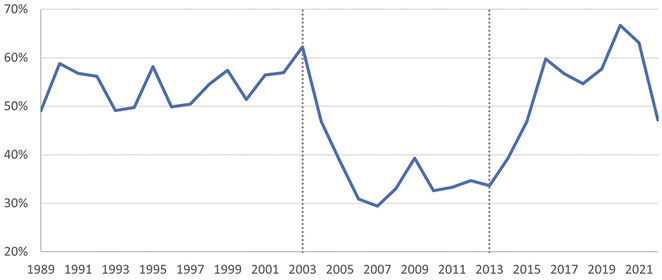
Figure 9.1: Salary and interest as a percentage of own revenue, 1989–2022
Note: Own revenue excludes foreign aid.
Source: PNG Economic Database.
The category of recurrent goods and services, that includes such essentials as drugs for hospitals and petrol for police cars, was crowded out. On a per person basis, this fell to PGK600 per person (in 2022 prices), not as low as the PGK400 reached in 2003, but still down from the PGK1,000-plus achieved in the eighties and during the boom (Figure 5.1).
A Public Expenditure and Financial Accountability assessment was carried out in 2016. PNG failed on 21 of 30 dimensions, making the country’s public financial management the fourth worst of the 24 developing countries reviewed (Fellows and Leonardo 2016) and showing deterioration compared to earlier, similar assessments. Weaknesses exposed included poor control over budget execution, lack of bank reconciliations and lack of audit reports. One particular problem is the end-of-year expenditure rush. In 2020, 64 per cent of non-salary, non-interest expenditure was booked to the last quarter, and much of this was actually spent in the next year (Igara, Kamit and Howes 2021, 35).
Childhood immunisation rates rose over the nineties and stabilised over the noughties but fell precipitously over the tens, putting PNG in last spot in a global league table of immunisation rankings (Figure 10.6 and Table 10.14). This was likely due to a combination of funding cuts, the secular decline in the quality of rural health services and the increasing shift in political attention to constituency funding, which favours projects over services.
In the previous period, legislation had been passed in 2013 to sideline (for a second time) the Public Services Commission (PSC) in the selection of departmental heads, provincial administrators and heads of statutory authorities (7.2.2). The PSC appealed these changes, and in 2019 the Supreme Court ruled that proper legislative processes had not been followed, and that the legislation therefore was invalid. This returned the PSC to its central role in the appointment and termination of the contracts of the heads of departments given to it under 2003 legislation. The 2013 legislation had also increased the retirement age to 65. With its annulment, the retirement age was returned to 60 (Elapa 2019). In 2020, the retirement age was once again increased to 65.
This court challenge by the Public Services Commission, as well as O’Neill’s own appeals to the court during his tenure as prime minister (9.2.1) are symptoms of PNG’s shift towards a highly litigious society. Kama (2017) describes PNG as ‘one of the most litigious societies in the world’. Many politicians go to court if they are unsuccessful at elections or to challenge parliamentary manoeuvres. But the recourse to the courts is widespread. ‘Local landowners are well aware of their rights over land and highly litigious when they are aggrieved’ (Macintyre and Foale 2004, 233).
The reliance on the courts helps keep the peace, but is also costly. May (2022, 211–12) notes the:
increased costs to the government of maintaining the judicial system, a huge demand for compensation payments by the state and a substantial outsourcing by the state of legal services to private legal firms.
There is an enormous backlog of cases: about 25,000 before the National and Supreme Court in 2020 (Post-Courier 2020). Litigation in PNG is ‘an expensive and drawn-out process, sometimes taking years for a decision to be handed down’ (US State 2022).
The process often pits one part of government against another. In 2017, one of the ICCC commissioners complained that ‘litigious SOEs’ would often resort to the courts because their ‘incentive is to “game” rather than “perform” in the public interest’ (Manoka and Rodrigues 2013). The inquiry set up by the defence minister to investigate the Moti affair (7.2.6) was taken to the courts by both the prime minister and the defence secretary. Nelson (2007a, 9) comments:
This is asking the courts to resolve what should be sorted out by the coalition politicians and their senior public servants. In most democracies it would be unthinkable for the courts to be engaged in such internecine detail.
A high level of litigation goes with a common failure of government institutions to go ‘by the book’, or what one commentator calls an ‘indifference to law and procedures’ (Nelson 2007a, 11). The public service commissioner was able to succeed in 2019 in his judicial bid to overturn the 2013 reforms to sideline the PSC because some of the legislation under question had been circulated two weeks prior to its tabling in parliament rather than the mandatory one month (Supreme Court 2019; Kolma 2019).
The frequent resort to the legal system also has a darker side. Some police are available for hire to the highest bidder: those who are powerful and hostile enough can now arrange for an arrest, regardless of the grounds (Howes 2018a, 2018b).
New authorities continued to be created, often with donor encouragement—for example, the National Energy Authority in 2021, established with support from USAID. There was little by way of rationalisation. The Insurance Act 1974 established the Office of Insurance Commissioner, which reports to the treasurer. Much later, the 2000 Life Insurance Act gave the job of regulating life insurance to the central bank. PNG, even though its insurance sector is small, may be the only country to regulate general and life insurance separately. BPNG (2007, 20) delicately commented on the ‘difficulties in effectively regulating the insurance industry’, given two different regulators and the ‘difficulty in determining who regulates composite policies which contain characteristics of both life and general insurance’. The government’s 2018–30 Financial Sector Development Strategy included a commitment to abolish the Office of Insurance Commissioner and give the job of regulating all insurance to BPNG, but nothing has been done so far by way of implementation.
9.2.3 Corruption
While these things are hard to measure, many claimed that corruption reached new heights under O’Neill. Former prime minister Mekere Morauta had retired from politics in 2012; he returned in 2017 on a mission ‘to undo the damage of the past five years’, in particular, to remove Peter O’Neill. He commented that ‘corruption is on a scale never witnessed before’ and noted ‘the weakening, destruction and politicisation of institutions of state and systems and processes, a lack of respect for the rule of law, and the crushing of dissent’ (Morauta 2017).
Certainly O’Neill embodied the merging of the business and political classes in PNG, a phenomenon apparent for decades (3.2.1). According to Institute of National Affairs head Paul Barker, with O’Neill as prime minister:
there was no such thing as conflict of interest … His business enterprises were burgeoning. He was clearly spending a lot of his working hours advancing his business interests, rather than the government’s interests. (McDonald 2022)
The anti-corruption body Task Force Sweep, established by O’Neill in 2011, was disbanded by him after the taskforce’s investigations led, in mid-2014, to an arrest warrant being issued against the prime minister himself in relation to payments said to be authorised by him in relation to payments made for legal services not rendered, one of the previous period’s massive scams (7.2.3). O’Neill challenged the arrest in court, sacked the police commissioner (Cochrane 2014a) and disbanded the task force. When he did so, he resurrected a commitment that goes back to the eighties to institute an anti-corruption commission (3.2.3). This was finally delivered on by his successor, James Marape, in 2020, when the legislation to establish the Independent Commission Against Corruption (ICAC) was unanimously passed. The Ombudsman Commission took the ICAC legislation to the Supreme Court saying that it was unconstitutional but lost the case. In July 2023, three foreigners were announced as ICAC commissioners. Unfortunately, the next year it was revealed they were accusing each other of corrupt behaviour (Post-Courier 2024).
In 2015, PNG passed the Anti-Money Laundering and Counter Terrorist Financing Act. This required banks to monitor the accounts of ‘politically exposed persons’, under the supervision of the newly established Financial Analysis and Supervision Unit (FASU), which was shifted from the police—where the Financial Intelligence Unit had been established in 2008—to the central bank. PNG had been placed on the international money laundering ‘grey list’ in 2014, but was removed in 2016 following passage of the Act. However, while FASU has been active, the lack of cases resulting from its investigations puts PNG at risk of once again being grey listed. A major focus of FASU is government spending, based on its own—completely unsubstantiated and certainly exaggerated—claim that ‘approximately 25–50% of the government budget is misappropriated every year’ (PNG FIU 2011). Cumbersome procedures to combat fraud are, as a result, imposed on banks. For example, contract payments require tender documentation, project proposal and proof that the relevant milestone has been met.
In 2018, a new National Procurement Commission was legislated and given responsibility for nearly all national procurement, including by government authorities. The theory is that central control would reduce corruption; the reality is long delays on critical projects (LoopPNG 2023).
These were the most significant of a number of anti-corruption initiatives, such as government corruption hot lines, joining of the international Extractive Industries Transparency Initiative, and legislation to protect whistleblowers and make unexplained wealth an offence under the Proceeds of Crime Act (UNODC 2022). These are all potentially positive developments, but their impact on the ground is more complex; the risk is that increasingly stringent procedures will add to delays but will not, in the end, reduce corruption and improve service delivery.
9.2.4 Decentralisation and Bougainville
This is the only one of our four periods in which there was no major policy shift on decentralisation. One was attempted but it was not seen through. As in earlier periods, there was no shortage of dissatisfaction with current arrangements. O’Neill commissioned a major policy review from the Constitutional and Law Reform Commission (CLRC), which reported in 2015, advising in favour of a new (third) Organic Law on Decentralisation that would:
abolish local governments, relying instead on the DDAs [District Development Authorities, created in the noughties, see 7.2.4]. It would restore provincial elections, but the provincial MPs would remain as governors. And it would allow for more autonomy for those provinces who wanted it and were capable of exercising it. (Howes, Sause and Ugye 2022, 68)
However, these proposals were opposed by provincial MPs threatened by the restoration of provincial elections. Although the CLRC report was eventually endorsed by Marape’s government in 2020, there appears to be a stalemate, and no legislation had been introduced as of the time of writing. The fact that a number of provincial governors have gone to the courts alleging that DDAs are unconstitutional (Post-Courier 2022a) is indicative of the divide between provincial and district (open) MPs.
Greater provincial autonomy remained a popular theme with governors, but, while a few memoranda of understanding were signed with select provinces (New Ireland, East New Britain, Enga), little has been done in practical terms to advance it. New Ireland put forward a charter of fiscal autonomy, under which it would become responsible for tax collection in the province, and amendments to the constitution to authorise the granting of autonomy to select provinces (Anis 2022); however, at the time of writing, these proposals remain just that.
Meanwhile, decentralisation via constituency funding has continued apace. Constituency funds had to be wound back following the end of the boom, but were still kept much higher than before the boom (Figure A1).
Bougainville voted overwhelmingly for independence in a non-binding 2019 referendum (with 97.7 per cent in favour). While Marape has taken a more conciliatory tone to Bougainville independence than O’Neill—who claimed that every PNG MP would vote against secession (Wiseman 2021)—he is still not supportive of it. Without national government support, the prospects for independence are remote (Carrick 2021).
9.2.5 Law and order
Much of what was true of the previous period—stabilisation of urban crime at a high level and growing concerns around heavily armed tribal warfare (7.2.5)—applies to this one as well. While violence was reduced in some parts of the Highlands, it increased in others. Main (2023b, 24) provides insight into the high level of violence when he writes, of one Highlands province, Hela, that:
Land boundaries between clans is a highly contested affair, and conflict often breaks out between two individuals in a land dispute. Conflict between individuals can escalate, and those individuals can, in certain instances, each raise a small legion of supporters to assist them. These conflicts can be deadly, involving major gun battles and razing homes, schools, and any and all infrastructure associated with the opposing side. Disputes can take years or decades to resolve, and almost the entire landscape is haunted by either unresolved or active conflict. Political elites sometimes garner support by arming their supporters and assisting them in their disputes. Police, who have clan ties themselves, may sell ammunition and, sometimes, weaponry to their clansmen.
Hostage taking became a new risk for expatriates in parts of the Highlands, especially around Hela, home to the PNG LNG project (Main 2023a).
One remarkable feature of this period was the growth in the number of security guards. The total had grown slowly from 12,400 in 2006 to 16,800 in 2014 but then took off to reach 31,300 in 2018 (Walton and Dinnen 2020). One explanation for this growth trajectory, which hardly seems consistent with a growth slowdown, is that this is a count of guards working for licensed security companies, and that, over time, more companies have submitted to regulation. Given that there are fewer than 5,000 police, it is evident that, at least in urban areas, security has largely become a private matter.
Evidence that businesses were getting on top of crime came in 2017 in the latest of a series of business surveys. Similar surveys in 2002, 2007 and 2012 had all rated law and order as businesses’ top concern, but in 2017 it was only their seventh (Figure 12.2). That said, the ‘Black Wednesday’ riots of 10 January 2024 in Port Moresby—catalysed by a police strike—saw widespread looting, arson, rapes and assault, and an estimated 22 deaths, and likely pushed insecurity back up the list of business concerns.
Moreover, it is not clear that crime has become less of a concern for the ordinary person. To the contrary, some provincial towns once thought of as relatively safe places came to be experienced by local residents as unsafe (Baroi 2023; Bungtabu 2023).
A positive feature of this period was the growing attention given to the deep problem of violence against women. This is not a new issue. PNG’s Law Reform Commission published a series of reports in 1985 demonstrating the extent of the problem. There is no evidence that the incidence of violence against women is waning, indeed some say it is getting worse, but the growing attention to this problem from various non-government organisations, the police, business and politicians over this period was a welcome development.
Another problem that received increased attention was sorcery-accusation-related violence (SARV). The most comprehensive research has found that SARV is a ‘a sustained and recurrent problem’ in PNG, and that ‘it is entering new geographical areas’ (Forsyth et al. 2019, 4–5). The authors found that:
SARV causes both immediate and long-term harm in multiple ways. Accusations without violence can be stigmatising and lead to social isolation and ongoing insecurity. Victims refer to it as a birthmark or scar that brands them for life … Physical violence against accused sorcerers ranges from threats and tying up, to torture over multiple days and death … It destroys social cohesion through eroding trust, and creates contexts in which suspicion and fear fester. (6–7)
They identify the underlying causes of SARV as:
a magical worldview in which the spirit world intervenes in the physical through human agency … poverty … inequality, including resentment about inequality … declining education and health systems; polygamy; weak law and order; legal and moral pluralism; normalisation of violence … and gender inequality. (9–10)
Proximate factors include ‘land disputes, economic jealousy within the extended family, ongoing intra-clan feuds/revenge cycles, epidemics, food shortages, and election violence’ and triggers ‘most frequently involve a death (particularly of a child), a sickness, or a misfortune (money or goods disappearing, a business failing, etc.)’ (9–10). While ‘sorcery beliefs and violent practices’ are ‘entrenched and widespread’ (32), so too are the actions of many individuals and organisations to prevent and respond to them (21–9).
9.2.6 Changing geopolitical environment
PNG’s geopolitical environment changed dramatically over this period with the rise of China. By 2018, China was as important a destination for PNG exports as Australia and, while Australia remained the most important source of imports, China was catching up (Figure 9.2).
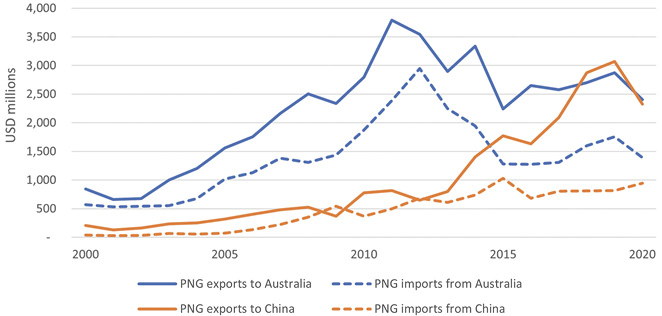
Figure 9.2: PNG exports to and imports from Australia and China, 2000–20
Source: Comtrade.
Investment from China grew in importance, as did the Chinese diaspora. The number of Chinese in PNG grew from only 5,000 in 2007 (including 3,000 of Chinese ethnicity born in PNG) to about 20,000 in 2020, mainly driven by new arrivals from China (Liu 2022). This is about double the number of Australians in PNG, which is estimated at about 10,000 (Australian Department of Foreign Affairs and Trade n.d.). Chin (2024, 89) has argued that the Chinese community ‘were the biggest beneficiary of the sell-off of white businesses after Independence and after the dramatic fall in the value of the kina in the 1990s’ and that new Chinese migrants have ‘become the largest investors outside the oil and gas sectors’.
PNG signed up to Beijing’s Belt and Road Initiative in 2018. While China has become an infrastructure financier, it has not become a major creditor. The more important role has been played by Chinese companies as infrastructure contractors on government- or multilateral-financed projects.
PNG has also benefited from Australia’s greater generosity in its dealings with its former colony in response to fears about China, especially that it might seek to establish a military base. This has extended from providing an undersea cable free of charge (9.1.1), to providing massive and at times unconditional budget support (8.3.5). Other Western countries have also ‘stepped up’, including the United States, which in 2023 signed a new military agreement with PNG.
9.3 Conclusion
KK Kingston, founded in 1972 in Lae, is a household name in PNG and a leading producer of household goods, paper products and cooking oil. It employs some 800 staff. In 2015, the CEO was quoted as saying: ‘It is increasingly difficult for businesses like KK Kingston to obtain foreign currency as and when we need it’ (Business Advantage PNG 2015). In October 2016, the company announced it was laying off 10 per cent of its workforce. Michael Kingston, CEO and son of the company’s founder, highlighted ‘lower economic activities in the mining, petroleum, resources and other economic generating activities in the country’ (Bailey 2016). Three years later, he commented on the mistakes made in the last boom in which, he says, Kingston ‘over-invested in assets and capacity … and we took on too much debt in anticipation of sustained growth that didn’t eventuate’. Now, by contrast, the company is ‘avoiding additional investment, reducing debt and looking to eke out more efficiencies’ (James 2019a).
The quiet bust was not a good period for PNG. Non-resource GDP growth was the lowest recorded for our four periods, and it was the only period in which formal sector employment consistently fell.
This period also stands out for very different macroeconomic outcomes compared to the other periods, including a record current account surplus and fiscal deficits, and record low imports and resource revenue (all controlling for GDP).
The bust was caused by a precipitous decline in revenue flowing to government from the resource sector that caught both government and businesses unaware. Businesses, finding themselves with excess capacity, went into retrenchment mode. A lack of new resource projects, higher costs due to a lagged Dutch disease and the pandemic intensified and elongated the downturn. The central bank made things worse by introducing foreign exchange rationing, and not allowing the exchange rate to adjust.
This abandonment of currency convertibility was the biggest policy change of the period. It compressed imports, encouraged fiscal profligacy, discouraged foreign investors, and induced rent-seeking to get to the front of the queue. Although it is an unusual strategy, PNG is not the only country to engage in foreign exchange rationing for a prolonged period. A 2020 study of Ethiopia, a relatively successful African economy, found that:
the main binding constraint on the country’s economic growth is the shortage of foreign exchange (forex). The forex shortage chokes output in nearly all sectors of Ethiopia’s economy … Stakeholder interviews repeatedly emphasized the time and opportunity costs associated with securing forex and the government’s unpredictable prioritization and allocation of forex uses. (Deren and Motamed 2020, 6–7)
Much the same could be said about PNG. Recent reforms to reduce the extent of rationing (8.3.1) notwithstanding, rebuilding confidence in the kina will be difficult, as its prolonged non-convertibility has made it an undesirable currency to hold.
Economic nationalism was growing in PNG before the boom ended and the bust began, but the poor growth performance during the bust period no doubt added strength to the argument that something new was needed—that PNG is missing out if not being exploited, that tariffs need to be increased, that more sectors need to be reserved for national businesses and that national champions need to be created in the resource sector. However, most of these policies have been tried before in the eighties. The notion of national champions is new, but it seems neither affordable nor sensible. Indeed, such policies may worsen the investment climate. The saving grace is that the rhetoric has been more nationalistic than the actual policy, which has been tempered by pragmatism.
The quiet bust ended in 2022 with record-high commodity prices, increased resource revenue and, at last, higher growth. It is too early to say what period PNG is in now. At the time of writing, foreign exchange rationing has been reduced but not ended, and business leaders still speak of a lack of confidence (Esila 2023). The PNG economy is out of the bust, but not out of the woods.
1 The Kumul Consolidated Holdings Authorisation (Amendment) Bill 2021.
2 The 2015 plant was established for mackerel processing in 2012 and expanded production to include tuna in 2015.
3 This preference was first established under the Contonou Agreement between the ACP (African, Caribbean and Pacific) countries and the EU. When that expired in 2007, PNG and Fiji negotiated so-called ‘interim’ Economic Partnership Agreements.
4 Since 2014, the Philippines has also enjoyed duty-free access to the European Union (Canivel 2020).
5 Oil Search (2019) said that the rationale for the loan was that ‘the PNG Government wanted to maintain a shareholding in the country’s biggest oil and gas company and the largest investor in-country’. O’Neill said at the time that: ‘For the people not to own shares in their own company is completely out of mind for me to comprehend that people can even justify their argument’ (Garrett 2014). The problem with this rationalisation is that the decision that PNG needed to hold shares in Oil Search was so quickly reversed.
6 Although the loan was to be repaid by Kumul Petroleum, the company was still then being established and (perhaps for that reason) initially the loan was to the government, but outside of the normal budgetary approval process, thereby raising questions of legality.
7 The Organic Law on Papua New Guinea’s Ownership and Development of Hydrocarbons and Minerals and the Commercialisation of State Businesses 2020 was drafted but not tabled.
8 O’Neill himself said at the time: ‘A lot of our people lost hope and trust that we leaders were capable of delivering. But now there is a generational change in the leadership, and people are expecting a big shift in the way we do business and manage the country. It’s a time to hope again’ (Callick 2012).
9 O’Neill got a series of amendments through parliament in 2013 to reduce the risks of being deposed (7.2.1); these were rejected by the Supreme Court in 2015. In 2014, he proposed a further constitutional amendment that would require that if a vote of no confidence was successful, then the new prime minister would have to come from the party with the largest number of seats in an election. However, this was widely opposed, including by Attorney General Kerenga Kua, who was sacked as a result, and it never got up (Cochrane 2014b).
Previous Next