


 menu
Rethinking Histories of Indonesia
5
Dealing with modernities: East Java’s plantation society in colonial times and the revolution
In 1934 the Dutch East Indies Government completed four years of construction work on the South Semeru Road (Zuid-Smeroeweg)—a project that had been planned since 1913. The new road connected Malang and Lumajang, which made possible travel by car in this southern part of East Java. A famous part of this road was a bridge across the Besoek Koboan River that was difficult to construct due to the contours of the hills at each end of the bridge.1 The road was so important for East Java that a large ceremony was held for its opening, as reported by the Dutch-language Surabaya newspaper Soerabaiasch Handelsblad (‘Surabaya Commercial Paper’) on 2 November 1934. In an array of speeches, Mr Schmidt, a surveyor from Kooy and Co., one of the plantation companies operating in Malang and Lumajang, stated that ‘the planters felt somewhat like parents of the Zuid Smeroeweg’ and were proud of how ‘the baby’ had grown.2

Figure 5.1 Bridge on the South Semeru Road from Malang to Bondowoso, 1939
Source: Leiden University Library digital collection.
The report on the opening ceremony indicates that the construction of the South Semeru Road was driven by the business agendas of plantation companies in East Java. The road connected different plantations in Malang and Lumajang that were previously only accessible with horses and carts. This meant that crops produced on those plantations, such as rubber and coffee, could be more easily and quickly distributed. While the South Semeru Road project fulfilled the agenda of the plantation owners, the surrounding villagers were supposed to join in and celebrate the road during the ceremony. The villagers were instructed to prepare the roadside in advance to welcome the guests at the opening ceremony. They hoisted flags as a welcoming gesture, but the result was not as expected. The Soerabaiasch Handelsblad reporter wrote specifically about these flags:
The flags fluttered happily in the village of Soemberrowo next to the houses. We could see countless variations of our national flag … purple-white-brown, bright red-white-lilac, amber-white-green, etc. The white colour was always in order, in any case, after 300 years of colonisation people are already starting to approach our tricolour [flag] nicely, another 300 years and they will understand it perfectly.3
In this cynical comment, the journalist suggests that the locals were unable to follow instructions and simply display the tricoloured Dutch flag of red, white and blue. Instead, the villagers prepared and displayed flags of a mix of colours—far from what was intended. This could have been for several reasons, including that the villagers did not have cloth of the required colours or it was an act of local subversion. Either way, without trying to understand the causes, the journalist adopted a highly colonial tone, emphasising the need for 300 more years of colonisation for the villagers to properly understand the Dutch national symbol. The journalist harshly implies that Indonesians were slow learners and in need of further education.
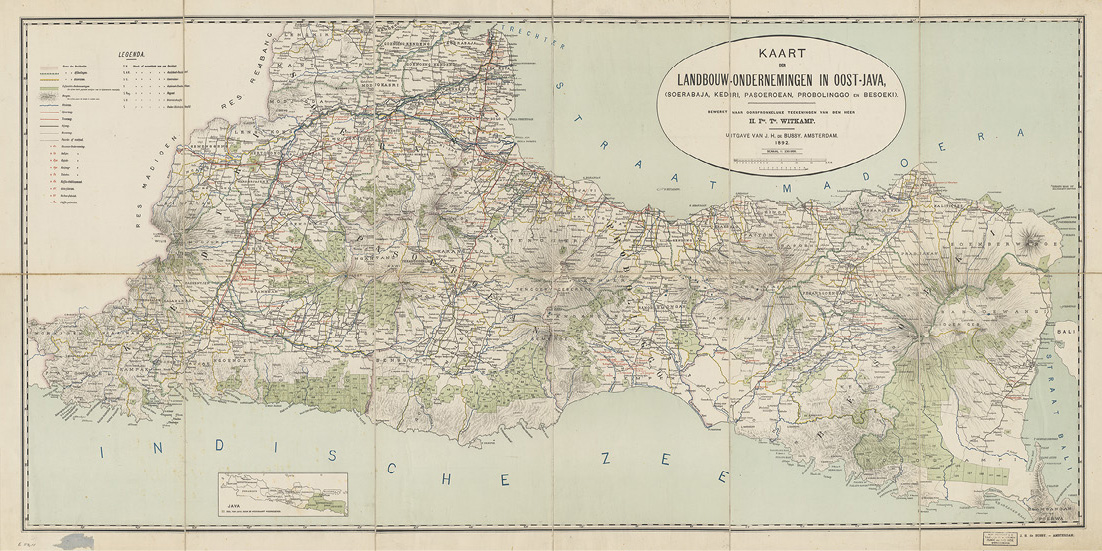
Map 5.1 Agricultural enterprises in East Java (Surabaya, Kediri, Pasuruan, Probolinggo and Besuki), adapted from original drawings by Mr H. Ph. Th. Witkamp, 1892
Source: Leiden University Library digital collections.
Nevertheless, the newspaper article about the opening of South Semeru Road was not just a report on a successful Dutch infrastructure project. The article presents the new road and flags as symbols that differentiate Dutch advancement and modernity (the high technology of road construction) from local ‘backwardness’ (the inability to understand the colour of a Dutch flag). As in other colonial states, infrastructure projects were built to pave the way for modernity—a process within which locals were expected to become educated and advanced.4 But, as Khusyairi and Colombijn have argued, modernity serves particular groups while excluding others.5 The South Semeru Road was built to accommodate the plantation economy in East Java, but along the way the effects of the road on local residents—those who could not put up the correct-coloured Dutch flag—were never considered.
The main aim of this chapter is not to add to the extensive literature on the injustice or exclusion of colonial modernities.6 What I intend to do is examine how the marginalised—in this case, the Indonesians—interpret, imagine and utilise modernity, and for what reasons. In other words, my aim is to scrutinise colonial modernisation not merely as a system imposed by the colonisers, but also in terms of the desires and agency of the colonised. For this aim, I chose to delve into the lives of local people working in the plantation society in South Malang. As Ann Stoler argues, modernity projects within plantation societies are part of a ‘larger effort of colonising bodies and minds in a sustained, systemic, and incomplete political project’.7 This chapter focuses on two plantations in the districts of Donomulyo and Dampit in Malang, East Java. To bring forward the agency of plantation workers and their interpretations of modernity, I provide a critical reading of archival sources from the colonial period, such as plantation reports and newspaper articles between 1900 and the 1930s, and combine these with oral sources collected during my fieldwork in 2017–18 from the second generation of plantation workers.
Modern plantations, modernising lives
The rapid investment of capital in plantations, particularly in the nineteenth century, transformed local society. This can be seen through the boom of plantation companies that was related to the establishment of the 1870 Agrarian Law. The law enabled European entrepreneurs to lease sawah (‘wet rice’) land from the local population on an annual basis. Moreover, allegedly uncultivated lands known as ‘waste’ lands could be leased from the colonial government under hereditary leases (erfpacht) for up to 75 years.8 The law soon contributed to the rise of private, European-owned plantation companies throughout the archipelago, including in Malang. From 1881 to 1884, almost one-third of the coffee production in Java came from Malang and, in 1922, the regency contributed 19.6 per cent of the total coffee production in Java and Madura.9
Following the extensive growth of plantation companies, infrastructure was developed to support the mobilisation of crops and people, such as the South Semeru Road. In 1879, a new railway was opened, connecting Surabaya, Pasuruan and, later, Malang. In 1901, the tramway in Malang City was opened, carrying people and crops from the plantation areas into the city and vice versa.10 Newly built residential areas and other infrastructure such as a market, slaughterhouse and water plant marked Malang’s new status as a modern city.11 These developments characterised what Anthony Reid refers to as the ‘high colonial period’ between 1870 and 1930, when increasing colonial capital was used for the extensive development of infrastructure: railways, roads, harbours and port cities.12
Moving away from cities towards plantation areas, modernisation manifested in the use of technology. One example is NV Kali Tello, a rubber and coffee company that was established in 1895 in Donomulyo, South Malang. In 1922, the company occupied 1,465 bouw13 (1,026 hectares) of land, of which 207 bouw (145 hectares) was used for the factory, houses, kampongs (‘villages’) and roads, while the remainder was given over to the coffee and rubber plantations. The rubber factory can be considered modern, for example, because of the use of machines and running freshwater to produce latex.14 A further sign of modernisation was the use of electricity in the factory, which also opened access for the neighbouring kampong.15 After the acquisition of the adjacent Poerwodadie plantation, NV Kali Tello established a special crop transportation system, in 1926, between these two plantations, comprising 2.6 kilometres of electric cable car (kabelbaan).16
Growing infrastructure such as roads and train systems also facilitated mobility, which led to an increased supply of labour. The 1907 Dutch government report Research on Declining Welfare (Mindere Welvaart Onderzoek) recorded that, between 1880 and 1885 and the opening of the plantations and the train connection from Surabaya to Malang, the population in Pagak subdistrict, South Malang, had tripled. There were thousands of new labourers from Central Java working for the plantation companies.17 People also travelled from Madura to the plantations, particularly in the regions of Pakis, Sengguruh, Gondanglegi and Turen. Plantation managers and owners preferred these workers to local people, who apparently had higher demands for their labour.18
Migration led to a surplus of contract labour in the South Malang area. However, this does not necessarily mean that labour recruitment was easy for the companies. NV Kali Tello’s yearly report described competition with other industries, particularly sugar factories, which offered better pay, which led to ongoing difficulties in recruiting labourers for their plantation. Furthermore, during planting seasons, locals opted to work on their own lands instead of for the plantation companies. To overcome this situation, plantations competed by offering alluring salaries and facilities to recruit labour. For example, Kali Tello plantation strove to bind its permanent workforce to the company by providing good housing.19 Health services were also established, particularly as a response to outbreaks of disease. When the bubonic plague hit Malang between 1910 and 1916, Kali Tello plantation provided vaccination for workers and converted their dwellings into rat-free houses by force.20 NV Kali Tello also provided free medicines, sent critically ill patients to the clinic in Malang and established an outpatient clinic in the plantation area. The residents of the plantations could also be treated by a doctor, who came from Malang once a week.
As well as health care, plantation companies provided entertainment for their workers. This is illustrated by Prambodo (pseudonym), the son of a former middle-level overseer in Gladakan Pancur plantation in Dampit. Born in 1930 on the plantation, Prambodo explained that, every week, the company organised shows for their workers:
The wage was given every week, on Saturdays. The lower-level overseer reported to the higher level, and the records were submitted to the factory, to another overseer, who was responsible for wages. So all work was reported every Saturday, and the workers received their payments … The Dutch were smart. Workers lived in the plantation area, a remote area. So they gave us entertainment. Every Saturday, there was entertainment, with tandak, or dancing. People also played with dice [a form of gambling]. From my observations, workers became occupied with this entertainment, while the Dutch went to Malang. They went to bowling centres, hotels, while the workers drank. They gladly joined in tandak, and other activities, that drained their money. And when their money was gone, they would work again on Monday.21
Prambodo’s experience shows how the plantation managers used entertainment as a strategy to keep their workers within the compound. Prambodo added that Chinese and Arab merchants also came to the plantation every week on payday to offer their merchandise. This further enticed workers to quickly spend their wages. The plantation was turned into an isolated compound full of facilities that were there not to support the workers’ welfare, but to maintain the capitalist production of the plantation.
It is important to note that, although modern plantation life was created to ensure the continuity of the company’s production, the drive towards modernity was not the monopoly of the colonisers. Prambodo illustrates this drive in his family’s motivation for education:
The Dutch would organise large events, such as art shows. Of course, the workers were happy. But on the top of that was colonialism … I witnessed those things. But I went to school, in Malang. And I return[ed] during vacations. So, how to describe it … I lived in the plantation, but I did not work there, in a sense I was a child of the plantation. No, I went to school [Rooms-Katholieke Hollandsch Inlandsche School, Dutch Roman Catholic School for Natives]. Why did my father send me to school? Because my father mingled with the plantation staff who graduated from HBS, AMS, HIK.22 This is where plantation staff usually came from. My father mingled with those people, so he thought of his children’s improvement, by sending us to school in Malang so that we wouldn’t work in the factory. But all the kids my age worked in the factory, some in the plantation, others on the road … My father was given a position as a middle level overseer, so he did not directly tend the crops. But he was also considered an elder, someone who took care of residents in the plantation. Like a community leader.23
Prambodo realised his family’s distinct position in the plantation society. His father envisioned education as the path to social change for his family, which was inspired by a circle of highly educated personnel in the plantation. Prambodo’s access to education was a result of his father’s position in the plantation, which was different from other Indonesians, most of whom were labourers. Prambodo’s family was middle class with certain privileges. This shows that individuals within the plantation society were never equal and, therefore, access to modernity also depended on class differentiation.
Implementing security and law, but whose justice?
Modernity also created new concepts of ownership: a strict line between what belonged to the plantation owners and what did not. The 1920 annual report of Kali Tello company stated that it built a long wall more than 2.5 metres high to surround the plantation area. The main purpose of the wall was to protect the plantation against coffee theft.24 Thefts were conducted by groups whose members had familial connections with plantation labourers and were a growing concern in the early 1900s in this area.25 As a response to these cases, the government established the koffie-passen stelsel (‘coffee pass system’) in the 1920s—a pass that local owners in Malang were required to possess, process or transport coffee. The pass was considered necessary because of the frequent coffee theft, caused by the boom in prices for coffee in the 1920s and insufficient security on plantations.26 However, when coffee prices fell dramatically during the Great Depression in 1929–30, and the security system had been improved, the passes were abolished.
Coffee thefts seem to have involved different modus operandi. Some were cross-border district operations, while others were quite local. For example, Soerabaiasch Handelsblad on 23 June 1934 reported that a group of five farmers from Donomulyo village stole 60 katti27 (30 kilograms) of coffee and sold it to another farmer in the village for a total of 86 cents.28 Another thief, named Karim, who was imprisoned for three weeks in 1933, stole 0.5 picol29 (31 kilograms) of coffee beans, which he sold to his niece in the same village. It was not uncommon for women to be involved in these activities. For example, the Soerabaiasch Handelsblad on 22 September 1939 recorded that two women were caught stealing coffee from Poerwodadi plantation. One had already been sentenced three times for the same act and the other received additional punishment for using a fake name during her arrest. In another incident, five women plantation workers in Kali Tello were caught stealing 2–3.5 kilograms of coffee. These women were arrested in their homes and sentenced to one month in prison.30
Of course, for the plantation companies, these acts were considered harmful. They used different security forces to guard the plantations from theft, which entailed high costs. In 1922, the Kali Tello administrator estimated that 20 per cent of coffee beans were lost to theft. This drove the management to ask for protection from the head of the regional administration, who sent 40 infantry men under the command of an officer. However, the presence of the infantry was not very useful because they had no authority to arrest the thieves.31 In 1924, the head of the military was stationed on company land and authorised to conduct house searches.32 The expenses related to the military and police were charged to the company. However, because these security forces were still considered inadequate, the company employed their own plantation guards and established a barbed-wire fence to increase security.33 The company guards possessed police equipment and cooperated with security forces from other companies and the village heads. The company spent ƒ4,300 a year on security alone.34 It was only in 1939 that the thefts began to decrease.
The colonial state and the plantation owners regarded these thefts as criminal acts. Cases were brought to the district court, with sentences that ranged from weeks to six months. However, this is a one-sided view of criminality. As illustrated by the police and justice report Research on Declining Welfare, laws concerning ownership were interpreted differently by the colonial government and local people. While theft of coffee was considered a ‘heavy’ criminal act by the government, workers and those living adjacent to the plantations did not think of the act of taking coffee in the same way.35 In another example, the newspaper De Avondpost (‘The Evening Post’) reported that although coffee thefts were spreading ‘like cancer’ in South Malang, the act was not considered as a misdeed by the thieves.36 There was never a unified conception of law in the colonial period, because the law was constructed and imposed by colonial authorities to sustain their power rather than being a mechanism to establish justice. Even if laws such as those used to prosecute coffee theft functioned as mechanisms of justice, we are left with the question: whose justice?
Going further than conceptions of law, these thefts point to a more substantial problem than mere criminality. This problem emerged as an effect of the 1870 Agrarian Law, which enabled private companies to directly rent land from landowners (in a system known as erfpacht). For large farms, a maximum of 250 hectares of land could be leased for 75 years.37 In reality, implementation of the law involved a certain degree of manipulation, such as forcing villagers to convert their tilled land into erfpacht land, therefore leasable to companies. In the long run, as plantation companies began to grow, the amount of good-quality tilled land was reduced and became inaccessible to local farmers.38 This is what Tania Li points to as the process of dispossession—a condition in which people can no longer sustain their own lives through either direct access to the means of production or access to a living wage.39 In the case of plantations in South Malang, incidents of coffee theft are presumably related closely to the effect of this dispossession of land. This could explain why coffee thieves did not consider their acts as misdeeds. For them, it was a strategy and implementation of their agency to tackle their dispossession.
Claiming modernity in the revolution
In general, plantations in Indonesia experienced massive transformation during the Japanese occupation of 1942–45. The Japanese rapidly took control of Java and started to exploit the island’s economic resources to support their military operations during the war. Farmers had almost no freedom to choose the crops planted on their land.40 Most of the plantation areas owned by Dutch companies were transferred to Japanese enterprises, such as the case of 80 Dutch-owned sugar companies in Java that were distributed among six Japanese corporations.41 Although the Imperial Japanese Government in Indonesia launched a massive campaign to increase food production, output in fact dropped sharply, in part because the amount of land for growing food crops decreased when the land was used for the production of non-edible crops.42 Another factor that contributed to a decrease in food production was the insufficient number of labourers to work the land, because most had been mobilised for defence and the production of military-related resources.43
After the Japanese surrendered, Indonesians were forced to defend their independence in the revolution of 1945–49. In this period, Dutch companies tried to reclaim their plantations. They put much effort into securing their properties—for example, by forming plantation guards comprising indigenous and a few European personnel under the companies’ direct management.44 However, on the republican side, plantations were also highly prized, which can be seen in several different functions of plantations in this period. First, crops were used to finance the war. Instead of giving employees a salary, they were paid with crops that were collected through compulsory donations from farmers. Regular farmers had to give up 20 per cent of their crops, half of which was given to the army and half to the civilian government.45 Every district was given the responsibility to provide food, money and travel funds for the military division within their area.46 This policy was very hard to control and often led to the military arbitrarily taking state-owned crops.47 Second, plantation lands were taken over by republican state forces and continued to produce crops. In some cases, the republican forces also divided this plantation land into farmland for incoming war refugees. Third, republican soldiers destroyed plantations as a tactic to prevent the return of the Dutch. Former plantation labourers then converted these ex-plantation lands into residential areas and farmland. These residential areas were called desa darurat (‘emergency villages’) because they sprang up in the emergency context of the revolution. While some of these villages were later formalised and included in the administrative government arrangements, in other cases, their inhabitants became a continuous focus of disputes between villagers and the state, such as the case of the current land dispute in Sumbermanjing Wetan, Malang.
The experiences of people living within plantation societies during the revolution were very different from the heroic depiction of this period in Indonesian historiography. Returning to Prambodo, the plantation overseer’s son in Dampit, he described the rubber plantation’s situation during the revolution as follows:
The plantations were strategically seized at that time, to support the guerrilla fighters in the mountains … The people planted [crops]. It was to support them. Besides the army, also to support the refugees. People from the city, from Malang, who migrated to the plantation area … After the transfer of sovereignty, they continued [to cut down the rubber trees] until everything was finished. Now it became the plantation village … It was scorched to the ground in the period of the second clash, in 1948. All the plantations were scorched … [T]he army brought bombs to the factory. The people who lived in the plantation were told to move away because they were going to blow it up. After the destruction, the people who lived in the mountains, that was it. Law was not working. The factory was destroyed, stripped down. Gosh, how can our people behave like this? All of it, the machines, the iron sheeting, were taken to build houses in the plantation … People took whatever they wanted, sold, or used them to build houses. Our family also built a house. The roof was previously reeds, but after the scorched earth, it was changed into iron sheet. Everybody took it.48
This experience in Dampit was replicated in Kali Tello plantation in Donomulyo. Marwono (a pseudonym), a farmer whose parents and grandparents worked in the plantation, described the revolution, saying it happened
[b]ecause people didn’t have land. The Dutch had already been sent home. It was the Dutch who had the right [to the plantation]. If we didn’t destroy it, they would return. That’s what they said, people said that. [Plants] were destroyed, everything was cut down to be planted [with] food crops. Some people walked around and burnt the factory … I didn’t really understand, but there was somebody who managed [the action]. My uncle was a guard at that time, a security guard. [Our family received] one farm, if I’m not mistaken, one hectare. The size depended on the number of family members.49
Marwono was a schoolboy at that time. Although he could not recognise the people who carried out these acts, he remembered the chaos in the plantation where his family had worked. Moreover, both Marwono’s and Prambodo’s families benefited from this chaos, for example, by obtaining land and materials for their houses. From both accounts, it seems that some plantation workers used the revolution to dismantle the colonial capitalists’ control of modernity—an opportunity to reverse their dispossession.
Perceiving modernity
The case of plantations in South Malang shows the proximity of colonialism, capitalism and modernity. Underlying the transformation of South Malang into a plantation society was systematic repression, the imposition of the ruler’s own knowledge production and, at the same time, the impeding of the cultural production of the dominated and the establishment of social and cultural control over them.50 In extreme cases of European cultural colonisation, peasant subcultures were condemned and replaced with formalised and objectivised expressions, through the cultural patterns of the rulers.51 Walter Mignolo goes even further by arguing that ‘there is no modernity without coloniality’.52 He argues that modernity is ‘a complex narrative that builds Western civilization by celebrating its achievements while hiding at the same time its darker side, “coloniality”’.53
I agree that colonialism is inseparable from modernity, but to perceive modernity merely in this way assumes that the concept itself is one dimensional: modernity is imposed and the colonised have no agency in its construction. According to Dipesh Chakrabarty, this unidimensional assumption stems from the tendency to perceive modernity as a binary. Tropes such as ‘premodern’, ‘backward’ and ‘medieval’ are used to define modernity itself.54 Chakrabarty then illustrates how the conception of modern versus backwardness or traditional is often not strict or clear in postcolonial India. Today’s India is more democratic (and, in that sense, more modern), enabling people to challenge older hierarchies of power and status.55 But this does not necessarily mean it is more civil. Chakrabarty writes: ‘Verbal, physical, and symbolic violence underwriting relations of domination and subordination are to be seen in every department of life: from relations of production to relationships in the family.’56 Modern democracy does not automatically diminish so-called traditional elements: local conflicts, patronage relations, family ties, factions, and so on. To define modernity in contrast to the traditional, then, is insufficient to understand the concept itself, because modernity is permeable, historically constructed, multifaceted and sometimes messy. Modernity is also mobilised and constructed by different people, both the colonised and the oppressed, and, as such, it encompasses what Susie Protschky describes as the ‘historical imagination’ of the Indies people.57
Therefore, to talk about colonial modernity is to look at how the concept is shaped, through what means and by whom. To do this, it is not enough to interpret modernity as an imposed act of colonialism. It is also necessary to interrogate how it is articulated and contested by the colonised themselves. According to Frederick Cooper, to elevate messy histories that shaped modernity into a consistent project underplays the efforts of colonised people to deflect and appropriate elements of colonising policies.58 Furthermore, Carol Gluck noted that, despite condemnation of colonial modernity, it also possessed a magnetism for reformers and revolutionaries, workers and peasants, elites and ordinary people who reached for modern ways of living and being.59 The Indonesian nationalist movement, the pribumi pangreh praja (native officials/government officers)60 and the urban middle class in the 1930s who were highly motivated to participate in a modern lifestyle61—all are examples of how modernity was also utilised for the agendas of Indonesians. Indonesian ‘wild literature’ of the 1930s is another example of how locals offered alternative versions of being modern, in which ideas of freedom were central.62 The life histories of plantation families, such as Prambodo’s, also illustrate how modern education was desired by middle-class overseer families. By glossing over such processes of engagement with modernity, we will have an incomplete understanding of colonial modernity. Furthermore, the violence and chaos in plantations during the Indonesian revolution show us yet another element of modernity. As Colombijn notes, a counter-colonial process of defining modernity did not reject the fundamental ingredients of modernity but challenged the assumption of its exclusive ownership.63 The cases of coffee thefts, destruction of plantations and land squatting during the revolution point to another dimension of modernity. These acts confronted the function of modernity as a catalyst of colonial capitalism through claims of property (be it coffee beans or land) and to shatter the monopoly of modernity that was once in the hands of the elites. Looking at the life history accounts of plantation communities, the revolution offered an opportunity to give a new meaning to modernity, which relates to the equality and agency of the Indonesians.
Conclusion
This chapter has articulated diverse interpretations of modernity not through the binary opposition between the colonisers and the colonised, but through their interactions and contestations. Plantation companies set the standards of modernity through the establishment of technology, facilities, housing, health care and security systems geared towards sustaining colonial capitalism. Health care and entertainment, for example, were provided to sustain workers within the plantation areas. At the same time, modernity created dispossession and exacerbated class differences. The case of coffee thefts indicates that the conception of property and legality that modernity brought was interpreted differently by plantation owners and locals.
However, this is not a complete picture of what modernity means. Focusing on the agency of the colonised, modernity is also the desires and goals of the locals or the colonised, which enable them to move towards social change. This move manifested in different forms, from ideas of independence to access to education. Nevertheless, this drive for modernity among the colonised does not necessarily mean that every group has equal access to achieve it. The opportunity to claim this equality emerged with the revolution. The destruction of plantations as a republican war tactic presented the chance for villagers to claim land or materials that once belonged to the colonial elites. In this case, violence became an extreme means to assert modernity.
References
Primary sources
Dutch East Indies Welvaartcommissie [Dutch East Indies Welfare Commission], Batavia. 1907. Onderzoek Naar de Mindere Welvaart Der Inlandsche Bevolking Op Java En Madoera. [IX, Economie van de Desa]: Samentrekking van de Afdeelingsverslagen over de Uitkomsten Der Onderzoekingen [Inquiry into the Declining Prosperity of the Domestic Population in Java and Madura. (IX, Economy of the Village): Merging of the Departmental Reports about the Outcomes of the Inquiries]. Ministerie van Koloniën: Collectie Grijs [Ministry of the Colonies: Grijs Collection]. Inv. 2.10.64. Box 21, folder 21.4. The Hague: Nationaal Archief [National Archives].
Dutch East Indies Welvaartcommissie [Dutch East Indies Welfare Commission], Batavia. 1907. Onderzoek Naar de Mindere Welvaart Der Inlandsche Bevolking Op Java En Madoera. [Recht En Politie]: Samentrekking van de Afdeelingsverslagen over de Uitkomsten Der Onderzoekingen [Inquiry into the Declining Prosperity of the Domestic Population in Java and Madura. (Law and Police): Merging of the Departmental Reports about the Outcomes of the Inquiries]. Ministerie van Koloniën: Collectie Grijs [Ministry of the Colonies: Grijs Collection]. Inv. 2.10.64. Box 21, folder 21.4. The Hague: Nationaal Archief [National Archives].
Soerabaiasch Handelsblad. 1931. ‘De Nieuwe Koffie Ordonantie [The New Coffee Regulation].’ Soerabaiasch Handelsblad [Surabaya Commercial Paper], 13 July.
Soerabaiasch Handelsblad. 1934. ‘Koffiediefstallen [Coffee Thefts].’ Soerabaiasch Handelsblad [Surabaya Commercial Paper], 23 June.
Soerabaiasch Handelsblad. 1934. ‘Feestelijke Opening Zuid-Smeroeweg: Plantershulde Aan “Kennis Den Bruggebouwer” [Festive Opening of South Semeru Road: Planters’ Tribute to Acknowledge the Bridge Builder].’ Soerabaiasch Handelsblad [Surabaya Commercial Paper], 3 November. resolver.kb.nl/resolve?urn=ddd:011110054:mpeg21:p009.
Soerabaiasch Handelsblad. 1939. ‘De Koffiediefstallen in Zuid Malang [The Coffee Thefts in South Malang].’ Soerabaiasch Handelsblad [Surabaya Commercial Paper], 22 September.
Verslag Over Het Boekjaar 1902–1949 [Report on the Financial Year 1902–1949]. Internationaal Instituut voor Sociale Geschiedenis [International Institute of Social History]. Inv. ZK 60163. Amsterdam: Nederlandsch Economisch-Historisch Archief [Netherlands Economic History Archive].
Secondary sources
Barlow, Tani. 2012. ‘Debates Over Colonial Modernity in East Asia and Another Alternative.’ Cultural Studies 26, no. 5: 617–44. doi.org/10.1080/09502386.2012.711006.
Chakrabarty, Dipesh. 2002. Habitations of Modernity: Essays in the Wake of Subaltern Studies. Chicago: University of Chicago Press.
Colombijn, Freek, and Joost Coté, eds. 2014. Cars, Conduits, and Kampongs: The Modernization of the Indonesian City, 1920–1960. Leiden: Brill. doi.org/10.1163/9789004280724.
Cooper, Frederick. 2005. Colonialism in Question: Theory, Knowledge, History. Berkeley: University of California Press. doi.org/10.1525/9780520938618.
Farid, Hilmar, and Razif. 2008. ‘Batjaan Liar in the Dutch East Indies: A Colonial Antipode.’ Postcolonial Studies 11, no. 3: 277–92. doi.org/10.1080/13688790802226694.
Fauzi, Noer. 1999. Petani & Penguasa: Dinamika Perjalanan Politik Agraria Indonesia [Farmers and Rulers: The Dynamic Processes of Agrarian Politics in Indonesia]. Yogyakarta: INSIST, KPA, Pustaka Pelajar.
Frakking, Roel. 2014. ‘“Who Wants to Cover Everything, Covers Nothing”: The Organization of Indigenous Security Forces in Indonesia, 1945–50.’ In Colonial Counterinsurgency and Mass Violence: The Dutch Empire in Indonesia, edited by Bart Luttikhuis and A. Dirk Moses, 111–32. London: Routledge. doi.org/10.4324/9781315767345-6.
Gillen, Paul, and Devleena Ghosh. 2007. Colonialism & Modernity. Sydney: UNSW Press.
Gluck, Carol. 2011. ‘The End of Elsewhere: Writing Modernity Now.’ The American Historical Review 116, no. 3: 676–87. doi.org/10.1086/ahr.116.3.676.
Houben, Vincent J.H. 2002. ‘Java in the 19th Century: Consolidation of a Territorial State.’ In The Emergence of a National Economy: An Economic History of Indonesia, 1800–2000, edited by Howard Dick, Vincent J.H. Houben, J. Thomas Lindblad, and Thee Kian Wie, 56–81. Sydney: Allen & Unwin. doi.org/10.1163/9789004486454_012.
Hudiyanto, Reza. 2021. ‘Between Modernization and Capitalization: Commercialization of Malang in the Early Twentieth Century.’ Paramita: Historical Studies Journal 31, no. 1: 45–55. doi.org/10.15294/paramita.v31i1.20463.
Kano, Hiroyoshi. 1990. Pagelaran: Anatomi Sosial Ekonomi Pelapisan Masyarakat Tani di Sebuah Desa Jawa Timur [Pagelaran: The Anatomy of Social-Economic Layering Amongst Farmers in an East Java Village]. Yogyakarta: Gadjah Mada University Press.
Khusyairi, Johny A., and Freek Colombijn. 2015. ‘Moving at a Different Velocity: The Modernization of Transportation and Social Differentiation in Surabaya in the 1920s.’ In Cars, Conduits, and Kampongs: The Modernization of the Indonesian City, 1920–1960, edited by Freek Colombijn and Joost Coté, 249–71. Leiden: Brill. doi.org/10.1163/9789004280724_011.
Kurosawa, Aiko. 2015. Kuasa Jepang Di Jawa: Perubahan Sosial Di Pedesaan 1942–1945 [Japanese Power in Java: Social Transformation in Villages 1942–1945]. Depok, West Java: Komunitas Bambu.
Leksana, Grace T. 2023. Memory Culture of the Anti-Leftist Violence in Indonesia: Embedded Remembering. Amsterdam: Amsterdam University Press. doi.org/10.5117/9789463723565.
Li, Tania Murray. 2010. ‘To Make Live or Let Die? Rural Dispossession and the Protection of Surplus Populations.’ Antipode 41, no. s1: 66–93. doi.org/10.1111/j.1467-8330.2009.00717.x.
Mignolo, Walter D. 2011. The Darker Side of Western Modernity: Global Futures, Decolonial Options. Durham: Duke University Press. doi.org/10.1215/9780822394501.
Nawiyanto. 2020. Dari Rimba Menjadi Kota: Bank Indonesia Dalam Evolusi Malang Raya [From Forest to City: The Indonesian Bank in Malang’s Evolution]. Jakarta: Bank Indonesia Institute.
Nordholt, Henk Schulte. 2018. ‘Modernity and Middle Classes in the Netherlands Indies: Cultivating Cultural Citizenship.’ In Photography, Modernity and the Governed in Late-Colonial Indonesia, edited by Susie Protschky, 223–54. Amsterdam: Amsterdam University Press. doi.org/10.1515/9789048523382-009.
Pholsena, Vatthana. 2015. ‘Technology and Empire: A Colonial Narrative of the Construction of the Tonkin–Yunnan Railway.’ Critical Asian Studies 47, no. 4: 537–57. doi.org/10.1080/14672715.2015.1079985.
Protschky, Susie. 2014. Photography, Modernity and the Governed in Late-Colonial Indonesia. Amsterdam: Amsterdam University Press. doi.org/10.1515/9789048523382.
Quijano, Aníbal. 2007. ‘Coloniality and Modernity/Rationality.’ Cultural Studies 21, nos 2–3: 168–78. doi.org/10.1080/09502380601164353.
Reid, Anthony. 2015. A History of Southeast Asia: Critical Crossroads. Chichester: Wiley Blackwell.
Safitry, Martina. 2016. ‘Dukun Dan Mantri Pes: Praktisi Kesehatan Lokal Di Jawa Masa Epidemi Pes 1910–1942 [Shamans and Health Care Workers: Local Health Care Practitioners in Java during the Bubonic Plague Epidemic 1910–1942].’ Master’s thesis, Universitas Gadjah Mada, Depok.
Sapto, Ari. 2018. Republik Dalam Pusaran Elite Sipil Dan Militer [Republic in the Vortex of Military and Civilian Elites]. Yogyakarta: Matapadi Pressindo.
Sato, Shigeru. 2010. ‘Relocation of Labor and the Romusha Issue.’ In The Encyclopedia of Indonesia in the Pacific War, edited by Peter Post, William Bradley Horton, and Didi Kwartanada, 245–61. Leiden: Brill.
Stoler, Ann. 2010. Carnal Knowledge and Imperial Power: Race and the Intimate in Colonial Rule. Berkeley: University of California Press. doi.org/10.1525/9780520946194.
Sutherland, Heather. 1973. ‘Pangreh Pradja: Java’s Indigenous Administrative Corps and Its Role in the Last Decades of Dutch Colonial Rule.’ PhD diss., Yale University, New Haven.
1 This bridge in Lumajang is currently known as Jembatan Gladak Perak and is no longer used. It is preserved as cultural heritage and managed by the Lumajang district government. The colonially built Gladak Perak bridge was destroyed in the 1947 military actions by republican soldiers, but was rebuilt in the 1950s.
2 ‘Spr.gaf een terugblik naar den tijd, nu 25 jaar geleden, toen men te paard de ondernemingen bereikte en de auto wegens gebrek aan wegen nog van weinig nut was … doch diezelfde auto liet niet met zich sollen en zoo was en er weldra op uit, haar de noodige wegen te verschaffen. Spr.noemde den heer Andriessen, van “Soember Telogo”, die de eerste auto kocht, en herinnerde aan de heeren Onderwater en Van de Sandt, welke de eerste plannen smedden voor aan leg van een weg. De heer Schmidt, landmeter van Kooyen Co., deed destijds de eerste metingen, en zoo werd in 1913 deze weg reeds voorbereid. De planters gevoelden zich dus eenigszins als ouders van den Zuid-Smeroeweg en spr.voegde hier een geestig woord aan toe over den uitgroei van hun “baby” [Spr. recalled 25 years ago, when one reached the enterprises on horseback and the car was of little use because of the lack of roads … but that same car was not to be trifled with and so soon people were eager to provide it with the necessary roads. Spr. mentioned Mr Andriessen, from “Soember Telogo”, who bought the first car, and recalled Mr Onderwater and Mr Van de Sandt, who made the first plans for the construction of a road. Mr Schmidt, surveyor for Kooyen Co., took the first measurements at the time, and that is how this road was prepared in 1913. So the planters felt somewhat like parents of the South Meroe Road and Spr. added a witty comment about the growth of their “baby”].’ ‘Feestelijke Opening Zuid-Smeroeweg: Plantershulde Aan “Kennis Den Bruggebouwer” [Festive Opening of South Semeru Road: Planters’ Tribute to Acknowledge the Bridge Builder]’, Soerabaiasch Handelsblad [Surabaya Commercial Paper], 3 November 1934, resolver.kb.nl/resolve?urn=ddd:011110054:mpeg21:p009.
3 ‘Vroolijk wapperden in het dorpje Soemberrowo de vlaggen naast de huisjes; we ontwaarden ontelbare variaties op onze nationale vlag … paars-wit-terra cotta, cerise-wit-lila, amber-wit-groen, enz. De witte kleur was steeds in orde; in ieder geval begint men na 300 jaar kolonisatie onze drie-kleur al aardig te benaderen, nog eens 300 jaar en men is er glad achter [Merrily, in the village of Soemberrowo, the flags fluttered next to the houses; we discovered countless variations on our national flag … purple-white-terra cotta, cerise-white-lilac, amber-white-green, etc. The white colour was always in order; in any case, after 300 years of colonisation, they are starting to get pretty close to our three-colour, another 300 years and they will be smoothly behind it].’ ‘Festive Opening of South Semeru Road’, Soerabaiasch Handelsblad [Surabaya Commercial Paper].
4 For example, Vatthana Pholsena shows how the Tonkin–Yunnan railway construction project (between what is now Vietnam and China) was part of broader and more complex factors of imperial rivalry (particularly between France and Britain), the mise en valeur ideology of the French (colonisation must be cheap yet profitable) and the motive of introducing modernity with the hope that it would create a greater appreciation of the French’s presence. See Vatthana Pholsena, ‘Technology and Empire: A Colonial Narrative of the Construction of the Tonkin–Yunnan Railway’, Critical Asian Studies 47, no. 4 (2015): 537–57, doi.org/10.1080/14672715.2015.1079985, at 538–40.
5 Johny A. Khusyairi and Freek Colombijn, ‘Moving at a Different Velocity: The Modernization of Transportation and Social Differentiation in Surabaya in the 1920s’, in Cars, Conduits, and Kampongs: The Modernization of the Indonesian City, 1920–1960, eds Freek Colombijn and Joost Coté (Leiden: Brill, 2015), 249–71, doi.org/10.1163/9789004280724_011.
6 See, for example, Paul Gillen and Devleena Ghosh, Colonialism & Modernity (Sydney: UNSW Press, 2007); Tani Barlow, ‘Debates Over Colonial Modernity in East Asia and Another Alternative’, Cultural Studies 26, no. 5 (2012): 617–44, doi.org/10.1080/09502386.2012.711006.
7 Ann Stoler, Carnal Knowledge and Imperial Power: Race and the Intimate in Colonial Rule (Berkeley: University of California Press, 2010), 10.
8 Vincent J.H. Houben, ‘Java in the 19th Century: Consolidation of a Territorial State’, in The Emergence of a National Economy: An Economic History of Indonesia, 1800–2000, eds Howard Dick, Vincent J.H. Houben, J. Thomas Lindblad, and Thee Kian Wie (Sydney: Allen & Unwin, 2002), 56–81, at 65–66.
9 Hiroyoshi Kano, Pagelaran: Anatomi Sosial Ekonomi Pelapisan Masyarakat Tani Di Sebuah Desa Jawa Timur [Pagelaran: The Anatomy of Social-Economic Layering Amongst Farmers in an East Java Village] (Yogyakarta: Gadjah Mada University Press, 1990), 13.
10 Nawiyanto, Dari Rimba Menjadi Kota: Bank Indonesia Dalam Evolusi Malang Raya [From Forest to City: The Indonesian Bank in Malang’s Evolution] (Jakarta: Bank Indonesia Institute, 2020), 65.
11 Malang was inaugurated as a gementee (town, city or district with its own government) in 1914. Reza Hudiyanto, ‘Between Modernization and Capitalization: Commercialization of Malang in the Early Twentieth Century’, Paramita: Historical Studies Journal 31, no. 1 (2021): 45–55, doi.org/10.15294/paramita.v31i1.20463, at 50.
12 Anthony Reid, A History of Southeast Asia: Critical Crossroads (Chichester: Wiley Blackwell, 2015), 295–319.
13 1 bouw equals 0.7 hectare.
14 Verslag Over Het Boekjaar 1902–1949 [Report on the Financial Year 1902–1949], Internationaal Instituut voor Sociale Geschiedenis [International Institute of Social History], Inv. ZK 60163 (Amsterdam: Nederlandsch Economisch-Historisch Archief [Netherlands Economic History Archive]), 1920.
15 ibid., 1919.
16 ibid., 1926.
17 Dutch East Indies Welvaartcommissie [Dutch East Indies Welfare Commission], Batavia, Onderzoek Naar de Mindere Welvaart Der Inlandsche Bevolking Op Java En Madoera. [IX, Economie van de Desa]: Samentrekking van de Afdeelingsverslagen over de Uitkomsten Der Onderzoekingen [Inquiry into the Declining Prosperity of the Domestic Population in Java and Madura. (IX, Economy of the Village): Merging of the Departmental Reports about the Outcomes of the Inquiries], Ministerie van Koloniën: Collectie Grijs [Ministry of the Colonies: Grijs Collection], Inv. 2.10.64, Box 21, folder 21.4 (The Hague: Nationaal Archief [National Archives], 1907).
18 ibid.
19 Report on the Financial Year 1902–49, 1910.
20 For example, they did this by changing bamboo poles to solid teak poles so that rats would not hide in the cavity of the bamboo. Authorised personnel were assigned to villages to enforce the hygiene of houses. See Martina Safitry, ‘Dukun Dan Mantri Pes: Praktisi Kesehatan Lokal Di Jawa Masa Epidemi Pes 1910–1942 [Shamans and Health Care Workers: Local Health Care Practitioners in Java during the Bubonic Plague Epidemic 1910–42]’ (Master’s thesis, Universitas Gadjah Mada, Depok, 2016).
21 ‘Upahnya per minggu, tiap hari sabtu. Apa yang dikerjakan oleh mandor-mandor kecil dikumpulkan sama mandor besar, lalu datanya disetorkan ke pabrik. Ke sinder, yang bagian upah. Jadi semua hasil kerja Sabtu dilaporkan, lalu dia terima gajian … Itulah pintarnya Belanda. Mereka tinggal di perkebunan, daerah terpencil, sehingga dikasih hiburan. Tiap Sabtu dikasih hiburan, ada tandak, menari itu. ada orang main dadu. Sehingga saya amati, pekerja-pekerja itu disibukkan dengan kesenangan itu. Belandanya pergi ke Malang. Ke kamar bola, ke hotel, tapi pekerjanya dengan mabuk-mabuk, dengan senang hati dia senang main-main begitu, ada tandak, ada macam-macam, uangnya kan habis. Karena habis, dia semangat lagi Senin cari duit lagi [The wages are paid weekly, every Saturday. What the small foremen do is collected by the big foreman, then the data is submitted to the factory. To the sinder [office supervisor], the wage department. So all the results of Saturday’s work were reported, then he received his pay cheque … That’s how clever the Dutch were. They lived in plantations, remote areas, so they were given entertainment. Every Saturday they were given entertainment, there was tandak, dancing, people playing dice. So I observed that the workers were occupied with this fun. The Dutch went to Malang. He went to the ballroom, to the hotel, but the workers got drunk, they were happy to play around like that, there was tandak, there were all kinds of things, and the money ran out. Because he ran out, he was excited again on Monday to make more money].’ Interview with Prambodo, Malang, 29 July 2016, #14.04–15.57. This interview is also cited in Grace T. Leksana, Memory Culture of the Anti-Leftist Violence in Indonesia: Embedded Remembering (Amsterdam: Amsterdam University Press, 2023), doi.org/10.5117/9789463723565.
22 The Hoogere burgerschool (HBS) or middle school was specifically for Dutch, Europeans and limited Chinese and Indonesian elites. The algemeene middelbare school (AMS) was a form of high school for Indonesians. The Hollandse indische kweekschool (HIK) was a school for teachers who would go on to teach in Indonesian schools.
23 ‘Dibikinkan rame-rame sama Belanda. Ya kesenian, ya senang orang. Tapi sesungguhnya di balik itu ya menjajah … Saya menyaksikan itu. Tapi saya sekolah, sekolah di Malang. Kalau vakansi pulang. Jadi agak gimana ya, saya hidup di perkebunan, tapi saya gak ikut kerja di perkebunan, dalam arti anak-anak perkebunan. Ndak, saya sekolah. Kenapa bapak nyekolahkan saya? Karena bapak bergaul sama itu, sama staf-staf perkebunan yang lulusan HBS, AMS, HIK, itu kan staf perkebunan kan itu. Bapak bergaul sama orang-orang itu, sehingga punya pikiran untuk anaknya maju, disekolahkan ke malang. Jadi ndak ikut kerja di pabrik. Tapi anak-anak sebangsa saya kerjanya ke pabrik, ada yang kebun, ada yang ke jalan … Bapak diberi jabatan wakilnya sinder, dan dia tidak ada urusan kebun. Tapi dia juga sebagai sesepuh, orang yang ngopeni yang tinggal di kampung itu. Seperti tokoh masyarakat [It was made by the Dutch. Yes art, yes people were happy. But actually behind it is colonising … I witnessed that. But I went to school, to school in Malang. When I travelled, I went home. So it was a bit like, I lived on a plantation, but I didn’t work on the plantation, in the sense of the plantation children. No, I went to school. Why did you send me to school? Because you hang out with the plantation staff who graduated from HBS, AMS, HIK, that’s the plantation staff. You hang out with those people, so you have the idea that your children should progress, so you send them to school in Malang. So they didn’t work in the factory. But the children of my countrymen went to the factory, some to the plantation, some to the road … My father was given the position of deputy sinder, and he had nothing to do with the plantation. But he is also an elder, someone who takes care of the people who live in the village. Like a community leader].’ Interview with Prambodo, Malang, 29 July 2016, #18.18–21.25.
24 Report on the Financial Year 1902–49, 1920.
25 Dutch East Indies Welfare Commission, Inquiry into the Declining Prosperity of the Domestic Population in Java and Madura.
26 ‘De Nieuwe Koffie Ordonantie [The New Coffee Regulation]’, Soerabaiasch Handelsblad [Surabaya Commercial Paper], 13 July 1931.
27 One katti equals 0.5 kilogram.
28 ‘Koffiediefstallen [Coffee Thefts]’, Soerabaiasch Handelsblad [Surabaya Commercial Paper], 23 June 1934.
29 One picol equals 61.7 kilograms.
30 ‘De Koffiediefstallen in Zuid Malang [The Coffee Thefts in South Malang]’, Soerabaiasch Handelsblad [Surabaya Commercial Paper], 22 September 1939.
31 Report on the Financial Year 1902–1949, 1922.
32 ibid., 1924.
33 ibid., 1929.
34 ibid., 1930.
35 Dutch East Indies Welfare Commission, Inquiry into the Declining Prosperity of the Domestic Population in Java and Madura.
36 ‘Het oude zeer der koffielanden heeft aan het bestuur reeds heel wat hoofdbrekens gekost; het is tot een ingekankerd misbruik geworden en in vele streken voelt men het confiskeeren van koffiebes niet eens als misdrijf aan. Koffiepluk—koffiediefstal is er voldoende bewaking [The old pain of the coffee lands has already cost the administration many headaches; it has become an ingrained abuse and in many regions confiscating coffee berries does not even feel like a crime. Coffee picking—coffee theft is there enough surveillance]?’ De Avondpost [The Evening Post], [The Hague], 19 April 1933: 9.
37 Noer Fauzi, Petani & Penguasa: Dinamika Perjalanan Politik Agraria Indonesia [Farmers and Rulers: The Dynamic Processes of Agrarian Politics in Indonesia] (Yogyakarta: INSIST, KPA, Pustaka Pelajar, 1999), 36.
38 ibid., 36–41.
39 Tania Murray Li, ‘To Make Live or Let Die? Rural Dispossession and the Protection of Surplus Populations’, Antipode 41, no. s1 (2010): 66–93, doi.org/10.1111/j.1467-8330.2009.00717.x, at 67.
40 Aiko Kurosawa, Kuasa Jepang Di Jawa: Perubahan Sosial Di Pedesaan 1942–1945 [Japanese Power in Java: Social Transformation in Villages 1942–1945] (Depok: Komunitas Bambu, 2015), 4.
41 However, not all the sugar companies continued to produce sugar under the Japanese government. Of the 85 companies, only 13 continued their operations, while at least 17 were converted into cement factories and nine into spinning mills. ibid., 52, 61.
42 Shigeru Sato, ‘Relocation of Labor and the Romusha Issue’, in The Encyclopedia of Indonesia in the Pacific War, eds Peter Post, William Bradley Horton, and Didi Kwartanada (Leiden: Brill, 2010), 245–61, at 257.
43 Defence in this context included a range of military and semi-military activities. Production involved producing strategic resources such as oil, minerals, transport and clothing. ibid., 245.
44 See Roel Frakking. ‘“Who Wants to Cover Everything, Covers Nothing”: The Organization of Indigenous Security Forces in Indonesia, 1945–50’, in Colonial Counterinsurgency and Mass Violence: The Dutch Empire in Indonesia, eds Bart Luttikhuis and A. Dirk Moses (London: Routledge, 2014), 111–32, doi.org/10.4324/9781315767345-6.
45 See Ari Sapto, Republik Dalam Pusaran Elite Sipil Dan Militer [Republic in the Vortex of Military and Civilian Elites] (Yogyakarta: Matapadi Pressindo, 2018).
46 ibid.
47 ibid.
48 ‘Terus ditebangi jaman revolusi. Sehingga akhirnya kebun-kebun itu di samping juga jaman itu menguntungkan untuk menghidupi para pejuang yang bergerilya di daerah gunung-gunung itu … Rakyat itu nanam itu. Itu untuk menghidupi mereka-mereka itu. di samping untuk menghidupi tentara, juga menghidupi pengungsi. Orang dari kota, dari Malang, yang mengungsi ke perkebunan dari jaman penjajahan Belanda … dia hidupnya dari mana? Padahal dia ndak ada gaji. Ya hidupnya dari rakyat yang nanam kebun itu … hingga akhirnya berlanjut, sehabis penyerahan kedaulatan itu, ditingkatkan sehingga habis. Sekarang jadi desa perkebunan itu … Bumi hangus periode clash II, [19]48. Semua kebun-kebun itu dibumi hangus … dari tentara membawa bom ke pabrik. Rakyat yang tinggal di perkebunan disuruh menjauh karena itu diledakkan. Habis itu setelah diledakkan dan rakyat itu tinggal di pegunungan, ya udah, hukum tidak berjalan, sudah, dihabiskan pabrik itu. Diteteli. Aduh, kok bangsa kita begitu ya. Semua, mesinnya, sengnya diambili, karena untuk kepentingan rumah-rumah penduduk yang di kebun-kebun itu. Diambili, habis. Penduduk mengambil seenaknya sendiri untuk kepentingannya sendiri, ya dijual, dipakai untuk rumah. Habis. Ya gimana, jaman seperti itu. termasuk saya sendiri bikin rumah … Dulu atapnya dari alang-alang, tapi dengan adanya bumi hangus, bisa berubah jadi seng. Semua ngambili [Then it was cut down during the revolutionary era. So in the end, the gardens were also profitable at that time to support the fighters who were guerrilla warriors in the mountains … The people planted them. In addition to supporting soldiers, they also supported refugees. People from the city, from Malang, who fled to the plantations from the Dutch colonial era … where do they live? He has no salary. He lived off the people who planted the plantation … Until finally it continued, after the transfer of sovereignty, it was increased until it was exhausted. Now it is a plantation village … The scorched earth of the second clash period, [19]48. All the plantations were scorched … from the army bringing bombs to the factory. The people who lived on the plantation were told to stay away because it was blown up. After that, after it was blown up and the people lived in the mountains, that’s it, the law didn’t work, that’s it, the factory was destroyed. That’s it. Ouch, how come our nation is like that. Everything, the machine, the zinc was taken away, because it was for the benefit of the houses of the people in the gardens. Taken away, exhausted. The people take whatever they want for their own use, they sell it, use it for their houses. It’s gone. I myself built a house … The roof used to be made of reeds, but with the scorched earth, it was turned into zinc. Everyone took.’ Interview with Prambodo, Malang, 29 July 2016, #45.27–51.03.
49 ‘Karena rakyat gak punya tanah, Belanda sudah diusir pulang. Dulu yang haknya kan belanda. Yang berhak sudah pulang ke negaranya. Kalau ndak dibabat, nanti pulang ke sini kembali. Katanya gitu, orang-orang ngomong gitu. [Tanaman] dihancurkan, babat semua. Untuk tanaman polowijo. Untuk tanaman makanan bagi rakyat, gitu. Sebagian mlayu-mlayu mbakar pabrik itu … Saya juga gak tau, tapi ada yang ngatur gitu. [Paklik] jaman semonten njogo. Njogo keamanan … [Dapat] 1 kebon, kalo ndak keliru 1 hektar. Lihat banyak kecilnya anggota keluarga [Because the people didn’t have land, the Dutch had been driven home. In the past, it was the Dutch who had the rights. The rightful ones have returned to their countries. If you don’t clear it, you will come back here again. They say that, people say that. [Crops] were destroyed, cut down. For polowijo plants. For food crops for the people, that is. Some people burned down the factory … I don’t know either, but someone arranged it. My uncle at that time was guarding. As a security … [you received] one garden, if I’m not mistaken, 1 hectare. See how many family members there are.’ Interview with Marwono, Donomulyo, 16 September 2016, #14.42–22.10. This interview is also cited Leksana, Memory Culture of the Anti-Leftist Violence in Indonesia.
50 Aníbal Quijano, ‘Coloniality and Modernity/Rationality’, Cultural Studies 21, nos 2–3 (2007): 168–78, doi.org/10.1080/09502380601164353.
51 ibid.
52 Walter D. Mignolo, The Darker Side of Western Modernity: Global Futures, Decolonial Options (Durham: Duke University Press, 2011), doi.org/10.1215/9780822394501, 3.
53 ibid., 2–3.
54 Dipesh Chakrabarty, Habitations of Modernity: Essays in the Wake of Subaltern Studies (Chicago: University of Chicago Press, 2002), xx.
55 ibid.
56 ibid., xxii.
57 Susie Protschky, Photography, Modernity and the Governed in Late-Colonial Indonesia (Amsterdam: Amsterdam University Press, 2014), doi.org/10.1515/9789048523382.
58 Frederick Cooper, Colonialism in Question: Theory, Knowledge, History (Berkeley: University of California Press, 2005), doi.org/10.1525/9780520938618.
59 Carol Gluck, ‘The End of Elsewhere: Writing Modernity Now’, The American Historical Review 116, no. 3 (2011): 676–87, doi.org/10.1086/ahr.116.3.676, at 677.
60 Heather Sutherland, ‘Pangreh Pradja: Java’s Indigenous Administrative Corps and Its Role in the Last Decades of Dutch Colonial Rule’ (PhD diss., Yale University, New Haven, 1973).
61 Henk Schulte Nordholt, ‘Modernity and Middle Classes in the Netherlands Indies: Cultivating Cultural Citizenship’, in Photography, Modernity and the Governed in Late-Colonial Indonesia, ed. Susie Protschky (Amsterdam: Amsterdam University Press, 2018), 223–54, doi.org/10.1515/9789048523382-009.
62 Hilmar Farid and Razif, ‘Batjaan Liar in the Dutch East Indies: A Colonial Antipode’, Postcolonial Studies 11, no. 3 (2008): 277–92, doi.org/10.1080/13688790802226694.
63 Freek Colombijn and Joost Coté, eds, Cars, Conduits, and Kampongs: The Modernization of the Indonesian City, 1920–1960 (Leiden: Brill, 2014), doi.org/10.1163/9789004280724, 11.
Previous Next



