


 menu
Rethinking Histories of Indonesia
9
Beyond the point of no return: The re-emergence of Indonesian debates about concepts of the return of cultural objects
Introduction
The shift towards systemic and structural criticism as represented by decolonial and anti-racist paradigms includes worldwide calls to decolonise the museum. These calls have fuelled demands for the return of cultural objects acquired in colonial situations and held in museum collections around the world, especially, but not limited to, looted objects. Formerly colonised peoples no longer accept the historical injustices and ongoing inequalities created by colonialism that continue to be reflected in museum collections and exhibitions. Indonesians, for example, are thinking more critically about the display and place of Indonesian objects in museum collections in the Netherlands. The topic is also receiving increasing scholarly attention to the extent that there now exists an extensive body of research that has meticulously mapped the historical development of the political discourse on restitution of cultural objects from the Netherlands to Indonesia.1
Early work in this field was published at the start of the 2000s but debates really gained momentum from the mid-2010s. The findings of the 2020 Dutch report Guidance on the Way Forward for Colonial Collections: Colonial Collection—A Recognition of Injustice2 were implemented on 15 July 20223 and led to the appointment of an advisory committee to the Dutch Government on the return of cultural objects from colonial contexts.4 In Indonesia, the Committee for the Repatriation of Collections from Indonesia in the Netherlands (Tim Repatriasi Koleksi Asal Indonesia di Belanda) was set up in 2021 to advise the government on object repatriation.5 In 2024 a Dutch report, Omgaan met Gedeelde Bronnen van het Koloniale Verleden (Dealing with Shared Sources of the Colonial Past),6 advised conditional return of archival materials to source countries on a case-by-case basis.
While discussions about object return and provenance research have recently gained momentum,7 the history of return in the context of Indonesia can be traced back to the colonial period. As such, and as set out in Chapter 1 of this volume, these discussions can be understood as an ongoing process of decolonisation, which will be discussed below.8 Within this longer history, the Draft Cultural Agreement developed during the Dutch–Indonesian Round Table Conference (RTC; or Konferensi Meja Bundar) held in The Hague in 1949 is generally regarded as a turning point in the discourse of restitution. Legêne and Postel-Coster, van Beurden and Scott refer to Clause 19 of this agreement as evidence that restitution matters were already on the political agenda during the RTC negotiations. Clause 19 states:
Objects of cultural value, originating from Indonesia and which otherwise than by transfer of private law have come in the possession of the Netherlands Government or of the former Netherlands-Indies Government, shall be transferred to the Government of R.I.S. [Republik Indonesia Serikat, United States of Indonesia] in result of the transfer of sovereignty from the Kingdom of the Netherlands to the R.I.S.
For the effectuation of the provision in the first paragraph, the joint Committee shall propose on the footing of article 5 a separate regulation, in which provisions shall be included concerning a possible exchange of objects of cultural or historical value, being the property or in the possession of the one country and originating from or of importance to the other country.9
Legêne and Postel-Coster view the Draft Cultural Agreement as the basis for Dutch cultural policy and Dutch–Indonesian cultural relations after 1949. They point out that the Dutch Government ‘had considered the idea of returning objects of particular value as a goodwill gesture to mark the transfer of sovereignty in 1949’.10 Scott echoes this viewpoint and signals that the Dutch considered a return of cultural objects as ‘spare change’ in the political negotiations and an opportunity to build goodwill in the relationship with Indonesia during the RTC in 1949.11
Ironically, during negotiations about the return of objects, the Dutch shipped off the archives of the Netherlands Forces Intelligence Service (NEFIS) containing documents of the Indonesian Government before the signing of the sovereignty transfer agreement on 27 December 1949. The so-called Djogdja Documenten, which hold records of the Indonesian republican state institutions and leaders that the NEFIS seized during the Second Dutch Military Aggression in Yogyakarta, were sent to the National Archives of the Netherlands (Nationaal Archief, NA) in The Hague (see Karabinos and Theo’s Chapter 10 in this volume).
The fact that debates about restitution of cultural objects have largely been discussed from the Dutch perspective is chiefly due to the accessibility of the NA, which contains the complete archives of the RTC. However, given the nature of the RTC—and the moment of decolonisation—in which the terms of the independence agreement were negotiated, Indonesian discourses on the return of cultural objects deserve more attention. Therefore, this chapter, in the words of Rolando Vázquez, intends to ‘listen to the colonial difference’12 by foregrounding Indonesian voices, which is also a key theme of this volume. This chapter focuses on the development of the Draft Cultural Agreement from an Indonesian perspective over about two months during the RTC, and its finalisation on 28 October 1949. As Dutch discussions have been extensively documented, this chapter asks how Indonesian delegates discussed culture and how Clause 19 ended up in the Draft Cultural Agreement. What did the Indonesian delegates discuss in the subcommittee for cultural affairs? How was culture understood and interpreted, and how do Clause 19 and the return of cultural objects fit within this larger discussion of culture? How did Indonesian delegates’ conversations and attitudes change over the course of negotiations? Zooming in on the discussions of the Indonesian side during the RTC provides a better understanding of discourses of the return of objects and how these fit into the larger context of discussions about culture.
Although it was decided that no official records would be kept of the meetings of the Cultural Committee during the RTC, the NA holds copies of this committee’s reports, predominantly in Dutch and English,13 while the UN Archives have mostly English copies. Reports primarily in Indonesian can be found in the Arsip Nasional Republik Indonesia (ANRI, National Archives of the Republic of Indonesia) in Jakarta.14 As this chapter will show, language and translation play a crucial role in our understanding of the discussions of Clause 19 of the Draft Cultural Agreement. By examining the archives available at ANRI and the United Nations, this chapter aims to reconstruct the Indonesian debates about cultural objects before, during and after the Draft Cultural Agreement was formulated. In so doing, I seek to examine early Indonesian efforts to decolonise cultural objects and cultural rights and attempts to equalise relations between the former coloniser and the formerly colonised, while also paying attention to how ideas developed during the period of political decolonisation have evolved over time and persist today.
Colonial collection practices
The current call for the return of cultural objects can be regarded as a reaction to colonial collection practices that emerged in the mid-eighteenth century as a result of the European urge to map the world through the collection and display of objects. Colonial, ethnographic and anthropological museums attempted to understand and display the world and its inhabitants beyond Europe through a European lens. Benedict Anderson pointed to the role of the museum in empire-building in his seminal 1983 work, Imagined Communities.15 Tony Bennett describes in The Birth of the Museum how the museum became one of the major institutions that facilitated the development of new sets of knowledge such as geology, biology, archaeology and anthropology, but also history and art history. Crucial for each of these new disciplines was the selection and ordering of objects in evolutionary sequence to map human progress and development.16 As one of the core institutions of modernity, in addition to the university, the museum can thus be viewed as implicated in coloniality. The formation of collections, narratives and peoples presented to European audiences lay at the core of the establishment of normative cultural archives, world views and subject formations17 that facilitated the separation of Europeans from other peoples and worlds through the process of ‘othering’ and the formation of ways of knowing and, as such, has become a ‘cultural archive’.18
Through such colonial practices, large numbers of Indonesian objects were collected and shipped to Europe, especially the Netherlands (see also Isabella’s Chapter 13 in this volume). These objects included but were not limited to art, religious and historical objects, jewellery, natural history objects and utensils. Human and ancestral remains also ended up in Dutch museum collections as ethnographic objects. The Tropenmuseum (Museum of the Tropics) and Museum of Ethnology (both now part of the Wereldmuseum, or World Museum), Museum Bronbeek and the Rijksmuseum hold the largest collections of cultural objects, amounting to hundreds of thousands of artefacts acquired in colonial contexts. Many smaller museums also own collections of Indonesian objects, as do private individuals.19 Cultural objects were obtained by many different people and institutions in a multitude of ways. Pieter ter Keurs points to six different contexts in which objects were acquired: scientific expeditions, archaeological sites, individual collectors, colonial exhibitions, gifts and military expeditions. Individual collectors can subsequently be divided into subcategories, such as members of the civil service and the military, scientists, missionaries, private traders and art lovers.20 Some objects were stolen and some came to the Netherlands as war loot or booty, were taken from temples and shrines or were ‘given to’ or purchased by Dutch people during collecting expeditions.21 It is crucial to consider the fact that practices of colonial collecting took place in the context of unequal power relations. For instance, ‘gifts’ might in fact have been coerced from their owners and, as a result, these objects certainly differ from those that were given under equal circumstances.
Ownership, value and collection practices were already points of discussion during the colonial period in Indonesia, which in some cases led to the return of objects to their original location or owners. An early case of return is the three Ramayana reliefs of the Prambanan Temple that were returned from Siam (now Thailand) to their original location in 1926. The reliefs had come into the possession of King Chulalongkorn of Siam in 1896, after the Dutch colonial government, the Archaeological Society, local colonial civil servants and princes collaborated to gift five Buddha statues of the Borobudur Temple, four Ramayana reliefs from Prambanan and two Ganesha statues from the Singosari Temple to the king when he visited Java. Chulalongkorn, as king of independent Siam, had expressed his religious and scholarly interest in his request for the objects, which in turn became popular for Buddhist worship in Siam. In 1926, however, when indignation arose in Dutch public discourse in both the Indonesian archipelago and the Netherlands about the loss of and harm from the removal of Javanese antiquities from their original site, three of the four Prambanan reliefs were returned to the Dutch colonial government. Nonetheless, one Prambanan relief and the Borobudur statues had gained such popular status in Thailand that they remained there.22
Another case of return during the colonial period concerns the regalia of the Bone and Gowa kingdoms in South Sulawesi in 1931 and 1938, respectively. The museum of the Batavian Society for Art and Sciences (Bataviaasch Genootschap voor Kunsten en Wetenschappen) in Jakarta returned the regalia to the rulers of Bone and Gowa, who had argued that they were powerless without them.23 These two examples of return indicate that, during the 1920s and 1930s, disputes about the ownership and value of cultural objects had begun to emerge.
Principles for a cultural future: Equality and voluntariness
A little more than a decade after the return of the Gowa regalia, the RTC began, on 23 August 1949, in The Hague. The RTC followed a tumultuous and violent period of struggle between Indonesians and the Dutch, who attempted to retake their former colony in what became known as the Indonesian revolution. The Dutch favoured and pursued a federal system that would unite the Republic of Indonesia (RI)—dominant in Java and Sumatra—with six autonomous or non-republican negara (‘states’) into the so-called United States of Indonesia (Republik Indonesia Serikat, RIS). The RIS in turn would be part of the Netherlands–Indonesian Union, after which the Dutch would formally ‘transfer sovereignty’ to the RIS.24 During the RTC, the non-republican states (see Map 9.1) unified in the Dutch-sponsored Bijeenkomst voor Federaal Overleg (BFO, Federal Consultative Assembly) together with the republic started to negotiate the terms of the independence agreement with the Kingdom of the Netherlands under the supervision of the United Nations. The Dutch State and the republican government dominated the negotiations, which focused largely on political, economic and military matters, while the BFO played a relatively minor role. Even though culture was considered of minor importance to the negotiations, a subcommittee was formed to discuss cultural matters.
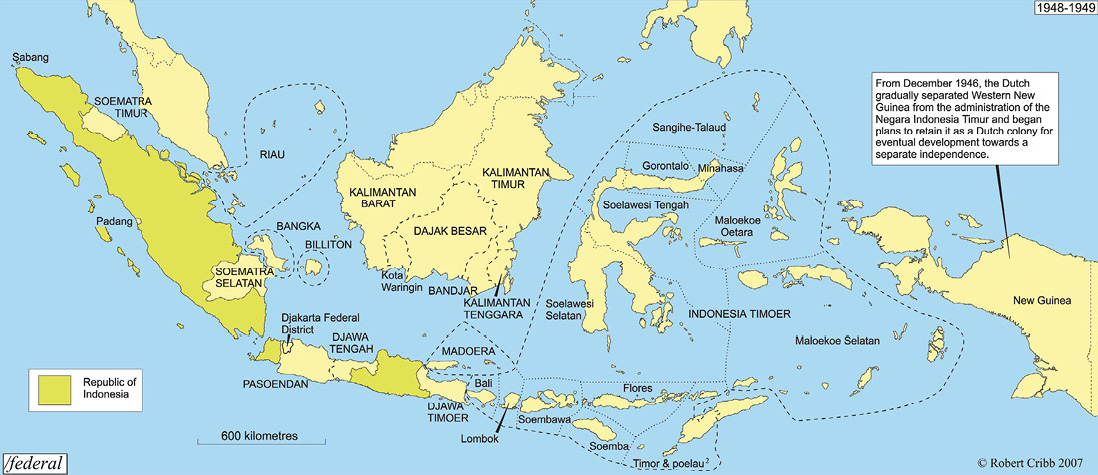
Map 9.1 Federal Indonesia, 1948–1949
Source: Robert Cribb, Digital Atlas of Indonesian History (Copenhagen: NIAS Press, 2010). Reproduced with permission.
The republican Cultural Committee comprised cultural and political heavyweights Ali Sastroamidjojo (1903–76), Sunarjo Kolopaking (1906–72), Susuhunan Pakubuwono XII (1925–2004), Mangkunegara VIII (1925–87), Sim Ki Ay (dates unknown), Mohammad Yamin (1903–62) and Soesilo H. Prakoso (1917–81) as secretary. Ali Sastroamidjojo, trained as a lawyer, had served in various political roles in the republican government in the field of culture and education and joined the RTC as deputy chairman of the republican delegation.25 Kolopaking, too, was a lawyer and a sociologist, who served as Minister of Finance in 1945, and notably held the first sociology lecture in Bahasa Indonesia at Universitas Gadjah Mada in 1948.26 Susuhunan Pakubuwono XII inherited the throne just two months before the proclamation of independence and sold many of his assets to support the republic financially.27 Similarly, Mangkunegara VIII ceded all his assets in support of the republic, except those for cultural purposes.28 Trained in medicine, Sim Ki Ay advocated for the establishment of higher education in Indonesia and led the newly established Chinese association Chung Hwa Tsung Hui (CHTH; Federation of Chinese Organisations in Indonesia), which supported the republic with military, financial and logistic means.29 Mohammad Yamin was an advocate for uniting Indonesian language and identity (De Indonesische eenheidsgedachte). He fought for the inclusion of regional representatives within the Volksraad (‘People’s Council’) and promoted collaboration between Indonesia and the Netherlands in the cultural field.30 Notably, Sastroamidjojo and Yamin were also members of the Committee for State Administration, which dealt with matters of nationality and citizenship, as well as sovereignty. Sastroamidjojo was also a member of the Committee for Foreign Affairs and Kolopaking was on the Committee of Financial and Economic Affairs.31 This suggests that culture was viewed in relation to the politics of state, foreign affairs and economic matters. The perspectives of these men—there were notably no women serving on the cultural committee—would shape the ideas about Indonesia’s cultural future.
Looking at Indonesian cultural discussions, three strands emerge from the archives. There is material from the republican delegation, as well as information on internal coordination meetings between the republic and the BFO, which operated as one front in the negotiations with the Netherlands. Third, there are reports of the negotiations between the Indonesians (the RI and the BFO) and the Netherlands. From the reconstruction of these meetings, we learn that the principles as formulated at the end of the second session of the Inter-Indonesian Conference, on 2 August 1949, were leading throughout the negotiations.
During the first internal meeting of the republican Cultural Committee on 21 August, Sastroamidjojo, Kolopaking, Yamin and Soesilo crucially determined that the principles of the Inter-Indonesian Conference and ‘whatever was set/decided by UNESCO’ (the UN Educational, Scientific and Cultural Organization) would serve as guidelines for cultural negotiations with the Netherlands but were not further specified.32 The Inter-Indonesian Conference had been held between the republic and the BFO before the RTC. The BFO was formed on 15 July 1948 to coordinate the autonomous non-republican states such as Negara Indonesia Timur (State of East Indonesia), Negara Sumatra Timur (State of East Sumatra), Negara Pasundan (State of Pasundan) and Negara Jawa Timur (State of East Java). Initially, the BFO opposed the republic as they feared and rejected the ‘Javanisation’ of the entire Indonesian archipelago, while the republicans viewed the BFO as Dutch marionettes who supported Dutch imperialism. This opposition started to decrease when Ide Anak Agung Gde Agung (1921–99) was appointed Prime Minister of Negara Indonesia Timur. In his drive for Indonesian unity, he proposed the Inter-Indonesian Conference to coordinate the positions of the republic and the BFO in the leadup to the RTC.33
During the first session of the Inter-Indonesian Conference (20–22 July), several committees convened,34 but no cultural committee gathered, for reasons unknown. Outstanding issues were discussed during the second session of the Inter-Indonesian Conference (31 July – 2 August). This time a cultural committee formulated 10 mutual starting points for the BFO and the republic in their negotiations with the Netherlands. These included the development of an Indonesian National Culture for all Indonesian people, being a ‘synthesis’ of the cultures of various areas throughout the United States of Indonesia, based on ‘godliness, humanitarianism and democracy’ with Bahasa Indonesia as the uniting language to be used for education and culture. International cultural cooperation was considered beneficial for the development of an Indonesian National Culture but must be based on the principles of equality and voluntariness,35 in contrast with the unequal power relations in, and coerced nature of, colonialism. Sovereignty thus was considered crucial for cultural collaboration. Notably, the return of cultural objects was not mentioned in the reports of the Second Inter-Indonesian Conference.
During the first internal meeting of the republican cultural delegation, representatives reiterated what the principles of the inter-Indonesian conferences meant for negotiations with the Netherlands. Culture was understood very broadly and must be based on education and knowledge to build a ‘national spirit–character’, expressed in Dutch as ‘nationale geest–karakter’, which could support a sovereign republic. Kolopaking emphasised that sovereignty must be the basis for cultural collaboration with the Netherlands, while Sastroamidjojo added that cultural collaboration with any foreign country had to be based on the principles of ‘equality/voluntariness’ (gelijkwaardigheid/vrijwilligheid).36 In the spirit of the Inter-Indonesian Conference, they decided to contact the BFO’s cultural committee as well as distinguished, ‘especially progressive’ people (terutama jang progressif) in Indonesia and the Netherlands.
Discussing the return of cultural objects
In the first introductory meeting between the republic, the BFO and the Netherlands on 26 August 1949, the negotiation agenda was discussed. Susuhunan Pakubuwono XII, Mangkunegara VIII and Sim Ki Ay joined the republican Cultural Committee from this meeting. Importantly, the three parties agreed that meetings would be conducted in Dutch and no records would be made; only short notes would be drawn up in Dutch, Indonesian and English. It was also acknowledged that none of the delegations had a proposal ready.37 Negotiations thus started with a clean slate.
The republic and the BFO met on 5 September to coordinate and agreed that the mutual starting points formulated during the Second Inter-Indonesian Conference would serve as guidelines for the cultural negotiations with the Netherlands. Culture was to be understood in close connection with education and religion. Cultural collaboration with the Netherlands was considered beneficial for the development of an Indonesian culture and would focus on teaching and education, the exchange of experts and professors, as well as performing arts, knowledge and economics. The republic and the BFO also discussed that any cultural collaboration with the Netherlands must be regulated through a bilateral cultural agreement (Indonesian: perdjandjian kebudajaan; Dutch: bilateraal cultureel verdrag).38
During this first coordination meeting, the republican and BFO delegates discussed the return of cultural objects for the first time. Point II of the results of this meeting states that there was agreement to:
[The] transfer of assets and liabilities to the R.I.S. as a consequence of the transfer of sovereignty, the Delegations jointly take this position that transfer must take place of: a. all cultural property [segala harta-benda], buildings for education, bodies for science and art and other bodies for science and art both inside Indonesia and outside Indonesia.39
The return of ‘harta-benda’ (translated as ‘material assets’ in the English report) was the priority, followed by the transfer of property and liabilities and assets. In other words, the return of cultural objects was high on the list of demands.
On 9 September, the Indonesians met with the Dutch for the second time to discuss the form and nature of cultural collaboration. The Indonesian principles for collaboration—freedom, voluntariness and mutuality—were unanimously adopted. It was also agreed that the cultural relations should have a ‘universal character’ and focus on ‘the democratic principle of the realisation of the free development of the free human spirit in a free society’.40 An informal report of the meeting in English paraphrases Sastroamidjojo’s delivery of the outcomes of the internal Indonesian meeting:
As soon as Indonesia became an independent sovereign state it were [sic] to take cultural affairs into its own hands, which had not been the case so far. If this fundamental principle were accepted, matters would be considerably simplified, and the question would be how further to organise co-operation.41
The English terms ‘material assets’, ‘cultural affairs’ or ‘cultural riches’ and the Dutch ‘culturele rijkdommen’, as used in the Dutch reports,42 are very broad and can refer to general matters of culture. ‘Culturele rijkdommen’ can also refer to multiple forms of cultural heritage, including movable objects and immovable forms like heritage sites. These translations suggest a very general interpretation of culture.
An amendment to the report of 9 September that appeared five days later provides clarity on what Sastroamidjojo had meant by ‘cultural riches’:
Even now he [Sastroamidjojo] would like to raise the reminder that, as a result of the transfer of sovereignty, cultural property in Indonesia must also be handed over to the R.I.S. After that, the cooperation in the cultural field between R.I.S. and Holland can be built.43
Notably, in the Indonesian amendments, the word ‘harta-benda’ is used, which refers to cultural objects with societal and historical value. Harta-benda can also designate places such as heritage sites. For the first time in the negotiations with the Netherlands, Sastroamidjojo had raised the return of cultural property located within Indonesia as a condition for cultural collaboration.
During the third meeting, on the morning of Wednesday, 14 September, a small working committee was appointed, as per Sastroamidjojo’s suggestion, with three members of each delegation to discuss a concept drafted by the Netherlands delegation that was confidentially and informally distributed to the Indonesians. The republican delegation comprised Sastroamidjojo, Kolopaking and Yamin; the BFO delegation was chair Abdul Malik (1912–?), Head of State and Representative of the State of South Sumatra, Jan Engelbert Tatengkeng (1907–68), Minister of Education of the State of East Indonesia, and K.H.M. Wilmers (dates unknown), Member of Parliament of the State of East Indonesia. Malik commented that the Dutch draft offered many points of connection but needed further consideration. The Indonesians were allowed to make (counter) proposals in writing and the results of the meetings would be reported to the central steering committee of the RTC.44
On the same day, Sastroamidjojo reported in a confidential memorandum on the progress of the cultural committee to Mohammad Hatta (1902–80), head of the overall republican delegation. Sastroamidjojo warned Hatta that ‘there may also be some difficulties regarding the confiscation of “all cultural property [harta-benda], college buildings, scientific and artistic bodies and other scientific and artistic bodies in Indonesia and outside Indonesia”’.45 Furthermore, Sastroamidjojo set out the main ‘point of disagreement’ (verschilpunt) was the Dutch concept of cultural collaboration, which he deemed overly formalistic and regulated. He emphasised the importance of the two main principles for collaboration in line with the results of the Second Inter-Indonesian Conference: sovereignty (independence) and the notion of voluntariness.46 Sastroamidjojo’s pencilled notes (Figure 9.1) in Dutch show that ‘voluntariness’ was a condition for ‘smooth’ collaboration that should be based on universal ‘human rights’ (peri kemanusiaan), while democracy meant the ‘free development of the free spirit in a free fatherland’.47 Equality and freedom were thus considered the basis for cultural collaboration.

Figure 9.1 Pencilled notes by Ali Sastroamidjojo
Source: ANRI, DI 1277 (1949).
Two days later, on 16 September, the working committee gathered to discuss the cultural agreement drafted by the Dutch delegation and agreed on the principles as previously discussed between the republic and the BFO. By 22 September, two versions of the Draft Cultural Agreement were circulated. In one, Clause 19 details that ‘the joint committee will annually compile a written report on work for the respective Governments’.48 It is likely that this was the original Dutch draft. Later that same day, the Indonesians met to coordinate and drafted a counter-concept agreement, which the Netherlands accepted on 23 September, including a request for the return of cultural objects in Clause 19:49
Cultural goods originating from Indonesia other than those for which rights have been transferred and are now owned or under the control of the Dutch Royal Government and the former Dutch East Indies Government, must be handed over to the Government of the Republic of Indonesia, as a result of the transfer of sovereignty from the Kingdom of the Netherlands to the R.I.S.50
From these events, we can conclude that the cultural objects and their return were first understood as part of movable and immovable property within Indonesia, as discussed by the republic and the BFO on 5 September. Over the course of the negotiations, the conversation shifted to encompass all cultural objects originating from Indonesia that were now both within and outside the archipelago. The clause specified that it applied to all objects except those ‘for which rights have been transferred’ or, in other words, all objects looted or taken without permission. Further, the issue was considered important enough that it received a separate clause.
The Draft Cultural Agreement reached
On 11 October, the cultural committee reported to the steering committee a ‘provisional result’ ‘regarding the editing of the Draft Cultural Agreement’51 and, by 28 October 1949, the Draft Cultural Agreement was reached, containing 20 articles. The Indonesian principles for cultural collaboration ended up in Article 1 as:
Cultural relations between the Kingdom of the Netherlands and the R.I.S. are based on complete freedom, free will and mutuality. These cultural relations between the Kingdom of the Netherlands and the R.I.S. bear a universal character and aim at the realisation of the free development of the free human mind.52
The Draft Cultural Agreement reflected the outcomes of the Second Inter-Indonesia Conference as discussed throughout the negotiations. Culture was important for the development of an Indonesian spirit based on education, and cultural collaboration was believed to contribute to building this new spirit. Radio broadcasts, cultural and educational institutions and recognition of certificates, books and translations were identified as tools to develop culture and cultural collaboration. Education in Indonesia was expected to benefit from the exchange of knowledge through the unlimited and free sharing of books, newspapers and periodicals published in both countries, as well as teachers, experts and scholarship programs for students.
Also on 28 October, republican secretary Soesilo sent ‘an improved Indonesian version of the Draft Cultural Agreement’ (Figure 9.2), which finalised the agreement. His corrections further specified the requested objects as those obtained by means other than ‘private law’.53 This shows that the republic requested the return of all cultural objects except those acquired under private law, which narrows the requested objects to those of cultural and historical value and excludes any that were exchanged in horizontal relationships between citizens. With Soesilo’s legal addition, Clause 19 was finalised as the clause quoted in the introduction and approved by the three cultural delegations. The Draft Cultural Agreement was reported to the steering committee for formalisation on 1 November.54

Figure 9.2 Corrections made by Soesilo to the final Draft Cultural Agreement
Source: ANRI, DI 1531 (1949).
The Draft Cultural Agreement was, however, never ratified. After several attempts to keep it alive in the years after the RTC, the agreement was finally withdrawn in a 1954 protocol, apart from Clause 19.55 The point of disagreement—a too formalistic Dutch approach to cultural collaboration, raised by Sastroamidjojo earlier in the drafting process—seemed to have been the stumbling block for ratification. In 1950, the Dutch rigidity was characterised by former education minister Ki Hadjar Dewantara56 as ‘cultural imperialism’ in a speech delivered at the Taman Siswa Congress in Yogyakarta.57 Nevertheless, the Draft Cultural Agreement of 1949 put the issue of restitution of colonial cultural objects on the political agenda for decades to come, even laying the groundwork for discussions today.
Legacies of the Draft Cultural Agreement
As Jennifer Lindsay has noted, after 1949, nationhood was negotiated ‘on the wide cultural front’ for Indonesia as a new nation-state.58 The Indonesian requests for the return of objects from the Netherlands persisted in the following decades, but amounted to nothing until the 1970s. The palm-leaf manuscript Nagarakratagama (1365) was given back in 1971 and, when the two countries reached the Joint Cultural Agreement in 1975, several objects, manuscripts and archives were returned. Some objects related to the Indonesian resistance hero Prince Diponegoro (1785–1855), including his umbrella, spear and the saddle of his horse, were returned (on 7 October 1977), and the thirteenth-century Buddhist statue Prajnaparamita also came back, in 1978. In this period, the so-called Djogdja Documenten—356 documents from the NEFIS archive—were returned as well.59 It then became quiet on the cultural object return front until, in 2015, the descendants of Governor-General Jean Chrétien Baud (1789–1859) returned Diponegoro’s staff to the Museum Nasional Indonesia (MNI). In 2019, 1,500 objects from the collection of the former Museum Nusantara in Delft were returned to the MNI after an arduous three-year process. On 20 March 2020, the first day of the state visit to Indonesia by Dutch King Willem-Alexander and Queen Máxima, the keris (‘ritual dagger’) belonging to Prince Diponegoro, which for more than 200 years had been untraceable in the collections of the National Museum of Ethnology in Leiden, was returned.
In recent years, both Indonesia and the Netherlands have created restitution committees, as discussed in the introduction to this chapter, which indicates that both countries intend to pursue more actively issues of ownership of Indonesian objects of (contested) cultural and historical value from colonial contexts in Dutch museum collections. This has led to the transfer and return of 472 objects: 355 from the Lombok collection looted in 1894, four statues from the thirteenth-century Singosari Temple, a keris from Klungkung and 132 items known as the Pita Maha collection in 2023.60
While during the RTC negotiations cultural objects were understood as part of culture and embedded in the quest to build an Indonesian culture, the return of significant Indonesian icons in the late 1970s was interpreted and implemented as identity politics. A similar approach was also discernible in the exhibition ‘Repatriasi: Kembalinya Saksi Bisu Peradaban Nusantara’ (‘Repatriation: The Return of the Silent Witnesses of the Archipelago’s Civilisation’), held from 28 November to 10 December 2023 at the National Gallery of Indonesia. In a press release accompanying the exhibition, Director-General of Culture Hilmar Farid emphasised the importance of knowledge production about the objects.61 Farid, historian Sri Margana, members of the Indonesian repatriation committee and others have repeatedly spoken in public forums62 about the importance of research, knowledge-building and exchange regarding the cultural objects collected in colonial contexts held in the Netherlands. Their comments suggest that as well as nation-building efforts, in which returned Indonesian objects are instrumentalised in political schemes, a desire to develop knowledge-building and exchange for a meaningful cultural future can be discerned once again.
References
Primary sources
Arsip Nasional Republik Indonesia (ANRI). n.d. A List of All Members of the Indonesian Delegation. DI 1278. Guide Arsip Diplomasi Indonesia [Guide to Indonesian Diplomatic Archives] 1945–2009. Jakarta: National Archives of the Republic of Indonesia.
ANRI. n.d. Draft Cultural Agreement between the Kingdom of the Netherlands and the Republic of the United States of Indonesia. Kabinet Presiden RIS 1945–1950, No. 339. Jakarta: National Archives of the Republic of Indonesia.
ANRI. n.d. Draft Cultural Agreement between the Kingdom of the Netherlands and the Republic of the United States of Indonesia in English and Dutch. DI 1281, Document No. GS 701/RTC. Guide Arsip Diplomasi Indonesia [Guide to Indonesian Diplomatic Archives] 1945–2009. Jakarta: National Archives of the Republic of Indonesia.
ANRI. n.d. Draft Cultural Agreement in Bahasa Indonesia. DI 1282. Guide Arsip Diplomasi Indonesia [Guide to Indonesian Diplomatic Archives] 1945–2009. Jakarta: National Archives of the Republic of Indonesia.
ANRI. n.d. Putusan jang Diambil dalam Rapat Panitya2 Kebudajaan dari Delegasi Republik dan B.F.O. untuk Menghadapi Pembitjaraan dengan Delegasi Belanda dalam K.M.B. jang Mengenai soal Kebudajaan [Decisions Taken at the Meeting of the Cultural Committee of the Delegation of the Republic and the BFO to Talk with the Dutch Delegation in Roundtable Conference About Cultural Matters]. DI 1272. Guide Arsip Diplomasi Indonesia [Guide to Indonesian Diplomatic Archives] 1945–2009. Jakarta: National Archives of the Republic of Indonesia.
ANRI. n.d. Rentjana Perdjanjian tentang Kerdja-sama Kebudajaan antara Republik Indonesia Serikat dan Keradjaan Belanda [Draft Cultural Agreement between the Republic of the United States of Indonesia and the Kingdom of the Netherlands]. DI 1282. Guide Arsip Diplomasi Indonesia [Guide to Indonesian Diplomatic Archives] 1945–2009. Jakarta: National Archives of the Republic of Indonesia.
ANRI. n.d. Results Arrived at the Meeting between the Cultural Sections of the Delegations of the BFO and the Republic of Indonesia Preliminary to the Discussions with the Netherlands Delegation to the RTC Regarding Cultural Matters. DI 1286. Guide Arsip Diplomasi Indonesia [Guide to Indonesian Diplomatic Archives] 1945–2009. Jakarta: National Archives of the Republic of Indonesia.
ANRI. 1949. Panitia Kebudajaan (Delegasi RI ke KMB). Tjatatan Rapat ke-1, 21 August 1949 [Cultural Committee (Delegation of the Republic of Indonesia to Roundtable Conference). Minutes of the First Meeting, 21 August 1949]. DI 1268. Guide Arsip Diplomasi Indonesia [Guide to Indonesian Diplomatic Archives] 1945–2009. Jakarta: National Archives of the Republic of Indonesia.
ANRI. 1949. Laporan Rahasia, Sekretariat Uni Indonesia Nederland Djakarta, 5 September 1949 [Confidential Report, Secretariat of the Indonesian Netherlands Union Jakarta, 5 September 1949]. DI 1272. Guide Arsip Diplomasi Indonesia [Guide to Indonesian Diplomatic Archives] 1945–2009. Jakarta: National Archives of the Republic of Indonesia.
ANRI. 1949. Konferensi Medja Bundar Panitia Urusan Kebudajaan. Lapuran Mingguan no. 3 Sesuai Fasal 32 Peraturan Tata-Tertib, untuk Minggu 4–10 September 1949 [Roundtable Conference. Committee on Cultural Affairs. Weekly Reports No. 3 According to Article 32 of the Rules of Conduct, for the Week of 4–10 September 1949]. DI 1278, RTC/Versl./CIV/3. Guide Arsip Diplomasi Indonesia [Guide to Indonesian Diplomatic Archives] 1945–2009. Jakarta: National Archives of the Republic of Indonesia.
ANRI. 1949. Konferensi Medja Bundar. Panitia Kebudajaan. Laporan Minggu no. 4 Menurut Fasal 32 Peraturan Tata Tertib, dari Minggu 11–17 September 1949 [Roundtable Conference. Committee on Cultural Affairs. Weekly Reports No. 4 According to Article 32 of the Rules of Conduct, from the Week of 11–17 September 1949]. DI 1278, RTC/Verls./CIV/4. Guide Arsip Diplomasi Indonesia [Guide to Indonesian Diplomatic Archives] 1945–2009. Jakarta: National Archives of the Republic of Indonesia.
ANRI. 1949. Wekelijks Verslag nr. 4 Ingevolge Artikel 32 Reglement van Orde, over de week van 11–17 September 1949 [Weekly Report No. 4 Pursuant to Rule 32 of the Rules of Procedure, for the Week of 11–17 September 1949]. DI 1278, RTC/Versl./CIV/4. Guide Arsip Diplomasi Indonesia [Guide to Indonesian Diplomatic Archives] 1945–2009. Jakarta: National Archives of the Republic of Indonesia.
ANRI. 1949. Laporan Mingguan No. 2. 12 September 1949 [Weekly Report No. 2. 12 September 1949]. Sekneg [State Secretary] 862. Arsip Sekretariat Negara Republik Indonesia [Archives of the Ministry of State Secretariat] 1945–1949. Jakarta: National Archives of the Republic of Indonesia.
ANRI. 1949. Laporan Mingguan No. 2. 12 September 1949 [Weekly Report No. 2. 12 September 1949]. DI 1274. Guide Arsip Diplomasi Indonesia [Guide to Indonesian Diplomatic Archives] 1945–2009. Jakarta: National Archives of the Republic of Indonesia.
ANRI. 1949. Panitia Kebudajaan (Delegasi Republik Indonesia). Memorandum Ali Sastroamidjojo, 14 September 1949 [Committee on Cultural Affairs (Delegation of the Republic of Indonesia). Memorandum of Ali Sastroamidjojo, 14 September 1949]. DI 1277. Guide Arsip Diplomasi Indonesia [Guide to Indonesian Diplomatic Archives] 1945–2009. Jakarta: National Archives of the Republic of Indonesia.
ANRI. 1949. Konferensi Medja Bundar Panitia Urusan Kebudajaan, 15 September 1949 [Roundtable Conference Committee on Cultural Affairs, 15 September 1949]. DI 1518, RTC/Not/CIV/2, Verb.l (Off). Guide Arsip Diplomasi Indonesia [Guide to Indonesian Diplomatic Archives] 1945–2009. Jakarta: National Archives of the Republic of Indonesia.
ANRI. 1949. Periodiek Verslag van het Secretariaat-Genereaal der RTC van 7 tot en met 16 September 1949 [Periodic Report of the Secretariat General of the RTC from 7 to 16 September 1949]. DI 1219. Guide Arsip Diplomasi Indonesia [Guide to Indonesian Diplomatic Archives] 1945–2009. Jakarta: National Archives of the Republic of Indonesia.
ANRI. 1949. Laporan Pekerdjaan Panitya Kebudajaan dari Delegasi Republik Indonesia ke Konperensi Medja Bundar Selama 2 minggu Mulai dari Tg 11-Tg 24 September [Work Report of the Cultural Committee from the Delegation of the Republic of Indonesia to the Roundabout Conference for 2 Weeks Starting from 11–24 September], 26 September. Sekneg [State Secretary] 862. Jakarta: National Archives of the Republic of Indonesia.
ANRI. 1949. Weekly Report from Ali Sastroamidjojo to the President of the Republic of Indonesia, Dated 26 September 1949 with the Draft of Cultural Agreement from the Republic and BFO. Sekneg [State Secretary] 862. Arsip Sekretariat Negara Republik Indonesia [Archives of the Ministry of State Secretariat] 1945–1949. Jakarta: National Archives of the Republic of Indonesia.
ANRI. 1949. Ronde Tafel Conferentie. Commissie voor Culturele Aangelegenheden, 10 October 1949 [Round Table Conference. Commission on Cultural Affairs, 10 October 1949]. DI 1289, RTC/Versl/CIV/7. Guide Arsip Diplomasi Indonesia [Guide to Indonesian Diplomatic Archives] 1945–2009. Jakarta: National Archives of the Republic of Indonesia.
ANRI. 1949. ‘Document Containing a List of All Members of the Indonesian Delegation, 11 October 1949.’ DI 1278, Document No. GS 703/RTC. Jakarta: National Archives of the Republic of Indonesia.
ANRI. 1949. Ichtisar Pekerdjaan2 Panitia Urusan Kebudajaan Diadjukan dalam Rapat Panitia Pusat dari 11 Oktober 1949 [The Summary of the Work of the Committee on Cultural Affairs, Presented at the Central Committee Meeting of 11 October 1949]. DI 1282. Guide Arsip Diplomasi Indonesia [Guide to Indonesian Diplomatic Archives] 1945–2009. Jakarta: National Archives of the Republic of Indonesia.
ANRI. 1949. Draft Cultural Agreement in Bahasa Indonesia, 28 October 1949. DI 1281. Guide Arsip Diplomasi Indonesia [Guide to Indonesian Diplomatic Archives] 1945–2009. Jakarta: National Archives of the Republic of Indonesia.
ANRI. 1949. ‘Letter from Soesilo H. Prakoso to Mr. J. de Bruyn, 29 October 1949.’ DI 1531. Guide Arsip Diplomasi Indonesia [Guide to Indonesian Diplomatic Archives] 1945–2009. Jakarta: National Archives of the Republic of Indonesia.
ANRI. 1950. Ki Hadjar Dewantara menolak K.M.B. tentang Kerdja-sama soal Kebudajaan [Ki Hadjar Dewantara Refuses Roundtable Conference About Cultural Cooperation]. Djawatan Kepolisian Negara Bagian [State Police Department] P.A.M. Yogyakarta, 13 March 1950. KPM RI Jogja, No. 107. Jakarta: National Archives of the Republic of Indonesia.
House of Representatives of the States General. 2022. ‘Brief van de Staatssecretaris van Onderwijs, Cultuur en Wetenschap: Nieuwe Visie Cultuurbeleid [Letter from the State Secretary for Education, Culture and Science: New Cultural Policy Vision].’ Kamerstuk [Parliamentary Paper]. Session Year 2021–2022, 32820, No. 480, 29 July. zoek.officielebekendmakingen.nl/kst-32820-480.html.
United Nations Archives and Records Management System (UNARMS). n.d. ‘List of Committee Members of the Netherlands Delegation to the R.T.C.’ S-0681-0004-09-00002, Document Master Files, R.T.C.—Cultural Committee. New York: United Nations Archives and Records Management System.
UNARMS. 1945. ‘Record of the First Meeting of the Committee for Cultural Affairs on Friday, 26th of August 1945 at 10.00 Hours in the State Hall (Ministry of Transport and Waterways), 21 Binnenhof, The Hague.’ S-0681-0004-03-00002, Document Master Files, R.T.C.—Cultural Committee. New York: United Nations Archives and Records Management System.
UNARMS. 1949. ‘Informal Report Prepared by the Secretariat for the Information of the Members of the Commission. Informal Meeting of the Cultural Committee Held on 9 September at 11.30 in the State Hall, 21 Binnenhof, The Hague, Page 3.’ S-0681-0004-03-00002, 9 September 1949. Document Master Files, R.T.C.—Cultural Committee. New York: United Nations Archives and Records Management System.
UNARMS. 1949. ‘Survey of the Activities of the Committee for Cultural Affairs Reported in the Meeting of the Steering Committee of 11th October 1949.’ S-0681-0004-02-00001, Document No. GS 701/RTC. New York: United Nations Archives and Records Management System.
UNARMS. 1949. ‘Round Table Conference Results as Accepted in the Second Plenary Meeting Held on 2 November 1949 in the “Ridderzaal” at The Hague.’ S-0681-0025-04-00002, R.T.C.—Various Booklets Round Table Conference (in Dutch and English). New York: United Nations Archives and Records Management System.
UNARMS. 1949. ‘Record of the Fourth Meeting (First Formal Meeting) in the State Hall, 20 Binnenhof, The Hague, Held on Tuesday 1st November 1949 at 11.15 Hours.’ S-0681-0004-03-00001, 3 November 1949, Document No. RTC/Not/CIV/4. Document Master Files, R.T.C.—Cultural Committee. New York: United Nations Archives and Records Management System.
Secondary sources
Advisory Committee on the National Policy Framework for Colonial Collections. 2020. Guidance on the Way Forward for Colonial Collections: Colonial Collection—A Recognition of Injustice. The Hague: Council for Culture. www.raadvoorcultuur.nl/documenten/adviezen/2021/01/22/colonial-collection-and-a-recognition-of-injustice.
Anderson, Benedict. 1983. Imagined Communities: Reflections on the Origin and Spread of Nationalism. London: Verso.
Ardiyansyah, Panggah. 2021. ‘Restitution and National Heritage: (Art) Historical Trajectories of Raden Saleh’s Paintings.’ In Returning Southeast Asia’s Past: Objects, Museums, and Restitution, edited by Louise Tythacott and Panggah Ardiyansyah, 163–86. Singapore: NUS Press. doi.org/10.2307/j.ctv1r4xctd.12.
Bennett, Tony. 1995. The Birth of the Museum. New York: Routledge.
Bloembergen, Marieke, and Martijn Eickhoff. 2013. ‘Exchange and the Protection of Java’s Antiquities: A Transnational Approach to the Problem of Heritage in Colonial Java.’ Journal of Asian Studies 72, no. 4: 893–916. doi.org/10.1017/S0021911813001599.
Budiarti, Hari. 2006. ‘The Sulawesi Collections: Missionaries, Chiefs and Military Expeditions.’ In The Discovery of the Past, edited by Endang Sri Hardiati and Pieter ter Keurs, 160–72. Amsterdam: KIT Publishers.
Budiarti, Hari. 2007. ‘Taking and Returning Objects in a Colonial Context: Tracing the Collections Acquired during the Bone–Gowa Military Expeditions.’ In Colonial Collections Revisited, edited by Pieter ter Keurs, 123–44. Leiden: Leiden University Press.
Council for Culture. 2024. Omgang met Gedeelde Bronnen van het Koloniale Verleden. Advies voor Herstel en Restitutie in Relatie tot Koloniale Archieven [Dealing with Shared Sources of the Colonial Past. Advice on Recovery and Restitution in Relation to Colonial Archives]. The Hague: Council for Culture. www.raadvoorcultuur.nl/documenten/adviezen/2024/03/25/omgang-met-gedeelde-bronnen-van-het-koloniale-verleden.
Cribb, Robert. 2000. Historical Atlas of Indonesia. London: Routledge. doi.org/10.4324/9780203824610.
Cribb, Robert. 2010. Digital Atlas of Indonesian History. Copenhagen: NIAS.
Drieënhuizen, Caroline. 2018. ‘Mirrors of Time and Agents of Action: Indonesia’s Claimed Cultural Objects and Decolonisation, 1947–1978.’ BMGN 133, no. 2: 79–90. doi.org/10.18352/bmgn-lchr.10552.
Government of the Netherlands. 2022. ‘Benoeming Leden Adviescommissie Teruggave Cultuurgoederen uit Koloniale Context [Appointment of Members of the Advisory Committee on the Return of Cultural Objects from a Colonial Context].’ News release, 17 November. The Hague: Government of the Netherlands.
Gunawan, Restu. 2005. Muhammad Yamin dan Cita-Cita Persatuan Indonesia [Mohammad Yamin and the Ideals of Indonesian Unity]. Jakarta: Ombak.
Handler, Richard. 1988. Nationalism and the Politics of Culture in Quebec. Madison: University of Wisconsin Press.
Ide, Anak Agung Gde Agung. 1996. From the Formation of the State of East Indonesia towards the Establishment of the United States of Indonesia. Jakarta: Yayasan Obor Indonesia.
Johari, Hendi. 2020. ‘Kisah Sunyi Ali Sastroamidjojo [The Silent Story of Ali Sastroamidjojo].’ Historia, [Jakarta], 11 July. historia.id/politik/articles/kisah-sunyi-ali-sastroamidjojo-P1RMO.
Jones, Tod. 2013. Culture, Power, and Authoritarianism in the Indonesian State: Cultural Policy across the Twentieth Century to the Reform Era. Leiden: Brill. doi.org/10.1163/9789004255104.
Keurs, Pieter ter. 2007. ‘Introduction: Theory and Practice of Colonial Collecting.’ In Colonial Collections Revisited, edited by Pieter ter Keurs, 1–15. Leiden: Leiden University Press.
Legêne, Susan, and Els Postel-Coster. 2000. ‘Isn’t It All Culture? Culture and Dutch Development Policy in the Post-Colonial Period.’ In Fifty Years of Dutch Development Cooperation, 1949–1999, edited by Peter Malcontent and Jans Nekker, 271–88. The Hague: SDU Publishing.
Lindsay, Jennifer. 2012. ‘Heirs to World Culture 1950–1965: An Introduction.’ In Heirs to World Culture: Being Indonesian, 1950–1965, edited by Jennifer Lindsay and Maya H.T. Liem, 1–30. Boston: Brill. doi.org/10.26530/OAPEN_403204.
Matanasi, Petrik. 2020. ‘Pencuplikan Pakubuwono XII dan Dihapusnya Daerah Istimewa Surakarta [The Abduction of Pakubuwono XII and the Abolition of the Surakarta Special Region].’ Tirto.id, [Jakarta], 29 December. tirto.id/penculikan-pakubuwono-xii-dan-dihapusnyadaerah-istimewa-surakarta-f8aC.
Ministry of Education, Culture, Research and Technology. 2023. ‘Indonesia Terima 472 Koleksi Benda Bersejarah dari Pemerintah Belanda [Indonesia Receives 472 Historical Objects from the Dutch Government].’ News release, 11 July. Jakarta: Government of the Republic of Indonesia. www.kemdikbud.go.id/main/blog/2023/07/indonesia-terima-472-koleksi-benda-bersejarah-dari-pemerintah-belanda.
Ministry of Education, Culture, Research and Technology. 2023. ‘Kemendikbudristek Gelar Pameran REPATRIASI: Kembalinya Saksi Bisu Peradaban Nusantara [Ministry of Education and Culture Holds REPATRIATION Exhibition: The Return of the Silent Witnesses to Indonesian Civilisation].’ News release, 28 November. Jakarta: Government of the Republic of Indonesia. www.kemdikbud.go.id/main/blog/2023/11/kemendikbudristek-gelar-pameran-repatriasi-kembalinya-saksi-bisu-peradaban-nusantara.
Penders, C.L.M., ed. 1979. Milestones on My Journey: The Memoirs of Ali Sastroamijoyo, Indonesian Patriot and Political Leader. Brisbane: University of Queensland Press.
Putro, Widhi Setyo. 2018. ‘Konferensi Inter-Indonesia Tahun 1949: Wujud Konsensus Nasional antara Republik Indonesia dengan Bijeenkomst voor Federaal Overleg [The Inter-Indonesian Conference of 1949: Formation of National Consensus between the Republic of Indonesia and the Federal Consultative Assembly].’ Jurnal Sejarah Citra Lekha [Citra Lekha History Journal] 3, no. 1: 34–42. doi.org/10.14710/jscl.v3i1.17341.
Samuel, Hanneman. 1999. ‘The Development of Sociology in Indonesia: The Production of Knowledge, State Formation and Economic Change.’ PhD diss., Swinburne University of Technology, Melbourne.
Sapardan, Wieske. 2021. ‘The Return of Cultural Property and National Identity in Postcolonial Indonesia.’ In Returning Southeast Asia’s Past: Objects, Museums, and Restitution, edited by Louise Tythacott and Panggah Ardiyansyah, 213–34. Singapore: NUS Press. doi.org/10.2307/j.ctv1r4xctd.14.
Scott, Cynthia. 2014. ‘Negotiating the Colonial Past in the Age of European Decolonization: Cultural Property Return between the Netherlands and Indonesia.’ PhD diss., Claremont Graduate University, California.
Scott, Cynthia. 2014. ‘Sharing the Divisions of the Colonial Past: An Assessment of the Netherlands–Indonesia Shared Cultural Heritage Project, 2003–2006.’ International Journal of Heritage Studies 20, no. 2: 181–95. doi.org/10.1080/13527258.2012.738239.
Scott, Cynthia. 2017. ‘Renewing the “Special Relationship” and Rethinking the Return of Cultural Property: The Netherlands and Indonesia, 1949–79.’ Journal of Contemporary History 52, no. 3: 646–68. doi.org/10.1177/0022009416658698.
Scott, Cynthia. 2020. Cultural Diplomacy and the Heritage of Empire: Negotiating Post-Colonial Returns. New York: Routledge.
Setiadi, Bram. 2001. Raja Di Alam Republik: Keraton Kesunanan Surakarta dan Pakubuwono XII [King in the Realm of the Republic: The Royal Palace of Surakarta and Pakubuwono XII]. Jakarta: Bina Rena Pariwara.
Setiawan, Dody. 2013. ‘Biografi Kanjeng Gusti Pangeran Adipati Aryo Mangkunegoro VIII [Biography of Kanjeng Gusti Pangeran Adipati Aryo Mangkunegoro VIII].’ Unpublished thesis, Universitas Airlangga, Surabaya.
Sunarmi. 2018. ‘Democracy in Indonesia Towards Mangkunegaran: The Fade of Javanese Royal Palace’s Political Power.’ Al-Ulum 18, no. 1: 231–46. doi.org/10.30603/au.v18i1.285.
Suryadinata, Leo. 2015. Prominent Indonesian Chinese: Biographical Sketches. 4th edn. Singapore: ISEAS Publishing. doi.org/10.1355/9789814620512.
Tirto.id. 2024. ‘Profil Ali Sastroamidjojo [Profile Ali Sastroamidjojo].’ Tirto.id, [Jakarta]. [Online]. tirto.id/m/ali-sastroamidjojo-Dh.
van Beurden, Jos. 2012. The Return of Cultural and Historical Treasures: The Case of the Netherlands. Amsterdam: KIT Publishers.
van Beurden, Jos. 2017. Treasures in Trusted Hands: Negotiating the Future of Colonial Cultural Objects. Leiden: Sidestone Press.
van Beurden, Jos. 2021. ‘Returns by the Netherlands to Indonesia in the 2010s and the 1970s.’ In Returning Southeast Asia’s Past: Objects, Museums, and Restitution, edited by Louise Tythacott and Panggah Ardiyansyah, 187–209. Singapore: NUS Press. doi.org/10.2307/j.ctv1r4xctd.13.
Vázquez, Rolando. 2018. ‘The Museum, Decoloniality and the End of the Contemporary.’ In The Future of the New: Artistic Innovation in Times of Social Acceleration, edited by Thijs Lijster, 181–95. Amsterdam: Valiz.
Wardhana, Adi Putra Surya, Titis Srimuda Pitana, and Susanto. 2019. ‘Revivalisme Kebudayaan Jawa Mangkunegara VIII di Era Republik [Mangkunegara VIII: Javanese Cultural Revivalism in the Republic Era].’ Mudra Jurnal Seni Budaya [Mudra Journal of Arts and Culture] 34, no. 1: 105–15. doi.org/10.31091/mudra.v34i1.568.
Wekker, Gloria. 2016. White Innocence: Paradoxes of Colonialism and Race. Durham: Duke University Press. doi.org/10.1515/9780822374565.
1 Susan Legêne and Els Postel-Coster, ‘Isn’t It All Culture? Culture and Dutch Development Policy in the Post-Colonial Period’, in Fifty Years of Dutch Development Cooperation, 1949–1999, eds Peter Malcontent and Jans Nekker (The Hague: SDU Publishing, 2000), 271–88; Jos van Beurden, The Return of Cultural and Historical Treasures: The Case of the Netherlands (Amsterdam: KIT Publishers, 2012); Jos van Beurden, Treasures in Trusted Hands: Negotiating the Future of Colonial Cultural Objects (Leiden: Sidestone Press, 2017); Jos van Beurden, ‘Returns by the Netherlands to Indonesia in the 2010s and the 1970s’, in Returning Southeast Asia’s Past: Objects, Museums, and Restitution, eds Louise Tythacott and Panggah Ardiyansyah (Singapore: NUS Press, 2021), 187–209, doi.org/10.2307/j.ctv1r4xctd.13; Cynthia Scott, Cultural Diplomacy and the Heritage of Empire: Negotiating Postcolonial Returns (New York: Routledge, 2020); Cynthia Scott, ‘Renewing the “Special Relationship” and Rethinking the Return of Cultural Property: The Netherlands and Indonesia, 1949–79’, Journal of Contemporary History 52, no. 3 (2017): 646–68, doi.org/10.1177/0022009416658698; Cynthia Scott, ‘Sharing the Divisions of the Colonial Past: An Assessment of the Netherlands–Indonesia Shared Cultural Heritage Project, 2003–2006’, International Journal of Heritage Studies 20, no. 2 (2012): 181–95, doi.org/10.1080/13527258.2012.738239; Cynthia Scott, ‘Negotiating the Colonial Past in the Age of European Decolonization: Cultural Property Return between the Netherlands and Indonesia’ (PhD diss., Claremont Graduate University, California, 2014); Marieke Bloembergen and Martijn Eickhoff, ‘Exchange and the Protection of Java’s Antiquities: A Transnational Approach to the Problem of Heritage in Colonial Java’, The Journal of Asian Studies 72, no. 4 (2013): 893–916, doi.org/10.1017/S0021911813001599; Hari Budiarti, ‘The Sulawesi Collections: Missionaries, Chiefs and Military Expeditions’, in The Discovery of the Past, eds Endang Sri Hardiati and Pieter ter Keurs (Amsterdam: KIT Publishers, 2006), 160–72; Caroline Drieënhuizen, ‘Mirrors of Time and Agents of Action: Indonesia’s Claimed Cultural Objects and Decolonisation, 1947–1978’, BMGN 133, no. 2 (2018): 79–90, doi.org/10.18352/bmgn-lchr.10552; Panggah Ardiyansyah, ‘Restitution and National Heritage: (Art) Historical Trajectories of Raden Saleh’s Paintings’, in Returning Southeast Asia’s Past: Objects, Museums, and Restitution, eds Louise Tythacott and Panggah Ardiyansyah (Singapore: NUS Press, 2021), 163–86, doi.org/10.2307/j.ctv1r4xctd.12; Wieske Sapardan, ‘The Return of Cultural Property and National Identity in Postcolonial Indonesia’, in Returning Southeast Asia’s Past: Objects, Museums, and Restitution, eds Louise Tythacott and Panggah Ardiyansyah (Singapore: NUS Press, 2021), 213–34, doi.org/10.2307/j.ctv1r4xctd.14.
2 Advisory Committee on the National Policy Framework for Colonial Collections, Guidance on the Way Forward for Colonial Collections: Colonial Collection—A Recognition of Injustice (The Hague: Council for Culture, 2020), www.raadvoorcultuur.nl/documenten/adviezen/2021/01/22/colonial-collection-and-a-recognition-of-injustice.
3 House of Representatives of the States General, ‘Brief van de Staatssecretaris van Onderwijs, Cultuur en Wetenschap: Nieuwe Visie Cultuurbeleid [Letter from the State Secretary of Education, Culture and Science: New Cultural Policy Vision]’, Kamerstuk [Parliamentary Paper], Session Year 2021–2022, 32820, No. 480, 29 July 2022, zoek.officielebekendmakingen.nl/kst-32820-480.html.
4 Government of the Netherlands, ‘Benoeming Leden Adviescommissie Teruggave Cultuurgoederen uit Koloniale Context [Appointment of Members of the Advisory Committee on the Return of Cultural Objects from a Colonial Context]’, News release (The Hague, 17 November).
5 ‘Keputusan Menteri Pendidikan dan Kebudayaan Nomor 18/P/2021, 24 Februari 2021 [Decree of the Minister of Education and Culture Number 18/P/2021, 24 February 2021]’, [Electronic copy seen by the author].
6 Council for Culture, Omgaan met Gedeelde Bronnen van het Koloniale Verleden. Advies voor Herstel en Restitutie in Relatie tot Koloniale Archiven [Dealing with Shared Sources of the Colonial Past. Advice on Recovery and Restitution in Relation to Colonial Archives] (The Hague: Council for Culture, 2024), www.raadvoorcultuur.nl/documenten/adviezen/2024/03/25/omgang-met-gedeelde-bronnen-van-het-koloniale-verleden.
7 Between 2019 and 2022, the Netherlands Institute for War, Holocaust and Genocide Studies and its in-house Expert Centre Restitution led a joint initiative with the Rijksmuseum Amsterdam and the National Museum of World Cultures called the Pilot Project Provenance Research on Objects of the Colonial Era, which aimed to develop a research methodology for determining the provenance of colonial collections to advise policymakers in the Netherlands.
8 van Beurden, Treasures in Trusted Hands, 144–49; van Beurden, ‘Returns by the Netherlands to Indonesia’.
9 Arsip Nasional Republik Indonesia [National Archives of the Republic of Indonesia; hereinafter ANRI], Draft Cultural Agreement between the Kingdom of the Netherlands and the Republic of the United States of Indonesia in English and Dutch, DI 1281, Document No. GS 701/RTC, Guide Arsip Diplomasi Indonesia [Guide to Indonesian Diplomatic Archives] 1945–2009 (Jakarta: National Archives of the Republic of Indonesia, n.d.); ANRI, Draft Cultural Agreement in Bahasa Indonesia, 28 October 1949, DI 1281, Guide Arsip Diplomasi Indonesia [Guide to Indonesian Diplomatic Archives] 1945–2009 (Jakarta: National Archives of the Republic of Indonesia, 1949).
10 Legêne and Postel-Coster, ‘Isn’t It All Culture?’, 274.
11 Scott, Cultural Diplomacy and the Heritage of Empire.
12 Rolando Vázquez, ‘The Museum, Decoloniality and the End of the Contemporary’, in The Future of the New: Artistic Innovation in Times of Social Acceleration, ed. Thijs Lijster (Amsterdam: Valiz, 2018), 181–95.
13 Rivka Baum (Researcher at NA), Email exchange, 22 June 2022.
14 I would like to thank Siti Zaenatul Umaroh and Sukiato Khurniawan for their research assistance. I would also like to thank all workshop participants and reviewers for their valuable comments.
15 Benedict Anderson, Imagined Communities: Reflections on the Origin and Spread of Nationalism (London: Verso, 1983).
16 Tony Bennett, The Birth of the Museum (New York: Routledge, 1995).
17 Vázquez, ‘The Museum, Decoloniality and the End of the Contemporary’, 183–85.
18 Gloria Wekker, White Innocence: Paradoxes of Colonialism and Race (Durham: Duke University Press, 2016), doi.org/10.1515/9780822374565, 2. See also Isabella’s Chapter 13 in this volume for further reflection on the coloniality of museums.
19 Advisory Committee on the National Policy Framework for Colonial Collections, Guidance on the Way Forward for Colonial Collections, 30.
20 Pieter ter Keurs, ‘Introduction: Theory and Practice of Colonial Collecting’, in Colonial Collections Revisited, ed. Pieter ter Keurs (Leiden: Leiden University Press, 2007): 1–15, at 2–3.
21 Advisory Committee on the National Policy Framework for Colonial Collections, Guidance on the Way Forward for Colonial Collections, 39.
22 Bloembergen and Eickhoff, ‘Exchange and the Protection of Java’s Antiquities’, 899–904.
23 Budiarti, ‘The Sulawesi Collections’, 168–70; Hari Budiarti, ‘Taking and Returning Objects in a Colonial Context: Tracing the Collections Acquired during the Bone–Gowa Military Expeditions’, in Colonial Collections Revisited, ed. Pieter ter Keurs (Leiden: Leiden University Press, 2007), 123–44.
24 For more detailed information, see Robert Cribb, Historical Atlas of Indonesia (London: Routledge, 2000), doi.org/10.4324/9780203824610, 160–61.
25 C.L.M. Penders, ed., Milestones on My Journey: The Memoirs of Ali Sastroamijoyo, Indonesian Patriot and Political Leader (Brisbane: University of Queensland Press, 1979); Tod Jones, Culture, Power, and Authoritarianism in the Indonesian State: Cultural Policy across the Twentieth Century to the Reform Era (Leiden: Brill, 2013), doi.org/10.1163/9789004255104; Hendi Johari, ‘Kisah Sunyi Ali Sastroamidjojo [The Silent Story of Ali Sastroamidjojo]’, Historia, [Jakarta], 11 July, historia.id/politik/articles/kisah-sunyi-ali-sastroamidjojo-P1RMO; ‘Profil Ali Sastroamidjojo [Profile Ali Sastroamidjojo]’, Tirto.id, [Jakarta], [Online], 2024, tirto.id/m/ali-sastroamidjojo-Dh.
26 Hanneman Samuel, ‘The Development of Sociology in Indonesia: The Production of Knowledge, State Formation and Economic Change’ (PhD diss., Swinburne University of Technology, Melbourne, 1999), 146.
27 Bram Setiadi, Raja Di Alam Republik: Keraton Kesunanan Surakarta dan Pakubuwono XII [King in the Realm of the Republic: The Royal Palace of Surakarta and Pakubuwono XII] (Jakarta: Bina Rena Pariwara, 2001); Petrik Matanasi, ‘Pencuplikan Pakubuwono XII dan Dihapusnya Daerah Istimewa Surakarta [The Abduction of Pakubuwono XII and the Abolition of the Surakarta Special Region]’, Tirto.id, [Jakarta], 29 December, tirto.id/penculikan-pakubuwono-xii-dan-dihapusnyadaerah-istimewa-surakarta-f8aC.
28 Dody Setiawan, ‘Biografi Kanjeng Gusti Pangeran Adipati Aryo Mangkunegoro VIII [Biography of Kanjeng Gusti Pangeran Adipati Aryo Mangkunegoro VIII]’ (Unpublished thesis, Universitas Airlangga, Surabaya, 2013); Sunarmi, ‘Democracy in Indonesia Towards Mangkunegaran: The Fade of Javanese Royal Palace’s Political Power’, Al-Ulum 18, no. 1 (2018): 231–46, doi.org/10.30603/au.v18i1.285; Adi Putra Surya Wardhana, Titis Srimuda Pitana, and Susanto, ‘Revivalisme Kebudayaan Jawa Mangkunegara VIII di Era Republik [Mangkunegara VIII: Javanese Cultural Revivalism in the Republic Era]’, Mudra Jurnal Seni Budaya [Mudra Journal of Arts and Culture] 34, no. 1 (2019): 105–15, doi.org/10.31091/mudra.v34i1.568.
29 Leo Suryadinata, Prominent Indonesian Chinese: Biographical Sketches, 4th edn (Singapore: ISEAS Publishing, 2015), doi.org/10.1355/9789814620512.
30 Restu Gunawan, Muhammad Yamin dan Cita-Cita Persatuan Indonesia [Mohammad Yamin and the Ideals of Indonesian Unity] (Jakarta: Ombak, 2005).
31 ANRI, ‘Document Containing a List of All Members of the Indonesian Delegation, 11 October 1949’, DI 1278, Document No. GS 703/RTC (Jakarta: National Archives of the Republic of Indonesia, 1949). See also United Nations Archives and Records Management System [hereinafter UNARMS], ‘List of Committee Members of the Netherlands Delegation to the R.T.C.’, S-0681-0004-09-00002, Document Master Files, R.T.C.—Cultural Committee (New York: UNARMS, n.d.).
32 ANRI, Panitia Kebudajaan (Delegasi R.I. ke K.M.B.), Tjatatan rapat ke-1, 21 August 1949 [Cultural Committee (Delegation of the Republic of Indonesia to Roundtable Conference), Minutes of the First Meeting, 21 August 1949], DI 1268, Guide Arsip Diplomasi Indonesia [Guide to Indonesian Diplomatic Archives] 1945–2009. Jakarta: National Archives of the Republic of Indonesia.
33 Ide Anak Agung Gde Agung, From the Formation of the State of East Indonesia towards the Establishment of the United States of Indonesia (Jakarta: Yayasan Obor Indonesia, 1996), 560; Widhi Setyo Putro, ‘Konferensi Inter-Indonesia Tahun 1949: Wujud Konsensus Nasional antara Republik Indonesia dengan Bijeenkomst voor Federaal Overleg [The Inter-Indonesian Conference of 1949: Formation of National Consensus between the Republic of Indonesia and the Federal Consultative Assembly]’, Jurnal Sejarah Citra Lekha [Citra Lekha History Journal] 3, no. 1 (2018): 34–42, doi.org/10.14710/jscl.v3i1.17341.
34 Ide Anak Agung, From the Formation of the State of East Indonesia, 595–99.
35 ibid., 611–13.
36 Sastroamidjojo used Dutch to articulate these principles. ANRI, Cultural Committee (Delegation of the Republic of Indonesia to Roundtable Conference).
37 UNARMS, ‘Record of the First Meeting of the Committee for Cultural Affairs on Friday, 26th of August 1945 at 10.00 Hours in the State Hall (Ministry of Transport and Waterways), 21 Binnenhof, The Hague’, S-0681-0004-03-00002, Document Master Files, R.T.C.—Cultural Committee (New York: UNARMS, 1945.).
38 ANRI, Putusan jang Diambil dalam Rapat Panitya2 Kebudajaan dari Delegasi Republik dan B.F.O. untuk Menghadapi Pembitjaraan dengan Delegasi Belanda dan K.M.B jang Mengenai Soal Kebudajaan [Decisions Taken at the Meeting of the Cultural Committee of the Delegation of the Republic and the BFO to Talk with the Dutch Delegation in Roundtable Conference about Cultural Matters], DI 1272, Guide Arsip Diplomasi Indonesia [Guide to Indonesian Diplomatic Archives] 1945–2009 (Jakarta: National Archives of the Republic of Indonesia, n.d.); ANRI, Laporan Mingguan No. 2. 12 September 1949 [Weekly Report No. 2. 12 September 1949], DI 1274, Guide Arsip Diplomasi Indonesia [Guide to Indonesian Diplomatic Archives] 1945–2009 (Jakarta: National Archives of the Republic of Indonesia, 1949); ANRI, Results Arrived at the Meeting between the Cultural Sections of the Delegations of the BFO and the Republic of Indonesia Preliminary to the Discussions with the Netherlands Delegation to the RTC Regarding Cultural Matters, DI 1286, Guide Arsip Diplomasi Indonesia [Guide to Indonesian Diplomatic Archives] 1945–2009 (Jakarta: National Archives of the Republic of Indonesia, n.d.).
39 ANRI, Weekly Report No. 2, 12 September 1949; ANRI, Laporan Rahasia, Sekretariat Uni Indonesia Nederland Djakarta, 5 September 1949 [Confidential Report, Secretariat of the Indonesian Netherlands Union Jakarta, 5 September 1949], DI 1272, Guide Arsip Diplomasi Indonesia [Guide to Indonesian Diplomatic Archives] 1945–2009 (Jakarta: National Archives of the Republic of Indonesia, 1949).
40 ANRI, Konferensi Medja Bundar Panitia Urusan Kebudajaan. Laporan Mingguan no. 3 Sesuai Fasal 32 Peraturan Tata-Tertib, untuk Minggu 4–10 September 1949 [Roundtable Conference. Committee on Cultural Affairs. Weekly Reports No. 3 According to Article 32 of the Rules of Conduct, for the Week of 4–10 September 1949], DI 1278, RTC/Versl./CIV/3, Guide Arsip Diplomasi Indonesia [Guide to Indonesian Diplomatic Archives] 1945–2009 (Jakarta: National Archives of the Republic of Indonesia, 1949).
41 UNARMS, ‘Informal Report Prepared by the Secretariat for the Information of the Members of the Commission. Informal Meeting of the Cultural Committee Held on 9 September at 11.30 in the State Hall, 21 Binnenhof, The Hague, page 3’, S-0681-0004-03-00002, 9 September 1949, Document Master Files, R.T.C.—Cultural Committee (New York: UNARMS, 1949) [emphasis added].
42 ANRI, Konferensi Medja Bundar Panitia Urusan Kebudajaan, 15 September 1949 [Roundtable Conference Committee on Cultural Affairs, 15 September 1949], DI 1518, RTC/Not/CIV/2, Verb.l (Off), Guide Arsip Diplomasi Indonesia [Guide to Indonesian Diplomatic Archives] 1945–2009 (Jakarta: National Archives of the Republic of Indonesia, 1949).
43 ibid. The transcript in Indonesian is as follows: ‘Sekarangpun ia [Sastroamidjojo] hendak memperingatkan, bahwa, sebagai akibat dari penjerahan kedaulatan, harta-benda kebudajaan di Indonesia harus diserahkan dijuga kepada R.I.S. Sesudah itu barulah kerdjasama dilapangan kebudajaan antara R.I.S. dan Nederland dapat dibangun.’
44 ANRI, Wekelijks Verslag nr. 4 Ingevolge Artikel 32 Reglement van Orde, over de Week van 11–17 September 1949 [Weekly Report No. 4 Pursuant to Rule 32 of the Rules of Procedure, for the Week of 11–17 September 1949], DI 1278, RTC/Versl./CIV/4, Guide Arsip Diplomasi Indonesia [Guide to Indonesian Diplomatic Archives] 1945–2009 (Jakarta: National Archives of the Republic of Indonesia, 1949).
45 ANRI, DI 1277, Panitia Kebudajaan (Delegasi Republik Indonesia). Memorandum Ali Sastroamidjojo, 14 September 1949 [Committee on Cultural Affairs (Delegation of the Republic of Indonesia). Memorandum of Ali Sastroamidjojo, 14 September 1949], DI 1277, Guide Arsip Diplomasi Indonesia [Guide to Indonesian Diplomatic Archives] 1945–2009 (Jakarta: National Archives of the Republic of Indonesia, 1949).
46 ibid.
47 ibid. Ali Sastroamidjojo’s memorandum is reported in the minutes: ANRI, Periodiek Verslag van het Secretariaat-Genereaal der RTC van 7 tot en met 16 September 1949 [Periodic Report of the Secretariat General of the RTC from 7 to 16 September 1949], DI 1219, Guide Arsip Diplomasi Indonesia [Guide to Indonesian Diplomatic Archives] 1945–2009 (Jakarta: National Archives of the Republic of Indonesia, 1949).
48 ANRI, Konferensi Medja Bundar. Panitia Kebudajaan. Lapuran Minggu No. 4 Menurut Fasal 32 Peraturan Tata Tertib, dari Minggu 11–17 September 1949 [Roundtable Conference. Committee on Cultural Affairs. Weekly Reports No. 4 According to Article 32 of the Rules of Conduct, from the Week of 11–17 September 1949], DI 1278, RTC/Verls./CIV/4, Guide Arsip Diplomasi Indonesia [Guide to Indonesian Diplomatic Archives] 1945–2009 (Jakarta: National Archives of the Republic of Indonesia, 1949). Also see: UNARMS, ‘Survey of the Activities of the Committee for Cultural Affairs Reported in the Meeting of the Steering Committee of 11th October 1949’, S-0681-0004-02-00001, Document No. GS 701/RTC (New York: UNARMS, 1949).
49 ANRI, Weekly Report No. 2, 12 September 1949; ANRI, Laporan Pekerdjaan Panitya Kebudajaan dari Delegasi Republik Indonesia ke Konperensi Medja Bundar Selama 2 minggu Mulai dari Tg 11-Tg 24 September [Work Report of the Cultural Committee from the Delegation of the Republic of Indonesia to the Roundabout Conference for 2 Weeks Starting from 11–24 September], 26 September, Sekneg [State Secretary] 862 (Jakarta: National Archives of the Republic of Indonesia, 1949).
50 ANRI, Weekly Report from Ali Sastroamidjojo to the President of the Republic of Indonesia, Dated 26 September 1949 with the Draft of Cultural Agreement from the Republic and BFO, Sekneg [State Secretary] 862, Arsip Sekretariat Negara Republik Indonesia [Archives of the Ministry of State Secretariat] 1945–1949 (Jakarta: National Archives of the Republic of Indonesia, 1949) [emphasis added]. The Indonesian text reads as follows: ‘Barang2 kebudajaan jang berasal dari Indonesia selain dari pada jang telah berlaku pemindahan-hak atasnja dan sekarang dimiliki atau ada dalam penguasaan Pemerintah Keradjaan Belanda dan Pemerintah Hindia-Belanda dahulu, harus diserahkan kepada Pemerintah R.I.S. sebagai akibat daripada penjerahan kedaulatan dari Keradjaan Belanda kepada R.I.S. Untuk melaksanakan apa jang tersebut di ajat 1, Panitia-Bersama akan mengusulkan, menurut tjara tersebut dalam fasal 6 suatu peraturan chusus, dalam mana diadakan pula ketentuan2 berhubung dengan kemungkinan adanja penukaran barang2 jang berharga bagi kebudajaan atau sedjarah, jang dimiliki atau diakuasai oleh negeri jang satu dan berasal dari atau penting bagi negeri jang lain.’
51 ANRI, Ronde Tafel Conferentie. Commissie voor Culturele Aangelegenheden, 10 October 1949 [Round Table Conference. Commission on Cultural Affairs, 10 October 1949], DI 1289, RTC/Versl/CIV/7, Guide Arsip Diplomasi Indonesia [Guide to Indonesian Diplomatic Archives] 1945–2009. (Jakarta: National Archives of the Republic of Indonesia, 1949); ANRI, Draft Cultural Agreement between the Kingdom of the Netherlands and the Republic of the United States of Indonesia, Kabinet Presiden RIS 1945–1950, No. 339 (Jakarta: National Archives of the Republic of Indonesia, n.d.); ANRI, Rentjana Perdjanjian tentang Kerdja-sama Kebudajaan antara Republik Indonesia Serikat dan Keradjaan Belanda [Draft Cultural Agreement between the Republic of the United States of Indonesia and the Kingdom of the Netherlands], DI 1282, Guide Arsip Diplomasi Indonesia [Guide to Indonesian Diplomatic Archives] 1945–2009 (Jakarta: National Archives of the Republic of Indonesia, n.d.); ANRI, Ichtisar Pekerdjaan2 Panitia Urusan Kebudajaan Diadjukan dalam Rapat Panitia Pusat dari 11 Oktober 1949 [The Summary of the Work of the Committee on Cultural Affairs, Presented at the Central Committee Meeting of 11 October 1949], DI 1282, Guide Arsip Diplomasi Indonesia [Guide to Indonesian Diplomatic Archives] 1945–2009 (Jakarta: National Archives of the Republic of Indonesia, 1949).
52 ANRI, Draft Cultural Agreement between the Kingdom of the Netherlands and the Republic of the United States of Indonesia [No. 339]; ANRI, Draft Cultural Agreement between the Republic of the United States of Indonesia and the Kingdom of the Netherlands [DI 1282]; ANRI, The Summary of the Work of the Committee on Cultural Affairs.
53 ANRI, ‘Letter from Soesilo H. Prakoso to Mr. J. de Bruyn, 29 October 1949’, DI 1531, Guide Arsip Diplomasi Indonesia [Guide to Indonesian Diplomatic Archives] 1945–2009 (Jakarta: National Archives of the Republic of Indonesia, 1949).
54 UNARMS, ‘Record of the Fourth Meeting (First Formal Meeting) in the State Hall, 20 Binnenhof, The Hague, Held on Tuesday 1st November 1949 at 11.15 Hours’, S-0681-0004-03-00001, 3 November 1949, Document No. RTC/Not/CIV/4, Document Master Files, R.T.C.—Cultural Committee (New York: UNARMS, 1949).
55 Legêne and Postel-Coster, ‘Isn’t It All Culture?’, 272.
56 Ki Hadjar Dewantara was a leading activist in the Indonesian independence movement and Indonesia’s first Minister of Education, in 1945. As an educational pioneer, he founded the Taman Siswa schools that provided education for common Indonesians, which had been limited to the Javanese aristocracy and Dutch colonials. He is perhaps most famous for his writing as Soewardi Soerjaningrat, ‘If I Were a Dutchman [Als ik eens Nederlander was]’, printed in De Expres newspaper on 13 July 1913, in which he fiercely criticised the colonial government of the Dutch East Indies.
57 ANRI, Ki Hadjar Dewantara Menolak K.M.B. tentang Kerdja-sama soal Kebudajaan [Ki Hadjar Dewantara Refuses Roundtable Conference About Cultural Cooperation], Djawatan Kepolisian Negara Bagian [State Police Department] P.A.M. Yogyakarta, 13 March 1950, KPM RI Jogja, No. 107 (Jakarta: National Archives of the Republic of Indonesia, 1950).
58 Jennifer Lindsay, ‘Heirs to World Culture 1950–1965: An Introduction’, in Heirs to World Culture: Being Indonesian, 1950–1965, eds Jennifer Lindsay and Maya Liem (Boston: Brill, 2012), 1–30, doi.org/10.26530/OAPEN_403204, at 5–9.
59 See Karabinos and Theo’s Chapter 10 in this volume.
60 Ministry of Education, Culture, Research and Technology, ‘Indonesia Terima 472 Koleksi Benda Bersejarah dari Pemerintah Belanda [Indonesia Receives 472 Historical Objects from the Dutch Government]’, News release (Jakarta: Government of the Republic of Indonesia, 11 July 2023), www.kemdikbud.go.id/main/blog/2023/07/indonesia-terima-472-koleksi-benda-bersejarah-dari-pemerintah-belanda.
61 Ministry of Education, Culture, Research and Technology, ‘Kemendikbudristek Gelar Pameran REPATRIASI: Kembalinya Saksi Bisu Peradaban Nusantara [Ministry of Education and Culture Holds REPATRIATION Exhibition: The Return of the Silent Witnesses to Indonesian Civilisation]’, News release (Jakarta: Government of the Republic of Indonesia, 28 November 2023), www.kemdikbud.go.id/main/blog/2023/11/kemendikbudristek-gelar-pameran-repatriasi-kembalinya-saksi-bisu-peradaban-nusantara.
62 Hilmar Farid’s presentation to the webinar ‘The Politics of Restitution’, organised by the Centre of South East Asian Studies and Southeast Asian Art Academic Programme, SOAS University of London, 20 May 2021, is available on YouTube: www.youtube.com/watch?v=aOF0tMOHnf4&t=2763s, at 46:03 mins. Sri Margana presented to the webinar ‘Decolonizing Museums: The Long and Winding Road of the Restitution Process of the Colonial Collection’ (6 April 2021) organised by PCI Nahdatul Ulama Belanda. I Gusti Agung Wesaka Puja’s speech in reaction to the PPROCE results presentation (17 March 2022) is available on YouTube: www.youtube.com/watch?v=omtStMtVhTM.
Previous Next



