


 menu
Landslide
8
Satire and social media: Cartoons, memes and videos
Lucien Leon and Richard Scully
Abstract
There were multiple satirical voices competing for audiences in the 2025 election, including political cartoonists, citizen satirists and the major political parties. This chapter examines how the mosaic of cartoons, videos and memes circulating throughout the campaign responded to and illuminated a selection of key themes and events. The scope of the content highlights the divide between legacy media and new media and the respective cultural distinctions inherent in these audiences. The chapter also explores the extent to which the major political parties succeeded as digital content creators and how they sought to mitigate voter perceptions of inauthenticity. It observes a disciplined and focused approach by the Labor Party, while the Liberal Party’s social media campaign reflected the misfortunes of its broader campaign.
Keywords: political cartoons; memes; TikTok; social media; video
In 2025 it seemed like more than three years since the previous federal election, given the number of cultural and technological shifts that had occurred in the social mediascape. Much was expected but, ultimately, little realised from this brave new world. With the cartoonists once again reliably consistent in their craft and confident in their purpose, citizen satirists surrendered much of the space they occupied three years ago to influencers and explainers. Among the political parties, Labor, the Greens and the Liberals produced and disseminated humorous memes and videos in their attempt to persuade voters. Despite a prolific output that leveraged contemporary meme and TikTok trends, the Liberal Party failed to achieve the cut-through of previous elections. Beneath a veneer of Gen Z slang and AI slop, their satirical offerings betrayed a lack of both policy substance and—perhaps more egregiously with respect to online culture—authenticity.
Elon Musk’s (brief) support of a newly elected US President Trump and the amplification of right-wing content on X (formerly Twitter) prompted an exodus of left-leaning progressives (including the Guardian) from Musk’s platform to Bluesky (Hinsliff 2024; Perez 2024; Robertson 2024). X/Twitter used to be a genuine ‘town square’, supporting voices from across the political spectrum, despite the vagaries of its algorithms. By 2025 this has largely been replaced with two political echo chambers—for the right and the left, along with a few others—where relatively little exchange of competing ideas occurs.
The sensational and sensationalised appearance of ChatGPT in 2022 introduced generative AI technology to the mainstream, enabling users with minimal technological proficiency to easily create and distribute fake content. Today, there is a plethora of generative AI tools capable of producing audiovisual content that is, to the untrained eye, indistinguishable from documentary. Especially in the wake of a 2024 deep-fake video of the Queensland Premier produced and disseminated by the LNP Opposition (Messenger 2024), some commentators (Barnes et al. 2024) had warned that deep-fake AI images might exacerbate misinformation and disinformation during the 2025 federal election. However, this imagery was largely absent from the contributions of citizen satirists and avoided altogether by the political parties. AI-generated content did, however, feature prominently throughout the campaign in the form of repurposing or recontextualising popular culture content and leveraging AI trends such as action figures, Studio Ghibli generators and ‘brain rot’—the last a deliberately purposeless, repetitive and trivial low-quality digital media content (Butler et al. 2025). One deeply disturbing imagining of Peter Dutton as an out-of-touch ancien régime monarch proffering ‘Let them eat yellow cake’ did the rounds on Facebook, care of Spud Gun/Reunion Media (29 April 2025).
Despite the proliferation and much-vaunted potential of AI tools and imagery, the pool of satirical imagery has shrunk dramatically since 2022 (though it must be said that the total volume of visual satirical material remains vast). There were few satirical videos circulating throughout the campaign compared with previous elections, with historically reliable satirical video producers such as the ABC and The Chaser absent from this space in 2025. Similarly, meme aggregator sites on Facebook—a prominent feature of elections since 2010—have now largely disappeared. For example, while Australian Green Memes for Actually Progressive Teens continues, the Simpsons Against the Liberals, ALP Spicy Memes Stash and Innovative and Agile Memes—once the most prolific of meme creators and distributors—are no longer active. Toilet Paper Australia tended to be haphazard in its posting of Coalition missteps (such as a slew of Facebook comments by authors supposedly ‘new to the area’ but coming directly from friendly MPs’ and Young Nationals’ accounts), but memes nonetheless remain a staple in online political discourse and are posted in their thousands to Facebook timelines, Instagram feeds and Reddit forums.
What has remained unchanged is the staple content of ‘legacy media’: political cartoons, whether hand-drawn or technology-assisted, from the stalwarts of the main mastheads. These are published on the newspaper websites, the personal websites of the cartoonists or—as they have been for at least a century—in newsprint itself. As the Francophone president of the Australian Cartoonists’ Association might say: ‘Plus ça change, plus c’est la même chose.’
In this chapter, we examine how the satirical cartoons, videos and memes circulating throughout the campaign responded to and illuminated a selection of key themes and events. In determining which images should be included for analysis, we have given preference to content with broad public reach (rather than the ‘dark web’ of internal party communications). Current newspaper readership and viewing figures validate the inclusion here of cartoons published in the editorial pages and webpages of the nation’s metropolitan daily newspapers and video content broadcast or streamed on network media platforms. Also included are selected videos from independent satirists—for example, The Juice Media and friendlyjordies have subscriber bases that number in the hundreds of thousands. The sample also captured TikTok videos from political party accounts as well as content by citizen satirists identified by ‘scraping’ the top 100 results returned from each of the trending hashtags ‘#auspol’, ‘#auspol2025’, ‘#ausvotes’, ‘#albanese’, ‘#albo’ and ‘#dutton’.
In the absence of a broad political spectrum of meme aggregators in this election, the memes in this analysis were drawn from a pool of 1,128 images mediated by official political party Facebook and Instagram accounts (n = 516) and the two best-subscribed political discourse forums on Reddit (r/AusMemes and r/AustralianPolitics, with a combined 600,000 users). The sharing and posting of memes, as well as their intermediation with legacy news media (traditional cartoons were also shared extensively), extend the reach of these images beyond their partisan base to a wider mainstream audience. Using Shifman’s (2014) taxonomy for the categorisation of memes, the images in this sample were selected from a deeper pool that included photographs, graphics and political advertising material. For ease of codification, only advertising images that leveraged traditional meme formats and styles (especially satire) were categorised as a meme. This means the many hundreds of images posted to the social media accounts of the Nationals, Pauline Hanson’s One Nation, Trumpet of Patriots, Independent candidates and affiliated political activist groups (such as the progressive GetUp! and conservative Advance) do not feature prominently in this analysis.
In aligning the satirical responses with the election outcome, the images collectively frame a narrative of voters who, although underwhelmed by Labor’s response to the cost-of-living and housing crises, were even less impressed by the Coalition’s threadbare policy platform and recent track record on the economy, energy and health care. Against a backdrop of global tumult including wars in Ukraine and Gaza, China flexing its military muscles and the United States upending decades of socio-cultural, political and economic conventions, Australians voted for familiar, stable and empathetic government.
The same old new media
Amid this dynamic and fast-moving socio-technological space, the Liberal Party once again recruited digital marketing agency Topham Guerin to drive their social media content strategy (Koutsoukis 2024). The ‘water dripping on a stone’ strategy that the firm executed so effectively during the Coalition’s 2019 election campaign—when they produced and disseminated hundreds of negative ‘boomer memes’ on Facebook—failed to resonate with online communities in 2025 (Carbone 2025). This was despite Ben Guerin and Sean Topham’s contribution to the victory of their alma mater, the New Zealand National Party, in 2023, and their boast that their digital advertising helped win the Queensland State election for the LNP and more besides:
We’re proud to have led the digital advertising efforts during the LNP’s recent victory in Queensland, and here are two top takeaways:
- Embracing AI Technology: The team created an impressive 744 unique pieces of creative for paid advertising, including 465 custom video ads. That’s significantly greater volume than Labor and enabled more bespoke, targeted creative for the audiences. AI tools enabled the LNP to produce over half of these videos rapidly, allowing the LNP to easily speak to local issues in many marginal seats.
- Video Dominance in Political Advertising: Nearly 80% of all advertising spend was video-first. By utilising clever hooks and modern techniques, the LNP’s digital video strategy exceeded industry benchmarks for video advertisements. Video content often results in better message retention which is why this tactic was critical. (Topham Guerin 2024)
It’s a fine pitch, but in recruiting Topham Guerin, and the contingent decision to ‘sacrifice veracity for virality’ (Hattotuwa 2025), the Coalition seems to have been the victim of its own hype and its own marketing (or, at least, the hype fed to them by those making money through marketing, regardless of the outcome).
Topham Guerin essentially did a very good job of convincing their client that they were on to something major when they announced ‘an Australian election first’ with a ‘fully AI-generated ad’ (Butler et al. 2025). Deploying a mix of Midjourney, Sora and Runway AI tools, the ad focused on the Opposition’s promise to halve the fuel excise, which would save motorists about 25 cents a litre. The ad, however, seems to have dropped like a stone, as did Matt Canavan’s and other Coalition MPs’ brief flirtation with the Studio Ghibli–style meme generators that were popular just as the election was announced (Australian Green Memes for Actually Progressive Teens, 28 March 2025).
‘Elsewhere in AI land’ (as the Guardian columnists noted), there was more happening, with the trend of creating virtual action figurines being applied to politicians. The meme format persists in failing to render a lifelike portrait or to include the individual’s legs (a bit like all those six-toed animations in earlier AI generation) but, apart from that, the ALP decided to get in first with their ‘Albo: Building Australia’s Future’ figure (mint on card) on 10 April 2025 on Facebook, complete with Medicare Card and bánh mì, Toto the dog and a Rabbitohs jersey. ‘Barely a day later’ (according to the Guardian, but in fact posted to Facebook on the same day), the Liberals created and disseminated an ‘In Action’ figure of their own, laden with accessories: a ‘Cheaper Power’ signboard, a ‘Vote Yes’ sticker from the failed referendum, light globe and duct tape. The packaging screamed the $450-million bill for the Voice referendum, labelled the figure a ‘Broken Promises Edition’, with a ‘3 year lie guarantee’ and ‘18% more for rent’ and included a ‘never falls over’ slogan.
For the Guardian columnists, ‘the obvious question’ was ‘what accessories would a Peter Dutton action figure come with’? Right on cue the answer appeared from GetUp! But Dutton was the accessory—to a ‘Mining Magnate Gina’ figurine (Vested Interest Edition), complete with wads of cash, yellow hardhat, fork and pickaxe. Thereafter, there were further attempts at action figure memes in the form of Ali France’s supporter base producing an ‘I 🩷 Free Healthcare’ edition (10 April 2025); live export lobby group Keep the Sheep and their Albanese ‘Destroying Rural Communities’ edition (13 April 2025); and then—as the seat of Dickson appeared to be even more marginal—the United Workers Union finally gave Peter Dutton his own ‘Limited Edition’ ‘Dickson Dud’ figure, with a MAGA ‘Thinking Cap’, dog whistle, nuclear briefcase dripping green radioactive waste and a ‘Plan’ with all the entries scrubbed out. Sadly, for collectors, a plan to fix childcare was ‘not included’.
These were action figure memes produced either by the political parties themselves or by pressure groups aligned with one or the other side. There were also those produced by citizen satirists, either for full, open consumption or circulated more privately. That the Coalition campaign in Kooyong could come up with a frowning, ‘insulting’ Monique Ryan action figure indicates that this could be deployed locally (Age, 16 April 2025), but the most notable was ‘John Smith’ on their ‘Albo is a Joke’ Facebook page (24 April 2025). The standard symbolism of the Pride and Aboriginal flags, a wind farm and solar panel, as well as a T-shirt emblazoned with the Chinese flag is a good indicator of the conservative constituency the meme was intended to reach. The result: 34 likes and other reactions, four comments and nine shares seem like a pretty standard payoff for a few seconds’ work by an AI bot.
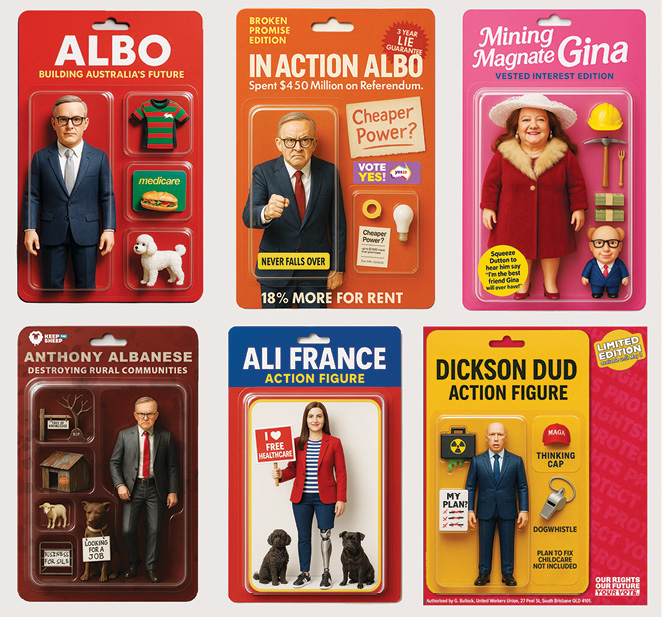
Plate 8.1 AI-generated ‘action figure’ images: The ALP’s ‘Albo: Building Australia’s Future’; the Liberals’ ‘In Action Albo’; ‘Mining Magnate Gina’ by GetUp!; ‘Anthony Albanese: Destroying Rural Communities’ by Keep the Sheep WA; ‘Ali France Action Figure’ by Ali France; ‘Dickson Dud Action Figure’ by the United Workers Union
Sources: ALP Facebook page, 10 April 2025 (www.facebook.com/photo.php?fbid=1207819777369195&set=pb.100044235528995.-2207520000&type=3); Liberal Party Facebook page, 10 April 2025 (www.facebook.com/photo.php?fbid=1229378591879798&set=pb.100044230069311.-2207520000&type=3); GetUp! Instagram account, 11 April 2025 (www.instagram.com/p/DITB4xhTb3L/); Ali France Instagram account, 10 April 2025 (www.instagram.com/p/DIQp_0cNWLp/?img_index=1); Keep the Sheep Instagram account, 13 April 2025 (www.instagram.com/p/DIXfqNyuZEv/); United Workers Union Instagram account, 29 April 2025 (www.instagram.com/p/DJBrcU-PWrU/).
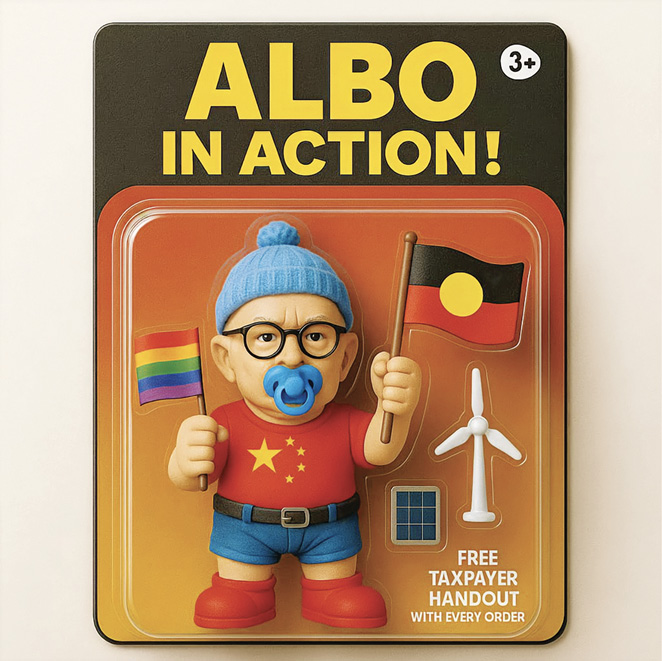
Plate 8.2 AI-generated ‘Albo In Action’ figure by John Smith
Source: John Smith, Albo is a Joke Facebook page, 24 April 2025.
With AI-generated satire failing to launch, this was a campaign that tended to highlight a divide between legacy media and new media, but not in the way many would have imagined. The staff cartoonists of the main mastheads, and those employed on a more ad hoc basis or as freelancers, maintained a standard and quality of art-cum-journalism very much in keeping with previous election campaigns. Readers were treated to the usual suite of Mark Knight brilliance in the Herald Sun; Cathy Wilcox was at her usual insightful best for the Nine newspapers stable (Age, The Sydney Morning Herald); Johannes Leak was able to stab the Liberals in the front like no other (the Australian); and Fiona Katauskas displayed her usual cheeky delight in the backflipping of left-leaning and right-leaning pollies for the Guardian. That there is still more great and real cartooning talent in the likes of Chris Downes (Hobart Mercury), Matt Golding (Nine), Brett Lethbridge (Courier-Mail) and Peter Broelman and David Pope (Canberra Times) was never in doubt. They have all seen enough elections and commented on enough politics to have honed their skills to a fine art. The 2025 election was a reminder, too, that Harry Bruce (Townsville Bulletin and Cairns Post) is still formidable after 30-odd years of work; Dean Alston (West Australian) continues to fly the flag for cartooning across the Nullarbor; and the campaign has also reinforced the status of David Macarthur (Mercury) as one of the rising stars. That Megan Herbert (the Age) and David Rowe (Australian Financial Review) are just as good as ever only underscores the way legacy media is still the gold standard when it comes to satire.
Reviewing five weeks’ worth of ‘Talking Pictures’ from the 2025 campaign is a reassuring experience. Despite this being something originally televised, and now viewable on ABC iView or YouTube, one wonders: Where was YouTube during the campaign? Where were the sensational influencers and independent news bulletins on Dailymotion, TikTok or via the podcasts as news information and opinion sources? The highlight of most Facebook feeds was the new content aggregated by Political Cartoons Australia and the Australian Cartoonists’ Association, and the feeds of mastheads and cartoonists. The real shock of the new seems largely to have been how unshocking it was.
Pre-campaign
Heading into the campaign, there were some positive signs for the Coalition. Just 18 months earlier, Peter Dutton had prosecuted a successful ‘No’ case for the Voice referendum that had galvanised the Coalition and shored up Dutton’s leadership credentials. In early March, the Coalition maintained a slight but stubborn two-party-preferred lead in all but one of the major polls (outlier YouGov showed a 51:49 lead for Labor). The electorate, fatigued by cost-of-living pressures and uninspired by Albanese’s leadership, seemed primed to boot out a first-term government for the first time in nearly a century. All that was needed from the Coalition, presumably, was a little reassurance in the form of a workmanlike campaign and a sprinkling of positive policy announcements. What transpired instead was one of the worst campaigns in Liberal Party history (Kehoe 2025; Savva 2025; Tingle 2025). Meanwhile, the incumbent—albeit assisted somewhat by global events—delivered one of Labor’s best.
Temu-Trump
In the last Question Time before the campaign, Greens MP Stephen Bates asked the Prime Minister, ‘Why would you invite Donald Trump to Australia when you’ve got a Temu-Trump sitting right opposite you?’ (Australian Greens 2025). A video of the exchange uploaded to the Greens’ TikTok account attracted more than 2.1 million views during the campaign period. Cartoonist James Hillier (aka Nordacious) released a range of ‘Temu-Trump’ merchandise (Plate 8.3), while #temutrump became a trending hashtag on all the major social media platforms. A reference to the popular website offering cut-price unbranded goods, ‘Temu-Trump’ was effectively employed by the Coalition’s opponents as shorthand for Peter Dutton’s leadership style and policy ambitions. In a campaign in which an increasingly unpopular US President and seemingly dysfunctional American politics dominated the news cycle, the perception that Peter Dutton would deliver similar leadership and governance proved disastrous for the Coalition.
This perception was driven by the Coalition themselves, at a time when the global conservative brand looked to have been enhanced by the US Republican Party’s ascendancy at the 2024 election. In a television interview in early February 2025, Liberal Senator Michaelia Cash declared in relation to Trump’s leadership style that Australians would ‘get the exact same attitude under a Peter Dutton government’ (Abo 2025). Interviewed by Radio 2GB and 60 Minutes just over a week later, Dutton offered his own praise of Trump, saying, ‘[H]e’s a deal-maker, he’s a thinker, he brings people together’ (Stefanovic 2025). These sentiments were reflected in a swathe of rhetoric and policy proposals that, contrary to assuring voters, deeply concerned them (see Chapter 4, this volume).
The appointment of Country Liberal Party Senator Jacinta Nampijinpa Price in January as shadow minister for government efficiency echoed Trump’s Elon Musk–led Department of Government Efficiency, which presided over a program of government employee redundancies. The parallel was reinforced by Dutton’s announcement in the campaign’s opening week that his government would sack 41,000 public servants. A week later, Senator Price introduced Peter Dutton to supporters gathered at a Perth bowling club with the promise that the Coalition would ‘make Australia great again’. In denying that the expression was ‘an ode’ to the US President, Price insisted that the media was ‘obsessed with Donald Trump’ (ABC News 2025)—a claim that was undermined somewhat the following day with circulation in the media of an image of Price celebrating Christmas wearing a totemic ‘MAGA’ cap and holding a Donald Trump Christmas tree ornament (Plate 8.4).
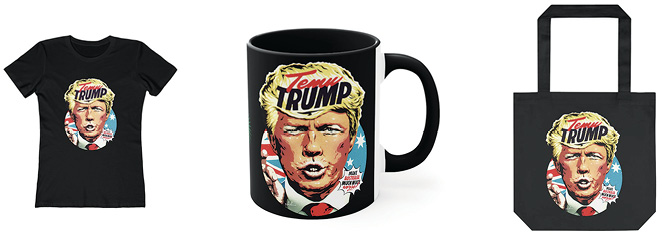
Plate 8.3 A selection of ‘Temu-Trump’ merchandise by Nordacious
Source: Nordacious (nordacious.com/products/temu-trump-australian-printed-womens-the-boyfriend-tee?variant=49960216920366).
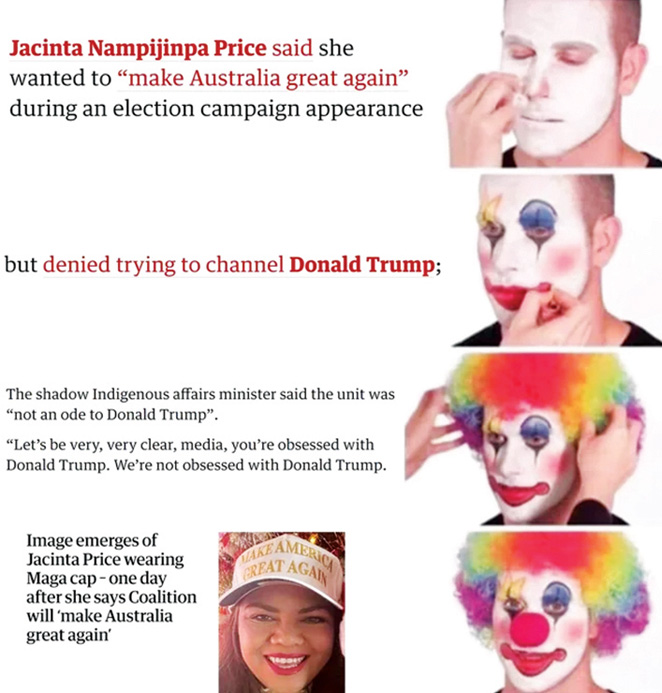
Plate 8.4 ‘Imagine if these absolute clowns got back into office’: Meme about Jacinta Nampijinpa Price by u/TinySmugCnuts
Source: Reddit subforum r/AusMemes, April 2025 (www.reddit.com/r/AusMemes/comments/1jxzrbm/imagine_if_these_absolute_clowns_got_back_into/).
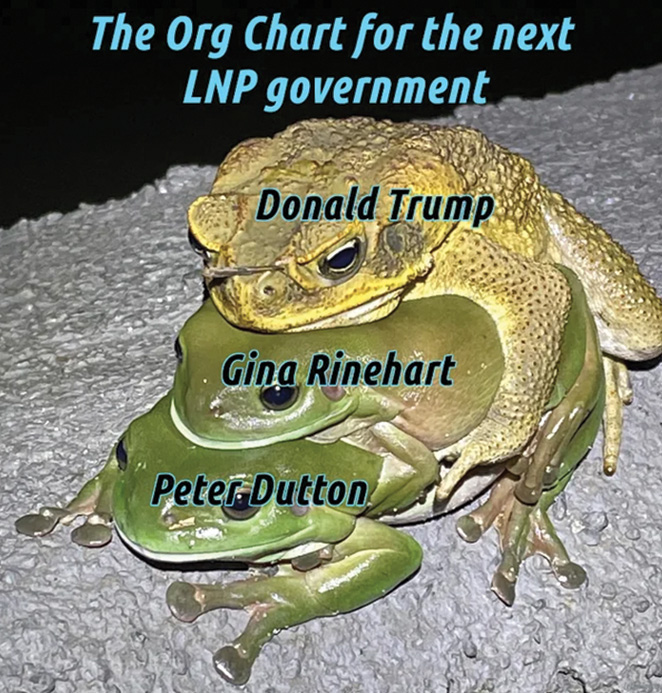
Plate 8.5 ‘Don’t do it Australia!’ meme by u/Broomfondl3
Source: Reddit r/AusMemes forum, 26 April 2025 (www.reddit.com/r/AusMemes/comments/1k8akmi/dont_do_it_australia/).
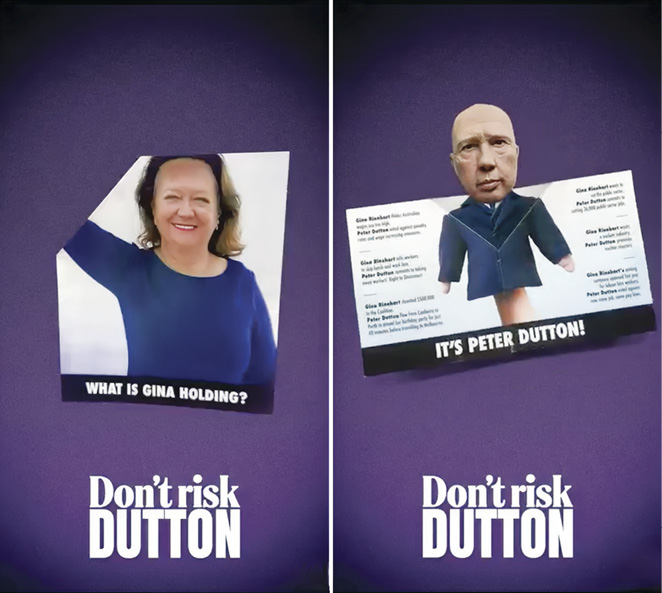
Plate 8.6 ‘Don’t risk Dutton’ pamphlet by Victorian Trades Hall Council
Source: Victorian Trades Hall Council Instagram account, 1 April 2025 (www.instagram.com/p/DH5e2ZlP3i7/).
Dutton’s earlier reservations about the integrity of the AEC’s Voice referendum process (Cassidy and Barry 2025) and floating of the idea for a referendum to allow the government to deport dual national citizens (McIlroy 2025) were followed in the campaign proper by promises to fix the ‘woke’ school curriculum and complaints about the ‘hate media’. The presence of billionaire mining magnate Gina Rinehart—the Liberal party’s second-largest donor—loomed over the Coalition campaign as she urged Australia to ‘follow the US’ lead’, raising comparisons with Musk’s influence in the Trump administration (Reuters 2025) and inviting questions about her influence in a future Australian one (Plate 8.5). This relationship inspired the Victorian Trades Hall Council to create pamphlets that unfolded to reveal Dutton as Rinehart’s puppet, which volunteers distributed at 100 Victorian train stations (Plate 8.6).
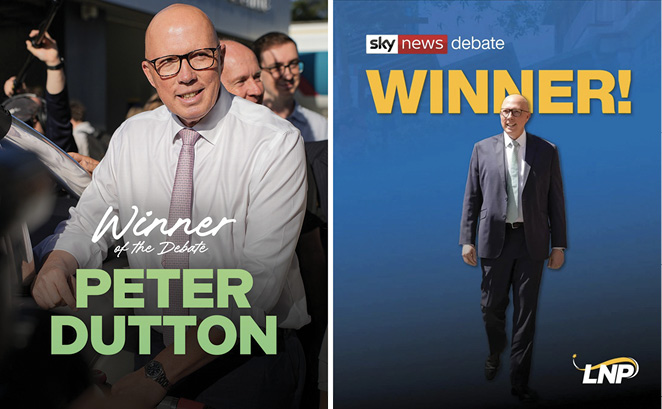
Plate 8.7 Images showing Peter Dutton as winner of the first leaders’ debate
Sources: Nationals Facebook page, 8 April 2025 (www.facebook.com/photo.php?fbid=1204143204400020&set=pb.100044130549325.-2207520000&type=3); LNP Queensland Instagram account, 8 April 2025 (www.instagram.com/p/DILrMrtzGZT/).
Then, in early April, President Trump unveiled a tariff plan that imposed a blanket 10 per cent import levy on most countries—including Australia—and global market chaos ensued. As Australian voters nervously contemplated the impact on their mortgage interest rates and superannuation balances, Albanese’s response that the tariffs were ‘not the act of a friend’ threw into sharp relief the cultural and political differences that separate Australia from the United States—and, by extension, Albanese from Dutton. With a succession of US allies failing to secure tariff exemptions, Dutton’s claim that he alone would be able to secure a favourable deal with the United States presented a decidedly Trumpesque recasting of fantasy as fact. A similar grandiosity was evident one week later when the Coalition triumphantly declared Peter Dutton the winner of a debate the audience had awarded convincingly to Albanese (Plate 8.7). Meanwhile, Albanese was conflating Labor values with Australian values and Liberal values with American values and applying this contrast to almost every policy issue: wages, student debt, education, defence, health, housing, superannuation, women’s rights and diversity.
Cartoonists were even gifted a little bit of Commonwealth cross-fertilisation with the victory of the ‘other’ Liberals—the liberal ones—in the Canadian election and the clear rejection of Trumpian conservatism by our fellow subjects of King Charles (28 April 2025). This repudiation of a recently favoured conservative Opposition seems to have reflected on all the Coalition ‘baggage’: its women problem, minorities (transgender people, Asians, Muslims) and the environment. Aggressive posturing was scorned as the electorate seemed much more desirous of kindness, and the notion that in a world of chaos, one should choose the safe, boring option, seemed to be common sense.
Medicare 2.0
Labor successfully portrayed itself in this campaign as the creator and enduring custodian of Medicare (Plate 8.8), while casting the Coalition as opponents of bulk-billing and urgent care clinics. With Albanese brandishing a Medicare card at every photo opportunity and a giant toothbrush accompanying Adam Bandt to studio interviews as he spruiked the Greens’ ‘dental into Medicare’ policy, Dutton was left defending his track record as health minister and playing catchup in matching Labor’s health initiatives. Dutton’s alignment with Trump also blunted his protestations about Labor’s ‘Mediscare’ campaign, with Labor happy to remind voters that ‘we don’t want American-style politics or American-style healthcare’ (Plate 8.9).
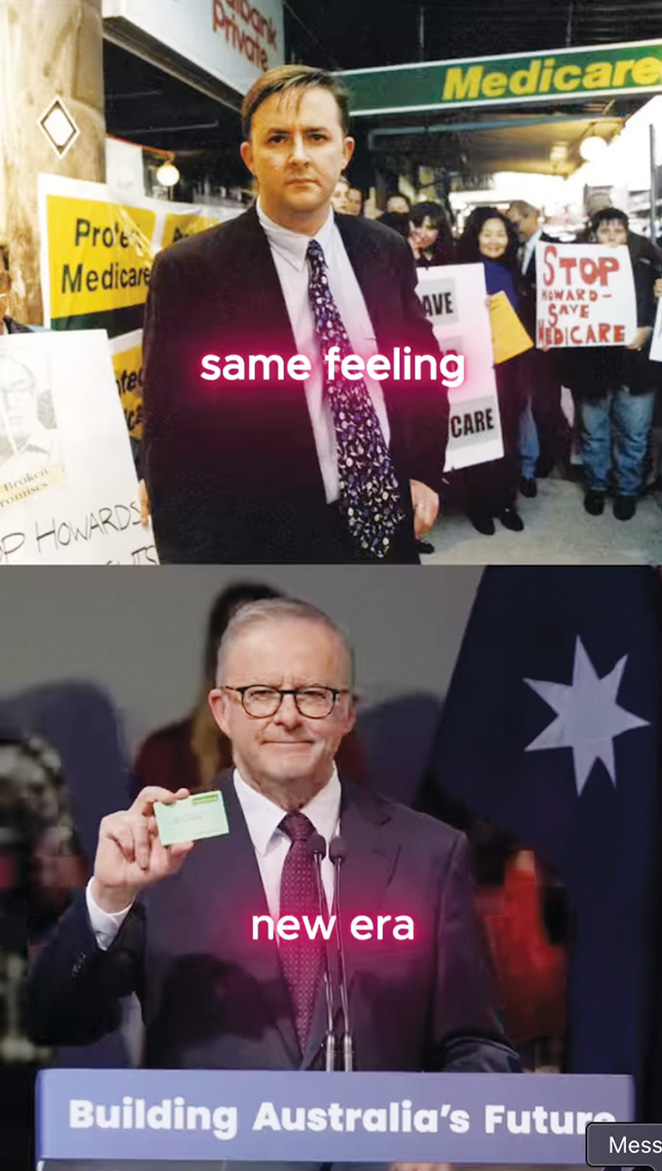
Plate 8.8 Image sequence from Labor Instagram reel
Source: ALP Instagram account, 26 April 2025.
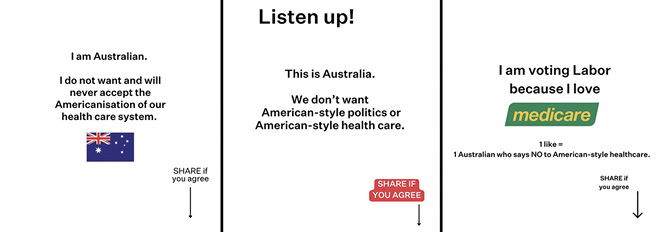
Plate 8.9 Medicare images from Labor Facebook account
Sources: ALP Facebook page, 29 April 2025 (www.facebook.com/photo.php?fbid=1223076472510192&set=pb.100044235528995.-2207520000&type=3); 30 April 2025 (www.facebook.com/photo.php?fbid=1224366712381168&set=pb.100044235528995.-2207520000&type=3); 1 May 2025 (www.facebook.com/photo.php?fbid=1224713605679812&set=pb.100044235528995.-2207520000&type=).
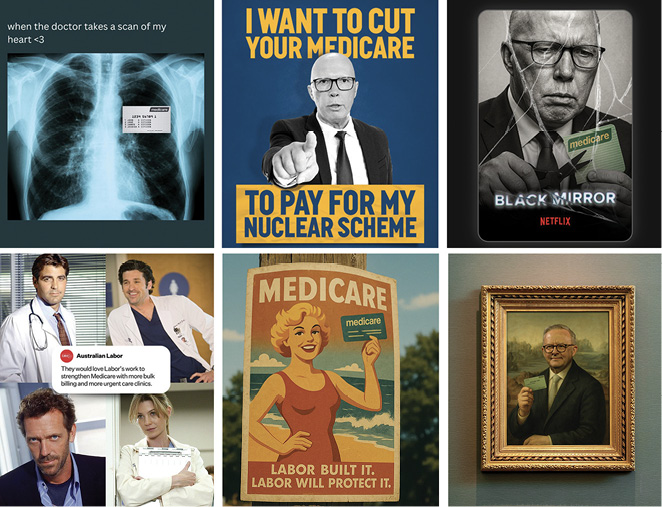
Plate 8.10 Medicare memes from the Australian Labor Party
Sources: ALP Facebook page, 28 March 2025 (www.facebook.com/photo.php?fbid=1197138905103949&set=pb.100044235528995.-2207520000&type=3); 2 May 2025 (www.facebook.com/photo.php?fbid=1225389642278875&set=pb.100044235528995.-2207520000&type=3); 14 April 2025 (www.facebook.com/photo.php?fbid=1211225220361984&set=pb.100044235528995.-2207520000&type=3); 12 April 2025 (www.facebook.com/photo.php?fbid=1209226720561834&set=pb.100044235528995.-2207520000&type=3); 22 April 2025 (www.facebook.com/photo.php?fbid=1217326819751824&set=pb.100044235528995.-2207520000&type=3); 30 April 2025 (www.facebook.com/photo/?fbid=1224235582394281&set=pcb.1224235809060925).
The politics of caring—not just medi-caring—was manifest in this kind of messaging. Although percentage terms are impossible to calculate, support for Medicare on social media via memes and TikToks was massive, and probably constituted the single biggest message in those forums. Albanese could quite easily pivot on this to stake a firm claim that the ALP was more purely Australian than its opponents, because—as he said at the Labor campaign launch—‘Medicare is a declaration of Australian values’ (13 April 2025).
The ALP was then able to sit back and watch the memes being generated, as Dutton’s record as health minister and his comments and soundbites about ‘free GP visits being unrealistic’ hardly needed embellishment by the party or citizen satirists. The contrast was with Albanese flourishing a Medicare card—‘the only card you’ll need when you visit the GP’.
Not everyone was sold on the messaging, of course. Megan Herbert (the Age) made as much clear in her cartoon showing both Albanese and Dutton as dodgy doctors pedalling bandaid solutions to the real problems facing Australia.
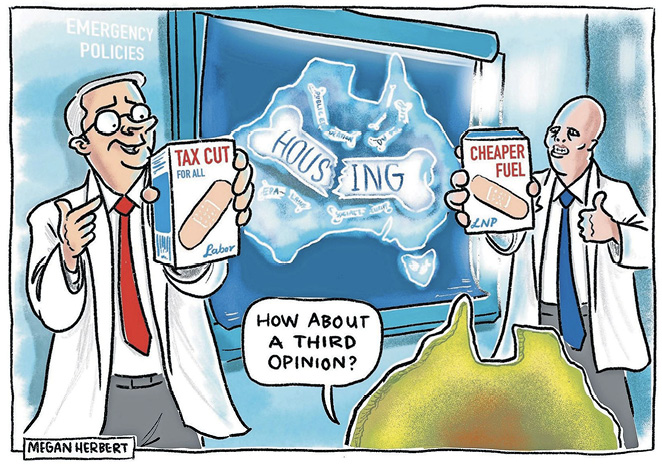
Plate 8.11 ‘How about a third opinion?’, cartoon by Megan Herbert, Nine newspapers
Source: ‘Talking Pictures’, Insiders, ABC TV, 6 April 2025.
Delulu with no solulu
In the days ahead of announcing an election in which younger voters in the Gen Z and Millennial cohorts would outnumber their Gen X and boomer counterparts for the first time, the Prime Minister presented as a guest on a popular youth podcast. The two Millennial hosts of Happy Hour with Lucy and Nikki schooled the PM on Gen Z slang, daring him to say ‘delulu with no solulu’ in parliament. The day the podcast went to air, the PM was in Question Time attacking the Opposition’s nuclear policy (26 March 2025). The idea that the taxpayer-funded plan would not result in cuts to education, services, housing, public servants or ‘cuts to everything’ was, according to the Prime Minister, ‘delulu with no solulu’. Now immortalised in Hansard, the line received substantial coverage in the legacy media, with the clip of Albanese channelling his inner Gen Z published by major news outlets and breakfast television. On social media, creator Candy Moore remixed the line into an electronic dance music or ‘EDM banger’ that was viewed more than 100,000 times.
Acutely aware of the fast-growing youth audience share commanded by podcasts, Labor contracted satirical news publication the Betoota Advocate to run an election podcast strategy for the Prime Minister (King 2025). Between January and the election, Albanese had popped up as a guest on more than a dozen youth podcasts. In March he invited 13 influencers to the Budget lockup. The contrast could not have been more stark: Albanese was strategically and positively engaging with influencers while Dutton was all but ignoring them. The fact that almost all the high-rating influencers are young women resulted in Dutton ignoring two key demographics at once. The podcast interviews in which Dutton did participate were aimed at a predominantly male audience—or, in the case of an interview with Olympic diver Sam Fricker, predominantly male athletes.
Albanese was also signalling that he understood that the shift in electoral demographics was accompanied by a shift in modes of media engagement. Cheek Media CEO (and Senate candidate) Hannah Ferguson noted the way legacy media bodies seemed obsessed with the supposed flaws and failings of their counterparts in the digital space: ‘While new media is busy making content which speaks directly to Australians about how parliament works and what the budget means for them, legacy media is spending its time focused on us’ (Ireland 2025).
That new media was turning out information on how Australian democracy works, rather than playing politics, was a point of difference that aligned with youth-friendly Labor policies such as ‘free’ TAFE, HECS debt reduction and a promise of $1 billion for mental health.
Where Labor was speaking directly to Millennials with Albanese’s podcast appearances, and the Greens were speaking to Gen Z via authentic TikTok videos—such as Nick McKim’s Fortnite Twitch streams—the Liberals appeared hostile to youth and, consequently, inauthentic in their social media engagement. In the last round of Senate estimates, Liberal Senator Jane Hume raised questions about influencer Abbie Chatfield’s interviews with Albanese and Adam Bandt and whether they constituted ‘political content’ that had violated campaign laws in not publishing accompanying electoral authorisations. The AEC later issued a statement saying that Chatfield’s videos required no such authorisation (see Chapter 1, this volume). In late March, Holly MacAlpine (handle ‘HollyUnmuted’) posted a video interview with Greens Senator Larissa Waters to her TikTok and Instagram accounts (MacAlpine 2025). The interview was edited into a video posted to the Liberal Party’s TikTok account that made it appear that MacAlpine was critical of the Greens. The video was removed only after MacAlpine’s legal representatives issued the Liberal Party with a concerns notice.
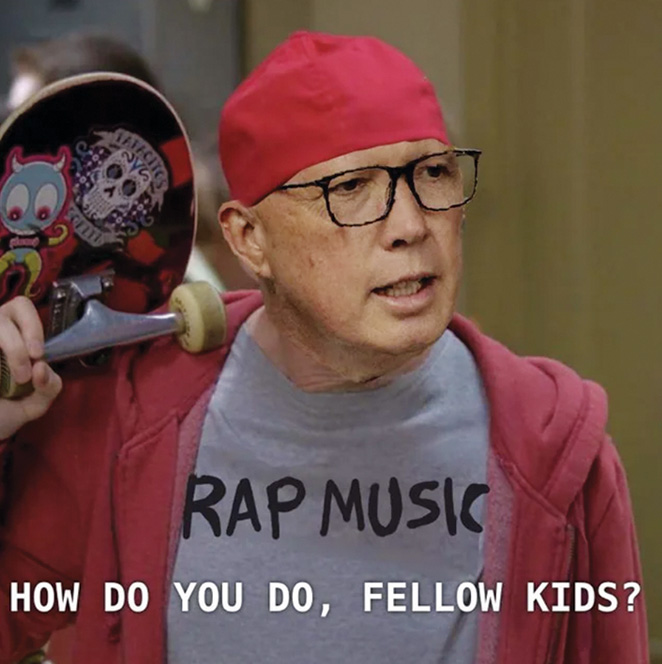
Plate 8.12 ‘Dropping a diss track to stay revenant hahaaha’: image by u/Accomplished-Role95
Source: Reddit subforum r/AusMemes, 9 April 2025 (www.reddit.com/r/AusMemes/comments/1jyr67n/dropping_a_diss_track_to_stay_revenant_hahaaha/).
The Liberal Party’s first salvo in the online battle to capture the youth demographic was the release of ‘Leaving Labor’, a ‘diss track’ performed in the style of rap artist Drake. First released on SoundCloud as a music track and subsequently featured in several Liberal Party TikTok and Instagram videos throughout the campaign, the track not only failed to resonate with young people, it also presented the Liberal Party as inauthentic, tone deaf and out of touch in their engagement with youth culture (Plate 8.12). Leaving aside the optics of appropriating North American culture to prosecute their case for election, the first error the Liberal Party made was the presumption that their audience would embrace the style of a rapper whose suspected grooming behaviour and paedophilia had just been publicly called out in a diss track performed by rapper Kendrick Lamar at the Superbowl half-time show. Albanese appeared very much aware of Drake’s problematic conduct when offering his own critique in an interview with 9News, saying, ‘The Liberal Party channelling Drake … I’m not sure they’re aware of Drake and his whole background, but I don’t think that’s a very wise thing to do’ (15 April 2025).
A second miscalculation was the appropriation of a protest culture that is famously anti-establishment and deployed by minority voices by a conservative party led by someone with a history of hostility towards minorities (and one that directed preferences to One Nation late in the campaign). This contradiction was roundly mocked by TikTok users including Mates Rates, who leveraged the design and format of song analysis account ‘Genius’ in a video that was viewed more than 250,000 times during the campaign. In the video (see Plate 8.14), a Peter Dutton impersonator with masking tape eyebrows and a silicone bald cap explains that:
everybody knows that the Liberal Party is the more hip hop, the more cool, the more street credited party in this nation … so I think it was really our place to use this genre that, you know, has given a voice to the disenfranchised, to give a voice to us, the very privileged.
A final nail in this particular satirical coffin came courtesy of the fourth and final leaders’ debate, in which Dutton famously underestimated the retail price of a dozen eggs even as the song lyrics of one of his party’s most prominent social media incursions complain: ‘[J]ust wanna buy some eggs and cheese, a hundred bucks you kidding me?’
Then, in the final days of the campaign, the Liberal Party posted a video featuring Senator Jane Hume that replicated the graphic and narrative style of US TikTok-er Ray William Johnson (Plate 8.14). Appropriating another creator’s video aesthetic is generally accepted practice in TikTok culture, though etiquette demands the original creator be credited, which the Liberal Party failed to do. But where the Liberal Party egregiously transgressed the sensibilities of TikTok natives was when they inexplicably decided to block Johnson from viewing the video they had just ripped off without attribution. Within hours, the video was flooded with hundreds of comments defending Johnson and mocking the Liberal Party. Tellingly, the comments received more likes than the video, with one comment liked more than 37,000 times. It only got worse from there: after Johnson posted a video calling them out for their conduct, the Liberals responded with another video that claimed they had ‘accidentally blocked’ Johnson—an implausible excuse that was predictably rejected by users, who piled into the comments to ridicule them for once again failing to read the room. As one commenter observed, ‘Just fire the PR team at this point’ (3 May 2025).
The failure of the Liberals on TikTok in particular, and its youth messaging more broadly, lay not in the cringe use of Gen Z slang (‘Labor is mid’) or the appropriation of contemporary TikTok trends (‘Tim Cheese’, ‘Italian brain rot’) or the dated popular culture references (Star Wars, Shrek), but in the fact that these images did not augment positive youth policies and rhetoric, and therefore lacked credibility. While Labor’s promise to cut HECS debts, make TAFE free and generously fund youth mental health initiatives spoke directly to young people, Dutton was musing about young people being more inclined to vote Labor because they were renters whose political views had not yet sufficiently matured to vote Liberal (29 April 2025). The Liberal Party’s social media video and meme strategy comprised in large part disguising home and car ownership as youth issues.
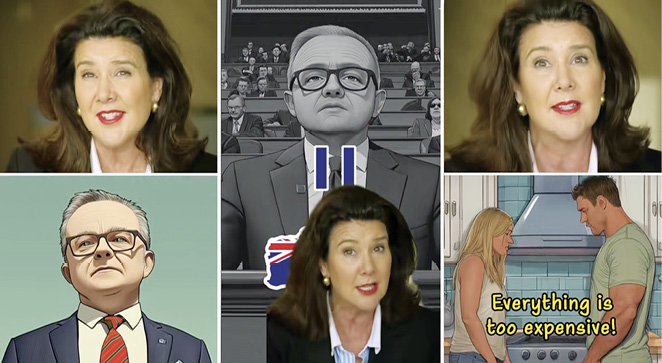
Plate 8.13 Still showing image sequence from Liberal Party TikTok video ‘This guy is in real trouble’
Source: Liberal Party TikTok account, 1 May 2025 (www.tiktok.com/@liberalaus/video/7499384820829621522).
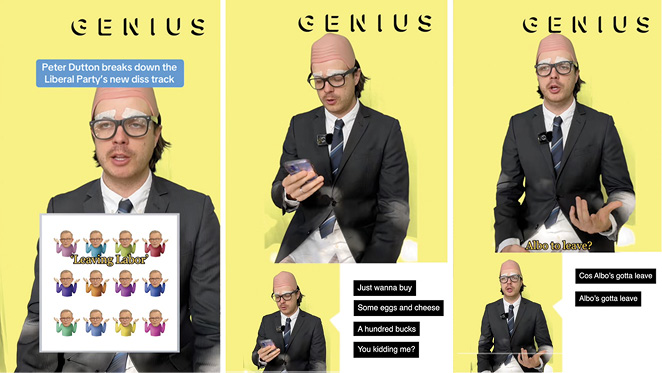
Plate 8.14 Still showing image sequence from Mates Rates TikTok video ‘This is a real song released by the Liberal Party …’
Source: Mates Rates TikTok account, 17 April 2025 (www.tiktok.com/@mates.rates/video/7494163655446056210).
Working from home
In their review of the 2022 federal election loss, the Liberal Party devoted nearly five pages to identifying how the party might address its ‘women problem’ (Loughnane and Hume 2022: 31–35). Yet, the Liberals not only failed to promote policy that spoke directly and positively to women, they also proposed measures that were openly hostile to them (see Chapter 6, this volume). That disaffected well-to-do women would continue to support the Teal candidates seemed obvious to the likes of the Betoota Advocate (2 May 2025) and others. For them, Teal candidate Caz Heise as a ‘Coffs Harbour midwife’ with ‘experience of telling unhelpful blokes to get out of the way’ seemed an ideal summary of the ‘Cowper curveball’ that nearly unseated Nationals incumbent Pat Conaghan (2 May 2025).
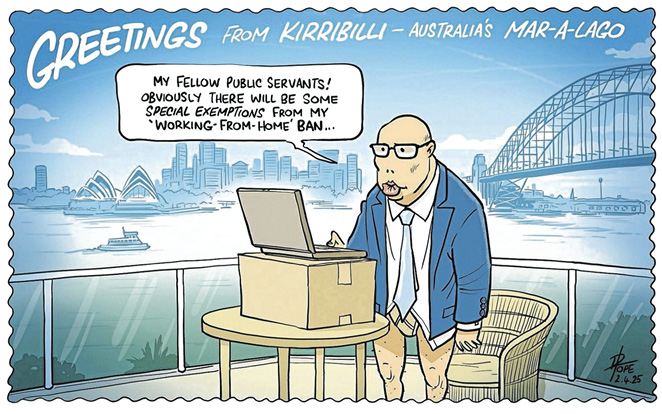
Plate 8.15 ‘My fellow public servants’, cartoon by David Pope, Canberra Times
Source: ‘Talking Pictures’, Insiders, ABC TV, 6 April 2025.
Even as the Liberal Party rolled out its policy to ban work from home (WFH)—a flexible work arrangement employed more by women than men—Dutton signalled that the ban would not apply to him as he prematurely mused that his preferred prime ministerial residence would be the harbourside Kirribilli House and not the Lodge in Canberra (Plate 8.15). Speaking directly to his local readership in the ‘Canberra bubble’, David Pope took Dutton to task for this and reminded everyone of the Trump connection one more time (Plate 8.15).
Meanwhile, in the leadup to the election, Labor had supported a wage increase for early childhood education and care workers and a guaranteed 72 hours of subsidised childcare. An election pledge to establish a $1-billion fund to build and expand childcare centres positioned Labor as the party most responsive to the challenges faced by working mothers.
A video by one TikTok user, viewed more than 575,000 times, paired a trending audio sample of misogynistic comments made by far-right live-streamer Nick Fuentes in the wake of Donald Trump’s election with the caption, ‘Anyone voting liberal please block me’ (the irony being that, in the United States, ‘liberal’ equates to left-wing).
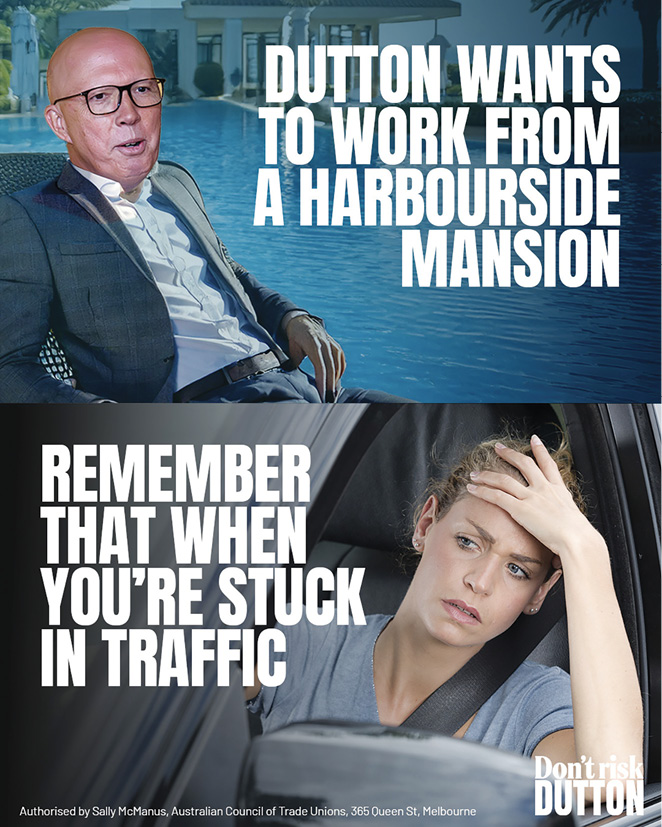
Plate 8.16 Work-from-home image by Australian Unions
Source: Australian Unions Facebook page, 31 March 2025.
Social media strategy
The array of memes and videos produced and disseminated by political parties throughout this campaign points to a well-targeted and future-positive social media strategy on the part of Labor and the Greens and a poorly devised one focused on the past by the Liberal Party. In an election in which the three issues of most concern to voters were the cost of living, housing and health care (Smith 2025), the Liberal Party’s social media offerings almost completely ignored two of them. As a post-election washup from the Australian noted, ‘Their policies were based around the fuel pump and owning houses and nuclear power plants’ (Carbone 2025), but the casual observer could have been forgiven for assuming the Coalition’s single biggest policy was fuel excise relief for 12 months (while Labor stood for free GP visits and the Greens for placing dental care in Medicare). In terms of defining imagery, Labor and the Greens opted for positive portraits of their leaders brandishing policy props (the green-and-gold Medicare card and a giant toothbrush, respectively) while the Liberals focused on petrol bowsers.
In line with their consultant Topham Guerin’s preferred approach, the Liberal Party outposted Labor and the Greens, but their policies did not align with the satire. In any case, Topham Guerin’s saturation did not really resonate with an audience. Aside from a handful of videos showing Peter Dutton in a sympathetic light, their strategy was largely negative in tone. While 25 per cent of the Liberal Party’s TikTok videos were devoted to the cost of living and the economy, these predominantly attacked Labor rather than offering alternative policy. Just less than 15 per cent of Liberal Party videos spruiked their fuel excise policy, with the second most frequent topic being Albanese’s denial that he fell over after speaking at a Mining and Energy Union event in the first week of the campaign (Plate 8.17). The attempt to insist that this showed he was a liar, not to be trusted (Plate 8.18), was perhaps clumsier than the Prime Minister’s own footing during the incident. On Facebook and Instagram, the fuel excise policy was reduced to the third most frequent topic, with memes attacking Albanese’s role in the failed Voice referendum accounting for just more than 20 per cent of the content.
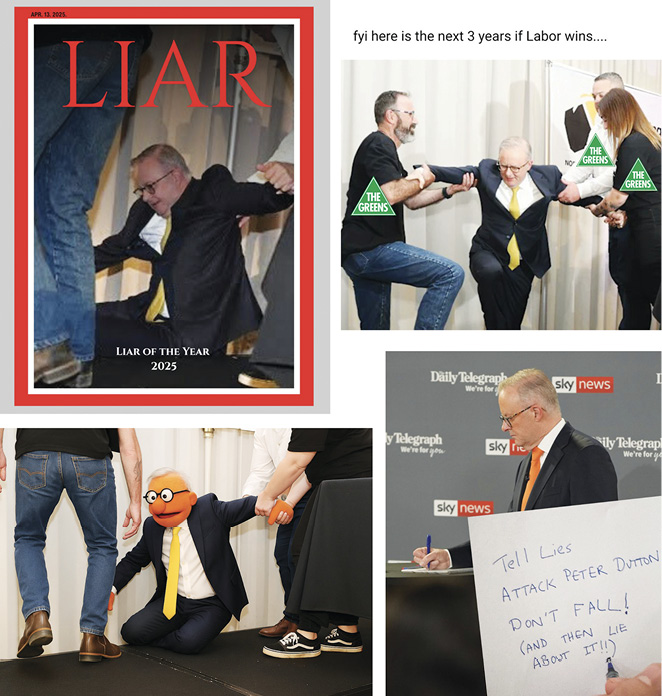
Plate 8.17 Liberal Party memes related to Albanese’s fall off a stage
Sources: Liberal Party Facebook page, 13 April 2025 (www.facebook.com/photo.php?fbid=1231832051634452&set=pb.100044230069311.-2207520000&type=3); 11 April 2025 (www.facebook.com/photo.php?fbid=1229906998493624&set=pb.100044230069311.-2207520000&type=3); 23 April 2025 (www.facebook.com/photo.php?fbid=1239609760856681&set=pb.100044230069311.-2207520000&type=3); 8 April 2025 (www.facebook.com/photo.php?fbid=1227894838694840&set=pb.100044230069311.-2207520000&type=3).
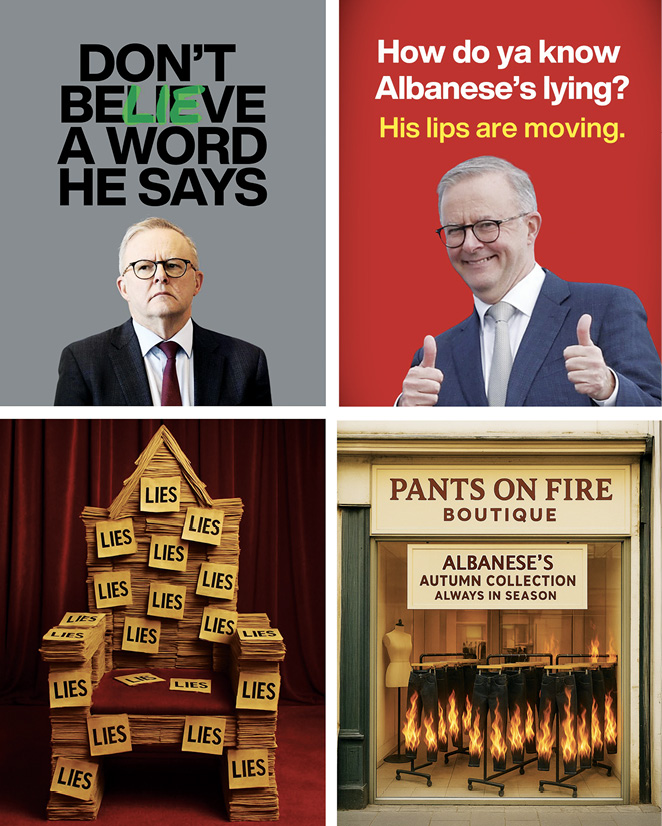
Plate 8.18 Liberal Party memes about Albanese lying
Sources: Liberal Party Facebook page, 11 April 2025 (www.facebook.com/photo.php?fbid=1229881085162882&set=pb.100044230069311.-2207520000&type=3); 16 April 2025 (www.facebook.com/photo.php?fbid=1234280598056264&set=pb.100044230069311.-2207520000&type=3); 24 April 2025 (www.facebook.com/photo.php?fbid=1240449320772725&set=pb.100044230069311.-2207520000&type=3); 27 April 2025 (www.facebook.com/photo.php?fbid=1242598473891143&set=pb.100044230069311.-2207520000&type=3).
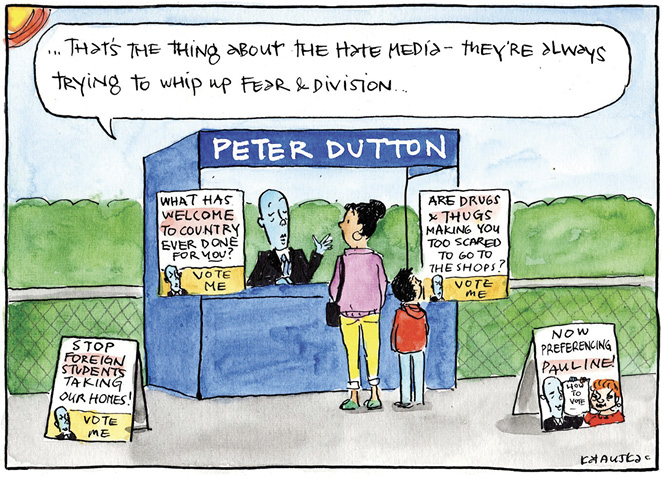
Plate 8.19 ‘Is the hate media really to blame?’, cartoon by Fiona Katauskas, the Guardian, 19 April 2025
Source: ‘Talking Pictures’, Insiders, ABC TV, 4 May 2025.
There was a not inconsiderable irony when, late in the campaign, Peter Dutton pointed the finger at what he called the ‘hate media’—something Fiona Katauskas took pleasure in pointing out (in the Guardian), as did David Pope in the Canberra Times (1 May 2025) and The Chaser via Facebook, imagining Dutton slamming the ‘hate media’ for ‘making him look bad by publishing the things he says and does’ (1 May 2025).
Interestingly, despite the big dollars shelled out by the Coalition for Topham Guerin, it seems the ALP made their investments in a cannier fashion. This was something noted by commentators:
While Labor has brought in experienced operators such as Dee Madigan, Darren Moss, The Shannon Company and two separate research agencies, Talbot Mills and Campbell White’s Pyxis Polling & Insights, the Liberal set-up is more stripped back, the Labor insider says. (Koutsoukis 2025)
Other Labor insiders deployed their Facebook feeds on an individual basis, with Jason Clare ‘complaining’ on 1 May about ‘getting old texts’ (from Peter Dutton, from 2014: ‘There are too many free Medicare services’) and Clare O’Neil reposting a sequence of ‘cuts’ memes (based on films such as Love, Actually, You’ve Got Mail, Notting Hill, 50 First Dates, Crazy Stupid Love, My Big Fat Greek Wedding and the like—all with the main noun or other form replaced with ‘Cuts’) (29 April 2025).
Election fatigue
As it became ever clearer that the ALP was in for re-election, cartoonists and satirists tended to express the exhaustion that many felt at the seemingly interminable nature of the campaign. Speaking with one voice with Guardian stablemate First Dog on the Moon (‘Is this the worst most boring election campaign ever? Will voting make any difference?’, 15 April 2025), Fiona Katauskas started relatively early, in the first week of the campaign, detailing just how far voters had to go before the democracy sausage of 3 May.
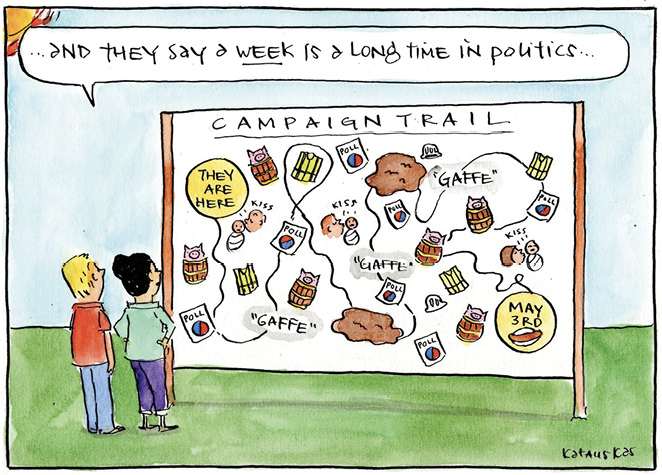
Plate 8.20 ‘It sure looks like familiar territory’, cartoon by Fiona Katauskas, the Guardian, 1 April 2025
Source: ‘Talking Pictures’, Insiders, ABC TV, 6 April 2025.

Plate 8.21 Cartoon by Brett Lethbridge in Brisbane’s Courier-Mail
Source: ‘Talking Pictures’, Insiders, ABC TV, 27 April 2025.
By the time polling day was in sight, Brett Lethbridge (Courier-Mail) could point to a few hazards that had appeared along the way, apart from those that had determined Albanese’s choice of a polling date in the first place (Easter, Anzac Day).
The alternative view, from Matt Golding, was that ‘five weeks of a depressingly negative, simplistic, chaotic and reactive election campaign’ would ‘be a welcome distraction’ from Trump’s antics.
No doubt this was something shared across the political spectrum, but it is worth noting (as Katauskas had done) that a week is a long time in politics. Or, at least, two weeks is. By the week of 20 April, Golding was convinced that Australians were completely over the repetition of campaigning, the high-vis clothing and the endless recourse of mainstream media to following the leaders around.
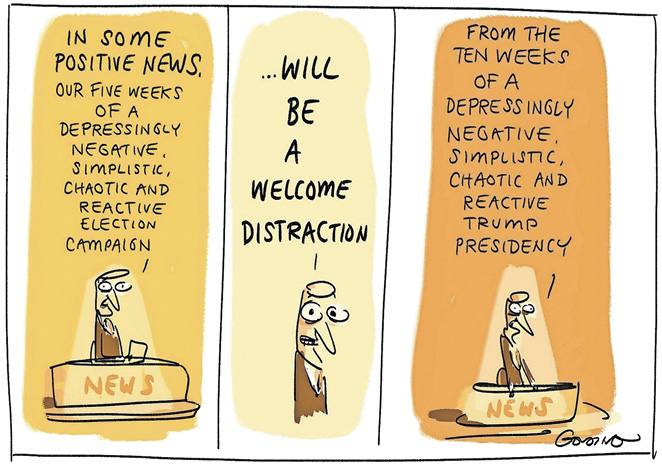
Plate 8.22 ‘Petty politics is stopping us from building a city’, cartoon by Matt Golding, Melbourne Age, 1 April 2025
Source: ‘Talking Pictures’, Insiders, ABC TV, 6 April 2025.
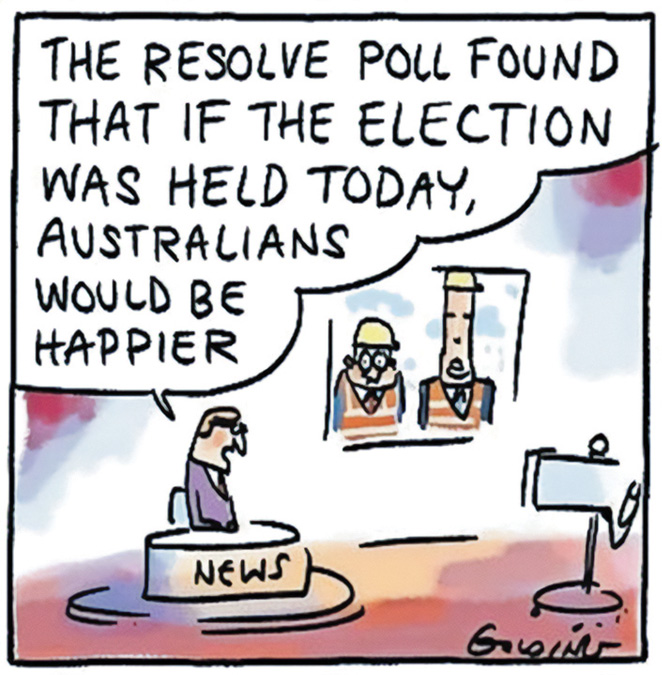
Plate 8.23 ‘If an election were held now …’, cartoon by Matt Golding, Nine newspapers
Source: ‘Talking Pictures’, Insiders, ABC TV, 20 April 2025.
It is worth noting, too, just how many of the cartoonists employed legacy media devices in their work throughout 2025—once again confounding the notion that this would be an election dominated by new media and AI. Golding again seemed uniquely suited to this, using the notion of put-upon voters hiding, like Doctor Who fans, behind or under the sofa to avoid witnessing the horror.
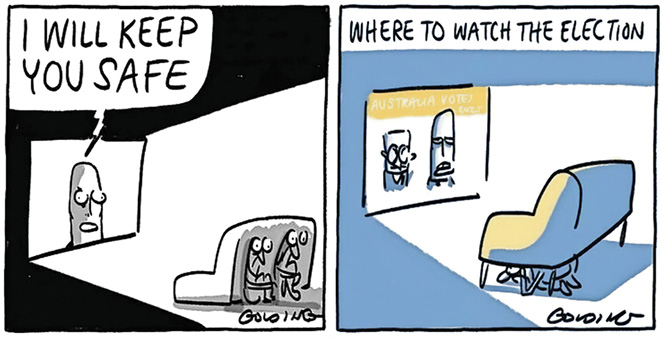
Plate 8.24 ‘I will keep you safe’ and ‘Where to watch the election’, cartoons by Matt Golding, Nine newspapers
Source: ‘Talking Pictures’, Insiders, ABC TV, 27 April and 4 May 2025.
The TV loomed large as well for Mark Knight, who imagined the leaders’ respective housing commitments turning the election campaign into an episode of the Nine Network’s The Block; and both he and Golding saw the televised leaders’ debate, and the whole campaign, being largely overshadowed by other issues (whether the ubiquitous Trump and a cameo from Putin or the death of the Pope). Sean Leahy made much the same point: the timing of Francis’s funeral broadcast from St Peter’s was something to feel grateful for: ‘Only one more week of election ads!’ (Courier-Mail, 28 April 2025).
Likewise, microphone-wielding journos and protestors (of the anti–salmon farming and anti-coal as well as anti-nuclear variety) were the ones Chris Downes saw as the culprits in prolonging the ‘2025 federal race’, pursuing both Dutton and Albanese to the point of exhaustion.
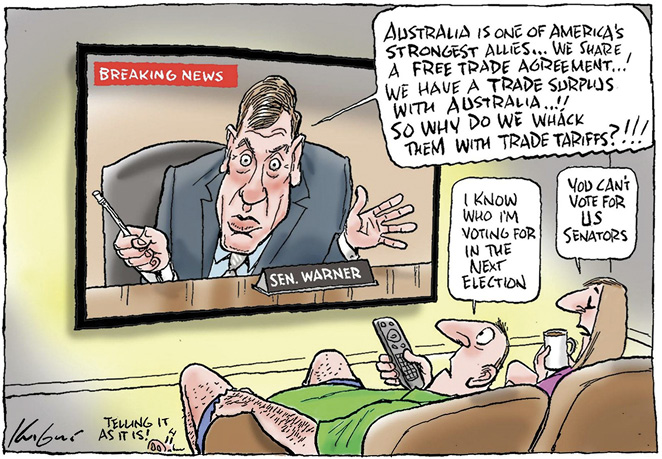
Plate 8.25 ‘Did you see US Senator #senatormarkwarner stand up for Australia …’, cartoon by Mark Knight, Herald Sun
Source: ‘Talking Pictures’, Insiders, ABC TV, 13 April 2025.
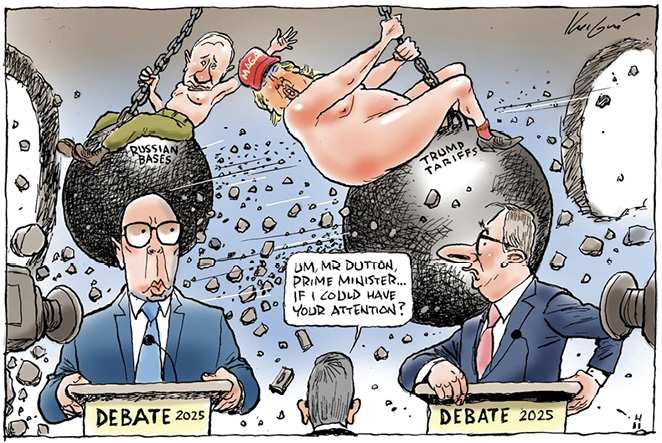
Plate 8.26 ‘Could I have your attention’, cartoon by Mark Knight, Herald Sun
Source: ‘Talking Pictures’, Insiders, ABC TV, 20 April 2025.
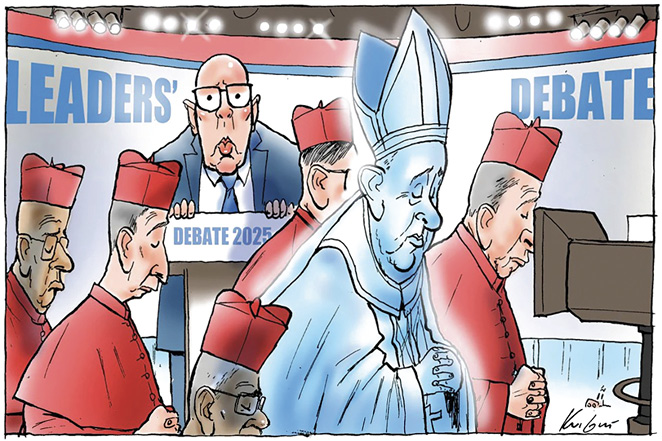
Plate 8.27 ‘Pope’s passing cuts across election’, cartoon by Mark Knight, Herald Sun
Source: ‘Talking Pictures’, Insiders, ABC TV, 27 April 2025.
The fact that something as ‘legacy’ as corflutes could also be the focal point of cartoons is also apparent from Matt Golding’s output, with Liberal dynastic scion Amelia Hamer a particular target in Kooyong (25 April 2025). Hamer’s team had apparently manufactured and disseminated a record number of posters and promotional items. Yet, the fact that this did not seem to be resulting in the royal-blue wave against Teal incumbent Monique Ryan was pretty telling, especially when so many of Hamer’s posters were fixed to the gates of mansions in Kew and surrounds, thus making for a perfect meme. So perfect that it required no real satire at all was the legacy media image of James Brickwood’s old-fashioned photograph of Hamer ‘enjoying’ a drink with Senator Jane Hume and Peter Dutton at the Tower Hotel in Hawthorn (30 April 2025).
So, too, Tim Wilson’s outlay in trying to win back Goldstein was targeted by the Betoota Advocate (1 May 2025): mock concern for his superannuation balance was accompanied by photos of Wilson standing proudly in front of a blue-painted campaign minivan (not a full bus) or in obviously posed conversation with a ‘genuine tradie’ (1 May 2025).
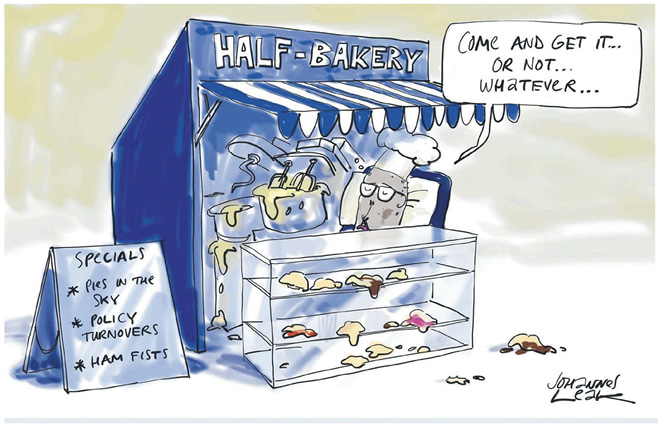
Plate 8.28 ‘Half-bakery’, cartoon by Johannes Leak, The Australian
Source: ‘Talking Pictures’, Insiders, ABC TV, 27 April 2025.
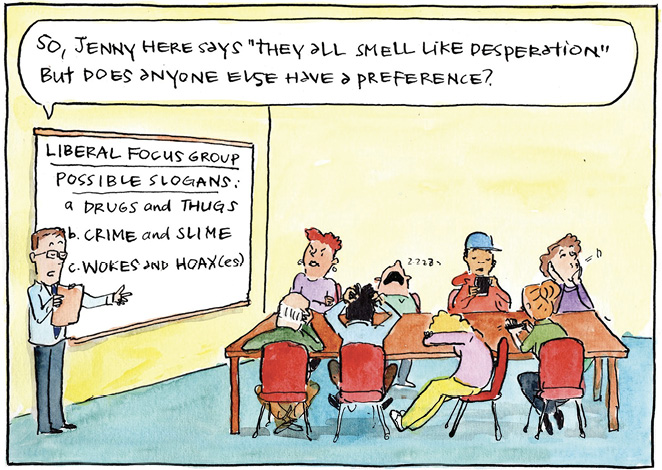
Plate 8.29 ‘Has the Coalition finally found the perfect slogan?’, cartoon by Fiona Katauskas, the Guardian, 22 April 2025
Source: ‘Talking Pictures’, Insiders, ABC TV, 27 April 2025.
That the party (and the Coalition) was out of ideas was also something apparent to Leak’s ideological opposite at the Guardian, as the theme of exhaustion and fatigue manifested itself once again (Plate 8.29).
Liberal Party–leaning cartoonists such as Knight and Johannes Leak had largely given up on Dutton’s campaign by the final week and were just as nonplussed as they had been in 2022 by the pie-in-the-sky promises, policy turnovers and ham-fisted approach. Leak’s ‘Half-bakery’ (the Australian; Plate 8.28) is the epitome of that feeling, from a conservative side of politics utterly disenchanted by its political representatives.
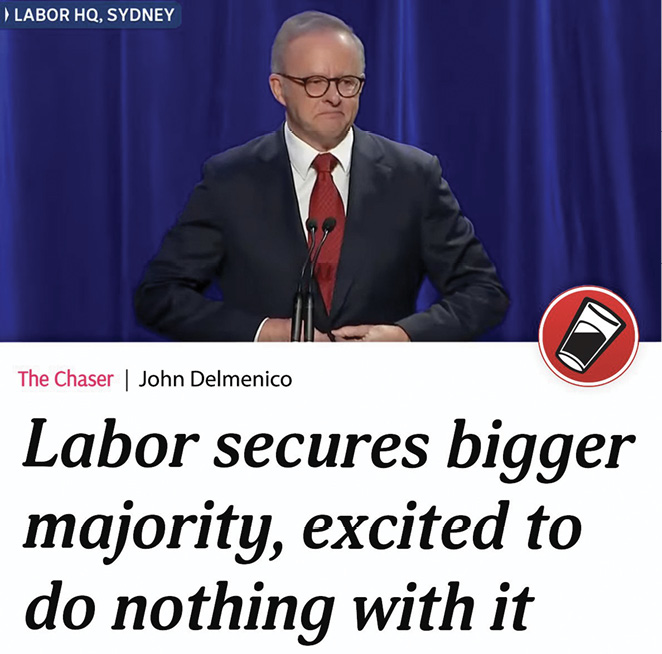
Plate 8.30 ‘You wanted action and we promise to deliver tinkering around the edges’, John Delmenico, The Chaser
Source: Facebook, 3 May 2025.
When all was (almost) said and done, the Betoota Advocate proclaimed: ‘This election shit is pretty much done and it’s Friday afternoon. Here’s a photo of Sydney Sweeney’ (2 May 2025); and then, when the washup began, it was—again—more of the same.
Matt Golding, however, provided a reminder of perhaps the most significant thing about election night 2025: Antony Green’s last outing for the ABC (Plate 8.31).
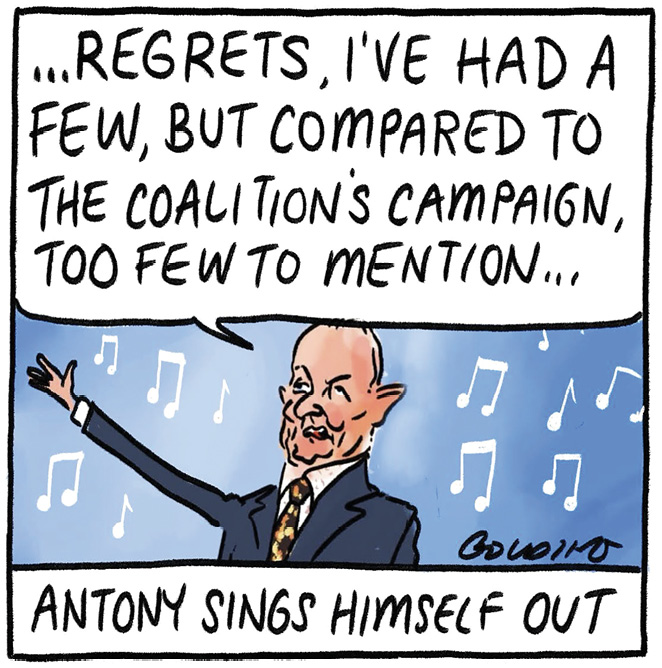
Plate 8.31 ‘Antony Green did it his way’, cartoon by Matt Golding, Nine newspapers
Photo: Facebook, 4 May 2025.
Conclusion
Political satire in the social mediascape has matured to the point where, like political cartoons, pundits and scholars are no longer seduced by the empirically impossible question of the impact of memes and videos on election outcomes. A more pertinent question is how this material, in conjunction with political cartoons and the ‘Temu-satire’ produced by partisan players, reveals and amplifies the prevailing mood of the electorate and the success or failure of a given party’s campaign. Among the political cartoonists, citizen satirists and political parties, only the Liberal Party failed comprehensively to understand their audience. Ignoring the lessons from the previous election, and seemingly oblivious to the evolution of the social mediascape into a venue for news and information as well as entertainment, the Liberal Party’s satirical offerings cynically and ineffectively privileged style over substance. As any political cartoonist will attest, satire contains a kernel of truth. Unfortunately for the Liberal Party, the kernel nestled in their content was that they were bereft of ideas and out of touch with the electorate—and they were duly punished for it by voters who demanded better.
References
6 News Australia. 2025. ‘Live: Question Time in the House of Representatives in Canberra.’ 6 News Australia, 27 March. www.youtube.com/live/WZ66P2irkVs.
9News. 2025. ‘Prime Minister responds to diss track.’ 9News, 15 April. www.youtube.com/shorts/GfLUgIH_-c8.
ABC News. 2025. ‘Coalition frontbencher’s “MAGA” moment prompts Trump comparison.’ ABC News, 12 April. www.youtube.com/watch?v=zfMPn2jOl48.
Abo, Sarah. 2025. ‘Interview with Michaelia Cash.’ The Today Show with Sarah Abo, 3 February. Transcript available: www.michaeliacash.com.au/federal-news/transcript/transcript-the-today-show-4/.
Australian Greens. 2025. ‘Think @StephenBatesMP struck a nerve with this one.’ TikTok, 27 March. www.tiktok.com/@australiangreens/video/7486372411571522824.
Barnes, Renee, Aimee Riedel, Lucas Whittaker, and Rory Mulcahy. 2024. ‘Disinformation and deepfakes played a part in the US election. Australia should expect the same.’ The Conversation, 21 November. theconversation.com/disinformation-and-deepfakes-played-a-part-in-the-us-election-australia-should-expect-the-same-243373. doi.org/10.64628/AA.qaexfv33g.
Butler, Josh, Dan Jervis-Bardy, Krishani Dhanji, and Elias Visontay. 2025. ‘AI ads, action figures and Auto-Tuned raps: Australian election campaigns battle on social media.’ The Guardian, 12 April. www.theguardian.com/australia-news/2025/apr/12/ai-ads-action-figures-and-auto-tuned-raps-australian-election-campaigns-battle-on-social-media.
Carbone, Joseph. 2025. ‘Why Coalition election social media campaign failed.’ The Australian, 13 May: 20.
Cassidy, Barry, and Tony Barry. 2025. ‘The Trump effect has left Dutton exposed and Albanese in poll position in this atypical election race.’ The Guardian, 1 May. www.theguardian.com/commentisfree/2025/may/01/the-trump-effect-left-dutton-exposed-and-albanese-in-poll-position-in-this-atypical-election-race-ntwnfb.
Guardian Australia. 2025. ‘Delulu with no solulu: PM channels Gen Z in attack on Coalition economic and energy plan.’ Guardian Australia, 26 March. www.youtube.com/watch?v=OAq7pPPhjWI&t=3s.
Hattotuwa, Sanjana. 2025. ‘Sacrificing veracity for virality: Topham Guerin’s influence operations, and democratic implications.’ LinkedIn, 5 March. www.linkedin.com/pulse/sacrificing-veracity-virality-topham-guerins-sanjana-hattotuwa-ph-d--mqvcf/.
Hinsliff, Gaby. 2024. ‘The exodus from X to Bluesky has happened—the era of mass social media platforms is over.’ The Guardian, 15 November. www.theguardian.com/commentisfree/2024/nov/15/x-bluesky-social-media-platforms.
Ireland, Olivia. 2025. ‘Australian Labor Party paid content creators’ travel costs for budget.’ The Sydney Morning Herald, 26 March. www.smh.com.au/politics/federal/lululemon-brand-ambassador-finance-advisers-13-content-creators-get-advance-budget-reading-20250325-p5lmdc.html.
Kehoe, John. 2025. ‘How the Liberals got it so wrong.’ Australian Financial Review, 4 May. www.afr.com/politics/federal/how-the-liberals-got-it-so-wrong-20250504-p5lwd6.
King, Tynan. 2025. ‘Company associated with Betoota Advocate contracted to run PM’s re-election podcast strategy.’ ABC News, 17 April. www.abc.net.au/news/2025-04-17/prime-ministers-secret-podcast-strategists-albanese-betoota/105180156.
Koutsoukis, Jason. 2024. ‘Exclusive: Dutton hires Morrison’s “disinformation” team.’ The Saturday Paper, 7 December. www.thesaturdaypaper.com.au/news/politics/2024/12/07/exclusive-dutton-hires-morrisons-disinformation-team.
Koutsoukis, Jason. 2025. ‘This is going to stick: Inside Dutton’s Trump thump.’ The Saturday Paper, 5 April. www.thesaturdaypaper.com.au/news/politics/2025/04/05/this-going-stick-inside-duttons-trump-thump.
Loughnane, Brian, and Jane Hume. 2022. Review of the 2022 Federal Election. Canberra: Liberal Party of Australia. cdn.liberal.org.au/2022/2022_election_review.pdf.
MacAlpine, Holly. 2025. ‘True or false with Greens Senator for Queensland @LarissaWaters.’ HollyUnmuted, [TikTok video], 24 March. www.tiktok.com/@hollyunmuted/video/7485289508146105616.
McIlroy, Tom. 2025. ‘Dutton wants deportation referendum to fix “restrictive” Constitution.’ Australian Financial Review, 18 March. www.afr.com/politics/federal/dutton-wants-deportation-referendum-to-fix-restrictive-constitution-20250318-p5lkct.
Messenger, Andrew. 2024. ‘Queensland premier rules out AI-generated election material after LNP releases dancing TikTok attack advertisement.’ The Guardian, 23 July. www.theguardian.com/australia-news/article/2024/jul/23/queensland-premier-steven-miles-ai-generated-qld-election-video-lnp-tiktok-attack-ad?utm_term=Autofeed&CMP=soc_568&utm_medium=Social&utm_source=Twitter#Echobox=1721703938.
Perez, Sarah. 2024. ‘Bluesky is benefitting from an exodus of unhappy X users following the election.’ TechCrunch, 12 November. techcrunch.com/2024/11/12/bluesky-is-seeing-an-exodus-of-unhappy-x-users-following-the-election/.
Reuters. 2025. ‘Australia’s richest person Gina Rinehart says she wants Trump-like reforms as election nears.’ The Straits Times, 1 May. www.straitstimes.com/asia/australianz/australias-richest-person-gina-rinehart-says-she-wants-trump-like-reforms-as-election-nears.
Robertson, Craig. 2024. ‘What does the X exodus to Bluesky mean for journalism?’ The Conversation, 20 December. theconversation.com/what-does-the-x-exodus-to-bluesky-mean-for-journalism-246296. doi.org/10.64628/AB.nruajvw94.
Savva, Niki. 2025. ‘Dutton has led one of the worst election campaigns in living memory.’ The Sydney Morning Herald, 1 May. www.smh.com.au/politics/federal/dutton-has-led-one-of-the-worst-election-campaigns-in-living-memory-20250429-p5lv7q.html.
Shifman, Limor. 2014. Memes in Digital Culture. Cambridge: MIT Press. doi.org/10.7551/mitpress/9429.001.0001.
Smith, Michael. 2025. ‘How Labor weaponised Medicare (again) to take on Peter Dutton.’ Australian Financial Review, 1 May. www.afr.com/companies/healthcare-and-fitness/how-labor-weaponised-medicare-again-to-take-on-peter-dutton-20250423-p5ltox.
Stefanovic, Karl. 2025. ‘Is Peter Dutton Australia’s Donald Trump?’ [Interview with Peter Dutton]. 60 Minutes Australia, 16 February. www.youtube.com/watch?v=6IT5_OkSj2w.
Tingle, Laura. 2025. ‘Laura Tingle on Dutton’s “shockingly bad” campaign.’ ABC News Daily, 1 May. www.abc.net.au/listen/programs/abc-news-daily/laura-tingle-on-peter-duttons-shockingly-bad-campaign/105235634.
Topham Guerin. 2024. LinkedIn post. www.linkedin.com/posts/topham-guerin_clientwork-digitaladvertising-politics-activity-7259055966267006976-iIns/?utm_source=share&utm_medium=member_desktop.
Previous



