


 menu
Australian Journal of Biography and History: No. 11, 2026
Blank spaces: Arctic sea ice, relics and Tasmanian biographies of John and Jane Franklin
As Tasmanians prepared for Christmas in 1893, Henry Higgins’s award-winning butcher shop in Hobart’s Elizabeth Street presented them with a remarkable sight (Figure 1). One window featured a sparkling white trophy, formed out of lard and wax, and surrounded by ‘fancy lambs’. As the Tasmanian described it, the trophy’s decorations represented a ‘subject dear to the heart of every Tasmanian from old recollections’. This was the lost Arctic expedition of Sir John Franklin, Tasmania’s one-time governor (1837–43), which had disappeared in the ice of Lancaster Sound in 1845. The decorations of preserved fat were, indeed, impressive:
White sparkling cliffs enclose an ice cave, at the rear of which is an illuminated picture of a ship embedded in the ice with a full moon shining through. Below is a sledge encampment in the ice, with the figures of the men and the dogs all arranged around it. At the middle distance are arranged a party of bear-hunters engaged in a fight with huge polar bears, whilst below is a walrus hunt. Cliff-climbers are seen at the edges, whilst on the left is a bear holding a man prisoner in a cave, and on the right is the obverse situation. Four large bouquets of flowers, coloured in lard, are placed in different positions, forming beautiful candlesticks, and the whole is surmounted by a statue of Sir John Franklin.1
In 1894, ‘relics’ of the Franklin expedition were displayed at the Tasmanian Exhibition, including an old tin can, the finger of a glove and a bullet casing. All had been gleaned from different sites in the Canadian archipelago, some from unburied bodies, and all were connected with the enduring mystery of what had happened to the men of HMS Erebus and Terror.2 By this time, a statue of Franklin had been in Franklin Square for nearly 20 years, erected at enormous expense by colonists to commemorate the lost explorer and his wife. It overlooked the harbour where, in 1841, the officers of Erebus and Terror had hosted a ball after they returned from their first Antarctic season. In the wake of the ships’ disappearance in the Arctic ice, Lady Jane Franklin had become a global figure whose fame almost eclipsed that of her husband. As an icon of wifely devotion (if not of Victorian domesticity), she had become the first female recipient of the Royal Geographical Society’s Gold Medal.
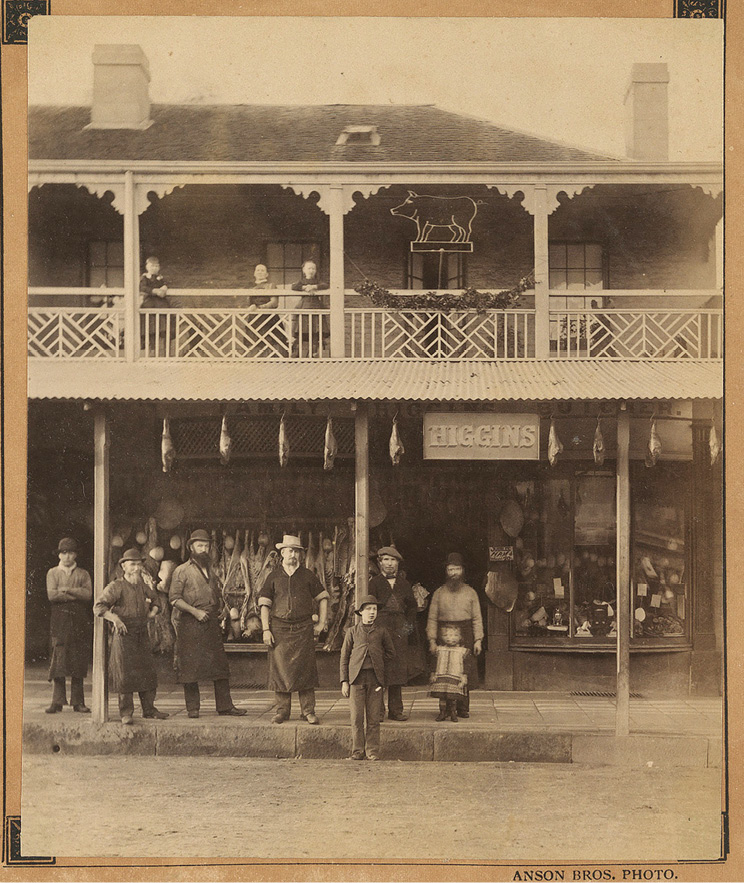
Figure 1: Henry Higgins’s butcher shop, c. 1888.
Source: Anson AMP Album 2, W. L. Crowther Library.
The Franklin expedition had been meant to complete the Northwest Passage, to contribute to magnetic science and to repair John Franklin’s fragile reputation. Accusations of Jane Franklin’s ‘petticoat interference’ in his administration of Van Diemen’s Land had followed him into Lancaster Sound; in his final letters from Greenland, he agonised over the damage done to his name in the penal colony.3 But it was John Franklin’s disappearance that changed the stories people told of the Franklins, both in Tasmania and in Britain. Between 1848 and 1859, many public and private rescue expeditions tried and failed to find the missing HMS Erebus and Terror. Five of these were sent by Jane Franklin. Though there was Indigenous testimony about the expedition’s fate (including that the men had succumbed to cannibalism), no scrap of writing was found until 1859, when officers of Jane Franklin’s Fox expedition found a message in a cairn of stones that fixed the date of Franklin’s death (11 June 1847), when the ships were abandoned (spring 1848) and where the survivors were heading (towards the mouth of the Back River, where Inuit testimony had placed them).
In the northern hemisphere, the mystery surrounding the lost expedition has long defined biographies of John and Jane Franklin. For nearly two centuries, adventurers have been drawn north to find bodies, relics, graves and records, and have come home (mostly) disappointed.4 In the last 20 years, there have been books, documentaries, television shows, exhibitions, podcasts, blogs and discussion groups inspired by the enduring mystery of Franklin’s fate.5 The wrecks of HMS Erebus and Terror remained missing until 2014 and 2016, respectively, when they were located on the sea floor of the Inuit province of Nunavut. Each season continues with a search for journals and papers that might be found preserved beneath the surface of increasingly ice-free waters.6
In Tasmania, the stories told of the Franklins are rather different. The ice has almost entirely disappeared, as though it were never present in the first place. Here, Franklin stories tend to fall into two camps. One set is concerned with the couple’s commitment to the progress, improvement and enlightenment of the colony, while the other implicates them in the abduction, abandonment and betrayal of Indigenous Tasmanian children.7 Both sets of stories are evoked in placenames and the names of institutions, boats, pubs, flora and fauna, and wharves; there is even a line of clothing that celebrates Jane Franklin’s ‘idealism and great mental activity’.8 Material traces are also marshalled to tell their stories, from Jane Franklin’s sedan chair and John Franklin’s pistols, to their collections of Indigenous Tasmanian ancestral objects and mortal remains.
Paying attention to Arctic ice, I argue, can help us to ‘re-story’ these Tasmanian narratives in new and important ways.9 Keeping the ice in view draws our attention to the power of blank spaces—in archives and on maps—and the work that they do. Neither blank spaces nor silences happen of their own accord. They are made and reinforced, even as we are drawn by their emptiness and mystery, longing to fill them up.10 This article looks at how, in the 1850s–70s, Tasmanians drew on an assemblage of relics, testimony and hearsay to address the blank spaces in the Franklin story, and so tell new stories about themselves. In the process, the Arctic ice refracted settlers’ own processes of memory, forgetting and disavowal. It helped them to re-story themselves, not as morally corrupt settlers of a penal colony, but as a scientific and philanthropic people worthy of self-government.
One important aspect of re-storying, as Nathan Sentence reminds us, is to attend to the natural world and the ways in which it has shaped and continues to shape colonial lives and histories.11 Ice has a unique capacity to generate, refract and gather stories—of nationhood, whiteness, manliness, suffering, sacrifice and pure imagination.12 In the Franklin case, ice is also a key component of the mystery of the expedition’s fate. Andy Bruno has argued that mystery is a key force in certain kinds of exploration, as it carries with it a forensic agenda, an open-ended series of investigations, shaped by the long-deferred expectation of discovery and solution.13 Objects associated with such mysteries can also evoke wonder. As Andrew Hurley has argued, there is great value in tracing their trajectories—their ‘ballistic biographies’—to account for the ‘narrative potential of dumb things with holes in their provenance’.14 This article traces some of the ‘ballistic biographies’ of the Franklin relics in Tasmania between 1850 and 1875, and how they were used in the service of Tasmanian biographies of the couple. It also reflects on how such stories can be submerged in archives and biographies, and how they might be brought back to our sightline. That process recalls something of the behaviour of ice, too, which can imprison, submerge and transport people, giving them new lives in the process.15
‘Her Ladyship’s exploring Maggot’: The Franklins in Tasmania, 1837–43
The Franklins’ path to Tasmania began on Canada’s Barren Grounds. In 1819, Lieutenant John Franklin was appointed to command the First Land Arctic Expedition (1819–22), one of several British attempts in the 1820s to chart the fabled Northwest Passage. It was a failure, marked by starvation, murder and cannibalism. On their return to Britain in 1822, Franklin and the surviving officers became ‘lions’ in the social worlds of Romantic science, equally famous for their suffering and their Evangelical piety. Jane Griffin was a fixture in this world, in which she attended Arctic dinner parties, inspected departing ships and developed a keen interest in phrenology. It was in these ‘Arctic circles’ that the widowed John Franklin courted Jane Griffin in 1827, presenting her with Cree moccasins and her name inscribed on the map of North America.16
As a result of his Arctic fame, naval service and Evangelical principles, in 1836 Franklin was appointed as lieutenant governor of Van Diemen’s Land. Both Franklins saw the appointment as an opportunity to practise ‘benevolent government’.17 Nevertheless, their time in Tasmania between 1837 and 1843 was fraught. They were forever caught between settler interests, directives from the Colonial Office, and the need to propitiate their scientific friends and humanitarian allies at ‘home’. They were constantly combating rumours about John’s perceived (unmanly) weaknesses and Jane’s (unwomanly) influence in colonial governance, spread by supporters of John Franklin’s predecessor, George Arthur.18 As Jane Franklin’s friend Mary Maconcohie wrote, ‘the system here is unhesitating falsehood, constant & secret, undermining’.19
The Franklins believed that their fragile colonial reputations depended upon promoting colonial science, both within Tasmania and to their metropolitan circles, which were now the nexus of far-flung global networks of imperial science.20 They established a scientific society (the Tasmanian Society, the forerunner of the Royal Society of Tasmania), hosted visiting Antarctic expeditions, and fostered the work of scientific travellers. These included James Clark Ross’s Antarctic expedition in HMS Erebus and Terror in 1840 and 1841. Within Tasmania, the Franklins’ scientific pursuits were often characterised by their opponents as metropolitan follies, evidence that the couple were ill-suited to the penal colony.21 As the settler Thomas Anstey wrote to the banker Charles Swanston, ‘there will be no end to the lively wriggling of her Ladyship’s exploring Maggot’.22
During their tenure, Jane Franklin took two Indigenous Tasmanian children from Wybalenna on Flinders Island, where the survivors of Tasmania’s frontier wars had been exiled. Eleven-year-old ‘Adolphus’ was taken in 1839, and six-year-old Mithina arrived in Hobart in 1841.23 Jane Franklin’s reasons for taking them were complex. Partly, she wished to prove to her humanitarian acquaintances that she had tried to ‘improve’ Indigenous children by removing them from their families. But she was also an early proponent of what would later be called the ‘extinction paradigm’. Accordingly, she exhibited the children (alongside collections of ancestral objects, portraits and mortal remains) to visiting officers, phrenologists and surgeons as ‘one of the remnant of a people about to disappear from the face of the earth’.24 Neither child, however, conformed to her expectations. Adolphus, like several other Indigenous boys, found a life at sea on the government cutter Vansittart, where he worked on a survey of Bass Strait under officers of HMS Beagle in 1842. By 1847, he had left Tasmania and his whereabouts remain unknown.25 After the Franklins left Tasmania, Mithina went first to the Orphan School and then to Flinders Island, where she testified in an 1846 enquiry into the administration of the Aboriginal establishment there.26 She subsequently returned to the Orphan School and then went to the new Oyster Cove establishment, where she is presumed to have died in 1852, aged 17, under the name ‘Aminia’.
Jane Franklin’s interest in science, improvement and colonial administration contributed to her husband’s dismissal in 1843. Rumours were spread at the Colonial Office by the former colonial secretary, John Montagu, that the Franklin administration was actually a ‘petticoat government’. James Stephen, the undersecretary to the Colonial Office, wrote that Jane Franklin had ‘forfeited the immunities of her sex’ by ‘meddling in affairs of state’. In Tasmania and in Britain, a volume of Montagu’s accusations against the Franklins (known as ‘Montagu’s Book’) circulated at Franklin’s club in London and at the offices of the Derwent Bank in Hobart.27 Franklin was also officially censured for his promotion of science—in particular, for lending the Vansittart to the Bass Strait survey. In November, the Franklins left the island. They had deposited Mithina at the Orphan School in June, after her father, Palle, proposed travelling to Hobart to see her.28 They took the child’s small doll, clad in a red dress, with them—one of many ‘relics’ of their time on the island.29
When the Franklins returned to Britain in 1844, John Franklin turned his sights northward again, hoping to heal his reputation. He was given command of HMS Erebus and Terror to continue charting the world’s magnetic field and, in the process, to complete the Northwest Passage. The polar ships were re-equipped with three years of stores, steam-powered engines, plenty of coal, scientific instruments and 109 men. In June 1845, they sailed into an apparently ice-free Lancaster Sound, hailed a passing whaler and vanished.
‘Regions of thick-ribbed ice’: The missing Franklin expedition, 1848–59
For Inuit, sea ice is a dynamic and deeply storied home that requires skill, experience and humility to dwell in and navigate across. For outsiders, sea ice is a perilous, alien environment, one imbued with both wonder and terror.30 Every year, millions of tons of ‘old ice’ break off from the ice pack in the Beaufort Sea, and are driven by prevailing winds, currents and the rotation of the earth into the narrow passages of the Canadian Archipelago. Ice jams together into pressure ridges, running hard up against both glacial ice and shore fast ice. These dynamics were even more severe during the heavy ice years as the Little Ice Age drew to a close around 1850.31 At the same time, the North American Arctic became an increasingly crowded place. Commercial whalers descended upon both the Western and Eastern Arctic, Russian and British fur traders expanded their activities on the continent, and expeditions arrived looking for Franklin by land and sea. European goods became lucrative items of exchange along Indigenous trade routes that developed along the sea ice far beyond the reach of ships and man-hauled sledges. As outsiders headed north, an Indigenous Northwest Passage of travel and exchange formed between Siberia to Greenland, in which information became a valuable commodity (see Figure 2).32
Beginning in 1848, the British Admiralty began equipping new expeditions to rescue Franklin. Between 1848 and 1859, more than 15 public and private expeditions were dispatched from Britain and the United States by sea and overland. Five were sent by Jane Franklin, which were partly funded by the sale of Tasmanian land and ‘curiosities’.33 As a result, she became an international figure, a model for wifely devotion, the living embodiment of Hope leaning on an Anchor.34 Faced with utilitarian arguments against entanglement in these ‘regions of thick-ribbed ice’, Jane Franklin’s supporters argued that suffering sailors and their waiting families were deserving subjects of philanthropy, and that it was therefore the duty of an imperial nation to rescue them.35 During these years, the only intelligence of the expedition came from Indigenous testimony and ‘relics’ of the missing men. Some of these ‘relics’ were found by searchers, while others travelled along Indigenous pathways. All were, as Adriana Craciun has put it, ‘designated as scientific, pietistic, and patriotic’ as they ‘accumulated indigenous Arctic owners, reauthored uses, and horrific narratives on their extraordinary journeys from and to Britain’.36
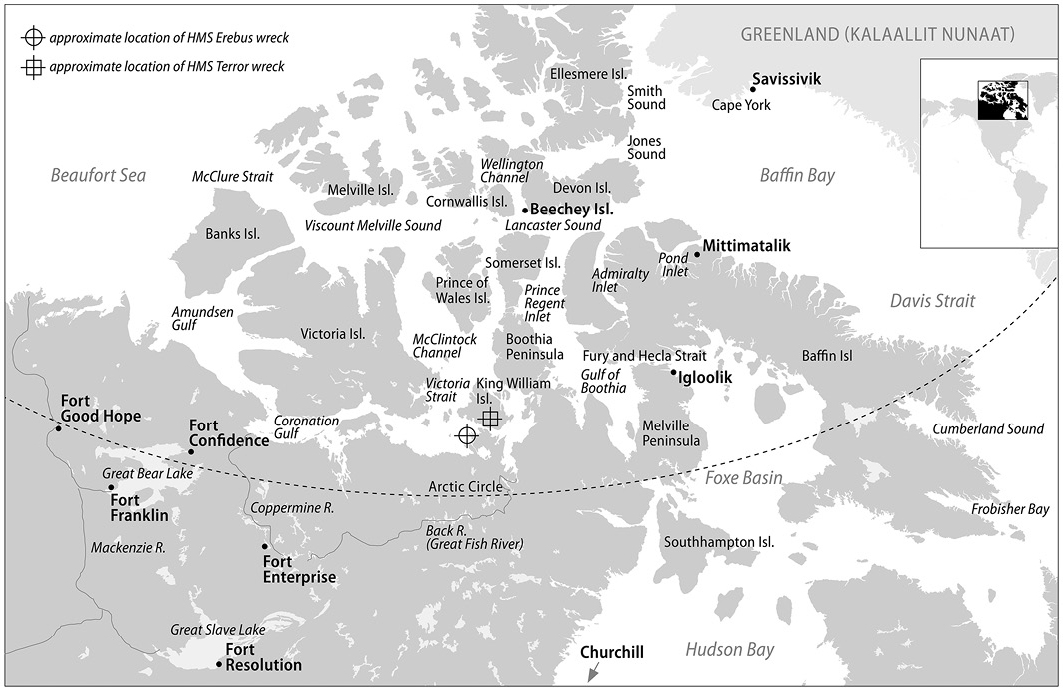
Figure 2: Northwest passages and the search for Franklin.
Source: Map by Milton Andrews, Square Peg Designs, Hobart, 2022.
The ice, therefore, lay behind the stories about the missing Franklin expedition. Ice hampered British travel and facilitated Inuit mobility, it concealed ships and birthed mysteries. Above all, it created archival and geographical blank spaces, begging to be filled in with coastlines and stories. Ice undergirded the ways in which Indigenous information and authority were understood by outsiders—sometimes as authoritative and trustworthy, and sometimes as venal and secret, and sometimes as all of the above.37 These blank spaces also became part of the Franklins’ Tasmanian biographies, as Arctic exploration became entangled with the campaign against penal transportation, and as Inuit evidence intertwined with Tasmanian’s disavowal of their own frontier violence.
Memorials of ice and snow: Franklin relics in Tasmania
In 1852, the Royal Society of Tasmania received a donation from Governor of Victoria Charles La Trobe—a collection of rocks from Franklin’s last known camp on Beechey Island. The camp, located in 1850, contained three graves with gravestones, a hut for taking magnetic observations, a pile of tin cans and a pair of cashmere gloves weighed down by a rock. Yet there was not a single scrap of paper—nothing to indicate how long the expedition had remained or where it had gone.38 La Trobe did not mention how he had come by these rocks, but they were probably sent by his brother, Peter La Trobe, a Moravian bishop who was one of Jane Franklin’s supporters (see below). The rock collection, like so many other artefacts of the search for Franklin, had gained meaning from its ‘ballistic biography’—its passage from one side of the world to another.39 Whether or not the rocks were collected as geological specimens, they had now become relics, linked with the last known spot that the Franklin expedition had touched, and with the possibilities that lay behind the barrier of ice at the top of Wellington Channel.
In Tasmania in 1852, these objects became part of a new story, in which Tasmanians embraced the struggles of John and Jane Franklin as extensions of their own struggles against transportation. As Bain Atwood has argued, over the second half of the nineteenth century, Australian settlers increasingly told origin stories that prioritised struggle and suffering with a challenging, alien environment. Such narratives of struggle eclipsed both the convict past and the frontier wars in an ongoing process of denial and disavowal.40 In Tasmania, this process was linked to the Arctic sea ice and the mysteries it concealed, and ‘relics’ like La Trobe’s rocks became touchstones.
La Trobe’s donation was particularly significant in 1852, for it was closely linked to the idea that Franklin and his companions were still alive, and that Tasmanians could play a role in rescuing them. For more than a year, Jane Franklin’s supporters had crafted a narrative about the ice in Wellington Channel to the north of Beechey Island.41 This assumed that, in the spring of 1846, Franklin had taken advantage of a rapid thaw and sailed north, but that the pack ice had closed behind the ships, trapping them in an open polar sea, where they might still be alive.42 This argument rested on blank spaces. Within Jane Franklin’s inner circle, this was known as the ‘argument from negative evidence’—essentially, that if there was no direct evidence that Franklin was trapped in an open polar sea, there was no evidence that he was not, and, therefore, the British Admiralty was morally bound to continue the search. Otherwise, as the naturalist Sarah Bowdich Lee wrote anonymously:
this Arctic Question, which they like so little, will be an incubus on their bosoms for years to come. The very uncertainty in which it may be left will give it an undying vitality.43
Peter La Trobe’s role had been to suppress Inuit testimony that conflicted with this theory by providing Moravian missionary interpreters from Greenland to provide alternative interpretations of sworn Inuit testimony.44
Between 1851 and 1852, the ‘argument from negative evidence’ fell on fertile ground in Tasmania amid the bitter struggle to end transportation. It circled through private correspondence, news reports and the testimony of whalers returning to Hobart from the Bering Strait and North Pacific.45 It appeared alongside Jane Franklin’s moving letters to foreign heads of state, in which she begged for assistance, criticised the British Admiralty and drew attention to her penury.46 At the same time, settlers were portraying themselves as victims of an unfeeling government determined to ship convicts to the shores of an island imagined as a Little England—an argument initially developed by many of the Franklins’ bitterest enemies.47 By 1852, the Arctic ice brought these two elements together. Like Jane Franklin, anti-transportationist settlers took humanitarian language—in particular, a model of masculinity that emphasised care for dependents—and used it to make claims about transportation as a threat to family life, morality and the body politic.48 Both criticised London for ‘unfeeling’ policies, both claimed to speak for victimised families, and both attempted to claim a moral high ground that rested on claims to science and civility. As the British Admiralty was seen to be ‘derelict in its duty’ if it refused to send steamers to rescue Franklin, so the Colonial Office was derelict if it insisted on sending more prison ships to pollute Tasmanian shores.49
In the Tasmanian winter of 1852, John Franklin’s nephews William Porden Kay (the colonial architect) and Captain Joseph Henry Kay (in charge of the Rossbank Observatory) organised what they called the ‘Franklin Fund’—a subscription to subsidise Jane Franklin’s proposed expedition to Bering Strait. Settlers were eager to link themselves to Jane Franklin’s cause and so portray themselves on a global stage as scientific, humane and philanthropic persons. It was argued that ‘colonists would be spoken of in every circle of polite and commercial men’, and that their actions would rank them alongside the United States, France and Russia.50 When the subject was debated in the Legislative Council, Thomas Gregson (whom Jane Franklin had once accused of being part of a ‘vast conspiracy’ against her) said that colonists would be reproached if they failed to act, warning: ‘Don’t let it be said that while so much had been done, the colony did not entertain the most lively solicitude for [Franklin’s] safety.’51 The enthusiasm for the campaign was largely undisturbed by the testimony of those who had actually been to Bering Strait. In the Arctic summer of 1851, at least 12 Hobart whalers were spotted in these waters; they did not endorse the idea of an open polar sea as they tried to avoid ice collisions, navigate in roaring gales and rescue others whose ships had been destroyed by the pack.52 As the subscription list for the ‘Franklin Fund’ made its way around Tasmania in the wet winter of 1852, most of these men were at sea, having scrounged together crews from those who had not already left for the Victorian goldfields.
At the same time, the Franklins’ Tasmanian biographies were being rewritten for both Tasmanian and British readers. The leader of the anti-transportation movement, Rev. John West, gave both John and Jane Franklin sympathetic treatment in his History of Tasmania, published in 1852. He argued that Jane Franklin had been admired by many and persecuted by a few, and that accusations of ‘petticoat government’ were unfounded. Her influence on her husband, he argued, was limited, and when present was ‘exercised on the side of religion, science and humanity’. John Franklin, West argued, was a ‘disinterested’ man of ‘ardent’ piety who had appreciated the ‘moral worth’ of the settlers as a whole.53 Louisa Anne Meredith’s My Home in Tasmania was published by John Murray in the same year. She was connected to the Franklins by marriage (her daughter Maria had married Joseph Henry Kay), though she did not mention this. She did, however, mock the young women who had not appreciated Jane Franklin’s conversaziones designed for their ‘improvement’ and deplored the ‘coarse and unmanly attacks made in some of the public papers on Lady Franklin’.54 Both books were widely available in Britain and Tasmania; both developed the idea that the Franklins had been martyred and mistreated by a few unscrupulous and ignorant settlers in Tasmania; and both claimed that they had left behind them morally sound settlers who were truly devoted to the pair, and who had inherited their disinterested piety and scientific interests.
In October 1852, Joseph Kay sent the ‘Franklin fund’ (over £1,700) to Jane Franklin, together with an explicit quid pro quo. He asked her to use her influence with the British press to argue against transportation. He wrote that the colonists were ‘the most liberal set of men in the world’, but that the colony’s ‘detestable penal character’ meant that:
it never obtains its share of favourable notice … [in] the Public Press of England … If you can command the columns of the ‘Times’ … it is astonishing how useful a favourable notice of their good qualities may be to the Colony in an indirect manner.55
It is notable, too, that he did not mention the recent death by drowning of the Indigenous girl named ‘Aminia’ who is generally presumed to have been Mithina. It seems unlikely that Kay would have been unaware of her death—after all, he worked closely with Dr Joseph Milligan, then in charge of Oyster Cove, at the Royal Society. But as Kay sketched a story of colonists’ philanthropy, liberality and sympathy with Jane Franklin’s suffering, the dead girl disappeared.
Jane Franklin did not disappoint her Tasmanian supporters. She wrote to the Legislative Council that their sentiments had ‘excited the attention and touched the hearts of the people of England’.56 With the funds they raised, she dispatched the steamer Isobel to the west coast of Greenland under Captain Inglefield, who sailed into what he thought was the polar sea. Jane Franklin sent a copy of A Summer Search for Sir John Franklin, with a Peep into the Polar Basin to Tasmania, with a note that she intended to rename the vessel Tasmania and send her to the Bering Strait.57 She referred frequently to the colonists’ contribution in her public letters as part of her ongoing rebuke of the British Admiralty. Like La Trobe’s rock collection, Jane Franklin testified to Tasmania’s links to the open polar sea, to herself, and to her missing husband and his crew. In this version of the story, colonists were no longer gossiping, underhanded conspirators, but chivalrous and enlightened men who had come to her aid.
The Tasmanian curiosity shop: Franklin relics in Tasmania, 1855–70
After 1852, relics of the Franklins continued to accumulate in Tasmanian institutions. In many ways, they mirrored Franklin relics on the other side of the world, blurring the boundaries between the veneration of explorers and scientific martyrs and the exhibition of ethnographic ‘curiosities’. As the search for Franklin dragged on, and new Inuit evidence came to light, these relics and stories became more problematic. They raised uncomfortable questions about Franklin’s fate, while also gesturing to the very real limits of ideologies of progress and improvement. Yet, at the same time, they developed a particularly Tasmanian version of Franklin as a ‘martyr to science’ or, as Stephanie Barczewski has put it, a ‘heroic failure’.58
In the years after 1852, the Royal Society of Tasmania became an unusual repository of rare Arctic cultural material as discussions swirled about whether or not the expedition could survive, perhaps by adopting Indigenous technology or by ‘going native’. Objects were donated by veteran Arctic whaling captains and whaleship owners, including exquisitely decorated Iñupiaq, Yupiq and Chukchi parkas, along with baleen armour and ritual objects associated with the whale hunt.59 A Yupiq kayak acquired by John Archer on Nunivak Island in 1851 was paddled around the Botanical Gardens in Hobart.60 These objects were tangible evidence of the superiority of Indigenous technology in the far north, whether of the insulating properties of caribou skin or the manoeuvrability of skin boats in icy waters. The street ballad ‘Franklin’s Fate’, known variously as ‘Lord Franklin’ or ‘Lady Franklin’s Lament’, was performed at the Royal Victoria Theatre in Hobart in 1853. Later versions of the now-traditional ballad include the stanza: ‘Through cruel hardships they vainly strove/on mountains of ice their ships were drove/where the Esquimaux in his skin canoe/was the only man who could ever come through.’ The Courier reported that it was ‘listened to with a silence indicative of the sympathy cherished in Tasmania for the fate of that gallant band’.61
In January 1855, Tasmanian newspapers carried the news of the shocking end of the Franklin expedition. A Netsilingmiut party near the Boothia Peninsula had traded several articles from the missing expedition to the Scottish explorer Dr John Rae, including Franklin’s Guelphic medal. The Netsilingmiut also told Rae that, in the spring of 1850, about 40 white men had died in the vicinity of Back’s Fish River (or the Back River) and that at least some of them had committed cannibalism. The ‘relics’ were returned to Britain, where they lay in state in the Painted Hall at Greenwich and were given a full-page spread in the Illustrated London News. As Craciun has argued, it was exceedingly difficult to categorise the disassembled, disambiguated relics, which had no body attached to them.62 They were, on the one hand, objects of pity and reverence. On the other hand, they had been repurposed and adapted by Netsilingmiut people into useful tools, into ulus (women’s knives) and harpoon heads. The fact that so many of the ‘relics’ were eating implements was also probably unsettling, given the accusations of cannibalism that travelled with them. They were also understood as a physical reproach to government for failing to rescue the men, leaving them to suffer and to die on their country’s service. As the Launceston Examiner wrote:
It is a melancholy reflection that if the search after these brave men had been … entrusted to proper persons, Britain and the scientific world would not now have to mourn over the fate of her most adventurous sons.63
The Netsilingmiut intelligence was pulled apart in both Britain and Tasmania. As Franklin’s niece Sophia Cracroft wrote to her cousin Mary Price on Norfolk Island: ‘All may speculate … & the speculations vary infinitely.’64 While cannibalism was rejected, the relics and the rest of Rae’s report was used to promote the case that Franklin had discovered the Northwest Passage. In Tasmania, it was used to further develop the idea that Tasmanian settlers shared the Franklins’ heroic devotion to science and philanthropy. The Colonial Times spoke of colonists’ ‘extreme anxiety’ for the expedition, papered over Franklin’s faults (which were ‘virtues to excess’) and lamented that ‘science, like religion, must have its martyrs’.65 Rev. Miller (whose son-in-law, John Archer, had brought the Nunivak kayak to the Botanical Gardens’ pond) delivered a special sermon to seafarers on Franklin’s fate.66 William Porden Kay sent an account of the memorial tablets that Jane Franklin intended to plant on Beechey Island to the Courier in October 1855. These commemorated the expedition as martyrs to science, and repeated the claim that Franklin had discovered the Northwest Passage.67 Not long after, the Hobart Regatta, which the Franklins had established, was held as a memorial for the dead, on a ‘sunny day’ when, ‘for once, every ill-feeling is banished, every dissolution forgotten’.68 At the final Royal Society meeting of the year, Thomas Lempriere presented the society with a finger from one of the cashmere gloves found at Beechey Island.69 Both La Trobe’s rock collection and Lempriere’s fragment of unravelling cashmere were associated with well-tended graves and huts for magnetic observation—scenes of domesticity, science and reverence, and not desperation and starvation.
By the time that Lempriere presented the finger of the cashmere glove to the Royal Society, the other Franklin relics were being used in conjunction with Inuit testimony to write Franklin’s first official biography. In 1855, Robert McClure applied for the parliamentary reward for the discovery of the Northwest Passage during his 1853 search for Franklin, but Jane Franklin wanted to secure that honour for her husband. However, the problematic Netsilingmiut testimony was the only evidence that Franklin had any such claim. John Franklin’s oldest friend, Sir John Richardson, wrote an article for the Times that argued that the discovery lay with ‘the forty determined men whose bones are blanching near the mouth of the Great Fish River’.70 He later developed this into the first official biography of Franklin in the Encyclopedia Britannica, which focused on his friend’s ‘strict honour and integrity’ and promotion of colonial science in Tasmania, and lamented the ‘factionalism’ among some of the settlers. Richardson also used the Netsilingmiut evidence to place the survivors of Franklin’s party at a specific location at a specific time—at the mouth of the Back River in the spring of 1850—and so to lay claim to the priority of discovery of the Northwest Passage. As Richardson put it, ‘they forged the last links with their lives’.71 The idea that Franklin had a posthumous claim to the Northwest Passage was enthusiastically received in Tasmania, particularly given the fact that he had suffered ‘a fate which must forever be without description, since language can never portray the horrors of starvation in those icy, lifeless deserts’.72 The relics also suggested that some men might still be alive among the Inuit, as an Arctic veteran discussed in a lecture to the Launceston Mechanic’s Institute.73
In 1857, Jane Franklin dispatched Robert McClintock in the yacht Fox to follow up on the Netsilingmiut testimony, and:
to confirm directly or inferentially the claims of my husband’s expedition to the earliest discovery of The Passage, which, if Dr. Rae’s report be true … these martyrs in a noble cause achieved at their last extremity.74
In December 1859, news reached Tasmania that McClintock had obtained written evidence of Franklin’s fate—a note found in a cairn on King William Island that gave a brief history of the ships’ imprisonment in the ice in 1847, of Franklin’s death, the ships’ abandonment in 1848, and how the survivors had headed to the mouth of the Back River to seek help, where the Netsilingmiut report had placed them. McClintock and his crew also found a boat containing two skeletons in European clothes. He collected many relics at ‘the Boat Place’, supplementing those that he had acquired in trade from Netsilingmiut, together with additional testimony about the expedition’s fate.75
McClintock’s expedition seemed to clear up at least some of the mystery surrounding the fate of Franklin. The documents attested to the date of Franklin’s death and meant that he could not have been among the men seen by the Netsilingmiut in 1850. Therefore, he could have neither committed cannibalism nor discovered the Northwest Passage. But McClintock’s relics were, like Rae’s, ambiguous. Some had been taken directly from British bodies. Others had been acquired in trade from Inuit. The discomfort was increased by the way that the relics circulated as stereoscopic slides. The result, Craciun has argued, was that they were removed into middle class homes ‘to be enjoyed or ignored like any other bric-a-brac’.76 A set of these stereoscopic slides were presented to the Royal Society of Tasmania by Mr W. R. Looker of London (Figure 3). The new technology made the relics leap out at the viewer in three dimensions, and the result was, as the Mercury put it, that they appeared ‘almost as vividly to the eye as though it rested on the articles themselves’.77
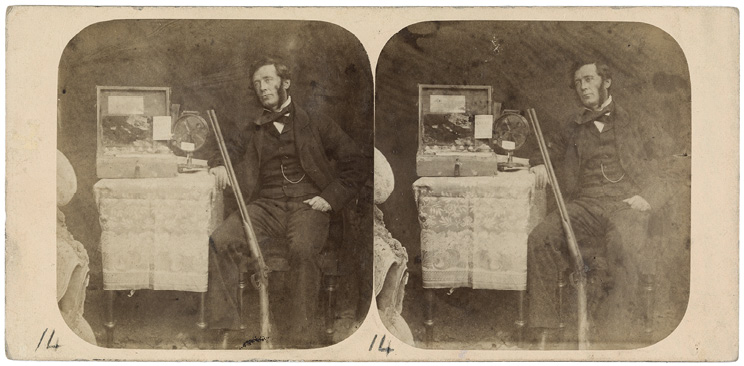
Figure 3: A series of stereoscopic views of the Franklin relics brought home in the Fox by Captain McClintock.
Source: Jack Thwaites Collection, Tasmanian Archives, NS 1155/1/20.
In Tasmania, McClintock’s narrative further hitched settlers and their scientific interests to the Franklin expedition. Now that the question of cannibalism had been laid aside, settlers began to contemplate new ways to memorialise the Franklins. The Cornwall Chronicle reflected: ‘What ever were his faults as Governor, he erred on the side of humanity.’78 It encouraged everyone in the colony to subscribe to some kind of testimonial to Jane Franklin. The Hobart Town Advertiser also suggested that a subscription should be circulated to ‘set up on high some enduring memento’ to Franklin, in order to remind the rest of the empire that part of his career ‘belongs to us’.79 On Jane Franklin’s instructions, McClintock had named a geographical feature after the Tasmanian colonists; this explains the presence of the ‘Tasmania Islands’ in the Canadian Archipelago. Jane Franklin sent an inscribed copy of The Fate of Franklin to the Royal Society and another to the Mechanics Institute, and, as the Hobart Town Daily Mercury put it when the first copies arrived: ‘No Tasmanian library can be, or will be, complete without it.’80
It was against this background that calls emerged for Tasmania to erect a statue to Franklin—and, ideally, before one went up in Britain. This was supposed to be as much a testament to the enduring relationship between Tasmanians and Jane Franklin as about John Franklin’s memory. A person who called themselves a ‘Son of the Soil’ reminded colonists that Jane Franklin remembered Tasmania ‘affectionately’, and that she had asked McClintock to name the Tasmania Islands ‘as an acknowledgement of the large subscription raised in that island towards the exploration fund’. Echoing the same claims colonists had been levelling at London in the 1850s, the letter writer claimed that failure to erect a statue was tantamount to a ‘dereliction of duty’ on the part of Tasmanians.81 Two years later, as the remnants of the Burke and Wills expedition were brought back to Victoria in state, the Mercury took it as an opportunity to make a case for the role that hagiographies of colonial explorers could and should play in new colonial histories—a nearly perfect illustration of settler denial and disavowal. Colonists, the Mercury writer argued, had thus far had no wars that could ‘sanctify their institutions and consecrate their very soil’, neatly skirting the fact that colonists were still engaged in frontier violence that sanctified nothing.82 What they could recognise were those names ‘made noble by exertions and sufferings’. Victorians had Burke and Wills, but Tasmania had Franklin, whose ‘daring and suffering’ were located in the Arctic ice.83
A statue was commissioned—one of a trio, whose partners stand in Waterloo Place in London, and in Franklin’s birthplace of Spilsby in Lincolnshire. After its arrival and installation in Franklin Square, Hobart, in 1865, the Franklin relics continued to circulate in Tasmania—but now as ‘curiosities’ worthy of exhibition in a museum. The most notable of these were a collection sent by Franklin’s son-in-law, John Phillip Gell, to the Hutchins School in 1865 to be auctioned off as part of a fundraiser. Gell had spent several years in Tasmania in the 1840s, and had been involved in the founding of Christ’s College, the Queen’s School, Launceston Church Grammar School and the Hutchins School.84 Many of Gell’s ‘relics’ had been gathered by the McClintock expedition on King William Island in 1859, and some had been taken from the bodies of the dead at ‘the Boat Place’. They included a bullet that had been taken from a loaded gun by the side of one of the skeletons, as well as a portion of a boat’s ensign taken from the Victory Point Cairn. The Advertiser wrote:
We have no doubt these relics will have found a customer, as many ardent lovers of Tasmania would, we think, have been ambitious to possess themselves of such curiosities with a view to presenting them to the Museum.85
By 1865, then, the Franklin ‘relics’ had become ‘curiosities’ in an eerie echo of Jane Franklin’s own collecting practices. That echo did not escape Tasmanians during Jane Franklin’s lifetime. In 1869, for example, after the publication of James Bonwick’s The Last of the Tasmanians, Or, the Black War of Van Diemen’s Land, J. W. Graves began publishing his memoirs of the life and death of Mithina.86 Whether or not the recollections were true is impossible to say, but they had at their heart the troubling fact that Jane Franklin had taken Mithina for her own purposes and had abandoned her, and, like so many others, that Mithina had died young. It sparked suggestions that the same colonists who had subscribed to Jane Franklin’s expedition should fund a memorial to Mithina at the Oyster Cove Cemetery. The Cornwall Chronicle suggested that failure to do so would be ‘a disgrace to the present occupiers of the land’.87 Bonwick’s book and Graves’s sentimentalised recollections were, like the Franklin relics themselves, difficult to reconcile with Jane Franklin’s international fame, now closely linked to colonists’ post-convict identity. So too were the claims made by some that Mithina had died while inebriated. The botanist Ronald Gunn wrote to the Cornwall Chronicle to ‘dispose of a mass of rubbish about Mathinna’, in particular the accusation that she had ‘acquired a taste for Commissariat rum’ at Government House.88
In the following years, a number of articles appeared in Tasmanian papers, often under pseudonyms, that tried to reconcile these points. They attested to Jane Franklin’s delicacy of stature and greatness of mind, her firmness of purpose, her womanly devotion—including to Mithina—and to the calumnies she had suffered.89 Her own relics began to circulate, too. The colonial surveyor J. E. Calder claimed to have collected one of her shoes during the Franklins’ expedition to the west coast of Tasmania, which he gave to J. W. Graves, who sent it to the Mercury ‘so that any of our young ladies, who are not ashamed of themselves, may take in time a good example’.90 He also sent a copy of her portrait by Thomas Bock. Jane had originally commissioned it as a phrenological portrait to show, as she called it, ‘my two great bumps of causality’.91 Graves said that the shoes and the portrait evoked the ‘softness of the countenance of her ladyship’ when he presented them to the Tasmanian Library.92 These too linked the Arctic ice to Tasmanian soil, harnessing Jane Franklin’s search for her husband to her Tasmanian experiences. But they also had the effect of raking up plenty of ire. One colonist, who styled himself as ‘Mathinna’s ghost’, wrote:
If Mr. J. W. Graves is going to establish a sort of old curiosity shop for the reception of discarded linen and old boots and shoes of old colonists, he had better say be at once, and I will forward him some interesting relics.93
Both relics and curiosities were meant, like the Franklin statue, to testify to Tasmanians’ capacity for progress and improvement, as well as their connection to one of the great mysteries of their time. They were used together with the blank spaces on the map and the blank spaces in the Franklin archive to weave new stories, new histories and new biographies for unfolding purposes. Early photographs of the statue show it, not fenced in by tall trees as it is now, but against a background of departing ships and busy wharves (Figure 4). At the time, it testified to Tasmanian commerce, improvement and progress. Today, the statue is accompanied by an arresting sculpture, Two Islands by Nigel Helyer, which shows the ribs of HMS Erebus, keeled over and with a gleaming Tasmanian reed canoe at its heart. It is accompanied by the recorded voices of members of the Indigenous community, reflecting on the consequences of colonial science, collecting practices and stolen children.94 It is a compelling way to re-story the Franklins in Tasmania. This article adds to that project of re-storying by looking at some of the ephemeral ways in which the Arctic sea ice, relics and stories were bound up with Tasmanian biographies of the Franklins and disavowals of the past. My hope is that it is far from the last.
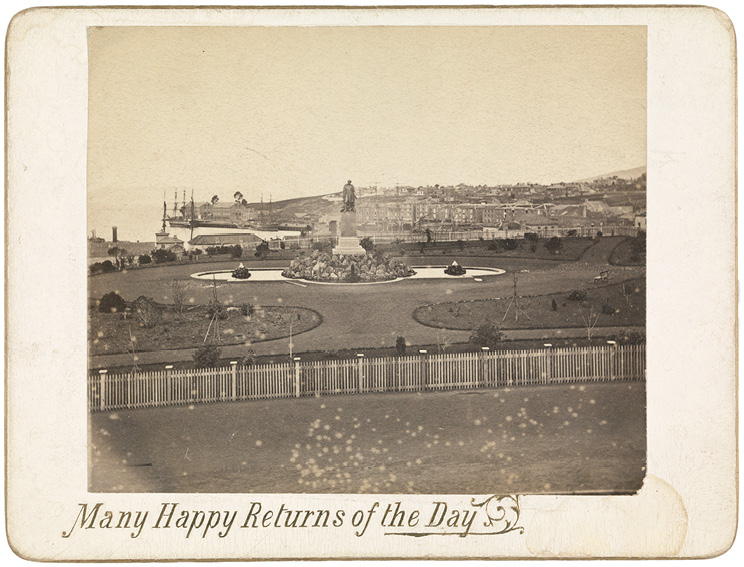
Figure 4: Postcard of the Franklin statue, c. 1870.
Source: Tasmanian Archives, NS 6904/1/78.
1 ‘Butchers and Small Goodsmen’, Tasmanian News, 22 December 1893, 3, nla.gov.au/nla.news-article173656196.
2 ‘Interesting Relics’, Tasmanian News, 20 November 1894, nla.gov.au/nla.news-article174591199.
3 Kathleen Fitzpatrick, Sir John Franklin in Tasmania, 1837–1843 (Melbourne University Press, 1949), 339; Alison Alexander, The Ambitions of Jane Franklin, Victorian Lady Adventurer (Allen & Unwin, 2013), 195–6. For the expedition’s scientific significance, see: Andrew Lambert, The Gates of Hell: Sir John Franklin’s Tragic Quest for the North West Passage (Yale University Press, 2009), 167–76. For Franklin’s final letters, see: Russell A. Potter, Regina Koellner, Peter Carney and Mary Williamson. eds., May We Be Spared to Meet on Earth: Letters of the Lost Franklin Arctic Expedition (McGill-Queen’s University Press, 2022).
4 See: Ann Savours, The Search for the Northwest Passage (St Martin’s Press, 1999); Russell A. Potter, Finding Franklin: The Untold Story of a 165-Year Search (McGill-Queen’s University Press, 2016), doi.org/10.1515/9780773599611.
5 See, for example: Gillian Hutchinson, Sir John Franklin’s Erebus and Terror Expedition: Lost and Found (Adlard Coles Nautical, 2017); Karen Ryan, Death in the Ice: The Shocking Story of Franklin’s Final Expedition, Souvenir Catalogue Series (Canadian Museum of History, 2018); ‘The Terror’, AMC Networks, accessed 29 August 2025, amcstudiosinternational.com/catalog/17674.
6 Russell Potter, ‘Parks Canada 2023 Finds’, Visions of the North (blog), 24 January 2024, visionsnorth.blogspot.com/2024/01/parks-canada-2013-finds.html.
7 See: Theresa Sainty, Taypani Milaythina-Tu: Return to Country (Tasmanian Museum and Art Gallery, 2023); Annaliese Jacobs Claydon, Arctic Circles and Imperial Knowledge: The Franklin Family, Indigenous Intermediaries, and the Politics of Truth (Bloomsbury Academic, 2024), 94–138; Alexander, The Ambitions of Jane Franklin, 125–38; Penny Russell, ‘“Unhomely Moments”: Civilising Domestic Worlds in Colonial Australia’, The History of the Family 14, no. 1 (2009): 327–39, doi.org/10.1016/j.hisfam.2009.07.001; Cassandra Pybus, A Very Secret Trade: The Dark Story of Gentlemen Collectors in Tasmania (Allen & Unwin, 2024), 137–80. Note: Pybus’s narrative does not include footnotes. For fully referenced discussions of the same material, see the preceding citations.
8 See: ‘Franklin A-Line Organic Denim—Staple’, Studio Tasmania, accessed 2 April 2024, thespottedquoll.com.au/products/franklin-a-line-organic-denim.
9 Following Alessandro Antonello and Nancy Cushing, I understand ‘re-storying’ to be a practice of restoring complexity to narratives by attending to webs of connection and obligation, as well as counter-narratives. Alessandro Antonello and Nancy Cushing, ‘Re-Storying Monuments: Forum Introduction’, History Australia 18, no. 4 (2021): 747–52, doi.org/10.1080/14490854.2021.1991816.
10 Michel-Rolph Trouillot, Silencing the Past: Power and the Production of History (Beacon Press, 2015).
11 Nathan Sentance, ‘Remembering, Re-Storying, Returning’, History Australia 18, no. 4 (2021): 823–9, doi.org/10.1080/14490854.2021.1991815.
12 Michael F. Robinson, The Coldest Crucible: Arctic Exploration and American Culture (University of Chicago Press, 2010); Max Jones, The Last Great Quest: Captain Scott’s Antarctic Sacrifice (Oxford University Press, 2003); Russell Alan Potter, Arctic Spectacles: The Frozen North in Visual Culture, 1818–1875 (University of Washington Press, 2007); Sarah Moss, The Frozen Ship: The Histories and Tales of Polar Exploration (BlueBridge, 2006).
13 Andy Bruno, Tunguska: A Siberian Mystery and Its Environmental Legacy (Cambridge University Press, 2022), doi.org/10.1017/9781108887847.
14 Andrew Wright Hurley, ‘Reports, Silences and Repercussion: Wondering about the Ballistic Biography of the Leichhardt Gunplate’, Rethinking History 24, no. 3/4 (2020): 556, doi.org/10.1080/13642529.2020.1845536.
15 See, especially: Karen Routledge, Do You See Ice? Inuit and Americans at Home and Away (University of Chicago Press, 2018).
16 Claydon, Arctic Circles, 21–91; Frances J. Woodward, Portrait of Jane: A Life of Lady Franklin (Hodder & Stoughton, 1951), 157–8.
17 Franklin had initially been offered the post of the governor of Antigua, where he thought that he and Jane might indulge their interest in the ‘moral improvement of the Blacks’, but she thought it was beneath his dignity, and so he turned it down. See: John Franklin to Jane Franklin, 25 March 1836, Scott Polar Research Institute (SPRI) MS248/303/67.
18 The best surveys are in Alexander, The Ambitions of Jane Franklin; Fitzpatrick, Sir John Franklin in Tasmania. See also: Craig Joel, A Tale of Ambition and Unrealised Hope: John Montagu and Sir John Franklin (Australian Scholarly Publishing, 2011).
19 Mary Maconochie to George Back, 30 April [1838], SPRI MS395/54/1/BL.
20 See: Lambert, The Gates of Hell, 110–40.
21 This was particularly the case with Robert Lathrop Murray. See: E. Morris Miller, Pressmen and Governors: Australian Editors and Writers in Early Tasmania (Angus and Robertson, 1952), 33–4, 208.
22 Thomas Anstey to Charles Swanston, 27 January 1840, NS 6102, Tasmanian Archives (TA).
23 ‘Adolphus’ had many names, including Timemernedic and ‘Timeo’ as Jane Franklin called him. He used ‘Adolphus’ with outsiders, as Eleanor Franklin recorded in March 1842, see: Eleanor Franklin diary, 14 March 1842, MM 4/1/3, TA. We do not know what name Mithina’s mother, Wongerneep, called her. She was named ‘Mary’ by Robinson, but Jane Franklin called her ‘Mathinna’ for reasons of her own, see: Jane Franklin to Josephine Richardson, 6 December 1844, SPRI MS 1503/28/10. The death record normally attributed to Mithina records her name as Aminia. If they are the same person, this may be the name that she used at Oyster Cove, see: Inquest 2798, SC195/1/31, TA. Neither child, it seems, used the name associated with Jane Franklin after they left her care. While her name has normally been spelled ‘Mathinna’, I use the spelling ‘Mithina’ as recommended by the Tasmanian Aboriginal Centre.
24 Claydon, Arctic Circles, 93–138. The quotation is from Jane Franklin to Mary Simpkinson, 8 March 1843, SPRI MS 248/174.
25 While on board the Vansittart, Adolphus revisited his country around Robbins Island, visited kin on Flinders Island and travelled to Sydney, and may also have travelled to Port Phillip. Claydon, Arctic Circles, 120–3; CON1/1/16/1442/2-3 Vansittart, TA; Letters of Captain John Lort Stokes (HMS Beagle) to F. Beaufort, Records of the Hydrographic Department of Great Britain, [M2318-M2337, M2436-M2467], nla.gov.au/nla.obj-2251336306.
26 Mithinna’s testimony to the Friend Enquiry, October 1846, CSO11/1/27, 93–5, TA. See also Leonie Stevens, Me Write Myself: The Free Aboriginal Inhabitants of Van Diemen’s Land at Wybalenna (Monash University Publishing, 2017), 305–13.
27 Alexander, The Ambitions of Jane Franklin, 195–6.
28 14–19 June 1843, CSO8/1/84/1925, TA.
29 Derbyshire Record Office (DRO), D8760/F/OBJ/3.
30 Routledge, Do You See Ice? 1–34; Julie Cruikshank, Do Glaciers Listen? Local Knowledge, Colonial Encounters, and Social Imagination (UBC Press, 2005), 3–20.
31 Renee Fossett, In Order to Live Untroubled: Inuit of the Central Artic 1550 to 1940 (University of Manitoba Press, 2001), 115–66, doi.org/10.1515/9780887553288.
32 This dynamic was, as some British authorities acknowledged, partly fuelled by whalers’ practices of taking young Inuit to Scotland to develop into intermediaries. In 1849, Sir Edward Parry feared that this amounted to Inuit surveillance of the British both in the ice at ‘home’ and that ‘the Esquimaux … must know the important facts as well as we do’. W. E. Parry to John Barrow, Jr, 25 October 1849, The National Archives, UK (TNA), ADM 7/189/13. See also: Claydon, Arctic Circles, 141–2.
33 Savours, The Search for the Northwest Passage, 186–303.
34 Alexander, The Ambitions of Jane Franklin, 214–28; Margarette Lincoln, ‘Waiting and Hoping: The Experience of Women Whose Loved Ones Went to Sea’, Institute for Historical Research: History Focus: The Sea, Autumn 2005, archives.history.ac.uk/history-in-focus/Sea/articles/lincoln.html.
35 ‘Remarks on … the Expediency of Adopting Further Measures for the Relief of Sir John Franklin’, TNA ADM 7/188/6. For the development of the philanthropic argument, see: Claydon, Arctic Circles, 139–68.
36 Adriana Craciun, ‘The Franklin Relics in the Arctic Archive’, Victorian Literature and Culture 42, no. 1 (2014): 1–31, doi.org/10.1017/S1060150313000235. The first relics were themselves connected—by long threads—to Tasmania. These were brought back to England in 1850 by Captain Charles Forsyth of Jane Franklin’s private vessel, Prince Albert. In 1842, Forsyth had commanded the Vansittart in Bass Strait, whose crew had included Adolphus, and they had been involved in an attempt to rescue John and Jane Franklin from Macquarie Harbour.
37 Most notably Charles Dickens, ‘The Lost Arctic Voyagers’, Household Words, 2 December 1854, 364; Dickens, ‘The Lost Arctic Voyagers,’ Household Words, 9 December 1854, 393.
38 The ships themselves were actually several hundred miles to the south, pushed into the channels near King William Island by sea ice driven by the Beaufort Gyre. Here, the remnants of the expedition had become islands in the archipelago of Indigenous trade, and had altered Inuit geopolitics in this region of the central Arctic. See Fossett, In Order to Live Untroubled, 139–66; Dorothy Harley Eber, Encounters on the Passage: Inuit Meet the Explorers (University of Toronto Press, 2008), 64–107.
39 Hurley, ‘Reports, Silences and Repercussion’.
40 Bain Attwood, ‘Denial in a Settler Society: The Australian Case’, History Workshop Journal 84 (2017): 24–43, doi.org/10.1093/hwj/dbx029.
41 These supporters included the veteran humanitarian Anna Gurney (author of the 1836 Report of the Select Committee on Aboriginal Tribes), and the Métis activist Alexander Kennedy Isbister, who together with his uncle William Kennedy were formidable critics of the Hudson’s Bay Company.
42 In fact, Franklin had indeed ascended Wellington Channel in 1846. However, the Erebus and Terror were caught in the pack ice and driven further south in the autumn of 1846. When their would-be rescuers were turning their eyes northwards, the last survivors were starving to death several hundred miles to the south.
43 [Sarah Bowdich Lee] Arcticus, ‘The Search for Sir John Franklin’, Daily News, 22 September 1851, 6. This is identified as Lee’s work in Sophia Cracroft’s journal, 19 September 1851, SPRI MS 248/162.
44 Claydon, Arctic Circles, 169–204. For the theory of the open polar sea, see: Michael F. Robinson, ‘Reconsidering the Theory of the Open Polar Sea’, in Extremes: Oceanography’s Adventure at the Poles (Science History Publications, 2007), 15–29.
45 The Franklins left a number of friends and relations behind when they departed Tasmania. Some of this correspondence is contained or referenced in ‘Correspondence of Mary and John Price’, NS1004, TA; and SPRI MS 248/108 BJ.
46 See Jane Franklin and Erika Behrisch Elce, As Affecting the Fate of My Absent Husband: Selected Letters of Lady Franklin Concerning the Search for the Lost Franklin Expedition, 1848–1860 (McGill-Queen’s University Press, 2009), doi.org/10.1515/9780773575165.
47 For example, Thomas Anstey. See: Kirsty Reid, Gender, Crime and Empire: Convicts, Settlers and the State in Early Colonial Australia (Manchester University Press, 2008), 204–54; Eleanor Robin, Swanston: Merchant Statesman (Australian Scholarly Publishing, 2018), 85; Launceston Examiner, 31 January 1846, 3.
48 Hilary M. Carey, Empire of Hell: Religion and the Campaign to End Convict Transportation in the British Empire, 1788–1875 (Cambridge University Press, 2019), 220, doi.org/10.1017/9781107337787; Reid, Gender, Crime and Empire, 204–54.
49 I develop this argument more fully in Claydon, Arctic Circles, 187–95.
50 ‘Sir John Franklin’, Colonial Times and Tasmanian, 6 July 1852, 2.
51 ‘Legislative Council’, Courier, 25 September 1852, 3.
52 However, not all of them said in their departure records that they were heading for Bering Strait. I take this number from the logbooks of the Litherland and the Eliza, both Hobart vessels who recorded the presence of other Tasmanians in Arctic waters. See: Litherland (barque) to Bering Strait, Capt. Davis, owner Charles Seal, CRO82/1/3, TA; John Archer, Journal of the Eliza, State Library of New South Wales, A 2028.
53 John West, A History of Tasmania, with Copious Information Respecting the Colonies of New South Wales, Victoria, South Australia &c., &c., &c. ed. A. G. L. Shaw (Angus & Robertson Publishers, 1971), 174.
54 Mrs Charles (Louisa Anne) Meredith, My Home in Tasmania, during a Residence of Nine Years (John Murray, 1852), 30.
55 J. H. Kay to Jane Franklin, 1 October 1852, DRO D8760/F/FLJ/1/5.
56 Jane Franklin to the Honorable the Legislative Council of Van Diemen’s Land, London, 6 May 1853, SPRI MS 248/2-6/2.
57 Copies of letters written and received, and notes, on expeditions in search of Sir John Franklin by Lady Franklin, Sophia Cracroft, 7 February to 3 April 1853, SPRI MS 248/110.
58 Stephanie Barczewski, Heroic Failure and the British (Yale University Press, 2016), 59–81, doi.org/10.12987/yale/9780300180060.003.0002.
59 Royal Society of Tasmania, ‘Proceedings of the Monthly Meetings of the Royal Society for January to December, 1853’, Papers and Proceedings of the Royal Society of Tasmania 2, no. 3 (1854): 490. The Tasmanian whaling fleet had arrived in the middle of the summer trading season, and the whalers’ and traders’ routes and trade goods contributed to breaking up the long-established monopoly of Chukchi middlemen. See: John Bockstoce, Furs and Frontiers in the Far North: The Contest among Native and Foreign Nations for the Bering Strait Fur Trade (Harvard University Press, 2009), 260–95.
60 ‘Royal Society of Van Diemen’s Land’, Courier, 14 May 1853, 2, nla.gov.au/nla.news-article2249151.
61 ‘Public Amusements’, Courier 25 June 1853, nla.gov.au/nla.news-article2245441. There is a broadsheet of the ballad in the State Library of Tasmania that does not mention the skin canoe (TL.P 919.809 FRA). It is a close copy of the 1852 version held at the National Library of Scotland (Crawford.EB.3734).
62 Craciun, ‘The Franklin Relics’.
63 ‘Sir John Franklin’s Expedition’, Launceston Examiner, 10 May 1856, nla.gov.au/nla.news-article36297456.
64 Sophia Cracroft to Mary Franklin Price, 4 November 1854, NS1004/1/15, TA.
65 ‘Sir John Franklin’, Colonial Times, 12 January 1855, 2, nla.gov.au/nla.news-article8778800.
66 ‘Sir John Franklin’, Courier, 20 January 1855, 3, nla.gov.au/nla.news-article2478032.
67 ‘The Late Sir John Franklin’, Courier, 5 October 1855, nla.gov.au/nla.news-article2491674.
68 ‘Hobart Town Regatta’, Tasmanian Daily News, 5 November 1855, 4, nla.gov.au/nla.news-article203385788.
69 ‘General Intelligence: Royal Society of Van Diemen’s Land’, Courier, 27 December 1855, 3, nla.gov.au/nla.news-article2496294.
70 Sir John Richardson, ‘Arctic Voyagers’, Times, 23 June 1855, 5.
71 Sir John Richardson, ‘Sir John Franklin’, Encyclopedia Britannica Online, originally published 1856, accessed 25 January 2015, britannica.com/EBchecked/topic/1994314/Sir-John-Richardson-on-Sir-John-Franklin.
72 ‘Sir John Franklin’s Expedition’, Launceston Examiner 10 May 1856, nla.gov.au/nla.news-article36297456.
73 ‘Mechanics Institute’, Launceston Examiner, 29 September 1857, nla.gov.au/nla.news-article36302483.
74 Lady Franklin to Captain McClintock, 29 June 1857, Royal Geographical Society – Institute of British Geographers, CB4 1851-60 (original emphasis).
75 Potter, Finding Franklin, 40–1.
76 Craciun, ‘The Franklin Relics’.
77 ‘Franklin Relics’, Mercury, 11 September 1860, 2, nla.gov.au/nla.news-article8792957.
78 ‘Sir John Franklin’, Cornwall Chronicle, 28 December 1859, 4, nla.gov.au/nla.news-article65991710.
79 ‘Captain McClintock’s Expedition’, Hobart Town Advertiser, 17 December 1859, nla.gov.au/nla.news-article264681375.
80 ‘The Fate of Franklin’, Hobart Town Daily Mercury, 11 April 1860, 2, nla.gov.au/nla.news-article19467805; ‘Royal Society of Tasmania’, Mercury, 22 November 1860, 3, nla.gov.au/nla.news-article8794519; ‘The Mechanic’s Institute’, Mercury, 16 March 1861, 2, nla.gov.au/nla.news-article8796966. There were quite a few private first editions circulating in Tasmania, four of which are now at the State Library, one of which was a presentation copy given to Rev. W. Grighton by Jane Franklin.
81 ‘To the Editor of the Mercury’, Hobart Town Daily Mercury, 25 June 1860, 3, nla.gov.au/nla.news-article19469044.
82 Attwood, ‘Denial in a Settler Society’.
83 Mercury, 15 December 1862, 2; Frances J. Woodward, ‘John Philip Gell (1816–1898)’, Australian Dictionary of Biography, National Centre of Biography, The Australian National University, published first in hardcopy 1966, accessed 12 June 2024, adb.anu.edu.au/biography/gell-john-philip-2087/text2619.
84 Woodward, ‘John Philip Gell (1816–1898)’.
85 ‘Bazaar in Aid of the Hutchins School Repair Fund’, Advertiser, 11 January 1865, nla.gov.au/nla.news-article264730799.
86 See: Penny Russell, ‘Girl in a Red Dress: Invention of Mathinna’, Australian Historical Studies 43, no. 3 (2012): 341–62, doi.org/10.1080/1031461X.2012.706627; ‘Something of the Past’, Mercury, 7 June 1869, 3, nla.gov.au/nla.news-article8859437.
87 ‘Mathinna’s Grave’, Cornwall Chronicle, 7 February 1870, nla.gov.au/nla.news-article65982112.
88 ‘Mathinna’, Cornwall Chronicle, 3 May 1872, nla.gov.au/nla.news-article66027468.
89 ‘A Portrait of a Lady’, Mercury, 3 October 1872, nla.gov.au/nla.news-article8925183.
90 ‘Sir John Franklin’, Mercury, 23 August 1875, nla.gov.au/nla.news-article8939349.
91 Jane Franklin to Mary Simpkinson, 21 June 1838, Royal Society of Tasmania, 16/8.
92 ‘Lady Franklin’, Mercury, 23 July 1875, nla.gov.au/nla.news-article8938737.
93 ‘Hunt the Slipper’, Mercury, 27 August 1875, nla.gov.au/nla.news-article8939448.
94 ‘Two Islands—Franklin Square’, City of Hobart, accessed 13 June 2024, hobartcity.com.au/Community/Creative-Hobart/Creative-Hobart-projects/Two-Islands-Franklin-Square.
Previous Next



