


 menu
The Doubters' Dilemma
5
The Road to Language Capital: Interpreting the findings
5.1. Characterising the three student archetypes
In Chapter 3 we identified three groups of students—Committed Students, Doubters and Quitters—which we described in Table 3.VI,reproduced here as Table 5.I for the convenience of the reader. In Chapter 4 we reported more detailed analyses (Figures 4.1 to 4.20) that allow us, in this chapter, to characterise each of the three groups, first on the basis of their most prominent characteristics (i.e. those found to be prominent and unique to one of the groups when compared to the other two), and then on the basis of additional relevant characteristics that contribute to a fuller, more rounded description. First, we summarise the student characteristics from section 4.2, grouping them in a way conducive to characterising the three student archetypes, as a foundation for the more theoretical analysis presented in the latter part of this chapter.
Table 5.I. Classification of students’ commitment to language study used to characterise the student groups
|
Commitment to language studies |
Continuing Students |
Discontinuing Students |
|
High |
Commited Students Did not think of discontinuing and continued |
Quitters Discontinued. Include both:
|
|
Low |
Doubters Thought of discontinuing but continued (or had to continue) |
Corresponds to Table 3.VI.
Source: Extrapolated from an analysis of Phase 2 Questionnaire Data.
5.1.1. Committed Students
The group we call Committed Students comprises those students who reported never having given serious thought to discontinuing their L&C studies. These are the students that language teachers consider ‘ideal’: confident and successful in their learning, self-motivated, appreciative of their past and present language learning experiences, yet discerning. These students stand out uniquely as a group in their positive perceptions of their language learning experiences, their teachers and the wider learning environment.
Committed Students show the following prominent characteristics:
- They would have chosen to study a language whether or not it was a compulsory element of their degree programs.
- They feel that studying the chosen language helps them with their other studies.
- They perceive teachers’ skills, feedback, approachability and availability as better than expected.
- They perceive the teaching materials, and the language learning environment in general, as better than expected.
- They find that the support they receive from fellow students is at the appropriate level or better than expected.
- They are satisfied with their progress in language learning.
- They report that they have learned more than expected about both the culture(s) and the writing of the language being studied.
- They achieve higher marks, and are more concerned about receiving poor marks, than the other groups.
- They are concerned when language classes are ‘too big’.
Compared with the other two groups, Committed Students also show the following characteristics:
- They rate their previous experiences of language learning as rewarding.
- Their expectations about the degree of difficulty of learning a language are more realistic than those of the other two groups—most Committed Students report the overall level of difficulty, and the specific difficulty of learning grammar, as the same, or even less, than expected.
- The reported knowledge of language learning in their families and peer group is higher than in the other groups. Committed Students are more likely to have a family background in the language they are studying, or to have studied the language previously. Moreover, if they have previously spent time in the country where the target language is spoken, they consider this important.
- Committed Students are more likely than the other two groups to rate highly certain reasons for studying a language, such as interest in the culture(s) associated with the language, a desire to communicate with native speakers of the language, and a general interest to understand people and cultures outside their own.
- They are more likely to be international students.
- They are more likely than Doubters to report an intention to complete a major in the language they are studying or to do Honours.
- They are more likely than Doubters to feel that knowing more than one language is very important, and to consider the language they are studying as easy to learn.
- They are more likely than Doubters to report that their friends have also continued learning the target language.
- They are more likely than Doubters to report that they need to use the target language in their work life.
5.1.2. Quitters
The group we have termed Quitters comprises those students who have already discontinued L&C studies. From the analysis reported in section 3.4.3, we know that this group includes both students who had wanted to continue their language study, but had to quit because they had no other choice (‘Reluctant Quitters’), and students who quit voluntarily, either because they had chosen to complete a major in another discipline or because they were dissatisfied with their L&C learning experience. (‘Voluntary Quitters’). This diversity potentially confounds any attempt to characterise the group. Nevertheless, we found that Quitters stand out uniquely as a group because of the following characteristics:
- They are more advanced in their undergraduate degree, or have completed their degree.
- They tend to be older.
- Language study is less frequently a compulsory requirement in their degree, so they have more freedom to choose whether or not to study a language.
- They consider it extremely important if people are discouraging them from studying the language.
- They consider their other study commitments more important than their L&C studies.
Compared with the other two groups, Quitters also show the following characteristics:
- They receive lower marks than the other two groups.
- They are less concerned about receiving poor marks than the other groups.
- They consistently rate lower than the other two groups their teachers’ skills, feedback, approachability and availability, as well as the teaching materials and the language learning environment in general.
- They are less likely than the other two groups to report that studying a language to complete their degree is an important reason to study a language.
- Compared with Doubters, they are more likely to report that practical reasons—timetable clashes, thinking of discontinuing university studies altogether, or work commitments—interfere with continuing their L&C studies.
- They are as likely as Doubters to report that their expectations of L&C studies had not been met.
5.1.3. Doubters
The group we term Doubters comprise those students who reported having seriously considered discontinuing their L&C studies, but who nonetheless were still enrolled in an L&C course at the time of data collection. Typically, these were the students who reported struggling with their L&C studies: they had either not studied a language before, or had done so but reported not having gained much from the experience. They stand out uniquely as a group because of their negative learning experiences (in direct contrast to reports by Committed Students).
As a group Doubters display some prominent characteristics:
- They find the workload for language learning is ‘too high’.
- They are not satisfied with their progress in language learning.
- They perceive that they have fallen behind in their study and cannot catch up.
- They feel that having friends who are discontinuing L&C studies is a very important influence on their own thinking about discontinuing.
Compared with both the other two groups, Doubters also show the following characteristics:
- They are less likely to have previously studied the language.
- If they have previously studied a language, they are less likely to rate that previous experience of language learning as having been a rewarding one than either Committed Students or Quitters.
- They perceive the degree of difficulty of both learning a language in general, and learning grammar in particular, as higher than expected.
- The reported knowledge of language learning in the Doubters’ families and peer group is lower than for both Committed Students or Quitters.
- They are less likely to have a family background in the language they are studying, or to have studied that language previously.
- They receive less encouragement from their family to study languages.
- They are less likely than Committed Students or Quitters to report that they were free to choose whether or not they study a language.
- When asked if they would have chosen to study a language regardless of whether this was compulsory in their degree program, Doubters were the most uncertain in their responses.
Doubters also show characteristics that distinguish them from the other two groups in different ways. For example:
- Some 25 per cent of Doubters reported that it was extremely important if people discouraged them from studying languages. This was even more relevant to Quitters (40 per cent).
- Doubters receive lower marks than Committed Students, and only slightly higher marks than Quitters. However, Doubters are less concerned about receiving poor marks than are Committed Students, but more likely to perceive poor marks as important than are Quitters.
- Doubters are more likely than Committed Students to report that it would be a shame to give up language studies at the stage they are at, and/or to report that they keep studying a language because there are no better alternatives.
- Doubters are more likely than Quitters to report that they are finding the course too difficult, that they don’t like the way the language is taught, and/or that they are not enjoying the course content.
- Doubters are more likely than Quitters to report worry about other students speaking better than they do, and/or that they feel uncomfortable speaking the language in front of others. This appears linked to a common perception by Doubters that not enough time in class is spent speaking the language, which is less commonly found among Quitters.
5.2. Doubters as ‘students at risk’
The methodologies described in Chapter 3, notably our extensive data collection and our statistical analyses, have allowed us to provide the detailed summary above of the characteristics of Committed Students, Doubters and Quitters. These characterisations are sufficiently evidence-based and robust to form the basis for our interpretation of the general findings using the construct of language capital, which we will discuss in this section in the context of ‘students at risk’.
We can differentiate as two groups—Committed Students and Doubters—the students who enrolled in L&C courses at ANU in 2008 and were still enrolled in at least one L&C course in 2009. Our data suggest that Doubters are likely to discontinue their L&C studies unless they are compelled to study a language by their degree structure or they are subjected to other external pressures—for example from family or work situations—that influence them to continue. Given these characteristics, we therefore consider the Doubters analogous to the ‘at risk’ group identified in various general attrition studies of the first year university experience in Australia and elsewhere (e.g. Baik et al., 2015; Krause, 2005; Krause, Hartley, James and McInnis, 2005; James et al., 2010; Lobo and Matas, 2010; Long, Ferrier and Heagney, 2006; Longden, 2006; McInnis et al., 2000; Nelson et al., 2009; Nelson, Quinn, Marrington and Clarke, 2012; Pitkethly and Prosser, 2001; Taylor and Bedford, 2004; Tinto, 1999, 2009; Weston, 1998; Yorke and Longden, 2008). Importantly from a teaching perspective, Doubters are also the students who are most likely to be sensitive to negative influences arising from being in mixed proficiency groups, from actual or perceived high study workloads, or from external pressures to discontinue L&C studies. The latter may include implicit as well as explicit pressures: stemming, for example, from an awareness that English-dominant language contexts are the norm in Australian business and social life, or from input from career advisors who do not sufficiently value L&C knowledge or capabilities.
We feel that the statistical identification and characterisation of Doubters is one of the most important outcomes of this study, as it allows for a clearer understanding of, and focus on, the typifying features of students who are at risk of discontinuing. This outcome is even more important as, to our knowledge, this subgroup of continuing students has not previously been identified in studies of retention in Australian L&C programs, yet would seem a key target for proactive policies and strategies designed to maximise retention, especially from a learner-centred perspective (e.g. as suggested by Baik et al., 2015; Lobo and Matas, 2010; Tinto, 2015; Zepke, Leach and Prebble, 2006). Moreover, the level of understanding of students’ motivations and concerns provided through this case study will allow researchers in the field to reconceptualise the nature of retention in L&C programs: in particular, the issues that Doubters find important could be investigated in retention studies that explore ‘at risk’ students in other disciplines. This is of notable importance because Doubters are not primarily ab-initio students nor are they students in their first year at university, as has been the focus of many retention studies.
5.3. The concept of ‘language capital’
Crucially, the above conceptualisation of student archetypes requires a theoretically motivated interpretation. In keeping with Bourdieu’s argument that ‘all speech is produced for and through the market to which it owes its existence and its most specific properties’ (Bourdieu, 1991, 76), we hypothesise that a useful way of thinking about the three groups we have identified—Committed Students, Doubters and Quitters—could be to consider that students enter university with a certain amount of ‘language capital’. In our context, the speech or writing produced by students in a ‘foreign’ language will be evaluated in the market of university language studies. Those students endowed with more language capital will be able to obtain more profit (e.g. greater enjoyment of the language learning experience, higher marks) and more opportunities (e.g. scholarships to study abroad, invitations to study at Honours level). Our suggestion is not intended to encourage an over-economic interpretation of language capital, such as those described by Chiswick and Miller (2003) or Pendakur and Pendakur (2002). Rather we seek to develop a social interpretation of the language learning setting at universities, in a similar vein to the notional use of ‘cultural capital’ in some other retention and attrition studies (e.g. Lawrence, 2005; Luzeckyj, King, Scutter and Brinkworth, 2011).
In our conceptualisation, language capital can be acquired and appropriated via a diverse set of life experiences. Thus we argue that a student in Australia who speaks a language other than English (LOTE) at home, or who has a partner or parents who speak a LOTE, would have more language capital than one who speaks only English. Similarly, students who have travelled abroad, or who are in constant contact with native speakers of the language they study, or who have parents or peers who have learnt foreign languages, would have more language capital than those who have never travelled to a non-English-speaking country, or who primarily have contact with monolingual English speakers, or who have monolingual English-speaking parents. On the same basis, students who had enjoyed a fruitful experience of language learning before entering university, or who had successfully participated as an exchange student in a non-English-speaking country, would have more language capital than those with no, or a frustrating, prior exposure to language learning (which may itself be related to low levels of language capital to start with), or those who have never travelled and never had a student exchange experience. Similarly, we would argue that students with previous experience of one language who, as Beginners, started study of a cognate language (e.g. students who start to learn Spanish when they already know French) would have more language capital than those who begin to study a language without prior exposure to a cognate language. One can imagine many more circumstances in which the language capital of students, and other individuals, would be enriched or impoverished.
In the context of this proposed conceptualisation, we believe that the amount of language capital that L&C students bring with them when they enter university could be the crucial influence as to whether they will become Committed Students or Doubters. As the Quitters category includes both Reluctant and Voluntary Quitters (see Chapter 3, section 3.4.3), we would expect this group as a whole to fall between the other two groups in terms of language capital: unfortunately we do not have enough data to explore how much the language capital concept influences the composition of the two subgroups of Quitters at ANU. However, this is an important issue that we believe would bear fruit if addressed in future studies (as we discuss in Chapter 6).
5.4. The concept of language capital as a means of interpreting the classroom context
Given that our interpretation of the ANU data leads us to argue that commitment to continuing L&C study is a function of both pre-existing and developing language capital, how could this new characterisation of students be applied to improving retention in L&C programs? One key factor in our characterisation of Doubters (section 5.3) is related to students’ perceptions of speaking the language they are studying in class. This is not the only characteristic that differentiates Doubters from the other two groups, but because it is a very important one in terms of its implications for curriculum design, we will explore it in detail here to exemplify how the concept of language capital could help not only in understanding the three identified groups but in more effectively meeting their needs as learners.
If we consider student interest in learning the four language skills according to four groupings of languages, it is clear that for all languages, except Classics, oral skills (understanding and speaking the language) are perceived as more important than writing and reading skills (Figure 5.1). This is also less relevant for students studying languages such as Sanskrit. Comparing the data in Figure 5.1 with that in Figure 5.2, which shows the students’ perceptions of how well they have learned the four skills, it is clear that students perceive that they have been less successful in learning the skills they are most interested in (i.e. oral skills) than they have in learning the skills of reading and writing the language studied. It is interesting to observe that students in Classics, while not as interested in oral skills, perceive that they have learnt these skills more than students in the other three language groups.
The difference between literacy skills (reading and writing) and oral skills is very pronounced in Classics, as it should be expected. However, in the other three groupings of languages, where oral skills are an integral part of the teaching, we also find the same contrast, even more pronounced in the Middle Eastern and Central Asian languages.
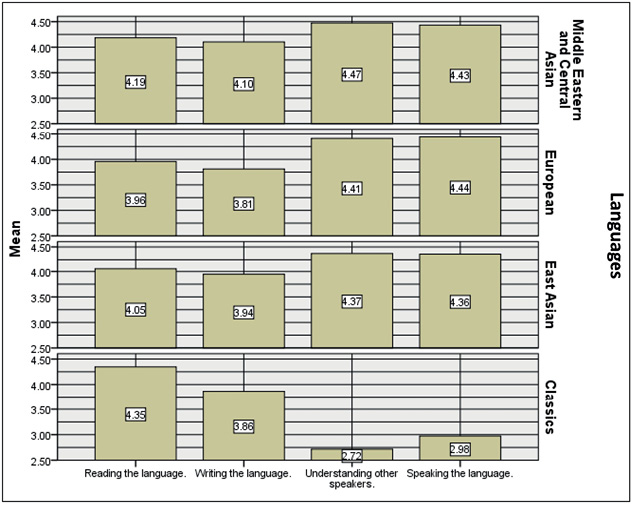
Figure 5.1. Interest in learning the four language skills—discriminated by grouping of languages
Source: Phase 2 Questionnaire Data.
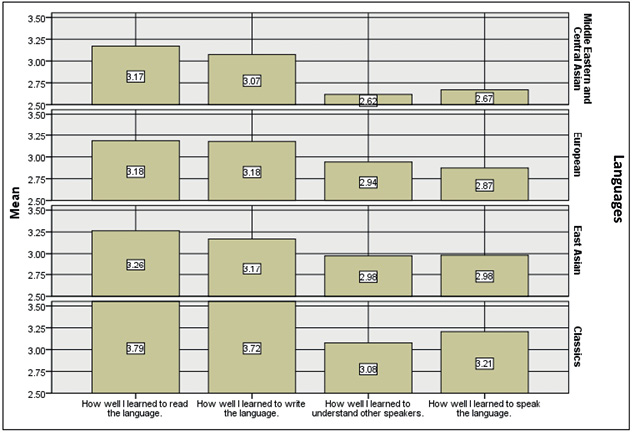
Figure 5.2. Perceptions of how well students report they have learned the four language skills at the time of the data collection. All students
Source: Phase 2 Questionnaire Data.

Figure 5.3. Perceptions of how well students have learned the four language skills, discriminated by language groups and propensity to discontinuation
Source: Phase 2 Questionnaire Data.
When we break down the perceptions reported in Figure 5.2 into the three groups of Committed Students, Doubters and Quitters (Figure 5.3), we find that, even for all groups and languages, there is still a differential in perceptions that reading and writing were learned more successfully than oral skills, as is evident in the considerable differences found across the three student groups. This is summarised in Figure 5.4, where, taking the whole respondent sample, we calculated means for the parameters related to students’ reports of how much that they had learned about the culture associated with the language studied, and how much of the four language skills (reading, writing, understanding and speaking) they felt they had learned by the time they were responding to the survey. Culture was added because of the commonly held view (which we share, as does the Languages and Cultures Network for Australian Universities) that the teaching of language and culture cannot be separated.
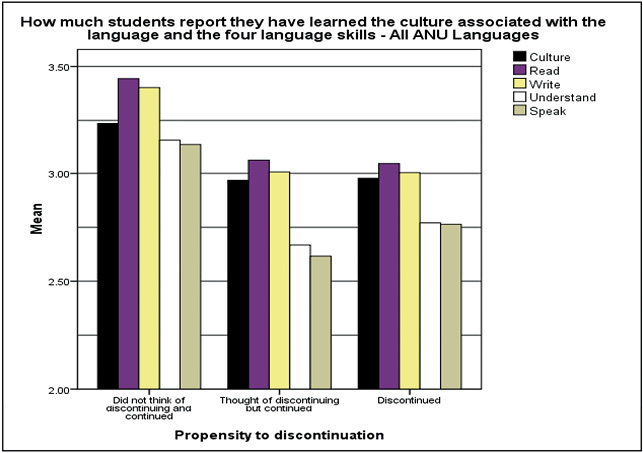
Figure 5.4. Perceptions of how much students have learned about the culture associated with the language and the four language skills, discriminated by propensity to discontinuation. All students
Source: Phase 2 Questionnaire Data.
On average, Committed Students reported more learning than the other two groups in each skill category: indeed, the means for all items reported by Committed Students are higher than the highest score in any skill category for Quitters or Doubters (Figures 5.3 and 5.4), except for Classics. Our interpretation of this undoubtedly interesting finding—which many teachers might see as indicating the nature of ‘good’ students—is that it reflects both the higher language capital that Committed Students have when they start at university, and their ability to use their language capital in the university L&C learning setting. Committed Students not only achieve higher marks, but are also able to derive more benefit from both the cultural components and the language skills-based content in their courses. This would then explain why Committed Students report that they have learned more grammar, or more culture, than they expected, and more than is reported by members of the other two groups (section 4.2.7, Figures 4.8.b and 4.8.c).
Quitters and Doubters can also potentially be differentiated in this context: while the two groups differ little in the average amount of learning they report for culture, reading and writing, they are noticeably different with respect to understanding and speaking the language (section 4.2.7, Figures 4.8.b and 4.8.c). However, this is possibly a sampling issue, because, as we discussed in Chapter 3, Quitters are actually a composite of two groups, Reluctant Quitters, who share characteristics with the Committed Students, and Voluntary Quitters, who are more like the Doubters. Therefore, we cannot convincingly say more about Quitters in relation to the issue at hand.
In contrast to the other two groups, Doubters are more likely to be sensitive to the presence in their classes of students with more language capital, and to worry that this differential in language capital will work to their disadvantage, especially in mixed-ability classes. Doubters are more likely to feel embarrassed speaking in front of other students who (because of their acquired language capital) are perceived to be better speakers of the language (section 4.2.12, Figures 4.17.c and 4.18.d). Moreover, Doubters share a perception that no amount of study could compensate for their lack of accumulated language capital. This perception appears to be confirmed as they progress in their L&C study and witness an increase in the proportion of students in their classes who speak the LOTE at home (section 2.6, Table 2.XV and Figure 2.15.b). Doubters are thus prone to feeling that not enough course time is being spent on speaking and understanding the language, because their deficits in this area provide the most noticeable evidence of their lack of language capital. Yet, because Doubters feel that they have no option but to continue studying in the relevant L&C program in which they are enrolled (because of degree requirements or external pressures), they worry about their grades (section 4.2.10, Figure 4.13.b).
Overall, therefore, Doubters are likely to feel that learning a language has proven more difficult than they expected. In an effort to compensate for their initial lack of language capital, they might focus more on learning language skills rather than on the cultural and other aspects of the course: in turn, this high level of effort could make them perceive the workload as unmanageable, and prevent them from enjoying the course content as a whole (sections 4.2.8 and 4.2.12, Figures 4.10 and 4.18.a). Notably, even if teachers try to cater for the whole class and take the Doubters’ needs into consideration, experience tells us that the mere presence of students with more language capital creates a class dynamic that might be perceived by Doubters as working against their success.
Undoubtedly, this putative psychographic exploration of what might be happening in an L&C course—what we term the Doubters’ Dilemma—needs refining in future studies that are designed to test the categorisation that we have found and to examine its nature in more depth. However, we feel that there is real value in using the construct of language capital to underpin more specific interpretations like those above, which purport to interpret how different students may be approaching and engaging with their language learning, almost irrespective of the nature of the actual teaching. We feel such interpretations of the collected data provide valuable insights, for teachers and curriculum design. Significantly, we could not have created this interpretation by simply listing the factors that contribute to discontinuation, or by considering the simple dichotomy of Continuers versus Discontinuers.
We believe that the Doubters’ Dilemma is a situation well known to experienced L&C teachers at universities. More importantly, our interpretation shows why Doubters may feel that they have not learned sufficient speaking and comprehension skills in the same classes that seem to satisfy other students. Our interpretation of the ANU data also provides a cogent explanation of why, survey after survey, researchers report that a considerable proportion of L&C students are dissatisfied with the amount of class time devoted to speaking, except in languages like Classics, where this is not pertinent (e.g. Bowden et al., 1989, 131; Leal et al., 1991, 141; Nettelbeck et al., 2009, 19).
In this chapter we characterised the student groups of Committed Students, Doubters and Quitters in detail and introduced the construct of language capital. We also explored an issue frequently reported in the language retention literature—perceptions about learning the spoken language—using the construct of language capital to illustrate how it could be apply in understanding the doubters’ dilemma. In the final chapter we will summarise the case study, reflect on methodological issues and implications of the use of the language capital construct, and explore other potential applications or uses of this construct.
Previous Next



