


 menu
New Directions for Law in Australia
43
Australian Legal Practice: Ethical Climate and Ethical Climate Change
Vivien Holmes, Stephen Tang, Tony Foley and Margie Rowe1
I. Introduction
This chapter discusses new research into the ethical climate of Australian legal workplaces. Our research confirms that ethics are perceived as a lived culture in legal practice. We know from other research that appropriate regulation can encourage senior management to create organisational cultures which support ethical behaviour. Unfortunately, the new Legal Profession Uniform Law (LPUL), in force in NSW and Victoria,2 takes a step backwards in this regulatory space. We join calls for reforms that will see the promise of such regulation renewed.
II. Research into Workplace Ethical Culture3
The past 25 years has seen considerable research on the impact of the organisational environment on employees’ behaviour.4 The idea that a person’s workplace environment might influence them toward (un)ethical behaviours is now well accepted. One significant stream of research in this field has been research into the ‘ethical climate’ of workplaces, ‘ethical climate’ being defined as ‘the shared perception of what is correct behaviour, and how ethical situations should be handled in an organization’.5 The most commonly used instrument of measurement in such research is Victor and Cullen’s Ethical Climate Questionnaire (ECQ), a questionnaire designed to ‘tap respondents’ perceptions of how the members of an organization typically make decisions concerning “events, practices, and procedures” requiring ethical criteria’.6 In 2010, in light of further research into ethical decision-making, Arnaud revised the ECQ and came up with a further questionnaire, the Ethical Climate Index (ECI),7 which we used in our research (see below).
Significantly, in a meta-analysis of research into sources of unethical decisions at work, Kish-Gephart8 found that the most significant dimensions of ethical climate for predicting (un)ethical behaviour were as follows:
- ‘Principled’, where there is a focus on following rules that protect the company and others;
- ‘Benevolent’, which ‘focuses employee’s attention on the well-being of multiple stakeholders, such as employees, customers and the community’;
- ‘Egoistic’, which promotes ‘an “everyone for himself” atmosphere’.
According to Kish-Gephart, the stronger the ‘principled’ and ‘benevolent’ climate dimensions, and the stronger the communication of ‘the range of acceptable and unacceptable behaviour’, the ‘fewer unethical decisions in the workplace’.9 Conversely, the stronger the egoistic dimension, the more likely is unethical behaviour.10
III. The Ethical Climate of Australian Legal Practices
Our research explored the ethical climate of Australian legal workplaces, as perceived by new lawyers. Our target population was lawyers within 3–12 months of entering the profession. We surveyed 325 new lawyers across all Australian jurisdictions and across all practice types: Private 63.6 per cent (Small: 32.6 per cent, Medium: 12.3 per cent, Large: 13.8 per cent, In-House: 4.9 per cent); Government 22.8 per cent; Community 8.9 per cent; Other 3.1 per cent. Respondents’ median age was 26 years. Most were full-time employees (91.5 per cent) and nearly two-thirds were female (62.3 per cent).
Using Arnaud’s ECI and other validated instruments, we constructed an online survey to measure respondents’ perceptions of the ethical climate of their workplace, as well as the following factors:
- Organisational Learning;
- Perceived Professionalism/Professional Identity;
- Meeting of Basic Psychological Needs;
- Job Satisfaction & Career Satisfaction;
- Psychological Distress & Optimism;
- Work Environment: employer type, practice area, etc.;
- Demographics & Legal Education Background.
IV. Respondents’ Perceptions of Ethical Climate
We used Exploratory Factor Analysis (EFA) to test whether the 17 ECI survey items could be reduced into a smaller number of identifiable ethical climate dimensions. The results suggested that there were three such dimensions.11 Two are essentially positive:
- Integrity and Responsibility, representing a sensitivity to ethical behaviour and formal ethical rules, and an inclination to be compliant, conscientious and accountable;
- Ethic of Care, indicative of a culture in which people express empathy and understanding to each other and strive, as professionals, to develop positive and respectful relationships.
The other is principally negative:
- Power and Self-Interest, signifying that power, control and instrumental outcomes are more important than principles such as honesty, ethical rules or relationships; that people would be willing to break rules to obtain personal benefit.
Each dimension is an independent contributing factor to how ethical climate is perceived. That is, participants perceive that their workplace climate contains more or less of each one of these qualities. Figure 43.1 shows that the distribution of these dimensions is quite wide. We note that these three ethical climate dimensions are very similar to the three noted by Kish-Gephart as being predictive of (un)ethical behaviour.
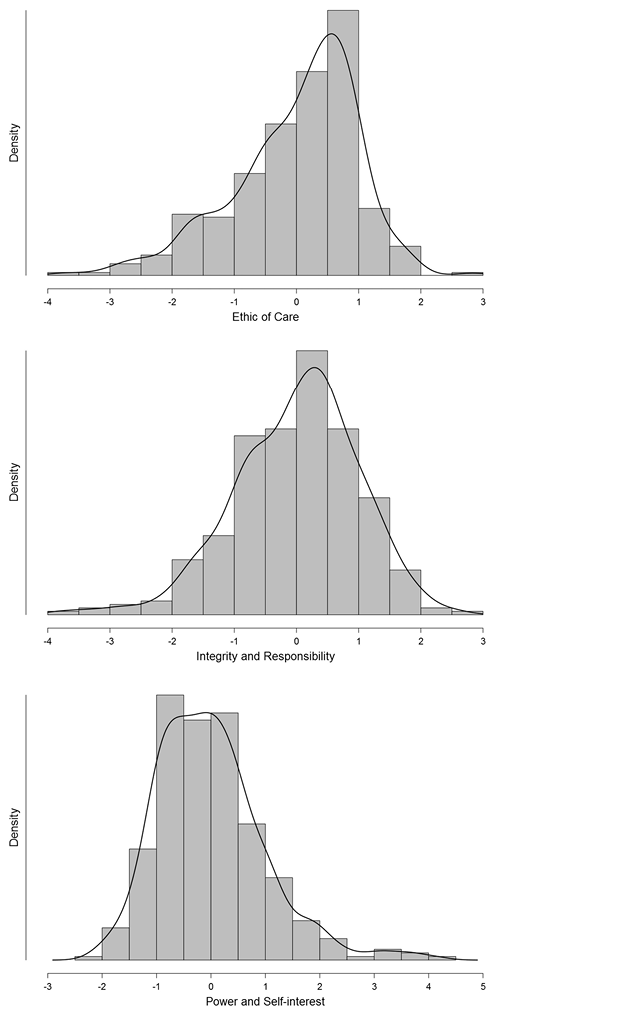
Figure 43.1: Density plot showing the distribution of each ethical climate factor
Source: The authors
V. Predictors of Ethical Climate
We investigated a set of factors as possible predictors of the ethical climate in participants’ workplaces. As a preliminary we controlled for age and gender, and found no significant effects for either of these factors.
A. Practice type
We investigated the extent to which the ethical dimensions identified by respondents depended on the type of practice – ‘private practice’ (small, medium, large), ‘in-house’, ‘government’ or ‘community’ – in which respondents were employed. We found perceptions of the integrity/responsibility ethical dimension were dependent to a small degree on practice type: lawyers in private practice overall (including in-house) had lower perceptions of this dimension than those working in government or community practice.
We then compared differences between ‘private practice’ (small/medium/large practices as a whole) and in-house lawyers. We found nothing additional to the above about the integrity/responsibility ethical dimension. But we found that lawyers in in-house practice had higher perceptions of the power/self-interest dimension (large law firms were also trending in the same direction) when compared with lawyers in medium and small law firms. It seems that on the whole, in-house lawyers (even allowing for the relatively small number of responses obtained) seemed to perceive their workplace as characterised by a preparedness to break rules when necessary.
Combining these analyses we looked at whether working in a particular practice type produced particularly weak perceptions of any of the dimensions. We found that lawyers in small/medium firms gave low ratings to the (positive) integrity/responsibility dimension, and at the same time, low ratings to the (negative) self-interested dimension. This suggests almost an ethical vacuum or apathy, the absence of an ethical consciousness, an indication that these young lawyers had entered a world of practice where ethics were invisible (at least to them).
Surprisingly, we found that other structural features, such as working in a litigious/non-litigious practice, or serving a certain kind of client (personal, corporate, government), were not predictive of particular ethical dimensions. Our conclusion is that overt structural characteristics of the lawyers’ practices (specifically, practice type) do have a small effect on perceptions of a firm’s ethical culture.
B. Organisational learning culture
In addition to structural factors, we analysed the lawyers’ perceptions about the learning culture of the practice in which they worked. An organisational learning culture (OLC) is evidenced by a high sense of trust, by high regard for initiative, by reward and encouragement for participation in learning, by flexibility and adaptability to challenge and change.12 We found that high perceptions of an OLC were predictive of much higher levels of the integrity/responsibility ethical dimension. They were also predictive of the ethic of care dimension. Conversely, we found that high perceptions of an OLC were predictive of lower levels of the self-interest ethical dimension.
This result reinforces the importance of looking beyond mere structural characteristics of practices (size, practice type, client base) to also consider non-structural ‘qualities’ (such as learning culture), which are significantly more predictive of a practice’s ethical climate and which can override the influence of structural factors.
VI. Job Satisfaction and Wellbeing
Importantly, our analysis showed direct relationships between ethical climate dimensions and job satisfaction. A strong power and self-interest climate dimension correlated with lower job satisfaction, while strong integrity and responsibility, and (especially) ethic of care climate dimensions, correlated with greater job satisfaction.
These findings are consistent with Kish-Gephard’s findings, that higher job satisfaction is related to a lower level of unethical behaviour in organisations.13
We know from our previous research with these same new lawyers that basic psychological needs (autonomy, competence and relatedness) are very good predictors of wellbeing and satisfaction in newly-admitted lawyers.14 Analysis of survey data shows direct relationships between ethical climate and the meeting of these needs. In particular, a strong power and self-interest dimension has a (small) negative effect on autonomy, competence and relatedness, while a strong ethic of care dimension is predictive of greater autonomy and relatedness.
VII. Being Professional
Respondents were asked to choose, from a list of 24 factors, the 10 factors most definitive of ‘professional’. For the purposes of analysis, we grouped the 24 factors into six categories: Communication (e.g. ‘communicating openly, courteously and respectfully with clients and colleagues (including opponents)’); Ethics (e.g. ‘being honest and trustworthy, including with the court’); Justice (e.g. ‘having a commitment to improving society through your participation in the law’); Skills (e.g. ‘having a good, up to date knowledge of legal content and processes’); Work (e.g. ‘taking responsibility for your own work’); and Problem (e.g. ‘ensuring that you never appear weak to your colleagues or clients’). Respondents then ranked their 10 factors in order of importance. For example, a respondent might rank an item in the communications category at positions 1, 5 and 9 in their ‘definition’ of ‘professional’.
We correlated a respondent’s perception of the ethical climate of their workplace and the importance (ranking) they gave to the ‘professionalism’ factors. We found (from ordinal regression analysis) that, the higher a person rated their ethical climate on the ethic of care dimension, the more frequently they included communication and justice items in their top 10, but the less frequently they included work and problem items. The higher a person rated their ethical climate on the integrity/responsibility dimension, the more frequently they included ethics items in their top 10, but the less frequently they included work items. Further, higher perceptions of a power/self-interest climate were associated with more frequent ranking of work and problem items in the top 10. Inclusion of skills items was not predicted by any ethical climate dimension. These results suggest that, not surprisingly, the ethical climate of a new lawyer’s workplace influences their understanding of what it means to be a professional.
VIII. Influencing the Ethical Culture of Australian Legal Practices
Our study is the first ethical climate analysis of Australian legal practice. But the broad ethical culture of Australian legal practices has come under scrutiny in other ways. In 2008, Parker and colleagues applied the concept of ‘ethical infrastructure’ to Australian large law firms. They used a broad conceptualisation of ‘ethical infrastructure’ to denote formal and informal management policies and the promotion of ethical dialogue and values.15 The authors contend that large law firms should consciously design and implement ‘ethical infrastructures’ to both counteract pressures for misbehaviour and positively promote ethical behaviour and discussions. We note there is no reason why this call should be confined to large law firms.
Alongside this research, a new regulatory regime was targeting ethical infrastructure. Reforms in 2001 to the NSW Legal Profession Act 1987 (replicated in the Legal Profession Act 2004 (LPA)) allowed law firms to incorporate, but required incorporated legal practices (ILPs) to have a legal practitioner director. That director’s task was to ensure, through the development of ‘appropriate management systems’ (AMS), ILP compliance with the LPA.16 Collaboration between the NSW Office of the Legal Services Commissioner and the legal profession resulted in an ‘education toward compliance’ strategy in relation to the AMS requirements. ILPs were required to complete a self-assessment process (SAP) which evaluated compliance with 10 specific objectives of sound legal practice.17 Those objectives were ‘intended to help ILPs work out how to professionalize ethical conduct, rather than [prescribe] detailed management systems and processes’.18 Importantly, the regulator was authorised to conduct a compliance audit of an ILP whether or not a complaint had been made in relation to the practice. So, audits could be done proactively, as a preventative measure. Queensland, WA, Northern Territory and the ACT eventually adopted a similar statutory and regulatory approach.19
Evaluation of NSW’s ‘light touch’ approach to regulation of the profession has shown it had a significant impact. Parker and colleagues conducted a preliminary evaluation based on an analysis of complaint rates. They concluded that the SAP ‘may well be guiding, encouraging, and requiring many practitioners consciously and systematically to think through practice management issues, including ethics management, for the very first time’.20 Other scholars describe the implementation of the AMS requirement as ‘a watershed event in the regulation of law firms’.21 Fortney evaluated the process in 2012 by surveying legal practitioner directors. The majority of respondents reported that the SAP ‘had a positive effect on different aspects of firm practice, most notably firm management, supervision and risk management, followed by a positive impact on client services’.22 It is not hard to see a link between ‘the process of learning and changes’23 prompted by the SAP, and an improved organisational learning culture (and, by inference, stronger integrity/responsibility and ethic of care climate dimensions). Further, Schenyer credits the NSW program for giving content to the concept of ‘ethical infrastructure’ by ‘identifying the ten types of recurring problems that infrastructure should be designed to prevent or at least mitigate’.24 It is clear that the LPA requirement of AMS was a powerful regulatory tool for improving the ethical culture of law firms.
Unfortunately, the Legal Profession Uniform Law (LPUL), in force in NSW and Victoria since July 2015, has taken a backward step in this regulatory space. The requirement (on ILPs) under the LPAs to implement and maintain AMS has been discarded. There is now no positive obligation placed upon an ILP, or any other type of law practice, to implement AMS. Instead, a law practice may be given a ‘management systems direction’ by a relevant regulatory authority to ensure that AMS are ‘implemented and maintained’.25 However, such a direction can only be made if the authority considers it reasonable to do so after an examination/investigation into a law practice, or a compliance audit.26 As the former NSW Legal Services Commissioner (Steve Mark) has noted, this means that ‘a law practice will only know what standard it is expected to comply with AFTER being audited and found wanting’.27 This contrasts with the LPA scheme which so successfully used AMS as a proactive tool to encourage compliance. Mark and Briton, the former Queensland Legal Services Commissioner, have both called for a return to the proactive use of AMS.28
IX. Conclusion: Needed Reform
Our research clearly shows that ethics is perceived by new lawyers as a lived culture in legal practice, and not simply or primarily as a personal disposition. The ethical climate in which a new lawyer works influences them towards, or away from, ethical behaviour. It moulds their perceptions of what it means to be a professional and what is appropriate professional behaviour. It affects their job satisfaction and their wellbeing. We know that the ethical culture of legal practices can be shaped through regulatory tools such as AMS, which help to improve organisational learning culture and ethical infrastructure. Our research shows that a significant number of legal practices in Australia would benefit from such improvements, and adds to the force of calls for a return to the proactive use of AMS in the regulation of the legal profession.
1 All of ANU College of Law, The Australian National University.
2 The Legal Profession Uniform Law (LPUL) was enacted in NSW in 2014 and then adopted in Victoria by the Legal Profession Uniform Law Application Act 2014. The LPUL came into force in both jurisdictions in July 2015 and replaced the NSW and Victorian Legal Profession Acts (2004).
3 ‘Ethical culture’ and ‘ethical climate’ are defined differently in the literature, but the concepts overlap. This chapter uses ethical culture in the sense of it being a subset of organisational culture, ‘representing a multidimensional interplay among various “formal” and “informal” systems of behavioural control that are capable of promoting either ethical or unethical behaviour’. Linda Klebe Treviño, Kenneth D Butterfield and Donald L McCabe, ‘The Ethical Context in Organizations: Influences on Employee Attitudes and Behaviors’ 8 Business Ethics Quarterly 447, 451.
4 Jennifer J Kish-Gephart, David A Harrison and Linda Klebe Treviño, ‘Bad Apples, Bad Cases, and Bad Barrels: Meta-Analytic Evidence About Sources of Unethical Decisions at Work’ (2010) 95 Journal of Applied Psychology 1; David M Mayer, ‘A Review of the Literature on Ethical Climate and Culture’ in Oxford Handbook of Organizational Climate and Culture (Oxford University Press, 2014).
5 Bart Victor and John B Cullen, ‘A Theory and Measure of Ethical Climates in Organizations’ (1987) 9 Research in Corporate Social Performance and Policy 51.
6 John D Cullen, Bart Victor and James W Bronson, ‘The Ethical Climate Questionnaire: An Assessment of Its Development and Validity’ (1993) 73 Psychological Reports 667, 669.
7 Anke Arnaud, ‘Conceptualizing and Measuring Ethical Work Climate: Development and Validation of the Ethical Climate Index’ (2010) 49 Business and Society 345.
8 Kish-Gephart, Harrison and Treviño, above n 4, 21.
9 Ibid.
10 Ibid.
11 This is not to say that there are not other ethical climate dimensions existing in law firms, simply that we have been able to distil three independent ingredients of ethical climate as measured on the ECI for newly admitted lawyers.
12 Catherine L Wang and Pervaiz K Ahmed, ‘Organisational Learning: A Critical Review’ (2003) 10 The Learning Organization 8.
13 Kish-Gephart, Harrison and Treviño, above n 4, 12.
14 Tony Foley et al, ‘Helping Junior Lawyers Thrive’ (2015) 89 Law Institute Journal 44.
15 Christine Parker et al, ‘The Ethical Infrastructure of Legal Practice in Larger Law Firms: Values, Policy and Behaviour’ (2008) 31 UNSW Law Journal 158, 160, n 6.
16 NSW LPA s 140.
17 Susan Fortney and Tahlia Gordon, ‘Adopting Law Firm Management Systems to Survive and Thrive: A Study of the Australian Approach to Management-Based Regulation’ (2012) 10 University of St Thomas Law Journal 152, 153.
18 Christine Parker, Tahlia Gordon and Steve Mark, ‘Regulating Law Firm Management: An Empricial Assessment of an Innovation in Regulation of the Legal Profession in New South Wales’ (2010) 37 Journal of Law and Society 466, 471.
19 Steve Mark and Tahlia Gordon, ‘Innovations in Regulation – Responding to a Changing Legal Services Market’ (2009) 22 Georgetown Journal of Legal Ethics 501, 511; John Briton and Scott Mclean, ‘Incorporated Legal Practices: Dragging the Regulation of the Profession into the Modern Era’ 11 Legal Ethics 241.
20 Parker, Gordon and Mark, above n 18, 495.
21 Fortney and Gordon, above n 17, 154.
22 Ibid. 181.
23 Ibid. 167.
24 Ted Schneyer, ‘On Further Reflection: How “Professional Self-Regulation” Should Promote Compliance with Broad Ethical Duties of Law Firm Management’ (2011) 53 Arizona Law Review 577, 585.
25 LPUL, above n 2, s 257.
26 Ibid.
27 Steve Mark and Tahlia Gordon, ‘Vale Appropriate Management Systems’ (2015) Creative Consequences, creativeconsequences.com.au/vale-appropriate-management-systems (viewed 18 November 2015).
28 Ibid.; John Briton, ‘Between the Idea and the Reality Falls the Shadow’ (2015), www.monash.edu/law/research/centres/clars/news-events/anzlec5-sustainable-legal-ethics (viewed 17 May 2017).
Previous Next



