


 menu
Australian Travellers in the South Seas
4
I didn’t believe all these stories of barbarity and savagery. I had heard similar stories of the cannibals of the Gulf of Papua, and I had found those same cannibals rather good chaps in the main … I considered the inhabitants of the Solomons maligned at least in part. And I was mistaken. I was to learn that there were degrees of savagery, that the word was after all a relative term.1
Like their European and US counterparts, Australian travellers were fascinated with the possibility of encountering the ‘savage’ in the Pacific Islands. Australian knowledge of the Pacific Islands in the early twentieth century was significantly influenced by the discourse of the savage, which remained a persistent and dominant literary trope since the appearance of first European explorer accounts. The dualism of the ‘noble’ and ‘ignoble’ savage became a popular image in Australian travel writing, one that became distorted, conflated and contested over time. Australians were exposed to the savage in multiple forms—it was a convenient and ambiguous figure in children’s literature, newspaper reports, mission and government propaganda, films, photography, tourism and travel accounts that were used to entertain, educate and justify. Australian notions of the savage were also underpinned by an increasingly racialised scientific discourse that informed notions about white racial superiority and a distinctively ‘Melanesian’ savagery.
Travel to the Pacific Islands provided Australians with an opportunity to come face to face with the savage of their imaginations. In doing so, some Australian travellers wrote specific and localised accounts that adapted, or departed from, the conventional stereotypes of the Islander savage. Jack McLaren’s quotation above is one example of this, as he was a popular writer and experienced traveller who sometimes confirmed these racialised and essentialised stereotypes; however, he also perceived ‘degrees of savagery’ within the region. A closer analysis of travel writing, contextualised within the historical relationship of Australia’s engagement with the Pacific Islands, highlights a more nuanced and diverse range of travellers’ perceptions.
Australian representations of the savage in travel writing often emphasised one or more of the following characteristics: the bestial, infantile, primordial and cannibal. Popular notions of the bestial savage were encouraged by the Queensland labour trade in the late nineteenth century. This trope was gradually eroded by persistent missionary influence in Australia from the 1900s that emphasised the childlike qualities of the savage. By the 1920s and 1930s, Australians were more familiar with the Pacific Islands, and the growing tourist trade had paradoxically both exoticised and standardised Islander savagery. Tourists lamented the loss of the primitive and natural savage due to modern developments and colonial influence in the Pacific. However, the most persistent fascination by far was with Pacific Island cannibalism, despite this practice’s abandonment by the early twentieth century.
Whether bestial, infantile, primordial or cannibal, Pacific Islanders were characterised as different from, or opposed to, those who observed and described them. Marianna Torgovnick’s work on the notion of ‘primitive’ is important here, and equally applicable to the concept of savagery. She argued that primitive societies were places in which Europeans could project their feelings about the present and test ideas for the future, so the value and nature of the primitive thus reflected the concerns of the time.2 Like in European and American literature, Australian travel writing was underscored by a tension that existed between the rhetoric of control and the rhetoric of desire, which were often expressed simultaneously. European notions of the primitive or the savage may have been generic, but the contexts in which individual Australians observed Pacific Islanders were not; the distinctive Australian contribution to this composite image has yet to be fully explored. Bestiality may have dominated initial concerns in the colonial Australian imagination, but some travel writing has evidenced a gradual softening of Australian attitudes towards the savage in the 1920s and 1930s, despite the persistent and racialised rhetoric found in fictional literature, newspapers and political debate. Conventional representations of the violent and bestial savage were eroded by several factors, such as a growing number of Australian travellers to the region; greater Australian interest in, and engagement with, the Pacific; and popular messages advocated by missions, governments and tourists for protecting and preserving the savage. This is evident in the accounts of Australian travellers who expressed a weariness regarding the fictional trope of the savage, as well as a more discerning attitude towards representations of the Pacific Islands.
Savage or Civilised?
The term ‘savage’ was originally used to refer to a wild and untamed forest—deriving from the French term sauvage, which in turn was derived from the Latin silva. However, it was not until the sixteenth century that ‘savage’ was used to describe ‘a wild person’. By the 1880s, descriptions of the savage environment and people in the Pacific Islands tended to be formulaic and predictable, with travellers increasingly reproducing stereotypical descriptions. This was a process of confirming one’s expectations, of validating and authenticating one’s travel and, often, of writing for a commercial market that demanded adventure and excitement. Terms such as ‘cannibal’, ‘headhunter’, ‘primitive’ and ‘native’ were used interchangeably to denote savagery, and travellers tended to label all Islanders with these generic markers rather than identify individuals by their specific names. ‘Savage’ was an ambiguous, versatile and value-laden term. Although it was commonly used in Australia during the nineteenth and twentieth centuries to describe Aboriginal Australians and Pacific Islanders, it was also applied to convicts, drunkards, politicians, vagrants and people living in remote rural areas.3 For foreign travellers to the Australian colonies, Australia’s penal origins marked the nation as ‘a place where only savage natives, degraded whites and economic opportunists could thrive’.4
Rather than delineating a specific set of individual characteristics and behaviours, the term ‘savage’ defined people according to what they lacked. For European explorers who were confronted by human difference abroad, their descriptions of the savage ‘other’ were informed by their own notions of European civilisation.5 The ‘noble savage’ had appeared in European thought well before Europeans reached the Pacific; it was a neoclassical ideal of primitivism often attributed to Jean-Jacques Rousseau. The noble savage was distinguished by his or her innocence, primitivity and a simple life that was lived close to nature. Uncorrupted by civilisation, the noble savage embodied a critique of European decadence.6 The ideal of the noble savage influenced many of the eighteenth-century French and British explorers in the Pacific Islands who described an Arcadian paradise. Developing out of Christian mission outreach in the Pacific in the early 1800s, the ‘ignoble savage’ was a stereotype used to present Islanders negatively. Emphasising nakedness, savage dances, warring and idol worship, missionaries used the ignoble savage to justify their conversion efforts. Subsequent violent confrontations between Europeans and Islanders confirmed this trend.7 The killing of Captain James Cook in Hawai‘i was an early symbolic marker of Island savagery that resounded with Australians who regarded Cook as a national hero.
The development of science served to confirm and explain the savagery of Islanders, as well as their supposed depopulation. This influenced later Australian travel writing, which incorporated Enlightenment notions of progress and biological theories of race. During the eighteenth century, the purpose of scientifically studying non-European peoples was framed in terms of better understanding the civilised self and the origins of civilised ‘man’, rather than for learning about how other societies functioned. In scientific and philosophical European thought, ‘savage’ was a term used to denote a certain level in a developmental sequence. Enlightenment philosophers often speculated that societies progressed through stages of increasing development, in which agriculture and commerce set civilised people apart from the savages. In this process, human beings progressed from savagery (hunting) to barbarism (nomadic pastoralism) to civilisation (agriculture and commerce). However, used in this way, ‘savage’ was initially a neutral term rather than a derogatory label.8
These notions of progress gradually became entangled with a biological conception of race. Increasingly racialised scientific thought explained the savage state as being caused by innate racial deficiencies rather than by environmental stimuli. For Australian travel writers of the twentieth century, who absorbed and applied these scientific theories, the savage was considered an inferior racial type in comparison to the civilised white race. Due to these hardened racial classifications, the region of Melanesia was widely perceived to be more savage than Polynesia or Micronesia. Racial assumptions about the Islanders’ physical and psychological characteristics supported the entrenched stereotypes of Melanesian savagery that early European explorers in the Pacific had articulated. Dumont D’Urville, a French explorer, observed that the Melanesian ‘condition’ was ‘always close to barbarity’.9 In general, the difficulty of accessing the Melanesian Islands combined with their relatively late contact with Europeans, as compared to Polynesia, signified that Melanesia was a region of unknown possibilities and ‘an openly imagined reality’.10
Although the general savagery of Melanesians was assumed knowledge to most Australian travellers in the twentieth century, the savagery of particular peoples within Melanesia was highly contested. Media reporting was partly responsible for this, as it encouraged caricatures such as ‘Tommy Tanna’, a figure that was based on the Melanesian labour recruit who worked in Queensland sugar plantations.11 Savage reputations were also fostered by certain violent encounters with Europeans, some of which were highly publicised and fixed in Australian public memory. The Islands of Malekula in the New Hebrides and Malaita in the Solomon Islands were frequently identified as the most savage in the 1900s due to their history of violence with labour traders, missionaries and government officials. For example, in the case of Malaita, violent encounters with labour recruiters were highly publicised (e.g. the attack on the Young Dick in 1886) and the murder of Resident Commissioner William Bell in 1927 sparked outrage within Australia, prompting the immediate dispatch of an Australian warship.12 Denoting an island or island group as savage also functioned as a justification for colonialism, distinguishing the successes of certain mission societies, businesses or governments in comparison to others.
Given the pervasiveness of the racialised stereotypes of savagery that saturated media coverage, popular fiction, public debate and official government policies, it is unsurprising that the existence of the Melanesian savage was often assumed. Science offered a powerful authority to those who applied the labels of ‘savage’ and ‘civilised’. Travellers may have been influenced by these standardised and distorted images, but once they began travelling, they constructed their own notions of the savage by selecting particular characteristics to describe. Bernard Smith identified this trend in the writers and travellers of the 1800s who combined elements of the noble and ignoble savage, as well as elements of the civilised European, to forge a ‘romantic savage’. He argued that travellers used this blended version of the savage to reflect on the future of the Pacific and to frame both savage and civilised within a discourse of progress.13 Australians of the twentieth century similarly blended savage and civilised attributes as they saw fit. This was especially important for those who sought to justify their own roles in the Pacific Islands (for reasons evangelical, commercial or colonial), which was often expressed with the intention of bringing ‘civilisation to the savages’.
Although some could use the savage trope to reinforce colonial authority, it was also shaped and reformed by travellers who were sincere about trying to understand other peoples. As Smith argued, the development of the romantic savage:
Was grounded upon a longer and better acquaintanceship with primitive peoples. Faulty as knowledge still was, the conception of the romantic savage was a genuine effort on the part of the European imagination to make contact with the personal life of primitive peoples.14
Similarly, Pacific travel in the twentieth century offered individuals the opportunity to test the merits of Australian civilisation in a purportedly savage and foreign environment. In doing so, they blended different discourses and representations of the savage according to their individual experiences, which were spatially and temporally specific. These representations contributed to a growing body of Australian knowledge about the Pacific Islands, and the voices of Australian travellers increasingly challenged European-based theories and assumptions.
Expectations of Bestiality
For the colonial Australians who embarked on a Pacific voyage in the 1880s and 1890s, the experiences of Queensland labour recruiters significantly shaped their expectations of the Melanesian savage. From 1869 to 1904, approximately 60,819 Pacific Islanders were brought to Queensland to work on sugar cane plantations.15 Most of the 10,000 recruits who remained in Australia in 1901 were repatriated between 1904 and 1906 under the provisions of the Pacific Island Labourers Act (1901) (though many descendants of these labourers presently live in Australia today). Queensland recruiting vessels visited the Torres Strait Islands, the New Hebrides (including the Banks and Santa Cruz Islands), the Solomon Islands and, later, Papua and New Guinea. The inhabitants of these Islands were indiscriminately termed ‘Kanakas’ (a term derived from the Hawaiian language), and the trade was often called ‘blackbirding’. The demand for cheap labour initially motivated colonial Australians and other colonies or nations to recruit in Melanesia from the 1860s, a process that Clive Moore has discussed in detail.16 Considerable opposition in colonial Australia eventually ended the trade, due to humanitarian grounds and fears that Pacific Islander labourers threatened the living standards of white workers. For both those who favoured and opposed the trade, the savage was a key figure in the debate. In regard to Australian travel writing about the Pacific Islands, notions about the bestial nature of the savage arose most clearly from the debates about the Queensland labour trade.
Limited surviving firsthand accounts of the Queensland labour trade that were written by colonial Australians exist. Five accounts were published by ship captain William Wawn, recruiter and trader John Cromar, government agents John Gaggin and Douglas Rannie, and traveller William Giles.17 Journalists John Stanley James, Joseph Melvin and George Morrison followed labour-recruiting ships and published accounts in newspapers.18 In addition, 26 surviving journals organised by Queensland recruiters and government agents exist. These witnesses described the prevalence of public hostility that was directed towards recruiting and increasingly strict government regulation. Giles, a curious traveller who accompanied the recruiting ship Bobtail Nag to the New Hebrides in 1877, described the public tension in the Australian colonies:
The Queensland Press at this time, was constantly publishing Articles on the so-called slave trade. Several furious letters had lately been published by Correspondents denouncing the Trade, as scan[d]alous, iniquitous, and a disgrace to our Colony. Of course on the other hand, Articles had appeared in its defence stating that without its continuance the important sugar industry along the Coast country would entirely fail.19
Facing this hostility and scrutiny, some recruiters and government officials aimed to set the record straight in their own accounts.
One example was Wawn, whose description of his recruiting voyages in The South Sea Islanders and the Queensland Labour Trade (1893) was the most widely read firsthand account of the trade. His book was commonly cited by subsequent Australian travellers to the New Hebrides and the Solomon Islands. Mark Twain even devoted an entire chapter to discussing Wawn’s book and to criticising the labour trade in Following the Equator (1897).20 Born in England in 1837, Wawn trained as a mariner and moved to Australia in 1867. He worked as a labour recruiter for Queensland and Fiji for 20 years, during which time he encountered all the typical troubles of a labour trade recruiter. Wawn’s book was primarily intended to counter the growing antagonism towards recruiters in the Australian colonies—which included scathing attacks on what he alleged to be inexperienced and corrupt colonial Australian authorities (including government agents onboard), overregulation, propaganda, misinformation and an ‘unsophisticated’, gullible public who believed fanciful stories about recruiters.21 In the book, he also refuted multiple accusations of kidnapping, murder and theft and contested his debarment from the labour trade for three years.
Wawn was one of many proponents of the labour trade who defended their work as heroic and considered their intentions noble, often by contrasting the bestial nature of the savage to the civilised colonial Australian trader and planter. Wawn dedicated his book ‘to the sugar planters of Queensland, to those bold pioneers, to those good men and true’.22 This heroic theme resonated with popular fictional literature of the nineteenth century that juxtaposed the savage Islander and the civilised Englishman. Children’s fiction further entrenched stereotypes of the savage by narratively pitting courageous, gentle and chivalrous English gentlemen against cruel and barbaric Pacific Islanders. Just as these formulaic fictions cultivated British ideals of civilisation, masculinity and racial superiority, so too did tales of the labour trade convey a romanticised view of pioneering Australian colonials.23
In contrast, the 14 unpublished manuscripts written by recruiters and government agents are distinguished by the absence of hyperbole and common savage characterisations that are typically mentioned in published accounts (though seven men were involved in malpractice).24 Few recruiters or government agents went ashore or spent a long time living with Pacific Islanders. Instead, their daily logs reflect the monotony of labour recruiting, containing short descriptions of weather, the number of recruits, illnesses and ship maintenance. When they did describe Islanders, it was their humanity that quite often surprised them. Christopher Mills wrote in his journal:
Everyone reports them as treacherous and unfit to be trusted, I find them the reverse—but I make a practice, and trust I always shall, of treating them as human beings, hence the difference.25
Although the reality of Island encounters might have contradicted the savage stereotype, the temptation to exaggerate and dramatise was strong. It is difficult to determine whether authors succumbed to this temptation deliberately, or whether they unconsciously romanticised the savage to meet their expectations (and those of the readers). Giles claimed he was inspired to join a recruiting ship by the imagined savage that he expected to encounter:
The noble savage arrayed in mantle of scalps, fastened with human hair, and dyed in blood, disposed in graceful festoons around his manly form; leaning on his long spear tipped with human bone, and thoughtfully masticating a succulent morsel of his last victim, as he anxiously gazed on the approaching ship, and considered how many meals her crew would provide for himself and his cannibal brethren.26
Although his expectations were not met, he still found reasons to criticise their allegedly ‘intolerable perfume’ and ‘unclassically shaped nose’.27 Similarly, despite Rannie’s opposition to the labour trade (he was motivated to be a government agent because he considered the labour trade ‘most diabolical, and a disgrace to civilisation’),28 his book conformed to stereotypical accounts of cannibals and savages. Titled My Adventures Among South Sea Cannibals, it was published 19 years after the event in 1912. Pictured alongside the recruiting crew in Figure 14, Rannie interspersed his account with reproduced images that were obtained from John Watt Beattie. Rannie frequently used hyperbole in his account, most likely to entertain and shock readers. In one instance, he recalled his first encounter with Islanders, in which he witnessed a canoe with the bleeding head of a woman on the prow upon arrival in the Solomon Islands.29
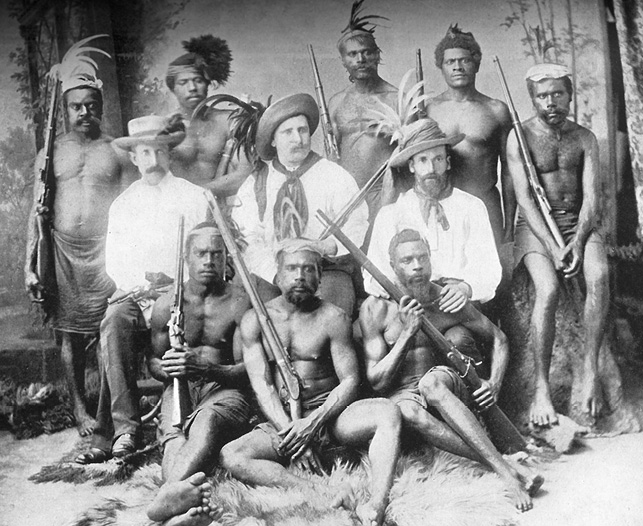
Figure 14: The Author, Recruiter, Captain, and Boat’s Crew of Natives.
Source: Rannie, My Adventures among South Sea Cannibals, 238.
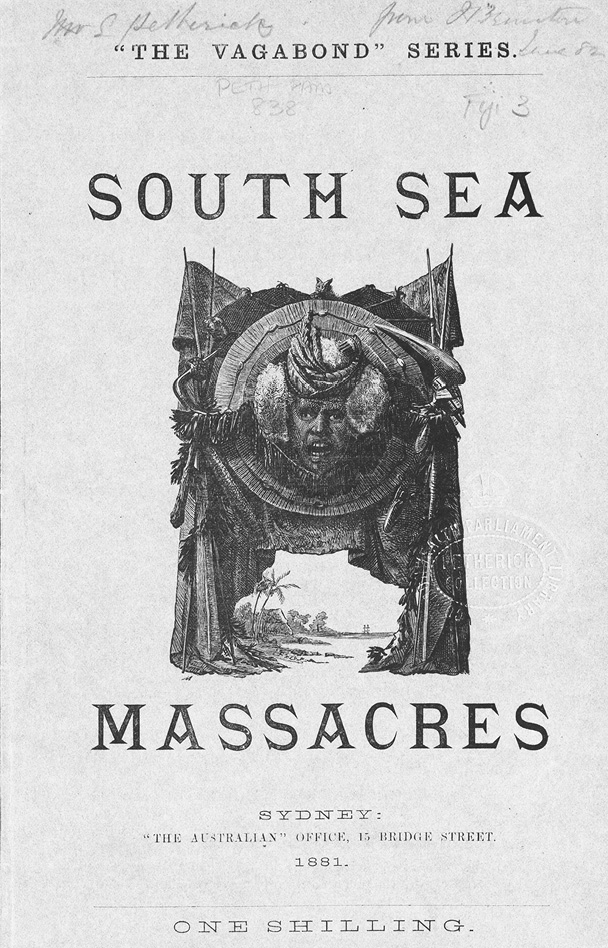
Figure 15: Front Cover of a Book in ‘The Vagabond’ series published by The Australian.
Source: John Stanley James, South Sea Massacres (Sydney: The Australian, 1881).
Without photographic proof, some writers and publishers relied on hand-drawn illustrations to embellish their accounts. The cover of Thomas’s publication in 1881, titled South Sea Massacres, is one such example (see Figure 15). It was dedicated to the ‘memories of the murdered white men’ in the Pacific.
Australians purported to have observed various degrees of bestiality in the Pacific, ranging from the animalistic to the grotesque and monstrous. Savages were commonly situated within a foreboding dark environment—Gaggin’s impression of the Solomon Islands as ‘a very black diamond indeed’ and Joseph Melvin’s description of their ‘low type of features, the savagery of which was exaggerated by black teeth, stained by the chewing of betelnut’, typically used darkness as a metaphor for savagery and evil to describe both the landscape and the people.30
Islanders were often likened to animals, which encouraged the fantasy that one could observe savagery. In some cases, physical similarities were imagined: Wawn described Islanders as ‘excited monkeys’, Ralph Stock observed ‘lizard men’ and Henry Tichborne expected Islanders to have tails.31 Alternatively, savages were attributed animalistic temperaments and were regarded as unpredictable, wild and possessing a ‘treacherous, cowardly and savage disposition’.32 These extreme and exaggerated representations were not accurate and reflected popular misconceptions within the Australian colonies at the time.
When travellers met Islanders who appeared physically the same as them, they were frequently ascribed grotesque features. The ‘grotesque’ was a hybrid form of human and monster, and depending on the traveller, either end of the spectrum could be emphasised.33 The grotesque was part of a performance for John Gibson Paton, a Presbyterian missionary: ‘The more grotesque and savage-looking, the higher the art!’34 For Charles Stuart Ross, another Presbyterian minister, the ‘occasional grotesqueness’ of Fijians could be tolerated in 1909; however, he distanced himself from the local dancing, which he found ‘too grotesquely wild and barbaric’.35 Descriptions of grotesque body mutilations (e.g. head binding, teeth removal, piercings and scarification) were exaggerated and embellished to generate an image of a corrupted and deformed race. Gaggin once claimed to witness a chief suddenly grab his young daughter and knock out her teeth with stones, supposedly so he could purchase a pig. By offering no explanation for the ritual, nor one for the cultural significance of the practice, Gaggin suggested that the people were exploitative and vicious.36 Similarly, Rannie’s remark that it was common for Islanders to carry a basket containing human heads to trade for tobacco is unlikely due to other accounts documenting Islander resistance to selling human skulls.37
By portraying Islanders as monsters, Australians created an image that was devoid of any humanity and that extended beyond the grotesque. Monsters embodied savagery and represented a break away from the Christian notion of a great chain of being. Margaret Hodgen argued that after Columbus’s voyages of discovery, the human monsters and wild men of the Middle Ages were transferred to representations of the savage, contributing to the conception of the savage as not fully human.38 Similarly, Australian travel narratives throughout the early twentieth century reaffirmed beliefs that the Islands were populated by giants, pygmies and other monsters. When travellers encountered humans rather than monsters in the Pacific, they created monstrous personas for the Islanders instead. These included descriptions of traditional ceremonies that involved monstrous masks and pagan idols, threatening war dances, shrieking and chanting to the beat of drums, and human sacrifices (all activities that were typically performed at night). Arnold Safroni-Middleton, an artist, stood in a forest ‘as fierce, stalwart savage men and women danced around a monstrous wooden idol’.39 Similarly, Gaggin wrote that ‘hideous masks are worn in their secret Masonic rites’.40 Gananath Obeyesekere argued that the inability to find monsters in the real world had one notable exception—anthropophagy.41 Cannibalism was the most commonly identified marker of bestiality and, in some cases (e.g. in Gaggin’s account), every Islander was labelled either as a perpetrator or as a victim of cannibalism.
As European contact with Melanesians increased over time, images of mythical beasts and monsters were gradually eroded. Incidents of violent encounters between labour recruiters and Melanesians also decreased, as Islanders were becoming more familiar with white traders. With significantly less evidence of Melanesian savagery in the 1880s and 1890s, colonial Australian travel accounts emphasised the savage potential of Islanders instead, suggesting that they were prone to animal instincts and unpredictable emotions. These notions were encouraged by labour recruiters who were wary of experiencing ambush and treachery while they recruited, often referencing violent encounters in the past as proof. This was evident in the tendency of recruiting accounts to preface their descriptions of each Island with a summary of European deaths. For example, Rannie’s account of Ambrym Island began with ‘Belbin and Heath were shot with rifles, Craig was done to death with thirteen spear wounds in his body, while Booth and Bowen were both poisoned’.42 Colonial Australian newspapers also reported incidents of violence and cases of European deaths in the Islands in a sensationalised and exaggerated manner; they described Islander resistance with hyperboles such as ‘massacre’, ‘butchery’ and ‘vengeance’ and framed Europeans as innocent victims who were only trying to bring civilisation to ruthless savages. Newspapers memorialised the fallen and maintained a historical memory of Islander violence towards white people long after the events had occurred.43 Consequently, notions of Melanesian unpredictability persisted well into the twentieth century, as demonstrated by McLaren’s impression:
I could never be sure of them, for they were possessed of instincts at which I could only vaguely guess and over which they had no control. At all times they were liable to give expression to certain queer impulses which were their age-old heritage, and causelessly murder the stranger in their midst—to regret it deeply afterwards no doubt.44
The supposedly unpredictable temperament of the savage resonated with scientific theories positing that some races were incapable of, or possessed a limited capacity for, reason and judgement. Supporters of labour recruiting framed savagery within a discourse of justice, contrasting a ‘British sense of justice’ with the treachery and betrayal of Islanders.45 They justified the labour trade by claiming that it could help civilise the Melanesian savages by bringing them into contact with Australian civilisation. Wawn argued:
At 16 he is a man, with all his savage habits rooted in him. When middle-aged he cannot be altered, except for the worse. Take him away from savagery as a child, and you can make him what you like.46
Despite labour recruiters’ attempts to portray themselves as being fair and just, they struggled to counter the growing public antagonism that was directed towards them and their practices. Wawn described himself as innocent and just when compared to the Islanders who he encountered. He offered a ‘curious example of the South Sea Islander’s sense of justice’, in which he was held accountable for the physical harm done to an Islander who had accidentally injured himself with a rifle.47 Similarly, Melvin questioned whether the recruits understood the benefits of civilisation:
Did they realise that they were about to pass from civilisation back into savagedom—from the care of parental Government back to the lawless tyranny of island life; from bread, meat, and etceteras in abundance to a scramble for native food; from peace to war; from a country where toil is rewarded and protected to one where might only is right?48
The injustice of the system was self-evident for opponents of the labour trade, and it was the colonial Australian recruiters and planters who were regarded as savages. The claims made by these planters and pastoralists that Islander labour was docile, dependable and beneficial to all parties involved were eroding away in the 1880s, as evidence of high numbers of fatalities on Queensland plantations surfaced (as high as 8.5 per cent in 1878).49 Newspaper coverage of public trials involving members of the labour trade kept colonial Australians well informed about the misdemeanours of both sides; it also prolonged Australian awareness of, and interest in, Pacific Island incidents. Churches in the Australian colonies were vocal opponents objecting to the labour trade in principle and in response to the potential loss of their Island congregations to recruiting ships. Paton was influential and effective in mobilising support against the so-called ‘slave trade’. The mission’s call was eventually answered by a Royal Commission in 1885, which concluded that the labour trade was ‘one long record of deceit, cruel treachery, deliberate kidnapping and cold-blooded murder’.50
However, opponents to the labour trade also emphasised Melanesian savagery and portrayed Islander recruits as a threat to a white Australian civilisation. This was a powerful message, delivered at a time when the colonies were debating whether to federate and create a new Australian nation at the turn of the century. A growing number of white working-class Australians felt threatened by a perceived arrival of cheap foreign workers and supported the push for government regulations that restricted non-white labour. The Queensland labour trade thus formed part of the discourse of a national White Australia policy. In this debate, the discourse of civilisation was appropriated to argue for better working conditions. In the first session of the Federal Parliament, Liberal politician HB Higgins expressed this sentiment when he argued: ‘We do not want men beside us who are not as exacting in their demands on civilisation as ourselves’.51 By emphasising the savage nature of Islanders, opponents to the labour trade generated fears that Islanders could not be contained within Australian plantations, let alone be trained, educated and civilised. Travellers such as Giles were susceptible to these racialised distortions, which led him to the conclusion that ‘it is almost, if not quite a hopeless attempt, to ever civilize them in the true meaning of the word’.52
The threat posed by the Melanesian savage was made worse by the claim that these Islanders would adopt the vices of civilisation while they worked in Australia. Raymond Evans, Kay Saunders and Kathryn Cronin have revealed that the working-class opinion became ‘positively rabid’ as Australians feared the barbarous activities of Islanders, whom they believed would become addicted to alcohol, gambling, opium and sexual desire.53 James criticised the missionary attempts to Christianise the recruits as also being ineffective: ‘The Kanaka, during his three years’ service in either of the labour fields, only learns the name of God as a curse’.54 Australians drew different conclusions about the danger that Queensland recruits posed. Some dismissed them as ‘pseudo-Europeans’ who would abandon their civilised habits once home, while others suspected that they could potentially become more dangerous because they were overly familiar with Europeans.55 This sentiment was expressed by Beatrice Grimshaw, who observed Melanesian labour recruits when they returned to their Islands:
With Tommy Tanna of Queensland—full of civilisation’s vices, sharper and more knowing than his fellows, yet a savage to the tips of his fingers—joins in the conservative party of the island, the older chiefs, who hate the white man and all his doings, and the younger and more savage savages, who are beginning to take alarm at the increasing power of the missions … Backed up by the Queenslander Tannese, they are beginning to talk in an unpleasantly significant way. The Queensland labourer has, after all, learned something during his foreign travels; and the cry that he is now spreading about the island is: Tanna for the Tannese!56
As an experienced professional writer who was often contracted by businesses and the government, Grimshaw’s observation signalled her support for advancing Australian sub-imperialism in the region.
Representations of Melanesian savagery circulated during the Queensland labour trade and continued to influence Australian travellers in the 1920s and 1930s. Australians were familiar with the labour trade’s history, although with a romanticised version of it, due to certain works such as Thomas Dunbabin’s popular history, Slavers of the South Seas (1935). Dunbabin acknowledged not only the brutality of the trade but also its popularity with Australian audiences: ‘Blackbirding was as full of horrors, of brutalities, of tragedies as was the African slave-trade—and fuller of romance, of heroism, and of self-sacrifice’.57 Blackbirders regularly featured as protagonists in fictional Pacific tales, simultaneously scorned and admired as being villainous and heroic (e.g. Louis Becke’s descriptions of American recruiter Bully Hayes). Although the labour trade entrenched stereotypes of the bestial savage, it also remained an example of white Australian savagery and brutality. As Dunbabin explained:
Not all the faults were on one side. They never are in this world. The natives of many islands were treacherous, murderous, brutal savages … But at least the savages were defending their own country and their own freedom, and living according to the only laws they knew. They were not sinning against the light, as were too many of the white savages who came to abuse, kidnap, and murder them.58
Australian travellers did not forget the exploitation of the blackbirding trade in the Pacific later in the twentieth century. When visiting Erromango Island in the New Hebrides in the 1930s, M Kathleen Woodburn lamented the damage that labour recruiters had caused to Islanders’ prosperity, as well as the damage caused by the earlier sandalwood trade.59 The significance of the labour trade to Australian commerce and development in the late nineteenth century ensured that subsequent Australian travellers were influenced by a collective historical memory of this colonial exchange.
‘Children of God’
The infantile nature of the savage was another literary trope and colonial fantasy evidenced in Australian travel writing. Plantation overseer, Eric Muspratt, wrote in 1931: ‘My first impression of them was as big, brown children, and this I finally decided was as near to the truth of their essential difference as one could get’.60 Though various individuals and groups used the trope to justify their colonial exploits and reinforce the racial inferiority of the savage, it was an image that was actively and widely propagated by Christian missionaries. Their message of salvation for the ‘children of God’ in the Pacific Islands was sustained and influential in Australia; it was distributed in literature, churches, Sunday schools and public arenas. Missionaries’ portrayal of the Islander as being infantile in the early twentieth century represented a significant departure from the traditional message that emphasised the ignoble savage.
European missionaries were initially responsible for devising the figure of the ignoble savage to justify their conversion of a heathen Islander population as part of their expansion throughout the region from the late eighteenth century. The London Missionary Society (LMS) was the first to establish missions in the Pacific Islands at Tahiti, Tonga and the Marquesas Islands in 1797. It was followed by missionaries from Europe, New Zealand and Australia who spread westwards from Polynesia, and missions from the US that spread through Micronesia from Hawai‘i. Early missionaries were convinced of the utter depravity of Islanders, witnessing practices of infanticide, human sacrifice, cannibalism, homosexuality, widow strangling and idolatry.61 By emphasising (and dramatising) the former bestial savagery of Islanders, missionaries created a ‘narrative of conversion’ that emphasised the successes of transforming Islanders to ‘an elevated and purified Christian state’.62 Mission texts tended to memorialise and romanticise the ‘martyrdom’ of pioneering missionaries at the hands of brutal savages. Australian readers were repeatedly reminded about the murders of missionaries John Williams (1839), George Gordon (1861) and John Patteson (1871) not only in texts but also in the names of ships and institutions.63 In response to the deaths of white missionaries, future expeditions were led by trained Indigenous pastors, who were more successful in entering hostile and isolated communities (and more expendable, in the eyes of Europeans).
For colonial Australians who grew up from the late nineteenth century, Melanesia rather than Polynesia was the most immediate site of conversion for pioneer missionaries. Christianity did not reach Fiji until 1835, and it slowly spread north through Melanesia, reaching Papua and New Guinea in the 1870s. Due to the great distance from Europe, Australia was a major source of supplies and support for missionaries in the Pacific. Australians were conventionally religious, carrying with them the religious affiliations of Europe across to their new homeland. Census data from 1911 reveal that Christians comprised 95.9 per cent of the population. The Church of England was the largest denomination (38.4%), followed by Roman Catholics (20.7%), Presbyterians (12.5%) and Methodists (12.3%).64 By 1947, Presbyterians outnumbered Catholics. The Presbyterian influence was particularly strong in Victoria, while a Catholic presence was more predominant in Sydney. Australian congregations offered funding, supplies and human resources to mission societies from Europe and New Zealand (specifically, to the LMS and Anglican Melanesian Mission) and to those at home (e.g. the Australasian Wesleyan Methodist Missionary Society and the South Sea Evangelical Mission). In this highly competitive environment, missionaries were justifying their efforts against those of other missionaries as often as they were against Pacific Islanders.
Possessing a more thorough knowledge of the Pacific than the average Australian (as well as a vast network of receptive congregations at home), missionaries held considerable influence over Australian perceptions of the region. Missionaries were prolific writers and published numerous texts for different audiences and purposes. Most mission texts (e.g. church newsletters and magazines, missionary biographies and memoirs, children’s textbooks) conformed to a narrative of conversion that justified mission work in the region, and they asked for further assistance. Many biographies of individual missionaries were popular due to their tales of pioneering heroism among savage peoples. Missionaries were also amateur ethnographers and anthropologists, with their observations circulating within academic circles in Australia and Europe. Notable Australian missionaries in this category include Lorimer Fison and George Brown.65 In addition to the prolific missionary publications that were circulated to promote and evangelise, there were also private accounts of travellers who were closely associated with mission work, such as the wives of Pacific missionaries and those travelling aboard mission ships like the John Williams and the Southern Cross. There were also publications such as The Southern Cross Log, which more closely resembled travel writing and contained first impressions of the Pacific Islands from a collection of authors that included laypersons and Islanders.66
Missionaries were also leading figures in Australian public debate, with their publications used to lobby for specific topical issues. Methodist minister John Wear Burton exposed the abuses of Indian indentured labour in Fiji in his book, The Fiji of To-Day (1910). This was followed by his children’s reference book, The Call of the Pacific (1914). He also commanded leading positions in the Methodist Church of Australasia and was editor of The Missionary Review for 23 years. John Gibson Paton was also well known in Australia, but mostly for his fundraising efforts rather than his mission work in the Pacific. He motivated popular opinions in Australia regarding the Melanesian labour trade and advocated for a religious conviction of national destiny and duty.67 His son, Frank Paton, followed in his father’s footsteps, publicising mission work and leading an Australian campaign to end the Anglo-French condominium in the New Hebrides in 1923.68
Christine Weir argued that missionary activity was changing from the 1900s to the 1920s, ‘From the exuberance of the era of early conversions to the routine work of educating and guiding converts—less glamorous and more frustrating than pioneer work’.69 Corresponding with this shift was an emphasis on the childlike qualities of Pacific Islanders in mission propaganda. This encouraged the domestication of the savage and the welcoming of the native ‘child’ into the missionary family.70 In her study of Protestant Sunday school literature, Weir identified a general trend towards a more child-oriented subject matter in the early twentieth century; the trend shifted away from evoking pity for Pacific children towards encouraging identification with them.71
In many mission texts of the early twentieth century, the childlike nature of the Islanders was a central tenet of their description; it emphasised their ability to be ‘saved’ from primitive savagery. In 1914, Burton wrote:
We must remember, right through our study, that it is childhood with which we have to deal, and we must orient our minds accordingly. It will be child-vices—black as they have been; child-faces—though old and wrinkled; child-minds—though cunning and treacherous; and child-virtues—neither deep nor strong, which will occupy our attention.72
It was an effective theme for signalling the essential humanity of the savage, and for rebutting evolutionary theories that the primitive races lacked the capacity to progress. However, this message was not universally applied. As Weir demonstrated, different missionaries negotiated between their firsthand experiences of Islanders and the broader global debates about race and racial hierarchies.73 On one side of the spectrum, childlike Islanders were presented in a positive light that emphasised their innocence, honesty and trusting nature. Missionary wife Helen Cato conveyed this image in several light-hearted anecdotes that described incidents of Islander misunderstanding or over-enthusiasm. In a chapter titled ‘Cumbered with Much Serving’, Cato described the process of teaching Fijians not to wipe the floor with a tea towel or not to clean the oven while a cake was cooking.74 Yet, acknowledgement of a common humanity was often tempered by certain accounts that affirmed the racial assumptions of inferiority and that applied scientific categories. This was the case with Fison, who was notably racialist for a missionary and who cautioned that childlike savages left unsupervised could return to former uncivilised behaviours:
Lord Avebury … was right in saying … that savages ‘unite the character of childhood with the passions and strength of men’. There is, on the outside of their character, much of the simplicity and even something of the amiability of childhood; and these traits may be all, or nearly all, that comes under the notice of those who have the opportunities for no more than superficial observation … the testimony of competent observers, who have been enabled to look below the surface, is unanimous to the effect that beneath this simple and childlike exterior there is too often a horror of cruelty and filth.75
The representation of missionaries as adult parents and Islanders as children in photographs and texts simultaneously depicted this negotiation between the realities of mission life and the ideologies of white superiority and colonial rule. Nicholas Thomas described this representation as reconciling the contradictory colonial objectives of hierarchising and incorporating.76 The trope of the family re-inscribed missionaries’ paternal authority, legitimised their work and implied the potential to civilise, educate and mould Islanders, bringing them from a proto-social condition to Christian salvation. The infantilising of Islanders created a people in miniature, ‘A perfect interior world capable of being entirely possessed and manipulated’.77 Emphasising paternal dominance was also a response to sceptics and critics who questioned the benefits of Christianity in the Pacific Islands. Missionaries were facing increasing scrutiny as Pacific Islands became more accessible and conflicts with traders, planters and other missionaries or colonial officials became more common.78 By stressing the potential for Islanders to revert to savagery, missionaries justified their continued presence in the Pacific to maintain civilised standards.
The trope of the family also reflected the structure of mission stations in the Pacific, as missionaries (and their wives) created spaces in which Islanders could be incorporated into Christian living. Islanders were instructed not only in religious training but also in ‘the whole field of practical, recreational and spiritual living’.79 This is indicated in the journals of missionary wives Helen Cato and Mary Cook, who described teaching numerous domestic skills, Christian doctrine, language, health and hygiene. They also nursed the sick, farmed, attended local ceremonies and travelled to other villages. Their focus on children partly reflects the nature of their work, as missionaries identified children as being more susceptible to conversion, as well as being potential vehicles of evangelisation. Regardless of whether missionaries had greater exposure to children or adults, they formed close attachments with the converts, which they understood in familial terms. Cato, who stated that ‘with about two hundred young people daily on the station we are our own village’, fondly recalled celebrations at the end of the school year.80 Similarly, in 1906, Cook found it difficult to leave the mission at Naduri, Fiji:
Tears were on many faces, and my own eyes were not dry … It was most affecting … Joeli was weeping copiously, and watched until the last glimpse had faded from his sight. Poor little chap, he is leaving country, friends, and all, to go with us. It is nice to have a ‘Nasoso’ face to look at, he is a link with the past.81
These personal experiences, though using language that reinforced the trope of the family and its paternalistic connotations, demonstrated that Australian missionaries were often informed by the basic principle of Christian humanism, which guided their work in the Pacific.
Australian travellers repeated mission representations of the infantile savage, with varying emphasis on the positive and negative implications. J Mayne Anderson, a tourist, believed in 1915 that the ‘primitive children of the soil’ were still governed by old savage laws in the New Hebrides, while McLaren perceived in 1923 that ‘many [Papuans] were too uncivilized to tell lies … they were not given to subterfuge or deceit’.82 Australian travellers regularly encountered missionaries in the field, describing their encounters onboard ships, at official functions and during escorted day trips to mission stations to observe schools and church services. In 1894, JC Hickson wrote:
The Rev. and Mrs Newall, of the London Missionary Society, who were returning to Samoa, gave an address [on the ship] on the habits, customs and superstitions, of the natives of Samoa.83
Although travellers often admired the evident progress in Pacific mission stations, they were sometimes disappointed that their exotic expectations were not met. For example, Grimshaw observed:
It is very gratifying, from a moral point of view, to see the clean, tidy, school-attending, prosaically peaceful folk that have replaced the original savage; but to the traveller, original savages are a good deal more interesting.84
Children were often convenient photographic subjects and served to reinforce notions of Pacific innocence. However, images and captions could be easily constructed or manipulated to hint at savage pasts or potentials.
The mission’s shifting emphasis away from the bestial nature of the savage to an infantile one also links to a wider public and political debate about civilisation during the interwar period. Christine Weir argued that ‘an international discourse of Christian humanism’ informed debates about Australia’s responsibilities in the Pacific following World War I—particularly in relation to its acquisition of the League of Nations Mandate for New Guinea, which was officially described as a ‘sacred trust of civilisation’. Although missionaries did not completely abandon their racialist assumptions, they ‘reframed them in the language of obligation’, as argued by Weir.85 Burton’s call that ‘we must still bear the White Man’s Burden’ was rooted in the popular belief that ‘the source of the European’s success in the Pacific has been our moral and intellectual superiority’.86 Frank Paton described this as ‘a national duty’ and ‘the white man’s privilege’.87 This call to action resonated with many Australians who believed in the ultimate superiority of white Australia over the brown Pacific. Missionaries were influential in lobbying Australian governments to take action, both in New Guinea policies and in stressing a general national obligation to halt rampant depopulation in the Pacific. This likely influenced Australia’s domestic policies as well; Warwick Anderson’s history of white Australia highlighted a similar shift in the official perceptions of Aboriginal Australians in the 1930s.88
Although the White Australia policy may have officially implemented notions of racial exclusivity in Australia, not all travellers believed that the Pacific Islanders were utterly depraved savages. This was partly due to the missions that engaged Australians through a literature that maintained a delicate balance between science and salvation—and one that emphasised a common humanity while confronting ‘darkness without Christianity’.89 The depiction of the infantile Islander was central to their message and bolstered their petitions for the civilised taking responsibility of the savage.
Primordial Promises
The accounts of missionaries and blackbirders, among other travellers, paved the way for an increasing number of Australian tourists who travelled on tourist cruises around Papua, New Guinea, the Solomon Islands and the New Hebrides in the 1920s and 1930s. As BP expanded its routes, it effectively marketed Melanesia as being a primitive paradise; the company offered the safety and comfort of a luxury steamer, and the region offered the potential for a dangerous and savage encounter. Descriptions of the primitive were marked by a certain ambiguity, in which moderate notions of the wild Islander savage were balanced against idyllic promises of natural and primordial beauty. Australian travel accounts conveyed a desire to imitate adventurous expeditions into unknown lands, along with the travellers’ cautiousness to not be completely immersed in savagery for fear of their own safety or of losing their civilisation. This notion of the primitive life was personified and exemplified by the beachcomber, who was simultaneously admired and vilified for completely rejecting the civilised world.
Australian travellers in the 1930s re-inscribed the primitivism of the eighteenth century, idealising the primitive as a simpler and more natural state of human being. Brian Street argued that this evoked a long tradition in European literature, in which ‘life nearer to nature is more virtuous and “real” than in the superficial urban environment that man creates for himself’.90 Travellers searching for authenticity found it in what they perceived to be the primitive and natural aspects of the Melanesian savage, rather than in the bestial images that dominated nineteenth-century representations. This is consistent with studies of tourism, which suggest that tourists attribute authenticity to primitive societies and that they constantly exoticise and distort them.91 McLaren searched for the ‘Real Wild’ in the 1900s because he regarded civilisation ‘with scorn’; he was also critical of city life because ‘people seemed unreal-artificial like’ and because they were ‘denied the spice of existence’.92 For South Australian tourist Hannah Chewings, the exotic and the savage were shaped by her Christian worldview:
Though some were heavily burdened with barbaric jewellery, hundreds were as bare as our first parents in the Garden of Eden before the sense of sin caused them to blush and the constant use of clothes turned them white.93
Similarly, Dickinson identified the Islands with a freedom ‘from conventions, worry, trouble and drudgery’ and attributed the ‘lure’ of the Islands to ‘a link with our long ago, primitive freedom’.94
The act of marking a territory or people as primitive could also serve to justify colonialism as progress or redemption. Although Polynesia was more accessible, increased instances of European contact had tarnished the romanticised ideal, and travellers had to subsequently travel further abroad to find the unknown and the unexplored. This was the case for Burton, who lamented:
The ruthless hand of Commerce has not yet touched the wild grandeur of the mountains, nor its breath dulled the vivid greens of the vegetation … Yet he [the traveller] cannot help admitting that he is somewhat disappointed that the town is so English and civilized in appearance … What a pity there is so much civilization.95
Although Aboriginal Australians were popularly and racially regarded as the most primitive of people, most Australian travellers separated their descriptions of the Pacific and of the Australian primitive. This may be due to Australians believing that the two races were unrelated, or perhaps it suggests that Melanesian primitivity was considered preferable in light of its association with generalised and exotic Pacific stereotypes. This may have also reflected official government policies that prioritised the administration of Papua and New Guinea over Aboriginal Australians and that considered the Aboriginal Australian race doomed to extinction.
Primordiality was closely associated with the natural and the physical, so Australian travellers thus frequently admired the physique of Islanders and their closeness to nature. Tourists would frequently comment on the strength and form of males. William Stephens remarked in 1935 that ‘the native Fijian is a handsome man, broad shouldered and slim hipped. He clothes himself in sleeveless shirts that permit his muscles full play’.96 Anderson also admired New Hebrideans and had regarded them as the ‘ideal natives, tall, muscular, broad, brown, shining-skinned people’.97 Other forms of admiration drew attention to Islanders’ ‘copper-’ or ‘bronze-’ coloured skin, their dress and, in the case of females, the floral decorations symbolising their closeness to nature. The natural abundance of the environment and the skill with which Islanders utilised local materials were also considered evidence of their close connection with nature. Although Polynesians were more frequently idealised and admired, Melanesians were not exempt from the regard of travellers. While in the New Hebrides in the 1930s, scientific researcher Alan John Marshall wrote, ‘I was delighted at the opportunity to witness the spontaneous revellings of these unspoiled children of nature’.98
Australian travel accounts were sometimes marked by a sense of nostalgia or regret that the primeval world was disappearing. Pacific Islanders were romanticised as primitive peoples who originated from an idyllic past—which was sometimes specified as the Garden of Eden, a Golden Age or a utopia. In the 1930s, some Australian travellers displayed an increasing concern that the purity and innocence of the Pacific Islands were threatened by the spread of civilisation (and its vices). Living in Erromango, Woodburn predicted that air travel would ‘destroy the charm of simplicity’.99 This fear was exaggerated by the perception of widespread population decline in the Pacific. Artist Arnold Safroni-Middleton lamented that:
Islands that twenty years ago had populations numbering many thousand, to-day have a scattered population of a hundred or so … We have weighted ourselves with the thick armour of civilization … Nevertheless, we are the old savages, the Dark Ages, in a double sense, dreaming that we are the children of the Golden Age!100
In Melanesia, where areas were still isolated and unexplored, Australian travellers believed they could chase the authentic primitive. In 1923, Elinor Mordaunt fondly recalled her time in the Trobriand Islands and in New Guinea:
It delighted me to ‘go bush’ like Adam, to ‘go walking in canoe’. I loved to have my tent pitched on the hard pinkish-cream sands on the very edge of the sea; listen to the patter of small waves, the swish of palm leaves far overhead, the cry of the flying foxes.101
Savagery (even cannibalism) could be tolerated and justified when chasing the authentic because it was primordial and natural.
Travellers who idealised the ancient in the Pacific Islands had to reconcile their romantic expectations with a scientific discourse—one arguing that Islanders lacked brain development, which meant that they consequently lacked any sense of history or memory. The influence of this discourse is evident in the numerous travel accounts in which Australians referred to phrenology, attempted to collect skulls or alluded to an Islander’s inability to have complex thoughts. Naturalist William Ramsay Smith employed this scientific logic in 1924, when he wrote:
He [the Pacific Islander] has none, in fact, of the complex passions which make the chief wear and tear of civilised life. His conscience is a very primitive affair, being no more than a sense of right attaching to the beliefs and customs of his tribe … He obeys his tribal conscience, as the animal obeys its instincts, without feeling any temptation to violate it.102
McLaren was more sympathetic in his judgement of the Solomon Islander native, whose ‘brain reacted to impulses foreign to European understanding’.103 By marking the other as primitive, travel writing reinforced popular assumptions of the savage’s animal instincts and infantile mentality.
It was in this setting, surrounded by the primitive and natural, that the notion of the beachcomber excited the Australian imagination. Although beachcombing was no longer common by the twentieth century, the archetypal beachcomber of the nineteenth century was a persistent and romanticised figure in Australian literature. Like blackbirders, beachcombers were simultaneously admired for their carefree lifestyle and scorned for corrupting Islanders, or for becoming corrupted by them. They were precariously positioned on the border between the savage and the civilised. Edmund Banfield was a popular beachcomber in Australia in the 1900s who produced multiple books about his self-imposed isolation with his wife on Dunk Island, off the coast of north Queensland. Living on an uninhabited island, Banfield enjoyed an idyllic island lifestyle, without having to manage cross-cultural exchange. He described the romanticism of beachcombing as so:
The Beachcomber of tradition parades his coral islet bare-footed, bullying guileless natives out of their copra, coconut and pearl shell; his chief diet, turtle and turtle eggs and fish; his drink, rum or coconut milk—the latter only when the former is impossible. When a wreck happens he becomes a potentate in pyjamas, and with his dusky wives, dressed in bright vestiture, fares sumptuously … A whack on his hardened head from the club of a jealous native is the time-honoured fate of the typical Beachcomber.104
This popular trope was usually male and advocated for exploitation and conquest (both sexual and physical). For Safroni-Middleton, beachcombers were ‘humanity in its most blessed state’ because they were the outcasts of a dysfunctional European society—a ‘postage-like stamp collection of men who had once been recognised as genuine currency by governments, but had long since gone through the post and had become valuable and rare’.105
Those Australians who were disenchanted with social conditions or restrictions in Australia favourably regarded the white residents of the Pacific Islands, who were perceived to lead carefree, happy and profitable lives. Articles that promoted economic development in the region encouraged the notion that wealth could be easily found in the Pacific Islands. The travel accounts of self-styled beachcombers and vagabonds encouraged the notion that travellers could start anew and occupy a position of power within the community, as they could not do at home. Muspratt ‘felt like a king’ when he worked on a coconut plantation in the Solomon Islands for six months:
I loved their savage, untrammeled ways, their wild, abandoned zest, simple and unspoilt as a child’s. I shed all the reserves and artificialities of civilization as easily as I shed my clothes. The only remaining difference was that I dominated and dispensed justice unswervingly.106
Although Australians were inspired by beachcombers, the romanticism was tempered with a concern about ‘going native’—a phrase suggesting that one could become uncivilised and degraded. Travellers were only willing to ignore the social conventions and norms of Australian (and British) society to a certain extent, fearing that they could be consumed by the alleged ‘red, raw, primeval barbarity’ of the Pacific Islands.107 Aside from the cautionary tales found in children’s literature, the mutiny onboard the HMS Bounty in 1789 was the most frequently cited example of the temptations of the Pacific Islands, as well as of the limits to abandoning civilisation and its values. Rather than fearing the corrupting influence of savage Islanders, most accounts exhibited a fear of prolonged exposure to a savage and/or tropical environment.108
Penny Russell has demonstrated how Australians defined social position and etiquette at home to ease the discomforts of social mobility.109 Just as early migrants to Australia feared that civil society would be lost to a savage wilderness, so too did Australians visiting the Pacific feel vulnerable about being far away from familiar, civilised surroundings. As they travelled through a ‘primitive Pacific’, Australians reflected on the origins of humanity, on the merits of their own civilisation and on the constraints of modernity. This was particularly significant in the 1920s and 1930s, when representations of the Pacific Islands were shaped by rapid growth in the travel and tourism industries, a surge in Australian publishing and cinema and a renewed emphasis on cultural vitality and self-reliance within the nation.110
Consistently Cannibal
A constant feature of almost every travel account, imagined or otherwise, was cannibalism—the most popular and best-known form of savagery. It was simultaneously infantile, primordial and bestial, flagged by blackbirders, missionaries and tourists alike. It was the ultimate marker of savagery and monstrosity, with accounts of cannibalism being in high demand in Europe: ‘Cannibalism is what the English reading public relished. It was their definition of the savage.’111 Although the prevalence of the Melanesian cannibal discourse appears throughout Australian travel writing from 1880 to 1941, it is not ‘chronologically or temporally defiant’, as Tracy Banivanua-Mar argued.112 Rather, the cannibal was tested, manipulated and, at times, rejected by Australian travellers. The different Australian representations of the cannibal correspond with the ‘degrees of savagery’ that were previously observed by Pacific travellers.
Australians were like most Europeans in regard to their fascination with cannibalism. Gananath Obeyesekere and William Arens have written extensively on anthropophagy (the actual consumption of human flesh) and the origins of the European fantasy of cannibalism.113 Scientific theory and language, childhood fantasy, sailors’ yarns and mission propaganda intertwined and fed a stereotype of the cannibal that ‘gained authorisation through its exoticism and conformity and longevity over time’.114 It was this mix of content that shaped travellers’ expectations of their Pacific journeys; travellers were affected to the extent that finding evidence of cannibalism was crucial in satisfying one’s desire for the exotic and validating one’s journey. This is evident in the growth of a vibrant tourist market of postcards, travel narratives, exhibits and curios from the early twentieth century, some of which still exist today.
Most Australian travellers ‘aspired to meet real cannibalistic savages’ from the 1880s.115 By the twentieth century, firsthand encounters with cannibalism were rare. Rather than a feared reality, the cannibal of the early twentieth century was an attraction and a symbol of past savagery. This figure ‘was represented as a normalised, systemic, and casual practice of the everyday, and as constantly observable through every sensory perception’, as argued by Banivanua-Mar.116 For travellers who sought validation, physical proof of cannibalism was essential (e.g. skulls, bones, weapons and burial or sacrificial sites), regardless of the reactions of the locals. In 1924, Smith admired human teeth necklaces at a museum in Noumea and took a tooth, tapa cloth and a skull with him.117 Woodburn, a temporary resident of Erromango and an aspiring anthropologist, searched a burial cave to acquire a skull, noting (yet ignoring) that ‘every one was very serious. It was obviously a momentous occasion’.118 Journalist Wilfred Burchett visited ‘Konienne Island’ in New Caledonia in 1941 and reported the discovery of ‘relics of a cannibal feast’, despite his local guide’s explanation to the contrary.119 Whether out of scientific curiosity or touristic desire, the search for ‘curios’ was paramount to many Australian travellers—and the Islanders responded to the demand. In 1897, Henry Tichborne noted an opportunistic market for curios developing:
The phenomenal relic which is popularly treasured in Fiji. ‘Baker’s fork’ they call it. This is the fork with which the body of poor Mr. Baker was eaten[.] I have myself seen about two hundred and fifty … Everybody has it. The traveller to Fiji is invariably sold the real ‘Baker’s fork’. I bought one myself once for half a dollar, but the burst of laughter which greeted me when I produced it at any hotel in Levuka made me ponder, and I was glad soon to abandon the treasure.120
Cannibalism was thus appropriated by Islanders as often as it was envisaged by foreigners.
The souvenir can be regarded as a trace of an authentic experience. Susan Stewart argued that it can be a sign of a traveller’s survival and that it allows the tourist ‘to appropriate, consume, and thereby “tame” the cultural other’.121 When physical evidence could not be found, it was invented. Islanders were often ascribed cannibalistic tendencies, with authors citing historical record or hearsay as proof. After arriving at Malekula in 1933, businessman Joseph Hadfield Grundy made a suspect claim that ‘two months before we arrived there had been a murder and the victims had been eaten … it is probable 10 other murders will be done’.122 When offered food, Gaggin cautiously ‘had a good look before the pig was cut up, to satisfy [himself] it was … not a baked boy or girl’.123 Such ludicrous remarks were likely written to shock and entertain readers. If the food was not suspected, then it was the smells and sounds that suggested cannibalism. In Santa Cruz, journalist John Henry Macartney Abbott described ‘a sour, offensive, depressing smell’ that emanated from the people.124 Savage drums and dancing satisfied Gaggin’s curiosity, who described ‘three hundred wild cannibals, of all ages, sizes, and sexes, innocent of clothes, dancing in the half gloom of a great cavern’.125 As the link between anthropophagy and imagined cannibalism became more tenuous, the cannibal archetype became distorted and romanticised over time. Photographic proof of cannibalism was unlikely, so photographs were staged with willing bodies and props. In many instances, benign images were transformed into savage depictions by mentioning ‘cannibal’ in the caption. The cannibal could even be alluring and feminine. Albert Stewart Meek’s 1913 travel account included in its frontispiece a photograph of a woman with the caption ‘a cannibal belle’.126
To meet an ex-cannibal was the ultimate achievement, and Australians frequently expressed admiration rather than disgust at the thought. Elinor Mordaunt recalled that ‘the Chief of Fishermen of Human Beings’ said that he did not like eating human flesh, and Dickinson fondly remembered Taki, ‘an old genial historic cannibal and headhunter chief … a truly grand old man’.127 A similar impression was recorded by Norman H Hardy (see Figure 16), who toured Melanesia from 1895 to 1897. His vivid paintings first appeared in a London publication titled The Savage South Seas in 1907 and became so popular that they were reproduced in Australian compendiums by JHM Abbott (The South Seas [Melanesia], 1908) and Frank Fox (Oceania, 1911).128 Rather than a feared reality, the cannibal of the 1910s and 1920s was ‘picturesque, polite, and gentle-seeming’—it was a nostalgic symbol of a savage past that always hinted at the potential to revert to former behaviours.129 Some Australians rejected the prevailing perception of cannibalism as an uncontrollable addiction or an ‘intense love of human flesh’.130 They lamented the loss of a primitive custom in the face of European corruption and recognised the ceremonial significance of the practice. In 1924, Winifred Ponder drew attention to ‘wildly impossible yarns’ to prove that cannibalism was a primitive custom rather than a heinous crime, while Frank Fox concluded in 1911 ‘that the horrors were but a slight and inconsiderable feature of Fijian life until the arrival of the white man’.131
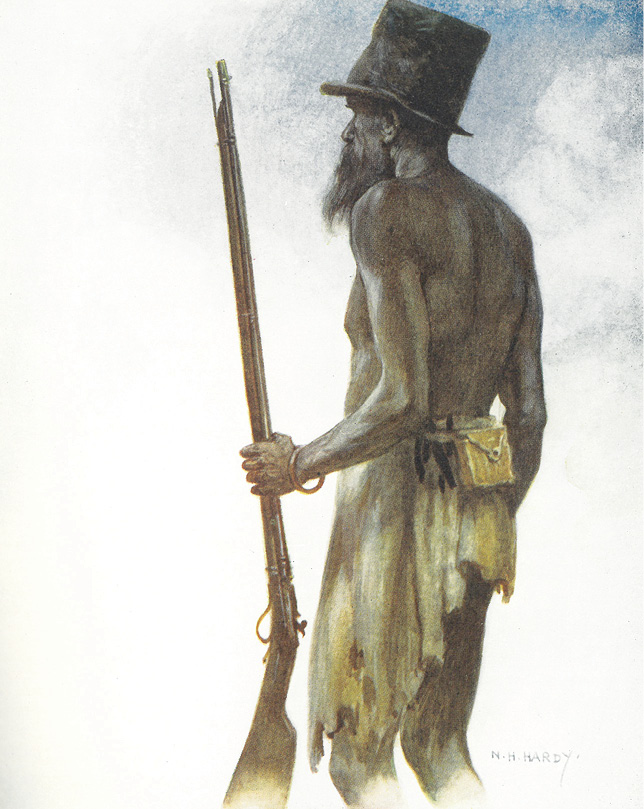
Figure 16: Old Cannibal Chief of the Island of Aoba, New Hebrides.
Source: Illustration by Norman H Hardy in Fox, Oceania, 49.
Cannibal attributes were not only restricted to Pacific Islanders. Young travellers Edward Way Irwin and Ivan Goff ascribed cannibal traits onto white visitors when they described the passengers of the cruise ship Aorangi as having ‘cannibal faces, feasting themselves on us’.132 Similarly, travellers to New Caledonia often attributed cannibal behaviours to French convicts. Others sought to test the merits of ‘going native’ by identifying with the savage. As Obeyesekere and Arens have demonstrated, the roots of European fascination with cannibalism lie not only in depictions of the other but in the potential for the civilised to also turn to cannibalism. For this reason, Safroni-Middleton actively searched for a village in the ‘Rewa cannibal district’ in Fiji and proudly announced to his readers that ‘I became a savage of the first degree’.133
As Safroni-Middleton alluded, cannibalism (and thus savagery) was perceived to occur in degrees, depending on particular Islands and regions. Such labels were tied to a colonial frontier that was always shifting, as argued by Obeyesekere.134 The racial label of Melanesia as being the most savage region in the Pacific implied that it was also the most cannibalistic. British naval captain Cyprian Bridge wrote in 1918 that ‘to the unscientific eye of people like myself it seemed that there were three distinct races and many mixtures’. He identified Melanesians as being ‘woolly-haired negroes’ and noted that ‘except where they have been brought into close and long contact with white men, especially missionaries, they are all cannibals’.135 Wawn was more specific in identifying the racial component, which encouraged the belief that the further west one travelled, the more savage one would become: ‘Solomon Islanders have more Papuan blood, therefore excel the New Hebridean in cannibalism and bloodthirstiness’.136 The Islands of Polynesia were not commonly attributed cannibal features, even though the ritual had been practised by Marquesas Islanders and Maori. This fact may have been forgotten in Australia by the twentieth century, or it might have been overshadowed by descriptions of Melanesian savagery. Some travellers to Polynesia explicitly denied any trace of cannibalism, such as Clement Lindley Wragge in 1906: ‘There appears to be no proof that the Tahitians were ever actually cannibals’.137
Literature of the early twentieth century generally placed Solomon Islanders in a more savage position than those from the New Hebrides. Fox’s 1911 reference guide stated that ‘the Solomon Islanders have been always the most notorious cannibals of the Pacific, and undoubtedly certain of their religious rites demanded that human flesh should be eaten’.138 Australians particularly associated the Solomon Islands with head hunting, a practice that had been exaggerated in travel accounts of the nineteenth century. Labour recruiters who found recruiting increasingly more difficult in the New Hebrides turned to the Solomon Islands after the 1880s and, as violent encounters inevitably ensued, the group featured more strongly in the public’s imagination.139 In contrast, accusations of cannibalism directed at Aboriginal Australians had dissipated by the twentieth century, despite their perceived primitivity. This was expressed much later in 1953 by Australian travel writer, Colin Simpson:
The eating of human flesh was not practised by the Australian native to the extent that it was by the South Sea Islander. The term ‘cannibalism’ is usually taken to mean gorging on human flesh, and with relish; and that seems a valid description of the cannibalism of the Melanesian indigenes of New Caledonia, who appear to have regarded man-meat much as we regard the Sunday joint. Not all cannibalism is the same in purpose.140
Such tongue-in-cheek comparisons were used as literary devices to entertain rather than to reflect any serious consideration of the similarities and differences that existed between indigenous cultures.
In the Melanesian group, Fiji was an outlier. Situated simultaneously between Melanesia and Polynesia—geographically, racially and ideologically—Fiji was considered a ‘special case’ by Australian travellers. It was not considered as savage as the ‘wicked cannibal groups’ in the Solomon Islands and the New Hebrides, as marked by Grimshaw in 1907, but neither did it have ‘the nameless dreamy charm of the Eastern Islands’.141 McLaren similarly noted, ‘I went to Fiji as a tourist, a man of leisure, intent on comparing the Civilized Wild [Fiji] with the Palaeolothic Wild [sic] of my roamings’.142 Fiji’s development as a key stopover and major industrial centre in the Pacific rendered it a well-travelled and modern destination.
The island of Bau in Fiji was frequently acknowledged as being the traditional centre, or ‘the shrine of cannibalism’. Mordaunt described the Island in 1926:
This is by far the most romance-haunted spot—the spot which almost speaks, and groans in speaking, of what is past—in all the islands. It is the center of all that was dreadful in the wild days of old Fiji; the home of kings and chiefs, the shrine of cannibalism. Mbau [Bau] the beautiful, Mbau the terrible.143
Bau rose to prominence in the mid-1830s and became Fiji’s seat of power under its chief, Ratu Seru Epenisa Cakobau, until Fiji’s cession to Britain in 1874. Cakobau became a legend among European and Australian tourists; his personality was exaggerated to describe a ruthless former cannibal who converted to Christianity. Bau became a site for historic tourism, with steamer tourists frequently making day trips to the Rewa River and Bau, where they could visit the graves of pioneer missionaries, see Cakobau’s memorial and the ‘relics of heathen Fiji’, and reflect on the victory of Christian civilisation over cannibalism.144 Christian missions had been effectively promoting the success of their work by emphasising the miraculous transformation of Fiji from its cannibal past. As John Gibson Paton noted:
Thus died a man who had been a cannibal chief, but by the grace of God and the love of Jesus has been changed, transfigured into a character of light and beauty.145
In contrast to the highly publicised savagery of pre-cession Fiji, the popular image of Fiji in the early twentieth century was increasingly sanitised and romanticised, with its reputation as ‘the Cannibal Isle’ receding.
An analysis of Australian representations of cannibalism in the Pacific Islands from 1880 to 1941 can offer insights into how Australians perceived themselves and their Pacific neighbours over time. Initially symbolising the brutality and inhumanity of the ignoble savage, the cannibal of the late nineteenth century was perceived as a threat to Australian civilised values, despite the dependence of domestic agricultural production on cheap Melanesian labour. By the first two decades of the twentieth century, Australian missionaries changed their propaganda to encourage an identification with the childlike savage; they wished to emphasise their common humanity and potential salvation rather than a heathen past. This shift suggests a softening of racial attitudes and assumptions towards Pacific Islanders, particularly after World War I, as well as a greater concern for Australia’s obligations to the Pacific. In the 1920s and 1930s, Pacific tourism had fostered a romanticised and sanitised version of the primitive ex-cannibal savage. Although this image became increasingly standardised, the growth of travel to the region encouraged more diverse representations of Pacific Islanders.
The Melanesian savage was a complex and ambiguous figure, formulated and reformulated by the entanglement of scientific discourse, racial theory, childhood fiction, Christian promotion, political propaganda, tourist guides and traditional European fantasies. Although this complexity became simplified, standardised and stereotyped in the popular imagination of Australians over time, some strands of Australian travel writing also highlighted a more discerning and nuanced collection of responses to the savage–civilised dichotomy. Some journeys reaffirmed individual preconceptions, while others found it difficult to reconcile the savage of the imagination with reality. In 1937, Marshall frequently referred to the Islanders whom he met as savages, yet he was unsatisfied with his own ‘civilisation’:
Our generation are indeed a curious people … so ultra-modern, yet so hopelessly backward and ignorant of most of the things that matter … The people of the future will regard us as barbarians, much in the same manner as we regard our ancestors. And if not for a hundred other things, it will be for the appalling way we have treated and are treating the primitive races whose territories we have taken.146
In 1924, Smith reflected that ‘we are as much the slaves of habit and the creatures of convention as they are, only we assume that our habits are good and our conventions are virtuous’.147 In the concluding chapter of her 1944 travel account, Woodburn asked the reader: ‘What right have we to interfere with the individual’s freedom of thought and action?’148
These dissenting voices may have been a minority in Australian travel writing, but they signalled a gradual shift away from traditional notions of the bestial savage. They also contributed to the erosion of racialist assumptions regarding Islander inferiority in the 1920s and 1930s. This reflected a broader shift in the public attitudes of post–World War I, one in which attention was directed towards the Pacific Islands and Australia’s role as a colonial power in the region. The increase in Australian travel to Melanesia at this time facilitated more face-to-face human encounters between Australians and Pacific Islanders, and it highlighted a weariness regarding the conventional savage trope, which had been an overused and exaggerated stereotype since first European contact with the Pacific.
1 Jack McLaren, My Odyssey (London: Jonathan Cape, 1923), 213.
2 Marianna Torgovnick, Gone Primitive: Savage Intellects, Modern Lives (Chicago: University of Chicago Press, 1990), 244.
3 Russell, Savage or Civilised?, 3.
4 Anna Johnston, ‘Writing the Southern Cross: Religious Travel Writing in Nineteenth-Century Australasia’, in Travel Writing in the Nineteenth Century: Filling the Blank Spaces, ed. Tim Youngs (London: Anthem Press, 2006), 205, doi.org/10.7135/upo9781843317692.012.
5 Thomas, Colonialism’s Culture, 71; Gananath Obeyesekere, Cannibal Talk: The Man-Eating Myth and Human Sacrifice in the South Seas (Berkeley: University of California Press, 2005), 184.
6 Smith, European Vision and the South Pacific, 318; Kerry R Howe, ‘The Fate of the Savage in Pacific Historiography’, New Zealand Journal of History 11, no. 2 (1977): 137.
7 Smith, European Vision and the South Pacific, 317.
8 Ronald L Meek, Social Science and the Ignoble Savage (Cambridge: Cambridge University Press, 1976), 5; Russell, Savage or Civilised?, 31; Russell McGregor, Imagined Destinies: Aboriginal Australians and the Doomed Race Theory, 1880–1939 (Carlton: Melbourne University Press, 1997), 31; Bronwen Douglas, ‘Climate to Crania: Science and the Racialization of Human Difference’, in Foreign Bodies: Oceania and the Science of Race 1750–1940, ed. Bronwen Douglas and Chris Ballard (Canberra: ANU E Press, 2008), 35, doi.org/10.22459/fb.11.2008.02.
9 Dumont D’Urville, in Tcherkezoff, ‘A Long and Unfortunate Voyage’, 176.
10 Tracey Banivanua-Mar, Violence and Colonial Dialogue: The Australian-Pacific Indentured Labor Trade (Honolulu: University of Hawai‘i Press, 2007), 22, doi.org/10.1515/9780824865467.
11 For example, see ‘Tommy Tanna’s Present Position’, Worker, 1 June 1901, 4, nla.gov.au/nla.news-article70830894; ‘Tommy Tanna’, The Clipper, 28 December 1901, 8, nla.gov.au/nla.news-article83085521.
12 See Peter Corris, ‘Passage, Port and Plantation: A History of Solomon Islands Labour Migration, 1870–1914’ (PhD thesis, The Australian National University, 1970), 130; Roger M Keesing and Peter Corris, eds, Lightning Meets the West Wind: The Malaita Massacre (Melbourne: Oxford University Press, 1980); Roger M Keesing, ‘The Young Dick Attack: Oral and Documentary History on the Colonial Frontier’, Ethnohistory 33, no. 3 (1986): 268–92, doi.org/10.2307/481815; Wilfred Fowler, ‘The Young Dick’, Queensland Heritage 2, no. 1 (1969): 23–5.
13 Smith, European Vision and the South Pacific, 326, 331. See also Campbell, ‘Savages Noble and Ignoble’.
14 Smith, European Vision and the South Pacific, 326.
15 Deryck Scarr, ‘Introduction’, in A Cruize in a Queensland Labour Vessel to the South Seas, ed. William E Giles (Canberra: Australian National University Press, 1970), 2.
16 Clive Moore, ed., The Forgotten People: A History of the Australian South Sea Island Community (Sydney: Australian Broadcasting Commission, 1979); Clive Moore, Kanaka: A History of Melanesian Mackay (Port Moresby: University of Papua New Guinea Press, 1985); Clive Moore, ‘Pacific Islanders in Nineteenth Century Queensland’, in Labour in the South Pacific, ed. Clive Moore, Jacqueline Leckie and Doug Munro (Townsville: James Cook University of Northern Queensland, 1990), 144–7; Clive Moore, ‘The Counterculture of Survival: Melanesians in the Mackay District of Queensland, 1865–1906’, in Plantation Workers: Resistance and Accommodation, ed. Brij V Lal, Doug Munro and Edward D Beechert (Honolulu: University of Hawai‘i Press, 1993), 69–99.
17 Wawn, The South Sea Islanders; Cromar, Jock of the Islands; John Gaggin, Among the Man-Eaters (London: T. Fisher Unwin, 1900); Douglas Rannie, My Adventures among South Sea Cannibals: An Account of the Experiences and Adventures of a Government Official among the Natives of Oceania (London: Seeley, Service & Co., 1912); Giles, A Cruize in a Queensland Labour Vessel to the South Seas.
18 James published his voyage aboard the recruiting vessel Lizzie in the Argus from 27 August 1883 to 9 February 1884, as well as in his travelogue, Cannibals and Convicts, under the pseudonym ‘Julian Thomas’; Joseph Melvin published ‘Our Representative—The Kanaka Labour Traffic’ in the Argus from 5 to 19 December 1892. See also Joseph Dalgarno Melvin, The Cruise of the Helena: A Labour-Recruiting Voyage to the Solomon Islands, ed. Peter Corris (Melbourne: Hawthorn Press, 1977). George ‘Chinese’ Morrison published ‘A Cruise in a Queensland Slaver’ in The Leader from 21 October to 9 December 1882, and an anonymous diary was published under the title ‘Diary of a Recruiting Voyage’ in the Brisbane Courier between 25 October 1884 and 19 February 1885.
19 Giles, A Cruize in a Queensland Labour Vessel, 34.
20 Mark Twain, Following the Equator: A Journey around the World (Hartford: American Publishing Company, 1897), 53.
21 Wawn, The South Sea Islanders, 359.
22 Wawn, The South Sea Islanders, xlvi.
23 Street, The Savage in Literature, 55.
24 As described by Scarr in Giles, A Cruize in a Queensland Labour Vessel, 17.
25 Christopher Mills, ‘Briefs and Associated Papers in Cases Involving Pacific Islanders’, in Crown Solicitor’s Office, Series ID 12102, Item ID 7876 (Queensland: Queensland State Archives, 1884).
26 Giles, A Cruize in a Queensland Labour Vessel, 36.
27 Giles, A Cruize in a Queensland Labour Vessel, 36.
28 Rannie, My Adventures among South Sea Cannibals, 17.
29 Rannie, My Adventures among South Sea Cannibals, 26.
30 Melvin, The Cruise of the Helena, 4; Gaggin, Among the Man-Eaters, 43.
31 Wawn, The South Sea Islanders, 237; Stock, The Cruise of the Dream Ship, 188; Tichborne, Rambles in Polynesia by Sundowner, 91.
32 Gaggin, Among the Man-Eaters, 237; Giles, A Cruize in a Queensland Labour Vessel, 39.
33 Dixon, Writing the Colonial Adventure, 64.
34 John Gibson Paton, Thirty Years with South Sea Cannibals: Autobiography of John G. Paton, ed. James Paton (Chicago: Moody Press, 1964), 40.
35 Charles Stuart Ross, Fiji and the Western Pacific (Victoria: H. Thacker, 1909), 67, 209.
36 Gaggin, Among the Man-Eaters, 104.
37 Rannie, My Adventures among South Sea Cannibals, 51. For examples of resistance, see Gaggin, Among the Man-Eaters, 162; Woodburn, Backwash of Empire, 188; and Gunga, Narrative of a Trip from Maryborough to New Caledonia (Maryborough: publisher unknown, 1878), 13.
38 Margaret T Hodgen, Early Anthropology in the Sixteenth and Seventeenth Centuries (Philadelphia: University of Pennsylvania Press, 1964), 18; Weaver-Hightower, Empire Islands, 152.
39 Safroni-Middleton, Wine-Dark Seas and Tropic Skies, 30.
40 Gaggin, Among the Man-Eaters, 105.
41 Obeyesekere, Cannibal Talk, 14.
42 Rannie, My Adventures among South Sea Cannibals, 16.
43 Keesing and Corris, Lightning Meets the West Wind, 154.
44 McLaren, My Odyssey, 68.
45 Rannie, My Adventures among South Sea Cannibals, 61.
46 Wawn, The South Sea Islanders, 76.
47 Wawn, The South Sea Islanders, 239.
48 Melvin, The Cruise of the Helena, 13.
49 Scarr, ‘Introduction’, 25.
50 ‘General News: The Labour Trade’, The Queenslander, 9 May 1885, 753, nla.gov.au/nla.news-article19797950.
51 Australian Parliamentary Debates, House of Representatives, 5077. See also Marilyn Lake and Henry Reynolds, Drawing the Global Colour Line: White Men’s Countries and the Question of Racial Equality (Carlton: Melbourne University Press, 2008).
52 Giles, A Cruize in a Queensland Labour Vessel, 69.
53 Raymond Evans, Kay Saunders and Kathryn Cronin, Race Relations in Colonial Queensland: A History of Exclusion, Exploitation and Extermination (St Lucia: University of Queensland Press, 1988), 165, 208, 222.
54 Thomas, Cannibals and Convicts, 153.
55 John Henry Macartney Abbott, The South Seas (Melanesia) (London: Adam and Charles Black, 1908), 30.
56 Grimshaw, From Fiji to the Cannibal Islands, 318.
57 Thomas Dunbabin, Slavers of the South Seas (Sydney: Angus & Robertson, 1935), v.
58 Dunbabin, Slavers of the South Seas, xiii–xiv.
59 Woodburn, Backwash of Empire, 90.
60 Muspratt, My South Sea Island, 35.
61 Niel Gunson, Messengers of Grace: Evangelical Missionaries in the South Seas, 1797–1860 (Melbourne: Oxford University Press, 1978), 185.
62 Thomas, Colonialism’s Culture, 126.
63 Gunson, Messengers of Grace, 4.
64 ‘2112.0—Census of the Commonwealth of Australia, 1911: Volume II Part VI—Religions’, Australian Bureau of Statistics, last modified 11 November 2013, www.abs.gov.au/AUSSTATS/abs@.nsf/DetailsPage/2112.01911.
65 Helen Bethea Gardner, Gathering for God: George Brown in Oceania (Dunedin: Otago, 2006); Christine Weir, ‘“White Man’s Burden”, “White Man’s Privilege”: Christian Humanism and Racial Determinism in Oceania 1890–1930’, in Foreign Bodies: Oceania and the Science of Race 1750–1940, ed. Bronwen Douglas and Chris Ballard (Canberra: ANU E Press, 2008), 286, doi.org/10.22459/fb.11.2008.08.
66 Cecil Wilson, The Wake of the Southern Cross: Work and Adventures in the South Seas (London: John Murray, 1932)
67 John Garrett, To Live among the Stars: Christian Origins in Oceania (Suva: World Council of Churches, 1982), 177.
68 Niel Gunson, ‘Paton, Francis Hume Lyall (Frank) (1870–1938)’, Australian Dictionary of Biography, adb.anu.edu.au/biography/paton-francis-hume-lyall-frank-7976.
69 Weir, ‘“White Man’s Burden”, “White Man’s Privilege”’, 286.
70 Edmond, Representing the South Pacific, 117.
71 Christine Weir, ‘“Deeply Interested in These Children Whom You Have Not Seen”: The Protestant Sunday School View of the Pacific, 1900–1940’, The Journal of Pacific History 48, no. 1 (2013): 2, doi.org/10.1080/00223344.2012.758921.
72 Burton, The Call of the Pacific, 3.
73 Weir, ‘“White Man’s Burden”, “White Man’s Privilege”’, 287–8.
74 Cato, The House on the Hill, 25–31.
75 Lorimer Fison, Tales from Old Fiji (London: Alexander Moring Ltd: The De la More Press, 1904), xiii.
76 Thomas, Colonialism’s Culture, 128–9.
77 Ballard, ‘Collecting Pygmies’, 130.
78 Street, The Savage in Literature, 64–5.
79 Thomas, Colonialism’s Culture, 140.
80 Cato, The House on the Hill, 2.
81 May Cook, Fijian Diary 1904–1906: A Young Australian Woman’s Account of Village life in Fiji, ed. Leigh Cook (Victoria: PenFolk Pub., 1996), 120. Cook does not specify why Joeli had accompanied them to Australia.
82 Anderson, What a Tourist Sees in the New Hebrides, 46; McLaren, My Odyssey, 67.
83 Hickson, Notes of Travel, 5.
84 Grimshaw, From Fiji to the Cannibal Islands, 330.
85 Weir, ‘“White Man’s Burden”, “White Man’s Privilege”’, 298.
86 Burton, The Fiji of To-Day, 173, 265.
87 Frank Hume Lyall Paton, The Kingdom in the Pacific (London: United Council for Missionary Education, 1912), 35.
88 Warwick Anderson, The Cultivation of Whiteness: Science, Health and Racial Destiny in Australia (Carlton: Melbourne University Press, 2002), 206.
89 Weir, ‘“Deeply Interested in These Children Whom You Have Not Seen”’, 14.
90 Street, The Savage in Literature, 120–1.
91 MacCannell, The Tourist, 91; Stewart, On Longing, 150.
92 McLaren, My Odyssey, 11, 41, 66.
93 Hannah Chewings, Amongst Tropical Islands, or, Notes and Observations Made during a Visit of the S.S. ‘Moresby’ in 1899, to New Guinea, New Britain and the Solomon Islands (Adelaide: publisher unknown, 1900), 30.
94 Joseph HC Dickinson, A Trader in the Savage Solomons: A Record of Romance and Adventure (London: H.F. & G. Witherby, 1927), 206.
95 Burton, The Fiji of To-Day, 74, 76–7.
96 Stephens, Samoan Holidays, 14.
97 Anderson, What a Tourist Sees in the New Hebrides, 38.
98 Marshall, The Black Musketeers, 88.
99 Woodburn, Backwash of Empire, 20.
100 Safroni-Middleton, South Sea Foam, ix, xii.
101 Mordaunt, Sinabada, 251.
102 Smith, In Southern Seas, 56.
103 McLaren, My Odyssey, 234.
104 Edmund James Banfield, The Confessions of a Beachcomber (London: T.F. Unwin, 1908), 57.
105 Safroni-Middleton, Wine-Dark Seas and Tropic Skies, 14, 61.
106 Muspratt, My South Sea Island, 64.
107 McLaren, My Odyssey, 212.
108 Banivanua-Mar, Violence and Colonial Dialogue, 34.
109 Russell, Savage or Civilised?, 3.
110 White, Inventing Australia, 148.
111 Obeyesekere, Cannibal Talk, 28.
112 Banivanua-Mar, Violence and Colonial Dialogue, 24.
113 Obeyesekere, Cannibal Talk; William Arens, The Man-Eating Myth: Anthropology & Anthropophagy (New York: Oxford University Press, 1979).
114 Banivanua-Mar, Violence and Colonial Dialogue, 22.
115 Safroni-Middleton, In the Green Leaf, 123.
116 Tracey Banivanua-Mar, ‘Cannibalism and Colonialism: Charting Colonies and Frontiers in Nineteenth-Century Fiji’, Comparative Studies in Society and History 52, no. 2 (2010): 264, doi.org/10.1017/s0010417510000046.
117 Smith, In Southern Seas, 20.
118 Woodburn, Backwash of Empire, 191.
119 Wilfred Burchett, Pacific Treasure Island: New Caledonia; Voyage through its Land and Wealth, the Story of its People and Past (Melbourne: F.W. Cheshire, 1941), 48.
120 Tichborne, Noqu Talanoa, 40.
121 Stewart, On Longing, 146.
122 Joseph Hadfield Grundy, The New Hebrides Group of Islands (Adelaide: Hunkin, Ellis & King, 1933), 7.
123 Gaggin, Among the Man-Eaters, 58.
124 Abbott, The South Seas (Melanesia), 80.
125 Gaggin, Among the Man-Eaters, 134.
126 Albert Stewart Meek, A Naturalist in Cannibal Land, ed. Frank Fox (London: T.F. Unwin, 1913).
127 Mordaunt, The Venture Book, 210; Dickinson, A Trader in the Savage Solomons, 203.
128 Max Quanchi, ‘Norman H. Hardy: Book Illustrator and Artist’, The Journal of Pacific History 49, no. 2 (2014): 214–33, doi.org/10.1080/00223344.2014.906298.
129 Frank Fox, Oceania (London: Black, 1911), 33.
130 Burton, The Fiji of To-Day, 104.
131 Fox, Oceania, 31; Ponder, An Idler in the Islands, 39.
132 Irwin and Goff, No Longer Innocent, 145.
133 Safroni-Middleton, Tropic Shadows, 17.
134 Obeyesekere, Cannibal Talk, 150.
135 Cyprian Bridge, Some Recollections (London: J. Murray, 1918), 232.
136 Wawn, The South Sea Islanders, 240.
137 Wragge, The Romance of the South Seas, 286.
138 Fox, Oceania, 38.
139 Corris, ‘Passage, Port and Plantation’, 1–2.
140 Colin Simpson, Adam in Ochre: Inside Aboriginal Australia (New York: Frederick A. Praeger, 1953), 203.
141 Grimshaw, From Fiji to the Cannibal Islands, 7.
142 McLaren, My Odyssey, 247.
143 Mordaunt, The Venture Book, 199–200.
144 Brummitt, A Winter Holiday in Fiji, 115–18.
145 Paton, Thirty Years with South Sea Cannibals, 108.
146 Marshall, The Black Musketeers, 239.
147 Smith, In Southern Seas, 57.
148 Woodburn, Backwash of Empire, 219.
Previous Next



