


 menu
Introduction: Situating Women
‘A ‘ohe o kahi nana o luna o ka pali; iho mai a lalo nei; ‘ike I ke au nui ke au iji he alo a he alo.
The top of the cliff isn’t the place to look at us; come down here and learn of the big and little currents, face to face (Pukui 1983: 24).1
Feminist international relations and political science scholarship has, in the last two decades, demonstrated an increasing interest in the political agency of women’s organisations. The claim that the institutions of global governance—the state, multilateral organisations and financial institutions—are ‘gendered, and gendered male’ (Pettman 1996: vii),2 has underpinned this scholarship. As a result, feminist scholars have turned their attention to alternative spheres of political engagement which have allowed women to have a global political voice. From this perspective, women’s organising is recognised as a significant realm of collective political activity with the capacity to challenge or initiate change within the structures of global governance.
Scholarship on this subject can easily incite controversy, as Peggy Antrobus notes in the opening lines of her book The Global Women’s Movement (Antrobus 2004: 1). Some studies have avoided this by emphasising the celebratory aspects of women’s activism and the many gains that women’s organisations have achieved in making ‘gender matter’3 within formal political institutions (Reilly 2009; Brown Thompson 2002; Keck and Sikkink 1998; Joachim 1999, 2003; True and Mintrom 2001; Stephenson 1995). This work amasses a strong body of evidence to support the claim that women’s organisations have been local and global drivers of political reform. The reforms are charted in a relatively uncomplicated manner, and the final analysis is, presumably, pleasing to all those who read it.
But others have told this story in a different way. Adopting an alternative structure which emphasises a counter-politics of resistance rather than reform, these studies give closer critical attention to the challenges which have been unmet by the women’s movement. They consider the institutional obstacles which have impeded women’s progress, even the movement’s unresolved internal tensions as activist agendas come to more closely resemble rather than challenge the conservative discourses on women promoted by a range of contemporary institutional actors. This work generates findings that are more uncomfortable and raises questions about the costs that women’s movements incur as they become ‘professionalised’ through their engagement with formal political institutions (Yuval-Davis 2006: 288; Kahn 2002; Tobar 2003; Alvarez 1999; Lang 1997; Antrobus 1984).
It could be argued that these contending evaluations of women’s organisations are underpinned by interesting ‘ideal-typical’ understandings of how women’s movements should operate (Marx-Ferree 2006: 10). Both seem to offer compelling, if opposing, illustrations of women’s capacities for political agency. But could they also be criticised for making their assessments from an analytical ‘cliff-top’? Each portrait seems to easily privilege identifiable forms of reform- or resistance-oriented organisational activity and its alignment with pre-established ideals dictating the ‘right’ type of behavior for women’s groups. Yet such assessments may simultaneously ignore the flux and contradiction that are an inherent part of everyday political life and how these too shape women’s movements. Might we gain a different perspective of women’s organising if a greater effort was made to understand the ‘currents’ which shape gender activists’ own understandings of what has resulted locally, and globally, from their political activity, and equally, what courses of action they have judged to be politically viable at particular historical moments?
In this study, I develop a different analytical approach to the study of women’s organising. My aim is develop a method of enquiry which goes beyond ideal-type assessments of organisational behaviour and the resultant narratives which often appear to map a linear trajectory of women’s waxing or waning political influence over time. My own study of women’s organising and gender politics in Fiji, and the broader Pacific region, gives extended consideration to the prevailing currents—socio-cultural, political, economic, religious, domestic and global—that have shaped the political landscapes negotiated by women activists across the past forty years. Importantly, I show how these broader factors influence the decisions women activists make about the appropriateness of their various advocacy strategies. Like many studies of gender politics conducted in other settings, this book therefore examines the emergence of evident trends in women’s advocacy conducted on the local, regional and international stage since the 1960s. What makes this study distinctive, however, is the effort made to situate this activity within a global and local political context. In short, this investigation is driven by a preliminary question: How is women’s political agency shaped by broader political contingencies?
The importance of such an approach was brought home to me with some urgency in the early stages of researching this project. Working as a volunteer with a Suva-based women’s organisation in early 2002, I attended a forum hosted by the Fiji government’s Ministry of Women on public policy approaches to gender mainstreaming in the convivial setting of Suva’s Tradewinds Hotel. Participants at this meeting represented a diverse range of women’s non-government organisations (NGOs), various aid organisations, a number of regional intergovernmental agencies, and members of Fiji’s national government. Most of the forum’s sessions involved presentations from a team of Asian Development Bank (ADB) consultants who had been coordinating a pilot gender mainstreaming project within two of Fiji’s government ministries. On the whole, the forum’s design afforded those assembled little opportunity for comment or feedback on presentations. The assembled audience of women’s NGO representatives seemed to observe the proceedings quietly. At one point, however, a startling intervention took place as an older woman in the audience began to admonish the speakers for their prescriptive tone and their apparent disinterest in dialogue. ‘NGOs want meaningful consultation,’ she protested. She continued,
This comes through a genesis of policy. Government wants the support of NGOs but the NGOs feel that they are not being consulted enough. They want to be part of the process. You talk about the need for NGOs to get on board. The government are [sic] the ones that don’t understand the processes of gender mainstreaming not NGOs!
This blunt interjection and the woman’s agitated demeanour contrasted dramatically with the general, more diplomatic tenor of the meeting. And while I imagined that many of the audience members may have agreed with the substance of the woman’s comments, and particularly her dissatisfaction with the lack of opportunities for consultation, she received no audible signs of support from other women in the room. In fact, her interjection was greeted with silence.
The audacity of the woman’s response immediately sparked my interest. I was later told that the meeting’s heckler was Amelia Rokotuivuna, a figure who had played an important role within the Fiji Young Women’s Christian Association (YWCA), and someone recognised throughout the Pacific as a major contributor to regional debate on the status of women. Before embarking on this research trip, I had been told about Amelia’s radical political profile in the 1960s and 1970s and her courageous efforts to promote social justice. As I saw for myself, some forty years later, Amelia had lost none of her legendary capacity for forthrightness.
In the weeks and months which followed, and as a result of follow-up trips made to Suva in later periods, I came to know Amelia better. I spent many hours talking to her about her involvement in Fiji’s YWCA, her efforts to realise the goals of equitable development and peace in the Pacific, and her views about the contemporary terrain of women’s organising in Fiji. In all of these discussions, I found Amelia to be no less frank than on the day I first observed her addressing (or perhaps that should be ‘dressing-down’) the ADB consultants. She would answer my questions directly, let me know in unambiguous terms if she thought I was assuming something incorrect, and offer piercing assessments of current gender advocacy strategies.
Amelia described herself as an early pioneer of the women’s movement in Fiji and, as part of the executive of the newly formed YWCA, she and her associates certainly developed a far more politicised style of advocacy than had previously been the norm for women’s organisations. Thanks to this work, she has been recognised regionally and internationally for the role she played spearheading campaigns which promoted women’s rights to birth control, opposed Fiji’s institutionalised systems of race discrimination, and identified threats to regional peace and security posed by powers outside the Pacific Islands.
However, as a result of discussions conducted with many other women activists in Fiji, I also came to understand that Amelia’s uncompromising style reflected a trend in gender politics that was often criticised as outmoded and no longer appropriate. And this, in part, explained the silence which greeted her outburst at the forum described above. For some, the tone and substance of Amelia’s brand of advocacy was deemed counterproductive for women’s organisations in Fiji in this particular period because it too easily encouraged hostility and negative responses from a conservative and politically dominant section of Fijian society. Activist women therefore voiced the opinion that, if real gains for women were to be secured in the current context, strategies of engagement rather than confrontation were required.
How were these shifts in the tenor of women’s advocacy to be understood? When asked about this, many of my interlocutors pointed out that although activists had adopted a more moderate political tone, their efforts to challenge women’s subordination continued to be viewed in controversial terms by many of Fiji’s political and religious leaders. The suggestion here was that radicalism was not absent from Fiji’s women’s movement, but simply present in ways that were different from the radicalism of the past. While such scenarios alerted me to the importance of understanding the shifts which take place within the realm of gender advocacy over time, they also highlighted the need for careful examination of the prevailing political circumstances in which advocacy takes place, with attention paid to how these circumstances alter and perhaps necessitate the formulation of new political strategies and agendas.
This book, therefore seeks to contribute to broader scholarship on women’s political agency by examining changing political contexts and considering how these shape the political agendas pursued by women’s organisations. In focusing upon the shifting currents of political life, at the local, regional and international levels across the previous four decades, this book demonstrates the ‘complexities’ of women’s political agency (Leckie 2002: 156). My aim here is to examine how particular trends evident in women’s political advocacy emerge at particular historical junctures and can be explained by shifts in the prevailing global and local political environment.
Fiji provides an important site for study of this type. The women’s movement in this setting is generally viewed as one of the strongest and most successful in the Pacific Island region (Jolly 2005a: 153), thanks to the intensity of activists’ political engagement and their increasing national, regional and international influence. Through a range of sustained campaigns they have raised the profile of issues such as women’s legal status, gender violence, women’s media presence and women’s rights to fair wages. They have won important government reforms for women in areas such as ministerial representation and law reform.
Fiji’s women activists have also been active participants on the regional and international political stage. Their efforts to focus international attention on the specific phenomena disadvantaging women in Pacific contexts have won global recognition and demonstrated the transnational reach of their advocacy (Keck and Sikkink 1998: 185; Merry 2006a and 2006b; Riles 2001; Fraser 1987).
Yet developments within the realm of gender politics in Fiji cannot simply be mapped in a way which suggests a linear trajectory of increasing political influence. As will be demonstrated, Fiji’s women activists have, since decolonisation, also worked within a volatile local political environment and negotiated serious challenges to national stability. The ramifications of the four coups that have taken place in Fiji since 1987, the development crises and communal tensions that these events have triggered, and the ensuing political struggles that have been waged over Fiji’s governance structures have had important impacts within the realm of women’s organising and have tended to shape women’s political agency in complex ways.
Authoritarianism has generally been the counterpart of coup-making in Fiji and this has made the operations of some women’s organisations precarious in certain instances. Post-coup political elites have frequently favoured restrictive interpretations of cultural and religious mores in an effort to protect indigenous political privilege (Lawson 1996). This has constrained the political role of women and often helped to de-legitimise the views of those female critics who have challenged Fiji’s self-imposed regimes. This has discouraged some women activists from articulating overtly politicised or highly partisan agendas but the trend has not been universal. Other women have taken active and often conflicting roles in the ongoing debate which rages in Fiji about how the country should be governed. They have linked efforts to promote women’s status with more broadly held concerns about appropriate models of governance and development for the country overall. For all activists, however, the impact of changing local political circumstances, in combination with shifting international norms influencing the directions of global political debate on questions of governance and development, has been profound. These changing circumstances have shaped activists’ understandings of their political capacity at various points in time, and ultimately influenced the way they have articulated and pursued political goals within local and international arenas.
Demonstrating the impact of these broader political contingencies and how they have shaped women’s political agency is, therefore, a key objective of this study. Yet my use of the term contingency should not be confused with those modes of critical academic enquiry which aim to ‘disassemble’ universal claims through the demonstration of ‘radical historical contingency and modes of construction for everything’ (Haraway 1991). Rather, I use the term contingency to examine the relationship between political agency and political context. In this sense, contingency is understood as a broadly encompassing term. It signifies the conjuncture of events and political circumstances which influence the political strategies employed by Fiji-based women’s organisations at particular points in time, and within particular arenas of political activity—local, regional or international. Through the use of the term contingency, I seek to explain how historical legacies, socio-cultural influences, sites of local political contestation, and broader international norms relating to governance and development shape the terrain of gender advocacy in Fiji. Ultimately, this enables me to develop a situated account of the local and global political agency of Fiji’s women’s organisations in the previous four decades.
These insights are further extended through close attention to gender activists’ own understandings of what has been achieved and what is possible in particular contexts. From this perspective, agency is not only considered in terms of outcome or influence, but also ‘situated’ through an added consideration of the meanings which actors themselves ascribe to the events under consideration. As such, I borrow from Donna Haraway’s (1991) concept of ‘situated knowledge’ and construct a ‘situated’ history of women’s organising which employs participant observation and textual and archival analysis as investigative tools while also drawing heavily from gender advocates’ oral histories, gathered through ‘face-to-face’ conversations. This approach allows for greater reflection upon the ways politically active women have appraised the events under consideration (a more precise elaboration of this study’s methodology follows in a later section of this chapter).
Examining gender politics in Fiji in a way which employs a situated perspective and is sensitive to activists’ own perceptions and evaluations of their political actions will ultimately enable a more nuanced understanding of women’s political agency. Chiefly, it will enable me to demonstrate how, at each level of political engagement—domestic, regional and international—the activity of Fiji’s women’s organisations has been shaped by interplaying global and local factors. By focusing upon activists’ own understandings of these influences, I will show how they shape organisational activity, opening up some avenues of institutional engagement and closing off others. The result is a study which emphasises ‘face-to-face’ learning and an understanding of how Fiji’s women activists have navigated the ‘big and little’ currents which shape their political environment. This approach differs in important respects from more conventional academic approaches to the study of women’s movements in other contexts.
Conceptual framework
Scholarly examinations of women’s organising generally tend to be oriented in two ways. Either they emphasise the reform capacities of women’s organisations and their institutional agency, or they demonstrate these groups’ capacity to act as sites of resistance to the formalised realm of politics. Across both perspectives, there tends to be a similar interest in establishing a conceptual distance between the organisational and institutional realms. This is done by highlighting particular features and approaches to the exercise of power which are said to be distinctive to the domain of women’s organising and by contrasting these with the more formal, institutional sphere. This sees a heavy emphasis placed upon collectivity, progressive ideas and transnationalism as characteristic features of women’s organising. These features are routinely contrasted with those said to define institutional politics and which are alternatively construed as hierarchical, conservative and governed internationally by state interest (Lang 1997; Alvarez 1999; Joachim 1999, 2003; True and Mintrom 2001; Walker 1984; Stephenson 1995; Ferguson 1984). It has been common for feminist researchers to therefore assert that the features of collectivity, progressive ideas and transnationalism define the realm of women’s organising and enhance the political agency of women’s groups in national and international politics.
Feminist researchers employing a reform-oriented perspective have frequently described the collective basis of women’s approach to power as a characteristic style of political engagement which differentiates this realm from the more hierarchical and individually competitive institutional political sphere (Reilly 2009; Marques-Pereira and Siim 2002; Stephenson 1995; Ferguson 1984). Emphasis is placed upon the horizontal and collective organisational structures of women’s groups, said to enable a distinctive, fluid and participatory style of political engagement (Walker 1984; Goetz 1997; Lang 1997; Alvarez 1999; Friedman 1999). Those working from a resistance orientation also privilege the collective and ‘transversal’ aspect of women’s organising as distinctive and enabling a ‘politics of dialogue and communication’ (Yuval-Davis 2006: 281). This is viewed as challenging ‘assimilationist universalism’ on the one hand and the reification of difference to the point of exclusion on the other (Yuval-Davis 2006: 281). Yet the integrity of this transversal politics is said to be threatened when women’s organisations engage with institutional actors, be they state-based bureaucracies or multilateral organisations. These are often judged to interfere with the collective structure of women’s groups and encourage the emergence of hierarchies within and between organisations (Yuval-Davis 2006; Riles 2001; Lang 1997; Alvarez 1999; Friedman 1999).
The idea that women’s organising is a realm of progressive ideas also features in a great deal of feminist literature on women’s organising. Within reform-oriented studies, women’s organisations are seen to respond to the needs of grass-roots women in ways which are more innovative and progressive than gendered (masculine dominated) institutions (Joachim 1999, 2003; True and Mintrom 2001; Walker 1984; Karl 1995; Kaplan 1997). Within resistance-oriented perspectives this innovative potential is celebrated but also seen to be stifled as a result of institutional engagement (Rankin 2002; Bergeron 2003; Steinstra 1994; Tinker 1999; Lang 1997; Alvarez 1999).
References to transnationalism constitute a third important feature of feminist research on women’s organising. In this context, transnationalism is generally defined loosely, taken to signify ‘any actor, organisation, or issue that could be either international or global in orientation’ (Booth 1998: 120). Within studies of women’s organising, utilisation of this concept draws attention to the international correspondence between women’s struggles in localised settings, and emphasises the broader global frequency of women’s movements (Al-Ali 2003; Alvarez 1999). At the same time, the notion of transnationalism is felt to enable a more flexible approach to comparative appraisals of feminist politics at the global level. This term is used to avoid questions of gender subordination being articulated in ways which reference hegemonic universalising ideals (Ackerly 2001; Reilly 2009) or romantic, yet essentialising images of ‘global sisterhood’ (Alexander and Mohanty 1997; Grewal and Kaplan 1994). Transnationalism therefore enables consideration to be given to the common feminist perspectives which link the efforts of advocates while simultaneously acknowledging the specific circumstances which contribute to gender subordination in particular settings. This ‘principled’ transnationalism is contrasted with the more self-interested international relations that occur within the realm of state-centric institutional politics (True and Mintrom 2001; Keck and Sikkink 1998).
Transnationalism within the sphere of women’s organising is viewed as facilitating the emergence of consensual norms (Jaquette 2003) which allow for a ‘more internationalised and multilayered feminist politics’ attentive to the intersectional influences—class, age, religion, ethnicity—that contribute to women’s disadvantage (Pettman 1996, 212; Reilly 2009: 14–15; Ackerly 2001). Conversely, resistance-oriented accounts have suggested that over-emphasising transnationalism can distract women’s organisations from responding to urgent issues of concern to women at the local level (Friedman 1999; Riles 2001; Spivak 1996; Oloka-Onyango and Tamale 1995). Others have been sceptical of the extent to which feminist transnationalism is truly participatory. They argue that a sense of superiority amongst western feminists often combined with a misplaced ‘saviour’ narrative, alienated women from the global South in the 1970s and has continued to negatively mark encounters between women from the west and non-west today (Tripp 2006).
This study addresses the same aspects of organisational activity—collectivity, progressive ideas and transnationalism—which feature in the accounts described above. My objective here, however, is to describe these features in a way which is sensitive to the changing contingencies—local and global—which shape political life in Fiji. In this way, I avoid privileging assumptions about organisational structures, ambitions or transnational engagements in ways that reinforce the idea of distance between women’s organising and a monolithic institutional politics. To do this, I place a heavy emphasis upon ‘situated’ understandings of these aspects of organisational behaviour and examine gender activists’ own appraisals of how they contribute to women’s political agency. To this end, I aim to construct a ‘situated’ history of women’s organising in Fiji which examines how gender advocates have themselves understood the significance of, and possibilities for, collectivity, progressive ideas and transnationalism at particular historical junctures.
‘Situating’ method
The utility of developing a ‘situated history’ of women’s organising is beneficial in two key respects. First, it allows a comparison of organisational activities across time, as well as a comparative discussion of gender activists’ motivations. As such, the history recounted in these pages becomes not simply a story of women’s campaigning towards achieved political outcomes, but instead, a nuanced and contextualised reflection upon women’s political ambition and the factors which account for shifts in that ambition over time. This study provides an important counter narrative to a great deal of the feminist research into women’s organising which tends to map political ‘achievement’ in ways that suggest either a teleology of increasing institutional agency or a negative teleology of increasing institutional cooptation. Instead, this study is inspired by a more limited body of work on women’s organising which emphasises greater attention paid to political agency in context (outlined in greater detail in the following chapter). It therefore examines how activists’ understandings of prevailing political circumstance have shaped their political ambitions and, in turn, how this translates into political achievement.
Second, this approach allows for Pacific women to feature as differentiated agents of history, rather than homogenous and passive observers (or even victims) of history. My historical account of campaigns undertaken by Fiji’s activists to advance the status of women locally, and across the region generally, provides important insights into how Pacific women have contributed to projects of social and political change. This activity was certainly not uniform, and did not always achieve its intended aims. Yet scrutiny of women activists’ personal explanations of how and why this activity evolved at a particular moment, provides an important means by which to reorient the ‘content and purpose’ (Thompson 1998: 22, cited in D’Costa 2006) of dominant masculinist narratives of struggle within contemporary Pacific history. While these have tended to emphasise a region sliding into post-colonial crisis (Reilly 2000: 261, 2004; Henderson 2005; Borgu 2002),4 such assessments have frequently made the grave error of discounting the political agency and capacities of Pacific women and relegating them to the margins of Pacific history (Douglas 1999).5
While these methodological choices contribute an innovative dimension to this study, my efforts to situate history are also subject to some limitations. These relate to my own subjectivity as a researcher and the particular positioning of my investigative lens. These considerations will be developed as I describe in more detail the research practicalities of this project.
Research for this book involved two long field-work trips to Suva which were taken in 2002 (together lasting roughly six months), and many follow-up trips conducted in later years. During this time, my position as an outsider connected to, but not of, the Pacific Island region, was something which I recognised would potentially interfere with my ambition to ‘learn face to face’ about the history of women’s organising in this setting. My status as an Australian during this period played heavily on my mind given my own government’s tendency towards heavy-handed engagement in the Pacific Island region and my knowledge that Fiji-based activists had unhesitatingly decried Australian industry and government ‘neo-colonialism’ in the past.6 Additionally, preparatory research also indicated that the Australian government’s policies towards its indigenous peoples were frequently viewed in gender activist circles as an issue which undermined the regional credibility of Australian aid and development objectives in the Pacific Islands.
While sensitivity to these issues was important, my increasing awareness of the history of transnational collaboration between local gender activists and women in my own country also suggested that contact between the Pacific Island region and ‘outside’ did not necessarily have to be negatively construed. Many representatives from women’s organisations described to me the important support they had received from partner non-government organisations in Australia, or from Australian government sources. Others described to me the regional importance of 1970s Australian feminist figures such as Germaine Greer or Elizabeth Reid and the inspiration they had provided for early local feminist struggles for gender equality or for higher levels of female representation within government.7
My decision to work on a voluntary basis with one local women’s organisation during both my field trips in 2002 also helped to reduce the weight of my outsider status. Through this work, I was able to build a close relationship with the group’s coordinator and a number of other staff members, as well as engage in participatory observation of the daily operations of a key women’s group. This work was highly beneficial to my research but also gave me entrée into the broader sphere of women’s organising in Fiji. This allowed me to conduct over sixty interviews with representatives from a wide range of women’s organisations ranging from faith-based groups, to secular, union-based and welfare-oriented women’s organisations. I also conducted in-depth interviews with long-time Fiji-based activists who had been connected with the women’s movement for a number of decades and who were able to comment upon the local evolution of gender politics. Through these contacts, I was given access to organisational archives, and given advice about where other organisational publications might be located.
In addition to my interviews with gender activists, I also interviewed local religious leaders, government bureaucrats, parliamentarians, representatives of Fiji's law and justice sector, local and foreign-based aid industry participants, and local academics, in order to gain a closer appreciation of the contours of the local political environment in which gender advocates operated. I also found daily newspapers a valuable resource which allowed me to follow the strands of current political debate in Fiji, while also providing some insights into how women’s organisations use the print media to promote discussion on women’s issues in the public domain.8
Although my outsider status sometimes made the task of discussing Fiji’s gender politics with my interlocutors difficult, it was, at times, also beneficial. Often I became a confidante, with interlocutors divulging sensitive information in a way which suggested that amongst the relatively small circle of gender activists in Suva, the outside ear could be privy to information, opinions or concerns that might not be raised amongst associates. In this vein, I had discussions with gender activists regarding intimate aspects of family life and their own experiences of subordination, their misgivings regarding perceived failures in local gender advocacy and their disappointments when internal organisational trust was broken. On many occasions, I was surprised by the open and frank accounts of this type offered by some of my interlocutors and the extent to which they appeared to contradict the more generally accepted representations of gender politics in Fiji, especially with regard to the effectiveness of policy gains, or the extent of NGOs’ political influence.
At the same time, my efforts to construct this ‘situated’ history were limited by my geographic location during much of this research and my decision to focus upon women’s organisations operating out of Fiji’s capital, Suva. The emphasis placed upon transnationalism within this study made Suva an obvious choice since it is a key site for transnational engagement beyond the Pacific Island region, as well as an important site for women’s organising at the national and regional level. The fact that many national, regional and international organisations concerned with gender and development are headquartered or have representation in this city, made Fiji’s capital an obvious site for researching the transnational aspects of women’s organising.9
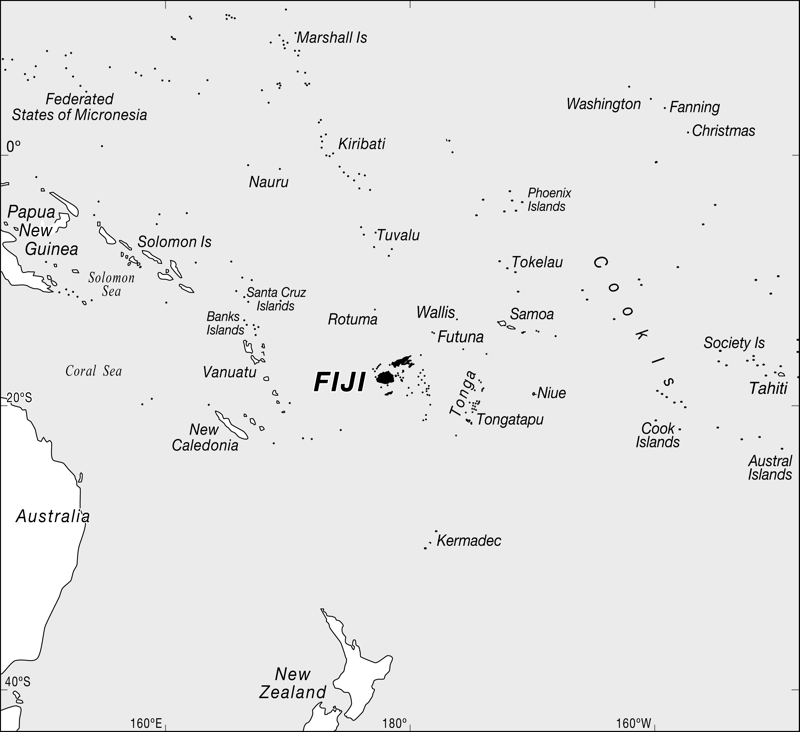
Map 1. Map of the Pacific Islands.
Source: Map production by Education and Multimedia Services, College of Asia and the Pacific, The Australian National University.
But this choice also limited the scope of my work in another sense. My concentration upon the urban setting meant that I was in contact with women’s groups who travelled to rural settings for consultations, network meetings, or for performances of drama and film, but ultimately I had limited engagement with women’s organisations located outside Fiji’s principle urban areas or the on the country’s remote islands.10 The scope of the study was also limited by my conscious decision not to consider in detail the activities of women’s unions. In certain instances, I give consideration to the activities of the Fiji Nursing Association in order to demonstrate how questions of women’s labour rights are dealt with in a particular political context and what that might suggest about how women’s rights claims are received at the institutional level and amongst policy elites. For the most part, however, I have considered the activities of women’s labour associations only when they have intersected with women’s organisations promoting women’s rights more generally, a research strategy which, in part, reflects a decision not to duplicate the efforts of researchers who have already done important work on the issue of women and labour in Fiji such as Jacqueline Leckie (2002, 2000a, 2000b, 1997), Claire Slatter (1987), ‘Atu Emberson-Bain (1992, 2001) and Christy Harrington (2000, 2004).
In addition to these general research limitations, the act of authorship means that, in the final instance, this ‘situated history’ of Fiji’s gender politics reflects my own ‘face to face’ learning choices regarding the ordering of information, and privileging of testimonies. The admission of limitations within this ‘situated’ history should not be viewed as a claim to historical relativism, which as Donna Haraway argues, implies a promise of vision from ‘everywhere and nowhere’ and a ‘denial of responsibility and of critical enquiry’ (Haraway 1991: 191). Situating this history does not preclude the construction of broader conclusions, nor does it detract from their critical value; it simply acknowledges the partial quality of these claims (Haraway 1991). As a result, the final conclusions I draw should be read in this vein, for they are tendered not as reductionist, absolute or verifiable truths, but as critical contributions to an ongoing conversation about women’s political agency in the Pacific Islands and beyond them. To this end, I also envisage that this is a cross-disciplinary contribution reflecting the fact that the construction of this ‘situated history’ has required close consideration of factors such as Fiji’s geopolitical location, colonial legacies, and socio-cultural environment. In addition it has drawn upon a diverse range of academic literatures which span international relations, political science, development studies, gender studies, Pacific history and Pacific anthropology.
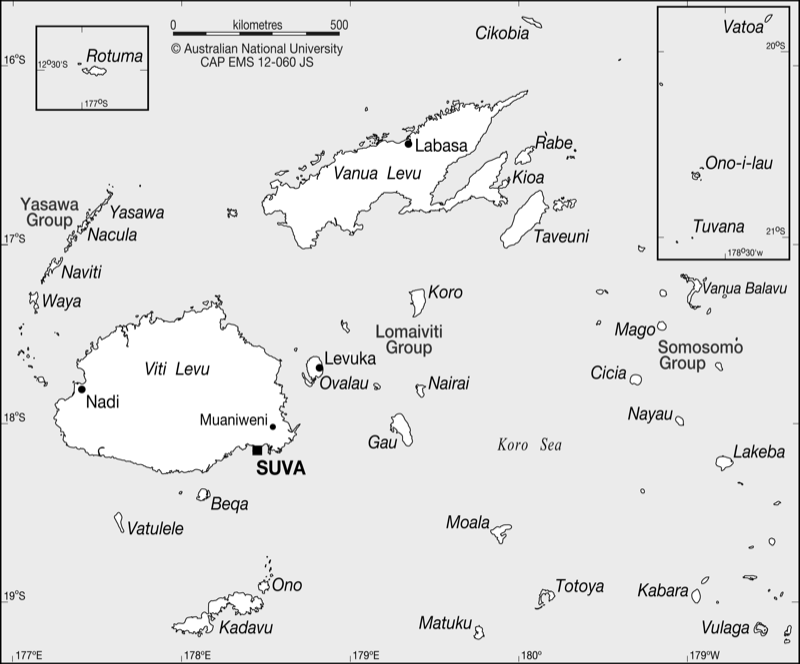 Map 2. Map of the Fiji Islands.
Source: Map production by Education and Multimedia Services, College of Asia and the Pacific, The Australian National University.
Conclusion
This book provides an account of the history of women’s organising in Fiji. It pays particular attention to the ways that global and local political influences contour the spaces for gender advocacy and, consequently, activists’ negotiations of collectivity, progress and transnationalism. Detailed consideration is given to the interactions that take place amongst women’s organisations and between this sphere of political activity and the broader institutional realm, with ongoing attention paid to the prevailing political conditions which shape these interactions. Through examination of the varying trends that have been evident in women’s organisational activity in this setting since the 1960s, this study provides a clear indication of the ways that domestic and international contingencies can shape the political space available to women’s organisations and the implications this can have for their political agency.
The following chapter provides a more detailed theoretical discussion of women’s political agency and the relationship between political capacity and contingency. It provides a critical reading of reform- and resistance-oriented accounts of women’s organising. From here, it draws upon a smaller body of work undertaken by scholars such as Jude Howell in China, Aili Mari Tripp in Africa and Nadje Al-Ali in the Middle East, to demonstrate the analytical gains which occur when women’s advocacy is assessed in ways that eschew ‘ideal-types’ and pays more attention to context. Again the themes of collectivity, progressive ideas and transnationalism provide the conceptual framework for this discussion. I show why it is important to develop a ‘situated’ understanding of the presumed ‘standard features’ of women’s organising and how they may in fact broaden the contours of varied socio-political environments. At various points in this discussion, I relate these points back to the Pacific Island context. Here I demonstrate how and why a focus on contingency is vital to understanding the organisational terrain of gender politics in Fiji and the broader Oceanic Region.
Chapters 2 to 6 provide an empirically focused investigation of the terrain of gender politics in Fiji since the 1960s, with each roughly structured to reflect a ten-year period. Discussion in the first part of each chapter examines how women’s organisations have negotiated prevailing domestic, regional and international political influences during this period. Each chapter concludes with a more thematically driven analysis of women’s organisations’ negotiations of collectivity, progressive ideas and transnationalism and draws attention to the impact of prevailing contextual factors in each of these regards.
Chapter 2 describes the early work of women’s community development organisations and the important leadership role for women played by the Fiji YWCA in the 1960s to the mid-1970s. Here I also describe how women’s organisations were able to articulate locally provocative agendas of reform in the immediate pre- and post-independence political environment. Chapter 3 is devoted to developments occurring within the sphere of women’s organising at the local, regional and international levels during the United Nations Decade for Women and describes how the initial importance of redistributive issues in local gender politics began to give way to a new style of gender advocacy organisation which was more issue-focused. Chapter 4 concentrates upon the period 1985–1995 when issue-focused women’s organisations flourished but also struggled for formal recognition in a local political environment which was less receptive to provocative articulations of gender advancement than was evident in earlier periods. Chapter 5 examines the situation from 1995 until 2003. Here I describe how the initial period of domestic political reform in the mid-1990s appeared to provide great scope for gender advocacy but ultimately dissipated in the wake of the 2000 coup. The ensuing rise of ethno-national allegiance which followed locally in the wake of this event was coupled with the regional and global predominance of neoliberal approaches to development which together created a restricted environment for activists aiming to promote reform agendas. Chapter 6 examines how the realm of women’s advocacy fared in the political environment leading up to, and following, Fiji’s 2006 coup. While it describes the civil society divisions which have again challenged the women’s movement locally in the wake of the coup, it also discusses the emergence of an introspective and self-reflexive mood amongst women advocates. This has led to the broadening of formerly narrow issue-specific advocacy agendas and new interest shown in the promotion of peace and global economic justice. In the conclusion, I reiterate some of this study’s most important findings and demonstrate the gains in understanding which have resulted from taking a situated approach to the study of women’s political agency in Fiji. I also consider how these findings contribute new insights into broader academic debate taking place on the place of civil society in global politics.
1 This quote, drawn from a collection of Hawaiian language proverbs edited by Mary Kawena Pukui, is originally cited by Teresia Teaiwa in her article tracing the evolution of Pacific native cultural studies entitled ‘Lo(o)sing the edge,’ which appeared in The Contemporary Pacific in 2001. Teaiwa’s discussion of academic frames of reference and analytical perspectives is particularly relevant to the methodological approaches adopted in this book (Teaiwa 2001: 343).
2 Jindy Pettman has made this claim primarily in relation to states; however, a wide range of feminist scholarship demonstrates that this claim can be extended to also include international multilateral organisations. A contemporary diffusion of gender equity norms may be apparent within the rhetoric of global governance, yet, as this scholarship attests, formal political institutions continue to function in ways which contribute to women’s political and economic subordination (Pettman 1996; Elshtain 1981; Grant 1991; Peterson 1992; Goetz 1997; Tinker 1999; Rankin 2002; Peterson and Runyan 2010; Parpart and Zalewski 2008).
3 A conscious play on the title of the book Making Women Matter by Hilkka Pietilä and Jeanne Vickers (1996) which discusses how women have shaped gender policy within the United Nations.
4 This perspective of regional Pacific Island affairs, although largely persuasive in Australian and New Zealand policy-making circles, has been roundly critiqued by eminent regional scholars such as David Chappell 2005: 290; Greg Fry 1997, 2000; and Jon Fraenkel 2004.
5 For a critique of this scenario and a discussion of the constructive role women can and should play in the achievement of regional security see George 2011.
6 In 2001, these issues had again been brought to a head as Pacific Islands activists voiced strong opposition to the Australian government’s ‘Pacific Solution’ to illegal immigration which involved transferring over 800 asylum seekers entering Australia to neighbouring Pacific Islands states. These states were then paid by the Australian government to house, clothe and feed the deported asylum seekers, and process their claims for refugee status. These policies were identified by critics in the region as reflecting a coercive and opportunistic approach to regional security issues in Australia and were intensely debated amongst many activists when I visited Fiji in 2002. I was left with little to say in response to the accusation I faced from one young NGO representative that these events were indicative of an Australian tendency to engage with the Pacific Islands region only in a self-serving manner.
7 In 1973, Elizabeth Reid was appointed as advisor on women’s affairs to the Australian Prime Minister, Gough Whitlam. It was the first bureaucratic position of this type created in the world. Reid presided over government events to mark International Women’s Year in 1975 and also led the Australian Delegation to the UN Women’s conference of that year staged in Mexico City (Caine et al. 1998: 481).
8 This situation altered in April 2009 when the Bainimarama-led military government placed its own officials inside the country’s newsrooms to monitor reporting of national issues. This policy of news censorship has shut down public political debate in the mainstream media with the result that newspaper reporting has become much ‘safer’ and less critical in the intervening years.
9 A large number of regional institutions are located in Suva which brings together representatives from Pacific Islands communities across the region. The city’s central location within the Pacific Islands region has made it home to the Pacific Islands Forum Secretariat, the Community Education and Training Centre which provides training in development to Pacific Islanders, the University of the South Pacific, the Pacific Theological College and the Pacific Regional Seminary of the Roman Catholic Church. In addition, the regional importance of Suva has also been noted by international agencies such as the International Labour Office (ILO), the United Nations Development Program (UNDP), and the United Nations Development Fund for Women (UNIFEM), all of which have regional offices established in Fiji’s capital. Likewise influential regional non-government organisations such as the Pacific Concerns Resource Centre (PCRC), the Regional Rights Resource Team (RRRT), Pacific Islands Network on Globalization (PANG), and the Foundation of the Peoples of the South Pacific, also use Suva as their base.
10 My research did take me to the south of Vanua Levu (Fiji’s ‘second’ island) and the neighbouring island of Taveuni.



