


 menu
Ted Freeman and the Battle for the Injured Brain
4. Emergence from coma after brain injury: Freeman’s contribution
This chapter discusses the initial events during emergence from coma and the ongoing strategies that Freeman adopted to facilitate this. In each case, it is intended to recount the story of his contribution to the advancement of recovery at these two stages of the process, whenever possible, using his own words.
As a background, the beliefs and practices inherent in managing comatose patients in the early 1980s are touched on. The inferences drawn by Freeman, acting on the basis of observation, to shorten the duration of coma, are examined in the light of studies employing brain scanning to study consciousness, a quarter-century later. In more than one instance, his empiricism will be seen to have been remarkably prescient.
Imposing a distinction between initial emergence from coma when a person is recovering from brain injury and subsequent improvements in the level of awareness and ability to engage in everyday activities may be biologically artificial. The distinction, however, is useful, even though emergence and subsequent improvement could essentially be parts of a continuum, as the differing management considerations, traditionally prevailing, justify their consideration in separate chapters.
Whilst Australian mainstream teaching and practice in the 1980s held that early intervention with the intention of expediting the emergence of patients with brain injury from coma was pointless, the medical literature was not lacking in suggestions that there could be advantages in alternative approaches. A 1968 review by Carl Carlsson and colleagues in the Journal of Neurosurgery identified a consistent association between the length of time during which a person remained in coma and the eventual level of recovery.1
It has not been possible to apportion causation when attempting to interpret this association. Furthermore, the nature of the observed association was not necessarily similar in all the cases reviewed by Carlsson et al. According to one interpretation, the duration of coma may be entirely a reflection of the severity of the initial traumatic damage. An alternative interpretation is that prolongation of coma might aggravate the initial damage. If this second explanation gains acceptance as applicable in some cases, interventions intended to shorten the period of coma can be considered.
Ideally, it would be preferable to identify in advance those cases in which intervention would be worthwhile. On the other hand, if there is nothing to suggest that intervention might introduce risks to any patient, identification of those who are most likely to benefit becomes less important; however, it might be argued that, notwithstanding the minimal likelihood of risk to the individual subject from early intervention, its general application might incur a waste of limited health system resources.
On the assumption that little can be achieved in the process of rehabilitation until a patient has emerged from coma, a distinction has commonly been drawn between measures appropriate in the management of a comatose patient and those to be adopted after emergence is first observed. For instance, Jacquelin Perry differentiated between measures to be adopted whilst a patient remains in coma and unresponsive, and those which might profitably be instituted at a later stage. Referring to the first stage, she advised that ‘[p]reventive rehabilitation is designed to minimise the complications of inactivity that tend to develop during a protracted curative process (contractures, pressure sores, muscle atrophy, cardiopulmonary deconditioning, cognitive dulling)’.2 She recommended that when the patient became responsive (or, more correctly, when such responsiveness was first observed by others), a new strategy be adopted.
A view contrary to that of Perry’s—namely, that active attempts at rehabilitation are both worthwhile and indicated whilst patients remain comatose—found support, at least in some US clinics, around the same time. For instance, among the contributors to a 1983 issue of the journal Physical Therapy, which was entirely devoted to the subject of head injury, Danese Malkmus wrote in the following terms of strategies that physical therapists might adopt in the earliest stage of recovery:
[T]he physical therapist is in an ideal position to address not only physical management concerns, but the individual’s depressed state of responsiveness. A sensory stimulation program may be constructed and taught to nursing personnel, family members and others having patient contact during the acute phase. Stimulation that may increase intracranial pressure, however, should be avoided.3
A caveat was added: ‘Physician consultation and approval should be obtained before implementing a program.’ Danese Malkmus, the author of the article, was co-director of the Head Injury Center at Hyannis, USA. Significantly, Freeman visited Hyannis in 1983 during the course of development of his approach to brain injury and was impressed by the centre.
The Glasgow Coma Scale
In any study of coma, it is necessary to agree on some scale of measurement of its depth if comparisons with the observations reported by others are to become possible. Similar considerations apply to the individual patient when the attending medical personnel wish to compare examinations undertaken at different times and so formulate estimates of progress in recovery.
The Glasgow Coma Scale (GCS) was devised by two leading neurosurgeons in the United Kingdom, Professor Graham Teasdale and Professor Bryan Jennett.4 A measurement of the depth of coma provides a baseline with which subsequent examinations could be compared. The GCS is set out in Table 4.1.
Table 4.1 The Glasgow Coma Scale
|
Eyes |
|
|
|
Open |
Spontaneously |
4 |
|
|
To verbal command |
3 |
|
|
To pain |
2 |
|
No response |
|
1 |
|
Best verbal response |
|
|
|
|
Orientated and converses |
5 |
|
|
Disorientated and converses |
4 |
|
|
Inappropriate words |
3 |
|
|
Incomprehensible sounds |
2 |
|
|
No response |
1 |
|
Best motor response |
|
|
|
To verbal command |
Obeys |
6 |
|
To painful stimulus |
Localises pain |
5 |
|
|
Flexion-withdrawal |
4 |
|
|
Flexion-abnormal (decorticate rigidity) |
3 |
|
|
Extension (decerebrate rigidity) |
2 |
|
|
No response |
1 |
|
Total |
|
3–15 |
Source: Bryan Jennett & Graham Teasdale (1974) Assessment of coma and impaired consciousness. The Lancet, ii, 81.
The GCS is used throughout the world as a simple assessment measurement and the result of examining a patient can vary from 3 to 15. The factors measured in the scale are
- 1. the extent of eye opening
- 2. the making of sounds or words
- 3. movement in response to touch or pain or voice.
The lowest score (3) indicates that no response has been detected to any stimulus. It may be recalled that the young patient Ian, whose case notes were included in Chapter 2, was scored at three. Patients who are assessed at 8 or below are regarded as being in coma and those at 9 or above are considered to have come out of coma. This does not imply that they are fully recovered—often far from it.
To be aware or not to be?
Freeman’s case notes and the family stories presented above describe many occasions on which patients were referred to as being ‘vegetative’ and predicted to remain in this category.
The defined characteristics of the vegetative state and the persistent vegetative state (PVS) are similar. The only distinction is the duration of the state. The US Multi-Society Task Force on PVS summed it up: ‘By definition, patients in PVS are unaware of themselves or their environment.’5 An interesting example of the flexibility accorded by an adaptable acronym has been the later substitution of ‘permanent’ for ‘persistent’ in PVS with consequent implications for management. Recent initiatives to adopt a new terminology, based on observations of cerebral activity in affected patients, will be referred to below.
Notwithstanding the precise definitions attached to the vegetative state by authoritative bodies, it is very likely that the term ‘vegetative’ had frequently been incorrectly applied in the case of people discussed in the earlier chapters. Whether expressed as prolonged unconsciousness, coma or vegetative state, these diagnoses were frequently inaccurate in patients whom Freeman encountered, as also were the predicted outcomes.
The decision by a clinician that some level of awareness is present requires the qualification that this interpretation essentially represents the ascertainment, recognition or detection by that clinician of the presence of some awareness. In essence, the attachment of the diagnosis to any patient reflects not only the actual condition of that patient but also the capacity of the clinical observer to recognise this. Awareness is required on the part of both patient and clinician if it is to be diagnosed. Awareness on the part of the patient is not necessarily accompanied by comparable ability on his or her part to indicate its presence to another individual.
The neural apparatus necessary for awareness and that required for a patient to be able to demonstrate awareness to others are discrete. The former may remain intact whilst the latter is disabled. This occurs typically in individuals who are diagnosed as ‘locked in’. Signs that an aware but immobile person can give may be detectable only by some observers and be manifest only inconsistently. It would hardly be surprising if a locked-in person became extremely frustrated by his or her predicament, a response likely to be manifest in aggressive behaviour.
In the same way that awareness and the capacity to demonstrate its existence to others are not necessarily coexistent, nor are the ability to experience something and the ability to remember it. The discrete nature of experience and memory in individuals who appear to be unconscious has been known for half a century, following the first report by Bernard Levinson of retained awareness by patients under general anaesthesia.6 A large volume of research subsequently on the subject of awareness under general anaesthesia (aided and abetted by legal proceedings instituted by aggrieved patients) has validated its occurrence.
In the circumstances of anaesthetic practice, amnesia was a consequence of ancillary medication. There is, however, nothing to exclude the likelihood that traumatic brain damage in some people may compromise memory to a greater extent than occurs with awareness. Meeting an individual who has regained consciousness and is able to provide an account of events that occurred in the vicinity while in coma provides impressive testimony to awareness retained whilst comatose. That another person, after regaining consciousness, is unable to match this performance does not exclude the possibility that she or he may have had similar experience, albeit not remembered.
Freeman’s experience that the diagnosis of ‘vegetative’ was often not accurate at the time when he met a patient was entirely consistent with conclusions that were increasingly being reported throughout the 1970s and 1980s by clinicians outside Australia.
Whilst the vegetative state was believed to be an entity that could be diagnosed with great certainty, this was becoming increasingly acknowledged not to be so in the early 1990s by some clinicians. A misdiagnosis rate of 37 per cent was reported by Nancy Childs and colleagues among patients referred to a hospital in Texas.7 The American Congress of Rehabilitation Medicine released a statement in 1995 to the effect that knowledge of misdiagnosis of the condition was longstanding, and added, ominously, that the situation was not improving.8 Probably the most influential statement of the situation in the 1990s, reflecting its publication in a widely read journal, was that of Keith Andrews and colleagues. They reported that 17 of 40 patients referred by specialists to the Royal Hospital for Neurodisability with a diagnosis of PVS were not vegetative.9 While it might be contended that these patients had regained consciousness after the original diagnosis was made, the history of ‘prolonged coma’ in all cases renders this an unlikely explanation.
Among the people whom he met who were definitely not vegetative, Freeman considered some to be ‘locked in’. The locked-in syndrome was originally described as an entity with well-defined neuropathological features, and clinical signs corresponding to these, by Fred Plum and Jerome Posner in 1966.10 That original pathological categorisation of affected individuals held that the cerebral cortex remained intact (permitting awareness) but that neural pathways had been interrupted by damage to the brain stem. Subsequently, it was discovered that the pathological features of locked-in patients could be quite diverse and that there was not necessarily a close correspondence between pathological anatomy and clinical features.11
Underlying the diagnostic approach to an apparently comatose person that Freeman developed in the course of practice has been a longstanding concern that the patient may actually be aware although unable to communicate with the examining practitioner—that is, in a locked-in condition as noted above. A quite compelling concern about this was well expressed in a 1980 paper from an Italian neurosurgical clinic:
There always remains some lingering doubt that the patient may have some mental activity which we have simply failed to detect. This doubt is often kindled by claims from those caring for the vegetative wreck on a full time basis that the patient actually makes himself understood in some uncommon or even eerie way.12
Freeman’s success in often detecting indications of awareness when others had been unable to do so may be attributed to at least two factors. First, his manner of approaching the patient and his patience in undertaking a slow and sometimes unorthodox clinical examination seem to be central. Second, his preparedness to accord value to the observations of laypersons who had spent prolonged periods with the patient, usually his or her family. This practice of involving the family extended, whenever possible, to his examination of the patient and could lead to detection of signs of awareness not conceivably detectable in a conventional clinical examination. Roger’s story of response to a cartridge in Chapter 2 exemplifies this well.
A 2009 report from Joseph Giacino and colleagues, based on comparison of observations from rehabilitation clinics and the Cyclotron Research Centre at the University of Liege, drew attention to the disparity between the results of neuro-imaging of unconscious patients and conclusions based on their conventional clinical examination. Having made the point that clinical diagnosis of coma depends upon observation of the patient’s behaviour, the authors emphasised the potential, frequently realised, for misdiagnosis to occur. The factors underlying diagnostic variance between clinical assessment and the results of neuro-imaging (invariably entailing the detection of cerebral activity by imaging when clinical examination failed to do so) were classified by the authors into three categories relating to the examiner, the patient and the environment.
The examining clinician may sample too narrow a range of behaviour, or examine too infrequently and use poorly defined criteria for judging purposeful responsiveness. The patient may have a fluctuating level of arousal, be fatigued and have motor impairment that curtails attempts to respond. Environmental obstacles could include sedation, poor positioning and restraint restricting the patient’s range of movement.13
The frequent disparity observed between clinical and imaging examination of patients led, in a 2010 article from Liege, to a proposal for a change in nomenclature to describe patients in prolonged coma. Having commented on the pejorative connotations implicit in the application of a description as ‘vegetative’, Steven Laureys and his colleagues continued:
[M]oreover, since its first description over 35 years ago, an increasing number of functional neuroimaging and cognitive evoked potential studies have shown that physicians should be cautious to make strong claims about awareness in some patients without behavioural responses to command.
The authors suggested that the expression ‘vegetative state’ could advantageously be replaced with another: ‘unresponsive wakefulness syndrome.’14
Another article from Liege, published in the following year, expanded on the revised nomenclature and the reasons for it:
Some severely brain damaged patients may show residual cortical processing in the absence of behavioural signs of consciousness. Given these new findings, the diagnostic errors and their potential effects on treatment as well as concerns regarding the negative associations intrinsic to the term vegetative state, the European Task Force on Disorders of Consciousness has recently proposed the more neutral and descriptive term unresponsive wakefulness syndrome. When vegetative/unresponsive patients show minimal signs of consciousness but are unable to communicate reliably the term minimally responsive or minimally conscious state (MCS) is used.15
Freeman’s concept, to be discussed below, of a ‘fragile period’ during which (soft) signs of awareness may be inconsistently detectable led to difficulties, and criticism, when attempts were made to conduct a clinical trial of his procedures. This trial will be discussed below. Nevertheless, as with many of the practices for which he attracted criticism in Australia, his thinking was close to that of respected overseas practitioners. For instance, the statement that ‘[f]amily members and others with whom the patient has a close relationship may be able to obtain a response when others have failed’ could have been written by him but was actually suggested by two rehabilitation specialists at the Greenery Rehabilitation and Skilled Nursing Center in Boston.16
Freeman’s account of his life in Chapter 1 recalls the sequence of events that inexorably led to his career commitment of trying to assist people most of whom had been classified ominously as ‘not suitable for rehabilitation’ following brain injury. One of these events, which appears to have been very influential in his later work, was his observation of the extreme care and consideration shown by some experienced and humane US practitioners towards children with severe neurological and mental disabilities. This contrasted with his dismay when he was personally confronted with the ‘mass production warehousing’ of many other children in this category at Peat Island. This consisted, as he has described earlier, of little more than feeding and cleaning of a patient with minimal other human contact and scant regard for privacy, accompanied by environmental deprivation.
An episode that seems to have especially impressed him was the occasion when he observed an American physician, Edward Le Winn, who had practised at the Albert Einstein Medical Center in Philadelphia. Freeman has described this experience:
Dr Le Winn examined children with severe brain injury. He took his time when speaking to the patient and the parents, and he carried out the clinical examination and assessment with great sensitivity and gentleness. Whether Le Winn was correct or not in his method of assessment I couldn’t say, but at least he had an approach. This seemed better than the traditional attitude of doing nothing for these children except admitting them to institutions. During lunch I spoke with the parents and their children. The parents appeared to be normal and realistic people, but there was certainly evidence of hope that something could be achieved for their children.
The family role
The crucial role that families played, under Freeman’s direction, in recovery from severe brain injuries will have been evident already in the preceding chapters. This family role commenced from the time of injury and took the form of ongoing advocacy accompanying continuing attendance at the patient’s bedside. During the period of unconsciousness, Freeman noted:
The families seemed to have a common story. They had the greatest admiration for the way the intensive care staff had treated their patient and the care given by the neurosurgeons, but they told me the moment the patient was transferred from the intensive care unit to the high-dependency ward, they noticed an enormous drop in the amount of attention being given. They said that in their opinion it appeared that the patient was being ‘parked’, as if waiting for him or her to wake up.
The presence of family members at the bedside of an unresponsive patient with a brain injury is likely to provide an environment that is beneficial. The clinical exploitation of the power of environmental stimuli with particular relevance for the rehabilitation of unconscious children was advocated in a 2009 report on the basis of observations from experiments with animals.17 Having drawn attention to the efficacy of environmental enrichment in promoting neural plasticity and positive functional outcomes when tested in animal models, Paul Penn and colleagues advocated their application to rehabilitation of children with brain injuries.
An indication, based on electrical responses recorded from the patient’s brain, provides objective support for the importance of stimuli with specific relevance to the patient. A 2008 report from a Lyon hospital described the electrical responses in the brain to speaking the specific patient’s name. The patients under examination had remained unconscious for an average period of 20 days following brain injury. In a number of these patients, a unique response was observed to their name.18 All but one of these patients had awakened when assessed three months after brain injury.
It was inferred that exposure to an individual’s name could activate higher-level cognitive functions in some apparently unconscious patients. The authors concluded that, in these individuals, ‘unconsciously perceived stimuli are processed and activate brain areas similarly to consciously perceived’ stimuli. Furthermore, observation of response to the patient’s own name could increase the prognostic value, for awakening, of electrical studies undertaken in the absence of this stimulus.
Any possibility that a family might have gained information that remained inaccessible to medical personnel, presaging a lessening of coma, would often have been discounted in medical assessment. In some instances, information from this source would be disparaged as coming from untrained observers whose interpretation had been coloured by unrealistic hopes of recovery. Disparagement sometimes extended from the families to Freeman’s ideas and ultimately to him as a person. The essential role for patients’ families envisaged by Freeman in a proposed clinical trial became a source of dispute with hospital personnel. It was asserted that the study could be better controlled and its results interpreted if the family role was undertaken by healthcare workers who would employ a uniform stimulation protocol.
The ‘traditional’ medical approach to the person who failed to wake up within a few weeks after brain injury as summarised by Freeman, and his attitude towards this, was as follows:
The traditional medical approach has been to say that the coma has ended when the patient is able to obey a command.19 But many doctors only consider the patient to be out of coma when he or she can consistently obey a command. I regard this requirement as a ‘hard’ sign and I question whether this is an accurate method of assessment. This need for a ‘hard’ sign often causes conflict between the families and the medical profession. The families and friends often observe ‘soft’ signs, which may be a head movement or a movement of an arm or finger or leg or a vocal sound or eye contact or a facial expression. These signs may be inconsistently present. Sometimes the doctors discount these ‘soft’ signs, but nevertheless they are very real to the families.
Freeman’s conclusion that signs of returning consciousness may only be inconsistently observed during the early stages of emergence (characterised by him as ‘soft signs’) did not sit comfortably with the generally accepted idea that only clear-cut signs that could be reproducibly identified at any time by different observers were acceptable as evidence. The concept of ‘soft signs’ could not readily be accommodated within a formal study of emergence—one of a number of obstacles to a trial of coma arousal. As has happened with a number of his conclusions, drawn from empirical observations, his description of ‘soft signs’ during emergence has recently been underpinned by a study from a Mississippi rehabilitation centre.
When introducing the report of this study, the authors note: ‘Published guidelines for defining the ‘minimally conscious state’ (MCS) included behaviours that characterise emergence, specifically ‘reliable and consistent’ functional interactive communication (accurate yes/no responding) and functional use of objects.’20
They note that guidelines had been derived by consensus rather than on the basis of extensive data collection. In their study, some 300 patients were submitted to weekly examinations, repeated on four occasions. Consistent responses were not obtained from many patients in the early stages of emergence. In the light of this it was concluded that ‘[c]onsistent yes/no accuracy is uncommon among responsive patients in early recovery from TBI (traumatic brain injury). These results suggest that the operational threshold for yes/no response accuracy as a diagnostic criterion for emergence should be revisited.’
Freeman has given an account of the conventional examination of a comatose patient:
Often the medical assessment of a patient is like this. Accompanied by the nurse and other staff members, the clinician enters the patient’s room. The clinician questions the nurse as to any changes in the condition of the patient, then checks the patient’s chin, arm and leg reflexes with a small hammer. He then scratches the sole of the patient’s foot to see if the big toe moves up or down. It usually moves up with severe brain injury. He squeezes the patient’s calf muscles, exerting enough pressure to cause some pain, and the patient’s whole body moves. The clinician is then likely to comment, ‘Still showing signs of severe brain injury!’ He feels the arm and leg muscles to check if their tone (tightness) is increased or diminished by grasping the limb and moving it through its range of movement.
The patient may be ‘locked in’ and unable to communicate during any of this time. Other tests may be performed, but the fact that the patient is present as a person may never be acknowledged. The clinician may ask the patient to obey a command such as ‘look at me’ or ‘move your right arm’. When the patient does not respond to this command immediately, the clinician often walks away from the bed, without realising that there is a ‘lag time’ in the patient with a brain injury. This lag time means that even if the patient can understand the request, he is unable to marshal the thought processes necessary to undertake the request quickly. Consequently, the clinician may have already left the room by the time the action takes place and the clinical record is noted ‘no change’.
It is probable that the patients discussed in the two preceding chapters had been formally assessed in a manner similar to Freeman’s description above. It would conform with attitudes to brain injury prevalent in the 1980s. Whereas this strategy more or less placed the burden of proof of any retained or regained awareness on the patient, Freeman’s approach was to transfer this burden onto the examining practitioner, assisted by family members. This obliged the observer to seek evidence of awareness, perhaps ‘soft signs’ that could not be consistently demonstrated, and to give credence to family-sourced descriptions of these, which were to be followed up. In the case of patients for whom no family members were accessible, Freeman’s strategy was severely restricted.
Accompanying the ‘conventional’ medical position that a regular neurological examination would suffice to exclude the possibility of retained or regained awareness was the belief that all participants, other than the patient, were spectators of any recovery process. It followed that any attempts to assist or to expedite the return of awareness were, by definition, pointless.
Freeman’s observations on what was done with patients who remained comatose after brain injury and his thoughts on what could be done led him to develop an examination protocol. His description of this follows:
When assessing a patient in coma I took a totally different approach to the clinical method described above. I took the view that the family was my most priceless resource for they provided the loving bridge that enabled me to gain information about the patient and I found them to be extremely reliable. This approach is not new. I was taught this in medical school. Sir Lorimer Dodds, a superb clinician and the Senior Physician at the Royal Alexandra Hospital for Children in Sydney, taught us to observe these maxims when assessing a child who cannot speak for himself—‘Always listen to the mother … It is a foolish doctor who does not take notice of what the mother says … More things in medicine are missed by not looking rather than not knowing.’
Three important aspects that he regarded as critical in the way in which he approached the examination of any patient were characterised as the ‘fragile period’, the ‘approach distance’ and the ‘mantle of safety’. Freeman has described the origins of his concept of the ‘fragile period’:
After studying the Glasgow Coma Scale, like many others, I soon realised that the measuring components of eye opening and the making of sounds had problems. Often, to measure eye opening was invalid because the patient had injuries to the eyes or to the nerves of the eye, and the making of sounds was often impossible as a tube had been inserted through the vocal cords into the trachea.
I consider the most important steps in the assessment of returning awareness is first measured by the reaction of the patient to touch and pain, two of the most fundamental sensations. This regaining of awareness can be charted using the following method:
1. No response to pain places the patient at the lower end of the scale.
2. A reflex response whether of extension (straightening) or flexion (bending) of an arm or leg in response to a painful stimulus being applied is the next step up.
3. The reaction of withdrawal of the limb or body from pain stimulus.
4. Localising to a painful or touch stimulus places the person at a higher level of response again. (Localising means that when a stimulus is applied to a part of the body, the eyes and/or head will turn to that stimulus or the hand will move towards it.)
5. Discrimination—at the highest level, occurs when the brain picks up the stimulus and begins to recognise it.
I have called the period B-C, between initial awareness and ‘normal’ awareness, the ‘fragile period’.
Figure 4.1 The ‘Fragile Period’
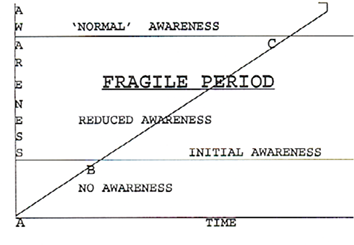
The period A-B theoretically and for practical purposes indicates the vegetative state or an absolute and total ‘locked-in state’. During this time there is no evidence of any reaction to a stimulus. Obviously, many patients pass through this stage before they reach a point of initial awareness or move out of the ‘locked-in state’.
C indicates the obeying of a command. This passage from B to C through the fragile period must be like a person looking up from the bottom of a swimming pool. At the bottom, all is blurred and familiar objects such as the pool steps are difficult to recognise. As the swimmer moves closer to the surface, objects become more distinct and recognisable. It is similar with the person arousing from coma. The patient may have some awareness but in the early stages it is vague and unclear. This fragile period also means that because the person has some awareness he can be emotionally hurt by insensitive comments at the bedside and by painful treatments. The person may also be aware that his personal space has been violated by nasogastric tubes and tracheostomy tubes, and it is very likely that the person is in a state of sensory deprivation.
The patient, while considered by some members of the medical profession to have no awareness, may have a significant amount of awareness. In my opinion, this passage from initial awareness to the conscious state can be clarified by close observation. The families who have spent time with the person they love and have observed the ‘soft’ signs are the ones who can generally indicate to the doctor when the patient has begun to travel up through these definite levels of awareness. Other specific indicators of awareness are the facial expressions of the patients, which when appropriate to the environment can demonstrate consciousness—for example, smiling when jokes are told, anxiety at unpleasant experiences, sadness when families indicate they are leaving. These may constitute a ‘cluster of soft signs’.
I am extremely conscious of the need to safeguard a person’s ‘approach distance’, especially when that person is totally incapable of defending him/herself and will rapidly go into a stress reaction with its ‘fight, freeze or flight’ pattern. I am aware that the totally dependent person who can neither fight nor take flight will freeze and give the observer a mistaken impression that they are not aware when they may be fully conscious and locked in. This is especially so if the person has had gross violation of their intimate space by catheters, a tracheostomy tube, and abdominal or chest drains.
I always provided ‘a mantle of safety’ for the patient. This term was used by the Reverend John Flynn, founder of the Australian Inland Mission and the Royal Flying Doctor Service, when referring to the isolation and lack of support for people living in the Australian outback.
Freeman’s account of the examination process was as follows:
To start an assessment, I always met with the family in a room away from the patient and sat down with them to explore what they had observed in the patient. I explained that they were not in a court of law and did not all have to agree on what they had seen or felt. I pointed out that if the patient was truly vegetative none of them would have seen any normal reactions. I also pointed out that if the patient was aware then he would react more to them than to any other person since he would know that they were his loved ones, and they as family would be infinitely more aware of the patient’s reactions than any doctor or nurse, since they were the ones who knew him best and were spending far more time with him than any professional could.
A very structured set of questions was developed by Freeman to present to family members:
1. Vigilance: Why do you believe the patient is awake? Does he know you are present? Why do you think that? Does he react to different people in the family? Does he react to one nurse more than the others? Does he react when his environment is changed?
2. Emotion: Does he show facial expressions indicating anxiety, fear, anger, pleasure, disgust, and so on? Is this appropriate? For example, does he show sadness and have tears in his eyes as you say you are about to leave? Does he show fear when the suction apparatus is switched on? (The suction in these patients is often carried out by a long plastic tube introduced into the endotracheal tube, which has been placed in the trachea. The tip of the sucker often hits the tracheal wall and causes a great deal of coughing and distress to the patient. If the patient shows fear when it is turned on it also indicates he has memory and anticipation. Both are higher cortical functions of the brain. Sometimes other apparatus such as the floor polisher can cause a similar sound to the suction tube and the patient may react in a similar way, showing fear.)
3. Drive: Can you get any actions from the patient by asking him? No matter how slight the actions, can they be repeated?
I then ask about the senses of vision, hearing, touch, taste and smell before moving on to asking what the patient can do with movement of the head, body, arms, hands and legs, and so on. I always allowed enough time for all the family members to put forward their personal views.
Some of my colleagues viewed everything the families said and all their positive offerings as ‘wishful thinking’ or ‘unreal hope’, but I found most families to be enormously truthful, honest and realistic. Their observations, made over many hours of sitting with the patient, provided me with valuable information, which then gave me an excellent idea of whether the patient was showing signs of awareness or not, and what the patient could and could not do. In my experience, rarely did a family member report observations that were obviously exaggerated or impossible.
In an inquiring and prolonged manner, I gathered the details needed for my assessment protocol. When it was time for me to examine the patient I always asked the two closest members of the family to go into the patient and state the following: ‘Doctor Freeman is coming in to see you. We will be with you for all the time he is here. He will not hurt you. He will tell you beforehand if he is going to touch you.’ By this method, I surrounded the patient with people who loved him and would ensure that nothing would be done to hurt him. This took away the ‘inward flight’ and allowed the patient to open like a flower.
Upon entering the room, I introduced myself to the patient: ‘My name is Ted Freeman. I will tell you if I am going to touch you. I will not hurt you.’ Often I would ask the patient, ‘Would you like to shake hands?’ I would stretch out my own hand. It was amazing how frequently the so-called vegetative patient would attempt to reach out for my hand. I would never do anything to the patient until I had first asked a member of the family to carry out a series of tests. I would tell them what to do and I observed the reactions of the patient.
Fortuitously, Freeman’s regular practice of using a family member as a ‘proxy’, if at all practicable, when physical contact with a patient was to occur, enabled him to undertake a worthwhile examination on those occasions when he had only been permitted to visit by the medical ‘custodians’ on condition that he was not to touch the patient. In more extreme examples of custody, Freeman was precluded from visiting the patient. His account continued:
Almost invariably at the end of my time with the patient, often in excess of three hours, the family would say in surprise: ‘No doctor has ever sat with us before and asked us those questions or sought our opinion like you have.’ Or: ‘You are the only doctor we have met who seemed to know what to do.’ It was by using the families as the bridge to the patient, by learning of their knowledge and by using an extended assessment time that the true state of the patient could be properly gauged. After nearly 20 years of involvement with patients diagnosed as PVS, my estimate is that approximately 90 per cent of those patients showed evidence of awareness and were not vegetative.
In each stage we found that the families were more skilled at identifying responses to a stimulus because of the bond of trust and love that existed between themselves and the patient.
We also found that other factors could have an important bearing on the patient’s response to a stimulus, such as the time of the day: generally patients responded better in the morning than the evening. Constipation and also the febrile state could cause the patient to feel listless, causing the responses to vary, as could the failure of a good rapport between the assessor and the patient. But these factors tended to be difficult to quantify and qualify.
The Coma Exit Chart
Whilst the GCS is a valuable way of assessing the depth of any patient’s coma, Freeman believed that it lacked the sensitivity necessary to detect very early indications of awareness. This may not have been a concern if the treating practitioner adhered to the belief that everyone caring for the patient was a spectator witnessing an event the progression of which they had no ability to influence. On the other hand, if one believed that the possibility existed of favourably influencing the rate and ultimate extent of that progression then the availability of some method to monitor it would be a powerful ancillary tool in assisting both. On any assessment, Freeman deserves credit for initiating the development of a strategy to monitor emergence, especially when this was slow and irregular. He developed the Coma Exit Chart, described as follows:
With an input from the observations of families of patients, together with my own observations, I formulated the ‘Coma Exit Chart’. This chart has been modified in the United Kingdom to form the Sensory Modality Assessment Rehabilitation and Treatment (SMART) tool.21
Commenting on the value of the chart and the study preceding it, Dr Sarah Wilson, Senior Lecturer in the Department of Psychological Medicine of the University of Glasgow, wrote:
As a psychologist with over twenty years’ experience of working with individuals who have suffered very severe brain injury including those with a diagnosis of vegetative state, I have found Dr Freeman’s work to be an invaluable contribution to helping both patients and their families.
I have recommended both his books The Catastrophe of Coma: A Way Back and Brain Injury & Stroke: A Handbook to Recovery to colleagues and patients’ relatives. I routinely incorporate Dr Freeman’s Coma Exit Chart in my assessment of patients diagnosed as being in a vegetative state (including use within a medico-legal context) and I regularly recommend its use to colleagues. Dr Freeman is recognised internationally for his expertise. His work has generated further research and is undoubtedly of benefit to patients with severe brain injury.22
The Coma Exit Chart has exerted a significant influence on the development of a tool for assessment of comatose patients in many overseas clinics. Thus, Dr Keith Andrews, Director of Medical and Research Services, Royal Hospital for Neurodisability, London, has written:
Dr Freeman has made a considerable contribution to the understanding of, and attitude to, people with profound brain damage, especially those in the vegetative state. His book The Catastrophe of Coma has been recommended by us to numerous relatives of patients in the vegetative state and they have found it illuminating, practical and supportive. Dr Freeman’s work was the stimulation and basis of our research into the vegetative state and the development of the Sensory Modality Assessment Rehabilitation and Treatment tool (SMART) which is now the standard for assessment in brain damage in the UK.23
Other modifications and refinements have followed—for example, an Italian version has been developed, written by the lead author of the Cochrane Review of coma arousal reports, which will be considered later when discussing a clinical trial of Freeman’s procedures.24
To conclude this account of Freeman’s approach to improving the situation of comatose patients, it is appropriate to quote from an article in which he listed six major changes that he advocated. These concerned both the practices of clinicians managing individual patients and the manner in which the healthcare system could improve their condition:
1. Trial of therapy
In an effort to increase the level of awareness of the patient, I would advocate a trial of therapy. Trials of therapy are common in medicine when the outcome of the disease process and the optimum type of treatment are unknown.
In this course of action the disease process is first defined and the therapy, whether drug or physical therapy, is applied for a trial of weeks or months or longer to observe whether it has changed the likely outcome. During this time the patient is closely monitored to ensure there are no disadvantageous events.
Since the patient with severe brain injury is in a state of sensory and emotional deprivation, a structured input of sensory stimuli can be devised for each person depending upon their position on the SMART test.
Emotional deprivation must be regarded as a constant state, and monitoring of the stimuli must be continuous to ensure that the maximum amount of positive stimulation is given. Negative stimuli are inherent in a hospital environment and often an essential part of the treatment. Steps should be taken to make certain that unnecessary negative stimuli are reduced to a minimum.
2. Coma Care Units
A Coma Care Unit is the optimum place in which to conduct the trial of therapy. These units should be similar to coronary care units, intensive care units, burns units, spinal units etc. This would allow intensive research into the process of the arousal from coma and the problems of treatment, with protocols automatically undergoing change and improvement as the knowledge of brain injury increases.
Since the long term costs of severe brain injury are high, the gains made with the increasing knowledge about patient response and outcomes would offset these costs.
3. Coma Register
The patients and the medical profession would benefit from a Coma Register. Since no one knows how many patients survive severe brain injury or remain in coma two weeks post trauma, it is essential to know the size of the problem. (Two weeks in coma is a marker time of great importance since it was (is) considered that the outcome of the injury is likely to be poor).
4. Coma Care Review Committee
At the time of notification to the register, a special committee called the Coma Care Review Committee consisting of both professionals and relatives (if available) would assess the patient and then monitor the treatment and progress of the patient. The flow of patients from the Coma Care Unit would be to home for domiciliary rehabilitation if possible, otherwise to a Special Facility. The decision making process at this point would be the responsibility of the Coma Care Review Committee in conjunction with family members.
5. Special Facility for Patients Diagnosed as ‘Locked In’ or Vegetative
There will always be patients who demonstrate awareness but fail to progress or do so very slowly and are classified as in the ‘locked in’ state. It is important to have a suitable facility for provision of their needs. Every effort must be made to initiate muscle function and improve communication so they can gain a level of independence and make known their needs and wants. A constant process of monitoring to change programs will be required.
6. Long Term Review Committee
It is essential that a Long Term Review Committee be established so that the people in the Special Facility are not cut adrift from the medical and educational systems. They should be assessed by knowledgeable people at set intervals or on request. If there are signs of improvement a new program should be structured to suit their particular needs.25
Conclusion
Ted Freeman has made a significant contribution to understanding the process of regaining consciousness following brain injury and to the clinical recognition of that process. This contribution was largely based on two practices—namely, paying attention to the observations reported by patients’ families, and developing a strategy for patient examination that provided the best environment for detecting early signs of awakening.
In order to afford the best chance of gleaning information about a patient’s current status, Freeman used an exhaustive protocol for questioning family members. This drew his attention to manifestations of awakening that were observed only inconsistently, which he described as ‘soft signs’. Recognition and acceptance of the importance of these soft signs stimulated the development of his Coma Exit Chart, which facilitated documentation of awakening from coma and so complemented what the Glasgow Coma Scale had done for assessing the depth of coma.
Freeman’s insights into unconsciousness occurred at a time when there was increasing recognition internationally that misdiagnosis of the vegetative state—attributable to failure to detect subtle signs of consciousness—was common. Because he paid considerable attention to the reported observations of ‘untrained observers’—namely, patients’ family members—and because he spent prolonged periods examining patients, with assistance from family members, many of his colleagues rejected his conclusions. Recently, objective evidence supporting many of his conclusions has become available as a result of refinements in scanning of brain activity. These include recognition of brain activity in patients diagnosed as unconscious and the salience of environmental cues with personal significance in eliciting brain activity. An approach to assessing Freeman’s impact on clinical practice is described in Chapter 8.
1 Carl Carlsson, Claes von Essen & Jan Lofgren (1968) Factors affecting the clinical course of patients with severe head injuries. Journal of Neurosurgery, 29, 242.
2 Jacquelin Perry (1983) Rehabilitation of the neurologically disabled patient: principles, practice and scientific basis. Journal of Neurosurgery, 58, 799.
3 Danese Malkmus (1983) Integrating cognitive strategies into the physical therapy setting. Physical Therapy, 63, 1952.
4 Bryan Jennett & Graham Teasdale (1974) Assessment of coma and impaired consciousness. The Lancet, ii, 81.
5 Multi-Society Task Force on PVS (1994) Medical aspects of the persistent vegetative state. Part 1. New England Journal of Medicine, 330, 1499.
6 Bernard Levinson (1965) States of awareness under general anaesthesia. British Journal of Anaesthesia, 37, 544.
7 Nancy L. Childs, Walt N. Mercer & Helen W. Childs (1993) Accuracy of diagnosis of persistent vegetative state. Neurology, 43, 1465.
8 American Congress of Rehabilitation Medicine (1995) Recommendations for use of uniform nomenclature pertinent to patients with severe alterations in consciousness. Archives of Physical Medicine and Rehabilitation, 76, 205.
9 Keith Andrews, Lesley Murphy, Ros Munday & Clare Littlewood (1996) Misdiagnosis of the vegetative state: retrospective study in a rehabilitation unit. British Medical Journal, 1313, 13.
10 Fred Plum & Jerome Posner (1966) The Diagnosis of Stupor and Coma. F. A. Davis, Philadelphia.
11 Joseph S. Karp & Howard I. Hurtig (1974) ‘Locked-in’ state with bilateral mid brain infarcts. Archives of Neurology, 30, 176; James R. Patterson & Martin Grabois (1986) Locked-in syndrome: a review of 139 cases. Stroke, 17, 758.
12 Albino Bricolo, Sergio Trazzi & Giannantonio Feriotti (1980) Prolonged post-traumatic unconsciousness. Therapeutic assets and liabilities. Journal of Neurosurgery, 52, 625.
13 Joseph T. Giacino, Caroline Schnakers, Diana Rodriquez-Moreno, Kathy Kalmar, Nicholas Schiff & Joy Hirsch (2009) Behavioural assessment in patients with disorders of consciousness: gold standard or fool’s gold? Progress in Brain Research, 177, 177.
14 Steven Laureys, Gastone G. Celesia, Jan Lavrijsen, Jose Leon-Carrion, Walter G. Sannita, Leon Sazbon, Erich Schumutzhard, Klaus R. van Wild, Adam Zeman & Guiliano Dolce (2010) Unresponsive wakefulness syndrome: a new name for the vegetative state or apallic syndrome. BMC Medicine, 1, 68.
15 Marie-Aurelie Bruno, Audrey Vanhaudenhuyse, Aurore Thibaut, Gustave Moonen & Steven Laureys (2011) From unresponsive wakefulness to minimally conscious PLUS and functional locked-in syndromes: recent advances in our understanding of disorders of consciousness. Journal of Neurology, 258, 1373.
16 John Whyte & Mel B. Glenn (1986) The care and rehabilitation of the patient in a persistent vegetative state. Journal of Head Trauma Rehabilitation, 1, 1.
17 Paul Penn, David Rose & David Johnson (2009) Virtual enriched environments in paediatric neuropsychological rehabilitation following traumatic brain injury. Developmental Rehabilitation, 12, 32.
18 Catherine Fischer, Frederic Daillier & Dominique Morlet (2008) Novelty P3 elicited by the subject’s own name in comatose patients. Clinical Neurophysiology, 119, 224.
19 Editorial (1981) Outcome of traumatic coma. The Lancet, ii, 507.
20 Risa Nakase-Richardson, Stuart Yablon, Mark Sherer, Clea C. Evans & Todd G. Nick (2008) Serial yes/no reliability after traumatic brain injury: implications regarding the operational criteria for emergence from the minimally conscious state. Journal of Neurology, Neurosurgery and Psychiatry, 79, 216.
21 Edward Freeman (1993) The clinical assessment of coma. Neuropsychological Rehabilitation, 3, 139; Edward Freeman (1996) New methodology. The coma exit chart: assessing the patient in prolonged coma and the vegetative state. Brain Injury, 10, 615.
22 Sarah Wilson, Letter to Freeman, April 2002.
23 Keith Andrews, Letter to Freeman, May 2002.
24 Francesco Lombardi, Giordano Gatta, Simona Sacco, Anna Muratori & Antonia Carolei (2007) The Italian version of the coma recovery scale revised. Functional Neurology, 22, 47.
25 Edward Freeman (1992) The persistent vegetative state—the fate worse than death. Clinical Rehabilitation, 6,159.
Previous Next