


 menu
Black, White & Gold
from protection to competition then isolation
At first the Sudest and the miners did not compete for the resources of the island. The miners worked the gullies and coastal silts, ‘blind-stabbing’ in the shallow water at low tide to recover the alluvial washed out to sea; most of the Sudest stayed close to their villages on the ridges and worked their gardens on the slopes. A few men came down to sell fish and coconuts, but their gardens were too small to allow them to become the main suppliers of food to the miners.
The alliance between the Sudest and the miners was strengthened when the villagers decided to work for the foreigners. From the arrival of Whyte’s party, men took sticks of tobacco for carrying and later they worked on the claims. The use of cheap labour to work alluvial claims was strange to diggers coming from Australian fields, and some found the practice repulsive. They thought it unjust for a miner to use a ‘team’ of labourers to work out a single man’s claim quickly and move on to new ground; they wanted the alluvial fields to be the preserve of white men who began work as equals on their claims of uncertain value. MacGregor excluded Chinese from the goldfields of British New Guinea, but he and most miners eventually agreed that Papuans could choose to shovel alluvial, dig races, and look after sluice boxes on the goldfields of their own land. The Sudest continued the basic economic change which began when the first men had left their villages to work on visiting ships; they added wage earnings to subsistence farming. The Australian miners also underwent a subtle transformation; from independent workers to employers. Still thinking of themselves as battlers, depending on their skill and luck and keeping the corns on their hands, the miners had acquired new interests; wage rates, ration scales and the ‘proper’ relations between a white boss and a Papuan ‘boy’.
The Sudest gave labour and food and tolerated the miners on their lands; the miners provided protection and a means of obtaining trade goods. These were basic and complementary bonds; but other factors caused minor clashes. The miners came without women and with false beliefs about the availability of ‘native’ women. Perhaps accepting a common belief among settlers of northern Australia, they thought that ‘If you give [an Aboriginal] a stick of tobacco or say a handkerchief of a pretty description, or anything of that sort which appeals to his fancy, he will no doubt let you have the use of his lubra … ’; or they knew of horsemen in outer areas who made a practice of ‘running [an Aboriginal woman] down in the bush and collaring her’; or they were influenced by the fantasy that on the islands the women were gifted with erotic skills and always eager for sexual encounters. But the Sudest men would not pander and the women were restrained by customs and personal obligations not unknown among the wives of Cooktown. Disappointed miners threatened violence and the Sudest responded by hiding their women. A miner entering a village would find only men, and when MacGregor first visited Sudest in October 1888 he saw no young women in the first three or four villages he inspected. It was, he reported, ‘only after they understood something of my official position that I was admitted to any intimacy and shown all the members of each family’. Three years later some villagers on the south coast still kept their women away from the puritanical MacGregor. The men of the area said that the miners were still asking for women but not getting them. Bingham Hely, Resident Magistrate for the Eastern Division, turned the miners’ failure into a virtue. He wrote in his annual report of 1890: ‘never since the commencement of the gold workings in this District have I heard of a single case of tampering with native women’. By 1893 some miners felt obliged to contradict the slightest suggestion that they were the sort of men who pursued island women. Lucien Fiolini, thought to have been an escapee from the French prison on New Caledonia, was killed on Rossel Island. On a tour of the south-east MacGregor met a deputation of six miners on Sudest who presented a list of the deficiencies of his government. They included a request that he withdraw a statement that Fiolini had been killed because he was after women; it reflected on all white men in the area. MacGregor chose not to withdraw.
While the miners won only a distant glance at Sudest women, the Sudest men coveted the possessions of the miners. In camps left unguarded during the day the Sudest had plenty of time to look around and take what they wanted; and the miners blamed the Sudest for everything they lost. Losses of stores and equipment were important to miners struggling to pay for their rations and they complained frequently about the thieving Sudest. Miners emptied their revolvers at ‘these gentry’; a man believed guilty of theft on a previous occasion was found ‘prowling round the camp again, and was promptly shot’; and J. Morrison, a storekeeper, said that one man caught stealing was tied to a tree and given a ‘sound hiding’. John Cameron, a surveyor and prospector whom MacGregor appointed the first warden on Sudest, punished villagers by seizing hostages and cutting down coconut trees: he earned MacGregor’s displeasure for acting illegally and the miners’ praise for being ‘firm handed’.
Two years after the opening of the field, when the number of white miners had fallen to about forty and both miners and villagers knew a lot about each other’s behaviour, two Sudest men killed a miner. Gaiboa, a leading man of southern Sudest, had sent two men to sell some sweet potatoes and coconuts to William Bakem, an old miner working alone near Condé Point. When the men returned with half a stick of tobacco Gaiboa, incensed by the smallness of the payment, told the two men to kill Bakem. They returned, speared Bakem through the chest and hit him with an axe. One of the men, Tamana, visited Bakem again the next day, and finding him still alive, killed him. Immediately the miners learnt of Bakem’s death they burnt some houses as a general punishment, but held the two murderers until a government officer arrived. In January 1891 at a sitting of the Central Court held on the government boat, the Merrie England, Judge Francis Winter sentenced Tamana to death and his accomplice to ten years’ imprisonment. MacGregor reviewed the case in a dispatch to the Governor of Queensland on 28 January 1891:
I have given full & careful consideration to all the circumstances of the case & have come to the conclusion that it is clearly my duty to direct that in this instance the law shall take its course. The natives of [Sudest] have been brought much into contact with white men & have been very frequently visited by Government Officers. It is impossible to believe that they do not know that it is a great & serious crime to kill a white man. There is nothing whatever in the case to justify or excuse the resort to violence …
Careful to check that there was no ‘injury to be avenged’, MacGregor may not have known the basis of Gaiboa’s deep sense of grievance. Bakem had violated the code regulating exchanges. He had not only underpaid Gaiboa; he had made a public declaration of his contempt for Gaiboa, and Gaiboa may have magnified Bakem’s gesture by assuming that the old miner was a rich man. MacGregor ordered his officers to assemble people from different villages and Tamana was hanged before them. On his return to Sudest in June MacGregor was pleased to find that people at the other end of the island knew about the execution. The Cooktown Courier, which had predicted that MacGregor with his ‘maudlin native policy and respect for his dear friends, the missionaries’ would act against the interests of white Australians in New Guinea, had already begun to praise him for dealing out ‘strict justice’: soon after his arrival he had hanged four Papuans on the mainland for the murder of a white trader.
Some thieving, summary punishment, one spearing and one public hanging was for miners and islanders a gentle encounter. Five years after he found gold at Runcie River, Whyte told MacGregor that ‘perhaps in no other country, placed in nearly parallel circumstances, has the commencement of settlement been attended by so few racial conflicts’. MacGregor was inclined to agree with him.
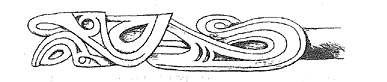
Lime spatula handle, Massim, after Haddon 1894
Early miners heard stories of a digger buying four ounces of gold from a villager for two sticks of tobacco, but the Sudest soon learnt the value of the metal in their ground. Men who could use the pan and sluice-box decided that it was better to work for themselves than be paid a few sticks of tobacco as labourers. By as early as 1891 Sudest were washing gold and selling it in the stores, and by 1895 the Sudest were obtaining most of the island’s declining gold yield. After the diggers had worked the main gullies a lot of gold remained in widely scattered surface deposits. It was poor ground for the white miners, who were unwilling to work an area if they could not clear wages after paying for rations and labour. But for the Sudest, able to subsist on their gardens and with no obligations to be paid in cash, mining gave more independence and greater access to goods in the stores than the other ways open to those wishing to enter the cash economy: working as labourers, signing-on with the pearlers, or fishing for bêche-de-mer.
The Australian miners objected to meeting the Sudest as competitors. The natives, said an observer in 1894, ‘rush the new patches, and with their keen eyesight they clean them out so thoroughly that a Chinaman could not live on the tailings. This enterprising feature of the natives is not relished by the white plodder after gold.’ D.H. (Harry) Osborne, who arrived on Sudest in 1901, was told stories of Andy Jorgensen smashing the panning dishes of those Sudest who wanted to wash gold for their own benefit. In 1894 MacGregor heard rumours of diggers burning houses to intimidate Sudest who wanted to mine. John Graham, the Resident Magistrate who was sent to investigate, found insufficient evidence to take action. The miners complained that the Sudest paid no licence fees; but the Sudest were not to be excluded from the field by administrative ritual. They bought licences, although frequently a holder did not enforce his right to stop other villagers working on his claim.
As the total amount of gold which the Sudest placed in one and two ounce lots in the pans of the store scales became important, the storekeepers decided that they could not support their countrymen’s demand for the exclusive right to exploit the goldfields of British New Guinea. They encouraged the Sudest to mine and spend: they stocked the tools, cloth, fishing lines, and ointment to cure skin diseases which the Sudest wanted, and for a while they acted in ignorance or defiance of the ordinance of 1888 prohibiting the sale of firearms to Papuans. Some departing diggers anxious to add to their stock of gold dust were also prepared to sell the guns that they had brought to protect themselves from the New Guinea blacks. One miner told MacGregor he had been offered 3 ounces of gold worth over £10 for his revolver. But from 1891 government officers supervised the area more closely and they confiscated the guns, rifles and revolvers owned by the Sudest. Most were handed over readily, perhaps because the raids which made them valuable to the villagers had ended. It was no longer possible for those communities who had guns to terrorise and rob those who did not. In the new order there were other ways of obtaining power.
Nearly two years before MacGregor defined the work of the village constables by regulation in 1892, he instructed William Campbell, Resident Magistrate for the Louisiades, to appoint ‘rural police’ who would be paid ‘a few sticks of tobacco a week’. Jimmy Sudest of the Pantava area, who had worked in Queensland, and Iami of Griffin Point, the first police to hold office on Sudest, began the fashion of meeting visiting government officers to tell them of events on the island and to learn of the government’s desires. When Iami reported to MacGregor in July 1892 he received a blue uniform, a belt, a knife and a pound of tobacco; and in return he assured MacGregor that he would have no trouble recovering a revolver from a nearby village. The people, he said, feared him because he was known as a friend of the government. Jimmy Sudest also gave evidence of his power and allegiance by handing in a revolver.
In 1890 MacLean and Samuelson began working a quartz reef on their claim, the Caledonian, about 2 miles across grasslands from the north-west coast. When MacGregor visited them in January 1891 they had put a shaft down 20 feet, taken out several tons of ore and spoke of floating a company to purchase machinery. While MacGregor watched, they washed some ground taken from the shaft and recovered a small nugget which they presented to him. Suspecting that they had put the nugget in the pan before testing the sample, MacGregor declined the gold but shared their tea, tinned meat and biscuits. MacLean and Samuelson shipped 3 tons of ore to Queensland for crushing, but the costs were high and the return was low. They struggled on for about two years, ‘living in the greatest misery’ and extracting a little gold by roasting the stone, pulverising it by hand, amalgamating the gold with mercury and then separating the mercury by straining it through a blanket. There were no villages close to the mine, but Sudest visited the miners, sold them food and stole some of their equipment. Miners still believed that somewhere in the islands there were reefs which would support a rich and permanent industry; but they now knew they were not on the Caledonian.
Inland from Hinai Bay on the south coast the Mount Adelaide reef seemed to offer a richer reward. After receiving a report from mining experts, the British New Guinea Goldfields Proprietary Co. Ltd appointed G.F.B. Hancock managing director and sent him north with a staff of twelve, a battery of stampers, sixteen working bullocks, two horses and twenty sheep. MacGregor, wanting to encourage forms of economic activity which were less transient than alluvial mining, supplied a gang of fifty-nine prisoners to build a road from the coast to the mine. The company agreed to pay the prisoners a penny a day, meet the costs of the wages of the overseer and the police guard, and supply rations. To tunnel, shovel the ore into the hoppers on the tramway and attend the stampers, the company recruited over 100 men from Rossel Island, Dobu and the Western Division. The Sudest knew the Rossel Islanders, having traded with them for sapi-sapi (shell beads), and they met other peoples who sailed to Dobu, but they knew nothing of the homeland and culture of the taller darker Kiwais from the Western Division, men they had seen infrequently as policemen and crewmen on boats. Before crushing had begun the overseer, nineteen prisoners and five of the seventeen Dobu recruits had died. The Papuans had suffered from beriberi caused by a deficiency in their diet. Most of the sixty-five Kiwais from the Western Division, led by Miserie, an ex-policeman, left the mine and set up camp near Pantava. Miserie told Alexander Campbell, the Resident Magistrate from Nivani, that they had been fed on rice and sago only, two of them had been beaten by a white overseer, and they feared they would die like so many of the other labourers. Hancock agreed to provide blankets and better rations but he defended his overseer, who, he said, had been threatened with an axe. The men returned to work: Papua New Guinea’s first strike had ended. In June 1898 the Kiwais were paid off, and as their boat passed the government schooner they gave ‘three cheers in good English style’. Campbell and his crew returned the salute.
The stampers at Mount Adelaide hammered for a few months only: the crushed ore freed little gold. The labourers were not replaced, the European staff abandoned their houses at the mine site and overlooking Hinai Bay, and by 1899 the Sudest were the only miners on the island.
As gold became hard to find the Sudest were caught in an economic trap. Some had become accustomed to going to the stores for the food, tools and clothing needed to satisfy their material needs and for the tani (strings of beads and shells) and other objects used in traditional exchanges. Men forced to shift a lot of alluvial for a few pennyweights of gold were persuaded to buy on credit, to buy ‘belong book’; and for some storekeepers the ‘book’ was a means of forcing the Sudest to keep bringing their gold to the store scales. Villagers complained to Campbell: ‘all time boy he afraid belong Mahony belong book’. John Mahony, a partner of Patrick Carvey, had been made a Justice of the Peace by MacGregor on the suggestion of the miners, and he now pretended to have the power to order the village constables to handcuff those who failed to pay their debts to his store. Carvey and Henry Burfitt, an employee, used more direct methods. Tomasi signed a statement to say that when he was unable to pay the 1 ounce, 10 pennyweight and 6 grains which he owed the store Carvey had taken a stick and thrashed him. Campbell believed him: he had heard similar stories before, Tomasi still had wounds on his scalp, and Campbell had noticed that while other traders went unarmed Mahony, Carvey and Burfitt carried ‘either guns or revolvers in a very conspicuous manner’. Campbell, zealously keeping his books in order and seeing that all men obeyed the law, slowly collected the evidence to bring the traders to court. In January 1898 he asked Burfitt whether it was true that he had threatened to hang a man who had failed to pay a debt. Burfitt denied the charge and called on Wilsoni, one of his crewmen, for support. Wilsoni immediately told Campbell that he had seen Burfitt ‘make fast fish line round neck of Sam’. Six months later on his next visit to Sudest Campbell saw Sam Manawah who said that Burfitt had come to his house and, finding him asleep, had seized him, banged his head on the floor and then pulled a fishing line tight around his neck. Manawah admitted owing 4 pennyweights to the store, but explained that he had been unable to pay as he had been collecting shell and afterwards had to work in his garden before he could again work for cash. Burfitt eased his anger by teaching the Sudest to repeat ‘filthy and disgusting’ statements about the government. Campbell imposed mild fines on Mahony, Carvey and Burfitt for assault and breaches of the labour and trading regulations.
The system ‘belong book’ continued but its abuse declined. The Sudest learnt that the law protected them from storekeepers who threatened to ‘hammer’ or ‘make fast boy belong book’, and by increasing their gardens they again became independent of the stores. Campbell compelled them to plant ten coconuts for every adult male and gaoled those who failed to make provision for their own independence. Some Sudest purchased their seed coconuts from Mahony and paid in gold. In 1900 Mahony and Burfitt asked if they could take some Sudest to a goldfield on the Papuan mainland where they would work ‘on their own account’. Campbell thought Mahony and Carvey were only interested in enabling the Sudest to spend gold in their store and opposed the idea. He was supported by his superiors in Port Moresby; perhaps they acted only to protect the Sudest, but they may also have decided they had enough troubles on the mainland goldfields without taking the chance that white miners, their labourers or local villagers would clash with the Sudest.
Table 1
Principal goldmining laws*
Papua
|
The Gold Fields Ordinance, 1888 |
|
|
adopted current Queensland legislation and regulations for the management of goldfields. |
|
|
The New Gold Fields Ordinance of 1897 |
|
|
gave the government the power to stop the granting of miners’ licences to Africans and Asians. |
|
|
The Mining Ordinance of 1899 |
|
|
repealed previous legislation and adopted the Mining Act of 1898 of Queensland. The Queensland act was amended to fix the fee for a miner’s right at ten shillings and to allow the granting of a larger reward claim for the finding of a new field. |
|
|
The Mining Ordinance of 1907 |
|
|
required any person about to mine on land ‘owned and occupied by natives’ to inform the warden, who assessed the probable damage, collected the money and held it for later payment to the owners of the land. The warden was to prevent any mining likely to cause ‘substantial damage’ until the owners of land and property gave their consent. The ordinance stopped the sale of miner’s rights to Papuans; but all ‘aboriginal natives’ were now given the same powers as the holders of miner’s rights except that they could not be employed to hold a lease or claim on behalf of another person. |
|
|
The Goldfield Reward Ordinance of 1909 |
|
|
provided for a reward of up to £1000 for anyone finding a new field able to support 200 miners of European descent for eighteen months. Members of prospecting parties subsidised by the government could not receive the reward. |
|
|
Mining Ordinance, 1937 |
|
|
repealed previous legislation. Although still based on the Queensland Act of 1898, Papua now had its own mining ordinance. The provisions of the 1907 legislation were included in the new ordinance. |
|
* In both Papua and New Guinea many of the basic rules about the taking up and forfeiture of claims were set by regulations made under general provisions in the current mining ordinance.
After 1900 the Sudest could work with the few Malay, Greek, Filipino, Japanese and Australian traders who lived in the area; they could become labourers on Craig’s or Mahony’s plantations on Sudest or agree to serve in the Cosmopolitan Hotel in Samarai which Elizabeth Mahony had bought after the death of her husband, John; they could sign on to work elsewhere in Papua; or make copra or collect gum, shell or bêche-de-mer; but gold remained an important source of cash.
Table 2
Louisiade Goldfield
European miners
|
1888 |
7 October |
Sudest |
200 |
|
1889 |
8 March |
Misima |
89 |
|
1889 |
8 July |
Sudest 300 |
Misima 400 |
|
1890 |
8 August |
Sudest 70 |
50 |
|
1891 |
June |
Sudest 38 |
Misima 38 |
|
1892 |
June |
Sudest and Misima |
65 |
|
1893 |
” |
” ” ” |
60 |
|
1894 |
” |
” ” ” |
38 |
|
1895 |
” |
” ” ” |
30 |
|
1896 |
” |
” ” ” |
20 |
|
1897 |
” |
” ” ” |
28 |
Table 3
Louisiade Goldfield
(Misima and Sudest)
Production
|
ounces |
£ |
|
|
1888/89 |
3850 |
14,387 |
|
1889/90 |
3470 |
12,440 |
|
1890/91 |
2486 |
8371 |
|
1891/92 |
1235 |
4332 |
|
1892/93 |
582 |
2236 |
|
1893/94 |
1128 |
3906 |
|
1894/95 |
728 |
2565 |
|
1895/96 |
600 |
2100 |
|
1896/97 |
560 |
1960 |
|
1897/98 |
600 |
2100 |
Sudest, briefly the main centre of foreign activity in British New Guinea, was visited infrequently by government officers and miners after 1902. Those foreigners who did go ashore at the old landings were surprised at the amount of Pidgin spoken (for the Sudest taught each other), the skill of the miners and the fact that some men had scales to keep a check on the pennyweights produced. On a horse supplied by Mrs Mahony and guided by a local ‘boy’, Assistant Resident Magistrate Henry Ryan in 1911 patrolled from Griffin Point past the old Four Mile camp. At Billy Bong creek he watched over twenty men exposing working faces on a hillside. They were ‘working mates’, each two men having their own claim. Further along the track at Jeneeta, a small village of seven houses, all the people, he thought, were ‘gully workers’. Close to a settlement of four houses called Talk-Money another thirty men were working in Sago Gully. All the miners that he spoke to said that they were getting a little gold. One pair showed him 6 penny-weights which they had taken during the day; it was worth about £1. Until 1942 when the war forced the traders to leave, the Sudest continued to re-work the alluvial fields, sometimes striking patches which gave them incomes far higher than those obtained by any Papuans who signed on as indentured labourers.
MacGregor prepared legislation excluding Chinese from the goldfields in 1889 but it was not passed until 1898. Early, MacGregor said that the Chinese would have to be excluded because they would clash with Papuans: in 1898 he thought that the 200 Europeans on Woodlark Island would cause an ‘immediate disturbance’ if Chinese arrived.
The quotation describing relations between white men and Aboriginal women is from Mr Justice Dashwood, Government Resident of the Northern Territory, to the Select Committee on the Aborigines Bill, printed in Reynolds 1972.
MacGregor in his dispatches to the Governor of Queensland, his diary and Annual Reports provides much material on the early history of mining on Sudest. Other information is from the north Queensland newspapers; Sydney Mail 31 March 1894; D.H. Osborne, Pacific Islands Monthly, January 1944, pp. 34, 35; and Queensland Parliamentary Papers, A.G. Maitland, ‘Geological observations in British New Guinea in 1891’, 1893, Vol. 2, pp. 695–728. From the appointment of Cameron in October 1888 until Campbell left Nivani in 1902 there was normally a government officer in the Louisiades. Except for the sections appearing in the Annual Reports, much of the early correspondence from the resident officers has been lost. But from 1897 to 1901 there are full papers from Nivani and later papers from Samarai, Kulumadau and Bwagaoia include the reports of patrols to Sudest.
Previous Next



