


 menu
Black, White & Gold
a beautiful country but a failure
In 1871 seventy-five ‘spirited young men’ paid £10 each to buy a leaky old brig, the Maria, and sail her from Sydney to New Guinea where they hoped to find gold. None reached New Guinea and less than half survived the voyage. Off the Queensland coast the Maria struck a reef and only about fifty of them were able to get away on boats and rafts. Some reached the settlement at Cardwell, eight drifting further north were kept alive by ‘good-natured savages’, and about seventeen others landing at different points on the coast were killed by the Aborigines. The first rescue party in a fight for possession of one of the boats from the Maria shot eight Aborigines dead and left another eight wounded. A few days later black troopers in a punitive raid caught a party of Aborigines in their camp and acted with ‘unrestrained ferocity’. The Police Magistrate at Cardwell, Brinsley Sheridan, thought that without harsh immediate action no boat would be safe on the coast, and settlers ‘or even the town itself, [might] be attacked by savages’. In spite of the fate of the Maria, the Reverend Wyatt Gill of the London Missionary Society, who landed the first Polynesian teachers on the southern coast of New Guinea in 1872, believed that many men were still eager to join another expedition to find gold on the island. Six years later news that a few specks of gold had been found was sufficient to cause several groups to charter boats for Port Moresby.
In 1877 Jimmy, a New Caledonian who had been on the Queensland goldfields, picked up a piece of quartz containing a few flecks of gold in a river bed about 15 miles inland from Port Moresby. His employer, Andrew Goldie, a naturalist, and the Reverend William Lawes of the London Missionary Society spread news of the find and cautioned against a rush. Lawes wrote in his journal that if the diggers came ‘with gold fever on them, the natives [will] be shot down like kangaroos as they have been in Queensland’. In letters printed in Australian newspapers Goldie reported that he had found further signs of gold at every prospect in the black sands of the river which he had given his
name; and he warned that the people of the area were intelligent and would be quick to revenge any wrong. It was for this reason, more than any other, that he feared disaster would follow any rush of white miners to New Guinea. Mr and Mrs Lawes and Goldie were the only Europeans with permanent homes in Port Moresby. They lived more than 200 miles from any other Europeans in a land unclaimed by any European power.
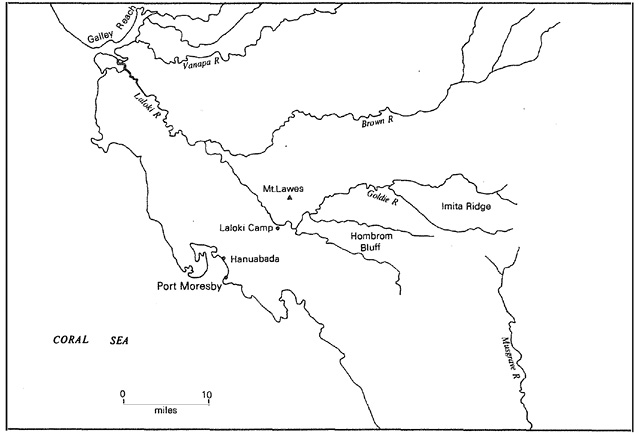
The first diggers arrived in April 1878 at the end of the wet season when the hills around Port Moresby were covered in lank grass. It looked ‘a beautiful country’ to John Hanran, whom the diggers had elected their warden. Over a thousand Motu and Koitapu people lived close to the harbour ‘in nice, clean grass-built houses on the beach, so at high tide the water comes rolling underneath the houses which are built on piles’. ‘The women’, said Hanran in his report carried by ship to Cooktown and telegraphed to other centres, ‘are virtuous, agreeable, and willing to work, and have not the wild appearance of Australian aborigines’. For four years the villagers had been listening to the Polynesian and English representatives of the London Missionary Society and they had been visited by traders, naturalists, fishermen and Her Majesty’s seamen. They met the miners with fish and coconuts ready to barter for tobacco, and they cut canoe loads of grass to feed the diggers’ horses.
About 100 white miners and two notorious goldfield followers, Annie Smith and Jessie Ormaston, arrived in Port Moresby in 1878. Most of the men crossed the low grass and thinly timbered country behind Port Moresby to a camp on the Laloki; the two women returned destitute to Thursday Island where ‘the uncivilized native women’ were much shocked by the behaviour of ‘their white sisters’. The Queensland Government accepted William Ingham’s offer to act as its agent but as he had no police and was outside the colony of Queensland he had little formal power. The diggers decided to try before his peers any man who ‘used violence wantonly’ against the local people or their property, and they pledged themselves to sacrifice ‘their lives and fortunes to prevent Chinamen from landing’.
For the short time he remained in Port Moresby Ingham was not greatly restrained by his lack of formal authority. He paraded eight armed diggers in the coastal village of Hanuabada and handcuffed a villager to a house post until some stolen goods were returned, and he ordered a digger to pay a tomahawk to a man whose dog was shot. But there was little trouble between the miners and the coastal people. Soon the diggers, who had previously travelled only in armed groups, began to move alone and unarmed between the Port and the Laloki camp. Prospecting parties crossed the Laloki and began cutting tracks to the north and west. Eventually a few men reached the headwaters of the Goldie River and crossed the Brown, another tributary of the Laloki.
The land beyond the Laloki belonged to the Koiari. They had seen little of the missionaries at Port Moresby, but they traded with the coastal people, who respected their power as spearmen and sorcerers. The Koiari fought later exploring parties and government patrols, yet their early encounters with the miners were peaceful. Hanran reported camping on the Goldie River close to a village of about 800 people who took the miners on a pig hunt, carried their swags and showed them tracks. To both Ingham and Hanran the Koiari seemed mentally and physically superior to the coastal people. Without government protection and confronted by numerous people in difficult country, most of the diggers realised that they could not prospect if the villagers were determined to resist. It was a fact clearly understood by Patrick Minnis, an illiterate digger who gave evidence against one of the few miners who acted brutally. After seeing a miner attempting to rape a struggling woman while her shrieking child stood by, Minnis told the man that he could not promise to keep quiet about the affair because ‘it was a fearful thing endangering men’s lives, and he should be cautious’. But within a few months the miners had lost their confidence in the goodwill of the Koiari. A lone miner, surrounded by Koiari panicked, fired his revolver and ran. The Koiari hit him twice with spears before he reached the protection of other miners. Hanran thought that the Koiari had at first just been curious, but the men at the Laloki now believed that the Koiari were massing for an attack and they abandoned the camp while one party was still out prospecting.
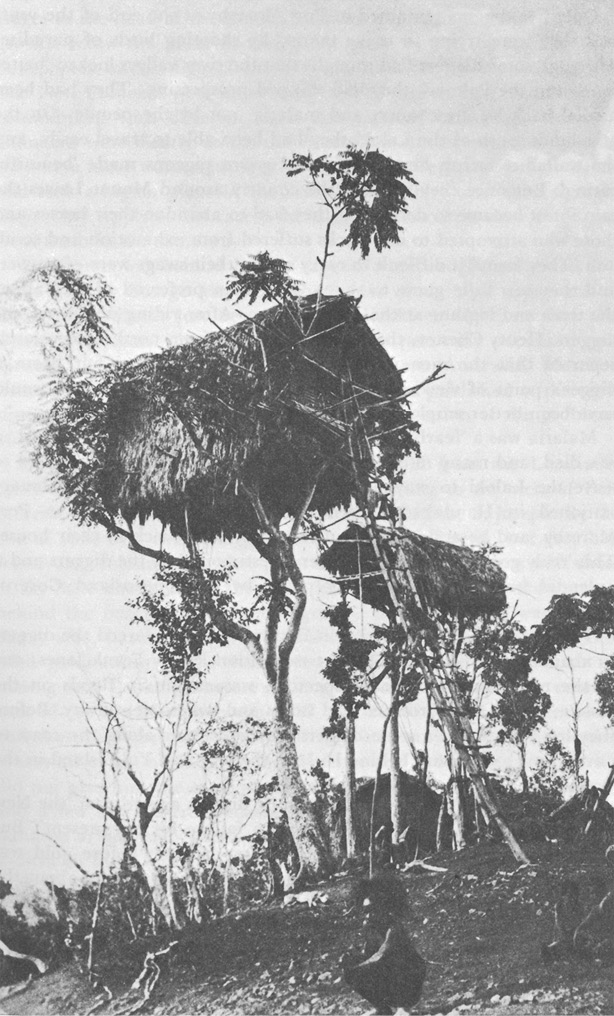
Koiari ridge-top village and tree-houses, 1885
PHOTOGRAPH: J W. Lindt
Only five diggers remained in Port Moresby at the end of the year, and they were trying to make money by shooting birds of paradise. Although some diggers had thought that the river valleys looked ‘better than even the Palmer’, they had stopped prospecting. They had been turned back by the country and malaria, not by the people. On the grasslands south of the Laloki they had been able to travel easily, and the wallabies, scrub hens, ducks and goura pigeons made ‘beautiful eating’. But once they reached the country around Mount Lawes the rain forest became so dense that they had to abandon their horses and those who attempted to cut tracks suffered from exhaustion and scrub itch. They found it difficult to carry stores, their swags were often wet, and they saw little game to shoot. Most men preferred to stay about the tents and log hut at the Laloki camp. After riding out to see the diggers, Henry Chester, the police magistrate from north Queensland, reported that the men were ‘a most respectable class’ but ‘from a digger’s point of view, some who have come to New Guinea would have been better employed in wheeling a perambulator at home …’.
Malaria was a ‘fearful reality’ for the diggers. Nearly all suffered, a few died, and many return ed to Cooktown believing that they had to leave the Laloki to stay alive. Ruatoka, a Cook Island missionary stationed in Hanuabada, carried two sick diggers back to Port Moresby, and he and his wife nursed many of the sick in their house. This ‘truly good Christian’ was given a testimonial by the diggers and a ‘splendid breechloading fowling piece’ by the Queensland Government.
The return of the wet season in December finally forced the diggers to abandon prospecting. The last expedition led by Frank Jones, one of the most active of the prospectors, was caught in floods on the Goldie, horses were drowned and stores and swags swept away. Before they left New Guinea some diggers took schooners along the coast to have a look at the land behind Hula in the east and Yule Island in the west.
After eight months in New Guinea the diggers agreed that ‘the New Guinea goldfields may be pronounced a failure for the present’. But many were sure that it was only a matter of time before gold was found in payable quantities; and they had learnt something about the people and the difficulties of travelling in the interior. They had to accept that nearly all prospectors in New Guinea would suffer from fever. At best they could say that most miners survived, that the rate of sickness had been worse on the Palmer, and that the fever might be less severe in the interior. They were able to describe the country around Port Moresby by comparing it with various areas of northern Australia; it was like the Warrego, or ‘the back of the settlement at Somerset’; but they knew of no parallel to the endless series of sharp ridges at the head of the Goldie, each smothered in a tangled mass of growth below the pleasant variegated green of the top canopy. The newspapers in the diggers’ home towns had carried reports denying that New Guineans were mere savages. The diggers had seen different communities with different skills and ways of behaving. The New Guineans were clearly unlike the Australian Aborigines; and because they were more numerous, looked more as if they owned their lands, and took a higher place in the scale which white men then thought they could apply to all races, the diggers knew that they could not treat them in the same way.
The horses left behind by the diggers were caught and used five years later by George Morrison, the leader of the Age expedition to cross New Guinea. Just beyond the Goldie River Morrison shot and wounded a man who stole a knife. The next day Morrison was speared. Recuperating at Geelong in southern Australia, Morrison wrote a series of articles which, added to others published at the same time, gave Australian readers a greater appreciation of the problems of travelling in New Guinea.
While the diggers were taking the first gold from the Louisiades other north Queensland miners were prospecting to the west of Port Moresby on the Alabule, a river the miners called the St Joseph. By the end of 1888 over twenty diggers had tried the St Joseph, but they had found only colours. On other parts of the coast prospectors who chose to say little about where they had been made trips into the country behind the beaches and the mangroves. One such man was George Sharp who, having left his job as a coalminer in New South Wales, tried goldmining in the Kimberleys of Western Australia and tin mining near Cooktown before making several journeys into the country west of the Fly River between 1887 and 1890. In the Kimberleys he had shot Aborigines who tried to drive him from the water he needed to stay alive, but he did not relish violence and in New Guinea the rifle did not give him the same superiority. Sometimes Sharp, his partner and a few carriers from coastal villages were surrounded by several hundred armed men whom they had to conciliate or evade; he found it difficult to travel among communities who were at war or hostile to each other for if he accepted help from one group, another regarded him as its enemy; and he finally left New Guinea after his partner had been killed and he had a narrow escape. George Sharp had never been to school, but after trying different jobs and looking for gold in Western Australia again, the Northern Territory and Africa, he attempted to write about his experiences. He said that he had learnt that ‘there are brainy men in these wild countries, many of them being able to reason with you if you could understand them’; and he thought that they were not to be blamed for ‘keeping whites out of their country’. Jolley, a man from Kataw (Mawatta), a village west of the mouth of the Fly, had accompanied him on his New Guinea travels. Without pretension or qualification Sharp wrote of him as his ‘best friend’.
Tobacco pipe, Koiari, after Haddon 1894

For many diggers the islands were preliminaries to the big fields which must soon be found on the mainland. The presence of gold on the islands confirmed what they had long believed; that somewhere in those ranges, looking close and accessible on clear mornings and disappearing each afternoon in thick cloud, there must be gold. The prospectors’ only tracks to the interior were the rivers. With the opening of the goldfields in the Louisiades they began looking for openings into the country of the east end.
Lewis Lett begins Papuan Gold, 1943, with an account of the Maria. The quotes in paragraph one are from Moresby 1876, chapter 4. Moresby picked up some of the survivors. The Reverend Wyatt Gill wrote in the Leisure Hour, 3 January 1874.
H.J. Gibbney 1972 has written in greater detail about the rush of 1878. The main reason why this chapter is able to add to Gibbney’s article is that he lent me his file of newspaper cuttings relating to the rush. Particularly valuable were articles from Town and Country Journal. British Parliamentary Papers, ‘Further Correspondence Respecting New Guinea’, 3617, 1883, includes articles from newspapers and statements from observers who were not government officials.
Marjorie Crocombe 1972 wrote a biographical article on Ruatoka. and Lovett 1903, pp. 132–8, quoted Chalmers on Ruatoka.
George Morrison’s travels in New Guinea are described by Pearl 1967, pp. 45–54.
It is difficult to find information about prospecting trips between the rush of 1878 and the discovery of gold on Sudest in 1888. The St Joseph expedition was referred to in the Sydney Morning Herald, 4 October and 10 November 1888. The Cairns Post, 12 December 1888 said that Bill McCord, a well known prospector, was going to try the St Joseph. It is this sort of entry which indicates that private expeditions were going to New Guinea: but they give little indication of where the prospectors went or what happened to them.
George Sharp wrote an autobiography, Elusive Fortune: the Adventures of George Sharp while Prospecting in the Kimberleys, New Guinea and Coolgardie, 1885–1907. The manuscript has been edited and has an introduction by Gibbney, Australian National University. The manuscript is in his possession.
Previous Next



