


 menu
Black, White & Gold
6
a few fine colours and malaria
By opening St Patricks Creek Frenchy and Jimmy the Larrikin had led the Cooktown miners to north Misima; but their experience on the mainland made other prospectors pause before trying the south-eastern end of New Guinea, that line of mountains pointing to islands where gold had already been found. In August 1889 they landed on the south coast near Abau Island. Having purchased beads and tobacco from Thomas Andersen’s trading station at Dedele Point, they moved to Domara village and prepared to go up the Bomguina River. For protection they fashioned armour from ships’ copper and carried two revolvers, a Winchester rifle and a double-barrelled shotgun. Ino, the son of Tuari the head man of Domara, having failed to persuade them that their plans were foolish, agreed to take them by canoe to Merani, the first inland village. Accompanied by men from Merani, Frenchy and Jimmy left the next day to trace the river back into the foothills. A few miles upstream the Merani led them across a swift-flowing tributary; and, as some villagers held the prospectors’ hands to steady them against the current, others axed them. The Merani sent a revolver and some gold (which the prospectors had brought from Misima) to Ino who, knowing there would be trouble, refused to accept them. Ten years before when the crew of one of Her Majesty’s ships burnt Dedele village, the coastal people had learnt of the Europeans’ determination to look after their own kind.
Two months later MacGregor, his police and several armed Europeans arrived. They found Merani and the adjoining village of Isimari deserted. MacGregor occupied the village while the Merani, camped outside their own stockade, shouted an admission that they had killed the prospectors and hurled spears and stones into the village. After three days of stalemate a government party went out to make contact with the Merani. Having surprised the villagers, the government force took up a position in a grassed area and the Merani ‘came on with great spirit, shouting and yelling as only savages can’. Before they came within spear range MacGregor ordered his men to fire: ‘In about one minute [the Merani] ceased to yell, then faltered, turned, and fled to the forest.’ Two were killed instantly and four died of wounds. MacGregor ordered the destruction of the sapling stockade and the tree-houses and fighting platforms built 60 to 80 feet above the village. He named the river the McTier, and a point just below where the prospectors were killed Rochefort Falls. Neither maps nor people now use Jimmy’s or Frenchy’s family name. Two prisoners were taken to Port Moresby where one died and the other was released when it was found that he was suffering from leprosy. MacGregor summarised his actions for the Governor of Queensland:
A fierce and powerful tribe has been defeated in open fight, and been thoroughly humiliated and demoralized; their strongholds have been occupied by us and destroyed, and they are for the time completely expelled from their houses and lands, and we occupy their dwellings and live on their food.
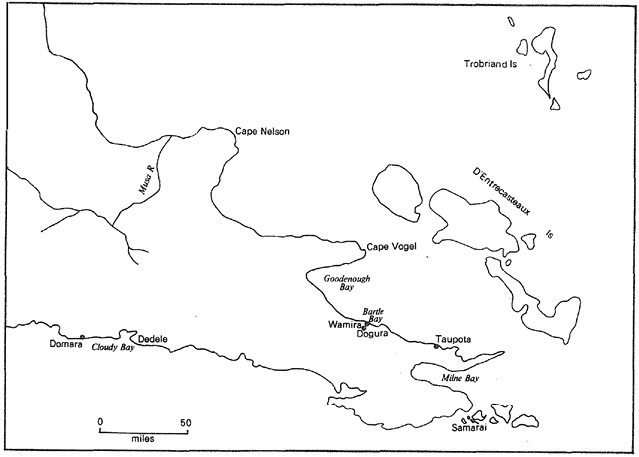
As MacGregor saw the situation, either he executed the Queen’s warrant or he succumbed to raw savagery. He was confident that his actions carried out with a ‘strong hand’ would be ‘once for all’. He was wrong. The Merani killed Ino, who had helped the government take prisoners; and the Domara, afraid of further reprisals, moved to Dedele. In 1894, after they had returned to Domara, the inlanders attacked them again, setting fire to the houses and spearing the occupants as they fled. Nineteen Domara were killed and more would have suffered but for the arrival of Joe Fiji and his shotgun. Brought from Fiji to serve in MacGregor’s police, Joe had married a Motu woman and joined the polyglot population then trading along the coast and, incidentally, giving some coastal communities access to greater wealth and power than that available to more isolated people. Joe had only two cartridges but one blast hit a man in the side, caused alarm among the marauders and turned their triumph into desperate flight. Government officers and a troop of police returned to Domara and the cycle of pursuit and arrest began again. Nor did the ‘strong hand’ influence other peoples along the southern coast. A year after MacGregor’s first expedition against the Merani a prospector, Neil Anderson, was killed at Baibara Island, about 60 miles east of Domara, by villagers who had probably heard the talk about the fighting at Cloudy Bay.
Prospectors hesitating to go inland were further deterred by reports of the sickness suffered by the government party. MacGregor’s first expedition only stayed a few days on shore, but twenty-three of the twenty-five were sick with fever before they left the area. The land behind Cloudy Bay, MacGregor reported, was remarkably fertile and unhealthy. Ten years later Cloudy Bay was crowded with schooners and men were trekking inland to the new field at Keveri.
For five years after the deaths of Jimmy and Frenchy few of the miners leaving the declining fields in the Louisiades attempted to prospect the interior. But from 1894 the Queensland miners sent several well-equipped parties to test the north-east coast. Fifteen Cooktown diggers led by James Hurley employed carriers from Bartle Bay to take them south into the ranges. The hill people, who spoke a different language from the coastal villagers, had seen no Europeans cross their lands, but they made no immediate attempt to stop the prospectors and some agreed to carry for them. Having located a patch yielding a little ‘scaly’ gold, Hurley left the main party to search ahead for a richer deposit. Five other miners and some coastal and hill peoples went with him. As they travelled up the bed of a stream Hurley bent over to help retrieve a panning dish lost in a pool. The hill man who had been carrying Hurley’s pack snatched up an axe and killed him with the second blow. The other hill men immediately attacked the rest of the miners, who were able to use their revolvers to kill one man and drive the others off. The Cooktown miners withdrew, and the police who came in pursuit of Hurley’s murderers reported shooting another man and taking six captives before the hill people abandoned their homelands for more inaccessible territory. As there was no evidence to show that the six prisoners had anything to do with the attack on Hurley they were convicted of resisting the police and put to work in the Samarai prison gangs. The 7 ounces of gold found by Hurley’s party was sufficient to bring more men from the Louisiades and north Queensland to Bartle Bay.
In Cooktown the public raised funds to send a second expedition to New Guinea, and a committee selected twelve men from a list of volunteers ready to make the trip. Three weeks after the Cooktown party under the leadership of Pat Riley left on the Merrie England in March 1895, eleven miners of the Cairns Prospecting Association went on board the schooner Meteor for Samarai. The best known miner in the Cairns Association was George Clark, about fifty-five years old, a founder of the Charters Towers and Mulgrave Goldfields, and a prospector on the Palmer, Hodgkinson, Herberton and Russell fields. Before leaving for New Guinea he was testing the conglomerate country on the Palmer for a Cairns syndicate.
New to New Guinea, the Cooktown and Cairns miners looked closely at Samarai, their first sight of their neighbouring British colony. Burns Philp’s store and Whitten Brothers’ boat sheds and copra store were built on the beach. In the centre of the 50-acre island the ‘residencies’ of Burns Philp’s manager and the senior government officer looked out across the crowns of the coconut palms. Gangs of prisoners were taking trolley loads of earth from the side of the one low hill and tipping them into a recently drained swamp. When completed the work would reduce the incidence of malaria and give Samarai a fine cricket ground. The men arrested after the killing of Hurley were pointed out to the Queensland miners. With its profusion of palms, gentle undulation, sheltered anchorage and neighbouring islands, Samarai presented ‘a beautiful picture’; but a north Queenslander who had taken a temporary job as storemen with Burns Philp told the miners that a man got lazy and demoralised with the natives doing all the handling.
Anchored off Taupota on their first night out from Samarai on their way to Bartle Bay, the Cooktown men watched women bobbing up and down ‘like dancing emus’ as the light from burning torches flickered on their bodies and grass skirts while they fished. At Wamira village where they established their first camp the miners thought the people docile and curious. One of the Cooktown party, charmed by the hymn-singing of the villagers, compared it with ‘the treble singing of the paid boy choristers at St. Paul’s in London’; and R.J. Walsh, travelling with the Cairns Association, thought it ‘very comical’ to see the missionaries ‘riding the niggers over the watercourses’. But he too chose to be carried over the creeks. At Easter next year the Anglicans were to baptise two men, their first Papuan candidates for the assembly of Christians. From their arrival in 1891 at Dogura on the west of Bartle Bay the Anglicans had obtained a strong influence over a few coastal villages. On the beach the Queensland miners were meeting Papuans who had encountered a variety of foreigners over the previous twenty years.
Inland the miners admired the productivity of the hillside gardens, the capacity of the carriers to handle 50-pound loads on the boulder-strewn gullies used as tracks; but they thought the New Guinea spearmen less skilful than the north Queensland blacks, deplored the spread of skin disease in an otherwise handsome people, and ridiculed the village dogs ‘so miserably poor and wretched looking that they have to lean against a tree when they want to howl’. Although the Cooktown miners were never in danger of attack Jack Christie, the best shot in the party, gave a ‘salutary check’ to each new group by demonstrating the power of his repeating rifle. The miners were aware of hostility between different groups in the area south of Wamira for they noticed that their carriers brought spears with them and attempted to interest the miners in raiding the mountain villages for food and women; but from their own observations and talk with the Anglican missionaries they concluded that ‘Plenty of preparations and a vast deal of palavering is the upshot of most of the tribal fights’.
The Cooktown miners made three trips inland, one from Wamira and two from Paiwa further north on Goodenough Bay. Most of the time the prospectors suffered a monotonous, enervating routine. Attempting to cut across as many streams as possible, they were forced to scramble up and down steep, broken ridges; they lived on johnny cakes, salt beef and rice, and vegetables and occasional pigs bought from villagers; at times unable to obtain carriers, they attempted to lump their own packs; frequently lashed by rain they camped at night in tents floored with cut saplings to keep stores and packs above the mud; and most experienced the shaking, profuse sweating, cold and delirium that went with malaria. The Cooktown party found no payable gold; and they thought themselves lucky that only one man died. J. Turner shot himself at the Paiwa camp while suffering a ‘delirium of fever’.
The Cairns Association split into two groups: one left Bartle Bay and cut across the tracks of Hurley, and the other, led by Clark, recruited carriers at Taupota for an expedition from the north coast over the ranges to Milne Bay. According to Bill Alexander, one of the group chasing Hurley’s prospect, the rivers behind Bartle Bay came down at such rate that not even fish could survive in them. The only alluvial they could find was small beaches on protected bends where they washed a few ‘fine colours’. The villagers, Alexander said, were ‘quite peaceable’. Each community was prepared to travel with the miners, but only within its own territory. To their surprise the prospectors became dependent on the villagers. As Alexander, a man ‘used to Queensland bush life for many a day’, explained to the reporter from the Cairns Argus:
You cannot find your way from one place to another without having native guides, and the way they dodge about is very curious. We would sometimes be sure our guides were taking us right away from where we wanted to go; but no, they were always right.
The Cairns miners prospecting behind Bartle Bay returned to Samarai when most of them ‘got down with the fever’. Jack Martin died before the Meteor reached Cairns. Bill Alexander decided to pack his ‘traps’ and return to the Towalla field in Queensland; but he was sure that if there was gold in New Guinea it would be found soon. With the temporary slump in the copra, pearl and bêche-de-mer industries many of the traders were idle and, Alexander predicted, they would now ‘dodge about the coast with a couple of boys, do a little trade with the natives, and try all the places they think likely’. Unknown to other miners one of the trader-prospectors, Charlie Lobb, was already working gold on Woodlark.
Clark’s party crossed to Milne Bay without finding payable gold. Having passed miles of almost impenetrable country Clark was convinced that prospectors were most likely to succeed where they could enter gold-bearing country by boat. The Mambare River, recently mapped by government officers, he now thought could be the track to the gold of the mainland. Clark took a canoe from the head of Milne Bay to Samarai where he met Johnny ‘Fiji’ (Cadigan), owner of the cutter Seagull. For shares in the Cairns Prospecting Association Cadigan agreed to take six miners, two Queensland Aborigines and fifteen Taupota carriers, their stores and a whaleboat to the mouth of the Mambare. Before leaving the south-east Clark wrote a note to the Resident Magistrate at Samarai asking him to send a boat to pick them up in about eight weeks’ time.
MacGregor’s dispatches recording his pursuit of Frenchy and Jimmy’s killers are reprinted in the Annual Report 1889/90, pp. 26-35. The Report includes a map by J.B. Cameron. Dutton 1971 locates villages and language groups along the south coast. Green, letters and Abau station papers, describes events in the area in the 1890s.
Lett 1943 has an imaginative account of the killing of Hurley. Winter’s dispatch referring to the incident is in the Annual Report 1894/95, pp. 4, 5.
All the members of Riley’s expedition are listed in the Cooktown Courier, 19 February 1895. Clark’s life is outlined in obituaries in the Cooktown Courier and Cairns Argus, 10 September 1895. These two papers carried long reports spread over several issues on the work of the prospectors.
The Annual Report 1895/96, pp. 17, 18, prints an exchange of notes between MacGregor and Moreton on whether or not Moreton had committed the government to provide transport for Clark’s expedition from the Mambare to Samarai.
Previous Next



