


 menu
Black, White & Gold
8
all golden country but very poor
Three months after Clark was killed, William Simpson, eight other miners and twenty-two Taupota carriers returned to prospect the ‘likely looking’ country they had seen on the upper Mambare. From ‘Clark’s Fort’, a log hut about 12 miles upstream from Tamata, the miners cut a track south to a point high above the western bank of the Mambare where they built ‘Simpson’s Store’. Using the store as a base, the miners spent five months cutting tracks and testing the creeks feeding the Mambare. They prospected the Chirima, the main tributary coming in from the west, and followed the Mambare beyond the Chirima junction into the lower Yodda Valley. The track from Clark’s Fort to the Chirima junction crossed no land much above 2000 feet, but it was a hard walk with many creek crossings, thick undergrowth and cliffs which had to be climbed with the aid of vines and makeshift ladders. John Green took only thirteen days to travel from Tamata to the junction and back, but at the end he threw away the new boots he had put on at the start. After MacGregor had seen the prospectors’ tracks he wrote that they had carried out ‘by far the most arduous undertaking ever performed by any private exploring party in the colony’.
When the miners came down the river in January 1896 they had 46 ounces of gold. The upper Mambare, Simpson reported, was ‘all golden country, but very poor’. Beyond the Chirima junction they had prospected one creek which, they thought, might be profitable. Although their gold would not pay the costs of their expedition, they had found enough to bring them and others back to the Mambare. John Green wrote home suggesting that the young men of Healesville should consider trying their luck in the area.
In March the returning miners and their Taupota carriers began relaying canoe loads of stores from Mambare beach to Tamata. Among the first group to arrive with Simpson were Clunas and MacLaughlin of the old Ivanhoe prospectors and McClelland from Clark’s party. They found that MacLaughlins Creek, flowing from the spurs of Mount Scratchley, was worth working. By August twelve miners and over eighty labourers had obtained 600 ounces to send away on the Merrie England. Some of the Taupota men were constantly carrying stores up and returning for another load, the round trip of about 150 miles taking fifteen days. Already news of the strike on MacLaughlins Creek had reached Samarai, and when Australian papers reported the find they added to the interest already aroused by the talk of the new alluvial field on Woodlark Island. There was general agreement that after the ‘wet’ there was ‘bound to be a big rush’ to New Guinea.
Although Australians had been mining in the islands for ten years, most of those about to leave for the mainland knew little about the country they hoped to work in. The newspapers sometimes informed and cautioned them; and sometimes misled them. The diggers were not told they were going to a foreign country. The eastern Australian colonies provided £15,000 a year to pay for Sir William MacGregor’s administration; British New Guinea was another frontier for Australians to develop. Settlement ought to be no more difficult than any other area north of Brisbane. Just as development in the eastern colonies and Western Australia had been stimulated by goldrushes, now it was to be New Guinea’s turn. And again the ‘Munchausens’ who located minute reefs in remote places would be able to milk the ‘British capitalistic cow’. Most of those general beliefs accepted by Australians were proved false eventually; within a few months the diggers knew that a lot of the details they had read were wrong. Several early reports said that the gold-bearing country was closer to the southern coast than the north, and the Cooktown Independent went so far as to announce that a 45-mile track fit for mules and horses could be cut from Port Moresby to MacLaughlins Creek. Much of the route, said the Independent, passed over ‘well-grassed and pleasant tableland’; it avoided ‘collisions with hostile natives’ along the Mambare; and there was no ‘miasma which creates fever on flats’. MacGregor, who had walked from MacLaughlins Creek to the south coast in 1896, diplomatically turned aside requests to cut tracks for pack animals and to revoke the regulations against importing horses from north Queensland.
Just before the diggers left Australian ports Davies, Steele and Olsen reported the deaths of Haylor and Fry, their own narrow escape, and the fact that the most successful of them had only 10 ounces of gold. Eight days later the papers announced the ‘massacre’ at Tamata. Men who had been to the Mambare spoke to make sense of the contrasting pictures of ‘treacherous arrow and sneaking fever’, and pack-horses winding over peaceful up land meadows. Charlie Lobb on his first trip south of Townsville since his arrival in the southern hemisphere and William Simpson in Sydney after prospecting on the Mambare and the Musa gave long interviews. Both ridiculed the idea of using horses, and warned that the only way to work the new field was to employ large numbers of carriers to transport rations from Tamata. To meet expenses and to cover the fact that there was no work for the unsuccessful digger to fall back on, they thought that no man should leave Australia without £100. If he was to work on the goldfield he would have ‘to say goodbye to the coast for at least six months’, and Simpson said, if he was unsuccessful, he was probably saying goodbye forever. Lobb warned that even the crews of boats anchored off the Mambare mouth for a few days suffered from fever. He predicted that if a rush occurred at least half the men would die. For himself, he would return to New Guinea, but to the islands: ‘Let the madmen go to the mainland’. The best course for the present, he suggested, was to let north Queensland men who were most inured to the climate continue their work of defining the location and value of the new field. From Port Moresby MacGregor wrote an official warning against a rush to the islands or the mainland. He was supported by Walter Gors, Burns Philp’s manager in Port Moresby, who said that the ‘patch’ on the Mambare was worked out, further payable gold was yet to be found, in the event of a ‘big rush’ many would die; and he repeated the false advice that the only practical route was from the south.
At the request of the Government Secretary, Shanahan prepared a shopping list for those still prepared to go. He recommended ‘2 pairs moles or dungarees, 2 pairs flannels’, boots, blankets, hammock, oilcloth, tent, twine, scissors, needle, towel and straps to make up a 40-pound swag; cooking utensils and stores; shovel, pick, dish and two tomahawks; 1 bottle sulphate of quinine pellets, 1 bottle Dover’s powders pellets, 1 bottle anti-febrine pellets and antibilious pills; and a revolver and a shotgun. Shanahan thought that for most men the shotgun was a better weapon than a rifle, and while he conceded that the bow and arrow had a better range than the shotgun, he pointed out that all the people in the auriferous country were spearmen. Shanahan believed that his 200-pound pack would support one miner for a month, it would require six carriers to transport it, and the carriers would need additional stores. Captain John Strachan, who had survived dramatic encounters with the people of New Guinea, advised all miners to wear a broad flannel belt to prevent cholera.
Nearly 1000 diggers sailed to New Guinea in the first half of 1897. About half went to Samarai and on to Woodlark or the Mambare, and about 400 landed in Port Moresby. The men on the south coast tried four starting points to take them across the Owen Stanleys: Rigo, Port Moresby, the Vanapa and the Alabule Rivers. One prospector wrote to the Ingham Planter that he and five others had attempted to go inland from Port Moresby. At Sogeri they realised that they ‘could do no good with horses’: some animals had rolled ‘packs and all’ for 100 feet down the first range rising from the coastal hills. They could not get carriers; and
As regards the country, I never dreamt there was such rough and broken country in the world, the only thing I can compare it to is country that has been boiled up into huge boulders ranging from 300 ft. to 12,000 ft. high, with gorges hundreds of feet deep, and covered with dense scrub, just like the Johnstone scrub.
But most of the miners who landed in Port Moresby went north to try the Vanapa Valley where a government party was said to be marking the route and erecting rest houses. They found no easy stages. Most of the 130 or so miners who reached the Vanapa gave up after two days on the track. The few who struggled on were led into difficult country inhabited by aggressive peoples with little knowledge of Europeans. Instead of following MacGregor’s tracks through Gosisi village and over the eastern flank of Mount Scratchley, the large and struggling government party had followed the Vanapa north towards Woitapi. One miner, Martin Dabney, was killed on the upper Vanapa, and another group led by George Wriford, an ex-government officer, was trapped in camp until its besiegers were routed by MacGregor’s police. Some miners had shot pigs and looted gardens, increasing the hostility of inland peoples. The coastal villagers would not carry into the lands of their enemies across tracks at over 8000 feet where men wept as the cold rain swept in each afternoon. And the miners could not travel without carriers. A digger returned to Rockhampton said, ‘So far from being able to carry your own swag, you do very well if you can carry your own carcass’. For the independent digger proud of humping a 100-pound pack to the Western Australian fields, this was an admission of defeat and a recognition that New Guinea was another country. When a miner opened a bag of flour, the basic food of the Australian bushmen, ‘you [could] smell it fifty yards away’. The New Guinea prospector had to use rice, a lesson learnt earlier in the islands. About six miners died on the track, another six died in the temporary hospital in Port Moresby and others died at sea or in Cooktown. The extent of the rush and the tragedy had been less than many had predicted.
By June 1897 only two parties had reached the Mambare from the south coast, and both included men accustomed to travel in New Guinea. G. O’Brien reached a miner’s camp after his two companions had been drowned when their raft capsized on the upper Mambare. Without stores, equipment or carriers, O’Brien was unable to mine and he was given a temporary job at Tamata station. W. Nettle and W. Kelly reached MacLaughlins Creek after two and a half months on the track. Dependent on the people of one village to move them on to the next, Nettle and Kelly had often been delayed, but they had been generously supplied with food, and only near Woitapi had they been in immediate danger of attack. They too arrived with their stores almost exhausted, and could not replace them without leaving the field. But MacGregor with his normal indifference to the physical hardship suffered by himself and others still asserted that ‘the journey across’ ought to be ‘an easy one for, say, fifteen days’.
Three men, Schmitt, Ryan and Burns, had remained on MacLaughlins Creek during the wet season of 1896–7. Isolated from the rest of the European community for five months after the attack on Tamata station, they survived because the people of Neneba village were willing to supply them with food. Schmitt lived in the village for six weeks, recovering from an injured foot.
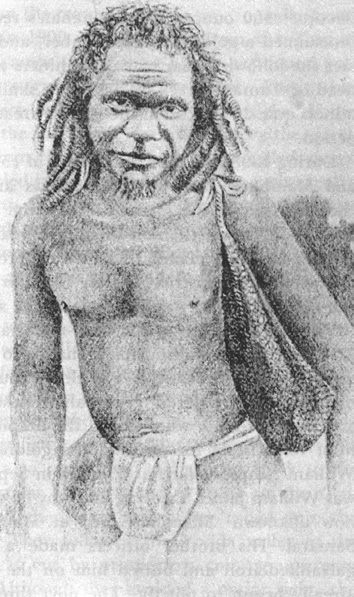
A small community of about 100, the Neneba occupied a cluster of leafy huts on Asiba Creek, a tributary of the Chirima. They had no spears, shields or beheading knives; their only weapons were a few stone clubs and small, weak bows blackened by the smoke of cooking fires. They seemed ‘peaceful and amiable’, dependent on their isolation to protect them from their aggressive neighbours. Originally a group of Mountain Koiari who had been pushed north, the Neneba had no contact with the Binandere, and infrequent meetings with the Orokaiva and Koiari peoples to the south and west; but they had formed an association with the Fuyuge villagers higher up the Chirima and by the 1890s they were beginning to adopt their language. Through the people of the upper Chirima they met other Fuyuge speakers living south of the ranges in the Woitapi Valley. In their gardens on the slopes of Mount Momoa the Neneba grew sugar cane, bananas, taro, yams, sweet potato, tobacco, and maize, a crop which had spread recently from the south coast in a series of exchanges by neighbouring communities. The Neneba had approached Simpson’s party in peace in 1896; Goiye, the village leader, had returned with Green to Tamata to meet the Binandere who made the smoke visible far down the Mambare Valley; and they had been generous hosts to MacGregor’s overland expedition, supplying him with four pigs and many vegetables. Tolerant of foreigners and keen to trade, the Neneba would sometimes carry for miners travelling in their area, but they were not inclined to work on the goldfield or to go away as indentured labourers.
At the end of October 1897 there were only about twelve miners on MacLaughlins Creek. The two most successful diggers, Gilbert Hudson and Moses MacClelland, had each taken over 600 ounces from the cold water and shifting boulders of the Mambare creeks. But now the rich patches had been worked out and the miners were struggling to find payable ground. In search of a new strike Robert Elliott and Alex Clunas prospected along the Chirima to the west and Elliott, Clunas and MacClelland traced the Mambare east beyond MacLaughlins Creek into the Yodda Valley. The Yodda was gold-bearing, they reported, but it was too far from Tamata to be worked by men dependent on carriers. Even on MacLaughlins Creek the miners found that their carriers had eaten most of the stores by the time they reached the camps. And the prospectors had twice been attacked by spearmen. In the second encounter they had shot three men ‘in self-defence’. Clunas and Elliott decided that it was worth attempting to cut a shorter track overland to the Yodda, but changed their plans when they heard that Shanahan had found ‘good colours’ on the Gira.
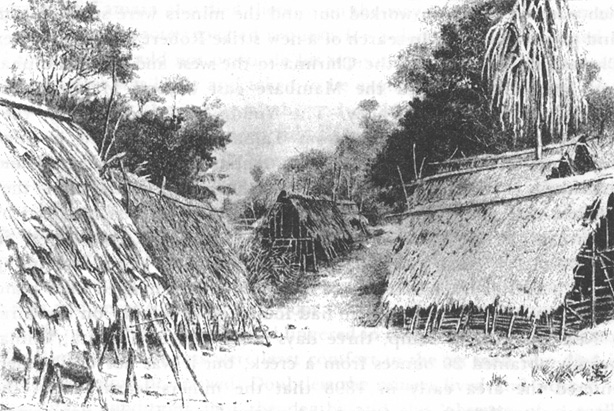
Sketch of Neneba village and man from Neneba made by a member of William MacGregor’s patrol, 1896
BRITISH NEW GUINEA ANNUAL REPORT. 1896/97
Near Shanahan’s camp, three days’ walk west of Tamata, Clunas quickly obtained 20 ounces from a creek, but it was not until others entered the area early in 1898 that the miners learnt about the extensive auriferous country on the upper Gira. Twenty-five miners took 1200 ounces from one creek, and after a pause while men fossicked and re-worked old ground, a rush to a new gully yielded another 2000 ounces. On Shanahan’s recommendation the Gira was proclaimed a goldfield in November, and regulation was confirmed a fact the following year when the miners washed 6000 ounces from the head of Tamata Creek. Working in shallow, narrow gullies the early miners quickly exhausted the richest areas, and again there was a dull period.
During 1898 and 1899 an average of 150 miners worked on the Gira and Mambare, most of them always arriving too late to peg rich claims. Many of the men suffered from malaria and dysentery. The death rate, higher than on Woodlark, reached one-third; it was, as the warden modestly claimed, ‘appalling proof of the almost pestilential character of the district’. As on Woodlark some men were as keen to rob the dead as they were to mine. The sick who struggled back from the mining areas lay in the bush-material settlements at Tamata and Mambare beach waiting for a chance to leave. A temporary hospital opened in December 1898 was closed four months later. The government was not prepared to pay all its costs, the successful miners left, and many of those who needed the hospital had no money. The man most responsible for opening the goldfields on the northern rivers, William Simpson, died at Tamata in September 1897. His real name was William James Shearing and why he chose to have another name is now unknown. Shanahan died at Mambare beach on the way to Samarai. His brother officers made a coffin from two sheets of galvanised iron and buried him on the same day for his body had already begun to putrify. The next three officers appointed to take charge of Tamata also died there or on the way to a healthier climate.
MacGregor wrote repeated requests for a doctor to be appointed to Tamata, but could not persuade his superiors to act. Finally he stated that disaster was likely and asked to be exonerated from blame. After MacGregor left the colony at the end of 1898, Doctor C.A. Brough arrived. A man of ‘advanced middle age, who had been leading a sedentary life’, he stayed in Moresby a few days and left without going to the Mambare. But when Joseph Blayney, the Resident Magistrate for the Central District and the only doctor in British New Guinea, visited Tamata in April 1899 he reported that much of the sickness was ‘brought on by the reckless mode of living’. Most of the miners, he said, expected to work as hard as they did in Australia, exposed their heads and necks to the sun, ate poor food, used polluted water, ‘drank heavily of alcoholic drinks’, and lingered in the area after they became ill. Blayney’s comments were least comfort to the six men who died in the week before he arrived. Doubtless the miners lived and worked in unsanitary conditions, but the deaths and the ‘absence of a really healthy face’ noted by the Acting Administrator Francis Winter, were a result of malaria, not a reckless disregard for the rules governing the care of a white constitution in the tropics.
The Gira revived briefly in 1900 when runners from the Tamata stores took word around the camps that Robert Elliott had found gold on the Aikora, the south-western branch of the Gira. About sixty miners, many without carriers, left Tamata together on the six-day walk to the new strike. Only the first camp was enlivened by the effects of rum and whisky taken from the centre of carefully rolled swags. From then on the miners settled into a rain-washed camp each evening and lit fires in a clear dawn to dry their tents so they would be lighter to carry. Elliott’s find was high on the slopes of Mount Albert Edward. Frequent rain storms had scoured nearly all gravel and alluvial from the creek beds, but crevices and rock bars had formed natural traps holding rich, easily worked deposits. Further down the Aikora at Campions Beach the miners worked a more extensive area of alluvial. Some gold-bearing ground was still undisturbed when news arrived that payable gold had been found on the Yodda.
Once they knew that there was a limited amount of gold on the Gira, men had returned to prospect the Yodda. In 1898 Clunas, Clark, Nelsson, Close, an escort of police loaned by MacGregor, and seventy carriers set out from Tamata to cut a new and shorter track to the Yodda. After several false starts they marked a track to the Opi, south along the Kumusi, and then west over a low range onto the upper Mambare or Yodda. They followed the Yodda valley to the north-west, meeting old tracks cut by prospectors coming upstream from MacLaughlins Creek. Although they avoided a major fight, the miners saw large numbers of peoples on the Opi, Kumusi and Mambare who seemed ready to attack and loot. ‘As far as prospecting is concerned’, Alex Clunas wrote to MacGregor, ‘nothing was got except fine colours throughout the whole trip’. Other miners attempting to reach the Yodda were harassed by the Opi and Kumusi Orokaiva, and some were forced to turn back.
In mid-1899 Henry Stuart-Russell, surveying the ‘road’ from Port Moresby to the north coast, reported that ‘Colours of gold are obtainable anywhere’ along the streams flowing into the Yodda Valley. The ‘tribes’ of the Yodda and beyond to the north, he said, were ‘numerous, warlike, and treacherous’. Stuart-Russell, who had served at Tamata after the death of Shanahan, was surprised at the boisterous confidence of the warriors who crowded to greet his expedition. The expected attack took place as the police and carriers prepared to cross back over the Mambare. Believing that their shields would protect them, the spearmen advanced boldly to be cut down by rifle fire; ‘and, though they came on again and again with the usual bravery of all natives belonging to that district they were repulsed everytime with loss, and eventually drew off, not a man in my party having been injured’. Foreigners had now approached the upper Mambare and Kumusi from MacLaughlins Creek, overland from Tamata, and across the ranges from Port Moresby; all had encountered what they thought were bold and aggressive peoples. At the end of 1899 miners on the Gira, the Mambare and in the south-east began moving up the Kumusi track; they had heard that Matt Crowe and others had opened a new field on the Yodda.
By 1900 the general location of gold-bearing ground on the northern rivers was known. On the Mambare it extended from MacLaughlins Creek for about 30 miles along the Yodda Valley, and to the west of the Mambare there was gold on the headwaters of Tamata Creek, the Gira and the Aikora. It was a vast auriferous area, but apart from a few patches it was poor. The miners standard comment was, ‘There’s a lot of gold in New Guinea, but there’s a lot of New Guinea mixed with it’.
The main sources used were Green’s letters. Annual Reports, Tamata station papers and Australian newspapers. A. Musgrave made a useful collection of papers, many concerned with the goldfields, and they are now in the Mitchell Library. Dutton 1971 and C.F. Jackson, patrol report, July-August 1914, Appendix A, Kokoda station papers, outline the history of the Neneba. MacGregor’s visit to Neneba is reported in detail in the Annual Report 1896/97. Sketches of the people and the village are included, D.H. Osborne wrote his memories of the Gira in Pacific Islands Monthly, January 1943.
Previous Next



