


 menu
Black, White & Gold
9
unavoidable mishaps which constantly recur in warfare
In 1899 about 150 white miners were working on the Yodda and Gira. A few came and more left, but for the next ten years about 100 miners and 600 labourers washed gold in streams on the Yodda and Gira, and for a time crossed to try the torrents in the broad bed of the Waria. The storekeepers told the wardens that the men were obtaining somewhere between 10,000 and 12,000 ounces a year; but as some diggers did not pass all their gold across the store counters the exact total was never known. The gold was taken by hard work and violence. The early signs that the Orokaiva would fight the ijiji-avujo, the puzzling foreigners who travelled without purpose across their lands, first in one direction and then in another, were fulfilled. Their attacks were ferocious, persistent and futile.
In 1900 William Armit, the Resident Magistrate of the Northern Division, left Tamata station to make the first government patrol to the upper Yodda. On the Kumusi he attempted to contact the people who had stolen the stores of a mining party two years earlier, but the villages were deserted. ‘Just as I was on the point of leaving’, he wrote in his journal,
two villainous-looking individuals, with blackened faces and wearing war-plumes, marched defiantly into the village. To seize these gentlemen, tear off their plumes and wash some of the black pigment from their faces was the work of about one minute. Then I clapped two heavy swags on their backs and sent them ahead. They did not like it at all.
After a fortnight Armit reached Papaki where he was met by ‘quite 250 people’. He wrote:
I ordered them to put away their arms, but they laughed at me, and one big man, taking two or three rapid strides forward, deliberately poised his spear at me. He was instantly shot dead. A fight commenced, but only lasted some few minutes … These [people had earlier clashed with a group of miners] and being a very powerful and aggressive tribe, it became imperative to teach them a salutary lesson.
Thirteen men were killed. As Armit crossed from the Kumusi to the Mambare there was a series of clashes. Three days after leaving Papaki Armit and his police shot seventeen people when they followed a retreating group of warriors close to their village. Included in the seventeen were two women whose deaths Armit explained as ‘one of those unavoidable mishaps which constantly recur in warfare’. Before the end of the patrol another twenty-four men had been killed and an unknown number wounded. No police or carriers were killed. Le Hunte received Armit’s report with ‘great uneasiness’; and he wrote to Armit stating that while he did not doubt the necessity for the action he must have more precise information about who was responsible for the shooting and how many people were wounded. Armit replied by listing the total killed at various places, claiming that he had seen no wounded and omitting any further information about responsibility for particular deaths. Armit was unrepentant when he made his annual report in the middle of the year. The people of the Kokoda area were ‘treacherous, truculent, aggressive, cruel and cunning’. He hoped to prevent them from re-occupying their villages for another two years. While regretting having to fight them, it was
incumbent on myself to uphold the prestige of the Government, and secure the safety of the miners who, I knew, were following in my wake.
Again, it was preposterous and intolerable to even dream of permitting a horde of savages to browbeat and intimidate a Government expedition with impunity, and as a consequence of their ill-advised action they lost a number of their warriors.
Six months later Armit died at Tamata station: the prestige of the government had to be upheld by others. It took them another five years to ‘pacify’ the peoples on the Kumusi.
Because of the death or delinquency of earlier officers and the reluctance of men to serve in the Northern Division, Alexander Elliott, who came to the Mambare to mine, was appointed Assistant Resident Magistrate at Tamata. He opened Bogi station to protect miners and carriers moving up the Kumusi track to the Yodda. In January 1901, a few months after Elliott’s arrival at Bogi, Sam McClelland reported that his two prospecting partners, Tom Campion and John King, had been killed higher up the Kumusi. Before the attack the neighbouring villagers had appeared friendly, entering the camp, watching the work, and trading with the miners. McClelland first knew he was in danger when his two labourers yelled a warning that his shotgun and rifle had been stolen. An hour later another two labourers who had been testing a creek with Campion and King rushed into camp with the news that the two miners had been killed. McClelland and the four labourers were attacked frequently, but by cutting through the bush, staying close together and McClelland keeping ‘his revolver going all the time’, they reached Bogi.
After a wait of nine days for more police to be sent up from Tamata, Elliott and McClelland left for the upper Kumusi. On the first day out they shot four spearmen who rushed them at a creek crossing. During the next two days Elliott’s force killed another thirty-six men and left seventeen with their legs broken; Elliott thought that ‘There must have been a few more wounded of those who got away’. The last and bloodiest clash had not been a case of a patrol shooting when attacked. Elliott deployed his police so that they could kill, not merely drive the chanting warriors from a stronghold on the edge of their own gardens:
I wanted the police to get round behind them before 1 started the fight.
They howled and hooted at me to their hearts’ content, and also once fired a revolver at me. It was two and a-half hours before I heard the first shot. This was followed by a volley, and then I started in earnest at 250 yards. I did not waste a shot, as I was firing low — mostly for the legs.
McClelland, whose presence with the patrol was justified because Elliott needed him to act as a guide and to identify the people involved, ‘opened up with his rifle’ when spearmen rushed towards his position. Later, miners and government officers believed that Campion and King were captured alive, tortured and eaten; but Elliott and McClelland had probably not heard that story when they set out on their savage punitive patrol. Sam McClelland, a member of George Clark’s expedition of 1895, died of ‘fever’ soon after he returned to Bogi. One of Campion and King’s labourers, ‘merely a lad’, was picked up two months later on the coast east of the Kumusi mouth; government officers never learnt what happened to the other labourers.
At Papaki on the upper Kumusi old villagers remember stories of miners who came into their area and began prospecting along Homa Creek, a tributary of the Kumusi. After a while the villagers made contact with the miners and presented them with a pig to demonstrate that they wanted peace. But later Hara, the man who had owned the pig, became angry. The pig had been named after his mother and in allowing it to be killed he felt that he had dishonoured her. He blew the conchshell of war and the villagers attacked the miners. The decision had been taken quickly. Pipiri, a Papaki man working in the creek with the miners, did not know what was going to happen until he saw the approach of men decorated for war.
The Papaki also talk of clashes with the patrols which followed the killing of the miners, and of one incident in particular. A government force entered the village, ordered the villagers to line up, forced a piglet to squeal, and while the people’s attention was diverted, opened fire. At least two people, who were children at the time, were still alive in 1972. It is now impossible to tell whether the accounts of the conflicts between villagers and foreigners differ because poor memories and loose talk over seventy years have distorted events, or because men chose not to write down what they knew had happened.
Spread over 40 miles of garden land and rain forest between Bogi and the head of the Kumusi, about 5000 Orokaiva lived in scattered settlements. In defiance or in ignorance of the power of the government patrols they continued to attack the carriers on the Yodda track. Accurate information did not pass quickly from one community to another, and different communities had conflicting stories to tell. Many villagers were shot, but others intimidated the miners, forcing them to flee, or they found the carriers easy victims. In 1901 another large government patrol made a slow irresistible progress through their lands teaching many more people about the power of the rifle.
Table 7
Gira Goldfield production and population
|
Year |
White Miners |
Papuan labourers |
Gold in ounces |
|
|
1899/1900 |
90 |
450 |
7000 |
|
|
1900/01 |
30 |
150 |
2400 |
|
|
1901/02 |
50 |
250 |
5500 |
|
|
1902/03 |
50 |
250 |
6000 |
|
|
1903/04 |
55 |
275 |
6000 |
|
|
1904/05 |
52 |
260 |
6000 |
|
|
1905/06 |
55 |
330 |
6000 |
|
|
1906/07 |
42 |
300 |
5000 |
|
|
1907/08 |
371 |
459 |
50002 |
|
|
1908/09 |
40 |
298 |
4500 |
|
|
1909/10 |
33 |
40 |
NA |
|
- Includes twenty-one men on the Waria River.
- About 3000 ounces of this came from the Waria. The next two years also include production from the Waria.
- Most miners had left for the Lakekamu field.
In February 1901 Le Hunte appointed two new officers to the Northern Division, Archibald Walker and the Honourable Richard de Moleyns. Walker, the son of an Australian Senator and a director of the Bank of New South Wales, went to New Guinea for adventure and gold. He had already made trips to the Aikora and other parts of the goldfields before entering the government service at the end of 1900. De Moleyns, son of the Baron Ventry of Kerry, Ireland, had also been ‘visiting different parts of the Possession’. He volunteered for a government post while waiting for a response to his application, supported by Le Hunte, for 200,000 acres of land near Mullins Harbour. Walker and de Moleyns left Bogi with twenty-five police and about seventy carriers recruited from the Mambare and lower Kumusi. Travelling up the west bank of the Kumusi they passed the ‘lookout tree’. From its branches over 100 feet from the ground the Orokaiva maintained a constant watch on the Yodda track: it was manned as the patrol passed. At Memekowari, 10 miles south-east of Bogi, the houses were deserted when the patrol arrived, but the people gradually came in bringing food and indicating that they wanted peace. They also persuaded Walker that higher up the Kumusi were warriors from a ‘big bullying tribe’ who had killed some of them and were boasting that they would soon wipe out the government.
Table 8
Yodda Goldfield production and population
|
Year |
White Miners |
Papuan Labourers |
Gold in ounces |
|
1899/1900 |
90 |
450 |
7000 |
|
1900/01 |
120 |
600 |
10,000 |
|
1901/02 |
70 |
350 |
6000 |
|
1902/03 |
70 |
350 |
6000 |
|
1903/04 |
45 |
225 |
5400 |
|
1904/05 |
48 |
180 |
5000 |
|
1905/06 |
45 |
225 |
6000 |
|
1906/07 |
61 |
305 |
5000 |
|
1907/08 |
391 |
NA2 |
3600 |
|
1908/09 |
24 |
437 |
3400 |
|
1909/10 |
53 |
60 |
NA |
- Twenty-one miners were on the Waria River.
- The figures for miners and labourers are the totals on 30 June. Although this figure is not available for 1907/08 other information for the year is given in the Annual Report: a total of 632 labourers were employed by miners and storekeepers; 312 were employed in mining, 188 carrying, 102 mining and carrying, and 30 general. This sort of distribution would have applied in other years.
- Most miners had left the Lakekamu field.
The gold was worth about £3 12s. 6d. an ounce.
Accompanied by ten men from Memekowari, the patrol passed through hundreds of acres of gardens before approaching the first settlements in mid-afternoon. The constant sound of drumming was broken by yells and the first shower of spears fell. On the rush into the village the police shot two men and the carriers axed two others. Fighting was then ‘not of a desultory character but continuous and determined’ until dark. Spearmen made attack after attack, one group screaming defiance while another group rushed into the village from a different direction. By dark the villagers were crossing their own dead on every track. The Orokaiva made two attempts to break into their village during the night, and in the morning de Moleyns, attempting to leave, was ambushed within a few yards. Sporadic fighting continued until midday when the people whom Walker called the ‘enemy’ withdrew. Close to the area where the patrol had been besieged were twenty-one villages, each of ten to twenty houses. In his official report Walker said that it was impossible to tell how many men had been killed, but he knew of twenty dead and thought that twice as many had been wounded. The police had fired 200 rounds ‘all at close quarters’; their Martini-Enfield rifles, Walker said, had ‘proved their serviceableness’. No member of the government party was injured. Charitable to the defeated, Walker wrote: ‘These natives are the most aggressively hostile and the most determined and pluckiest I have met, Mr. de Moleyns and the police concurring.’
Before returning to Bogi the patrol was involved in minor skirmishes with local villagers close to where Campion and King had been killed. Other groups did not fight. Walker believed that the communities higher up the Kumusi retreated or tendered food as gestures of peace because they had heard of the defeat of other groups. The Government Secretary conveyed to Walker the Lieutenant-Governor’s appreciation for ‘the stand made against the natives, & the efforts they made to secure peace’.
Six months after his patrol Walker wrote that the people at the head of the Kumusi and Mambare were still in a ‘constant state of turbulence and revolution’. They had fought all government patrols entering their lands and ‘attacked the miners’ and the storekeepers’ carriers practically every week for the last eighteen months’. They had suffered ‘crushing defeats’, been harassed and driven from their gardens. Yet, said Walker, they would not desist or make peace:
|
The Northern Division |
||
|
October |
1899 |
Northern Division created from area called north-east coast and Mambare district. |
|
April |
1909 |
Northern Division divided into Mambare and Kumusi Divisions. |
|
May |
1920 |
Mambare and Kumusi Divisions amalgamated to form Northern Division. |
‘There is no doubt a remarkable strain of courage and pertinacity running through these people.’ When seventy white miners and 200 carriers left the Yodda for the new rush at Cloudy Bay:
they seemed to think they had achieved their one purpose and aim in life namely that the stranger they loathed was evacuating.
They became most jubilant, hordes of natives from the other side of the Kumusi crossed over and joined in the jubilation.
They harassed carriers and whites for quite 40 miles of the 60 miles to the goldfield, hooting and yelling from daylight till dark.
Fearing an attack, the miners remaining on the Yodda moved close to the stores or to a central camp further down the valley on Finnegans Creek.
During the early years of mining on the Yodda the Neneba alone continued to keep peace with diggers, carriers and government officers. Some time before 1901 they had shifted to Beda, closer to the Chirima River; and it was by this name that they were now known to the miners on the Yodda and MacLaughlins Creek. Labourers from the camps at the northern end of the field visited them to buy food, communicating with them in a mixture of English, Motu and Dobu. The Beda had fixed prices: a tomahawk would buy three bags of potatoes; a plane blade, one bag; they no longer accepted payment in beads or calico. To provide a surplus beyond their own needs they had increased the area of their gardens. In 1901 Robert Hislop on his first patrol as a government officer estimated that they had 1500 acres under cultivation. With food purchased from Beda, miners on MacLaughlins Creek and the northern Yodda could afford to work poorer ground than men dependent on imported rations carried from distant stores.
To give greater protection to the men on the Bogi-Yodda track the government opened a new station at Papaki. According to Walker, de Moleyns was a ‘decided triumph’ at Papaki. His ascendancy was either imaginary or brief. After de Moleyns, emaciated by malaria, left for Australia, Allen Walsh, Assistant Resident Magistrate at Papaki, found that the Orokaiva were still ready to challenge the ‘government’. Although he reported no major fight his patrols were a routine of pursuit and skirmish. In December 1902, attempting to find the people who had killed Baiwa, the village constable of Koropata, and many of his people, Walsh was jeered at and threatened on his second day out from Papaki. The police shot two men in a brief attack and later in the day they shot another three and a carrier was wounded by a spear. In two incidents the next day six more were shot and another carrier was speared. On the fourth and fifth days a further four were shot. A year later his patrol diary was still a flat record of sporadic violence:
Aug 22nd A very wet night. Started from camp with 6 police & 20 carriers to look at the surrounding country, leaving Lance Corporal Waibua in charge of camp with 3 police & the balance of the carriers. Travelled SSE through old gardens passing through several villages 2 or 3 houses in each & got sight of mountain at back of PAPAKI 221°, Mt. Lamington 163°. Travelled then by very winding tracks seeing some natives on the way, one man being killed resisting capture, to a garden above a deep creek. Passed through 3 villages in one of which were 2 fresh skulls. Natives on the opposite ridge called out to us that they were WASETA men & wanted to fight us. Crossed the creek, name unknown & climbed a steep bank to the village where the men had been but found both it & another village close to it deserted. Picked a site for camp having travelled about 6 miles & keeping 3 police & 3 carriers with me sent the balance back to bring on the camp. They had not long gone when armed men appeared at both ends of the village. They retired on 5 shots being fired. No damage was done. Soon after the natives were shouting all round us & the men I had sent to camp returned saying the natives were mustering in force. Started for camp & the natives at once attacked us but retired on one man being wounded. In the meantime the natives were mustering strongly across the creek, where the track led up a very steep track about 100 ft high. One carrier was speared in the arm climbing the bank while a spear passing within a foot of me nearly hit the man behind me. It was a wonder we got off as lightly as a number of spears were thrown and the natives had a very strong position in our front & were in considerable numbers in our rear. They here lost 3 men killed & I fancy 2 more were wounded. About 1½ miles further on they were so numerous & close on our flanks & rear that I halted outside a village & drove them back with a loss of 5 men. They soon however came close on to us again so as I had a very nasty gully to cross 1 mile further on I attacked them & drove them back. They fled losing 3 men & after that contented themselves with hooting & shouting at a respectable distance leaving us altogether some time before we reached camp. Lance-Corporal WAIBUA reported all had been quiet during my absence. Shortly after my return to camp a carrier said that the natives were coming along the track but they did not come in sight of the camp. All the country travelled through was populated, very thickly just where I turned back & I consider that there were at least 200 armed men following us on our homeward journey. The soil is rich & there are good gardens. In two villages there were signs of recent cannibalism. 2 skulls in one village, one of which showed the mark of a tomahawk, & in the other a thigh bone & pelvis.
A total of twelve Orokaiva were killed on 22 August and five were shot soon after the patrol moved off the next morning.
Faced with persistent attacks and behaviour which they thought insolent, government officers found it difficult to avoid violence. In 1903 a large expedition including the Acting Administrator, Christopher Robinson, William Bruce, the Commandant of Police, and Monckton, went up the Bariji River attempting to reach the Yodda by passing to the south and west of Mount Lamington. Two days after leaving the coast the police at the head of the patrol shot one man and captured two others. Later in the same day Corporal Bia shot a man who threw spears at the expedition from a tree-house, and fired at another who escaped into the bush. In the evening Robinson told the police that he
desired as little bloodshed as possible and enjoined them not to kill unnecessarily, but to endeavour to make captives from whom they might be able to obtain some information, and not to shoot native scouts if it could be avoided.
The following day the police shot two men and Constable Maioni was wounded by a spear. Frequent fights between police and spearmen took place, and Robinson revised his instructions: Now ‘every native scout if armed and apparently hostile [was to] be shot’. By the time the patrol reached Papaki, Robinson was
convinced of the fact that as a general rule before it is possible to pacify and maintain friendly relations with Papuans who are disposed to be insolent and hostile, it is necessary to inflict a short sharp punishment. This is what some of the natives hereabouts need as they have been treated too pacifically in the past …
The station journals from Papaki and Bogi for early 1904 continued to report inflicting numerous short sharp punishments. On 22 March Elliott’s police shot five men. Three days later they shot four more. Elliott, finding nearly all the villages deserted and people constantly aggressive, was unable to find anyone who would listen to the government’s plans for their improvement. When he finally captured two men his message was brief: if they brought the goods stolen from the white men back there would be no more trouble — but if they didn’t plenty more fight would come up.
Early miners on MacLaughlins Creek had said that a shorter overland route could be cut from the coast to the Yodda. After his patrol through the Northern Division Robinson won the gratitude of the miners by agreeing to survey and clear a track from Buna to the upper Mambare. The £1000 set aside for the construction of the road was then the largest single allocation the government had made to open the interior. Again the prospect of a field supplied by mule trains was held out to the miners. Crossing the closely settled country between the Kumusi and the sea, the Buna track exposed new communities to direct contact with the foreigners, but unlike the peoples living close to the goldfields they were to have their first prolonged and dramatic encounters with government patrols and construction gangs.
The first patrols from Papaki and Bogi to the coast had the same experience as others which crossed the water courses, bush and gardens of the plains. In some places they found deserted villages but heard distant hooting and drumming; a few communities tendered gifts of food; and some groups fought the patrols, the spearmen making desperate rushes and constantly looking for unguarded points along the flanks. But the period of violence ended more quickly than on the Bogi-Yodda track. Two reasons why peace came quickly were the greater frequency of government patrols and the conscription of villagers to work on the road.
The government abandoned the stations at Bogi and Papaki, selected to guard the old track up the Kumusi, and took up a new site, one day’s walk from the Yodda on the Buna road. Within eighteen months of its foundation in 1904 Kokoda was a show-place of the Papuan field service. Built on a short plateau jutting from the main range, Kokoda overlooked the flat, steep-sided Yodda Valley to the north-west and Oivi Ridge, the plains and Mount Lamington to the east. Immediately behind the station the Owen Stanleys rose in massive blue peaks. As the mist left their high ridges in the morning the sun struck white patches of water tumbling across rocks. The Mambare, normally a series of swift channels dividing and meeting along a strip of boulders and gravel where it passed just to the north of Kokoda, increased in volume as it picked up the creeks draining the Yodda Valley. From 1905 there was regular overland contact between Kokoda and Port Moresby. Sometimes each village constable along the track was responsible for seeing that the mail was handed on to someone in the next village, but normally members of the Armed Constabulary took the mail from Buna and Ioma to Kokoda and fresh men carried it over the ‘Gap’ to Sogeri and Port Moresby.
The first government officers appointed to Kokoda expected to be healthy for they found no Anopheles mosquitoes there. It was a basis for optimism unknown when other stations had been opened in the Northern Division. While the death rate was at its height on the Gira and at Tamata, Ronald Ross in India had written to Patrick Mason in London telling him that ‘the mosquito theory is a fact’. A year later in 1899 he wrote Memoir One of the Liverpool School of Tropical Medicine, Instructions for the Prevention of Malarial Fever, for the Use of Residents of Malarious Places. By 1902 the pamphlet, revised and expanded, had reached its ninth edition. One of the earliest administrators to apply Ross’s teachings was the new Governor of Lagos, Sir William MacGregor.
All equipment, building material not available locally, and stores for the officers, police and prisoners at Kokoda had to be carried over the partly made track from the coast. Government officers also frequently needed carriers to support patrols or service road gangs. Villagers could not avoid the education of the 70-mile walk from Buna to Kokoda. When the people near Buna ran away rather than carry, the Assistant Resident Magistrate, Henry Griffin, said, ‘I did what I had threatened to do and went to the villages & shot 3 pigs, then I went to their gardens & took enough taro for one day’. Armed Constable Donabai, recruited from the area, told the people that Griffin would continue to feed himself and the police on their pigs and taro until the men agreed to carry. At Kokoda government officers obtained carriers by instructing the village constables that either they sent men in or they spent some time in irons; or a police troop went out and brought in a line of handcuffed men. In January 1905 Rayner Bellamy wrote:
I found a SISERETA native at the top of a big tree busily engaged in chopping out some sort of animal. I told him to come down. He refused. I repeated the order. He persisted in remaining up the tree. I then told him I would chop the tree down & when the tree arrived he would come too. I pretended to be about to carry this plan out with tomahawks. He came down & joined the carriers. I gave him the preliminary fee of one stick of kuku [tobacco] & he carried in to camp with the rest.
Still believing in his right to choose whether or not he worked for the government, he deserted during the night.
The road gangs were also conscripted. Having cleared the bush, the gangs built up the low sections with corduroy or with stone laid between log borders. Between Buna and Samboga they bridged forty-five creeks, up to 100 men being needed to drag the logs used on broad spans. At the Kumusi they slung a cable from bank to bank and travellers crossed by pulling themselves over on a platform suspended from a pulley. The ‘wire-rope’ had been carried up from the coast looped like a giant snake across the shoulders of an extended line of carriers. While the police often had to force reluctant communities to work, most men probably found the communal labour close to their own lands more congenial than carrying. They had the compensation of using steel tools, participating in a new mastery of their environment, and continuing communal rivalry in a novel form. Groups demonstrated their strength by appearing in large numbers and working hard and flamboyantly. After a few days they might still begin work at seven with a show of energy, but by mid-morning only a few were still singing, and by eleven men were stopping to ask for matches, and perhaps a deputation would approach the overseer to say that a man had died at their village and they must join the mourners. They would be given ten minutes to smear themselves with mud and return to their work. The labour gangs were given three meals a day, and one gang was always sent ahead to make temporary shelters and sleeping platforms. At the end of each day the men ‘lined’ to receive a stick of tobacco and a piece of paper; at the end of six or seven days when one group ceased work and another community took over each man was paid three sticks of tobacco and a box of matches. Although most of the work was done by peoples living close to the road, men from as far away as the Mambare were directed to work on sections of the track.
While supervising Dobuduru men building a swamp crossing, Bellamy received some knotted pieces of grass which accompanied the spoken message that Poumbari, a leader from near Bogi, had eaten three men and now he was hungry again. He was unafraid of the ‘government’ and if it came let it bring plenty of police because he would like to eat one. Bellamy did not respond to the challenge.
By the time the road was completed in 1905, it was also safe for travellers. Forcing men to build the road had probably been more important in changing old ways than the rifles carried on infrequent patrols or the lectures about the road being a sanctuary for all men. In his 1904-5 report Monckton wrote in self-congratulation that in the Kokoda district no European had made a complaint against any villager while in the previous year ‘hardly a day passed without its story of outrage and robbery’. Some Orokaiva agreed to carry for the Yodda storekeepers, and others living along the track sold food to the carriers, sometimes being paid in bottles which they smashed and used in trade with more isolated villagers. In January 1905 the peoples within a few days’ walk of the station demonstrated their new relationships with the government and each other by accepting invitations to dance on the cut grass of the Kokoda parade ground. They celebrated from early one morning until noon the following day with breaks for divertissements from an alien culture. The government officers organised races for different age groups and a greasy pole-climbing contest; only four men were able to wrench the tomahawk from the top of the pole. Before the arrival of Christian missionaries the ‘Christmas’ celebrations at Kokoda were an annual event.
The building of Kokoda station brought the government closer to the Mountain Koiari, a people then known to miners and officials as the Biagi or Isurava. From their small stockaded villages they kept a constant guard against Orokaiva raiding parties. In 1899 before he went down to the Mambare Stuart-Russell had been shown the remains of six men on burial platforms at Iuoro village, the result of an Orokaiva raid. Themselves a people with a warrior tradition, the Koiari used their lookouts to survey developments on the Yodda; and from 1904 they attacked carriers and stole from deserted camps. They took firearms and ammunition whenever they could. Less flamboyant in fighting manner, not using the charge of massed warriors carrying spears and shields, and away from the main carrier tracks, the Koiari were not involved in such bloody conflicts as those which took place on the plains. But neither did they quickly submit to direction by the foreigners at Kokoda station. In 1906 they killed two labourers employed by the naturalist and sometime miner, A.S. Meek, who was, he said, forced from the area by the ‘ferocity of the natives’. Reluctant to visit the station except to bring in the mail or join the Christmas dances, the Koiari seemed reserved and independent to the government officers. Even in 1909, on the eve of the exodus of the alluvial miners, Laurence Henderson, the Assistant Resident Magistrate, investigating the attempted spearing of a miner’s labourer, found that all the men had left the villages and Village Constable Babila could not persuade them to come and talk to the gavamani.
After about five years of peaceful trading the Beda too were drawn into the violence on the Yodda. Unknown to any European officer until long after the event, the Papaki police in 1902 killed a Beda man, intimidated others by handcuffing them, seized two women, smashed a house and stole valuables. To retain the friendship and trade of the Beda one of the miners compensated them for the damage caused by the police. But the Beda were also harassed by raiding parties from the Kokoda area and by miners’ labourers. Some of the labourers, having run away from their employers, lived by plundering gardens; others, sent to obtain food, found life in Beda more attractive than mining, and loafed about the village. In 1903 the Beda killed a labourer caught stealing from their garden, and in 1904 Elliott went to investigate reports that in another clash the Beda had killed four labourers.
Delayed by flooded creeks and the rough track along the Yodda, Elliott eventually arrived at the gardens on the slopes leading up to Beda village. Corporal Bakeke took a troop of police ahead while the rest of the patrol followed. Elliott heard three shots before climbing out of a gorge to see the stockaded village full of people and in front of them four bowmen advancing towards the police. He ordered the police to fire, fix bayonets, keep firing and charge. Caught in a ‘blind gully’ Elliott did not see any fighting, but by the time he entered the stockade, the police had occupied the village, captured a woman and two children, and they showed Elliott the bodies of three villagers who had been shot. The patrol camped in the village for three nights. They ate pigs and vegetables, destroyed spears and arrows, and confiscated all objects obtained by trade or theft from mining camps: tomahawks, knives, billy cans, frying pans, pannikins, cloth, singlets and one home-made flannel. Unable to speak to the woman, Elliott released her and the two children. Police patrols attempted to capture one of the men, but while they did not use their rifles and narrowly escaped being speared, they took no prisoners. At night the Beda gathered outside their village and Elliott (his prose this time not corrected for publication) ordered ‘a volley to be fire where we Heard them there Must Have been a large Crowed & a good few Must Have been wounded as I found the tracks of Blood the Next Morning’. During their last day in the village Elliott again instructed the police to use their rifles to clear a ridge of spear throwers. Another three Beda were killed. After a last attempt to capture some of the men, the government party left. Elliott regretted that ‘these Natives Have turned out bad’, but he thought that they had ‘seen that it is useless for them to fight the Government’.
Government officers from Kokoda gradually re-established contact with the Beda. In November 1905 Koiari mailmen reported that some weeks earlier the Kokoda Orokaiva had killed two Beda men. The two Kokoda village constables were gaoled until their people brought in compensation to pay the Beda. Once sufficient payment was held at Kokoda the police asked the Koiari to bring the Beda to the station. When he learnt of events at Kokoda, Musgrave, the Government Secretary, was disturbed that people should be allowed to buy immunity from punishment; it was, he said, contrary to law and to practice elsewhere in British New Guinea. But the Beda left Kokoda apparently satisfied that justice had been done; and government officers acted in the same way to bring peace to other areas of the Northern Division.
In 1907 the Beda again visited Kokoda station accompanied by Koiari villagers. They presented a pig to the Assistant Resident Magistrate and told him that they still sold food to miners on MacLaughlins and Finnegans Creek. Ten years later when there were only two or three miners in the area the Beda continued to sell to the foreigners. Sometime between 1915 and 1917 they combined with another group of people who had broken away from the Koiari to form a new village, Nairoda. Known as the Karukaru people they numbered just under 100 in 1919, but by 1930 Nairoda was deserted. Most of the Karukaru had been absorbed into villages higher up the Chirima. The transfer of the people’s cultural allegiance from Mountain Koiari to Fuyuge, probably under way when they first encountered Europeans in the 1890s, was complete.
Drum, Orokaiva, after Williams 1930
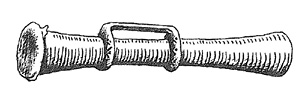
The violence along the Kumusi disturbed briefly the uneasy peace on the Mambare. According to Elliott, whose opinion was forthright but whose knowledge may have been slight, the Binandere had strongly resented Walker’s gaoling of the twenty-five men who took part in the raid on the Waria. Having been to the Kumusi and seen the clans there robbing carriers and hurling abuse at the foreigners, some ‘restless spirits’ among the Binandere attacked Tamata station in 1902. No European officer was present at the time and the police repelled the raiders with five shots. Elliott gave his ‘word of honour’ to the Government Secretary that if they came again ‘half of them will stop just where they may have the luck to fall — gaol is no good to them at present …’. The attack may have been an expression of Binandere bitterness and a test of the police defences; but it was scarcely a serious attempt to destroy the station. For the officers at Tamata the violence between miners and villagers on the upper Gira was more serious and more difficult to control.
The early miners on the head of Tamata Creek and the Gira saw no people in the area but during 1902 the men further west on the Aikora were constantly skirmishing with a community which they called the Seragi or Red Creek tribe. Driven out of their homeland on the Waria, the Seragi had moved to Red Creek, a tributary of the Aikora. A small group speaking a different language from their distant neighbours, the Binandere and Chirima, the Seragi lived in temporary shelters, planted little, and hunted over a wide area. In October 1902 the Seragi killed James Blackenbury and James Jassiack (Jimmy the Austrian). Both men had claims close to other miners who arrived too late to save them from sudden attacks. Jimmy, a ‘poor old man 65 years of age and as harmless as a child’, was too battered to move and his body was burnt; Blackenbury was buried by building a stone wall around him and covering his body with earth. Earlier in the year James Delaney, Fred May and two carriers had been wounded by spears, and camps had been robbed. Among the miners ‘all hands’ were crying for ‘blood’ and the government officers began organising a patrol which they called a ‘punitive expedition’. After attending divine service at Tamata three government officers, Halkett Parke, Walsh and Hislop, twenty-one police and a large crowd of miners and carriers left for the Aikora. On the fifth day they saw people who, by dress and physical appearance, the miners recognised as the marauders. So as not to alarm the Seragi, the police removed their uniforms, and two men who came into camp were held captive to prevent them from warning the rest of the community. Instructed to take captives and to fire only if attacked, the police attempted to surround a settlement. When seen by a woman, who uttered a piercing scream, the police and carriers rushed forward. Amidst the spearing and shooting four Seragi were killed and three women and some children were taken prisoner. Police on independent patrols during the next few days shot another ten men: ‘No rougher country could be imagined, & no prisoners were taken’, Parke reported. Although police, carriers and labourers could ‘muster some 18 or more languages’ no one could communicate with the prisoners. But having found saucepans, billy cans, tools, two rifles and other goods in the houses, some of them taken from Jimmy the Austrian’s camp, the government officers and miners were confident that they were punishing the right people. Unable to find sufficient food in the Seragi gardens, most of the expedition withdrew after a week on the Aikora.
Three years later the miners on the Aikora were again appealing for protection, and six of them signed a letter threatening to ‘take matters into their own hands’ unless the Seragi were stopped from robbing their camps. Government officers patrolled the area and police were stationed at some of the outer camps. But both miners and government employees found it difficult to stop the looting of camps and attacks on labourers. Men from the upper Chirima and Kambesi were also visiting the mining areas to trade and pick up anything of use from deserted camps. The Seragi were not constantly hostile: they maintained friendly relations with one miner while robbing and harassing another. Using prisoners taken on earlier patrols, Bell assembled the Seragi and told them that they must stop robbing the camps or be punished severely. There were only about 100 people to hear the government’s message. But no peace was made.
In 1908 Joe Sloane told Arthur Lyons, the Resident Magistrate at Ioma, that he and his partner Charlie Ericksen had been living with two women from the Waria: the Seragi had looted their camp and abducted the two women. Sloane admitted that in an attempt to arrest some of the Seragi, he and Ericksen had killed two men. From camps in the area the Seragi had stolen four rifles, a shotgun, a revolver, ammunition, and other goods, and killed a labourer signed-on to John Butler. The Seragi may have had a specific reason for killing the labourer: Butler had been feeding his men on their gardens without paying them, an action which angered the other miners who feared that it would stop all trading and lead to violence. Lyons sent a rifle and ammunition to Ned Ryan, who was left without protection, and instructed Corporal Bokina and five police constables to work with a few Seragi men who remained friendly with the miners to recover arms and arrest the murderers. Patrol Officer James Keelan followed the police to the Aikora and while he waited about the mining camps Bokina captured ten Seragi men, and Domata, recognised as the leader of those Seragi still working and trading with the miners, brought in two men supposed to have killed Butler’s labourer. In great ‘jubilation’ Keelan and the miners contributed tins of meat and jam to a feast for the police and Domata’s men; and to demonstrate further ‘how good boys are treated’ he rewarded Domata with trade goods and put the prisoners in irons for two days. Lyons was disturbed by Keelan’s graphic history of events at Aikora. He pointed out that the government punished men only after they had been found guilty at a trial: it was Keelan’s duty to make friends with the Seragi, not to intimidate them.
During 1909 the Seragi decided that they would be government men. Domata was appointed their first village constable. On a site above the Aikora about fifty people began building a permanent village, their houses, a government officer noticed, were the same design as the huts built by the miners on their claims. The Seragi fulfilled their first obligation to the government by using their skills to build vine and bush-timber bridges across the Aikora and Gira Rivers. Domata held office for only four months. He was murdered by a released prisoner he was escorting from Tamata to Sloane’s camp on the Aikora. Lyons hoped that the Seragi would develop into ‘useful people for road work in and around these localities’. It was a lowly station which they did not have to accept, for after ten years of skirmishing with the miners the Seragi had changed their ways just as most miners left the area. The Seragi too abandoned the Aikora, perhaps because the gardening land was poor, and settled on the headwaters of the Eia River where optimistic government officers attempted to transform them into cash farmers by issuing them with rubber tree seedlings. The trees grew but the Seragi saw little cash.
Fighting spear, Orokaiva, after Williams 1930

Miners and government officers believed that the Seragi would not have continued fighting and thieving for so long had the lawless communities on the Waria been punished. It was true that the Waria killed seven labourers during 1908–9 and ‘punctured’ others, and it is possible that the Seragi knew about the actions of peoples with whom they shared a language; but some of the Waria communities had been ‘punished’.
By as early as 1903 miners had crossed from the Aikora to prospect along the Waria. They found gold, but not in payable amounts. Then in 1906 Matt Crowe and Arthur Darling, with a strong party of thirty-five labourers carrying over twenty rifles and guns, left Finnegans Creek on the Yodda and passed through the Aikora to come down the south-western tributary of a large river. Through their labourers, who were able to persuade some local villagers to talk to them, the prospectors learnt that they were on ‘the Wariah for certain’. During July they travelled slowly upstream sometimes keeping close to the river and at other times crossing the spurs and creeks on the flanks. After a hurried trip to the ‘head’ of the Waria the prospectors came back downstream to Gamundu. They had not been attacked by any of the Waria people and they had frequently been able to barter for food. At Gamundu, which could be reached by canoe from the sea, the people had met other white men. Nearly four months after leaving the Yodda the prospectors arrived at Tamata.
Crowe said little to the miners eager for news of a new strike, but Darling admitted finding over 40 miles of shallow river beaches returning a few grains to the dish and ‘in places up to a quarter of a weight’. Looking for evidence to help them decide what to do the miners noticed that the prospectors did not apply for a reward claim, but this could be explained by the fact that Crowe and Darling ‘were rowing the whole time, and bust up as soon as they reached Tamata’. And both planned to return to the Waria. While the prospectors had been away some miners had recruited fresh teams so that they would be able to spend the full period of their labourers’ contracts on any new field. Now about twenty miners decided that although it was ‘nearly sure to be a tough affair’ they would make the long overland trek north-west to the Waria. One group of seven miners, 100 labourers, a government officer, twelve police and carriers left from Tamata, and another group started from Waterfall Creek, a tributary of the Gira. The miners quickly spread over many miles, racing up the valley of the Waria to work the richest patches and try the creeks coming in from the west. Men beyond Garaina were more than ten miles inside the German New Guinea border and nine days’ walk away from those men working downstream where the Waria looped south-wards into British New Guinea.
Back in Tamata after a year on the Waria the Pryke brothers, Frank and Jim, had 300 ounces. Fred Kruger, they thought, had more, but many had less. After a spell in Australia the Prykes spent another year on the Waria in 1908–9 and again won just on 300 ounces. But they decided they would not return to the Waria; as a goldfield ‘she [was] done’ said Frank. In the year of greatest production 1907–8, the miners had taken about 3000 ounces from the Waria, but their expenses had been high. Carriers took fourteen days to make the round trip from Tamata to the Waria, and the highest camps were too far away to be supplied by porters. Even on the middle Waria a miner needed to find a prospect giving more than half an ounce a day before setting to work. And after the government employed over 200 men to improve the Tamata-Waria track and Whittens put in a store at Jijingari, isolated miners could still work only if they traded with local villagers.
Villagers from the lower Waria had visited Tamata before 1906 and during the early months of the rush the first village constable was appointed at Gamundu; further downstream the village officials were appointed by Germans. The people of the lower Waria were ‘spear-men’ speaking a language related to that of the Binandere whom they met in trade and war. But on the upper Waria the people had developed a different culture, they spoke other languages and their main fighting weapon was the bow and arrow. Neither those living south of the river in British New Guinea nor those beyond Biawaria through to the Ono in German New Guinea had seen the foreigners from Tamata and the sea. Frank Pryke, one of the first miners to travel to the upper Waria, reported that another party ‘had some trouble’ and he was hampered by people cutting bridges, but never attacked. The vine bridges, ‘cobwebs’ Billy Ivory called them, nearly 100 yards long and swaying high above the water, were often the only means of crossing the turbulent Waria. The miners used them but had to carry their dogs across.
Needing to trade with the villagers, the miners and labourers were tolerant of men who were at first aggressive or who came to their camps out of curiosity. Frank Pryke wrote to his brother Dan in Australia:
There are a lot of villages and a big population of niggers two days up from here and I have established friendly relations with them. I have been up along the river to there on both sides; and I think we will be able to get plenty native tucker from there.
In his diary for 1908 he recorded frequent visits to his camp of ‘boys & gins’ bringing ‘a lot of tucker’. Local men carried for him when he shifted camp, and he made an entry: ‘One boy (Agunomi) started to work for me.’ The labourers added to the rations by shooting birds and game. But because of the divisions between the different groups on the Waria miners could trade with one community and fight another. In fact once they formed a close relationship with one village they were more likely to be drawn into local feuding, either by a friendly village inducing them to fight for them, or by another village assuming that they had joined their enemies.
On 20 October Frank Pryke noted in his diary that two of Coleman’s labourers had disappeared, ‘supposed to be eaten’. Two days later he wrote, Driscoll came up today — one of his boys killed by the Wakaia boys’. The Pryke brothers, Edward Driscoll, twenty-one labourers from south-eastern Papua and fifteen Waria men set out for Wakaia. Pryke’s diary, always brief, gives no indication of their actions at Wakaia, but the miners had clearly set out to punish. Describing another incident to his brother four months later, Frank Pryke was more explicit. One of Arthur Darling’s labourers was killed when he left camp to get water. Frank explained:
It was too late that night to do anything, but next morning Darling and I were among them just at daylight and gave them a bit of a shock, but I think by the way they got to cover they are used to being surprised or else they train for it … . Anyhow they suffered heavily in pigs and would also have to build fresh houses.
He described the people they had fought, probably from Guswei near the junction of the Ono and the Waria:
They are a rather unsociable lot and are armed with the bow and arrow or skewer as Darling calls it. These weapons are much better than the spear as a native can send them over a hundred yards on level ground, and in that open grass country they must be able to send them long distances down the sides of the steep hills. Of course there was no chance of the nigs making a stand against us in a fair go as we were well armed, I had a Lee Enfield, Automatic Winchester, and two ordinary winchesters and a shot gun and Darling was even better fitted out, but there are places about there where a large rock rolled with a bit of judgement, could wipe out an army.
At the time Frank wrote there were only seven miners still on the Waria. Soon after the Prykes left to recruit fresh labourers and look for another field: ‘we have’, Frank said, ‘kept our noses in front of Bill Whitten’s books so that is alright’. A government officer in mid-1909 thought that the ‘take per man’ over the past year had been about 200 ounces valued at £3.15s. an ounce.
When the miners first worked on the Waria they had been uncertain of the whereabouts of the eighth parallel of latitude which on maps clearly marked the border between British and German New Guinea; and they did not know what German officials would do to Australian miners found in German territory. In shifting backwards and forwards across the border the miners were violating the customs regulations of both colonies; they contravened the Native Labour Ordinance by taking their teams outside British New Guinea, and their Miner’s Rights purchased for 10s. at Ioma or Samarai gave them no authority to take gold from German New Guinea. The Germans responded to the border incursions and stories that their black citizens were involved in fighting by establishing a station at Morobe, just to the north of the Waria mouth.
In spite of rumours among the miners that the Germans would not let them reach the upper Waria by entering the river mouth, Governor Hahl on a visit to the area in 1909 told them that they were free to use the Waria for transport where it passed through German territory. German officials did not attempt to impose licence fees or collect customs dues. And they did undertake to punish the Wakaia. One member of the Papuan Armed Native Constabulary helped the Germans to capture four Waria men said to have killed miners’ labourers and then accompanied the German police and their prisoners to Tamata. There Lyons was perplexed by the whole operation: he could not read the letters in German carried by the police and he had neither evidence nor witnesses to use against the Waria prisoners. By the time most miners were leaving the Waria the German officials were displaying a lot of energy by proxy’; that is, they were compelling local villagers to cut a track from Morobe inland along the Waria Valley.
From their meetings on the border the Germans decided that the Australian miners were guilty of wanton violence; the Australian officials thought that the German officials were too ready to punish by shooting. The Reverend Percy Shaw of the Anglican mission on the Mambare complained that the German police were ‘Kidnapping women for immoral purposes’, and using their arms to intimidate and extort. Murray, after talking with Governor Hahl, wrote a general condemnation of his imperial rivals in his diary: ‘The Germans take any land they want without payment, also if the Government wants labour they simply take it, likewise women and food.’ But the two governments combined to place two teams of surveyors in the field to mark the boundary. Malaria, sago swamps near the coast and hail-swept mountains inland forced the Anglo-German boundary commission to abandon its plan to mark all the border where it followed the eighth parallel. After much hard work and nearly a year in the field the two teams had erected only a few posts and cairns at significant points. Several times the police and government officers with the Australian surveyors had fought off people who objected to the foreigners crossing their lands. They reported that they had fired mainly to frighten and had killed no one. By the time the surveyors decided that most of the bed of the Waria known to contain gold-bearing wash lay in Australian territory there were only four alluvial miners left to rejoice at the news. Men who held dredging leases may have thought it an important decision; but they soon found that their leases were worthless.
When Australian troops replaced German officials in 1914 the people on the upper Waria were still beyond the area administered from Morobe station. They maintained their stockaded villages, fought each other, and they fought the patrols directed by Australians which entered their valleys in the 1920s. By that time the Lutheran missionaries, who had come early to the coast, were well established on the middle river and had walked beyond the headwaters of the Waria and on to the Bulolo.
The lives of most peoples of Papua and New Guinea who lived in mining areas were profoundly changed, and even after the alluvial miners moved on they immediately faced other agents of change. But the people of the upper Waria had had only a brief encounter with the miners. They had fought them, traded with them, and perhaps a few men had worked for them and a few women had slept with them. It was more than ten years before foreigners again lingered in their area. The coming of the miners had been more of an interruption than a revolution.

As on the Mambare in the 1890s, the fighting on the Kumusi and the Yodda was not simply a clash between villagers and foreigners. The Kokoda Orokaiva fought the Mountain Koiari and the Beda, but the most violent encounters were between alliances of Orokaiva clans. On his pioneering patrol to the Yodda in 1900 Armit counted 102 houses burnt at Sisireta; the gardens were devastated and everything of value taken. In 1901 Walker, travelling with a strong patrol near the Kumusi mouth, passed through numerous deserted villages and pillaged gardens. He saw many people suffering from spear wounds and he was told that thirty-three people had just been killed on Mangrove Island. The first patrols to mark the track from Kokoda to Buna crossed country which was, in Monckton’s colourful prose, the ‘theatre of constant warfare and scenes of cannibalism. Groups of cocoanuts and desolate stretches of fertile country, which were once the site of villages, were to be seen everywhere, whose inhabitants had long since passed into the cooking pot.’ The sight of plundered villages, the dead, and the bodies gutted and prepared for feasting gave miners and government officials a ready excuse for harsh actions: the people they were dealing with were savages, they bowed to force but never to reason or compassion, and they were killing one another at such a rate that lives would be saved if the government quickly imposed control. And again as on the Mambare, clans attempted to form alliances with the government, for protection and to direct the government’s power against their enemies.
The desperate grasp by clan leaders for government help can be seen in the journals of officers who may not have known what was happening. Walsh at Papaki wrote in May 1902: ‘The only natives near here that I can really depend on are the KOROPATI tribe. They bring in far more food than any other tribe and if I tell BAIWA (V.C.) to do anything I find it is nearly always done at once. ’ In October Baiwa told Walsh that Koropata was likely to be attacked, but Walsh decided that no immediate attack was being planned. In December Baiwa and several of his followers were killed, Koropata destroyed and the surviving people scattered. Accepting his obligation to punish, Walsh led a patrol which shot at least fifteen villagers, but when he reached Baseta, thought to be the home of the raiders, he found it already destroyed by another warring group. It is possible that the intrusion of foreigners, upsetting old balances, and the increased movement that followed their arrival, had increased violence on the northern plains.
In brief asides government officers referred to ‘unofficial’ violence. Armit reported that Thomas Davitt, a Yodda miner, and his labourers were ‘visiting villages, shooting, looting and destroying’. After the killing of Campion and King the miners gathered strong punitive forces, but whether they punished anyone is unrecorded. In 1904 when attacks on camps were frequent and the Orokaiva wounded two miners with shotgun pellets, the government officers could not dissuade the men assembled on the Yodda from attempting to recover stolen guns and ammunition. Later Elliott reported that
they Had better Have stayed at Home it cost them 8 oz of Gold & they done nothing whilst they were out only frighten the Natives all over the Place they say they Had a good feed of Potatoes & Pig & got a lot of catridges & fly Calico Billy cans but that was all they told me.
The miners were not always so accidentally benign. On a patrol to the Koiari villages in 1906 Griffin noted the old site of Iworo which, he said, had been destroyed by the miners. He was probably referring to the village which Stuart-Russell had called Iuoro in 1899; it was then the ‘principal village’ of the communities living in the ranges over-looking the Yodda and inhabited by ‘Friends’. As late as 1909 Matt Crowe and James Lawrence, prospecting on the upper Kumusi, fought the Wawonga, a general name for several communities speaking Koiari languages. Lawrence ‘in the course of conversation’ said he thought that two spearmen were wounded. Later the Assistant Resident Magistrate at Kokoda heard that five men were killed and three others wounded. Although no one thought it proper to advertise the extent to which the miners used their guns, it is clear that for fifteen years after Clark fired to keep Binandere canoes at a distance, miners shot villagers on the Waria, Gira, Mambare and Kumusi. Sometimes they supported government forces and sometimes they acted independently or in defiance of officials.

The most numerous strangers encountered and killed by the Orokaiva were miners’ labourers. Between 1900 and 1910 there were always from 400 to 1000 Papuans from other areas working in the Northern Division. About half of them were carriers shifting rations and equipment to the mining claims. Some were employed by individual miners but most of the men lumping cargo worked for the storekeepers, Clunas and Clark and Whitten Brothers. In the 1890s Tamata was the start of the tracks: to MacLaughlins, the Gira and Aikora, and in 1899 and 1900 to the Yodda. Crossings, camps, swamps, steep climbs and outstanding physical features became well known to miners and carriers: the Calico, Double Crossing, the Four Mile, the Sisters and the Lookout. The Tamata-Yodda track was the worst for loaded carriers. Men struggled for hours in waist-deep swamps searching with their feet for the logs and roots which kept them above the mud. When floods made creeks impassable the carriers gathered in temporary camps until the water-level fell. Thirty years after the event Frank Pryke remembered how he had:
Tested all the reaches
Out to Finnegans and back
And fattened up the leeches
Away along the Bida track
By 1901 most men and rations reached the Yodda by going by launch up the Kumusi to Bogi where the stores stood on one point, the government station on another, and the boats anchored in the backwater between the two. The carriers walked for ten days from Bogi up the Kumusi, across the low divide and then down the Mambare to the workings on the Yodda. Most of the Bogi-Yodda track was flat, but some carriers lost their lives when the earth gave way on the narrow benches cut into the banks of the swift-flowing Kumusi. If the carriers went beyond the Yodda stores past Finnegans Creek towards Prospect and MacLaughlins the track became very rough with sharp ridges and boulder-strewn creeks.
The Bogi-Yodda track was the most dangerous used by the carriers. Even those manning canoes bringing stores up from Kumusi beach to Bogi were likely to be attacked or intimidated so that their packs could be looted. For the four years that the Bogi track was the main route to the field the carriers were never free from abuse and violence. When the track was first opened and all travellers were jeered at and threatened by large numbers of armed and decorated men, Clunas and Clark paid the government £10 a month to meet the costs of a troop of police to travel with their carriers. But after the escort was withdrawn attacks continued in spite of the efforts of carriers, miners and irregular government patrols from Bogi and Papaki. In August 1903 Elliott near Kokoda suddenly came upon thirty men chasing a carrier; the leading warrior had his axe raised ready to strike. Elliott fired: ‘I caught Him in the small of the back. He dropped at once.’ The police also opened fire, killing or wounding others. How many carriers were not saved by the opportune arrival of quick-firing government officers is unknown; their numbers were lost among the many who deserted or died of disease and malnutrition.
The Buna-Kokoda-Yodda track opened in 1905 was safer and easier walking. Many of the indentured labourers travelled alongside groups of Orokaiva who had agreed to carry. In July 1909 Beaver estimated that in the previous year over 1200 ‘local natives’ had carried on the Buna road for miners and storekeepers. With the rush to the Waria another long and difficult track was opened; and even after gangs had spent months cutting and forming sections between Tamata and Jijingari many Binandere, Waria and indentured men found the track to the upper Waria beyond their endurance.
The average size of miners’ teams increased from four or five in the early years on the Yodda and Gira to ten by 1909. The most energetic and successful miners such as the Prykes or others who ‘worked mates’ employed up to thirty men. On the claims the labourers looked after the sluice boxes, cleared away overburden and forked large stones from the alluvial. Once the most accessible deposits had been exhausted the miners began to work higher ground and stream beds. To bring water onto higher claims the labourers dug races, sometimes over a mile in length, and ensured a sufficient and constant flow by connecting creeks and building dams. In some places the stream could be brought across the gold bearing area to scour away the overburden and then the deposit could be ‘ground-sluiced’, a method which meant that the labourers did not have to carry the silts to the sluice boxes. The digging of races and exposing of new faces was ‘dead work’ to the miner; he might have to pay his labourers and buy stores for several weeks before recovering any gold. The labourers worked some creek and river beds by building ‘wing dams’ to divert the stream from successive areas. Where it was difficult to build dams the labourers tried ‘blind stabbing’, shovelling the alluvial from the flowing water while supported by vines against the current and boulders which moved underfoot and crashed against shins. On the Aikora and Waria the labourers were often forced out of working areas by floods which destroyed dams, races and sluices; on the Yodda dry spells were more likely to cause delays and the labourers had to dig longer races to draw on higher streams. In steep country heavy rains could cause landslides with hundreds of tons of mud and boulders sprawling across a claim, forcing the miner to abandon a working face. Where nests of boulders obstructed mining the labourers would have to ‘shoot the stones’. Holes to take explosives were cut with a hand-held drill and a heavy hammer, the gelignite and detonator put in place, and the fuse attached and fired. Sometimes big rocks could be shattered by ‘plastering’: the charges were laid on the surface and packed down with clay. By law a labourer without a permit could not handle explosives but some did set and fire charges when no white miner was at the mine site.
Early recruits on the Yodda and Gira were often new to mining work, but later many of the ‘leading boys’ and men in the teams were skilled miners. They knew how to set up temporary camps while prospecting, or build bush material huts and plant gardens when the miner decided to set in on a piece of ground. They adzed logs to make sluice boxes, and hunted, fished and traded to supplement stores. Some labourers from the islands were competent prospectors and went out with the dish and shovel to look for more payable ground. In 1908 Frank Pryke noted in his diary, ‘Most of the prospecting on the Waria appears to be done by boys’. There is a touch of disapproval from the son of a man who had mined on the goldfields of Victoria and New South Wales in the 1850s and 1860s.
The death rate among labourers, appalling in the early years on the Gira, declined slowly, but even in 1909 twenty-nine of the 729 labourers who spent at least part of the year on the Gira or Waria did not live to complete their contracts. On the Yodda where 806 men worked, eighteen died. Expressed as a percentage of the average number of labourers in the Northern Division the death rate varied from about 30 per cent in 1898-99, to 10 per cent in 1903-4, and even in later years was probably never less than 5 per cent. The Yodda was normally more healthy than the Gira. In 1905-6 the difference was most marked; the death rate on the Gira was 17.7 per cent against 5.6 per cent on the Yodda. Until at least 1907 the death rate was almost equally high among white miners. But ‘bosses’ and ‘boys’ died of different causes. Of the nine European miners who died on the Yodda and Gira in 1903-4 one committed suicide, one was killed in an accident and seven succumbed to malaria. The labourers had some immunity to malaria and while they may sometimes have suffered from fever, especially when they came in contact with new strains of the disease, it did not kill them. They died of dysentery, beriberi and respiratory ailments. The wide fluctuations in the death rate were largely a reflection of the prevalence of those diseases in the mining camps.
In 1896 Bill Whitten brought Lihoiya of Taupota and Tabe of Koira on the Opi to Tamata station. Lihoiya explained that he and another labourer, Yarumeku, had deserted while working for Simpson on the upper Mambare. By keeping in the bush they had passed Tamata and stolen a canoe from Ume, the first village downstream. At the mouth of the Mambare they left their canoe and began walking south along the beach. The Koira people, especially Tabe and his father, greeted the two strangers in a friendly way and allowed them to sleep in the village. But just south of the Kumusi they were attacked: Yarumeku escaped but Lihoiya, the stouter and slower, was caught and injured with club and knife blows. He was saved by a man from a village near Koira who washed his wounds and accompanied him back to Tabe’s house where he stayed until he was picked up by Whittens’ schooner.
Green set out to return Tabe to his home and look for Yarumeku. He found him living at Oreya village, south of the Musa and over 100 miles from the mouth of the Mambare. Yarumeku had continued walking along the beach, swimming rivers and avoiding villages. He again outran a hostile group near Oro Bay, and when he met Taniava of Oreya he was making his way homeward by canoe. Taniava, who had married into the Oreya community, knew a language spoken by Yarumeku. He acted as Yarumeku’s guardian at Oreya where most people suspected that he had taken part in the killing of Oreya warriors on the Musa.
Lihoiya and Yarumeku were two of the first labourers to throw aside their loads and begin odysseys which enabled a few of them to reach their home villages. Men who knew that they had to cross over 100 miles of country inhabited by hostile and warlike peoples, and travel a further 100 or 200 miles by land and sea to reach their kinsmen, chose to make the attempt. They decided that a tough journey and a slight chance of survival were preferable to the life they were leading. Wio of Rossel Island when asked, ‘What you do along Mambare?’ had replied, ‘Me been run away long bush; plenty boy dead’. Fifty-four men had gone from Rossel to the Northern Division, and Wio was one of about twenty to survive. Eight men from Cloudy Bay agreed to go to Samarai with Andersen, the trader from Dedele. Five signed-on there to work for Clunas and Clark and three for James Swanson, a miner. Boie, one of the men who worked in the Northern Division for Swanson, said that his two companions died and he buried them. Swanson had left him in Samarai at the end of his contract and after serving another year on Woodlark he had found his own way home along the southern coast. The other five men deserted on their first trip to the Gira, taking their loads with them. They were not seen again.
When Monckton opened the first government station at Cape Nelson on the north coast the police and nearby villagers frequently brought in men who had already completed the most dangerous part of their journey home. On 12 May 1900 he wrote in the station journal: ‘A runaway carrier from the Mambare arrived at daylight looking to be in the last stages of death by starvation and exposure he reported that seven companions had been killed on the road to here.’ Later in the month he reported arresting six deserters who were travelling in comfort; they had stolen a cutter and stores at the Kumusi. To encourage the people of the area to bring runaways to the station Monckton paid an axe for each man brought in. One group handed over to Monckton had stolen arms which they had used to shoot a village man and woman before they were captured. The practice of paying bounties for deserters was used on the Mambare too, but there some Binandere were guilty of extracting from the deserter any stolen goods he carried with him and putting him to work in the gardens before taking him to Tamata.
After the Kokoda-Port Moresby track was well marked, deserters from the upper Mambare hoping to reach the south coast could take a much shorter and safer route. Immediately Griffin learnt that the Gulf and the Western Division labourers knew about the road to Port Moresby he sent a message to the Koiari villagers informing them that they would get a ‘present’ for any deserter brought back to Kokoda. But a few days later a police mailman brought news that six men from Orokolo in the Gulf of Papua had already walked from the Yodda to Port Moresby.
Groups of deserters lived in the bush near the mining camps on the Yodda and the Gira. Perhaps they realised that it was almost impossible for them to reach home alive, or they knew that if they reached home, the gavamani would arrest them, make them work in prison and then send them back to complete their contracts. They lived by robbing gardens and camps and planting their own crops. A constant problem for the Beda, the deserters were an irritant to both sides in the general conflict between villagers and foreigners. Miners whose camps were robbed by runaway labourers blamed villagers, and peaceful trading relations between miners and villagers were disrupted by deserters pillaging gardens.
One measure of the rate of desertion is the number of men convicted at government stations in the Northern Division. It is an imperfect measure for it takes no account of those who escaped, were killed, or were caught and charged elsewhere, or not charged at all. And the figures are not available for the early years when the desertion rate was probably highest. Even so the number of men who chose to flee is high. From 1905-6 to 1908-9 about 200 men a year were convicted of desertion under the Native Labour Ordinance. In 1907-8 nearly 17 per cent of all men who worked for at least part of the year on the Gira and Waria were found guilty of desertion. Given the rates of death and desertion, there could have been few cases in which the men who signed-on were still together when they were paid-off, and there must have been many cases when at least half the team was missing.
Miners and government officers frequently said that the men threw down their packs and bolted for no reason. But given the knowledge that some labourers had of the foreign world and wage-labour, they had reason enough. Eni swam ashore from the Merrie England when he saw preparations for a feast and feared he might be eaten. In fact the officers and crew were preparing to celebrate Christmas, and Eni, his contract time having ended, was being taken home. Two Good-enough Islanders employed as carriers from Tamata to the Gira gave as their reason for deserting, ‘the road was too long’. Perhaps that alone was a sufficient reason, but it was more the answer of men with few English words to express their dissatisfaction than evidence that men absconded for frivolous reasons. And many men did have specific grievances: they were beaten, ill-fed or sick. A labourer, released from Ioma prison where he had served a term for desertion, was thrashed by his employer in front of the policeman who had escorted him back to the camp. Another man reported to Ioma with ‘ulcerated testicles in a very advanced stage of suppuration’; he said that he had received no medical treatment from his employer. Others worked on, their shoulders galled by loads and pack straps. Parke in February 1903 noticed that many of the carriers on the Bogi-Yodda track were ‘walking skeletons’. Two months later Elliott inspected Whittens’ carriers and, finding several too sick to work, helped the storekeeper hold them and dose them with medicine. Bellamy, on his way to the Northern Division goldfields, first encountered captured deserters at Cape Nelson. He was curious about the men working in leg irons, the few survivors of one or two months in the bush. Asked who they had been working for they replied ‘Bobstore’ (Whittens’) or ‘Alecstore’ (Clunas and Clark’s). After seeing the carriers at work Bellamy said that he now understood why some men deserted, were returned, and deserted again; gaol was preferable to carrying.
Bellamy suggested that there was a need for a government inquiry into the treatment of labourers in the Northern Division, but as he wrote for the Grey River Argus, a New Zealand provincial paper, neither his revelation nor his opinion had any influence. The few other independent observers who saw the labourers at work tended to accept that they deserted for trivial reasons. The Reverend Copland King wrote for the Sydney Morning Herald: ‘they dump their swag and bolt on the least provocation’. He added a salutary story: ‘One boy asked the magistrate to gaol him; he did so, and I saw the boy doing his morning’s work, carrying a bag of rice of 50 lb weight round and round the compound.’ Yet there was always some evidence that the many who chose to run were not irrational: the rate of desertion was highest where the tracks were toughest and sickness most common. Men who went to the goldfields ignorant of what work they would have to do or with false expectations were also most likely to desert. Wio and the other Rossel Islanders who went to the Northern Division in 1898 had originally agreed to go to Sudest where other Rossel men had worked for miners and storekeepers. At Sudest they were shipped to Samarai and from there to the Mambare. Ten years later the terror experienced by the men on the Mambare was well-remembered on Rossel. Owen Turner, Acting Resident Magistrate at Samarai, spoke to a man from Milne Bay who had just signed-on to work at Buna Bay; he was certain that he had not agreed to go near the Kumusi. Since the new road to the Yodda had been opened the recruiters had another name free of old associations to offer village men. Or they lied, telling the recruits that they were going to plant coconuts near Milne Bay and then inducing them to sign-on to go to the goldfields when they reached Samarai. In strange surroundings and seeing the recruiter as the only man who knew their home and how to get them there, they agreed to any suggestion. After talking to the crewmen on Edward Auerback’s boat and questioning many of his recruits, Campbell decided that Auerback had given his crew arms to impress and intimidate the villagers and instructed them to deceive the recruits about where they would have to work. Campbell thought it a ‘moral certainty’ that the men recruited by Auerback would desert immediately they reached the Northern Division. He fined Auerback and sentenced him to one month’s gaol.
The miners’ dependence on indentured labourers and the reluctance of men to go to the Northern Division was a situation equally open to exploitation by knowledgeable villagers. Nicolas of Fergusson Island schooled men to take the ten sticks of tobacco offered as an inducement to go to the Mambare and then swim ashore. He took five sticks from each man for managing the deception. After investigating violations of the Native Labour Ordinance, Campbell decided that he was dealing with ‘many scoundrels amongst the natives’ and a ‘few very blackguardly alleged white men’.
Each boat bringing government mail from the Northern Division to Samarai brought ‘as usual a sheaf of “Notices of Death’” of indentured labourers. Officers on patrol paid the next of kin trade goods equal in value to the wages due to the dead men. The payments helped communities tolerate the high death rate; they could release the recruiter from responsibility for the labourer’s death in the same way that a clan member guilty of injuring or killing a man could sometimes avoid retaliation against his group by paying compensation. But government officers were frequently asked for news of men who had left the village and not returned; and the officers could find no mention of the men in the labour records. The gaps in the records were a sign of the loose supervision of recruiting during the early years on the Yodda and Gira.
Recruiters’ agents were in danger when they entered the villages of men who had died while away. The people on the south coast of Fergusson Island killed a Suau man working for a recruiter in 1904. In their defence the Fergusson islanders said that three men had left their village for the goldfields, and had not returned, and no more would go. Two years later the people of a neighbouring village killed Inade who was working for James Swanson. Inade came ashore with Wai-iupa in a dinghy and joined a group of men talking near the beach. After a while Inade asked if anyone wanted to go mining. According to a returned labourer one of the group then jumped up and shouted, ‘no boy he go work Kumusi two boy belong me he go work Kumusi long time now, he no come back I no been get pay now I make you pay’. Rushing forward he tomahawked Inade. Wai-iupa fled as the group attacked the fallen Inade. The body was cooked and pieces distributed so that others would share the victory and unite against any attempt to inflict punishment.
Yet even when the death and desertion rates were high most men went willingly to the Northern Division and some went with a clear knowledge of the work and the conditions. By at least 1903 men from both the Eastern and Western Divisions were signing-on to go to the Mambare for the second time. There were even cases of men, rejected as being physically unfit, stowing-away so that they could go with their age-mates. Miners who recruited their own teams in the villages told them where they would be going and what they would be doing, paid them off in Samarai, made sure that they got value for their money in the stores, and returned with them to the villages, had little trouble persuading other men to try another year on the field. Often they could use their ex-labourers as unofficial agents.
In answer to the question, ‘What all something you been get along work for six months?’ Mai of Rossel Island listed his goods: one tomahawk, one axe, one sixteen-inch knife, one ten-inch knife, one blanket, one dozen matches, one small mirror, one wooden pipe, two pounds of tobacco, one shirt and two strings of beads. He had lost a few articles because the recruiter had returned him only to Sudest and there he had to pay men to take him home by canoe. The Rossel Islanders decided that they would never again go to the Mambare, but other communities decided that the rewards justified the risks. Villagers had come to depend on some manufactured goods, but they knew of few ways to get them: individual young men went away to acquire wealth, demonstrate their manhood, and see distant places. Men died on the goldfields; but some recruits left villages where men were still killed in warfare and all left villages which suffered periodic epidemics.
Early recruits for the Northern Division came from near the Fly River estuary, the eastern mainland and the islands. In 1904 and 1905 men from the Gulf of Papua agreed to go to the goldfields, but they quickly decided that carrying and labouring for the miners was not the way of life they desired; they broke their contracts and were inclined to be aggressive when instructed to be more diligent. The communities which supplied most of the men to work underground at Woodlark and Misima were the ones most ready to send men to the mainland fields. In 1903-4 over 600 men from the Eastern Division signed-on to go to the Northern Division, and most of those men were picked up by schooners moving about the bays and straits of the D’Entrecasteaux Islands.

While the labourers were the most numerous ‘foreigners’ on the goldfields and the miners and government officers were the nominal commanders, to the Orokaiva the police may have been the most distinguished, feared and comprehensible. In 1900 there were about forty men in the Northern Division wearing the blue serge jumper and red-braided rami of the Armed Native Constabulary: by 1908 fifty-five were attached to the stations at Buna, Kokoda and Ioma. When they had first gone to the Mambare most had carried Snider rifles, but in 1901 they began to be issued with the new Martini-Enfield and bayonet. Men were keen to join the Armed Constabulary. When the Anglican Bishop, Montague Stone-Wigg, accompanied Monckton to the Yodda in 1906, a man from Gona was prominent among the carriers. Monckton suggested that he might like to join the police. Excited at the prospect but appalled at Monckton’s obtuseness the man replied, ‘I have carried for you up the track and down the track. Now you wake up, and offer me the clothes!’ To collect their dark blue uniforms, recruits were sent to Port Moresby where they did their preliminary training. Having come before the Commandant of Police as the ‘rawest of savages’ they did a brief course in discipline, weapon training and patrol work before being sent to the out-stations. When the force was being built up quickly some recruits were given only one month’s training at headquarters, and they left Port Moresby ‘far from finished’. Many did not stay in the force beyond the contract period of two years. Praised for their physical endurance, bravery and loyalty, the police were also keen to shoot and loot. Under officers who could not, or would not, restrain them, they could be a ruthless force.
The nature of the country, the work the police were asked to do and the knowledge they possessed frequently put them beyond the supervision of white officers. The police alone manned the base at Mambare beach and in the absence of white officers they maintained other stations for long periods. On Armit’s patrol to the Yodda in 1900 the police often acted independently. On 7 February Armit wrote, ‘Today, not feeling over well, I sent Sergeant Tomu and six police to pay a few domiciliary visits. They returned at noon bringing in two flies, one long-handle shovel, and an adze.’ When the patrol left the Kumusi and crossed to the west of the Mambare Armit ‘sent the police out … to beat up the quarters of the natives who attacked us so wantonly yesterday. They came into collision in a gorge 1,000 feet above the camp, and six of the Twidians were hurt’. (Armit later admitted that ‘hurt’ meant ‘killed’.) Two days later, ‘The police while patrolling towards the gap [near Kokoda] were suddenly attacked by six natives four of whom came to grief. Armit could not stop the police from looting. ‘They glory in it’ he wrote, ‘and it is astonishing what awful rubbish they treasure’. Armit’s assurance to Le Hunte, ‘I always lead my men’, was either figurative or untrue.
The surviving monthly journals from Tamata, Bogi, Papaki and Kokoda show that over the next five years the police continued to act independently on short patrols, bringing up stores, supervising the cutting and improving of tracks, and taking messages to government officers, miners and villagers. In 1905 Monckton showed that there was a limit to the use of unsupervised police. At Kokoda he found that a troop of police had been sent on a night raid to a village to recover stolen firearms. Night operations, said Monckton, should only be made by picked members of the constabulary under the supervision of white officers.
Stone-Wigg was worried about the morality of the police. He told Robinson that married policemen should take their wives to government stations and ‘it should be laid upon [single policemen] to keep pure’. When Robinson said that he approved of ‘temporary liaisons’ the Bishop replied that ‘Self-control was the great lesson of life’. Apparently it was a difficult lesson to teach. John Stuart-Russell reported that he could not stop his police from procuring women, and he attempted to strengthen self-control by flogging one time-expired constable. As Chief Judicial Officer, Robinson could not approve all ‘liaisons’. On his first visit to Papaki he gaoled three constables for two years for rape, but he dismissed most of the charges of procuring women and terrorising the villagers. When the Papaki people were assembled (presumably by the police) they told Robinson they had no complaints. Some officers were even more tolerant. In 1905 Monckton found that the police at the Kumusi crossing had been given permission ‘to obtain and keep women there’. He thought this merely an ‘error of judgement’ by the officer.
It was easy for the police to abuse their powers. On Robinson’s first patrol through the Northern Division, Bruce left a troop of police at Papaki to strengthen the local detachment. When Robinson returned to the Division five months later he heard charges against four of them for murder. Corporal Kaio confessed that the Papaki people had offered him a wife so he had agreed to assist them in an attack on the Wasida Orokaiva who lived on the northern slopes of Mount Lamington. The raiders killed fifteen Wasida, whose bodies were eaten by the Papaki people. Corporal Kaio was sentenced to seven years’ imprisonment and the three constables were imprisoned for two and three years. In another case a month later Corporal Emanboga was supervising the movement of stores from the mouth of the Kumusi to Bogi. Corporal Bakeke reported that Emanboga had taken food from the stores and failed to pay his crew all the tobacco due to them. Later Elliott learnt that Emanboga had intimidated the villagers along the Kumusi either by waving a piece of paper which he said gave him powers from the government or by threatening to shoot people. At Batow he demanded a woman. When he did not get one, he asked for a pig, and finally he settled for head-dresses, betel and coconuts. Elliott decided there was no use putting ‘this Boy in gaol as he [had] been in to [sic] often’. He had in fact worked in the prison gang sent to Sudest in 1897 to build a road from the coast to the mine on Mount Adelaide Reef.
While police from other divisions could use their position for their personal advantage, once most of the police were recruited locally they had other motives. By 1906 forty-four of the fifty-three constables and six of the nine non-commissioned officers came from the Northern and North-Eastern Divisions. Their knowledge of the languages spoken by villagers and of local alliances and enmities gave them opportunities to manipulate government power to the advantage of particular groups. On the Mambare the men who joined the police were personally engaged in clan fighting before and after the arrival of the foreigners; in the area from Buna to Yodda most of the police were less immediately involved in local conflicts. But they alone knew the clans, alliances and boundaries; they alone could talk with fight leaders; and they told the government officers what they wanted them to know about the fighting in an area and the tracks patrols should use. Acting as forward scouts they could determine peace or war without the knowledge of the government officer. John Waiko has pointed out that in the clan histories which he has collected wars are remembered as being decided by negotiating and fighting between clans and the police; white officers are rarely mentioned.
By the time the Buna road was being built some Binandere, the first of the Northern Division people to join the police, were non-commissioned officers: they used the police not merely to protect the interests of clans along the Mambare but to re-establish that broader power and prestige of the Binandere lost in the fighting between clans and against the foreigners after the killing of Clark in 1895. At least twice Binandere policemen took the names of men they shot in distant parts of the division and gave them to members of their own families. It was a continuation of an old practice in which men appropriated the names of slain enemies, and an indication of the way the Binandere polisimani continued to behave as Binandere warriors.
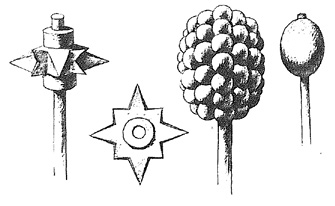
Five years after the early rush to the Yodda, when there were about 100 white miners in the Northern Division, the diggers had become a stable, if wandering, group. Men shifted frequently from one field to another, left to ‘spell’ and recruit new teams, but few abandoned the goldfields altogether and there was little excitement to attract new hands to the area. The Yodda, Bellamy wrote, was ‘a somewhat prosaic field … . It has been a steady-going field with few surprises, few fortunes, just a steady income for those who worked there …’. The miners knew one another: they met in the stores, in Clunn’s, the Cosmopolitan and Billy the Cook’s hotels in Samarai, and on recruiting trips around the islands; they waited together for boats and better weather; they drank together, played cards (billiards in Samarai), watched their dogs fight and shot the tops off bottles floating down the river. Many of them were over forty. They had followed alluvial strikes across salt pans and sand in Western Australia, through the rain forests of north Queensland and two at least had looked for a big strike on the Yukon in northern Canada. They came from varied backgrounds. One, MacKay said, ‘held a good position in Australia before he took up life in Papua; another was a rector’s son …’. Frank Rochfort, said Monckton, was ‘a born agitator and trouble maker of the de Valera class’. Barton, in more moderate language, agreed that Rochfort was a trouble maker but added that he was an ‘exceptionally well educated man’. Others found the pen more difficult to use than the pick and the pan. John Higginson recalled inspecting a claim and being handed a piece of paper on which a labourer had written, ‘Tommy, too much he fight’. The labourer had a means of communicating with the government officer without the knowledge of his master; for ‘Tommy’ could neither read nor write. On this occasion the labourer’s skill, acquired at the Methodist mission station on Dobu, won him no reward and enraged Tommy.
Hubert Murray, who first went to the Mambare as ‘Judge Murray’ in November 1904, thought that the miners were ‘very law-abiding’. Stone-Wigg supported his opinion:
I must confess myself an admirer of the digger, with all his faults. At first sight he seems nothing but a dirty swearing, drinking, spitting animal — on the higher side he is much enduring, generous-hearted, kindly and as a conversationalist both interesting and instructive. Again I noticed how well their carriers looked, and how kindly was the relation between the two classes. I must acknowledge that in this I was agreeably surprised.
The Bishop’s diaries give brief descriptions of the incidents on which he based his assessment of the miners. On 30 June the English prelate, educated at Winchester College and Oxford University, recorded a meeting in the disused store on the Gira field:
H. Osbourne & J. Ward there. Aft. J. Foley and T. Kelly came over fr. their camps. All very friendly & insisted on giving me gold, as Ivory and O’Brien had already done. After tea had some hymns. Neither Ward nor Ivory knew a single one, either the words or the tune. Finished with Bible reading and prayer. Ward has been drover, shearer, miner. Strong labour man. All quote the ‘Bulletin’ as tho’ it were Bible. Laughed a good deal at night.
Disputed claims were infrequent and gold thieving rare. Higginson, who served as Assistant Resident Magistrate at Tamata, wrote in the Lone Hand:
Isolated as they were, in one of the most God-forgotten spots on earth, the miners always supported and gave unquestioning obedience to an authority that must sometimes have seemed unnecessary and vexatious, an authority which had nothing but the feeling of the community to support it in reality.
In his capacity as warden of the goldfields for 1904, Higginson was called to arbitrate on only one case of claim-jumping; and the diggers imposed their own sentence by forcing the guilty man to leave the field. Away from centres of government administration and living according to a code accepted by all diggers, many men did not register their claims; but they did argue about water, and prudent men secured their access to creeks. The frequency of disputes in dry spells and the passing of ‘personal animosities’ when the rains fell gave rise to the common Yodda comment, ‘The more rain the less law’.
But Murray, Stone-Wigg and Higginson knew that there were scars on their portrait of the humane, generous, uncouth digger. In May 1904 Higginson reported that Harry Edmunds, a miner on the Gira, had come to Tamata to report that he had killed Mabie, a labourer from the Bamu River. After taking evidence from two other miners Higginson charged Edmunds with ‘murder under provocation’ and released him on bail. A month later three of Edmund’s labourers reported that he had shot Hakaia, an Orokolo labourer. While Higginson was preparing to go to the Gira, Edmunds arrived at Tamata where Higginson charged him with ‘wilful murder’. Two days later Stone-Wigg spoke to Edmunds at Tamata gaol. Afterwards he visited Edmunds’s camp, talked to the miners who had given evidence leading to the first charge, and ‘saw graves of the two natives [Edmunds] had shot … one accidentally, one apparently needlessly’. In November Murray heard the two charges against Edmunds; he found him not guilty on the first charge, guilty of manslaughter on the second, and sentenced him to one year’s gaol with hard labour. From his arrival in British New Guinea in 1904 until he gave evidence before the Royal Commission in 1906, Murray heard only two other cases against Europeans on the goldfields. He found Peter Lawson not guilty of shooting John O’Toole with intent to cause grievous bodily harm, and he sentenced Steve Woolf to death for the murder of Manewa, a decision which the Executive Council commuted to three years’ imprisonment. Murray had also tried one labourer who shot a miner and another who was charged with putting poison in his master’s tea.
These cases were one extreme of relations between miners and labourers on the field. At the other extreme was Joe Faulkner, an old miner working at Prospect Creek on the Yodda. He treated his team with gentlemanly consideration: ‘Won’t you have another cup of tea?’ ‘Let me cut you some more bread and butter.’ A bemused Hubert Murray thought that Faulkner’s men worked well for him. But most labourers learnt a tougher code of relationships. While they were working on the Waria Jim Pryke wrote a note to Arthur Darling: ‘I owe you an apology for helping one of your boys to rise with the boot. It was certainly a breach of the ordinance which gives every man the sacred right to “boot his own nigger”.’ The diggers had added to the unwritten law which they brought from Australia, for in New Guinea the miner was also a master. Rochfort, who mined on Woodlark before shifting to the Northern Division, explained his success as an employer to the Royal Commission of 1906:
In working boys there are three principal rules I work on —
|
1st. |
I see that they are well fed, and have a good camp. |
|
2nd. |
I don’t nag, am not brutal, nor do I expect them to work like machines. |
|
3rd. |
I allow no familiarities. Let the boys respect you, and when you give an order see that it is carried out. |
He claimed that apart from one gang of Orokolos who cleared out in a group no man had deserted from his service. The Commissioners found themselves ‘entirely in accord’ with Rochfort’s views, and decided that if the Papuans were treated according to his three principles they would ‘gradually own towards the higher race an affectionate respect’. There were cases of mutual respect, even affection, between miners and their leading hands: on the field miners and labourers worked together to defend and feed themselves, and the miners knew that their chances of securing more recruits depended on returning satisfied men to their homes. For many miners the ideal relationship was strong master and docile boy: it was an ideal tempered by self-interest and shared experience in isolated and dangerous country; it could also condone sinking the boot into a labourer thought to be lazy or cheeky.
The shared experience could be the capture — by strength, bribery, magic or guile — of village women. No miner legally married an Orokaiva woman, and Sloane and Ericksen, who lived with two Waria women for five months, abandoned them when they heard of a new rush on the south coast. But some miners and labourers were eager for quick pleasure. Opportunities were few on the Gira and Aikora but sometimes they were there to be taken on the Mambare and sections of the Yodda track. After Stone-Wigg publicly criticised the miners for ‘loose living’, King called a meeting of all white miners at Tamata in November 1900 to defend his Bishop and reduce the miners’ hostility towards the missionaries. The thirteen men who gathered in the cookhouse of Whittens’ store to argue with King and the Reverend Frederick Ramsay made a rare public declaration of their sexual morality.
King told the meeting that on the night before a miner had pursued a prostitute near the mission station, but that she had sworn at him and sent him away. The miners accepted that King’s description of events was probably correct; such things happened. When King asked whether they approved of the miner’s actions, one man said he did not and all the others thought no harm was done if the miner did not use force. Some added that they did not have sexual intercourse with village women but they did not condemn those who did. In a sharp debate the miners then accused the missionaries of condemning all miners for doing what some scorned to do; declared that the village women saw no wrong in such things; asked why the missionaries did not criticise the government officers who lived with local girls; and, arguing that it was not in man’s nature to be pure, challenged the missionaries to name six men who ‘had not had connection with women before marriage’. When the miners became more aggressive King said that his colleague would accommodate anyone who wanted to fight. Ramsay, who was known to combine ‘calisthenics with religious and secular education’, doubted his capacity to handle the miners either in a group or in succession, but the miners chose to battle in words. King countered with the charge that the storekeeper had offered a ‘large sum’ to break the ‘taboos’ of the Mambare women, and that if the women did not know right from wrong the woman of the previous night had chosen to spurn the miner. Joe Sloane then admitted that he was the miner involved; he had been misled into believing that getting a woman was ‘an easy matter’. Whitten declared that of course the missionaries and miners would never agree about women, and the meeting of frank testimony ended with Sago Bob Harrison making a witty remark which the missionaries chose not to write down. Among the children of Papuan mothers and foreign fathers gathered at Ganuganuana by the Anglican missionaries were several who were the sons or daughters of miners; nearly all the mothers were from the south-east or the islands.
At Papaki where there were no missionaries to question the morality of miners, officials or police, Monckton found ‘shameless prostitution’ of women. Halkett Parke, arriving unexpectedly at the police barracks in the evening, saw the women ‘clearing off into the bush’. At other times the police at Papaki were charged with rape and abduction, and the villagers were accused of pandering. Four Yodda miners took a ‘holiday’ at Papaki over Christmas 1904, and the next year Monckton ordered the removal of two Papaki women from William Parkes’s camp on the Yodda. But from the limited evidence available it seems that the opportunities for sexual adventure were fewer for miners and labourers than for the police.
Miners complained to government officers about the government’s failure to protect them, the lack of roads, and the labour laws. William Durietz in 1906 suggested a plan to curb troublesome ‘boys’ on the Gira:
There is only one way of doing it, and that is to chase them out of the district — disperse them!
Meaning?
Well, I mean they should be fired at, or something like that.
To those miners who passed through the lands of perhaps 10,000 people to reach their claims and were then dependent on local trade to stay in the area, Durietz’s policy was neither just, practicable nor desirable. Most other miners demanded that the government be more effective, but apart from pointing to particular officers who were lazy or incompetent they could not say how the government could provide quickly cheap labour, roads and safety.
The miners thought that labourers were too hard to get, too hard to control, too expensive, and on the goldfields too briefly. They wanted the government regulations amended so that recruits could re-engage at the end of their contract without returning to their villages, the time during which a man deserted was not counted as part of his contract time, the contract did not begin when a recruit left the village but when he signed-on, the cost of stolen property was deducted from wages, and employers could cancel the contracts of unsuitable men without too much trouble. To recruit, feed and pay a labourer on the Yodda cost about £60 a year in 1904. As the average miner had at least five labourers and he was paying £1 16s. for a bag of rice, 1s. 6d. for a tin of meat for his own sustenance and £1 for a bottle of brandy for pleasure at the Yodda store, he needed more than 100 ounces to cover his costs. By agreeing to set the minimum wage for miners’ labourers at 10s. a month, Robinson effectively reduced wages to that level for all except ‘leading boys’. For a miner who previously may have been paying £1 a month for ten men the saving was significant. Many other specific grievances of the miners were met by the Native Labour Ordinance of 1906, but at the same time other regulations were introduced to protect recruits from abuse. Yet even as the legislation stood in 1909 only the most gross cases of physical discomfort were illegal. Before a man could be recruited for mining or carrying in the Northern Division he had to be at least 31 inches around the chest, he could sign-on for eighteen months only (although most men still chose to sign-on for one year), and he had to be issued with two yards of calico, swag slings and four loin cloths every twelve months. He was not to carry more than 50 pounds (plus his food and calico), or if he had to travel more than 12 miles in a day his load was not to exceed 30 pounds; and if he was carrying regularly on the Buna-Yodda or Tamata-Aikora tracks he was to have thirty-six hours rest between trips. The labourers on the claims were not to work more than fifty hours a week. At about a halfpenny an hour, it could still be a hard life.
Writing in 1908 to Atlee Hunt, the Permanent Secretary of the Department of External Affairs, Monckton was pleased to be able to say that the government officers seemed to be neither more efficient nor united after getting rid of the ‘effete scions of aristocracy’. Before he retired to New Zealand where he found contentment looking after his hunters, bulldogs, dachshunds and prize pigs, Monckton had been placed by his opponents amongst those officers who were British, pretentious and unpractical. But in his books Monckton presented himself as a man of action impatient with a niggardly bureaucracy and those officers unable to make quick decisions. He assumed the ideals of the English sporting gentleman; he did not like to take advantage of those unable to defend themselves, but there were times when the natives were all the better for a thrashing. He formed closer relationships with New Guineans and he spoke more generously of their abilities than most Europeans of his time. At all times Monckton cast himself as the master with absolute powers; just, firm and terrible in righteous anger. To his police and to the Kaili Kaili and Binandere people he was ‘The Man’; they gave him their unquestioning loyalty, they would die for him. While they were surrounded by ‘hundreds of stalwart natives’ near Kokoda, Monckton told MacKay:
Nothing can happen to me in this part of New Guinea until these ten men [of Monckton’s personal police guard] have been killed, and if they and I were killed, the news would spread fast, and from the German frontier to Cape Vogel the tribes would march to take a bloody vengeance … . That small escort of mine is but the point of many a thousand spears, and the people know it.
Monckton was pleased that his police would interrupt receptions at mission stations and Government House to check that The Man was safe. Several times he reminded his readers that a Kaili Kaili or Binandere attendant slept close to his door. Monckton’s picture of himself as the masterful governor and his police as brave, faithful, efficient servants nourished his own sense of importance; but it was inaccurate. While Monckton was active and aggressive, his police were not mere instruments; sometimes they manipulated him (and others) to their advantage.
Griffin, less energetic than Monckton and more inclined to expect preferment by calling on his background of being an old boy of Harrow school, an officer in the British Army and habitué of the best clubs, could more aptly be criticised as an effete Englishman. To his credit he was less violent than Monckton, and he worked patiently to improve relations between some peoples and the government in the Northern Division. To his discredit he was involved in the sale of bird of paradise feathers while still a government officer, and the virtuous tone of his reminiscences was undisturbed by any mention of the children he had fathered in Papua.
Opponents of British’ officers praised Australians, who were thought to be tough, practical bushmen. Kenneth MacKay praised John Higginson. ‘Young Australians of this type’, said MacKay, ‘are the men to send to Papua where an ounce of practical experience of how to make the best of things is worth a ton of theory.’ Monckton was less fulsome in his praise:
J.B. Higginson was a man who had served with the Australian forces in the Boer War, with, I believe, distinction, and should have been a very capable officer; but unfortunately he had returned with a fixed idea that any Englishman was firstly a fool, and secondly an awful snob, and generally inferior to Australians. In fact according to his idea, any Australian in six weeks’ time would be capable of replacing the admiral in command of the Atlantic fleet, or taking over the See of Canterbury from the Archbishop; and he really believed these things.
In a review and in the discussion which followed the publication of Monckton’s first book Higginson had made his public comment on the author: he was an efficient officer but his ‘flamboyant posturing [had] made him, in his day, the laughing-stock of his contemporaries in Papua, official and otherwise’.
In fact the distinction between ‘Australian’ and ‘British’ officers was forced. It was partly imposed by men concerned with the political change from British New Guinea to Australian Papua, a change long discussed in the Australian federal parliament and formally announced in Port Moresby in 1906. Australian nationalists wanted Australian officials, and they invested them with special qualities and stressed their differences from British officers. The distinction was forced too when applied to particular men. Elliott, an Australian, was not like the literate, practical Higginson. Except when disabled by malaria or squashed testicles after he fell legs-astride a log bridge, Elliott was active enough but he was deeply conscious of his own inadequacies once he entered the office. Unable to spell or mark the beginning and end of sentences, he was also reprimanded for his choice of words. Robinson told him not to use ‘sporting parlance’ when he wrote about killing and wounding, or to advocate in his official reports the kicking of village constables so that they would be unable to sit down for a week. Illegal acts which other officers glossed over or used to present themselves as forthright men of quick decision, became brutal and thoughtless in Elliott’s awkward prose.
Other officers were neither ‘British’ nor ‘Australian’. William Armit was born in Belgium in 1848 and probably trained as a soldier before migrating to Australia. A tough, experienced bushman, writer of ‘first class alligator and nigger lies’, naturalist and dismissed officer of the Queensland Native Police, he was a man of many talents and wild irresponsibility. After his death Murray heard stories that he had been naked and drunk while he drilled his police and had used crucified captives for target practice. Rayner Bellamy was certainly ‘British’. Having left Cambridge and Edinburgh Universities without taking his final examinations in medicine, Bellamy tried acting as a career and then went to New Zealand where he worked as a journalist. After joining the British New Guinea government service in 1904 he was always about to return to England to complete his medical studies, but did not in fact do so until 1917 when he was on leave from service with the Australian Imperial Force in France. Universally liked, Bellamy was praised for reducing the death rate among the labourers on the Yodda. The miners asked him to stay on the Yodda as a doctor. When he said that he was not fully qualified they replied, ‘half a medical man was better than none at all’. At the end of six months’ service in the Kokoda area Bellamy made a careful assessment of the Orokaiva people and government policy. It was, he said, a mistake to treat the Papuans as though they possessed ‘all the cardinal advantages of a
20th century intelligence’. They regarded kindness as weakness, they were to be treated firmly, and they had to learn that all disobedience would inevitably bring punishment. At the same time he wanted to dissociate himself from ‘the attitude expressed so forcibly in “bloody nigger’”. Bellamy was humane and paternalistic; he believed he had the knowledge and a duty to chastise, protect and improve Papuans. He chose to stay in the Australian government service, spending much of his time until his retirement in 1937 working to reduce venereal disease in the Trobriand Islands.
The actions of Joe O’Brien caused miners and government officials to declare their beliefs about the proper behaviour of white men on the goldfields, and briefly awoke a wider audience to events in the Northern Division of British New Guinea. Little is known about O’Brien’s early life. A Queenslander by birth, he was probably about twenty-five years old in 1905. According to Griffin, who was his gaoler for a month, O’Brien was a ‘fine looking man’. For a number of years he worked on the Gira and Yodda Goldfields where he acquired a reputation for his bushmanship and his intense hatred of Papuans. When his fellow miners wanted to praise him, they recalled that he was ‘one of the foremost to give his services in the protection of this small community from the depredations of surrounding natives, and assisting to avenge some of the brutal murders that [had] occurred’. And when David Rennie, a miner suffering from delirium tremens, was lost in the bush O’Brien found him and brought him back after others had abandoned the search. By 1903 O’Brien’s other activities had provoked Hislop, the Resident Magistrate at Tamata, to boast that he ‘would make it hot for O’Brien’. Having failed to make it hot for anyone, Hislop was asked to resign. In 1904 O’Brien gave some gold to Bishop Stone-Wigg and later was arrested and charged by Charles Higginson with assaulting Ingala, the village constable of Kuma, who had attempted to stop him seizing a village woman. Three of the witnesses from Kuma also claimed that O’Brien had threatened Ingala with a rifle. Having heard the evidence of four Kuma men, Higginson found O’Brien guilty of assault and fined him £5. O’Brien also appeared in court as a witness for the Crown against Harry Edmunds, who had shot two of his labourers. O’Brien was not permanently attracted to His Majesty’s side. Already there were rumours among the miners that O’Brien had captured a deserter from Jim Wallace, appropriated some stolen sovereigns carried by the man, knocked him on the head with a tomahawk, and thrown the body into the Gira. Summonsed for debt by Whittens, O’Brien paid nothing and shifted to the Yodda. There he asked for time and labour, but received neither. Rochfort’s Orokolo labourers, briefly under O’Brien’s control, deserted at Buna, stole the government whaleboat and were eventually picked up at Cape Nelson. The only debt O’Brien paid was two tomahawks and two pounds of tobacco to the people of Buna; compensation for the pigs he shot when they refused to carry for him. With some assistance from Griffin and Bellamy, O’Brien, barefoot, carried his own swag back to the Yodda where by threatening violence and asking for another chance he tried to evade Whittens’ summonses for debt. In April 1905 his attempts to gain time ended.
Shortly after the event, Monckton and Bellamy gave five accounts of their arrest of O’Brien: both described the incident to the Royal Commissioners, Bellamy wrote of it in the Kokoda station journal, and Monckton made a report to Barton and kept his own journal. All are in basic agreement. On 15 April Constable Motu, sent to obtain carriers, returned with five ‘weedy’ men; all others refused to come because they wished to attend a dance. Corporal Bia and five policemen equipped with handcuffs then went out and brought in enough carriers. The next morning, a Sunday, Monckton, Bellamy, eight police and the carriers left Kokoda station for the Yodda. Most of the miners were out shooting or resting at the stores where they could talk, drink, play cards and listen to the gramophone. Bellamy knew O’Brien and had visited him on the Two Mile only a week earlier. When they arrived at his camp, O’Brien was either reading or asleep and did not see Monckton and Bellamy enter his hut. He offered no resistance as Monckton arrested him for assault; in fact he told Monckton he would have gone to Kokoda on a summons, and pointing to the police he said, ‘You need not have brought those black b.........s’. Having heard the general talk that O’Brien intended to shoot the first man who tried to take him in, Bellamy was surprised at the ease of the arrest. They took O’Brien to a camp on the Yodda where Bellamy, under Monckton’s instructions, put leg irons on him for the night. It was the act, said O’Brien, of a person who ‘had no respect for a white man’. The next day O’Brien was put in Kokoda gaol.
After hearing three cases against O’Brien on 18 April, Monckton found him guilty of assaulting a policeman and a carrier, and dismissed the third charge. Monckton had accepted the testimony of several Papuan witnesses in the face of O’Brien’s denials or explanations. O’Brien was sentenced to two months’ hard labour for both offences and informed that at the next sitting of the Central Court he would face charges of:
Robbery of gold to the amount of £1,000 [from Whittens’ Kumusi store]
Shooting with intent to murder, two charges; Arson, two charges;
Rape;
Unlawfully destroying dogs and pigs, the property of natives, six charges.
When witnesses were brought from distant areas, O’Brien was to be charged with murder and officers were to investigate complaints by the managers of Whittens’ stores that O’Brien had been continually threatening to kill them.
In spite of O’Brien’s claim that he would die if sent to work in the sun, Monckton instructed Griffin that O’Brien, guarded by two members of the Armed Constabulary, was to clear scrub. But when O’Brien’s hands were blistered he worked inside copying out forms where he was ‘very useful as his writing [was] neat’. One month after entering Kokoda gaol O’Brien spent the day transcribing labour forms. On the next day, 18 May, Griffin sent him back to cutting scrub under the supervision of one policeman, Griffin’s old orderly, Constable Dambia. The rest of the thirteen police on the station were either supervising Orokaiva labourers in another section of the garden, improving tracks, sick or under arrest. Soon after starting work O’Brien hit Dambia several times on the head with a tomahawk, and taking Dambia’s rifle but no ammunition, disappeared into the bush. From J. Aitcheson’s camp, one of the first on the Yodda road, O ’Brien ‘took forcible possession’ of a revolver and ammunition. That night he visited Rochfort’s camp where he made a ‘statement’:
I was treated like a dog at Kokoda gaol. They gave me bad taro and dirty unwashed rice to eat. They made me work all day, and put black police over me with rifles.
They allowed the black police to walk around the gaol at night and call me filthy names, and I had to submit to such indignities that I would rather lose my life than stand it any longer. The black policeman told me to work plenty. I struck at him with my hand, my foot happened to slip, and he struck me in the forehead with a tomahawk. Then I knocked him down and cleared with the Government rifle. I would go back, but I believe they have natives retained to swear away my liberty, and that I would have no chance of getting a fair trial. I am fully armed, and will shoot any man who tries to arrest me, but otherwise will injure nobody.
Rochfort said he tried to persuade O’Brien to return but he ‘preferred death than suffer the indignities that he had to undergo under the native constabulary’. After Rochfort dressed his head wound, O’Brien ‘departed in the night’.
Dazed and bleeding profusely from head wounds, Dambia eventually attracted the attention of two constables. Sergeant Barigi roused Griffin from the office and he sent armed police out to search for O’Brien. After attending Dambia’s wounds, Griffin sent a letter to Monckton at Tamata and messages to the villagers telling them that if they saw O’Brien they were to report to Kokoda and if ‘he shot at them they were to spear him’. Two police took notices to Yodda to display at the stores telling the miners that they were ‘perfectly justified’ in shooting O’Brien if he failed to stand or go in front of them to the police.
Rochfort wrote to Griffin telling him that O’Brien had visited his camp and left without saying where he was going. Co-operation between some miners and government officials ended at that point. On 2 June Griffin went to the camp of B. Reynolds and G. Arnold on Klondike Creek. Arnold’s cook, Lavai-i, told one of the police that Arnold had fed O’Brien for several days and Griffin heard that Arnold had threatened to kill another employee who helped the police. Reynolds declared that if O’Brien asked for anything he would get it, not because he sympathised with O’Brien but because O’Brien would shoot anyone who refused his demands. Monckton, after investigating Lavai-i’s statement, decided that although Arnold’s behaviour was suspicious there was no clear evidence that he had assisted O’Brien. Government officers kept a watch on tracks leaving the goldfields and on shipping on the north coast. Among the miners there were rumours that O’Brien had been seen in Yule Island, German New Guinea, Brisbane and Singapore; but nothing definite was ever known and he may have died in the Northern Division.
Some miners, already resenting the fact that O’Brien had been guarded by the police, objected when Griffin sent armed police to hunt him. Les Joubert, Clunas and Clark’s storekeeper at the Yodda, wrote a note to Rochfort:
The A.R.M. is not satisfied in putting us under black martial law. One of the black police actually sent word by my cook last night saying that no white man should go out at night for fear they would be shot in mistake for O’Brien. I sent up and advised them in most emphatic way that on no account were they to bang bullets about in this vicinity, unless they knew what they were shooting at. It seems that the police are getting as good as their boss at issuing proclamations.
At the store the next day twenty-three miners decided to tell the Minister for External Affairs of their grievances. They objected to a white man being forced to work with ‘a black policeman as boss standing over him with a rifle’. The policeman, ‘the naked savage of yesterday’, was as good or perhaps better than could be expected but ‘it acts like a dagger in the heart of a white man when he knows that the poor ignorant savage is placed in authority over him by his own fellow white men’. The miners said that the evidence of ‘every black witness’ was totally unreliable and any white man charged with a crime should only be brought before a magistrate ‘in the hearing of white men’. The letter was signed ‘on behalf of the miners’ by Martin Gallagher and Dan Horan.
Barton forwarded the miners’ grievances to the Governor-General with the assurance that the ‘better class miners’ held a ‘very different opinion’. O’Brien, said Barton, was a troublesome criminal who would not have been permitted to stay on a goldfield by miners in a more civilised country, but the Yodda miners were afraid of him. Not infrequently, Barton observed, one met miners like O’Brien, men who expressed ‘the utmost repugnance for the natives’ yet had ‘the least reluctance in making use of native women to satisfy [their] sexual appetite’. Barton enclosed details of O’Brien’s appearances in court at Tamata and Kokoda, the record of an inquiry into his escape and point by point a refutation of the miners’ case written by Monckton in the prose he was later to use for dramatic effect in his books.
Monckton said that O’Brien had eaten the same food as Bellamy and Griffin and had been well-treated by the police. He agreed that
‘black savages’ be not placed in authority over white prisoners. I hardly think, however, by this the miners can mean the members of the Armed Native Constabulary, to whom the present security of life and property on the gold-field is entirely owing.
While he regretted that ‘natives’ did not always tell the truth in court, he thought they were not alone in this respect. Trained and experienced officers, he said, were better fitted to judge the value of evidence than miners ‘by whom the evidence has not even been heard’. Having reminded His Excellency that Clunas and Clark’s place of business was licensed to sell intoxicating liquor, Monckton supported his superior’s belief that the miners’ letter did not express opinions generally held on the field.
Barton forwarded two other statements from the Yodda miners to the Governor-General. The first was a letter from Rochfort to the miners advocating that they petition the government condemning the ‘superabundant energy’ officers displayed in hunting O’Brien, who was known to be guilty of only minor crimes, while the murderers of Jassiach and Blackenbury, killed three years before on the Gira, remained free. The second was a statement by ‘residents of the Yodda’ who did not condone the offences of, nor sympathise with, the escaped prisoner, O’Brien. It was signed by seventeen men, the first being William Little, member of the Legislative Council, and included were some of the best known miners on the field: Mark Royal, William Parkes, Matt Crowe and Hugh Clunas.
In August Senator Staniforth Smith of Western Australia gave a long and eloquent exposition of the O’Brien case in the Federal Parliament during which he was occasionally interrupted by the chairman attempting to maintain a quorum. Smith was unique among members of the Federal Parliament. He had travelled widely in British New Guinea and written to advertise its attractions and wealth. He had walked from Bogi to Kokoda, he was at Kokoda station while O’Brien was evading debt-collectors, and, prostrated by fever, he had been carried part of the way back to Buna by conscripted villagers. Smith objected to Griffin’s notice at the Yodda stores which ‘outlawed’ O’Brien and pointed to the wider implications of O’Brien’s treatment. ‘The whole government’, said Smith, ‘… rests on one word, “prestige”.’ Forcing O’Brien to cut scrub, ‘an occupation which no one but a native ever undertakes’ would ‘revolutionize the views of natives in regard to the power and prestige of the white man [and make him] an object of contempt rather than of respect … as he should be’.
In the brief debate which followed Thomas Playford of South Australia said that O’Brien was ‘unmistakably a bad lot’ and he had not been under the control of black gaolers. Smith replied that O’Brien may not have been the fiend described by Playford and as he escaped by attacking a black guard presumably there had been one. One Senator, John Gray of New South Wales, cut through the arguments by saying that he could not see ‘why a man, even though he is not white, should not have the necessary power given to him to uphold the law’. No Senator rose to support him. The papers relating to the administration of justice in the case of Mr O’Brien, British New Guinea, were tabled, printed and forgotten.
Speaking of the man who was soon to be his rival for the Lieutenant-Governorship of Papua, Smith told the Senate that the miners respected Murray, and would accept a report from him. When asked for an opinion on Griffin’s declaration that the miners had the right to shoot O’Brien if he resisted arrest, Murray decided that it had no basis in law.
By the time the two most vigorous Royal Commissioners reached the Yodda they found that the miners were not greatly interested in the events of eighteen months earlier. In their Report the Commissioners quoted a statement made by Horan in the presence of the miners: ‘We [the miners] never said a word about the O’Brien affair until the man was outlawed by a notice posted by Mr Griffin, A.R.M., at the store … Now it has been established there is no such law on the statute book they are satisfied.’ The Commissioners decided that the government deserved to be censured on only one point; it had made too little effort to recapture O’Brien.
Two of the Royal Commission’s general recommendations arose from the O’Brien case; that white police should be employed and juries should be introduced. The Commissioners noted the ‘strong feeling of resentment with which the majority of the white population regarded possible arrest by one of the Armed Native Constabulary’. They accepted that government officers used the police against white men in exceptional cases only; but even these were to be avoided. The Commissioners re-stated Smith’s argument that the superior prestige of white men was essential for good government and all white men could be reduced by the actions of one: ‘no matter how little a particular white man may deserve the respect of the native, it is still necessary in the interests of all white men that the natives should not be put in a position where respect for the ruling race will be jeopardized’. While most miners accepted that a ‘boy’ sometimes responded best to ‘physical argument’, O’Brien’s brutality had alienated nearly all the diggers on the northern fields. Remembering the incident forty years later, one of the Gira miners said that only Patrick Finnegan sided at all times with O’Brien. Finnegan’s concern was tribal: ‘Joe is no good, but his name is O’Brien — and we must respect the name.’ O’Brien gained the support of about half the miners after his arrest: they thought that no white man, for his sake and for the sake of all white men, should be shackled, forced to work under black guards, and on his escape be a target for village spears and police guns. For all men at Kokoda O’Brien’s treatment was indeed revolutionary. Yet many miners still chose not to defend O’Brien. Frank Pryke expressed their attitude:
O’Brien left himself open for it and in fact had been looking for it some time previous to the affair and I don’t think that I could manage to bring myself to sympathise very much with a man of the O’Brien stamp under any circumstances.
On Christmas day 1909 the police arrived at Kokoda with the overland mail from Port Moresby; in letters taken on to the Yodda the miners learnt that gold had been found on the Lakekamu River to the west of Port Moresby. The next day two miners and twenty-two labourers paused at Kokoda to transfer labour agreements before beginning the walk over the ‘Gap’ to Port Moresby. On the last day of the year a second group of eight miners, about 100 labourers and police guides left Kokoda for ‘Port’. By the middle of January only two miners remained on the Yodda: the storekeepers had closed up and shifted their goods to Buna for shipment south. On the Gira miners and labourers gathered at Ioma, some waiting for a boat to Samarai and others preparing to walk to Kokoda and on to Port Moresby, a distance of about 170 miles. The police mailmen could reach head-quarters in twelve days, but it was a longer trip for the miners, forced to camp early to allow the slowest man to reach shelter before dark.
Watching the exodus the villagers thought that the gavamani too would leave. Sergeant Bakeke on a patrol to the Kumusi from Kokoda to reassure the people that the government officers would stay and government laws would still be enforced, found that many people had abandoned their villages for temporary bush shelters. The weaker clans feared that they would be raided by stronger groups. On the Mambare Village Constable Barigi was asked to counter similar rumours that the foreigners were leaving and the old warfare would begin again. There were no raids, the government stayed, and eventually a few miners returned. In most years after 1910 there were two or three miners on the Gira and Yodda. Dave Davies, Jack Murphy and Bob Elliott were camped on the same creek on the Gira in 1919. Davies was one of three miners who escaped by raft from Mambare beach in 1897, Elliott had been a pioneer prospector in the area, and Murphy had been known as One-Eyed Jack ever since his eye had been damaged by gunshot fired by an Orokaiva on the Yodda in 1904. Matt Crowe and Bill Parkes were the only miners on the Yodda in 1925. Crowe had taken out the first claim on the Yodda. Parkes, sometimes known as Red Bill or The Leaning Tree to distinguish him from William (Sharkeye) Park and Andy Park, had first taken gold from the Yodda over twenty years before.
The Yodda revived briefly in the 1930s when Yodda Goldfields Limited operated a dredge on the upper Mambare. The company solved some of its transport problems by building an airstrip just to the west of Kokoda Station. An aircraft coming from Port Moresby had to be at a height of at least 7000 feet to pass through the Owen Stanleys, then go into a spiral, dropping against a folded wall of mountains, to land on the vivid green of the Kokoda ‘strip’. In its best year, 1939-40, the company produced £12,053 of gold, but it was already in decline by the time World War II came to the Pacific.
The most violent encounters between villagers and foreigners in British New Guinea took place in the Northern Division. Every year between 1895 and 1910 some community in the Northern Division or along the Waria fought the foreigners. Given the fighting tradition of the Orokaiva, a peaceful meeting between them and aggressive, confident strangers was unlikely. After the death of Clark no miner entered the Mambare unprepared for violence; when Green, Fry and Haylor were killed the miners became more inclined to meet any show of opposition with rifle fire. Government officers, sometimes following and sometimes in advance of the miners, used the language of war. It was a language which came easily to some because they went to New Guinea after assisting the Empire to defeat the Boers in South Africa. For ten years the vocabulary of war was apt in particular clashes, but in general there was no war. No government officer or policeman on patrol was killed. The language disguised the imbalance in power and gave an excuse, even a nobility, for what were otherwise brutal acts of punishment. When Elliott’s police surrounded a village, there was little fighting, and a lot of shooting.
Table 10
Papuan goldfields
Total Gold Yield from first working to 30 June 1926*
|
Name of goldfield |
Gold yield ozs |
Value of gold £ |
Division |
Date field proclaimed |
|
Louisiade |
138,049½ |
253,557 |
South-Eastern |
20 May 1889 |
|
Murua |
200,348 |
693,105 |
South-Eastern |
6 November 1895 |
|
Gira |
67,242 |
253,414 |
Northern |
5 November 1898 |
|
Milne Bay |
14,230 |
49,987 |
Eastern |
6 December 1899 |
|
Yodda |
76,822 |
287,090 |
Northern |
31 July 1900 |
|
Keveri |
4770 |
17,737 |
Eastern |
6 August 1904 |
|
Lakekamu |
37,170 |
138,822 |
Central |
13 December 1909 |
|
Astrolabe |
3299½ |
13,500 |
Central |
21 December 1906 |
|
Total |
541,931 |
1,707,212 |
*With the flourishing of the mines at Umuna on Misima after 1926, the Louisiade was the premier field by 1941. (From Handbook 1927, p. 150.)
Moreover the fragmentation of the ‘sides’ made the conflict something other than a ‘war’. The Beda formed different relationships with the Orokaiva, Koiari and Chirima peoples. They traded with the miners, who valued and tried to protect the relationship they had formed with them; labourers traded with them, stole from their gardens and fought them; and government officers protected them and gave the police orders to fix bayonets and charge them. Orokaiva villagers fought one another with great ferocity. The foreigners sometimes acted together and sometimes independently. Groups of runaway labourers struggling to survive robbed both miners and villagers; the police worked for government officers, themselves, their own people, or groups with whom they had formed an alliance. There was not a war but a series of encounters between divergent groups and shifting alliances. Violence was frequent; but if the police, miners or officials had rifles then they had the power to wound or kill while the bravery of their opponents became futility.
Events on the Yodda and Gira Goldfields rarely disturbed Australians. Little news reached them, and when it did it was usually about incidents which had taken place at least a month earlier. To Australians who remembered the death rate on north Queensland and Western Australian goldfields, the events in the Northern Division were not unusual — and the miners found less gold. Later writers have tended to look at the history of Papua New Guinea from the centre and through the eyes of the white and important. They have looked at the correspondence between Port Moresby and Australia to comment on the plans and reports of the central government and the behaviour of Sir William MacGregor and Sir Hubert Murray. But the outstation records are the main written source for a history of the Northern Division and much of the violence took place after MacGregor left in 1898 and before Murray assumed office in 1907. Until recently historians have tended to look at the peoples of Papua New Guinea only as the recipients of a policy expounded in overseas capitals and Port Moresby and Rabaul. Had historians been concerned about the most dramatic and significant experiences in the lives of the peoples of Papua New Guinea, they would have looked at the Northern Division between 1895 and 1910.
Joe Saruva of Papaki village and a student at the U.P.N.G. supplied information about his people’s memories of contact with miners and government patrols.
Reports by Armit, Elliott and Walker of their violent patrols are in the Annual Reports of 1899/1900 and 1900/01. Walker’s comments on the Kumusi peoples and their reaction to miners leaving for the strike at Cloudy Bay are from his report of 23 November 1901, Tamata station papers. The quotes from Robinson are from his diary, Papua New Guinea Archives. Other reports of patrols over the Northern Division plains are among the Bogi and Kokoda station papers.
Ross 1923 wrote of his research into the cause and prevention of malaria.
The building of the Buna-Kokoda road is recorded in the Kokoda station papers. Meek 1913, Monckton 1934 and Kokoda station papers refer to the killing of Meek’s labourers. Elliott’s patrol to Beda, March 1904, is with the Bogi station papers.
The account of relations between the Seragi and the miners and government officers is based on the Tamata (Ioma) station papers. Cawley, Annual Report 1922/23, and Chinnery and Beaver 1917 comment on the Seragi. Both use ‘Ali-Tahira’ or ‘Aili-Tahari’ as alternative names for the Seragi.
Chinnery 1931 located villages and language groups on the Waria. Pilhofer 1915 wrote of his trip up the Waria and down the Bulolo in 1913. Pilhofer has an excellent map. Apart from the Ioma station papers, Annual Reports, the Prykes’s letters and diaries, the file ‘Delimitation of the Boundary between Papua and German New Guinea, 1903-1910’, C.R.S. Al, item 14/4329, Australian Archives, has references to the miners by government officials, newspaper cuttings and A. Darling’s report on his and Crowe’s pioneering prospecting expedition. Van der Veur 1966a has a detailed account of the marking of the boundary.
Elliott’s statement that the miners would have been better off at home is with the Bogi station papers. Frank Pryke 1937 recalled the Beda track in the poem, ‘To a Mate and Brother’.
The figures for the numbers of labourers who died or deserted are from Annual Reports. Green wrote the story of Lihoiya and Yarumeku in his letters and in the Annual Report 1895/96. Cases of desertion were noted in the Cape Nelson and Samarai station papers as well as in the papers of stations in the Northern Division. The examples of deceptive recruiting are from the Samarai station papers. Copies of Bellamy’s articles for the Grey River Argus are in the library of the U.P.N.G. Randolf Bedford wrote an article on the Northern Division goldfields, Sydney Morning Herald, 16 December 1905: he thought men deserted for trivial reasons. The Reverend Copland King’s article is in the Sydney Morning Herald, 17 October 1908.
Stone-Wigg wrote about the eagerness of men to join the police and the morality of those who had already joined in his diaries now held in the library of the U.P.N.G. Stone-Wigg’s published comment on the miners was quoted by Tomlin 1951 and his private note on a meeting is in his diary, 30 June 1904.
Cases which went before the Central Court are listed in Register of Criminal Cases, Central Court of British New Guinea, Papua New Guinea Archives. Murray’s record of the cases which he heard is in his Notebooks and he referred to many cases in his diary.
Several Yodda miners appeared before the Royal Commissioners and their evidence was printed with the report in Commonwealth Parliamentary Papers, 1907.
Copland King’s record of his meeting with the miners to discuss morality is in Box 1 of the Anglican mission records, library of the U.P.N.G.
Monckton 1921, 1922 and 1934 revealed a great deal about himself; and so did Griffin 1925. Gibbney, Australian Dictionary of Biography, Vol. 3, outlined Armit’s life. Black 1957 wrote a biography of Bellamy.
The basic source for the section on Joe O’Brien was ‘Papers Relating to the Administration of Justice in the case of Mr. O’Brien, British New Guinea, Commonwealth Parliamentary Papers, 1906, Vol. 2. Other information was taken from Kokoda and Tamata station papers, Report of the Royal Commission of 1906, Commonwealth Parliamentary Debates, Monckton 1922, Griffin 1925, Lett 1943, D.H. Osborne, Pacific Islands Monthly, May 1946, Roe 1962.
The exodus from the Yodda and Gira is recorded in the Kokoda and Ioma station papers and in Annual Reports.
Previous Next



