


 menu
Black, White & Gold
10
Nearly five years after the Cairns and Cooktown prospecting expeditions had looked for gold on the northern arm of Milne Bay the miners in Samarai learnt that James Lindon had found payable gold to the south-west of the head of the bay. In May 1899 Lindon arrived in Samarai by canoe to obtain treatment for a wounded jaw. In a sworn statement he told Matthew Moreton, the Resident Magistrate, that he and his prospecting partner, Jack Gray, had had their shotgun stolen, their camp stoned, and he had been speared while using his revolver in desperate defence. Later the Kumudi villagers told the investigating officers and police a different story. A Kumudi man in Lindon and Gray’s hut had called out that he was being beaten by the white men. The Kumudi then began to stone the camp. Gray fired hitting a man in the shoulder, and when Lindon stepped outside, the wounded man’s brother speared him. The villagers had not stolen a gun. Gray, interviewed near Kumudi, told a story which gave more support to the villagers than to Lindon.
Without waiting for his jaw to heal Lindon left Samarai. Until then the incident at Kumudi had just been a topic to enliven the conversation of the miners staying at Billy the Cook’s or camping in the sago roof huts near the waterfront while they waited for a boat to Woodlark or the Gira. Now they guessed that Lindon, known to some of them from his days on the Western Australian goldfields and already an experienced New Guinea prospector, had made a strike. It is also likely that some of the government party on their return from Kumudi told outsiders that Gray and another miner were working gold. The miners had been unable or unwilling to tell the government officers whether the find was payable. The men who followed the rumours found that Lindon was ‘on gold’. By the end of June seventy-eight miners were on the field. Twenty-eight of them arrived on the Ivanhoe; they had left Cooktown for the Mambare but, having heard of the new strike in Samarai, persuaded the captain to turn into the bay. The normal rumours exaggerating the richness of the find spread through the mining community. A sample of quartz sent to Australia was said to have yielded 60 ounces to the ton. Here was a field to support 10,000 men: Samarai was ‘jubilant’, and the missionaries ‘considerably anxious’. But probably never more than 100 white miners worked on Milne Bay at any one time. Even before the end of 1899 Milne Bay was ‘cooling down’. For the next five years twenty or thirty alluvial diggers attempted to make a living there; but with no chance of getting rich. The great advantage of the Milne Bay field was that it was close to a seat behind the iron lace balcony of a Samarai hotel. With stores, a spell and local food readily available, men were prepared to work at Milne Bay for about half the average return of the miners on the Gira and the Yodda. By the end of 1906 Milne Bay had produced only 5 per cent of Papua’s gold.
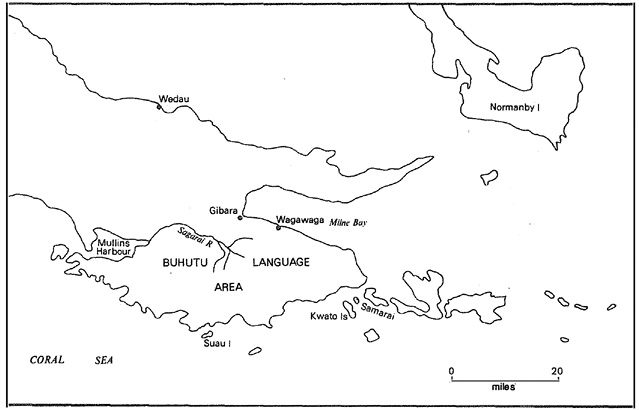
The diggers left their boats at Gibara Landing, a few hundred yards from the mouth of Gibara Creek. The main workings were on the upper Sagarai River, which flowed west into Mullins Harbour. Broad and sluggish where it passed through swamps into the harbour, the Sagarai headwaters reached back into the steep ridges close to the southern shore of Milne Bay. The track from Gibara to the field was wet, steep and short: most of the mining camps were within five miles of the stores at the landing. Sometimes the south-east winds drove big seas up the bay and held rain clouds against the mountains, and at other times, especially during the north-west, the winds failed, leaving the bay as flat as the water in the sago swamps; but in fair weather the canoes, whaleboats, and schooners of the Samarai ‘mosquito fleet’ could reach Gibara in a day.
The people of the Milne Bay coast had known a variety of missionaries, government officers, recruiters and traders for twenty years before the miners began moving up Gibara Creek. Within the loosely linked communities of Massim peoples spread through the south-east, the villagers from the head of the bay were ‘great fishers and traders’. Captain Moresby admired the craftsmanship of the men who made and sailed the 50-foot canoes:
They use a great oval-shaped mat sail, and handle it so skilfully, that when we met them at sea, and the ‘Basilisk’ was going five knots, they easily sailed round us, and luffing under our lee were with difficulty prevented from boarding us while under weigh.
By 1899 the villagers from the head of the bay were taking their canoes to Samarai to sell food and buy goods in the stores. A few men had gone to the Mambare but no more would go, others worked on boats and around the town of Samarai, and many had come under the influence of the London Missionary Society teachers from Kwato. From his arrival in the area in 1891 Charles Abel had gathered young people at Kwato to train them as Christians, craftsmen and cricketers. During a holiday declared in 1899 to honour his first visit to the south-east, Lieutenant-Governor Le Hunte watched the Kwato cricketers defeat a team selected from Samarai’s white community. But Abel saw enemies as well as opponents in the bare-foot pyjama clad drunks of Samarai looking for an easy life and in the harder men in high collars or working men’s flannels prepared to push aside or enslave the local people in their determination to make money.
Away from the coast the Buhutu of the Sagarai Valley were also Massim people. They traded with the Suau of the south coast and the Wagawaga on Milne Bay, but few foreigners had disturbed their home villages. In 1899 the Buhutu were neither converted by missionaries nor controlled by government officers.
During the first two years of mining the Milne Bay peoples behaved in much the same way as the islanders in their encounters with the diggers. They visited the claims, sold food and did some carrying and mining. Relations between villagers and diggers were changed by the Buhutu stealing from the camps and the miners retaliating with brutal, summary punishment.
Alexander Symons, the Assistant Resident Magistrate at Samarai, heard complaints on a patrol to the goldfields at the end of 1900 that people from the Sagarai River were stealing everything they could carry away, including tents and working gear. The police and carriers he sent to arrest the people thought guilty returned with seven prisoners taken after a fight in which one of the government party and one villager had been wounded. The thieving continued and in April 1901 Symons took tougher measures. He burnt three villages where he found stolen goods and the police, attempting to take prisoners, fired several shots. In his report Symons did not say whether they hit anyone, and he mentioned only briefly the actions of four miners who were also trying to recover stolen property.
Table 11
Milne Bay Goldfield
production and population
|
Year |
White Miners |
Indentured labourers |
Production (ounces) |
|
1899/1900 |
73 |
292 |
4000 |
|
1900/01 |
20 |
80 |
1503 |
|
1901/02 |
20 |
80 |
1503 |
|
1902/03 |
34 |
136 |
1748 |
|
1903/04 |
28 |
112 |
1680 |
|
1904/05 |
28 |
112 |
1440 |
|
1905/06 |
18 |
72 |
1000 |
|
1906/07 |
7 |
28 |
357 |
|
1907/08 |
4 |
27 |
211 |
|
1908/09 |
1 |
0 |
170 |
After Charles Abel had made seven trips to the head of Milne Bay and spoken to witnesses, he wrote to Moreton at Samarai and Le Hunte, then in Australia, adding to Symons’s brief report of his second patrol. Symons and four miners, Jack Gray, Harry Morley, Bob Lindsay and Steve Woolf, Abel said, had burnt thirty-eight houses, destroyed gardens and graves, shot two men and a woman as they fled, and another man, Sipiliei, who had accompanied the patrol, was roped, led away by the four miners, and later found shot through the head. Sipiliei, a leading man of the area, had previously acted as a guide for Abel and for government parties. Abel also revealed a bond of deception linking Symons and two of the miners. A few weeks after the shooting and burning in the Sagarai Valley, Jack McLean, the Gibara storekeeper, was murdered. McLean lived with Bi, ‘the Queen Bee’, a beautiful and notorious woman remembered by a miner as being part-Samoan and by a government officer as coming from Dutch New Guinea. At the inquest into McLean’s death three Papuan witnesses told Dr Cecil Vaughan that Morley and Lindsay had killed McLean and beaten Bi, but at the trial of the two miners they said that Bi had killed McLean. Other Papuans told Abel that the evidence given at the inquest had been true; and when he asked the three men why they had changed their story for the court they said they had been intimidated and then rewarded by Symons. Abel assumed that Symons had protected the miners because they could so easily have incriminated him by revealing the truth about the patrol through the Buhutu villages. Even if Symons had not personally acted illegally Abel believed he had neglected his duty by failing to control those under his command and taking no action against men guilty of brutal crimes.
By threatening to make the whole affair public Abel forced Moreton to hold an inquiry. After a long delay the four miners were brought to court to answer for their actions against the villagers. To the applause of the white citizens of Samarai crowded into the court, Judge Winter decided that three of the miners deserved no punishment. In their defence they had said that they were acting under the instructions of a government officer. Winter ruled that while they were mistaken in their belief, it was still an adequate excuse. The crowd demonstrated their disapproval when Winter sentenced Woolf to six months’ imprisonment for shooting a woman in the back at a distance of 5 yards. Woolf, the only non-Australian among the miners before the court, asked the judge if he called this British justice. Winter accepted that Symons first learnt of the miners’ actions from Abel’s letters although there were several witnesses ready to say that Symons had talked of the shooting soon after his return to Samarai. At the end of his inquiries Winter concluded: ‘These rumours, when sifted and reduced to distinct charges, and to the evidence that supported them, showed that considering the circumstances, nothing very exceptional had taken place.’ It was a statement remarkable for its qualifications and lack of substance. After all, the ‘rumours’ were supported by corpses and the burnt wreckage of villages. But Abel was most disturbed by a comment made by Winter in court: ‘Racial feeling is so general and so strong in this country, that I cannot regard the defendant [Woolf] morally culpable in taking the life of a native.’ In another case Michael Bowler, a Milne Bay miner, came into Samarai boasting that he ‘had done for another of the d...d niggers’ who had been stealing. Bowler was fined £5 and imprisoned for three months. The man shot was not a Buhutu villager and he was probably not a thief; two points of fact which may not have disturbed Bowler or altered the decision of the court.
These events happening before an Australian judge, in courts crowded with Australians, on the eve of the transformation of the Possession from a British Colony to an Australian Territory, made others ask with Steve Woolf whether they were watching the end of British justice. On leave in Australia to recover from fever, Abel went to Melbourne to see Alfred Deakin, the Attorney-General in the first Australian Government. Deakin assured him that in speaking on the bill to transfer British New Guinea to Australian control he would state in ‘unmistakable terms’ that in dealing with New Guinea Australia would ‘think first for the well-being of the aboriginals’. Since he believed that ‘the labour party dominate[d] Australian politics’ Abel also saw John Watson, the leader of the twenty-four Labor members in the Australian parliament. Having heard some of the speeches in defence of the White Australia Policy, Abel asked Watson whether ‘the labour party saw any place in the world for a man with a black skin’. Watson replied that while he believed in an Australia for white men he would advocate the advance of natives in their own lands. Abel left ‘jubilant’. He was comforted by the declarations of goodwill, and for other reasons he decided that the Papuans would be saved by the Labor Party. There would, he thought, never be enough white men in New Guinea for their interests to override the interests of the white citizens of Australia. The Labor Party would be a powerful force retarding economic development in New Guinea: it would never allow industries using white capital and cheap black labour to grow and compete with Australian factories and farms.
Abel was also reassured by Le Hunte’s mild actions. He shifted Moreton and Symons to posts of lesser importance and promoted Campbell, ‘a much better stamp of man’. Campbell toured the Milne Bay villages telling the people that, the old order had gone. The Buhutu were in need of reassurance for some had abandoned their homes to shift away from the diggings. Miners who had abused Abel and threatened him with revolvers became less hostile and he began to preach again in Samarai of a Sunday evening. On Gibara some of the miners, finding that they had helped protect McLean’s murderers and convict the Queen Bee, forced Lindsay and Morley from the field. No government officials were brought to court, the Papuan witnesses were not charged with perjury although it was obvious that either at the inquest or at the trial they had lied, and none of the four miners was again called to answer for his actions in the Sagarai Valley or in the Gibara store. Woolf was gaoled for another lapse on the Gira. Winter resigned in 1902. In his defence it ought to be remembered that he was criticised by MacGregor for being too lenient with Papuan offenders. He was a man of kindly prejudice.
What distinguished the Milne Bay field was not the events in the Sagarai Valley, but the fact that they became matters to be disputed in public and decided by the courts. The men shot on the northern rivers were anonymous to all outsiders; Sipiliei was not. In a sense Winter was right, nothing very unusual had happened at Milne Bay. Later O’Brien was exceptional, but until then no miner in the Northern Division had been taken to court for mistreating villagers; they were called to answer only for their treatment of labourers, Papuans with their names in government records. The Milne Bay miners appreciated the comforts of Samarai, but the closeness of the port and the existence of the ‘fine church’ in Wagawaga meant that they were more likely to have to account for their actions.
In 1909 there was only one white miner on Milne Bay. He had no indentured labourers but employed local men who worked for two or three months and then returned to their villages. The Gibara storekeeper equipped other local men with boxes and tools to rework old ground. It was a practice followed again by Henry Dexter in 1929 when copra prices fell. Of the twenty men he supplied with tools seventeen returned with gold. In a week of fine weather they brought in up to £80 worth of gold. Sometimes an inland man would appear at the store counter and take from his hair a parcel of gold wrapped in rag. After it was weighed he might produce a second and a third, the earnings of other miners. When he came to make his purchases he took a longer time than coastal people and he was more reluctant to use the few words of English that he knew. Europeans kept returning to Milne Bay to work reefs and peg dredging leases; but it is doubtful if any made more than they spent. By contrast Papuan miners who invested time and labour won £1200 in 1937-38. Like the islanders the Milne Bay people were able to turn to alluvial mining when their other sources of cash declined.
Henry Dexter, Reminiscences of a ‘Gin-soaked’ Trader, Pacific Manuscripts Bureau microfilm, recalled his years as storekeeper at Gibara in the 1920s and 1930s. He also collected and recorded information about the early days on the field. Charles Abel and Frederick Walker wrote of developments on the goldfield and missionary-miner relations in Papuan Letters, London Missionary Society Archives, microfilm, National Library of Australia. Charles Abel 1902 described the peoples of Milne Bay, and Russell Abel 1934 referred to his father’s response to events on the goldfield. Dutton 1973 has a map showing the distribution of languages in the Milne Bay area. Moresby 1876, Belshaw 1955 and Seligman 1910 have material about the Milne Bay peoples during their early years of contact with foreigners. Most reports by government officers are in Annual Reports and the Samarai station papers. Monckton 1921 wrote his account of Symons’s punitive patrol. Cecil Abel, Charles Abel’s son, and John Smeaton, his son-in-law, have spoken to me about Charles Abel.
Previous Next



