


 menu
Black, White & Gold
11
a magnificent valley and an intense interest in killing
Three days’ walk from where Frenchy and Jimmy the Larrikin’s copper armour had failed to protect them from axe-blows to the head a track passed Mount Clarence on the west and crossed the watershed of the Owen Stanley Range. To the east of the track Mount Suckling rose to over 12,000 feet, the highest point in south-eastern New Guinea. North of the divide the creeks drained into the Adau River, which escaped through a gorge at the northern end of a broad valley to meet the Moni and flow on as the Musa. Wet with sweat from a hard climb, travellers looked across a ‘panorama … of great beauty’, the Keveri Valley. The floor of the valley was lightly timbered grasslands cut by sharp spurs and watercourses. In dry weather the creeks were clear streams winding and falling along rock-strewn beds, but when rain washed the hills they changed to roaring clay-stained torrents blocking all work and movement in the valley.
Foreigners called the people of the valley Keveri. They lived in small ridge-top villages, three or four tree-houses and fighting platforms rising above a cluster of another four or five houses within a stockade. The Keveri hunted, collected breadfruit, okari nuts and pandanus fruit, and cleared and cultivated the slopes above the grasslands. Within the Bauwaki language community, which spread south of the watershed, the Keveri traded and fought with people speaking related languages near Cloudy Bay. But by their decorations and the way they wore their hair twisted into a mass of trailing plaits, the Keveri men showed that they also had some association with peoples to the north. Travellers thought the valley secluded, fertile, healthy and peaceful: but F.E. Williams, the one anthropologist to see the Keveri in their homeland, concluded that the ‘salient feature of [their way of life] was nothing other than an intense interest in killing’.
The ‘killing’ brought government officers to the valley. In 1899 Albert English, the Assistant Resident Magistrate at Rigo, twice visited villages recently raided by people said to have come from Keveri. At the end of the year English and Joseph Blayney, the Resident Magistrate for the Central Division, spent four days in the ‘magnificent valley’, but they saw little of its inhabitants and made no arrests. In 1900 about sixty warriors from Keveri and Dorevaide, south-east of the valley, attacked Merani, killing nineteen people. English, Blayney and Francis Barton, Commandant of the Armed Native Constabulary, made another patrol north from Cloudy Bay. After arresting three Dorevaide men the patrol moved on across the watershed. Although one or two men from the valley had already been away to work as indentured labourers, most of the Keveri kept well away from the patrol, and again none was arrested.
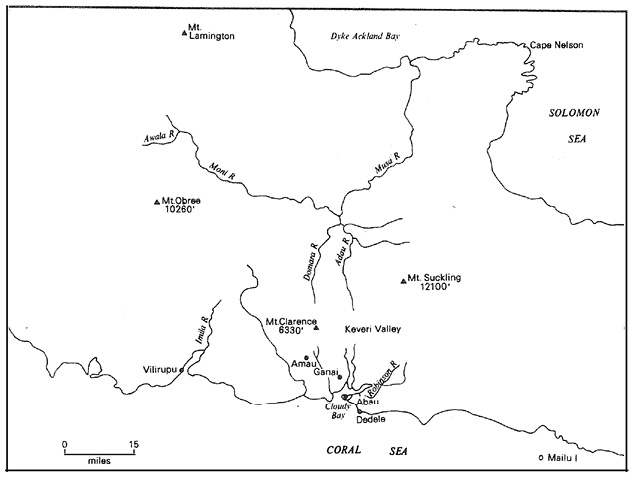
Fighting and trading parties from Keveri may also have learnt about the prospectors who had approached their lands from the Musa. William Simpson, after his second trip up the Mambare, tested the Moni and Adau Valleys at the end of 1896. Penetrating well beyond the highest point reached by MacGregor and an estimated 25 miles up the Adau, Simpson must have been close to the northern edge of the Keveri Valley before he turned back to try the Moni. On his return to New Guinea from Australia in 1897 Simpson went back to the Mambare; but the fine colours he had seen on the Adau encouraged others to go up the Musa. Frank Pryke was one of twelve prospectors who recruited carriers in the D’Entrecasteaux Islands and then ascended the Musa in a whaleboat and two canoes. The carriers having deserted in the whaleboat, the prospectors persuaded local villagers to help shift their gear about 20 miles up the Moni. Ignoring the warnings of the villagers, the prospectors attempted to raft downstream and they and their stores were tossed overboard. Frank Pryke spent three days without food making his way back to camp and ‘nearly pegged out’. When the prospectors reached the beach they found a note from Moreton telling them that he could not pick them up in the government schooner as he had just received news that Green had been killed at Tamata.
Having tried the north Queensland goldfields Pryke teamed with George Klotz for a trip to the Gira and across to Finnegans Creek on the Yodda where they ‘did fairly well’. After recovering their health in a camp at Gabagabuna at the head of Milne Bay, Pryke, Klotz and nine carriers went north across the ranges along the northern arm of Milne Bay to prospect the country behind Bartle Bay. Like the north Queensland miners who had preceded them, they suffered from fever, constant rain and inadequate food, and found no gold. In Samarai they heard that a group of miners had picked up signs of gold inland from Cloudy Bay. Although the reports were not encouraging Pryke and Klotz gathered a team and three months’ stores, and took a cutter along the south coast. When they arrived at Cloudy Bay they found that the miners there had decided that they were unlikely to find anything worthwhile in the area, but Pryke and Klotz thought they would prospect the country near the Domara River. In May 1901 they put in a box on a small ravine: when they left for Samarai three months later they had 370 ounces.
Men set out immediately from Samarai, and as the news spread to the camps at Milne Bay and the more distant fields the demand for a place on the boats increased. Whittens established a store at Iaba, just inland from Cape Rodney and about 40 miles from the field. At first selling straight from crates, the storekeeper had hardly completed a grass roof and packing-case counter before the miners were drifting back saying that the field was a duffer. More than a hundred men had landed at the beach; not all had bothered to go inland and none had made a worthwhile strike. The ravine had held an isolated patch; for years it had been acting as a natural sluice box.
Pryke and Klotz on their second trip to the area were among those who failed, but Frank Pryke and his brother Dan returned to the area in 1902 and after prospecting about the head of the Musa found gold in the Keveri Valley. Frank and Dan worked at Keveri in 1903 and 1904, and Frank and Jim, a younger brother, went back there again in 1905. At the end of ten months’ work in the valley in 1903 Dan banked 256 ounces in Cooktown while Frank went to Samarai, ‘Imbibing and playing cricket at Kwato’ before taking Whittens’ schooner for another recruiting trip through the D’Entrecasteaux Islands. But other miners, and the Prykes in other years, took less profit from the valley: they made ‘a few quid over exes’, or, looking at the amount of stone to be shifted, decided there was a ‘crust in her with a big team’. The greatest number of miners at Keveri was about twenty in 1904; the next year there were only five. By the end of 1907 the miners had completely deserted the field. But when little gold was being found in other areas a few men went back to Keveri, and even in 1940 there was still one miner in the valley. The miners built stores at Ganai and used local villagers and their own labourers to carry rations and equipment over the range. The Keveri miners rarely saw a government officer or any other outsider.
The isolation had disadvantages. In 1904 Luke Soich’s leg was shattered by a stone thrown out by dynamite being used to cut a race. Frank and Dan Pryke and eleven labourers carried him to the coast in three days. ‘Coming down the main range today’, Dan wrote, ‘it looked impossible to carry a man on a stretcher but the boys were really splendid.’ The labourer sent ahead found a boat in the bay, and Soich was in the Samarai hospital six days after the accident, but he died within a few hours of an operation to amputate the damaged leg. Nearly all the white residents of Samarai witnessed the burial of old Luke at the Logea Island cemetery, and Campbell recorded a tribute in the station journal: Soich was ‘one of those good sterling miners who are respected by both white men and the brown alike for their honesty and straightforwardness in all their dealings with either race’.
In spite of their reputation for fighting and killing, the Keveri lived in economic harmony with the miners. On his last trip into the valley Frank Pryke was greeted by a boisterous crowd, and several men asked anxiously about Dan, who had gone to Australia. After he had worked on nearly all the alluvial fields of Papua, Frank Pryke decided that he never met a ‘more friendly lot of coloured men’ than the Keveri. They carried and mined, but like the Beda they were most important to the miners as suppliers of garden crops. The miners also added to their stores by ‘shooting fish’ (throwing explosives in pools) and hunting pigs, wallabies and cassowaries across Keveri lands. With no mosquitoes, cool nights and plenty of food Keveri was a favoured spot; except that there was little gold.
Peace between miners and villagers did not mean that the Keveri and neighbouring communities lost their interest in killing. Raiding parties attacked villages within the area or up to six days’ walk away, killing ten or more of the inhabitants, taking anything of value and throwing the dead back into their burning houses; but more frequently a small group of warriors went out and killed some man, woman or child found alone. The lone victim might be killed by mimi: he would be held down, suffer assault and sorcery, be released and die within a few days in his home village. Europeans tried to explain the violence in the area by suggesting that before a Keveri man could marry or have any standing in his own community he had to earn the right to wear the badge of the killer, the beak or tail feather of the hornbill. The explanation was inadequate for often the man who emerged after a period of purification wearing the hornbill feather was not the killer; his display was part of the ritual to deceive the spirit of the dead man and prevent it from taking vengeance on the killer.
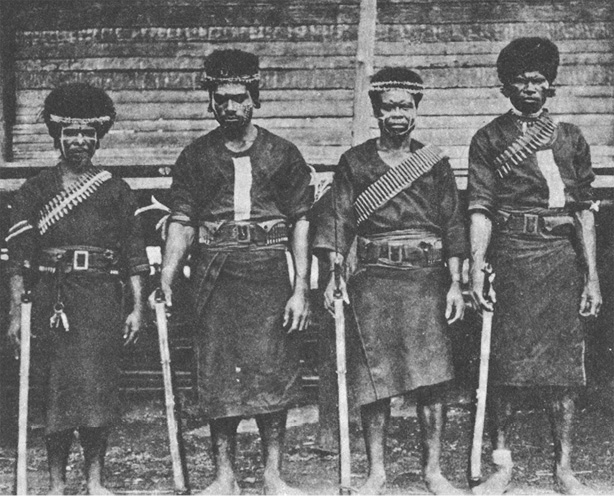
The Abau detachment of the Armed Native Constabulary
PHOTOGRAPH: H. DEXTER
While the miners were witnesses to lament and triumph in the villages their labourers were sometimes more directly involved. Local men working for the miners were at risk and indentured labourers who deserted were likely to die. In 1903-4 fifteen runaway labourers were killed. The labourers briefly became raiders when Kruger and the Prykes’ labourers shot three Barua men from south of the watershed. In court the labourers admitted that their first story about only firing in self-defence was untrue.
The miners did not appreciate English’s attempts to arrest the men who raided coastal villages. He shot pigs, fed his police and carriers on the gardens and left the valley almost deserted. By disrupting trade between miners and villagers the government patrols cost the miners time and money, and Frank Pryke went on to make a general condemnation of the government’s ‘way of civilizing the niggers’:
I think that they should either leave them alone to settle their own feuds or else when they start out to give them a lesson they should give them a proper one, and not make a farce of it by taking a few harmless ones who are either too old or too young to be in the mischief and giving them a few months or a few years while the real culprits almost invariably escape.
Pryke was right about the ineffectiveness of the government’s actions for the Keveri continued their raids into the 1930s.
George Arnold, the only miner on the field in 1912, fought in defence of the village of Ona-Audi. A raiding party armed with spears, shields and clubs ran past his camp and on towards Ona-Audi. A man from the village called for his help, and he responded when he saw a fleeing woman caught and clubbed to death. According to the Papuan Times Arnold grabbed his ‘Winchester and managed to put in some good work — the only work that is effective in such circumstances’. But Charles Wuth, the Acting Resident Magistrate at Abau, reported that Arnold had killed one man only while seven men, six women and one child from Ona-Audi had died. Occurring ten years after gold was first worked in the area, the shooting at Ona-Audi was the only reported time that a miner on the Keveri Goldfield shot a villager. The Keveri were no less violent than the Orokaiva, but they lived in small communities engaged in feuds and swift raids; it was a type of fighting which did not need to include the foreigners.
Nor did the Keveri fight the government, in spite of the irregular government patrols which passed through the valley pursuing men wanted for murder. Guilty men evaded the patrols, but when surrounded or surprised they were normally handcuffed without a shot being fired. Leo Flint, after serving several years as Assistant Resident Magistrate at Abau, wrote:
The Dorowaida and Keveri people give continual trouble. I am certain very few of the adult male population have not been in gaol for murder. Some have returned home after serving a sentence for murder, and then within a few months, committed the same crime again. Yet in other ways they are amenable to the law. They clean roads, erect rest houses, and assist with carrying etc.
Murray said he knew of no other area where men who had served a term for murder came before the Central Court charged with another murder, and asked Flint if he had exaggerated. But Flint was able to name men and cases to support his statement. Fortunately for the peace of government officers the Keveri were too few and too far away to force them to question the value of their basic practices.
The Keveri Valley is now almost deserted. By reducing the numbers of fish, birds and game animals in the valley, and bringing diseases, the miners may have contributed to the decline in population. George Arnold in 1923 said that when he first mined in the area twenty years earlier, there were twice as many people in the valley and there was much more food for sale. Yet between 1923 and 1940 there was little, if any, further fall in the population. The main factor in the final depopulation of the valley was emigration. In 1940 274 people lived in the valley: the movement out was just beginning. Influenced by missionaries or government officials or for reasons unknown to outsiders the Keveri had stopped fighting. The missionaries were from the Kwato Extension Association, two of them were sons of Charles Abel and the others were Papuans who had passed through the schools he had founded. Many Keveri, after listening to the missionaries, condemned their own past. The men understood the ‘message’ for they had learnt some Motu in Port Moresby gaol. The Keveri gave up their dances, decorations, songs, plaits, bark belts, sorcery and killing, for calico ramis, short hair, family prayer, washing, shaking hands, the word of Darava (God), peace, a hope of everlasting life, and a chance to participate in the new life being experienced by communities on the coast. They shifted first from their ridge-top villages to Eoro and later to Amau south of the watershed. Keveri, the miners’ ‘happy valley’, held no permanent community.
Humphries, Annual Report 1922/23, and Williams 1944 described the valley and its people. L. Armit, Annual Report 1913/14, has some ethnographic notes. Dutton 1971 mapped the distribution of languages in the area.
The early patrols by English and Blayney were noted in the Annual Reports for 1899/1900 and 1900/01. Simpson’s letter to MacGregor reporting his prospecting trip up the Musa was printed in the Annual Report 1896/97. Frank Pryke wrote an account of his ‘First trip to New Guinea’ in a coverless notebook, Pryke papers. The expedition was reported in the Sydney Mail, 1 May 1897. Frank and/or Dan Pryke’s diaries for 1901, 1903, 1904 and 1905 are with the Pryke papers. Entries are brief and the diaries do not cover all months of those years. Fred Kruger in an obituary for his mate and fellow miner described the discovery at Cloudy Bay, Papuan Courier, 22 October 1937. Frank Pryke’s reference to the friendliness of the people is from his poem, ‘Keveri’. Collinson 1941 recalled his time as the manager of Whittens’ store at Cloudy Bay. Robinson, diary, recorded his walk into the valley. Some wardens’ reports were printed in Annual Reports. The Abau station papers recorded events after 1911. The Papuan Times, 22 January 1913, reported the attack on Arnold. The extension of mission influence in the valley has been written about by Russell Abel. They broke their Spears, typescript, Abel papers, library of U.P.N.G.; Vaughan 1974; Wetherell 1973; and Williams 1944.
Previous Next



