


 menu
Black, White & Gold
Two Ounces a Day and Dysentery
it grieves a man to lose one of them especially if he is a good boy
By 1909 gold was difficult to find on the alluvial fields of Papua. Twenty-four miners and over 300 labourers were still on the Yodda, about the same number were on the Gira and a few were prospecting on the Waria. In the south-east one miner was working on Milne Bay, men returned intermittently to Keveri, and on Sudest, New Guinea’s first payable field, the villagers were still panning a few pennyweights. On Misima foreigners and villagers shared the little gold being taken from the east of the island. Three or four of the white miners in the Louisiades were investing in plantations and trade or trying to raise capital to work lodes of unknown extent; and the others no longer cared for the values of the communities they had left. On Woodlark alone each boat brought one or two new men. The ‘reefers’ were optimistic. Served by crushing batteries at Kulumadau, Busai and Karavakum, they had won 3537 ounces in the previous twelve months. The alluvial miners had taken about half as much, but they were not hopeful of increasing production.
The Papuan Government introduced three schemes to assist the alluvial miners. Some Yodda miners argued that below the conglomerate on the valley floor they would again find rich alluvial. To test their belief the government granted them £150 and passed the Gold Mining Encouragement Ordinance which allowed the granting of a reward claim to anyone boring through the false bottom of a field to locate more gold bearing ground. A second ordinance introduced into the Legislative Council by Little permitted the Lieutenant-Governor to pay up to £1000 to the discoverer of a goldfield if it supported not less than 200 miners of European descent for eighteen months. The payment was in addition to the normal reward claim equal to forty times the area of one man’s claim. The government also agreed to pay £800 to finance a prospecting trip into new country. No one collected the cash reward for opening a new field and it was another twenty years before worthwhile gold was again found on the Yodda; but the government prospecting party opened up country where a few men pegged claims yielding over 2 ounces a day, more miners were disappointed, and many labourers died.
The miners on the upper Yodda met at Clunas and Clark’s store where ten voted for Matthew Crowe to lead the prospecting party and five favoured Frank Pryke. Further down the Yodda all eleven miners on Finnegans Creek who registered a vote decided to support Crowe. Billy Ivory (with the covering assurance, ‘you can Rely on this been correct’) sent in the Gira and Waria vote:
we had a meeting hear. But all that was not to tired to vote sent in a voting Papper to the store which had to be oppened on a giving Date. The Result I am sending to you. You will see By it that Mr F Pryke is Easialy the man hear. Now the quearely is will he except it has he is out on the waria yet no one knows wheather he will or not …
The Woodlark miners decided that they would accept the decision of the men on the mainland.
Believing that the Waria was finished and not looking forward to shifting a lot of earth in the Keveri Valley for little gold, Frank Pryke was indeed eager to open new country, but when the votes from the Yodda and Gira were added, Crowe had just defeated him. In Samarai Crowe offered to toss Pryke for the leadership, Pryke declined, and Staniforth Smith, the Director of Mines, formally appointed Crowe leader of an expedition to ‘search for valuable minerals’. Crowe then had the right to choose his mates and, rejecting Staniforth Smith’s offer to secure a professional geologist, he named Frank and Jim Pryke.
Matt Crowe was about forty-seven in 1909. His six-foot-four frame was becoming more bent and his tongue sharper. There were few men on the goldfields who had not been lashed by old Matt’s tongue. After Frank Pryke retired to Sydney and a hectoring wife he wrote:
Few people understood Old Matt
Or his keen sarcastic wit
But I had early found out that
He was straight and full of grit
Few as good as him are found
And I should surely know
For many years I knocked around
As mates with long Matt Crowe
Crowe left the Victorian police to mine in Western Australia and the Yukon before going to British New Guinea. He took out the first registered claim on the Yodda, opened the Waria with Arthur Darling and prospected widely across the headwaters of the northern rivers.
Frank Pryke was thirty-seven, just above medium height and strongly built. Although no longer the young man who had run at athletic meetings, competed in fire brigade demonstrations, and played rugby in Goulburn, New South Wales, he was tough, tireless in the bush, and genial and generous towards all men. The son of an English migrant who spent nearly all his working life on the goldfields of Victoria and New South Wales, Frank Pryke looked for work in New Zealand and then went prospecting in Western Australia with an older brother, Dan. Frank and Matt Crowe first met in Western Australia. After the failure of the expedition up the Musa in 1897 Frank had carried his swag through the north Queensland fields before returning to New Guinea to join the early miners on Finnegans Creek. Dan had taken reefing claims on Woodlark, but he joined Frank at Keveri after Frank and Klotz made the first rich strike in that area. When Dan left New Guinea in 1904 to marry and become the proprietor of the Royal Exchange Hotel in Armidale, New South Wales, Jim joined Frank for one year before they shifted to the Gira and then the Waria. Jim was thirty-five. Like Frank he was strong, reliable and quick-witted; but he was less restrained, he had a touch of the larrikin. He played as a forward for a country side in Goulburn against the English rugby touring team of 1899. The miners of the Northern Division had voted with good sense when they selected Matt Crowe and Frank Pryke.
In June 1909 Matt Crowe, Frank and Jim Pryke and thirty-five indentured labourers with stores for six months left Port Moresby on
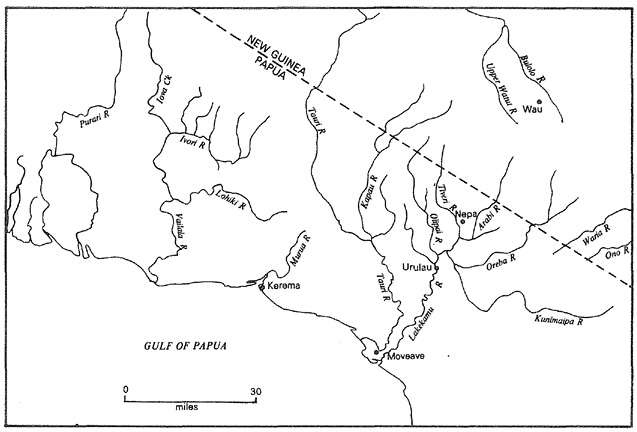
the Merrie England for the headwaters of the Tauri River in the Gulf Division. The labourers, recruited from Milne Bay and the islands, signed-on for £1 or 10s. a month. Each was granted a Special Arms Permit giving them the right to carry a gun or rifle. In heading for the eastern Gulf, the prospectors were following the wish of most of the miners who attended meetings to select the expedition’s leader. The miners’ choice of country was based on a little knowledge and a lot of speculation. Much of the mainland east of Yule Island had been crossed by prospectors, and those pockets still unknown were accessible. As Billy Ivory put it: ‘a Privite Party Can Prospect anything on the N E But west of Port Moresby Say 100 miles is beyond a Privite Party to expensive’. The rivers draining into the eastern Gulf rose close to the source of the Aikora and the Waria, and it was possible that the formations releasing gold into the northern streams were duplicated on the southern slopes. Two recent expeditions had increased interest in the southern rivers. James Swanson and one of his sons, who had previously tried the rivers behind Yule Island, went up the Vailala and the Tauri, and Charles Higginson, Resident Magistrate of the Gulf Division, obtained a ‘few substantial colours’ from a dish taken from the upper Tauri in 1908. There was, Higginson reported, a vast tract of country which an experienced miner could prospect from a base on the upper Tauri.
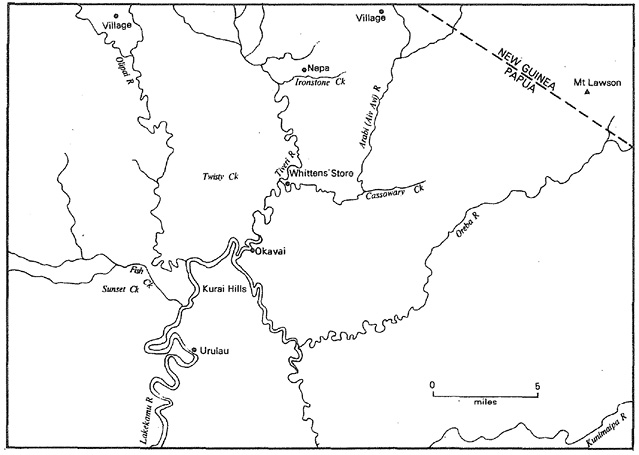
From a camp he located as ‘fifty mile beach’ Crowe sent a note down river: ‘if we get into touch up here with Natives we may be able to go on for months’. In September Murray attempted to find the prospectors and replenish their stores. From Ernest MacGowan who was trying to establish a copra, fibre and cotton plantation on swampy ground just above Moveave village, Murray learnt that Crowe and the Prykes intended to form a base camp at a point where three tributaries joined the Tauri. Murray found the long-abandoned camp and travelled by canoe and foot up the tributaries without seeing any recent evidence of the expedition. He returned to MacGowan’s where the prospectors were waiting for him. They had explored the headwaters of the Tauri then gone east, made sago and canoes and come down the Lakekamu. The prospectors told him that they found good indications of gold in the east, and they were anxious to return. They also told Murray that they had frequently seen sturdy, light-skinned people armed with small bows and wearing grass skirts and bark cloths. The prospectors knew that they had been watched constantly by these people who had shot a lot of arrows at them. They ‘did no harm’; but neither would they trade. Murray loaned the prospectors a launch from the Merrie England to take them back up the Lakekamu; he was not to see them again until December. By foot, raft and canoe, the party prospected the headwaters of the Lakekamu from the Tiveri to Mount Lawson, frequently finding ‘colours’. Again the mountain people were hostile. On the western branch of the Tiveri they ‘sniped’ at the intruders driving their ‘boys back’ and on the middle Tiveri the ‘boss boy’, Wagawaga Dick, was killed by an arrow. On their way down the Tiveri, Crowe and the Prykes pegged a reward claim on a small tributary: a box put in just below the claim averaged 2 ounces a day.
In Port Moresby, after six months in the field, the prospectors reported that they had found enough payable ground for the miners then in Papua, but they warned that they had found nothing to justify a rush from Australia. The field did appear to have one advantage: it was only one day’s walk from navigable water and the miners hoped it would be a place where they, rather than the storekeepers, would profit. By confidential dispatch and coded telegraph from Thursday Island, Murray advised the Minister for External Affairs to caution impetuous Australians against joining the rush: the extent of the field was uncertain, it was difficult to reach and the ‘natives extremely hostile’.
The expedition had carried the hopes of the Northern Division miners, and they were eager to learn of its success. In Samarai they took little notice of Frank Pryke’s warning that the amount of gold was limited; they were confident that as soon as the ‘crowd’ got there, more payable ground would be uncovered. With fresh stores and their labourers’ contracts endorsed for mining and carrying in the new area, the miners waited for a passage. Boats which had serviced the Northern Division fields shifted to the south coast and the Lakekamu. The movement to the west hastened Port Moresby’s eclipse of Samarai as the chief port of the Territory, but ‘Port’ did not gain the miners’ affection. Frank Pryke wrote: ‘Port Moresby is one of the most miserable places to spend a few days that even I have yet struck. I would sooner spend a week at Kulumadau or Tamata. There is still only one pub there … .’ The patronage of the Lakekamu miners helped support another: the Papua Hotel opened in 1911.
Hopeful amateurs from Australia where the ‘rush [had] been boomed a bit too much’ crossed to Papua. The first fifty to arrive in Port Moresby had the money to get to the field but forty-nine soon returned to Port: without stores, equipment and a ‘team’ they were unable to work. By the end of February Murray reported that about 120 miners had come from Australia and already about eighty had left the Territory. Some had been misled by reports of claims yielding 1 and 2 ounces a day. They did not realise that where fifteen labourers could recover 1½ ounces a day, a white miner working alone could only put enough earth through a box to obtain 1 or 2 pennyweights. Murray telegraphed the Minister again asking him to warn diggers through the press that they should not come to Papua unless they had three months’ supplies and £100 in cash. On the Lakekamu and in Port were destitute men. After they signed a statutory declaration the government gave them an order for meals at Tom McCrann’s Port Moresby Hotel and provided them with a free passage to Cairns.
To reach the field, miners and labourers travelled by launch and schooner from Samarai and Port Moresby. The best known of the launches was Whittens’ Bulldog which, impeded by floods, low water, breakdowns and snags, made irregular runs up the Lakekamu. The mouth of the Lakekamu was deep, but sometimes the south-east beat up high seas and some boats preferred to enter the Tauri and then take the ‘cut’ through the low-lying sago country into the broad stream of the Lakekamu. The miners had two or three days sitting on the deck, the sun sometimes on their back and sometimes in their eyes, as the boat followed the broad curves of the river. By the second day they saw the first high ground, the Kurai Hills, rising above the tall vine-covered timber on the river banks. At night they could camp on the broad sand beaches which stretched for over a quarter of a mile on the inside of bends when the river was low. Piles of broken, bleached tree trunks showed the power of the stream in flood. Having passed the junction with the Kunimaipa, they went up the narrower, faster-flowing Tiveri to the landing close to the point where the Tiveri is joined by the Arabi or Aiv Avi. The boats went no further and in the dry season men and stores sometimes had to be unloaded several miles below the landing. If no launch were available at the Lakekamu mouth, a miner anxious to find gold and escape the mosquitoes might persuade Moveave canoe men to make the eight-day trip against the current to the Tiveri landing. Tiveri was one day’s walk from the field. The road, crossing many creeks and cut through thick undergrowth, was flat except for a steep spur before the descent into the valley of Ironstone Creek. Crowe and the Prykes had pegged their reward claim a mile above the junction of Ironstone and Rocky Creeks. New arrivals took up most of the ground along the two creeks. Lyons, the Warden and Resident Magistrate, told Murray that by February there were about 100 white miners and 500 labourers on the field. In April, when there were 120 miners and over 800 labourers on the Lakekamu, the field had reached its height. From the ridge overlooking Ironstone Creek it was difficult to see the workings, the tents and the bush houses because ‘the men lived, like fish, groping about at the bottom of the deep green sea of forest, a hundred feet removed from the light of day’. Races and flumes carried water to the teams ground-sluicing and shovelling the alluvial into the boxes. Lines of carriers constantly brought rations from the Tiveri landing where two storekeepers had set up businesses. Two other stores were built on
Ironstone Creek and the government declared over 12,000 acres Crown land and reserved it as a site for a town. Both stores on the field and one of those at the landing were licensed. For celebrations, beer was 3s. and whisky 10s. a bottle; for sustenance, flour was 15s. a 25-pound tin, and golden syrup 1s. 6d. a tin. The prices were as high as those on the Northern Division Fields. The warden’s office, officers’ quarters, gaol, police barracks, carriers’ shelter and dispensary of the Nepa Government Station were built on the slopes overlooking the field.
On 25 January the reward claim was measured and registered; after nine labourers had worked for five hours the box was cleaned up and 2½ ounces were taken out. The reward claim continued to average over 2 ounces a day for several months, but the richest strikes were made in an area known as the ‘Jeweller’s Shop’ at the head of Rocky Creek. One miner with a team of eight men won 195 ounces in less than four months: the highest daily earnings were about 7 ounces. In April Lyons thought that perhaps seventy miners were on payable gold, although their costs were high and they were employing larger teams than on other fields. After six months over 200 white miners and 1100 labourers had come to the field; 61 miners and 677 labourers were still on the Lakekamu. They had produced about 3000 ounces of gold.
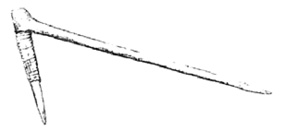
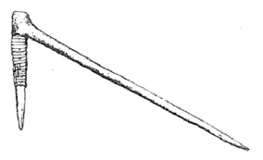
Stone adze, Kukukuku, after Blackwood 1950
The Papuan Government supervised the Lakekamu more closely than any other field; and the Lakekamu became a tough test of its willingness to look after the welfare of its subjects. On 11 December Murray reported the arrival of Crowe and the Prykes in Port Moresby, on 13 December an area of 768 square miles at the head of the Lakekamu stretching to the German New Guinea border was pro-claimed a goldfield, and on 28 December Murray left Port Moresby for his first visit of inspection. Having looked at the claims on Ironstone Creek, Murray and Matt Crowe led a party to make contact with the people who had attacked the prospectors on the upper Tiveri. They found houses, gardens and tracks but no people. Murray said he had expected no more, but he hoped that his ‘reconnaisance in force’ might make the villagers hesitate before attacking any stray miners. When he left Tiveri on 10 January, two assistant resident magistrates, Norman Bowden and George Nicholls, a troop of police, and about twenty miners remained at Ironstone Creek. At the end of January, Lyons, who had served as Resident Magistrate and warden on the goldfields in the Northern Division, and Dr C.C. Simson, who had just resigned after one year as Chief Medical Officer, joined Bowden and Nicholls at Nepa. When the Reverend Henry Newton of the Anglican Mission offered the services of two nurses for the Lakekamu, Murray accepted and he also authorised the immediate construction of a tent field-hospital until timber was supplied for a permanent building. ‘It is to be hoped’, Murray wrote to the Minister, that ‘[the Lakekamu’s] death roll will be less than those of other fields’. On 22 April Murray telegraphed the Minister from Cooktown: ‘dysentery raging’. During February fifteen labourers and one miner had died. To shelter the sick, the miners provided sixteen labourers and a supervisor to construct a ‘native hospital’, while the police built a ‘European hospital … a commodious structure of native material’. But as the epidemic intensified, buildings, supplies and staff were inadequate. In March fifty-four labourers died. On one day six labourers and one policeman, Corporal O’ori, died. On 28 March Bowden wrote in the station journal: ‘After working till 5p.m. we suddenly remembered that it was Easter Monday. The holidays were not celebrated here’. On 1 April, eight labourers died; on 2 April, seven died; for the month, seventy-two died. Police and government carriers helped bury the dead. When a white miner died the Resident Magistrate read the service while the sympathisers stood about the grave. Soon the rise above Nepa Station was being called Graveyard Hill. In May fifty-three died; but by the end of June when another twenty-three had died, the epidemic was almost over. In the six months to the end of June, 1101 labourers had worked on the field: 255 had died, and of these, 231 had contracted dysentery; 415 had been admitted to the hospital established in February, and 160 had died there. Dysentery epidemics had occurred frequently before on plantations and goldfields in Papua, but none had persisted for so long or killed so many. Only four Europeans died from dysentery. One who survived its symptoms, Chas Lumley, Whittens’ storekeeper, said that he had had the ‘shittttts’ so badly that he had feared there would soon be nothing left of him to push his pen.
Murray visited the field at the height of the epidemic. Sixteen men had died on the three days before his arrival, but the police guard of honour which received the Lieutenant-Governor at Nepa Station may have assured him that his government could maintain order in the face of disaster. After inspecting the field with Little, Murray announced that the field would be closed to further recruiting. Whitten and Nelsson, the storekeepers, asked Murray if less severe measures could be taken, but Murray thought all alternatives inadequate. Without enough members of the Executive Council to form a quorum, Murray had to wait until his return to Moresby to put the restrictions into law. By proclamation on 21 April 1910 Murray banned all recruiting for the Lakekamu Goldfield, and under the Native Labour Ordinance he published a regulation to prevent a spread of the epidemic. All labourers leaving the field were to be taken direct to Port Moresby where they were to be examined by the Chief Medical Officer, and no labourers were to land or return to their homes without his permission. In May the law was strengthened by further proclamations stating that ‘No native may be removed to the Lakekamu’. The previous proclamation had allowed an employer who had recruited labourers before 21 April to take them to the Lakekamu.
Under the labour regulations which came into force in August 1909 government officers had the power to see that labourers were supplied with minimum rations, a latrine in ‘a proper sanitary condition’, and a ‘suitable dwelling’ with the surrounding area ‘free from weeds and refuse of every description’. A government officer could direct any labourer to enter hospital and employers of more than ten labourers had to keep a stock of basic medicines on hand.
The legislation was more adequate than the stores, staff and knowledge available to combat the epidemic. In 1910, Dr Julius Streeter, the Acting Chief Medical Officer, issued instructions on the treatment of dysentery. He recommended the isolation of the patient, and the disinfecting of buildings and the careful disposal of waste. If a case were detected early and there were signs of constipation Streeter recommended ‘a good dose’ of a half to a packet of salts and a further four to eight doses in the next twenty-four hours. But if a case was not seen early, then it was better to give the patient a ‘dose of castor oil’ laudanum and ipecacuana (an emetic and purgative). Where practicable, the ‘most rational plan of treatment’, said Streeter, was ‘to irrigate the bowel’ by giving an enema.
The instructions to isolate the patient and ensure general cleanliness would have helped prevent the spread of the epidemic. The laudanum may have given the patient some relief from pain, but the other medicines recommended by Streeter would have hastened his decline. The false prescription arose from a misunderstanding of the effects of the disease: it was believed that the dysentery ‘germ’ ulcerated and inflamed the bowel so that it became blocked. It was the doctor’s task ‘to clear the passage’ and when this had been accomplished the patient was ‘out of immediate danger’. In fact, the use of purgatives and emetics was likely to increase the loss of fluid which doctors later believed it was their task to prevent. The shortage of drugs deplored by the medical officers during the early weeks of the epidemic may have been to the advantage of the suffering labourers.
Simson, who had accepted a temporary position on the Lakekamu, stayed only long enough to see that the government’s apparent foresight gave him few advantages. The epidemic had arrived before the promised tent hospital, the timber for a prefabricated building, and the nurses. When Streeter took over in March he found two European patients in tents near the government station and, about 200 yards away, eighteen labourers in ‘three dirty, dilapidated native buildings’, a poor supply of medicines, and a staff of one untrained European attendant and three untrained Papuans.
Before going on leave in June Murray could assure the Minister that he had agreed to give Streeter everything he asked for except a pair of handcuffs. This was true; Streeter’s problem was getting stores and staff to the goldfield. There was often over a month between incoming mails and it was difficult to get bulky supplies to Nepa. Because the government did not have sufficient stores to feed the hospital patients, rations had to be bought from the traders on the field, and they were not always well stocked. At the end of May and July rice, the basic food of the labourers, was unavailable. When the Merrie England was damaged in a storm and had to go to Australia for repairs it was even more difficult for the government to get staff and equipment to the field. A portable house to be used as a hospital arrived on 6 April, a marquee to house European patients on 28 April, the nurses Combley and Nowland, whom the Anglican Mission had offered in January, arrived in June, and Nurse MacDonald, who was delayed in Australia during April while it was decided what colour dress she should wear, finally reached the Lakekamu in October. At the height of the epidemic Streeter had to use the resources already on the field. The miners and the labourers built more bush shelters and he employed more unskilled attendants. Satisfied with the work of the builders, Streeter had little sympathy for his Papuan orderlies: ‘Natives’, he reported, ‘are of little use as wardsmen, as they are unreliable and careless, and are in a state of constant fear when in attendance on infectious cases.’ He might have conceded that their fears were well-based.
Government officers were probably most effective when they enforced the regulations made under the Native Labour Ordinance to prevent the spread of disease. Murray claimed that he had asked Streeter to go round the field periodically to discover and remove the causes of the epidemic. This was, said Murray, the only time he had attempted to direct the work of the medical officer. Streeter refused: he argued that the inspections would be useless and in any case he was physically incapable of doing the travelling. But at least after April the three field officers made frequent tours of the camps, instructing the miners to make adequate shelters, clear the surrounding undergrowth, get rid of old tins and rubbish, dig proper latrines and send all sick labourers to hospital. In June Bertram Brammell, the Commissioner for Native Affairs and Control, inspected the goldfield and reminded the government officers to see that each labourer was supplied with a blanket, that his quarters were dry and warm and the floor was above ground level, and that where there were more than ten labourers, the quarters were to be inspected daily by the employer or another European. The steep gullies, dense undergrowth and over 200 inches of rain which fell in the first year the field was worked made it difficult for employers to provide reasonable conditions for their labourers, and government officers took few employers to court. On 20 April Nicholls visited the camps on Ironstone Creek and ordered four labourers to hospital; on 25 April, two of the employers, Fred Kruger and Peter Dowell, were each charged with failing to send a labourer to hospital. In July Dowell was summonsed for not having a pit latrine, and W.S. Pinney was charged with removing a labourer from hospital without permission. While prepared to pay labourers above the minimum of 10s. a month and provide more than the prescribed minimum rations (if they could get them), the miners had to be constantly reminded about keeping their camps in order and they were reluctant to send labourers to hospital. It was not merely the inconvenience or loss of the labourers’ services. Murray wrote that sometimes when a miner told a ‘boy’ he had to go to hospital, the labourer wept, divided his possessions among his friends, arranged for some things to be sent home, and went to the hospital to die. It was ‘pretty tough’, Frank Pryke said, when a labourer asked his employer to hit him on the head with a tomahawk rather than send him to hospital. In these circumstances some miners allowed sick labourers to stay in camp, particularly when employer and employee had been together for a long time. And there was some evidence to support the beliefs of the labourers and the actions of those miners who did not send labourers to hospital. Over one-third of the men admitted to hospital died there, whereas when Robert Elliott and Dave Davies left in November because their labourers’ contracts had expired, they took with them the twenty-six men that they had brought to the field: none had died, none had deserted, and the eighteen who had contracted dysentery had recovered in camp before government officers enforced the regulation making hospitalisation of the sick compulsory. The case of Elliott and Davies was exceptional but it helped miners believe that they were justified in letting the sick stay in camp. In a letter to Dan, Frank Pryke wrote with his normal honesty of the forces affecting those miners keen to work valuable ground, concerned about the welfare of their labourers, and distressed at the ‘little hell’ around them:
Living here is very expensive as you have to buy a lot of medicines and luxuries for the nigs to keep them alive at all and then you cannot get much work out of them as it is not safe to drive them and I tell you it grieves a man to lose one of them especially if he is a good boy. I have several of our old boys here. Bete and Gelua amongst them. I had a big contest to save Gelua as he was laid up for a month … .
Gelua and Bete both survived to be paid £9 for twelve months’ work.
The government struggled to prevent the spread of the epidemic from the goldfield. The first regulations controlling the movement of labourers from the Lakekamu were replaced in July by a more general regulation under which an area could be proclaimed a ‘centre of epidemic disease’. Labourers leaving a centre had to be taken either to Port Moresby or Samarai where the master of the vessel had to report to the Chief Medical Officer. If the C.M.O. detained the labourers, then the employer continued to be responsible for paying for their rations. In centres of epidemic it was compulsory to send sick labourers to hospital; previously the employer could wait until he received a specific direction from the government officer. Captains of ships on which cases of dysentery occurred had to sail direct to Port Moresby or Samarai. Penalties under the new regulations were greater than they were for most other breaches of the Native Labour Regulations. Employers could lose the right to employ labourers, be fined £50, or be imprisoned with hard labour for six months. When Captain A.C. Reid was fined £50 for failing to go directly to port after a labourer on board the Kia Ora contracted dysentery Whittens protested strongly, claiming that Reid (and most other captains) was ignorant of the regulations. Whittens argued that Reid had attempted to contact the doctor in Port Moresby, and that the regulation was unreasonable in requiring a captain to make an accurate diagnosis of the ills of his passengers. The Executive Council compromised and reduced the fine to £25. In April 1911 a new regulation was introduced under which any camp or plantation on which a case of dysentery occurred immediately became an ‘infected centre’ and comprehensive provisions for the isolation of the area came into force. But by this time the government was more concerned with outbreaks of dysentery in the Port Moresby area where eighty-one labourers had died between July 1910 and March 1911.
Although the epidemic on the Lakekamu appeared to have reached its height in April 1910 this was not clear to Staniforth Smith, acting as Administrator in Murray’s absence. Smith told the Minister that while the number of deaths had fallen in June so had the total number of labourers. Smith concluded: ‘after a period of five months, the epidemic is raging as seriously as ever’. The next day he left Port Moresby for the Lakekamu taking with him the Chief Medical Officer and the Government Secretary so that he could hold a meeting of the Executive Council on the field if necessary. ‘If no improvement is manifest’, he wrote, ‘I shall, in spite of the large interests involved, have no hesitation in closing the field … ’. In the event of the field being closed, the sick were to be moved to high ground where they were to be cared for. All other labourers were to be taken to camps at the mouth of the Lakekamu where they were to be picked up by the Merrie England and shifted to a quarantine area on Fishermans Island near Port Moresby. But when Smith reached the Lakekamu on 10 July he found only six men suffering from dysentery and nine convalescing. He decided not to close the field. At a public meeting the miners agreed that ‘The government had done all they could to meet the difficulties and overcome the epidemic of dysentery’. Either Smith suppressed some evidence or the miners decided there was no point in being critical after the event. Frank Pryke in his letters had been strongly opposed to the government’s plans to take labourers from the area and thought Streeter might have ‘put up a record here as he must have lost at least 200 cases in a little over six months’.
Table 12
Lakekamu Goldfield Death Rate
|
Total number of labourers on 30 June |
Deaths in preceding 12 months |
||
|
1910 |
643 |
258 |
(6 months only) |
|
1911 |
428 |
57 |
|
|
1912 |
507 |
26 |
|
|
1913 |
141 |
8 |
|
|
1914 |
386 |
1 |
|
|
1915 |
224 |
11 |
(including 5 in a mining accident) |
By September there were no cases of dysentery, but there was an increase in the incidence of beriberi. Labourers complained of pains or heaviness in the limbs, then partly lost the use of their legs. Sometimes there were few outward signs of illness and an employer might think the labourer was malingering; but after suffering acute distress the patient died. Beriberi had occurred in other parts of New Guinea but its cause was unknown. The most common explanations were that it was a result of either dampness or some diet deficiency. When it appeared on the Lakekamu Streeter was not in fact certain that the labourers were suffering from beriberi and he preferred the diagnosis, ‘Epidemic ideopathic polyneuritis’. In admitting that his conclusions were based on inadequate evidence, Streeter pointed out that he had carried out no post-mortems, had frequently been ill with malaria, and although he had asked for a microscope none had been supplied. He thought it appropriate to remind his superiors of the ‘famous epigram of Dr. Ross, a mighty enemy of tropical diseases. … “The success of Imperialism depends upon success with the microscope”’. Streeter noted that on the Lakekamu most who had the disease had also suffered from dysentery; they were what the miners called ‘hard-workers’, so perhaps over-exertion was a factor; the sick tended to come from particular areas; and the inclusion of rice in their diet seemed to have no ill-effects. While calling for further investigation, Streeter thought that the disease may have resulted from ‘mineral poisons’ in the water. But Dr. R. Fleming Jones, the Resident Medical Officer at Samarai, informed his colleagues that studies in the Malay States had established the cause of beriberi: the rice theory was right after all. Each year, said Jones, a new explanation was put forward but the rice theory, like Banquo’s Ghost, could not be put to rest. Now it had been shown that beriberi resulted from the absence of some substance in milled rice. Smith instructed the Resident Magistrate at Nepa to increase the size of the government gardens, and he arranged for peas and lime juice to be brought from Cairns. But the disease persisted. From September 1910 until July 1911, fourteen labourers died, and the following year two died of beriberi and another two deaths were classified as ‘mouth disease’, presumably also caused by diet deficiency. The Medical Officer on the Lakekamu wrote that beriberi ‘still seems to lurk in our midst, and no doubt will continue to do so until the use of polished rice as a stock food is abandoned’. Yet the regulations concerning rations remained unchanged: it was still possible for an employer to feed his labourers on a diet of 10½ lbs rice, one lb biscuits, and one lb meat per week. The government’s continued approval of a diet largely dependent on rice without specifying its type was all the more surprising in the light of events in other parts of the territory: in 1910-11, sixty-seven labourers died of beriberi and on Woodlark Island 131 cases were reported among 574 labourers. But at least on the Lakekamu, the advice, ‘isolation of the sick’, concern with the comfort and cleanliness of camps, and time, led to an improvement in health.
It seemed that the effectiveness of the government’s policies was to be tested again in 1912. On 27 December 1911 Dr William Giblin found that one of Whittens’ labourers from Tiveri had dysentery. Giblin reported that the rest of the labourers were healthy, and the employers kept adequate supplies of disinfectant. On 3 January three labourers had dysentery and the man admitted to hospital on 27 December had died. The police cleaned out their barracks and disinfected their blankets. Lionel Armit inspected camps, reminded miners of the regulations about the control of dysentery, and sent Lance-Corporal Lagoni to Port Moresby to inform the Government Secretary of the outbreak. When one of Henry Fletcher’s men contracted dysentery Fletcher burned his old camp and moved to a new site. The attempts to contain the epidemic had little effect. By the end of the month thirty-two labourers had been admitted to hospital with dysentery. By gathering at Tiveri for Christmas miners and labourers had spread the infection widely. But the disease was apparently of a mild form; few died and the epidemic had passed by the end of February. Now malaria, which had been absent from the field when the miners first arrived, became ‘abundant in every camp’. Stagnant pools were drained or covered with kerosene to no effect: the malaria depressed and debilitated miners, government officials and labourers, but it rarely killed.
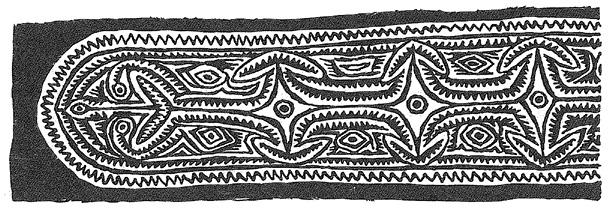
Bark belt, Toaripi, after Haddon 1894
In mid-1911 Giblin reported that the work of a doctor on the field was ‘extremely light, in fact, monotonously so’. A year later, Frederick Rorke, Giblin’s successor, left the field and the hospital was closed. To that date the Lakekamu had produced about 17,500 ounces of gold worth £65,600 at a cost of 331 labourers’ lives: or 53 ounces of gold worth £200 for each dead labourer. When the dysentery had just passed its peak, some of the old miners told Staniforth Smith that it had been worse on the Gira: they were probably right.
News of Papuans dying on the Lakekamu caused members of the Commonwealth Parliament to examine briefly Australia’s stewardship. The outlawing of Joe O’Brien was the only other event to stir the members’ interest in the behaviour of men on the Papuan goldfields. In August 1910 William Higgs, the Labor member for the Queensland electorate of Capricornia, asked whether it was true that 300 out of 1000 labourers had died, what caused their deaths, who employed them, what were they paid, and what rations they were given. Egerton Batchelor, the Minister for External Affairs in the Labor Government, replied: 269 had then died, he listed the causes of death, he did not know the names of the employers, the labourers were paid from 10s. to £1 a month, he quoted the minimum rations prescribed under the native labour regulations, and in the government’s defence he pointed out that hospitals, medicines and trained staff had been provided. Later in the debate on the estimates, Higgs made clear what lay behind his questions. A journalist, Higgs had previously sat in the Senate from 1901 to 1906 where he had been one of few members to oppose the transfer of British New Guinea to Australian control. ‘Now’, he said, ‘we have no right to use our superior strength to make wealth out of the natives of New Guinea.’ He went on to support his conclusion with a rambling but consistent argument. Imperialism was in the economic interest of one class in the metropolitan power and to the detriment of the people in the colony. Capitalists, said Higgs, not content with low interest rates in the old country, wanted to invest abroad where they could obtain labour for 2s. 6d. a week. The labourers were ‘treated as slaves’, poorly housed and fed on a monotonous diet which was responsible for the epidemics of dysentery. Now the companies wanted to recruit not just men, but whole families to live on plantations, a move which would lead to the break-up of the villages and a decline in population. If Australia’s administration was ‘primarily in the interests of the natives’, then the government, said Higgs, should see its money spent to assist Papuans and not the companies who ‘exploited these guileless children’. The Papuans were not lazy, he claimed, they were skilled craftsmen and anyone who doubted this could have a look at their art in the Melbourne Museum: they should be taught trades so that they ‘might produce wealth for themselves in co-operatives’.
Batchelor, who had visited Papua, answered Higgs much as Murray would have. The Papuans could not be left in ‘a savage condition’. It was in the interests of the Papuan himself that he was being encouraged to work: the government aimed to develop his agricultural instincts and the only way to do so was to permit his employment. Government officials ensured that the labourer freely and knowingly entered a contract and that he was treated humanely by his employer. ‘The Government’, said Batchelor, ‘would be no party to the surrender of the natives to capitalists.’ But in two interjections, Higgs showed that he wanted not protection of the Papuans, but a fundamental redirection of policy. Did the government, he asked, spend any money teaching Papuan men a trade or educating their children? Batchelor was not prepared to say offhand that the government spent nothing directly on education, but he could have told members that the government provided no schools for Papuans and that he had just received a letter from Staniforth Smith stating that ‘practically the whole of the white residents, including officials’ objected to ‘natives and half-castes’ attending a proposed government school in Port Moresby. Later Higgs pointed out that acceptance of the government’s arguments depended on whether you thought ‘the native should work for himself or for the capitalists’.
The implications of Higgs’s interjections may not have been clear to the House. When Batchelor claimed that government was in the interests of Papuans, he was saying that government officials were instructed to see that employers met the minimum conditions set by the government: but Higgs thought that if a government acted in the interests of Papuans it would give them opportunities for advancement so that they did not stay low-paid, unskilled, indentured labourers. Higgs had a vision of the development of Papua by Papuans: Batchelor spoke of development by Australians made benevolent by government supervision. At the time Higgs spoke most indentured labourers were employed on plantations, but the group who had initially aroused his interest were the teams employed by alluvial miners. The diggers staked by trading companies, hopeful of finding good dirt and getting full shammies before the ‘boys” contracts run out, the battlers of Kalgoorlie and the Palmer, had become capitalists and exploiters in Papua. At the close of the debate, Higgs suggested that the Minister consider ‘giving the white residents an elected representative … in this House, and, further, of giving the natives a native representative when one is found able to speak our language intelligently’. For the next thirty years few other members saw that the government’s proclaimed intention to act ‘primarily in the interests of the natives’ meant only that it would prevent the worst abuses of the people in its territories.
The few other members who joined the debate wanted the government to be more vigilant in its protection of the Papuan labourers. Two members pointed out that the death rate among labourers was higher than it had been among the kanakas in Queensland. All were concerned that ‘no stigma shall rest on the reputation of the Commonwealth in connection with the administration of Papua’. Several members assumed that the Papuan was a ‘child of nature’ who lived in a ‘happy village’ and therefore it was not ‘civilisation’ to take him to labour on plantations or mines where the death rate was high. Advanced in the government’s defence, this assumption undermined Batchelor’s position for it was basic to his argument that ‘the natives are very much better off, even as they are treated on the worst labour plantations, than they were originally’. In further defence of Australia’s actions in Papua, Batchelor pointed out that the death rate in 1909-10 was exceptional and that more people had died in the villages. He may well have been right. For several years there had been outbreaks of dysentery in the villages and, in 1909, both dysentery and whooping-cough had killed many people east of Yule Island. In the next year, when Papuan men had to decide whether they preferred the village or the plantation, many chose the plantation: in 1909-10, 2407 were engaged for plantation labour, and in 1910-11, 4514 signed-on.
While the ban on recruiting labour for the Lakekamu was in force, the goldfield’s population steadily declined. Labourers who died, deserted, or were paid-off when their contracts expired could not be replaced. In July 1910 there were about 600 labourers on the field; by the end of the year there were only 343. On Ironstone Creek where there was ‘good gold’ the miners ‘deplored the absence of labour to enable them to carry on’. Following advice from the Resident Medical Officer the government revoked the proclamation against recruiting in November, and a few miners left immediately to recruit new teams. Knowing that news of the death rate on the field had been spread widely in recruiting areas by government officers distributing trade goods to the next of kin, miners thought it might be difficult to persuade men to sign-on. But in January Davies returned with twelve labourers, the first new recruits. He had been away two months; Lyons thought his trip ‘singularly successful’. Frank and Jim Pryke found recruiting ‘pretty tough’ but they signed-on thirty-six men and they paid them the same wages as the previous year, 15s. a month. By March the Bulldog was landing over forty labourers at Tiveri on each trip, and the sight put ‘fresh heart into the miners’. There were over 400 labourers on the Lakekamu in June 1911, and 500 the next year.
Table 13
Lakekamu Goldfield production and population
|
Year |
Miners (30 June) |
Labourers (30 June) |
Production (ounces) |
|
1909/10 |
61 |
643 |
3000 |
|
1910/11 |
38 |
428 |
8000 |
|
1911/12 |
33 |
495 |
6500 |
|
1912/13 |
14 |
141 |
5000 |
|
1913/14 |
29 |
386 |
4000 |
|
1914/15 |
22 |
224 |
3000 |
|
1915/16 |
27 |
340 |
2715 |
|
1916/17 |
14 |
280 |
*3400 |
|
1917/18 |
5 |
55 |
194 |
|
1918/19 |
5 |
46 |
350 |
|
1919/20 |
4 |
32 |
500 |
* The total number of labourers on the field during the year. The wardens could not obtain accurate figures for production.
In spite of the miners’ fears most recruits continued to come from the D’Entrecasteaux Islands. In 1912 the warden reported that some were signing-on for their second term on the Lakekamu and ‘nearly all had experience on the older fields of the Territory’. For almost twenty years now the eastern islanders had worked for alluvial miners, and a few had probably worked gold for themselves. They knew their trade, responding to the taubada’s (master’s) enthusiasm when rich alluvial was going through the bokis. Their aptitude convinced the miners that the ‘east end boys’ were in some way more intelligent and better fitted for mining than western men. When a number of Milne Bay labourers deserted in 1913, the Assistant Resident Magistrate thought it was because not enough gold was being found. ‘These boys’, he wrote, ‘like to work where there is gold, and if they find that after a week or a month’s work there is nothing to show for it, they get very dissatisfied.’ Kiwai, Bamu, Purari, Goaribari, Orokaiva and Paiwa men also worked on the Lakekamu. Sometimes they were the first to recruit from their area: they had to learn to use the shovel and cook strange foods as well as master the skills of bush camp and mine. Under experienced miners, recruits normally settled quickly to the work, although problems arose with those groups who had no language in common with the taubadas and there was no interpreter on the field: they could not learn what was expected of them. At the end of 1911 W. Newland was getting an ounce a day and he attempted to employ ‘raw, Western Division men’, but gave up in despair after a day and a half. Recruits from Paiwa on Goodenough Bay were on the field for a year before a Paiwa-speaking policeman arrived to tell them that they were not supposed to run away and live by robbing the camps. Because men from the Western Division, the Gulf, and the Northern Division had little experience of working gold, and some miners were prejudiced against them, they were often employed only as carriers, taking the stores from Tiveri out to the camps or, when the river was low, meeting the Bulldog and packing the rations to the Tiveri landing.
There was a lot of ‘dead work’ on the Lakekamu before the final washing of the gold, and the miners employed bigger teams than on other Papuan goldfields. Heavily timbered areas had to be cleared, and a head of water taken from upstream to give sufficient pressure, particularly if the claim was on the terraces above the valley floor. Races up to a mile in length had to be dug following the valley contour, crossing gullies on flumes made of hollowed logs or bark, and tunnelling through spurs. Within six months the ground between Ironstone and Rocky Creeks had ‘been torn out of all recognition’ by men equipped only with pick, shovel and axe.
The labourers, at first living in tents or rough shelters, built substantial bush houses with wooden sleeping platforms ‘close fitted’, according to regulation, ‘so as to prevent draughts’. After the first year the only store on the field was Whittens at Tiveri, and labourers had to carry all the stores from Tiveri to the claims; a one day walk to Ironstone and several days to the camps further out. To add variety and quantity to the stores the ‘shooting boys’ brought in wallaby, cassowary and pigeon to put with the rice. When the Bulldog failed to arrive and stores were short some labourers camped at the swamps, making sago for those working the claim. During the first year the heavy rains frequently washed out bridges and roadworks and flooded the claims; yet there were still times when there was not enough water to run all the races and the teams just ‘dodged along’. Sunday was, by regulation, a day of rest for all; a point impressed on miners and labourers in 1911, when the Resident Magistrate prosecuted two employers for working their teams on the Sabbath. At Christmas police and labourers competed in sports and danced at Nepa and Tiveri.
When they made periodic inspections Resident Magistrates and officers of the newly formed Department of Native Affairs and Control asked labourers if they had any complaints, the labourers normally had little to say. But their habit of deserting was evidence of dissatisfaction. In the first eighteen months after the opening of the field 180 labourers were charged with desertion at Nepa, 179 were convicted and one case was adjourned for want of an interpreter. The rate of desertion was high, partly because of the fear of dying of dysentery, but it was still less than it had been on the Gira. Normally three or four policemen were out looking for deserters, who were not easy to find. Labourers from the Lakekamu showed the same skills and determination as escapees from the Northern Division and Woodlark. They were picked up at Moveave, nearly 70 miles from the mining camps, and along the coast to the west at Kerema and to the east at Kairuku and Manumanu. In 1919 two men were arrested for desertion at Efogi. They had travelled about 250 miles to reach their home village on the Port Moresby-Kokoda track. When William Murray reported that two of his labourers had made rafts and gone down the Lakekamu, Humphries assumed there was little chance of catching them: they would not go to their home village on Kerema Bay but to Port Moresby or some other station and sign-on under another name. Some labourers must have been surprised at the tenacity of the system they entered by signing-on. In April 1918 two policemen brought back from Kerema four labourers reported missing by Andrew Gillespie in September 1915. In the following year Gillespie continued to use the law to his advantage, charging several of his labourers with absenting themselves from work or failing to ‘show ordinary diligence’.
While Resident Magistrates were charged with seeing that all labourers knew what they were doing when they signed-on, some labourers only learned of the intransigent nature of a contract when they decided they had had enough of working on the goldfields. On 10 November 1916 Humphries, after gaoling two of James Preston’s labourers for desertion, and discharging one, wrote in the station journal: ‘It is quite a common thing for Preston’s boys to turn up at the Station (carrying their swag and gear) and to say that they have come because they don’t want to work for “money”’. In reply to Humphries’s questions the labourers said that Preston did not hit them, and they were well fed. Humphries then attempted to explain to them that they had to work for Preston or be sentenced to hard labour on the station and then return to Preston for more work. Two days later the labourer discharged on the 10th came back to Nepa: he still did not want the ‘money’. Then another turned up carrying his pannikin, plate, spoon, mosquito net and blanket. He claimed he was sick but he appeared normal to Humphries who watched him prepare to settle at the station. By 20 November Preston had only two labourers left: his Bamu recruits had learned that under the indenture system a re-negotiation of the contract was impossible. The alternatives were to suffer or run. Escape was simple for the Western Division men: they entered the vast sago swamps to the south of the station where food was plentiful and capture difficult. The country was similar to that near their home villages. One man, Humphries reported, had camped for days in a hollow tree trunk from which he had watched the passing police. Other deserters lived in abandoned camps and in 1910 Lyons reported that five deserters had been living for three months in the bush near Tiveri, fed by the Kiwai carriers based there. Not all deserters were so fortunate. In 1910, Pegolo, a Milne Bay labourer, was wounded and his two companions were killed by men who attacked them on their journey to the coast, and in 1911 Moveave villagers were said to have killed some ‘runaways’. But generally the life of the deserter on the Lakekamu was far less hazardous than on the Northern Division fields where the way of escape lay through more numerous and warlike peoples.
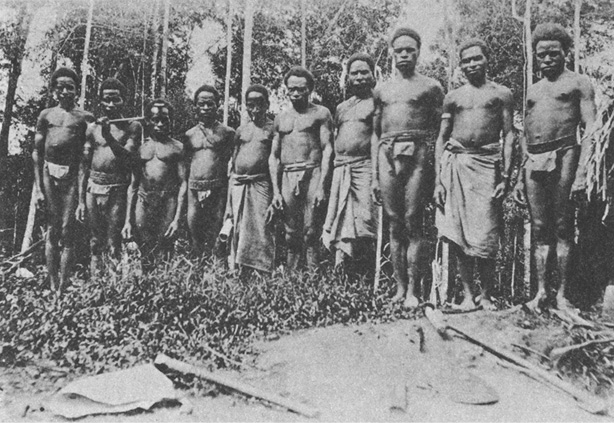
A ‘team’ of labourers from Orokolo on the Lakekamu Goldfield, 1914
PHOTOGRAPH: FRANK PRYKE
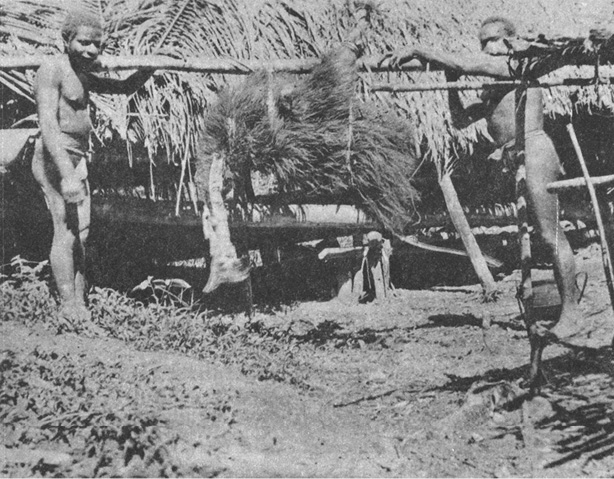
Two labourers bringing in a cassowary to feed the team, 1914
PHOTOGRAPH: FRANK PRYKE
There was also less violence between employers and labourers, partly because the Lakekamu was more closely supervised by government officers than any of the other alluvial fields. In 1913 Lagalaga was committed for trial for assault occasioning grevious bodily harm to James Mulholland. But when Mulholland died in the Port Moresby Hospital the charge was changed to manslaughter, and Lagalaga was sentenced to five years’ hard labour. The case was unique: any other cases of labourers assaulting the taubadas were minor ones dealt with in the Resident Magistrate’s court. Instances of miners savagely assaulting labourers were also infrequent, and there is no evidence to show that such cases were not taken before the Central Court. In fact the senior government officers, Murray, Campbell, Herbert and Bramell, were determined to see that the law was observed and that the courts would receive and consider evidence from Papuans. At least twice field officers took miners before the central court for gross mistreatment of labourers. In August 1911 Lyons committed Henry Jeffrey for trial for assaulting Ewarupa, an indentured labourer, and ‘doing him bodily harm’. While collecting evidence, holding a preliminary hearing and sending one European and nine Papuan witnesses to Port Moresby was a burden for the government, the costs for Jeffrey were greater. He was ground-sluicing a claim at Robertson’s Gully just to the north of Nepa when he was instructed to go to Port Moresby for trial. ‘As the notice was so short he simply had to let all his work go. The last day’s boxing he did before commencing ground-sluicing yielding him 4 ozs. gold.’ In Port Moresby Judge Herbert found Jeffrey guilty of assault causing bodily harm, and fined him £20. Jeffrey returned to the field where two months later he was again fined for assault, although the records do not say whom he assaulted. His antagonisms were not exclusively inter-racial. Later in 1912 the warden had to resolve a dispute between Jeffrey and another miner and he was involved in a fight with Lumley at the store. On this occasion Lumley conceded that he was at fault: ‘I started it through being sober & touchy & thin skinned & just recovering from a near approach tothorrers [to the horrors]. Anyhow Jeff finished the bastard fite. My beak aint set straight yet & I never put a mark on Jeff.’ Shortly after Lumley ‘picked a row with Joe Sloane [in Port Moresby] and got a devil of a hammering’. If the miners sometimes engaged in ‘physical argument’ among themselves they could not be expected to refrain from throwing punches at their labourers. The question is not whether miners struck their labourers, but whether they treated them brutally.
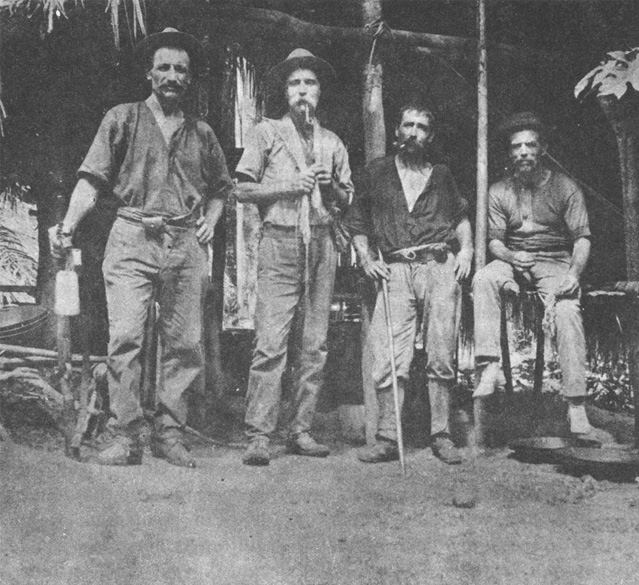
Miners at Sunset Camp, Lakekamu Goldfield, 1914
PHOTOGRAPH: FRANK PRYKE
Having shown in its treatment of Jeffrey that it was prepared to take men to court in spite of inconvenience and some miners’ prejudices, the government faced a more complex and serious case in 1915. In May the Resident Magistrate, Eric Oldham, while questioning some men employed by J. Regan, mentioned the name of another labourer, Jiaro. One of the men present remarked, ‘He is dead — Jerry killed him’. ‘Jerry’ was William Kelly, a miner who had had some of Regan’s labourers transferred to him earlier in the year. At the time, Jiaro’s death had been reported and as Regan said he had been ill, Oldham had made no further investigations. Now a different story emerged. Oldham took statements from two labourers who claimed to be witnesses. One, Miara, said:
Before Jerry hit one boy named Jiaro plenty time with a big stick. The stick was about as big as my arm. He hit him so much that plenty excrement come out along behind. When Jerry finish hit him Jiaro fell down and Ai-i-ia and me picked him up and put him along fly house [tent].
Miara believed that Jiaro had been beaten because he left a bag of rice on the road while carrying goods up from the store, and when Kelly told him to get it he had refused. Jiaro died the day after he was beaten. Ai-i-ia’s evidence agreed almost exactly with that of Miara. Other labourers had knowledge of the case, but one group was from Paiwa and Oldham had no interpreter, and the others from Goaribari had completed their contracts and left the field. When Murray learned of the case he instructed Oldham to take evidence from the Paiwa labourers and ‘take such steps against W. Kelly as the evidence warrants’. The Resident Magistrate in the Delta was asked to contact the Goaribari labourers, but he reported that there was no point in doing so because the Goaribari labourers had been paid off before Jiaro had died. (On this point, the Resident Magistrate is contradicted by the dates in the Nepa station journal.) In September Oldham committed Kelly for trial charged with murder. In the Central Court the charge was reduced to causing grievous bodily harm and Herbert ruled that Kelly was not guilty. Herbert or Murray may have reduced the charge to avoid having to call a jury, mandatory when Europeans were tried for crimes punishable by death. After his acquittal Kelly decided that he had been persecuted by Oldham and threatened to sue the government, but Murray assured the Minister that Kelly had no case against the government. In fact Murray thought that Oldham had acted correctly in charging Kelly with murder and although the case against Kelly was not a strong one, he was sure that had Herbert found Kelly guilty of murder no court would have quashed the conviction.
Minor cases of assault were also infrequent. Only two miners were convicted in the Resident Magistrate’s court in the four years 1910-13. As in their policing of the regulations controlling the spread of dysentery, the government officers were more inclined to warn than prosecute. For example, Oldham recorded in the station journal for April 1914: ‘Mr. C. Castleton, cautioned as to his treatment of natives.’ Later in the same year, Thomas Murray, Regan and Sloane were also warned. None was taken to court, but James Wallace and Murray had their permits to hire labourers from Whittens’ cancelled, a more severe punishment than the normal £5 fine imposed by Resident Magistrates.
Apparently indulgence could be as much a crime as severity. In 1917, Humphries inspected Jerry Ford’s camp at Sunset Creek and reported:
As this man’s age increases he becomes less fit in my opinion to control natives. They sleep in his hut, help themselves to his stores, and in fact just do as they like. He was put under a Prohibition Order in Samarai, but that has not prevented him from getting liquor … he is irresponsible and incorrigible.
Ford was fined for a breach of the Native Labour Ordinance, but the labourers’ contracts were not cancelled.
The labourer who went to the Lakekamu was most likely to appear in court because he ran away, and a few went before the magistrate for failing to work hard enough or for stealing or fighting. A government officer would also send him to Port Moresby if he had venereal disease, or have him sent home if he were too ill to work. But he would also have learnt that the court sometimes had power over the taubada. Each year one or two miners were fined for working their labourers on Sunday or not having a pit latrine, or for ill-treating labourers. In the courts the labourer could speak against his employer, and weight was given to his evidence. This was not the case in the other major Australian territory. In the Northern Territory European juries heard all criminal cases and there, Mr Justice Bevan said, when a European was charged
with an offence against a coloured man, no matter what the evidence may be, the matter is decided on the question of colour … The injustice is made more glaring by the fact that it is not that ‘coloured’ evidence is disbelieved qua ‘coloured’ evidence, but it is disbelieved because it is offered against a European; the same ‘coloured’ evidence against a ‘coloured’ man will be accepted, and, rightly, acted upon.
Murray later recalled that employers had reacted in horror when they found that the government intended to enforce the Native Labour Ordinance and accept Papuan evidence in the courts. But both Murray and Batchelor were incorrect to conclude that the government therefore acted primarily in the interests of Papuans. What it had done was make employers behave as enlightened self-interest should have directed them. The government attempted to ensure that the ‘boys’ did not run away, were fit to work, and unlikely to deter others from trying the same experience. But in forcing employers to act in their own interests, Murray’s officers gave Papuans rights which were not granted to non-whites in the Northern Territory and which were resented by some employers in Papua.
Mining on wet cliff faces was sometimes a dangerous occupation. In November 1910 there were two accidents: in the first a man was killed and another injured, in the second a man’s leg was crushed and he died after it was amputated by Giblin at Nepa. The death of only one other labourer killed in a mining accident was recorded in the station journals until 1915 when J. Reilly … had a terrible accident in his claim whereby five boys were killed’. Taking all the police and prisoners Chisholm went to Reilly’s claim but the men were buried under many tons of earth and their bodies were not recovered until the next day. Under the Queensland Mining Act of 1898, an inquiry had to be held before four experienced miners, and another miner assisted the warden in the conduct of the inquiry. The report on the accident at Reilly’s claim was referred to the Director of Public Works, who found no evidence of negligence. But the application of the Queensland Act to Papua made possible an abuse not considered by those who passed the legislation: in Papua the men who heard and assisted the inquiry were more fellow-employers of Papuan indentured labour than they were fellow-miners. The difference may explain the failure of the warden and the four miners to agree in a second inquiry in 1915. Tomowi-u-ia, employed by Sloane, had his leg broken, and when the miners came to apportion blame they decided that the accident was due to ‘the negligence of the native labourers’. The warden, showing more concern for the labourers’ welfare and less respect for their ability, thought that Tomowi-u-ia’s leg was broken by a fall of rock (not a point of dispute) and that Sloane should not have left the removal of the rock ‘to the intelligence of his native labourers’. While the miners had given themselves absolution, Sloane had demonstrated his personal concern for Tomowi-u-ia by accompanying him over 100 miles to Yule Island where he had him put on a boat for the Port Moresby Native Hospital.
Only one European was killed in a mining accident. (Not that they led uneventful lives: one was shot by a Tiveri storekeeper, one went mad, and another was drowned.) Early on Saturday morning 7 September 1912 D. James came into the station ‘in an excited state’ and reported that one of Edward Jones’s labourers had just arrived and said his boss had blown one of his hands off with dynamite. Oldham, Reilly, three police and twenty labourers left for Jones’s claim. Later other miners set out to help. Believing that Jones’s camp was within a day’s walk, Oldham and Reilly took no stores and when they failed to reach Jones by Saturday night they were forced to camp without food or tents. The next day when Reilly became exhausted, Oldham, the police and labourers went on and had Jones ready to shift when three other miners and their labourers arrived. They carried Jones to Tiveri and then took him by boat to the mouth of the Lakekamu where they caught the Bulldog, but the Bulldog, short of benzine, was forced to return to Motumotu. Oldham then took the Kerema whaleboat and after stopping overnight at Keveri village they reached Yule Island, where the mission sisters attended Jones before Oldham commandeered the Maimera in the absence of its skipper. Half way to Port Moresby they sighted the Kia Ora which towed them into Port. Jones was taken to hospital where he was operated on but died of tetanus. Oldham and the police had covered about 250 miles in eight days. Commending Oldham, Lyons wrote: ‘I think this performance is unprecedented so far as Papua is concerned … . ’
Wooden club, Kukukuku, after Blackwood 1950

At first concentrated at Ironstone and Rocky Creeks, the miners soon began prospecting in neighbouring valleys, cutting the tracks originally marked by Crowe and the Prykes. Early in 1910 Fred Kruger began mining at Cassowary Creek, a tributary of the Arabi River about 14 miles east of Tiveri. After nearly a year’s work Kruger was said to have taken out 400 ounces of gold. By June 1911 twelve other miners were working claims at Cassowary and they spread out in what became known as Big Cassowary, Little Cassowary and Preston’s. To the north of Ironstone gold was found on the Tiveri, Fish Creek and Robertson’s Gulley. In the west there were five miners working at Tailend Creek or Thirty-five Mile on the upper Olipai early in 1911, but they abandoned the workings as the cost of packing stores was higher than the returns. More substantial finds were made west of Tiveri at Twisty Creek and south-west of the Olipai at Mosquito and Sunset Creeks. Miners concentrated in particular areas following rumours of big ‘wash-ups’. In January 1914 most miners were on Twisty Creek: the next year they were out between Mosquito Creek and the Tauri. But from 1910 to 1918 there were always some miners on Rocky and Ironstone Creeks. On the reward claim the Prykes and Matt Crowe had won over 1400 ounces of gold in their first twelve months and after they abandoned the claim in December 1911 it was re-worked by several miners.
From early in 1911 when the Lakekamu was reopened to labour and it became clear that the field offered an income for only thirty or forty diggers, the miners were keen to see new country opened up. In September 1911 the miners on the Lakekamu elected Frank Pryke to lead a prospecting expedition financed equally by the miners and the government. Pryke selected Bob Elliott and Charlie Priddle to go with him. In December the prospectors and forty-one labourers established a base 120 miles up the Vailala. Finding that the Iova, a turbulent north-western tributary flowing through narrow gorges, was impossible to prospect Pryke, Priddle and thirty carriers turned east and crossed a series of gullies where they found fine ‘colours’. Although they saw gardens they met no people until 20 December when, at a point Pryke thought was close to the German New Guinea border, they came to a village of twenty or thirty houses. The people accepted tobacco and appeared friendly, but as Pryke led the party on a track away from the village he was suddenly confronted by five or six men standing on a rock. He walked forward making signs to them to put their bows down; but one man released an arrow. Pryke shot and killed his attacker and the prospecting party ‘shook tribe up generally’. The arrow had entered Pryke’s chest ‘just below left nipple and travelled down towards left kidney’. Frank pulled the arrow out then became ‘pretty ill’. Fearing he might die he dictated a note to Priddle describing what had happened and largely absolving the villagers from blame. After camping for two days the party started back for the base camp carrying Pryke on a stretcher. The return journey took nine days. While Pryke recovered, Priddle and Elliott tested the Ivori, another branch of the Vailala. By their return Pryke had recovered sufficiently to accompany Priddle up the Lohiki then south across country to the government station at Kerema. Frank Pryke’s recovery was only slightly less dramatic than that described by Murray in his Annual Report: ‘Mr. Pryke is a man of iron nerve. An arrow went nearly through his body, and would probably have killed any one else: Mr. Pryke, however, simply pulled it out and went on with his prospecting.’ While waiting for a boat back to the Lakekamu the prospectors tried the Murua River, but found only ‘colours’. In March the Lakekamu miners learnt that the expedition had opened no new field. In spite of a second clash with villagers on the Lohiki and much tough travelling all the carriers completed the return trip on the Bulldog.
In April 1912 the miners raised another £150 to support a prospecting expedition and the government again provided an equal amount. Avard Newcombe, a Canadian-born engineer who had spent several years on Papuan goldfields, was chosen as leader and he selected Gordon Robertson and A.G. Hicks as companions. For three months Newcombe, Robertson, Hicks, and ‘thirty-eight boys’ tested the upper Tiveri, Olipai and Fish Creek. Having crossed to the Tauri they made a double-canoe and went downstream to Moveave. Before ascending the Tauri and returning overland to the Lakekamu they prospected the Maiporo and Kororo Creeks to the west. The villagers of the upper Tiveri and Olipai again showed they ‘desired no intercourse with the outside world’; they accepted no trade goods left for them and their arrows wounded three carriers. In his report Newcombe, B.Sc., regretted that he had found no new goldfield for it would have helped bring ‘the native population into touch with civilization and [done] something toward making them useful members of the community’. ‘All hands’ on the Lakekamu were ‘sadly disappointed’ at the expedition’s failure. In October John Butler, a miner at Cassowary Creek, reported that he had made two trips west to the St Joseph River but had found neither gold nor people.
By the end of 1912 there was no talk of big ‘wash-ups’ and many were marking time, employing their teams on well-worked ground. Frank and Jim Pryke had left the field to invest in businesses in New South Wales and Lumley sent them news from the Lakekamu:
Things are dam crook up here. No gold, no water & in fact you can feel a state of buggerization in the atmosphere. The blokes had a meeting on the Field last Sunday & sent an ultimatum demanding a reduction in prices all round of about 40%.
But some men still had cash for when Mulholland’s leg was ‘cronk’ and would not heal, ‘the crowd sent a list around to get him out of it for a few months. £117/-/- was hit up for him’. Later in 1912 Lumley wrote that the Lakekamu was ‘dam near done for bar tucker shows’. He did not know ‘where the crowd [would] go next’; he himself had already left for Woodlark. Some miners wanted to try the Fly River but the cost of an expedition would have been high. Their hopes of a new field depended on Crowe, James Preston, Edward Auerbach and William Park, who had gone up the Markham valley in German New Guinea. In Rabaul before crossing to the mainland they learnt that Piastre had won the Melbourne Cup: Crowe and Auerbach had put their money on Duke Foote. Two days after leaving the mission station on the Huon Gulf they clashed with New Guineans and they fought with them nearly every day for the rest of the trip. The Australians prospected on south New Britain before returning to Australian territory.
By 1914 Crowe was back on the Lakekamu building canoes to go up the Kunimaipa, and not finding any gold there, he joined another expedition to the head of the Tauri and Olipai.
In 1914 the miners were given a chance to prospect the Fly. On his return from an exploratory survey of the Fly and Strickland Rivers Murray brought alluvial samples which revealed a few grains of gold, and then in May Sir Rupert Clarke, a Victorian property-owner, businessman and Papuan planter, financed a well-equipped expedition. Frank Pryke had learnt, after a year as a tobacconist, seller of fancy goods and proprietor of a billiard saloon in Moree, New South Wales, that ‘selling penny and halfpenny articles [was] a mighty slow way of accumulating a fortune’, and his partner was ‘as mad as a dingo’. Jim too was ‘talking Papua again’ so the Prykes needed little persuasion before they joined Clarke as prospectors. With Clarke and Archie MacAlpine, the manager of Clarke’s Kanosia plantation, the Prykes explored the Black and Alice, upper tributaries of the Fly and then after Clarke and MacAlpine returned to Daru the Prykes dragged canoes and scrambled up the steep valleys of the Tully and the Alice. They had gone further up the Fly than any previous expedition, and although they washed a few ‘colours’ they found nothing worth working. On their way down the river the Prykes stopped to trade just below D’Albertis’s Attack Point. At first the people appeared friendly but when they became anxious to get the prospectors ashore, offering women as an inducement, the Prykes became suspicious and attempted to move the launch into deeper water. Immediately a burning stick was thrown onto the awning of the launch and a shower of arrows followed. The Prykes returned the fire. Among the prospecting party five labourers received arrow wounds. Jim Pryke was ‘scratched’ on the stomach and an arrow went through Frank’s forearm. On shore the prospectors found the body of one Fly River man shot through the heart. They destroyed canoes and houses and cut down coconut trees before going down to Daru. Apparently still preferring Papua to town life in New South Wales the Prykes returned to the Lakekamu in November and went up the Olipai.
Early in 1916 Henry Fletcher reported finding gold inland from Vilirupu to the west of the old Keveri field in the Central Division. He was granted a reward claim one day’s walk from the landing on the Imila River. It was the first reward claim granted in Papua since the opening of the Lakekamu six years earlier. About twelve other miners joined Fletcher but none found sufficient gold to keep them at Vilirupu. Most of the Lakekamu miners had waited hoping that extensive new ground would be opened near Fletcher’s claim but it was not; and in 1917 Sloane, Arnold and Robertson reported that they had prospected much of the Keveri country without success. All three were restless prospectors. Besides accompanying Newcombe’s expedition in 1912, Robertson had gone with Arnold to prospect between the Tauri and Kerema in 1914. In the same year Sloane and Preston had investigated country on the west of the Lakekamu.
Often prospectors were beyond the government’s protection, but in 1913 when Murray learnt that M. Walsh was to prospect in the upper Tiveri he instructed Patrol Officer Frederick Chisholm to establish a police camp in the area. During the two months Chisholm, the police and their prison labourers maintained the camp two diggers, Smith and Arnold, prospected the area. Later Murphy and Davies accompanied Chisholm beyond the headwaters of the Kunimaipa to the north-west of Mount Lawson into German New Guinea, and Jeffrey and Harry Ariotti (‘dago but good worker’) went with Oldham to the north-west of the Olipai. Several times the villagers fired arrows at Oldham’s patrol and when a carrier was wounded the police fired twenty shots in reply. Ten days later Jeffrey and Oldham each fired a warning shot. Murray wrote on the cover of the patrol report for the Government Secretary to transmit to Oldham: ‘I do not consider it advisable that G. O.’s should take gentlemen who are not members of the service upon a patrol when there is likelihood of a collision with natives …’ It was good advice although it ignored the fact that for four years miners had roamed the Arabi, Tiveri and Olipai without benefit of government presence.
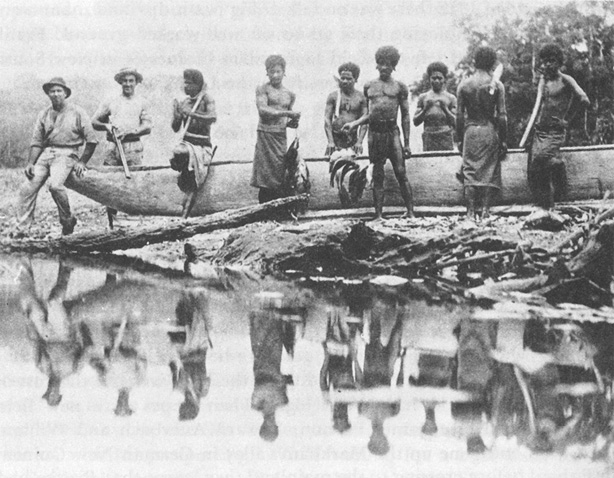
Labourers from Milne Bay with canoe that they have made to allow miners to prospect the tributaries of the upper Fly River, 1914. Frank Pryke is on the left.
PHOTOGRAPH: FRANK PRYKE
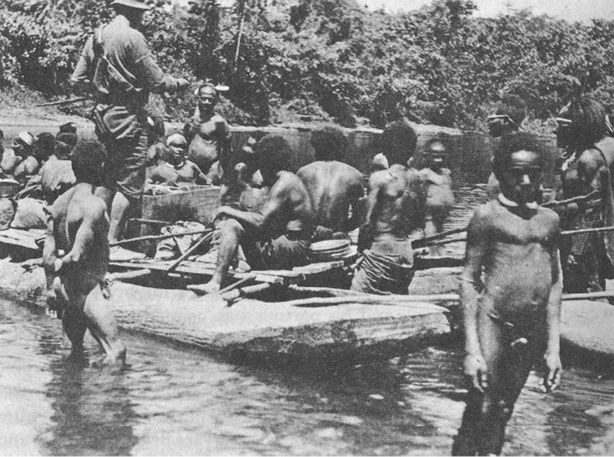
Prospector trading with people on the upper Fly, Pryke expedition, 1914
PHOTOGRAPH: FRANK PRYKE
Between 1909 and 1916 the Lakekamu miners had penetrated the valleys between the headwaters of the Vailala in the west and the St Joseph in the east. Major expeditions had also gone up the Fly and the Markham and some miners had returned to old alluvial areas of the Northern Division and the south-east. They were often in the country either unknown or vaguely known to government officers. On government patrols the Native Armed Constabulary were intermediaries between carriers and officers and their guns protected the patrol. In the bush miners and carriers were mutually dependent and with fewer resources they were more reliant on their own skills. Where possible they traded with strange peoples for food, made sago and collected bush foods, cut canoes and rafts on river banks and tested river beaches for gold with boxes made of hollow logs or bark. Although several expeditions lasted over three months the death of only one labourer was recorded on a prospecting trip. By contrast eleven carriers died on the Staniforth Smith government expedition in 1911: this was an exception but it was not unusual for carriers to die on long government patrols.
Frank Pryke’s revolver. It ‘barked beautifully’ on the Fly.National Library of Australia
On 20 August 1914 Oldham wrote in the station journal: ‘News of European War to hand.’ It was sixteen days after Germany invaded Belgium and thirteen days after Murray had signed a declaration notifying citizens of a ‘state of war between the United Kingdom and the German Empire’. The war had no immediate effect on the actions of men on the Lakekamu. Government officers were more concerned about stores not arriving and signs of laxity in the Armed Native Constabulary. Most of the rice ordered in February did not arrive until September and without rice government officers could not go on patrol. When Constable Aviri allowed a prisoner to escape he was given one month’s imprisonment with hard labour for his carelessness, and when Constable Fonu permitted another to escape the penalty was increased to two months’ hard labour. The miners were worried about the dry spell which interrupted work and made it difficult for the Bulldog and the Mayflower to reach the landing. The Lakekamu miners also shared in the general interest in dredging prospects in Papua. Experts and investors came up from Australia to inspect likely areas and several of the local miners pegged dredging leases on the Tiveri and at Cassowary Creek. But when Chisholm resumed patrolling in October he discovered evidence which made miners and officials think that Nepa might be the scene of the first international battle fought on Australian territory.
On his second day out from Nepa Chisholm came across a camp on the Arabi recently abandoned by a large German expedition. He sent two constables back to warn Oldham, who relayed the message to the miners and sent a report to Port Moresby. By the time Chisholm returned Oldham had police, prisoners and miners’ labourers digging trenches around the government station, mounting guards and conducting short reconnaissance patrols. On 10 October, three days after he had sighted the German camp, Chisholm, the miners Sloane, Preston and Swanson, three armed constables and five carriers set off to look for the Germans. Guides from a village on the Arabi led them to a more recent German camp and on their second day out from Nepa they caught sight of the Germans on the divide between the Arabi and the Tiveri. Estimating the strength of the German party at two white men, twenty-five police and seventy carriers, Chisholm sent a message back to Oldham asking for more men. Before the reinforcements arrived the Germans moved on, leaving three police at the camp to look after some sick carriers. ‘These I captured’, Chisholm reported, a task which should not have been difficult because apart from their recent fight with local villagers they did not know they were at war. Chisholm sent one of the captured carriers with a letter to the leader of the German expedition informing him that war had been declared and all German possessions in the Pacific had been captured, and inviting him to come to Nepa. The carrier did not return. Two days later when Oldham arrived with seven miners and seven police, the Australians set out to find the Germans. After several days following their tracks, Oldham decided that his party was three days behind the Germans who were ‘making their way in a Northerly direction as fast as they possibly can’. On the Tiveri the Germans had burnt two village houses, a punishment, Oldham thought, for people who had followed their custom of firing arrows at all who entered their lands. The village gardens too had ‘suffered severely. The Germans apparently fed their police and carriers out of them’. After complaining of the ‘disgusting state’ in which the German expedition had left village houses Oldham felt obliged to leave trade goods to compensate for the behaviour of these other imperialists. The Australians returned to Nepa and Oldham sent the five prisoners to Port Moresby where Murray, uncertain of their status, did not know what to do with them.
The German expedition had left Morobe in March to map the country along the Papua-German New Guinea border. Its leader, Hermann Detzner, gave a different account of his meeting with the Australians. Detzner said that when his head of police, Konradt, who spoke no English, went to meet carriers bringing up supplies from Morobe he found a note held in the hand of a dead policeman. On one side the note said: ‘10 tins Bully beef, 8 tins vegetables, 5 tins hard bread, 4 tins butter, 12 tins tobacco etc’. On the other side it said:
To the Officer in charge of the German forces. I have to inform you that war has been declared between Great Britain and Germany on August 4. 14. In order to avoid unnecessary loss of lives I advise you to come in as soon as possible to the Nepal Camp [sic] at the Lakekamu-Goldfield which you will reach after five days march and to surrender there with all your men. You will be treated as an officer and a gentleman. Two native policemen and carriers I took along as prisoners of war.
Chisholm
Officer in charge of the British force
Detzner said he then learnt that the Fatherland was at war with its hated rival, England, while he wandered in the far corners of the earth. Writing in 1920 Detzner recalled the questions immediately raised by the note. France he knew must be involved in the war but what of Austria, Italy, Russia and the United States? What had been the immediate cause of the fighting? Perhaps the note was just a cruel joke by an Australian miner or recruiter. How could he explain the behaviour of the Australian official who arrested two inoffensive men, made no attempt to contact the main party, and left only a ridiculous note? Detzner decided that although Chisholm had a five-day start he would take a selected group of men, find him and obtain a full explanation. Having reached the edge of the ranges above Nepa Detzner turned back: he said that one of his patrols was fired on and he did not want to walk into an ambush. He rejected any plan to attack Nepa because he did not want the Papuans to see white men fighting each other, a spectacle which in any colony could be followed by grave consequences. Detzner thought that the wisdom of his decision to withdraw was confirmed when his two carriers, having escaped from Nepa, arrived. They reported that the two captured policemen had been sent by boat down the Lakekamu and that the force which had left the note for Detzner consisted of two white men and many Papuan police. Detzner’s presence, they said, had caused great excitement at Nepa and Chisholm had asked that two extra companies of police be sent to the Lakekamu.
Detzner’s account disagrees with that of Chisholm and Oldham on many points, and the reports made by the Australians are generally easier to believe. For example Chisholm reports the capture of three carriers and three policemen and the sending of one carrier with a note to Detzner, Oldham notes the despatch of five prisoners from Nepa and Murray acknowledges their arrival in Port Moresby. It seems that there were five prisoners, not four, and that none escaped. Detzner’s story of his encounter with the forces from Nepa appears to be a fitting preliminary to the later fantasy of his journeys to the vicinity of Mount Hagen. Alone of the German officials, Detzner refused to surrender to the Australian occupying force. After the war he wrote that he had carried the German flag deep into the previously unexplored central highlands; a claim he eventually admitted was false. Presumed dead by the Australian troops, he had waited out the war in the known, if not comfortable, lands around the Huon Gulf.
In December 1914 Chisholm found numerous old German camp sites on the upper Oreba and the village men who had been ‘unarmed and friendly’ in 1913 seized their weapons and the women urged them to fight. Eventually they recognised Chisholm’s patrol and indicated that they had thought the Germans were returning. ‘By the signs they made’, wrote Chisholm, ‘the Germans took all they wanted from the gardens, and gave them nothing in return.’ In March and April 1915 Chisholm again patrolled the upper Arabi, Tiveri and Oreba Rivers to make ‘friends with the natives and see if any Germans were moving in the area’. While Chisholm saw no more Germans, Armed Constable Kaptin on sentry duty at Nepa thought he did. When three policemen arrived unannounced from Kerema, Kaptin opened fire, hitting Constable Naboko. After holding an inquiry Oldham decided that Kaptin had fired without first challenging. Constable Naboko was the only casualty in the defence of Nepa.
The war had little other effect on the Lakekamu. Of the thirty-nine miners who were on the field either in February 1914 or May 1915 only three certainly enlisted, Jim Pryke, Ryan and Castleton. At least two other miners who spent long periods on the Lakekamu, Newcombe and Joubert, also joined the army, and Lumley, Whittens’ storekeeper, served in the Light Horse. Government officers were more inclined or more of an age to fight for king and country. Chisholm and Oldham both enlisted and of the earlier Lakekamu officers, Keelan and Giblin served overseas. Castleton, Chisholm, Pryke and Ryan were killed. Newcombe died on the troopship taking him overseas. A teacher in a county school before leaving England, Claud Castleton travelled widely in eastern Australia before working on the Lakekamu. The citation for his Victoria Cross said: ‘Sergeant Castleton went out twice in face of … intense fire and each time brought in a wounded comrade on his back.’ He went out a third time and was killed. To both Pryke and Lumley the Lakekamu improved with distance. From the mud and snow of the training camp on Salisbury Plain Pryke thought the English would have been well advised to let Kaiser Bill have the place. In a ‘rotten bloody hole’ near Jericho Lumley, regretting his eagerness to leave his wife and his struggling trading and pearling interests, wrote wistfully of the ‘land of the coconut’ and ‘Tommercrann’s’ (Tommy McCrann’s hotel in Port Moresby). At least he had the satisfaction of using his specialised knowledge: his experience with dynamiting fish made him a valuable member of demolition parties and he believed he could cure the troops’ malaria with Dalwhinnie whisky.
The Lakekamu miners were given a chance to vote in the conscription referenda of 1916 and 1917: the only time Europeans in Papua voted in an Australian poll. By the second referendum in December the wet season had set in and Humphries had to wade and swim to reach the eleven miners still at scattered camps at Sunset, Mosquito Creek, Belfield’s Gully, Fly Gully, Palm Island and Tiveri. The votes were carried in a bag tied to Constable Ekau-hu’s hair. Constable Wali then took the votes to Port Moresby, leaving by raft on 15 December and not returning to Nepa until the middle of January. Unlike most Australians the white residents of Papua voted in favour of compelling young men to fight Turks and Germans.
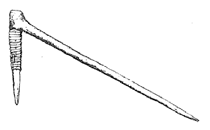
The Lakekamu declined between 1914 and 1918. The war may have made stores more difficult to obtain and more expensive, and a few miners had left ‘for the front’, but generally the war had not caused the decline in the number of men on the Lakekamu. They left when the amount of gold they could recover no longer gave them an adequate return above the cost of their stores and the wages they paid to their labourers. The war may have delayed attempts to operate dredges on the Lakekamu. In the wake of the development of Bulolo the Tiveri Gold Dredging Company was able to raise the capital to place a small dredge on the Lakekamu and keep it working from 1934 until 1939. But Guinea Gold No Liability, which carried out an extensive testing program from 1934 to 1936, decided the field was not rich enough to support dredges.
When the Bulldog arrived at Tiveri on Sunday 8 December 1918, after an absence of two months, Assistant Resident Magistrate C.R. Muscutt, the only government officer still at Nepa, learnt of the armistice declared a month earlier in Europe. There were only eight other Europeans on the field, six miners, one storekeeper and Mrs Priddle who had arrived on the Bulldog to join her husband at Cassowary Creek. Isolated, rarely assisting or restraining either miners or villagers, Nepa station became an embarrassment to Murray who was reluctant to withdraw his most inland station. Their actions partly excused by a prolonged shipping strike in Australia, government officers in Port Moresby forgot about Nepa. In May 1920 when the storekeeper brought the mail up from Tiveri Muscutt received his first news of the outside world for five and a half months and the police were given eleven months’ back pay. Muscutt wrote that he found it much easier to live on the police and prisoners’ rations than to go without news. In May the storekeeper learnt that Whittens had written in February instructing him to dismantle the store and pack the galvanised iron ready for shipment to Port Moresby.
After the store closed the Lakekamu might be a place for prospectors, ‘hatters’ and speculative companies, but it was no longer a goldfield. Humphries, who saw the field in its declining years, recreated the importance of the store:
Everything radiated from the Store. Every expedition, every prospecting party, started from the Store. It was the hub of the Field. There you could drink anything, buy anything, and gamble anything. There you could ‘hire a team’ (carriers), there you could have a spell. If it was the latter you wanted, it would cost you nothing. Meals were always free at the Store, and there was the ground to sleep on. What needed man more? If you died there, as men did — well, there always was someone to bury you, and there was not always someone to do it on the claim.
The storekeeper listened to everyone ‘rousing’ and received orders written on ‘dysentery wipe’, but when there was no rice, no mail and no news at the store he might give the waiting carrier a bottle of Dalwhinnie for the Taubada. Scrawled across the bottom of Whittens’ accounts Lumley wrote invitations and scraps of information: ‘Got a crowd in. Newcombe, Arnold, Belfield, Reilly, Franklin, Hendry & Clare. Wrestling and boxing is now being discussed. Why dont some of yer come down & ave amenegs.’ Or ‘3 Rice 37/6, Fruit 5/3, 1½ Biscts 1/-£2-3-9 … . The Doc is also on the shicker & tried to do it to Kruger’s gin.’ If the miner himself made the trip he could listen to the ‘charming strains of Mme Melba at her best on the Phony graph’ while he drank and yarned. If he was still dissatisfied he could fight the storekeeper; and in Lumley’s time he had a fair chance of winning. The ‘deadhouse’, an incomplete shack, was available for those needing to sleep off the effects of various forms of excess.
For Christmas 1920 only one miner, William Ward, walked in to Nepa. Ward, the first white man Muscutt had seen for about five months, was the only miner still on the field and his team was then making a canoe on the Olipai to take them to the coast. The next year the three agents of government, the white officer, the police and the prisoners, left Nepa. Periodically alluvial miners returned to the area, their interest stimulated when Jack Hides reported finding gold on the Tauri in 1930 and by the later activities of the dredging companies. In 1940 A. Bethune and H. Garbutt were still making ‘a comfortable living’ on the Lakekamu, and Bethune, who had worked on the field from soon after its opening in 1909, returned after the second world war.
The results of the ballot to choose the leader of the prospecting expedition are preserved in the Australian Archives, C.R.S. G 70, Papua Lands and Mines Dept etc. Mines Papers, Annual Single Number Series 1907-27, item 1907/87. The file includes correspondence between Staniforth Smith and various people about the selection of the prospectors, a report written by Crowe while on the expedition, and some early comments on the field by government officers. Frank Pryke in a letter to Dan, 4 April 1909, mentioned the vote, and he and Jim wrote about the expedition and working the field in later letters. In the Lett papers, folder three, there is a letter by Chas C. Deland(?), 10 August 1944, outlining Crowe’s early life. The verse is from ‘Matt Crowe’ by Frank Pryke, Poems, p. 46. Higginson’s report of his patrol up the Tauri is with the Kerema station papers. Murray in his dispatches to the Minister reported on the progress of the prospectors, the discovery of the field and the development of mining. He also informed the Minister about important legal cases and enclosed statements from witnesses. The Commissioner for Native Affairs reported direct to the Minister and the reports of his officers on labour conditions are in dispatches. The Nepa station papers are detailed and almost complete. The journals run from January 1910 to June 1915 and from July 1916 to December 1920. The patrol reports are from 1913 to 1920. As government officers came to the field with the first miners, Nepa was close to the workings and the officers’ main duty was supervising the field, the government records for the Lakekamu are fuller than for any other Papuan field. Murray and the Government Secretary sometimes commented on journals and patrol reports. The annual reports of the warden, resident magistrate and medical officer were published in Annual Reports.
Dr Anthony Radford, then at the U.P.N.G., provided information about past and present methods of treating dysentery.
Lumley’s brief and colourful notes were scrawled across the bottom of Whittens’ accounts sent with stores to the reward claim on Ironstone Creek. Frank Pryke preserved them and they are with his papers.
The various amendments to the Labour Ordinance and the regulations to control dysentery were published in the Papuan Government Gazette.
In the six years 1910 to 1915 five cases of assault were referred from Nepa to the Central Court. Lagalaga, Jeffrey and Kelly account for three. The others may have been cases of labourers fighting amongst themselves, or fighting villagers, or European miners fighting each other.
Mr Justice Bevan’s comments on the practices of juries in the Northern Territory were printed in Commonwealth Parliamentary Papers, 1914-17, Vol. 2, pp. 1783-4.
Frank Pryke kept a rough diary on the prospecting trip to the Vailala. The diary, which includes the note Pryke dictated to Priddle, is in the National Library. There is a more carefully written account in the Mitchell Library, and he also wrote the report published in the Papuan Times, 20 March 1912. The Papuan Times, founded in 1911, occasionally carried other items of news from the Lakekamu. Newcombe’s report of his prospecting expedition is in the Annual Report 1912/13. Edward Auerbach recalled the trip up the Markham in Pacific Islands Monthly, March 1940. Frank Pryke’s diary written on the Fly is in the National Library and his typed report is in the Mitchell Library. Murray to Minister, 7 October 1914, enclosed a sworn statement by Pryke about the conflict with Fly villagers. Government officers’ reports of patrols to the Vilirupu field are with the Abau station papers, eg. Bastard, April and June 1916.
Detzner 1920 wrote of his exploits and Biskup 1968 tested his accuracy. Dr William Gammage, U.P.N.G., checked the Australian War Memorial records for references to men from the Lakekamu.
Humphries 1923 wrote of the Lakekamu in decline. The quote is from p. 34.
Previous Next



