


 menu
Histories of Australian Rock Art Research
4
The Sydney School and the genesis of contemporary Australian rock art research
Introduction
Australian rock art research as a field of research has progressed through a series of phases, each with its own research aims, understandings and methods, and each dependent on the previous but also on the rise of archaeology as a discipline: the study of humans through their material remains. The earliest days of settler encounter/arrival/invasion in eastern Australia realised the endemic presence of Aboriginal rock art (Phillip 1789). But it was only in the 1800s that ethnographers began to document rock art as part of the long-term and widespread evidence for Aboriginal Australia’s cultural practices (e.g. Mathews 1894, 1896). This was part of a worldwide trend of learned societies and museums increasing anthropological understandings of cultural groups across the world and making significant collections of their material culture (Pitt Rivers 1882). At first steeped in antiquarian interests that spoke of the West’s own deep antiquity, the recording of people in place was encouraged by the learned societies of Great Britain and France, an ‘ethnomania’ (Thomas 2011:15) for increasingly vast audiences wanting to be informed by an ‘indefatigable’ collection of new and interesting facts (Thomas 2011:62). The accumulating curios and ‘facts’ in anthropological knowledge required arrangement into museum collections, which Hicks (2013) argues was central to the development of anthropology’s four-field approach (see below). The early 1900s thus saw a continued enhancement of rock art documentation across the continent with the professionalisation of specialist academic fields by people with varying backgrounds: for example, the Frobenius expeditions to the Pilbara and Kimberley, D.S. Davidson and Fred McCarthy across much of the continent, and later Bob Edwards through Central Australia (see Smith et al. 2021).
Anthropology was first taught at the University of Sydney in 1925 (Conway and Philp 2008) but prehistory – as Australian Indigenous archaeology was then called – only became a discipline for study at Australian universities in the early 1960s. The first university teachers were Australians: John Mulvaney and Isabel McBryde, both Cambridge-trained. Mulvaney returned to teach in the Ancient History Department at the University of Melbourne in the mid-1950s where he had previously studied history as an undergraduate. During this time, he undertook several foundational deep excavations recognising the importance of stratigraphic sequences (Griffiths 2018; Mulvaney 2011; Murray and White 1981). Isabel McBryde was the first prehistory lecturer at the University of New England in 1960, the first (in 1966) to complete a PhD based on Australian fieldwork and the supervisor of the first prehistory Honours thesis (by Sharon Sullivan in 1964; Bowdler and Clune 2000:29). Meanwhile, she also undertook a foundational disciplinary approach, combining regional analyses, field archaeology and ethnohistory (Bowdler and Clune 2000; Moser 2007). Around this time (in 1961) Jack Golson first joined The Australian National University (ANU) as a Research Fellow in the School of Pacific Studies, and John Mulvaney was recruited to the ANU Faculties.1 The University of Sydney only developed a full four-field approach in the early 1960s, when the Anthropology and Prehistory Department taught social anthropology, linguistics, prehistory and physical anthropology. Fuelled by a ‘Cambridge in the Bush’ pathway of training and influence (Murray and White 1981), this influx to the University of Sydney included archaeologists Richard Wright, Rhys Jones and John Clegg, and slightly later Roland Fletcher and J. Peter White – whose journey post-Cambridge included the University of California at Berkeley, where he adopted ‘New Archaeology’, advocating logical positivism modelled on scientific methods as the guiding research philosophy.
Rock art courses were taught in Australian universities after this Cambridge influx, first at the University of Sydney (with John Clegg from 1965) and then at ANU with the arrival of Andrée Rosenfeld in 1973. Isabel McBryde recorded rock art as part of her PhD research, but the University of New England (UNE) only offered a rock art course after Mike Morwood arrived in 1981 (Morwood 2002). Morwood, originally from New Zealand, undertook his PhD at ANU (supervised by John Mulvaney). Iain Davidson joined UNE in 1974, and initially taught religion and portable art, having ‘done cave art at Cambridge which was dominated by Leroi-Gourhan with Ucko and Rosenfeld as a counter’ (Iain Davidson, pers. comm., April 2021).
The early underpinnings of Australian rock art research flourished and included regional, landscape and contextual studies. Research interest shifted from ‘art as an object’ (Mulvaney 1969) to ‘style’ as a means of communication (Hodder 1978; Wobst 1977). European, and particularly French and Spanish Palaeolithic, rock art research at this time provided stimulus for early Australian rock art researchers (e.g. Laming-Emperaire 1962; Leroi-Gourhan 1968; Ucko and Rosenfeld 1967; although see comment by Maynard below). By the early 1980s, these were being adapted to an Australian flavour, founded on firm archaeological approaches to style and signalling behaviour, as a new generation of anglophone archaeological researchers working at the junction of social anthropology and social theory began to make their mark (Conkey 1980; Hodder 1978; Wobst 1977). These new research endeavours were fuelled by increasing resources to record rock art, and in the mid-1980s by a burgeoning group of anthropologists especially coming from ANU (for instance Howard Morphy and Luke Taylor) who undertook research in northern and central Australia, building on earlier anthropological approaches (such as Munn 1960; Myers 1976 and later 1991) and moulded by the growing recognition of Aboriginal ownership (Langford 1983) and ontologies (e.g. Mowaljarlai et al. 1988). The development of formal archaeological approaches to rock art and the mobilisation of myriad scientific techniques (e.g. Rosenfeld et al. 1981) has resulted in the realisation of rock art’s potential to contribute to archaeological discourse. These developments in archaeology went on to inform approaches (beyond ethnographic analogy) used by anthropologists (led in this timeframe by scholars such as Margaret Clunies-Ross, Les Hiatt, Anthony Forge, Howard Morphy, Fred Myers and Bob Layton) and mobilised by early practitioners such as Ian Crawford in the Kimberley.
The Sydney School
‘The Sydney School’ has been used previously to describe a group of regionally based practitioners who represent a distinct praxis. The Sydney School of Architecture reacted against modernism and developed an ethos of organic residential designs that celebrated the natural environment (Jahn 1997). Similarly for linguists, although perhaps less well known, the functional linguistic perspective on genre analysis distinguishes the Sydney School of linguistics (Rose 2011). In this chapter I argue that a combination of factors, approaches and personalities created a Sydney School of rock art research, during a foundational phase in Australian rock art research as archaeology became a discipline (Moser 2007). The 1960s efflorescence of Cambridge-trained archaeologists at the University of Sydney created this platform. John Clegg was the first academic to teach rock art in Australia and to train a generation of researchers how to do rock art research. Lesley Maynard was the first Australian to write a rock art Honours (and then a Masters) dissertation, thereby providing both an archaeological approach and a chronological stylistic framework within which subsequent generations of rock art researchers practised. These two researchers (Figure 4.1) were responsible for driving one of the most significant paradigm shifts in Australia (Clegg 1971, 1977a, 1977b, 1978a, 1978b, 1981, 1987; McMah 1965; Maynard 1977, 1979), during a pivotal time when rock art became an archaeological subdiscipline. Both Maynard and Clegg worked on classification, typology, style and chronology – supported initially by Richard V.S. Wright’s focus on multivariate statistical analyses and the development of computer programming at the University of Sydney (next by Ian Johnson, and later Andrew Wilson). Maynard’s and Cleggs’s distinctive approaches and joint outputs, inspired by each other’s creativity and individuality, provide a dual legacy for an energetic generation of scholars – a new breed of Australian university students, inspired by Gough Whitlam’s free education mandate and the concomitant recognition of Aboriginal land rights (Krishna 2014). Their approaches were genuinely archaeological, at a time where there was scepticism that rock art could play any role in understanding Australia’s deep history (in part because of problems in dating it). Clegg railed against a comment by John Mulvaney (1969:173) that people studying rock art ‘are amongst the workers whose memoirs will contribute basically to art appreciation’.2 While ANU a decade later arguably trained more of the current rock art practitioners to PhD level in this same mould, the Sydney School was the key teaching and research group in the sixties and seventies responsible for the disciplinary shift from an antiquarian focus on cataloguing rock art as a relic of times past (e.g. D.S. Davidson, R.H. Mathews and to a lesser extent McCarthy), to a research framework that was theoretically informed and scientifically oriented. Maynard and Clegg had very different career trajectories, publication outputs and training roles, and I focus on these in this chapter.
Following the foundation of the Sydney School, from the mid-seventies to mid-nineties, there was an Australia-wide halcyon period. This was a time when the Australian Institute of Aboriginal and Torres Strait Islander Studies (AIATSIS), formerly the Australian Institute of Aboriginal Studies (AIAS), supported rock art and anthropological research projects across the continent (see below), providing the research funding and impetus for this early generation of Australian-trained rock art researchers to thrive. Many of Australia’s contemporary rock art faculty members were trained at Australian universities (except for several South African, German and Swedish researchers now at the University of Western Australia, who trained at Cambridge, University of California Berkeley, Southampton and Umea universities; and Paul Taçon, who trained in Canada and at ANU). The intellectual groundings provided by the Sydney School in the sixties and seventies opened Australian archaeological career pathways that were missing in many other countries, notably the USA, where rock art was rarely taught at universities, and where rock art research was not considered to be mainstream by the majority of practitioners and was and continues to be often undertaken by avocationalists.

Figure 4.1: John Clegg and Lesley Maynard at her Masters graduation ceremony in the University of Sydney Quad in 1976.
Source: Photograph provided by Lesley Maynard.
Lesley McMah/Maynard (1945–)
Australia’s first Australian-born and university-trained rock art researcher was Lesley Maynard, who enrolled at Sydney University in 1962. She was then 16. She took subjects in anthropology in her first year of undergraduate studies while also studying English and history, intending initially to be a teacher. That same year, while attending a Sport and Recreation Camp at Commodore Heights (now in Ku-ring-gai Chase National Park), she saw her first rock engravings:
Bushwalking to rock engravings was the main activity; we played games on Mundoes and Echidna because it was the only flat area. We bivouacked at America Bay; I first met Daramulan while carrying a big metal milk can. (Lesley Maynard, pers. comm., 2021)
Richard V.S. Wright and Rhys Jones who arrived at Sydney University in 1963 were her prehistory lecturers (Rhys Jones was also her tutor), Harry Oxley taught her ‘very dense’3 social anthropology, and Betty Meehan and Ian Glover were in her Honours cohort. John Clegg arrived to take up a teaching fellowship. Lesley remembers Richard announcing in a lecture that ‘carbon dating showed that Aborigines had inhabited Australia for at least 7,000 years’. She completed her Honours dissertation (McMah 1965), one year after Sharon Sullivan’s landmark Honours thesis at UNE (see above). Lesley’s study of the Sydney Hawkesbury engravings (Figure 4.2) aimed ‘to produce, first, a typology of the engravings, and second a spatial distribution of the traits, based on typology’ (McMah 1965:7). This analysis indicated that ‘there are definite patterns of distribution in both north–south and east–west planes; and, that the differences between one end of the range and the other may be ascribed to cultural causes – except those obviously resulting from the stimulus of different environments’ (McMah 1965:75). She applied quantitative analysis to thousands of motifs, the data for which she harvested from previous records collected by W.D. Campbell, Fred McCarthy and Ian Sim (and see Griffiths 2018:188–189). It was early days for computers. I recollect my father telling of riding a pushbike from one end of the mainframe computer to the other, at this same time, when he worked in the Oak Ridge Nuclear Research Facility (Tennessee). To process this huge dataset, Lesley used computer punch cards to numerate her data, but then used knitting needles to sort the sites. I asked her why she did this, and she replied:
The bloody punch cards were entirely Richard’s idea = New Technology. Rhys suggested applying it to Sydney rock engravings. The amount of practical work was huge, punching characteristics around a card 8” ´ 5” (nonextant except in my thesis in National Library), thousands of figures ~ Campbell (original from Fisher), McCarthy, Sim, and a few etc. Then using a needle with a wooden handle (new technology) to sort the North–South matrix. One of the markers suggested I should have managed the East–West one as well ~ the one that shows the fish are near the sea (simple numbers). Billy Griffiths wrote that I was inspired by Leroi Gourhan and Andrée Rosenfeld but I didn’t hear of them until years later. (Lesley Maynard, pers. comm., 2021).
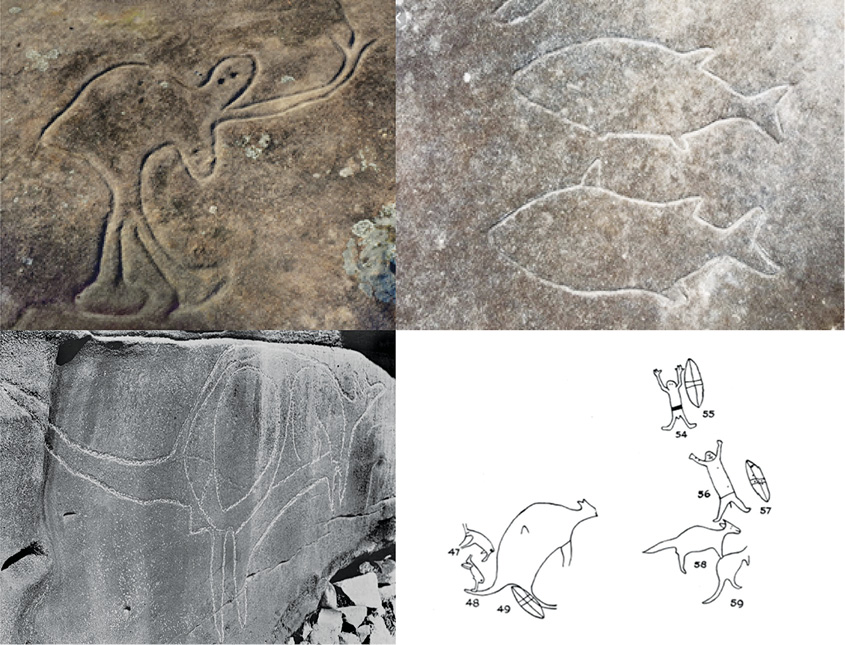
Figure 4.2: East–west differences in the Sydney Basin can be attributed to environmental factors (top), with a cultural style boundary at the Georges River – north of this boundary kangaroos are depicted with four legs; south with two legs in profile (McMah 1965).
Source: Photographs by Jo McDonald; figure from McCarthy 1967.
Lesley insists on it being recorded here that she was marked 62/100 for this ‘first analytical study’: (i.e. her thesis) although for their overall degrees, both she and Betty Meehan got 2/As (at that time Second Class, A division was 75–85 per cent). It has always been apocryphal at the University of Sydney that a 2/A Honours (contra a first-class Honours degree) did not mean the end of one’s archaeological career: noting that Rhys Jones was famous for ‘not having a first’ for his Cambridge Masters thesis, completed during his first years at the University of Sydney (in 1966; Pollard 2014) – while this author (in 1982) received a final mark of 84.5! In 1966, Rhys left the University of Sydney (accompanied by his new partner, Betty Meehan; she recently returned from fieldwork in Maningrida with ex-husband Les Hiatt). Maynard replaced Jones as a University of Sydney teaching fellow: she was 21.
1n 1967, Maynard recorded the rock art of Koonalda Cave with Bob Edwards, while Richard Wright was re-excavating and analysing ‘the Gallus site’, as it was then known by some (this informal naming was also steeped in contemporary disputes on research, interpretation and publication of the site; Wright 1971). The radiocarbon samples from the excavation ‘were sent by passing trucks to Canberra, “the local mail system”. The telegram came back the same way with an Ice Age date’ (Lesley Maynard, pers. comm., 2021). Bob Edwards proved to be highly influential for the budding rock art researcher that Maynard was. He was then curator of anthropology at the South Australian Museum and he had been recording rock art across the arid zone and the Northern Territory for over a decade (e.g. Edwards 1965). Maynard and Edwards’s Koonalda Cave recordings included ‘meticulous and well-written descriptive analysis … helped out by good drawings and excellent photographs’ (Elkin 1973:162) of the site’s Pleistocene finger flutings (Part II in Wright 1971). This focused a spotlight for Maynard on the potential of Australian rock art to be very old. Maynard and Edwards’s contribution to the Koonalda Cave published edited volume concluded cautiously of a ‘ritual’ intent, but also described that the markings transcended the range ‘from non-art to art’ (Elkin 1973:163).
Lesley also discussed desert petroglyphs of Central Australia with Edwards: the style she would later name ‘Panaramitee’ (after the type site at Panaramitee Station). Edwards had already developed an extensive record of these arid zone sites (Smith et al. 2021:47–48) and had quantified large samples (1000+ motifs) as well as positing that this was an archaic Australian art form (Mountford and Edwards 1963; Edwards 1965; Rosenfeld 1991). As Lesley has said since then: ‘should I have named it the “Edwardian?”’.
That same year, Maynard flew to Laura in Far North Queensland with Channel 7 (she was sent as a rock art expert by Richard Wright, who had completed his nearby excavation at Mushroom Rock) to comment on Percy Trezise’s find – Giant Horse Gallery. All of her early experiences as a student and nascent researcher at the University of Sydney spoke of developing a strong sense of rock art research, in an archaeological context that was being developed concurrently by her colleagues. She also excavated, and for many years she held the earliest Pilbara Pleistocene occupation date for her work in Newman Rockshelter (Maynard 1980).4 For over 30 years now, Newman Rockshelter’s radiometric chronology has been central to archaeological discourse on the Pleistocene Aboriginal occupation of the Pilbara. Recent re-excavation of Newman Rockshelter (Slack et al. 2020) has refined the radiometric chronology using optically stimulated luminescence (OSL) ages – a technique not available until decades after her work – and confirmed an even longer occupation sequence (c. 45 and 40 kya; Slack et al. 2020:1).
In 1968, Maynard enrolled in her Masters degree at the University of Sydney. Richard Wright was again her supervisor ‘in the Cambridge manner ~ set it up and leave it alone’. This was completed (Maynard 1976) just before John Clegg finished his own master’s thesis, titled ‘Mathesis pictures; Mathesis words’, a cheeky play on words in the irreverent Clegg style (Clegg 1978a). Maynard published a long extract from her thesis (Maynard 1979), following presentations made in 1974 at both the AIAS Biennale and in Canada:
In 1974 I was invited to a Symposium ~ The Art of Oceania ~ at McMaster Uni, Hamilton, Ontario, organised by Sidney Mead (never heard of him). I never found out who gave him my name, possibly after the Institute (AIAS) conference. Papers submitted months beforehand; on arrival we were issued with a thick volume of everyone’s. I was teased about the length of mine ~ 56 pages including the never published pictures. Was I going to read it aloud? Not at all, I showed slides, Koonalda to Kakadu, and talked. Back in Oz I showed them to anyone who would sit still in the dark, thus my Tripartite Theory spread ahead of the publication. (Lesley Maynard, pers. comm., 2021)
Lesley’s move to Western Australia was facilitated by the Whitlam (and then Fraser) Government’s putting ‘buckets of money into Aboriginal Affairs’ (see below). A proliferation of funded activity increased rock art databases and anthropological knowledge about sites around the country. In 1975 Bruce Wright, to whom Lesley was later married, became the registrar of Aboriginal sites at the West Australian Department Aboriginal Sites (DAS), which later (in 1995) separated from the Western Australian Museum (WAM) and became the Aboriginal Affairs Department. He had already published his detailed Pilbara rock art opus (Wright 1968). Lesley was hired by the DAS to do ‘stones and bones, maps and snaps’. At the same time three male anthropologists were hired to work in the Kimberley, Pilbara and Western Desert. The Pilbara anthropologist was Kingsley Palmer (e.g. Palmer 1975); the others were Charles Hamilton and Ken Liberman (Moya Smith, WAM, pers. comm., February 2022).

Figure 4.3: Lesley excavating at Newman Rockshelter in 1976; and recording Pilbara rock art with Bruce Wright in 1978.
Source: Photographs provided by Lesley Maynard.
In 1978, Lesley began a PhD at ANU studying the well-known Pilbara engraved rock art province at Woodstock/Abydos – centred on the old pastoral station boundaries (Figure 4.3). She undertook a solitary three-week pilot study in October/November that year, when temperatures reached ‘44 degrees at the homestead and somewhat hotter standing on a bloody big rock’. Lesley recorded 1000+ motifs and 200 grinding patches during that field season. She used low-level colour air photography to find sites and focus her recording effort. In 1979, Kingsley Palmer went to a regional gathering of Aboriginal male Elders, known as a Pilbara Men’s Meeting. At this he reported on various pieces of ‘museum news’ along with details of Lesley’s research project. He reported to Lesley afterwards that the men’s response to her project had been hostile – largely because of her gender. She said: ‘Kingsley told me “They are afraid that you might find out something that they don’t know themselves”. To which I snarled “That’s what archaeologists DO!!!”’. Soon afterwards, the Roebourne Aboriginal Association (an organisation representing the language groups on the coastal Pilbara) wrote to the Aboriginal Sites Department complaining about Lesley’s research, a short news article appeared in the West Australian and Maynard’s research permit was cancelled.
There was a lengthy period after this time in Western Australia when women were actively discouraged from working on rock art. Many felt this was because there had been a gendered divide in the information being collected by male anthropologists about sites, mythological narratives and the role of women in ceremony (e.g. Bell 2002). Certainly, the careers of Lesley, Pat Vinnicombe and Moya Smith – to some extent – were all affected by this.
Years later I realised what I should have done when trouble started ~ tow a caravan to Roebourne and do my own bloody social anthropology. Taking women and kids to lovely picnic sites and showing them seed-grinding patches. (Lesley Maynard, pers. comm., 2021)
Maynard never completed her PhD. Leaving ANU, she became the regional archaeologist for the Northern Region of the New South Wales National Parks and Wildlife Service (NSW NPS): ‘the most exciting, productive and happiest part of my career was helping Sharon (Sullivan) invent Cultural Resource Management in Oz’. In 1986, ‘while driving at night [Lesley] had an overwhelming spiritual experience which kicked off a major manic episode’. This change in her mental health meant that she has rarely published again (cf. Maynard 1988).
In 1999, in a manic phase, I couldn’t stand the sight of my career relics ~ No More Bloody Archaeology! I packed up all my original manuscripts and photographs, [from] 1960’s Anthropology lecture notes to Egina [a desert rock art province] research. [I] drove to Canberra, AIAS, where Kingsley Palmer was then Deputy Principal. Dumped my boxes on his office floor and conversed briefly. I didn’t keep any copies, make a list or sign anything.
This material (in five boxes) is now held in the AIATSIS digital collection (MAR03/288), where it remains unprocessed (Lesley Maynard, pers. comm., 1 May 2021).
Lesley recalls that well-known local avocational rock art enthusiast and surveyor John Lough (see Rhodes 2018:159) was the only rock art recorder she worked with in Sydney, mostly after she joined the NSW NPWS in 1981, where John Lough was a frequent visitor ‘usually at 5pm’. Lesley credits Lough with the invention of ‘The Night-time Method … carbide lamps and chalk in the dark; he gloated over many details missed by Fred [McCarthy]. The following morning, he would use a chalked string to snap a grid over the engravings and drew them on squared paper’ (Lesley Maynard, pers. comm., May 2021). I, too, remember going out to record rock art at Devil’s Rock, Maroota, with John Lough at night (McDonald 1986) using carbide lamps and our 1980s ‘innovation’ – Dolphin torches – which were an improvement because of the better angle that could be achieved with the oblique light. Lough was indeed vainglorious about his improved accuracy over previous recorders: I was scolded for introducing over 100 errors into my Maroota (McDonald 1986) recording but praised for being much better than Fred (McCarthy) ‘who had more than 1,280 errors’ for the same large complex panel (John Lough, pers. comm., 1987). I remember being amused by the fact that the very accurate Lough, who still used imperial measurements 20 years after introduction of the metric system to Australia, used his shod foot (his shoe was exactly 12 inches long) for measuring purposes!
John K. Clegg (1935–2015)
John Clegg emigrated to Australia in 1961 with a Bachelor of Arts (Honours) and Certificate in Education (1959) and Fine Arts Honours (awarded in 1962) from the University of Cambridge, where his archaeological mentor was Charles McBurney. When he arrived in Australia he first tutored at the University of Queensland, and then in the mid-1960s became a part-time tutor at the University of Sydney while also enrolled at East Sydney Technical College studying drawing and sculpture. John’s drawing skills were instrumental to his seeing and understanding the Sydney Basin’s Aboriginal charcoal drawings. His interests in fine art led to his later focus on aesthetics with Thomas Heyd (e.g. Heyd and Clegg 2005). His focus on the cognitive processes that contribute to art’s creation meant that he analysed rock art from a different perspective to his predecessors and many of his contemporaries. He undertook experimental work on Sydney’s sandstone to determine likely timeframes required to produce the large engravings on the open horizontal platforms, a kind of ‘experimental archaeology’ akin to experimental research occurring elsewhere in the world especially in the 1970s and 1980s. His interest in the techniques and technologies of rock art production (materiality) influenced his analysis of rock art. He applied and developed several fieldwork approaches, which improved the accuracy of the recording process (night photography; tracing on polythene for later photography (Figure 4.4); use of a monopod [pre-drone] to get extra height/distance imagery for photogrammetry).

Figure 4.4: John Clegg tracing rock art on polythene at Little Devils Rock, Old Northern Road, 1972.
Source: Photograph taken and provided by Kate Sullivan.

Figure 4.5: The Woronora rock-shelter assemblage where the placement of motifs was explored.
Source: From Clegg 1971, amended by author.
One of his first papers (Clegg 1971) explicitly aimed at contradicting John Mulvaney’s views on (unsystematic) rock art research being ‘art appreciation’ (Mulvaney 1969:173). This early paper on a Woronora rock-shelter assemblage (in the south of the Sydney region) counteracted the prevailing view at the time that hunter-gatherer art was essentially random in its placement and intent (following Laming-Emperaire 1962; Leroi-Gourhan 1968). Most of the animal species depicted in the Woronora rock-shelter assemblage (snakes, bats, macropods, eels and fish) were positioned on the walls in what John described as ‘their natural order’: that is, according to their natural habitats (Figure 4.5). However, while 14 of the 21 animal motifs conformed to this expected landscape positioning, the snakes and eels did not. John quantified the relative sizes of these depictions (Table 4.1) and realised that the size ratios of the depicted animals was also patterned. The eels and snakes were depicted as extremely large creatures, while other species were generally life-size.
Table 4.1: A metaphysical approach to the study of Aboriginal rock paintings.
|
Motif |
Natural |
Woronora |
Relative size |
|
Eel |
1.2 |
6 |
5 |
|
Snake |
1.25 |
3.5 |
2.8 |
|
Wallaby |
1.95 |
3.8 |
1.4 |
|
Fish |
0.3 |
0.4 |
1.3 |
|
Bat |
0.4 |
0.4 |
1 |
|
Tortoise |
0.2 |
0.2 |
1 |
Note: Measurements in metres.
Source: Data from Clegg 1971:39.
Clegg used spirit animal ethnography to explain this result. Rainbow Serpents (Radcliffe-Brown 1930) could be in the sky as well as in water sources and on land; and in the Sydney region they are also sometimes depicted as huge eel-like creatures with tails (Sim 1969). Clegg’s (1971) paper also confirmed schematic differences that McMah (1965) had identified for either side of the Georges River (a regional style boundary): with eels pointing downwards at Woronora (a rock-shelter south of the Georges River), compared to those depicted at Canoelands (a rock-shelter in the north of the region) oriented upwards. Clegg concluded that:
a drawing is just as much an artefact as a Bondi point is, and as such, should be just as illuminating for prehistory … [and that] Archaeologists need to be educated to deploy a range of new techniques, rather than rejecting the great potential of rock art studies. (Clegg 1971:40)
While teaching at the University of Sydney, John completed his Anthropology and Prehistory Department Masters of Arts (Hons) dissertation (Clegg 1978a), for which he was awarded the University Medal. Richard Wright was his official supervisor, although this relationship was a tense one. According to Kate Sullivan (Clegg’s spouse, and now widow, and a student at the University of Sydney in the early 1970s), John waited until Richard was away on leave to lodge his thesis. The two volumes of John’s Masters’ thesis were entitled ‘MAthesis words’ and ‘MAthesis pictures’. Clegg loved the pun of the word ‘mathesis’ (i.e. meaning ‘the measuring of things not normally measured’) combined with the formal MA (Master of Arts) thesis title. The confusion that this caused in the Examination Office at the University of Sydney is legendary (as recounted by Chris Chippindale in 2015 at the memorial service for John held in MacLaren Hall).
John Clegg’s research addressed a central question in much rock art research: how do we know what a painting/engraving is meant to depict? His scholarly work is perhaps best known for his insistence on the pointlessness of trying to construct emic meaning for motifs given the impossibility of securely ascertaining the motivation of the artists (see Clegg 1981, 1987). Clegg (1991) developed, and a few other scholars initially adopted, the typographic convention of an exclamation mark before their own categorisations of motifs to emphasise their view that the names allocated to motifs may not convey the same meaning as was intended by the artists, but rather simply signalled what a motif looked like to the researcher (e.g. !fish, !kangaroo). For some researchers, this was satisfactorily pronounced as a !Kung click (glottal stop) and represented an improvement on using double quotation marks to signal this same point. In due course, as rock art researchers and social anthropologists began to explicitly point out that motif names allocated by researchers were not necessarily meant to represent emic meanings, the use of the exclamation mark began to be dropped in line with the changing times and improved assumptions behind rock art recordings.

Figure 4.6: Knobs and blobs: A neutral geometric way to describe the shape of a motif.
Source: Clegg 1981:65.
John continued to wrestle with questions of meaning in his development of ‘a geometry which would allow the description and definition of motif forms without the need of nouns’ (Clegg 1981:60). ‘Knobs (K) and blobs (B)’ was in effect an early attempt at morphometric analysis: a four-legged dog with tail up and two ears would be B 2R (2 round attachment) 5L (long addendums); an ungendered anthropomorph with arms up and legs down would be B R 4L; an elephant B R1 R2 2L 2R 2L R3 L (Figure 4.6). While proving repeatable and therefore fully ‘scientific’, the lack of ultimate insight in these labels and a geometry that ‘seems to maximize incomprehensibility’ (Clegg 1986:60), meant that many of his students experimented with – but moved quickly past – this abstract coding towards John’s objective approach.
Another early morphometric approach – which has retained relevance in the interpretation of different animal species depicted in rock art (De Koning 2014; Gunn et al. 2011; Jones et al. 2017; McDonald 1993; McDonald and Veth 2006), was John’s early work on interpreting which striped mammals were thylacine depictions, as opposed to numbats, bandicoots, striped hare-wallabies, etc. (Clegg 1978b). His approach used zoological imagery and diagnostic attributes that he then applied to recorded striped animals from around northern Australia (Figure 4.7). He manually matched the imagery and scored motifs on their similarities and then tested this using a Chi-squared calculation (Clegg 1978b:24). Just over half of the striped mammals could be identified as thylacines based on this approach, with another six being classed as different kinds of striped animals. Three images were indistinguishable from multiple species, having shared characteristics (e.g. of numbat and/or thylacine). He concluded that this systematic approach was repeatable and allowed confidence in accepting the statement that ‘thylacine designs are widely distributed … in western and central Arnhem Land rock painting sites’ (Calaby and Lewis 1977:150), with crucial implications for better understanding the age of the rock art, given the known timing of the extinction of the thylacine in mainland Australia (Clegg 1978b:29).

Figure 4.7: An early morphometric approach to striped animal depictions.
Source: Clegg 1978b: Figure 1.
Like Maynard, John was also fully engaged with the contextualisation of rock art through the excavation of associated archaeological deposits. One of his more eccentric collaborations was with Spike Milligan (and this also involved Lesley Maynard, by this time at NSW NPWS). Spike (who ‘lived at Woy Woy, you know!’ The Goons, 1965) had found a rock-shelter with midden and charcoal drawings and engravings (of a fish/echidna and a macropod) low on the sloping back wall – as well as several large whale engravings at nearby Daley’s Point on the NSW central coast. Clegg excavated the shelter prior to the NSW NPWS constructing a metal grid to protect the art from vandals. The predominantly Anadara granosa (now Tegillarca spp.) shell midden was dated to the last millennium, and the shelter had a Mid-Holocene basal date (Clegg 1979:2; McDonald 2008:301).
Bull Cave, near the Georges River, was similarly excavated prior to the installation of a protective grid (by David Bell, archaeologist at NSW NPWS), and this lithic assemblage was later analysed by a University of Sydney Honours student (Miller 1983), who did not attempt to correlate the art with the occupation evidence. The pigment art at Bulls Cave includes several motifs among its complex assemblage of black and red drawings and white hand stencils interpreted as colonial-period contact motifs: large bulls executed in traditional drawing techniques. Clegg (1981) argued that these drawings depict the polled cattle that went missing from the early days of the British colony (in 1788; Tench 1789). The ‘bull’ motifs have no horns, unlike the 61 progeny of the escapees, which were eventually found by settlers in 1795 in (what is now) the Sydney suburb of Cowpastures. Clegg also argued for a ‘developmental’ or ‘bitsa’ schema whereby one of these (red) drawings is more bird-like than bull-like, while the other, black version, is more schematically ‘correct’. The bulls’ feet were obviously problematic for the Aboriginal artist (i.e. these drawings are not naturalistic) and Clegg argues that this is because these were unlike any native fauna known to the Aboriginal artists. Intriguingly, another cave with similar motifs has since been found in the north of the Sydney region, near Putty, by avid rock art recorder Ron Volmerhausen (Figure 4.8). While this does not discount the original European contact period interpretation (it is still hard to discern the feet on these paintings), it does suggest that these depictions could be a mythical bird-like being known to the Darkingung/Tharawal language speakers from the western parts of the Sydney region.

Figure 4.8: The Bull Cave Bulls (left) – and mythical creature of similar schemata found in Putty (right) – to the north of the Sydney Basin.
Source: Sketch by Jo McDonald from Clegg 1981; photograph by Ron Volmerhausen, used with permission.
Throughout his tenure at Sydney University, John Clegg inspired and trained a new generation of rock art scholars on how to look at and how to think about Aboriginal rock art (Smith and McDonald 2015). I remember doing a rock art unit in second year and another in third year, when his Notes towards mathesis art (1981) was freshly minted. This self-published textbook, with its incomparable typing and sketched figures (captioned in his distinctive handwriting, usually green in the original), included information from multiple projects undertaken in the classroom with his students over the preceding 10 years. I still refer to this book when I need inspiration for how to structure teaching about perception, schemas, classification, taxonomy and more.
John supervised 18 Honours theses (between 1981 and 2004), one Masters and three PhD dissertations (between 1999 and 2004) while at the University of Sydney (Table 4.2; White 1994). Of his Honours students, seven went on to complete PhD theses, and another three completed higher degrees in other fields. One, George Susino, was supervised by John for both his Honours and PhD dissertations. Almost without exception, every one of these graduates went on to participate fully in an archaeology/heritage/regulatory or management role. Several of his early students are now university lecturers and training current undergraduates and postgraduates (e.g. myself included, and Laurajane Smith), overseeing the regulation of state or federal legislation (e.g. Katherine Sale, Sam Higgs, Natalie Franklin), or running companies that employ large numbers of archaeologists (e.g. Richard Mackay, Matthew Kelleher).
In 1994, the University of Sydney awarded John a Long Service Medal and he remained an academic there until his retirement in 2001. Australian archaeology benefited from John’s genuine individuality, his sharp wit and his acute observations. He was an intellectually formidable scholar for whom eccentricity, intellect and humour were intertwined.
Table 4.2: Honours, Masters and PhD students supervised by John Clegg.
|
Year |
Student |
Thesis title |
Subsequent career |
|
1981 |
Graf, Christina |
What is primitive art? |
? |
|
1981 |
Konecny, Tania A. |
What could it all mean – Conclusions on an enigmatic subject |
Grad Certificate, Australian museum collections manager, registrar Historic Houses Trust |
|
1982 |
McDonald, Josephine |
On the write track |
PhD (ANU), ARC Future Fellow, professor UWA |
|
1982 |
Jones, Ann |
A Saussurian analysis of Aboriginal bark paintings from east Arnhem Land and Groote Eylandt |
Public servant |
|
1983 |
Mackay, Richard |
The use and abuse of ethnographic analogy from Australia in the study of rock art |
MBA, director GML Heritage, Mackay Strategic |
|
1983 |
Smith, Laurajane |
What’s in the size of a macropod? A study of variance in prehistoric pictures from the Mangrove Creek area |
PhD (USyd), professor ANU |
|
1984 |
Franklin, Natalie |
Of !macropods and !men: An analysis of the Simple Figurative styles |
PhD (La Trobe), regulator/consultant/researcher Qld |
|
1988 |
Sefton, Caryll (MA) |
Site and artefact patterns on the Woronora Plateau |
Consultant |
|
1989 |
Bell, M. |
Least effort art: An investigation of the rock engravings in Wardaman Country, Victoria River District, Northern Territory |
? |
|
1989 |
Edgar, John |
Stylish messages |
Consultant |
|
1991 |
Drew, Julie |
Women & gender relations in Australian Aboriginal rock art |
Consultant |
|
1992 |
Sale, Katharine |
Make ‘em bright’ – Aboriginal re-marking of rock art in past and present Australia |
Commonwealth public servant, heritage regulation |
|
1994 |
Wilson, Meredith |
Shaping Pacific rock art |
PhD (ANU), World Heritage List heritage adviser |
|
1996 |
Susino, George |
Fitting pictures and stories: A study of archaeology as a resource |
PhD (USyd) |
|
1997 |
Barry, Michael |
I would sooner not call them Bradshaws |
Private researcher |
|
1998 |
Forsyth, Hannah |
Classification. An examination of principals and methods |
PhD (USyd), ARC DECRA, ACU |
|
1999 |
James, Pamela |
A pillar curiously engraven …: What is the Ruthwell Cross? |
Art crime, museologist, University of Western Sydney |
|
1999 |
Susino, George (PhD) |
Microdebitage and the archaeology of rock art: An experimental approach |
UoW, University of the Witwatersrand, private researcher |
|
2002 |
Kelleher, Matthew (PhD) |
Archaeology of sacred space: The spatial nature of religious behaviour in the Blue Mountains National Park Australia |
Director, Nightingale Kelleher Pty Ltd |
|
2003 |
Higgs, Samantha |
Emu bums & second generation knobs: A taxonomic look at some Sydney Rock engravings |
PhD (ANU), NSW regulator |
|
2004 |
Black, Adam |
YAPA-PUWAN KARUL the Mount Grenfall ‘rocks with art’, a significant physical, cultural, historical/political archaeological landscape |
MA, PhD candidate, research officer at Gunditj Mirring Traditional Owners Corporation |
|
2004 |
Jordan, Darran (PhD) |
From semiotics to mapping: Semiotics, gaps, multivocality & theory clouds |
Principal archaeologist, AECOM |
Notes: ACU: Australian Catholic University; ANU: The Australian National University; ARC: Australian Research Council; DECRA: Discovery Early Career Researcher Award; USyd: University of Sydney; UoW: University of Wollongong; UWA: University of Western Australia.
Source: Author’s summary.
Theory, practice and ‘buckets of money’
While universities in Australia began to teach a new generation of rock art researchers, AIATSIS came to play an important role in the development of Australian rock art research, through several phases of focused funding of national rock art research and conservation programs. Fred McCarthy, the first AIAS principal (1964–1972), brought his long rock art career to the role (McCarthy 1967), as did his replacement Peter Ucko (AIAS principal 1972–1981; along with deputy Bob Edwards). Ucko is considered by many (e.g. Griffiths 2018; Morwood and Smith 1994; Ward 2011) to have been pivotal for the development of Australian rock art research. He championed Aboriginal peoples’ rights to be recognised as the owners and managers of their own heritage, as well as providing the mechanisms to increase the discourse around rock art research and archaeological practice. Ucko’s arrival in Australia was timely, with the Whitlam Government creating the Aboriginal Land Fund (in 1974) and the drafting of the Aboriginal Lands Right Act (1975), which significantly increased funding to Aboriginal Affairs and the capacity of AIAS for largesse in funding cycles.
During his tenure at AIAS, Ucko promoted a change in AIAS funding priorities, giving rock art a greater precedence in this grants scheme. He also encouraged several European rock art researchers (Michel Lorblanchet, Bob Layton) to come and work in Australia, and funded targeted anthropological and archaeological rock art research programs around the country. Rock art research by Lorblanchet and Layton, Andrée Rosenfeld (who worked with Percy Trezise in Laura), Ian Crawford (Kimberley) and Peter Sims (Tasmania) were all funded by AIAS. Bob Edwards, along with Warwick Dix (AIAS deputy principal after 1974), implemented the National Site Recording Program (NSRP, 1973–1979). The NSRP funded Indigenous cultural places research and protection and the employment of site recording staff, through Australian state and territory agencies. As with AIAS’s general grants program, rock art recording became a central focus of this funded research, contextualised by other broader regional analyses also supported through this funding scheme (Ward 2011:8). Among the 20+ site recorders funded were rock art researchers Lesley Maynard and Bruce Wright (DAS/WAM), George Chaloupka and Darrell J. Lewis (Museum and Art Gallery of the Northern Territory), Grahame L. Walsh (Queensland NPWS) and Patricia Vinnicombe (first at NSW NPWS, later at DAS). A later AIATSIS program that prioritised rock art conservation was initiated in 1986 as the Rock Art Protection Program (Ward and Sullivan 1989). The Australian Heritage Commission was also fundamental in the recognition and conservation of rock art through their National Estates Grant Projects (e.g. Rosenfeld et al. 1981; Veth et al. 1993).
This national resourcing of research activities with a rock art focus was a much-needed injection of capital, but it would have had only short-term benefits had the training and financial support of rock art researchers not happened in tandem.
Style and classification – the 1974 AIAS Biennale Conference
The ‘Schematisation in art’ symposium was one of eight symposia held at the AIAS Biennale Conference that ran over 17 days in May–June 1974. This conference was highly influential in setting research agendas for Australian archaeology more generally, as well as fostering academic interest and consolidating theoretical approaches to the study of prehistoric art. Form in Indigenous art (Ucko 1977a) was one of eight ensuing volumes published from this marathon event.
Both John Clegg and Lesley Maynard participated in the ‘Schematisation in art’ symposium (which ran for three days). Both contributed to the volume that was published three years later (Ucko 1977a). When I asked Lesley about the significance of this conference and whether it and Peter Ucko had stimulated her into new ways of thinking about rock art, she snorted that Peter Ucko had been quite dismissive of Australian efforts to that point (‘Australian Rock Art Studies? Excuse me while I laugh!’, he had said), a remark that Lesley told me had definitely ‘stimulated hers and John’s opinions about Peter Ucko’!
While Ucko’s personal views at the commencement of the symposium may have been dismissive of the colonial efforts of Australian rock art researchers until then, Form in Indigenous art was a landmark volume, clearly showing the strengths of a nascent Australian rock art research scene in 1974. The book contains 38 chapters, eight of which Ucko commissioned afterwards to include a range of aspects of Aboriginal art (sand sculptures, toas, bark paintings, bark dwellings) – ‘a unique statement about the status and development of Aboriginal Studies at this particular period’ (Ucko 1977b). In his preface to the volume – written three years after the conference – he says it ‘was one of the most challenging editorial roles [he] had ever undertaken’ (Ucko 1977b:4). The three sections he wrote, which include ‘Opening Remarks’ (Ucko 1977c) and an introduction (Ucko 1977d) – are deserving of an analytical chapter of their own!
The contributions by Maynard and Clegg at the symposium were foundational papers on style, schema, form and classification. Their papers are standout contributions on the archaeological approaches required to disentangle ‘style’ in an assemblage, as well as clearly defining the current state of Australian rock art pedagogy at the time. Papers by seasoned rock art researchers (Bruce Wright, Fred McCarthy, Ian Crawford, Warwick Dix, Eric Brandl, George Chaloupka, David Moore, Enzo Virili and others) revealed the depth and breadth of the national endeavour to this point, as well as marking the transition from a widespread, more antiquarian/art historical approach to an archaeological one.
Clegg’s two contributions were chapters titled ‘The meaning of schematisation’ and ‘A method of resolving problems that arise from style’ (Clegg 1977a, 1977b). The first focused on defining and applying schematisation as it had been used in other fields of research (e.g. stone artefacts), to mobilise the concept for archaeological purposes. A schema was seen as a mental model and schematisation a reduction of a complex idea to a simple motif (Clegg 1977a:21). As described above, John was grappling with the dilemma of attributing original meaning:
the trouble with most words when used for purely descriptive purposes is that they imply knowledge of the intention of the artist, or the process of making the art … ‘Abstract’ means derived from nature, ‘stylise’ infers conformation to a traditional norm, as does ‘conventionalised’; ‘poorly drawn’ is a value judgement; ‘symbolic’ assumes some referent importance … information cannot be convincingly obtained if the original description of the artefact implies the answer. (Clegg 1977a:25)
His other paper in Form in Indigenous art dealt with classification and style, and here he defined four sets of causal factors that could be brought to play when trying to interpret ‘style’. Clegg combined fine art approaches with archaeological methods applied to stone tool classifications (1977b:Table 1; Clegg 1977c) and argued that ‘style’ could be perceived as variation in an artefact/motif/regional art body caused by four factors (1977b:260):
- Function: the purposes (if any) for which the artefact was made and its uses.
- Medium: the physical materials of which an artefact is made, and the techniques used to create it.
- Culture: the social group to which (context within) the artificer belonged.
- Personality: the individuality of the artificer.
Here he deployed a multi-trait analysis to distinguish between the pigment rock art at Bare Hill (North Queensland) and six sites across the Sydney Basin and identified assemblage differences between the two geographically distinct regions in terms of motif compositions and proportions. He attempted to calculate (again, manually) a correlation matrix. While based on a small sample size, he concluded that his approach had great potential for identifying regional stylist patterning and confirmed that the Woronora site south of Sydney was stylistically distinct from those sites in northern Sydney, as McMah (Maynard) had demonstrated a decade earlier (McMah 1965). This early theorising and methodological approach to Australian rock art research is now standard archaeological practice, with a focus on regional, landscape and contextual studies.
While Clegg’s work was focusing attention on methodological and theoretical quandaries yet to be overcome, Maynard’s ‘Classification and terminology in Australian rock art’ outlined the approach she was deploying in her MA thesis (Maynard 1976, 1979). In this paper, published in Form in Indigenous art, she redefined how motifs and traits should be used in relation to Australian rock art styles, observing that ‘styles’ were ‘clusters’ of particular characteristics repeatedly manifested among figures (Maynard 1977:402). Maynard deconstructed McCarthy’s (1967) nomenclature and methodologies. She identified why his separation of pigment and engraved art was problematic (i.e. his terminology ‘ignored a common artistic intention’ with an absence of ‘consistent hierarchy of concepts’ (1977:389)). She proposed a new terminology as an alternative to McCarthy’s ‘personal set of terms he has evolved during his long study of Australian rock art’ (1977:390). She identified and defined five levels of descriptive process, which on combination could describe any rock art motif: technique, form, motif, size and character.
The influence of the Sydney School on current research
Lesley Maynard’s 1965 Sydney Basin rock art research ‘was a landmark’ (Clegg 1983:88), and not only because it was the first rock art research by an Australian-trained rock art researcher at an Australian university. Her thesis found that:
pictures as artefact-types may be defined with sufficient rigour to carry out the work; that patterns in the distribution of pictures may be discovered without any need to identify the subject of a depiction; … that those patterns may be explained by interpretation in relation to ethnography and geography. (Clegg 1983:88)
Research done decades later (Clegg 1983; McDonald 2008; Officer 1984) confirmed the major style boundary she identified at the Georges River (for both rock art media), and that these patterns are complex, with the rock art needing to be contextualised in a broader archaeological record.
John Clegg also wrote that, during the 1974 ‘Art in Oceania Symposium’, Lesley Maynard ‘made sense for the first time of the overall art history of the continent’ (Clegg 1983:89) when she said:
There are, within the whole corpus of Australian rock art, three major identifiable styles which can, at this stage of our knowledge of the material, be placed in a relative sequence. It is not very meaningful to call these units ‘phases’. I have called the three major units, in the order in which I believe them to have been used in Australia, Panaramitee style, Simple Figurative styles, and Complex Figurative styles. (Maynard 1979:91–92, in Clegg 1983:89)

Figure 4.9: The pan-continental sequence (from Maynard 1979:Figure 4.1), and the transitional sequence from nonfigurative to figurative.
Source: Maynard 1977: Figure 1.
At the University of Sydney, Maynard’s three-part pan-Australian art style sequence (Figure 4.8) set the rock art research agenda for decades to come, as well as more broadly among many (but not all) researchers (see, for instance, the 1988 debate in Rock Art Research 5(1)). No one has successfully attempted a pan-continental model since then (see Bednarik 1988), but detailed regional studies have proliferated, such as for Arnhem Land, the Kimberley, Murujuga, the Pilbara and the Western Desert (e.g. Jones et al. 2017; McDonald 2017; McDonald and Veth 2013; Mulvaney 2015; Veth et al. 2018). Some of these regional sequences confirm aspects of Maynard’s tripartite scheme (e.g. the earliest arid zone style is comprised of geometrics and tracks across many parts of the continent (McDonald and Veth 2010)). However, each and every one of these regional sequences contradict the scheme as a pan-Australian evolutionary model of art production from nonfigurative, to simple and then more complex figurative motifs (Figure 4.9). There is no evidence that style production (or perception) becomes more complex through time (see Rosenfeld 2000). Within regions defined as one or another of Maynard’s original definitions (e.g. the Simple Figurative styles), significant internal variability has demonstrated the complexity of peoples’ signalling behaviour at the site, local catchment and regional scale (Franklin 2007; McDonald and Harper 2016). In parts of the Western Desert, for instance, there is a parallel use of geometric and figurative forms in all style phases after the earliest abraded grooves and/or cupules and then Panaramitee-like engraved phases (McDonald 2017, 2021; McDonald and Veth 2013). In other deep-time engraved sequences (such as at Murujuga), there is no clear ‘progression’ from track/geometric to figurative forms, and some of the most complex geometric and human forms are arguably Pleistocene in age, to be replaced by Simple Figurative styles in more recent times (McDonald 2015; Mulvaney 2015). Similarly, in the Kimberley, the Complex Figurative Gwion motifs have recently been dated to the Last Glacial Maximum (Finch et al. 2020), and a Simple Figurative Irregular Infill macropod has been dated to older than the Gwion style (Finch et al. 2021), while the Simple Figurative Wanjina styles have been dated to the past 4000 years (Harper et al. 2019). In Central Australia there is stylistic continuity through deep time and into the contemporary past (Ross and Davidson 2006).
The appointment of academic positions dedicated to rock art studies was crucial to the development of rock art as a subdiscipline in Australia. The international revolutions known as the new archaeology (e.g. Sabloff et al. 1987) in the USA and analytical archaeology (Clarke 1978) in the UK and post-processualism influenced Australian practitioners, but also resulted in the strong local development of archaeological thought and methods, and rock art has contributed significantly to these. Australian rock art research also has developed a strong collaborative component with Aboriginal and Torres Strait Islander Traditional Owners of rock art estates, moving beyond the ethnographic analogy ‘trap’ bemoaned by early practitioners worldwide. One of my earliest memories of Sydney rock art was a field trip organised by John that included University of Sydney undergraduates and Aboriginal trainees from Tranby College (in Glebe, Sydney); while similarly the 1982 Sturt’s Meadows Australian Research Council (ARC) Linkage Project fieldwork (Clegg 1987) involved site visits from Aboriginal community members then based in Wilcannia and Broken Hill in western NSW. This was the first time I met Badger Bates, Baakandji Traditional Owner for Sturts Meadows (Bates 1993) and now a Traditional Owner well known to all Australian practitioners, who has participated in collaborative work with many in the Australian archaeological discipline for decades and is currently leading community activism countering water theft from the Darling River (Baarka) in western NSW (Ellis et al. 2021).
The Sydney School was at the forefront of this training revolution, and there was a proliferation at the University of Sydney in the 1980s of archaeological Honours theses with a rock art focus (see Table 4.2). This and the concurrent, and slightly later, rock art teaching and training programs at (especially) ANU in Canberra and UNE in NSW created the current generation of active Australian rock art researchers. My own research trajectory involved undergraduate training at the University of Sydney (with John Clegg), a PhD at ANU (supervised by Andrée Rosenfeld, Anthony Forge and Isabel McBryde), followed by decades as a cultural heritage practitioner before moving to my current role at as director of the Centre for Rock Art Research + Management (CRAR+M) at the University of Western Australia (UWA), where I teach undergraduates and supervise Honours, Masters and PhD candidates, as well as undertaking large ARC-funded Linkage and Fellowship projects. Based on this I have commenced a ‘genealogy’ of rock art researchers that shows the spheres of connections between the University of Sydney, ANU and UWA (Figure 4.10). This does not represent the entire Australian rock art research network but is intended to demonstrate how that initial influence of the Sydney School has permeated the rock art field today. This diagram is a force-directed network visualisation plotted using the visNetwork package in R (Almende et al. 2019). Similar ‘genealogical’ influences and connections should also be made to show the interconnectedness of other key researchers, and their interdisciplinary influences, at UNE, Flinders, Monash and more recently Griffith’s rock art centre, the Place, Evolution and Rock Art Heritage Unit (PERAHU), to reveal this entire entangled network of influences and effects.

Figure 4.10: The Sydney School’s influence on rock art research (including ANU and UWA): The start of a rock art research network map.
Researchers are colour-coded by first Australian institution where they studied rock art (University of Sydney in red, ANU in gold, UWA in blue). Solid lines represent thesis supervision, dashed lines represent colleagues.
Source: Jo McDonald.
At the turn of the millennium there was a degree of pessimism about the future of Australian rock art research among some commentators (McDonald 2004), with the retirement of key rock art academics (Rosenfeld, Clegg, Morwood and Davidson – sequentially) and their respective teaching departments realigning their research focuses. In 2004, only two rock art researchers were employed full-time: Paul Taçon at the Australian Museum and Bruno David at Monash University (and Bruno points out that he was employed through postdocs and fellowships for 23 years before he had a tenured position (Bruno David, pers. comm., 2022)). A decline in tertiary education funding (Wallis 2020) was accompanied by a decline in institutional resourcing (e.g. the closing of the Australian Heritage Commission in 2004 and loss of National Estate Grant Programme grants, and reduction in scale and scope of AIATSIS grants including the elimination of dedicated rock art research funding).
The last decade, however, has seen a major upswing in rock art research funding, largely through ARC funding accompanied by philanthropic and industry support. We are again in an exciting period of rock art research efflorescence. Rock art today is a viable subdiscipline of Australian archaeology with a vibrant research profile and more trained rock art specialists than ever before (McDonald 2020). Advances in digital technologies and archaeological sciences, and the important recognition of Indigenous knowledge means that interdisciplinary rock art research that contextualises rock art in its broader sociocultural context has again placed Australia at the forefront of international formal and informed research.
There are currently two recognised Rock Art Research Centres in Australia. PERAHU at Griffith University is directed by Paul Taçon (recently completing an ARC Laureate Fellowship), with Sally K. May, Jillian Huntley and Andrea Jalandoni as specialist staff funded by Taçon’s laureate program, and Huntley now an ARC Discovery Early Career Research Award (DECRA) Fellow and May now an ARC Future Fellow at Adelaide, as well as Maxime Aubert (ARC Future Fellow) with large Linkage projects (led by Lynley Wallis and Adam Brumm) on the rock art of Cape York Peninsula in Far North Queensland and into Southeast Asia.
CRAR+M at UWA, directed by the author,5 has two endowed chairs (Jo McDonald and Joakim Goldhahn) and several internationally recognised rock art and cognate scholars (Sven Ouzman, Alistair Paterson, Martin Porr, Benjamin Smith and Peter Veth). Current CRAR+M ARC projects include documenting rock art in the Kimberley, trialling innovative dating methods for Murujuga’s engraved art, and exploring intergenerational knowledge transfer and long-distance social connections through rock art and Dreaming cosmologies.6 There are also vibrant impactful rock art research projects being run out of Monash’s Indigenous Studies Centre (led by Bruno David and his French collaborators, especially Jean-Jacques Delannoy), and Flinders University also continues to build research capacity with rock art researchers Claire Smith and Amy Roberts and ARC recipients Liam Brady (Future Fellow) and Daryl Wesley (DECRA). All these individuals and institutions are actively mentoring Honours, postgraduate and early career researchers specialising in rock art. The future of Australian rock art research is promising.
Conclusion
This paper has discussed ontological and methodological innovations evident in the early works of Lesley Maynard and John Clegg. Both drove a significant paradigm shift in Australia during a pivotal time when the international archaeological discipline was in a state of flux, and rock art research first began to be professionally recognised as an archaeological subdiscipline. Their work and the ‘Sydney School’ in which they delved and from which they trained their students, who in turn trained others, overturned antiquarian and art historical approaches and contributed significantly to the formation of a systematic archaeological approach to Australian rock art research, such as is now practised widely across Australia. Maynard and Clegg’s approach(es) were genuinely archaeological, at a time when there was doubt that rock art could play any role in understanding Australia’s deep history. The Sydney School was largely responsible for the shift from an antiquarian focus on collecting and cataloguing rock art as a relic of times past, at a time when there was scepticism about the ability of rock art research as an effective archaeological practice for the understanding of human behaviour. Practitioners from the Sydney School, directly and indirectly, have continued to develop research frameworks that are theoretically informed and scientifically oriented. Maynard and Clegg had very different archaeological callings, publication outputs and training roles. Their personalities, eccentricities and professional lives, and their own career trajectories at the University of Sydney, at a time of considerable political change as well as intellectual upheaval, shaped both of their futures and the platform for future research endeavours. Lesley Maynard’s faltering research career can be attributed in part to the political climate of the times that resulted in the rightful assertions by Aboriginal people as to how they wanted their heritage to be studied. It can also be attributed to a tension that has persisted between anthropological and archaeological approaches in some parts of Australia, particularly in the north-west of the country, with anthropologists often exerting an interdisciplinary gatekeeper role (also experienced by other archaeologists in the Kimberley). This has really only been resolved since Native Title legal practice has accepted the dual narratives provided by anthropological and archaeological evidence, and the burgeoning of heritage compliance work in places like the Pilbara that has resulted in a deep-time history of great pride to Aboriginal custodians (see the Juukan Gorge heritage disaster debate; and various submissions to the Senate Inquiry into the destruction of 46,000-year-old caves in the Pilbara region of Western Australia7).
Australian archaeological practice in 2022 is very different from that which was taught by researchers from ‘Cambridge in the Bush’ in the 1960s and 1970s, signalling that Australia is now a very different country post–Land Rights and Native Title. Both Maynard and Clegg’s parallel efforts to redefine an Australian approach to classification, typology, style and chronology, and their joint outputs – no doubt inspired by each other’s creativity, eccentricities and individuality – provided both a platform for future research directions and a training ground for Australian rock art archaeologists and their contemporary practices.
Acknowledgements
I want to thank Lesley Maynard and Kate Sullivan for providing details included here that would have been impossible to know without their input. I wish I had thought to have similar conversations with John Clegg when we were both younger. The photos provided in this paper have been provided by Kate and Lesley (as indicated) and are reproduced with their permissions. I thank Patrick Morrison (CRAR+M) for wrangling my ‘spheres of connection’ illustration, and Bruno David for thoughtful comments on the original manuscript.
References
Almende B.V., B. Thieurmel and T. Robert 2019. visNetwork: Network visualization using ‘vis.js’ library. R package version 2.0.9. CRAN.R-project.org/package=visNetwork.
Bates, B. 1993. Mootwingee National Park: A case study. Historic Environment 10(2/3):63–66.
Bednarik, R.G. 1988. Comment on F.D. McCarthy’s rock art sequences: A matter of clarification. Rock Art Research 5(1):35–38.
Bell, D. 2002. Daughters of the Dreaming. Spinifex Press, Geelong.
Bowdler, S. and G. Clune 2000. That shadowy band: The role of women in the development of Australian archaeology. Australian Archaeology 50(1):27–35. doi.org/10.1080/03122417.2000.11681663.
Calaby, J.H. and D. Lewis 1977. The Tasmanian Devil in Arnhem Land rock art. Mankind 11(3):4–17.
Chippindale, C. 2015. Remembering John. Eulogy read at John Clegg’s memorial Service, MacLaren Hall, University of Sydney. 15 May 2015.
Clarke, D.L. 1978. Analytical archaeology. Columbia University Press.
Clegg, J.K. 1971. A ?‘metaphysical’ approach to the study of Aboriginal rock painting. Mankind 8:37–41. doi.org/10.1111/j.1835-9310.1971.tb01440.x.
Clegg, J. 1977a. The meaning of schematisation. In P. Ucko (ed.), Form in Indigenous art: Schematisation in the art of Aboriginal Australia and prehistoric Europe, pp. 21–27. Australian Institute of Aboriginal Studies, Canberra.
Clegg, J.K. 1977b. A method of resolving problems which arise from style in art. In P. Ucko (ed.), Form in Indigenous art: Schematisation in the art of Aboriginal Australia and prehistoric Europe, pp. 260–276. Australian Institute of Aboriginal Studies, Canberra.
Clegg, J. 1977c. The four dimensions of artefactual variation. In R.V.S. Wright (ed.), Stone tools as cultural markers – Change, evolution and complexity, pp. 60–66. Australian Institute of Aboriginal Studies, Canberra.
Clegg, J.K. 1978a. Mathesis pictures; Mathesis words. Unpublished MA thesis, University of Sydney.
Clegg, J. 1978b. Pictures of striped animals: Which ones are Thylacines? Archaeology and Physical Anthropology in Oceania 13(1):19–29.
Clegg, J.K. 1979. Milligan’s: The state at 1:xii:79. Unpublished manuscript. Copy held on file NSW National Parks and Wildlife Service.
Clegg, J.K. 1981. Notes towards mathesis art. Clegg Calendars, Balmain.
Clegg, J.K. 1983. From the study of Aboriginal art to the archaeology of prehistoric pictures. Australian Archaeology 16(1):87–91. doi.org/10.1080/03122417.1983.12092884.
Clegg, J.K. 1987. Style and tradition at Sturt’s Meadows. World Archaeology 19(2):236–255. doi.org/10.1080/00438243.1987.9980037.
Clegg, J. 1991. !Pictures and pictures of … In P. Bahn and A. Rosenfeld (eds), Rock art and prehistory, pp. 109–111. Oxbow monograph 10. Oxbow, Oxford.
Conkey, M.W. 1980. The identification of hunter-gatherer aggregation sites – The case of Altamira. Current Anthropology 21(5):609–630. doi.org/10.1086/202540.
Conway, R. and J. Philp 2008. People, power, politics: The first generation of anthropologists at the University of Sydney. Catalogue for Macleay Museum exhibition, the University of Sydney. Available at: www.sydney.edu.au/museums/collections_search/imu/request.php?request=Multimedia&method=fetch&key=153804 (accessed 3 April 2022).
De Koning, S. 2014. Thatharruga: A stylistic analysis of turtle engravings on the Dampier Archipelago. Unpublished BA(Hons) thesis, University of Western Australia.
Edwards, R. 1965. Rock engravings and Aboriginal occupation at Nackara Springs in the north-east of South Australia. Records of the South Australian Museum 15:9–29.
Elkin, A.P. 1973. Archaeology of Koonalda Cave – A review article. Archaeology and Physical Anthropology in Oceania 8(2):162–166.
Ellis, I., W.B. Bates, S. Martin, G. McCrabb, J. Koehn, P. Heath and D. Hardman 2021. How fish kills affected traditional (Baakandji) and non-traditional communities on the Lower Darling–Baaka River. Marine and Freshwater Research 73(2):259–268. doi.org/10.1071/MF20376.
Finch, D., A. Gleadow, J. Hergt, V.A. Levchenko, P. Heaney, P. Veth, S. Harper, S. Ouzman, C. Myers and H. Green 2020. 12,000-year-old Aboriginal rock art from the Kimberley region, Western Australia. Science Advances 6(6):eaay3922. doi.org/10.1126/sciadv.aay3922.
Finch, D., A. Gleadow, J. Hergt, P. Heaney, H. Green, C. Myers, P. Veth, S. Harper, S. Ouzman and V.A. Levchenko 2021. Ages for Australia’s oldest rock paintings. Nature Human Behaviour 5:310–318. doi.org/10.1038/s41562-020-01041-0.
Franklin, N. 2007. Discontinuous Dreaming networks: Analyses of variability in Australian pre-historic petroglyphs. Rock Art Research 24(1):79–103.
Griffiths, B. 2018. Deep time Dreaming: Uncovering ancient Australia. Black Inc, Carlton.
Gunn, R.G., L. Douglas and R. Whear 2011. What bird is that? Identifying a probable painting of Genyornis newtoni in Western Arnhem Land. Australian Archaeology 73:1–12. doi.org/10.1080/03122417.2011.11961918.
Harper, S., P. Veth and S. Ouzman 2019. Kimberley rock art. In C. Smith (ed.), Encyclopaedia of global archaeology, pp. 1–16. Springer International Publishing, Cham. doi.org/10.1007/978-3-319-51726-1_3449-1.
Heyd, T. and J.K. Clegg (eds) 2005. Aesthetics and rock art. Ashgate, Aldershot.
Hicks, D. 2013. Four-field anthropology: Charter myths and time warps from St. Louis to Oxford. Current Anthropology 54(6):753–763. doi.org/10.1086/673385.
Hodder, I.R. 1978. The maintenance of group identities in the Baringo district, West Kenya. Social Organisation and Settlement. British Archaeological Reports, International Series 47. British Archaeological Reports, Oxford.
Jahn, G. 1997. Sydney architecture. The Watermark Press, Sydney.
Jones, T., V.A. Levchenko, P.L. King, U. Troitzsch, D. Wesley, A. Williams and A. Nayingull 2017. Radiocarbon age constraints for a Pleistocene–Holocene transition rock art style: The Northern Running Figures of the East Alligator River region, western Arnhem Land, Australia. Journal of Archaeological Science: Reports 11:80–89. doi.org/10.1016/j.jasrep.2016.11.016.
Krishna, Y. 2014. Courting Blakness: Recalibrating knowledge in the Sandstone University. Hecate’s Australian Women’s Book Review 26(1/2):32.
Laming-Emperaire, A. 1962. La signification de l’art rupestre paléolithique: méthodes et applications. A. and J. Picard, Paris.
Langford, R.F. 1983. Our heritage – Your playground. Australian Archaeology 16:1–6. doi.org/10.1080/03122417.1983.12092875.
Leroi-Gourhan, A. 1968. The art of prehistoric man in western Europe. Thames and Hudson, London.
Mathews, R.H. 1894. Aboriginal rock paintings and carvings in New South Wales. Proceedings of the Royal Society of Victoria 7:143–156.
Mathews, R.H. 1896. Australian ground and tree drawings. American Anthropologist 9(2):33–49. doi.org/10.1525/aa.1896.9.2.02a00010.
Maynard, L. 1976. An archaeological approach to the study of Australian rock art. Unpublished MA thesis, Department of Anthropology and Prehistory, University of Sydney, Sydney.
Maynard, L. 1977. Classification and terminology in Australian rock art. In P.J. Ucko (ed.), Form in Indigenous art: Schematisation in the art of Aboriginal Australia and prehistoric Europe, pp. 385–402. Australian Institute of Aboriginal Studies, Canberra.
Maynard, L. 1979. The archaeology of Australian Aboriginal art. In S.M. Mead (ed.), Exploring the visual art of Oceania, pp. 83–110. University Press of Hawai‘i, Honolulu.
Maynard, L. 1980. A Pleistocene date from an occupation deposit in the Pilbara region, Western Australia. Australian Archaeology 10(3):3–8. doi.org/10.1080/03122417.1980.12092747.
Maynard, L. 1988. Comment on F.D. McCarthy’s rock art sequences: A matter of clarification. Rock Art Research 5(1):31–33.
McCarthy, F.D. 1967. Australian Aboriginal rock art. 3rd edition. Australian Museum, Sydney.
McDonald, J. 1986. Maroota historic site archaeological survey, Parts 1 and 2. Unpublished Report to National Parks and Wildlife Service NSW. Funded by grant from Aboriginal Arts Board.
McDonald, J. 1993. The depiction of species in macropod track engravings at an Aboriginal art site in western New South Wales. Records of the Australian Museum, Supplement 17:105–116. doi.org/10.3853/j.0812-7387.17.1993.62.
McDonald, J. 2004. Australia: Rock art capital of the world. In T. Murray (ed.), Archaeology from Australia, pp. 96–108. Australian Scholarly Publishing, Melbourne.
McDonald, J. 2008. Dreamtime superhighway: Sydney Basin rock art and prehistoric information exchange. ANU E Press, Canberra. doi.org/10.22459/DS.08.2008.
McDonald, J. 2015. I must go down to the seas again: Or, what happens when the sea comes to you? Murujuga rock art as an environmental indicator for Australia’s north-west. Quaternary International 385:124–135. doi.org/10.1016/j.quaint.2014.10.056.
McDonald, J. 2017. Discontinuities in arid zone rock art: Graphic indicators for changing social complexity across space and through time. Journal of Anthropological Archaeology 46:53–67. doi.org/10.1016/j.jaa.2016.08.005.
McDonald, J. 2020. ‘Disrupting paradise’: Changing pedagogy, practice and specialisations into a collaborative venture to ensure Australian archaeology has a future. Australian Archaeology 49(3):1–3. doi.org/10.1080/03122417.2020.1834187.
McDonald, J. 2021. Desert rock art: Social geography at the local scale. In J. Magne and M.S. Arntzen (eds), Perspectives on difference in rock art – The ALTA conference III proceedings in honour of Knut Helskog, pp. 1–23. Equinox Publishing, ALTA, Norway.
McDonald, J. and S. Harper 2016. Identity signalling in shields: How coastal hunter-gatherers use rock art and material culture in arid and temperate Australia. Australian Archaeology 82(2):123–138. doi.org/10.1080/03122417.2016.1186345.
McDonald, J.J. and P. Veth 2006. A study of the distribution of rock art and stone structures on the Dampier Archipelago. Jo McDonald Cultural Heritage Management Pty Ltd. Unpublished report prepared for Heritage Division, Department of Environment and Heritage, Canberra.
McDonald, J. and P. Veth 2010. Pleistocene rock art. A colonising repertoire for Australia’s earliest inhabitants. Préhistoire, art et sociétés: Bulletin de la Société Préhistorique de l’Ariège 65:172–173.
McDonald, J. and P. Veth 2013. Rock art in arid landscapes: Pilbara and Western Desert petroglyphs. Australian Archaeology 77(December):66–81. doi.org/10.1080/03122417.2013.11681980.
McMah, L. 1965. A quantitative analysis of the Aboriginal rock carvings in the district of Sydney and the Hawkesbury River.Unpublished BA(Hons) Thesis, Prehistory and Anthropology Department. University of Sydney, Sydney.
Miller, R. 1983. Archaeological evidence from Bull Cave, near Minto. Unpublished BA(Hons) thesis, Prehistory and Anthropology Department, University of Sydney, Sydney.
Morwood, M.J. 2002. Visions from the past: The archaeology of Australian Aboriginal art. Allen & Unwin, Sydney.
Morwood, M.J. and C.E. Smith 1994. Rock art research in Australia 1974–1994. Australian Archaeology 39:19–38. doi.org/10.1080/03122417.1994.11681525.
Moser, S. 2007. On disciplinary culture: Archaeology as fieldwork and its gendered associations. Journal of Anthropological Method and Theory 14:235–263. doi.org/10.1007/s10816-007-9033-5.
Mountford, C.P. and R. Edwards 1963. Rock engravings of Panaramitee Station, north-eastern South Australia. Transactions of the Royal Society of South Australia 86:131–146.
Mowaljarlai, D., P. Vinnicombe, G.K. Ward and C. Chippindale 1988. Repainting of images on rock in Australia and the maintenance of Aboriginal culture. Antiquity 62(237):690–696. doi.org/10.1017/S0003598X00075086.
Mulvaney, D.J. 1969. The prehistory of Australia. Thames and Hudson, London.
Mulvaney, D.J. 2011. Digging up the past. UNSW Press, Sydney.
Mulvaney, K. 2015. Murujuga Marni: Rock art of the macropod hunters and mollusc harvesters. UWA Press, Perth.
Munn, N.D. 1960. Walbiri graphic art and sand drawing: A study in the iconography of a Central Australian culture. Unpublished PhD thesis, The Australian National University, Canberra.
Murray, T. and J.P. White 1981. Cambridge in the bush? Archaeology in Australia and New Guinea. World Archaeology 13(2):255–263. doi.org/10.1080/00438243.1981.9979829.
Myers, F. 1976. To have and to hold: A study of permanence in Pintupi Social Life. Unpublished PhD thesis, Bryn Mawr College, Bryn Mawr.
Myers, F. 1991. Representing culture: The production of discourse(s) for Aboriginal acrylic paintings. Cultural Anthropology 6(1):26–62. doi.org/10.1525/can.1991.6.1.02a00020.
Officer, K. 1984. From Tuggerah to Dharawal. Unpublished BA(Hons) thesis, The Australian National University, Canberra.
Palmer, K. 1975. Petroglyphs and associated Aboriginal sites in the north-west of Western Australia. Archaeology & Physical Anthropology in Oceania 10(2):152–160.
Phillip, A. 1789. The voyage of Governor Phillip to Botany Bay: With contributions from other officers of the First Fleet and observations on affairs of the time by Lord Auckland. John Stockdale, London.
Pitt-Rivers, A.H.L.F. 1882. Anniversary address to the Anthropological Institute of Great Britain and Ireland. Journal of the Anthropological Institute of Great Britain and Ireland 11:487–509. doi.org/10.2307/2841783.
Pollard, K. 2014. Jones, Rhys Maengwyn. In C. Smith (ed.), Encyclopedia of global archaeology, pp. 4215–4218. Springer, New York. doi.org/10.1007/978-1-4419-0465-2_2386.
Radcliffe-Brown, A.R. 1930. The Rainbow Serpent myth in south-eastern Australia. Oceania 1:242–247. doi.org/10.1002/j.1834-4461.1930.tb01653.x.
Rhodes, J. 2018. Cage of ghosts. National Library of Australia, Canberra.
Rose, D. 2011. Genre in the Sydney School. In J. Gee and M. Handford (eds), The Routledge handbook of discourse analysis, pp. 209–225. Routledge, London.
Rosenfeld, A. 1991. Panaramitee: Dead or alive? In P. Bahn and A. Rosenfeld (eds), Rock art and prehistory: Papers presented to symposium G of the AURA Congress, Darwin 1988, Volume 10, pp. 136–144. Oxbow, Oxford.
Rosenfeld, A. 2000. Meanings in chronology: ‘Direct dating’ and style. In G.K. Ward and C. Tuniz (eds), Advances in dating Australian rock-markings: Papers from the First Australian rock-picture dating workshop, pp. 55–58. Occasional AURA Publication No. 10. Australian Rock Art Research Association, Melbourne.
Rosenfeld, A., D. Horton and J. Winter 1981. Early man in North Queensland: Art and archaeology in the Laura area. Terra Australis 7. Department of Prehistory, Research School of Pacific and Asian Studies, The Australian National University, Canberra.
Ross, J. and I. Davidson 2006. Rock art and ritual: An archaeological analysis of rock art in arid central Australia. Journal of Archaeological Method and Theory 13(4):304–340. doi.org/10.1007/s10816-006-9021-1.
Sabloff, J.A., L.R. Binford and P.A. McAnany 1987. Understanding the archaeological record. Antiquity 61(232):203–209. doi.org/10.1017/S0003598X00052005.
Sim, I.M. 1969. A gallery of cave art in the Macdonald River district New South Wales. Archaeology & Physical Anthropology in Oceania 4(2):144–179.
Slack, M.J., B. Law and L. Gliganic 2020. The early occupation of the Eastern Pilbara revisited: New radiometric chronologies and archaeological results from Newman Rockshelter and Newman Orebody XXIX. Quaternary Science Reviews 236:106240. doi.org/10.1016/j.quascirev.2020.106240.
Smith, C. and J. McDonald 2015. John Kay Clegg 11th January 1935–11th March 2015: Appreciation. Antiquity. Available at: journal.antiquity.ac.uk/tributes/clegg/ (accessed 3 April 2022).
Smith, M.A., J. Ross and D. Kimber 2021. Robert Edwards and the history of Australian rock art research. Historical Records of Australian Science 32(1):41–51. doi.org/10.1071/HR20011.
Sullivan, S. 1964. The Aborigines of the Richmond – Tweed. Unpublished BA(Hons) thesis, University of New England, Armidale.
Tench, W. 1789 (reprinted 1962). Sydney’s first four years: Being a reprint of A narrative of the expedition to Botany Bay and A complete account of the settlement at Port Jackson. Angus and Robertson in association with the Royal Australian Historical Society.
Thomas, M. 2011. The many worlds of R.H. Mathews: In search of an Australian anthropologist. Allen and Unwin, Crows Nest, Australia.
Ucko, P.J. (ed.) 1977a. Form in indigenous art: Schematisation in the art of Aboriginal Australia and prehistoric Europe. Australian Institute of Aboriginal Studies, Canberra.
Ucko, P.J. 1977b. Preface. In P.J. Ucko (ed.), Form in indigenous art: Schematisation in the art of Aboriginal Australia and prehistoric Europe, pp. 1–4. Australian Institute of Aboriginal Studies, Canberra.
Ucko, P.J. 1977c. Opening remarks. In P.J. Ucko (ed.), Form in indigenous art: Schematisation in the art of Aboriginal Australia and prehistoric Europe, pp. 7–10. Australian Institute of Aboriginal Studies, Canberra.
Ucko, P.J. 1977d. Introduction. In P.J. Ucko (ed.), Form in indigenous art: Schematisation in the art of Aboriginal Australia and prehistoric Europe, pp. 11–18. Australian Institute of Aboriginal Studies, Canberra.
Ucko, P. and A. Rosenfeld 1967. Paleolithic cave art. World University Library, London.
Veth, P., E. Bradshaw, T. Gara, N. Hall, P. Haydock and P. Kendrick 1993. Burrup Peninsula Aboriginal Heritage Project: National Estate Grant Project. Department of Conservation and Land Management, Perth.
Veth, P., C. Myers, P. Heaney and S. Ouzman 2018. Plants before farming: The deep history of plant-use and representation in the rock art of Australia’s Kimberley region. Quaternary International 489:26–45. doi.org/10.1016/j.quaint.2016.08.036.
Wallis, L.A. 2020. Disrupting paradise: Has Australian archaeology lost its way? Australian Archaeology 86(3):284–294. doi.org/10.1080/03122417.2020.1834181.
Ward, G.K. 2011. The role of AIATSIS in research and protection of Australian rock art. Rock Art Research 28(1):7–16.
Ward, G.K. and S. Sullivan 1989. The Australian Institute of Aboriginal Studies’ rock art preservation program. Rock Art Research 6:54–62.
White, J.P. 1994. Theses about prehistoric archaeology and associated disciplines in Australia, 1975–1993. Archaeology in Oceania 29(2):95–106. doi.org/10.1002/arco.1994.29.2.95.
Wobst, H.M. 1977. Stylistic behaviour and information exchange. In C.E. Cleland (ed.), For the director: Research essays in honour of JB Griffen, pp. 317–342. Museum of Anthropology, University of Michigan, Ann Arbor.
Wright, B.J. 1968. Rock art of the Pilbara region, north-west Australia. Australian Institute of Aboriginal Studies, Canberra.
Wright, R.V.S. 1971. Archaeology of the Gallus site, Koonalda Cave. Australian Institute of Aboriginal Studies, Canberra.
1 For more information, see: humanities.org.au/our-community/tribute-john-mulvaney.
2 I note that by the early 1980s Mulvaney explicitly recognised the great importance of rock art, and acknowledged that it was an under-studied field in Australian archaeology, amending his earlier comment in later editions of The Prehistory of Australia.
3 All quotes from Lesley Maynard are from email correspondence with the author during the writing of this paper (between 2019 and 2021). Where I have used short passages, these are in unreferenced quotation marks; where I have extemporised Lesley’s extravagant language, I indicate with an exclamation mark! – homage to John Clegg …
4 The Pilbara is in north-western Australia, where she initially recorded rock art with Bruce Wright.
5 For more information on the centre, see: www.crarm.uwa.edu.au.
6 Further information on the centre’s research can be found here: www.crarm.uwa.edu.au/research.
7 See submissions to the Senate Inquiry at: www.aph.gov.au/Parliamentary_Business/Committees/Joint/Former_Committees/Northern_Australia/CavesatJuukanGorge/Submissions.
Previous



