


 menu
Navigating Prosperity and Security in East Asia
5
‘Japan First’? Economic security in a world of uncertainty
Shiro Armstrong and Shujiro Urata
Introduction
Japan’s economic and national security depends on managing its economic, political and security relationships with its security guarantor and ally, the United States, and its largest trading partner, China. The rise of China and protectionism in the US—most prominently but not limited to the ‘America First’ agenda, involving increased strategic competition and a trade war between China and the US, the world’s two largest economies—has meant a much more uncertain international policy environment for countries like Japan, the world’s third-largest economy.
In this uncertain external policy environment, Japan has shown international leadership in its initiative to conclude the Comprehensive and Progressive Agreement for Trans-Pacific Partnership (CPTPP) after the US withdrew from the Trans-Pacific Partnership (TPP), conclude the Japan–EU Economic Partnership Agreement (EPA) and host the G20 Summit. Japan has also signed a bilateral trade agreement with the US that is a departure from multilateral rules and norms, and introduced ‘economic security’ policies that include export controls and the tightening of foreign investment regulations for security reasons.
Some small but potentially significant reforms to the machinery of government have taken place to better integrate economic policy with national security policy, resulting in the establishment of economic security divisions in key agencies and the Cabinet Office. There does not appear to be a clearly articulated or obvious framework of national security that includes welfare-enhancing economic security guiding policy.
The entanglement of economics and security for Japan has led to a series of policies that appear to promote national security interests over economic prosperity. This chapter reviews Japan’s response to the increasingly uncertain external environment, including its leadership in multilateral trade, and its dealings with its major economic, political and security partners. The new developments raise questions as to whether Japan’s ‘economic security’ policies are welfare enhancing or put national (or political) security interests ahead of welfare considerations.
The first section sets out Japan’s economic circumstances, the trends in its international economic position and its national security priorities. The chapter then examines Japan’s response to an increasingly uncertain external environment through active international economic diplomacy. Finally, the chapter details the new set of economic security policies deployed by Japan to manage the complexities in international commerce, and makes a preliminary assessment as to their effects on Japanese prosperity, before concluding.
Japan’s foreign economic position and security policy priorities
Japan’s national security depends on the US security umbrella, including its extended nuclear deterrence. The Japanese Self-Defence Forces have gradually expanded their role and capabilities, including allowing for collective self-defence, following a reinterpretation of the Constitution of Japan, but the pacifist constitution still limits Japan’s ability to defend itself. Reliance on the military alliance with the US, which includes US bases in Japan, has increased with the growth in Chinese power and the North Korean threat.
American leadership of the rules-based order, including the US security network that has secured stability in the Asia-Pacific and leadership of the global economic commons like the World Trade Organization (WTO), has allowed Japan and the broader region to prosper. It is within that framework that China made the commitment to open up its economy and develop with a view to overtaking Japan, becoming the world’s second-largest economy and largest trading nation. China is the largest trading partner for Japan and most countries globally.
Japan’s strategic priorities lie in managing its economic and security relationship with the US amid fears of alliance abandonment or entrapment, and its economic and political relationship with an increasingly assertive China. This challenge, which is not unique to Japan, is putting pressure on Japanese policy strategies.
Japan may be the world’s third-largest economy, but its share of global trade has been falling. Though its total trade grew 1.7 times between 2000 and 2018, its share of world trade fell from 7.2 per cent in 2000 to 4.2 per cent in 2018. The US experienced a similar decline, from 16.2 per cent in 2000, to 11.1 per cent in 2018; meanwhile, Chinese trade managed to grow from 4.7 per cent of total world trade, to 12.1 per cent in the same period. As Japan and the US decline in economic importance relative to China—mainly as a function of the natural slowing of growth in rich countries, but also due to China’s successful containment of COVID-19—international economic relations will shift as well.
The decline of Japanese and US trade shares globally is partly a consequence of the rise of China. Global GDP or trade league tables and rankings are not important in themselves but simply describe the reality of the change in structure of global economic power and interdependencies that have implications for the management of economic, political and security relations.
China’s increasing weight in global trade relative to the US is reflected in bilateral trade with Japan. In 2000, the US accounted for 24.7 per cent of total Japanese trade compared to 10.9 per cent for China. By 2020, the share of the US in Japan’s total trade had fallen to 14.7 per cent and China’s had risen to 23.9 per cent. The US was both the largest export destination and source of imports for Japan in 2000, and, by 2008, China was the largest. This shift was particularly notable in the case of exports compared to imports. China’s share of Japan’s total exports accounted for 8.2 per cent on the eve of China’s WTO accession in 2000, growing to 22.1 per cent in 2020. The US accounted for 29.1 per cent of total Japanese exports in 2000 and that fell to 18.4 per cent in 2020 (Figure 5.1).
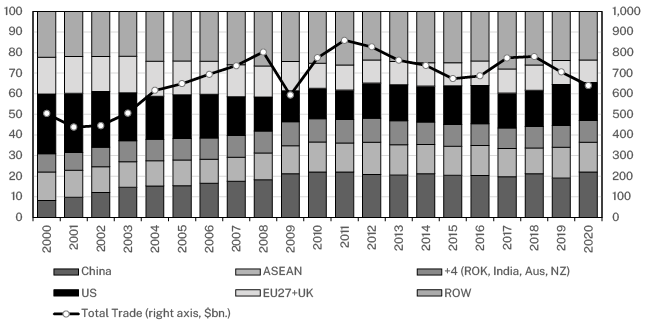
Figure 5.1: Japan’s export destination by share and total exports, 2000–20
Source: UN Comtrade online.
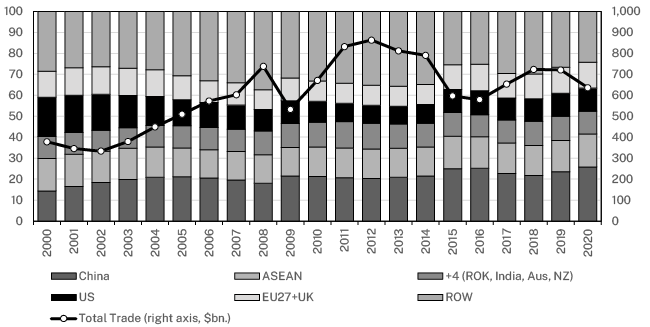
Figure 5.2: Japan’s import shares by source and total imports, 2000–20
Source: UN Comtrade online.
Japan’s dependence on China for its imports was 25.8 per cent in 2020, growing from 14.5 per cent in 2000, while the US share of Japanese imports fell from 18.8 per cent in 2000 to 11.0 per cent in 2020 (Figure 5.2). In some categories, Japanese reliance on China is heavy: for example, personal protective equipment (PPE) and electronics products. For Japan, China is the source of 75 per cent of imports of face masks, 66 per cent of goggles, 53 per cent of infection protective wear, 99 per cent of laptops and tablet PCs, and 86 per cent of smartphone imports.1
High trade shares with China have become a concern for some policymakers and businesses in Japan in the context of the China–US trade war. Chinese exports to the US that embody Japanese parts and components, or are part of Japanese supply chains that include Japanese value-added, have become exposed to US trade barriers. The high dependence on Chinese manufacturing for Japan’s imports of PPE and other electronics has also brought concern about diversification of supply chains, as it has in other countries. There is also the risk of interference in the market, both real and perceived, driven by political differences between Tokyo and Beijing.
Japanese firms have managed the ups and downs of political relations between Tokyo and Beijing, with past boycotts in China of Japanese goods having had little effect on the trade and investment relationship (Armstrong 2012), though there are still issues surrounding intellectual property violations.2
Japanese firms have deployed a China plus one strategy with investment diversification in Southeast Asia in addition to China. This has helped expand East Asian production networks and supply chains. The East Asian grouping consisting of China, the Association of Southeast Asian Nations (ASEAN) and the plus four countries (Australia, India, New Zealand and South Korea) are all initial members of the Regional Comprehensive Economic Partnership (RCEP) grouping and account for 44 per cent of Japan’s exports and 47.5 per cent of its imports. The share of this group in Japan’s trade has stayed relatively consistent through 2000–20 (Figures 5.1 and 5.2). Even this underestimates Japan’s impact in deepening trade between East Asian countries, driven by Japanese foreign direct investment, and masks some of the significance of the trade relationships.
Australia accounted for only 2.1 per cent of Japan’s trade in 2018 but is the major source of energy imports and strategic raw materials like iron ore. Japan relies on imports for 90 per cent of its energy needs and Australia is the largest supplier, providing over a quarter of Japan’s energy needs (Figure 5.3). Australia is the largest supplier of coal and liquefied natural gas (LNG) for Japan accounting for 71.6 per cent of Japan’s coal imports and 34.6 per cent of Japan’s LNG imports METI 2020a). Australia supplies over half of Japan’s iron ore imports.
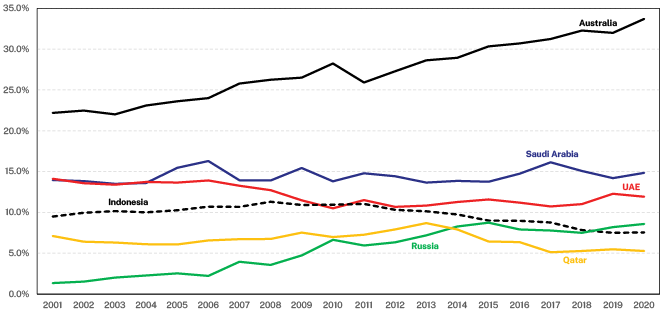
Figure 5.3: Share of Japan’s energy imports, 2000–20, gigajoules
Source: Calculated based on Trade Statistics of Japan, MOF, Japan; UN Comtrade, UNSD; BP Statistical Review of World Energy, June 2020, BP.
Japan’s energy security depends on reliable energy imports from the international market. Its commitment to the open multilateral trading system helped to secure Japanese energy imports, complemented by bilateral and regional agreements, giving confidence in open markets.
The position of Japanese foreign direct investment (FDI) abroad is in stark contrast to Japan as a host of FDI: Japan has the smallest FDI stock to GDP ratio of any OECD (Organisation for Economic Co-operation and Development) country. Japanese FDI accounted for 5.4 per cent of global FDI stock in 2018, up from 4 per cent in 2000, but Japan only hosted 0.7 per cent of global FDI in 2018—an insignificant share, given the size of the Japanese economy as the world’s third largest. Japanese FDI is global. The largest destination is the US, followed by the United Kingdom, the Netherlands and then China, where Japan is the largest source of non-Chinese FDI. Japan’s investments in ASEAN economies have also been growing rapidly as wages rise in China and geopolitical tensions encourage geographical diversification in supply chains.
Japan has managed its large trade and investment relationships—including securing energy and strategic raw material imports—under the framework of the multilateral trading system. It has managed its largest economic relationships without bilateral free trade or economic partnership agreements until only very recently. The bilateral agreements that Japan has secured have been complementary to, not substitutes of, the WTO and multilateral rules. It is that multilateral system that is weakening and under threat.
Uncertainty and Japan’s international economic diplomacy
Five related major trends are creating unprecedented challenges for countries like Japan:
- The rapid economic rise of China and accompanying growth in Chinese political and military power.
- The US’s retreat from global leadership of multilateral institutions and economic governance and pursuit of an ‘America First’ agenda.
- Strategic competition between China and the US, including a trade war that has only seen a temporary truce in a Phase One trade deal.
- New technologies centred on cyber and digital that are changing how economies engage and, without agreed multilateral rules, are introducing new vulnerabilities and fault lines between countries.
- The COVID-19 pandemic, which resulted in a major health crisis and an economic downturn not seen since the Great Depression of the 1930s. While the health and economic fallout from the pandemic has not led to cooperation between the US and China, it has intensified it.
These challenges are particularly acute for Japan given its geographical position between the US and China and economic reliance on both. Japan is also reliant on the US for security. China is its largest trading partner and close neighbour. Japan has relied on the open, rules-based multilateral trading system for its economic development and to secure its economic interests with both China and the US, as well as the rest of the world.
‘America First’, trade wars and uncertainty
President Donald Trump introduced significant uncertainty for the global economy and dramatically changed the circumstances for countries like Japan. While his brazen and sharp form of leadership cast doubt on Japan’s US security umbrella, his approach to trade and multilateralism was a symptom of underlying domestic challenges in the US. The approach to trade with allies and competitors alike caused great uncertainty, with the rise in protectionism in the US largely due to the maldistribution of income and wealth.
Japan’s response to these new uncertainties in its external environment was to shift from passive to proactive external policies to protect and shape the multilateral trading system (Urata 2020). Prime Minister Shinzo Abe’s active diplomacy and coalition building from the beginning of his return to the prime ministership in 2012 set the groundwork for a leadership role in international economic policy that became seen as necessary with the election of Donald Trump as US president in 2016. One of Trump’s first actions was to withdraw the US from the TPP in January 2017, which had been concluded in late 2015 but had not yet entered into force.
The TPP served multiple purposes for its members. In political security terms, Australia, Japan and other US allies and partners saw the TPP as a way to keep the US engaged in the Western Pacific. The US had framed the TPP as the economic arm of its pivot to Asia. In economic terms, the TPP was pushing rule-making and liberalisation. Bilateral agreements were delivering limited and diminished returns in both rule-making and liberalisation; and multilateral rule-making and liberalisation at the WTO had become difficult and stalled.
The TPP was not without its problems and challenges: for example, there were significant gaps in its membership. Just over half of the 21 Asia-Pacific Economic Cooperation (APEC) countries were members, excluding China, Indonesia, South Korea and other major economies. It had the perception of being US led because of the rhetoric and structure of negotiations. It also had a set of liberalisation and rule-making demands from the US that were difficult for negotiating parties to commit to. Many governments expended vast amounts of political capital in agreeing to the high standards of deep liberalisation and new rules, including those demanded by the US. At times, and at worst, it was framed as an agreement that was aimed at containing China’s economic rise; at best, it shaped the rules and standards for China to conform to.
For Japan, the TPP was a key pillar of the structural reform arrow of the Abenomics growth strategy, both symbolically and for what it would achieve as a beachhead in liberalising the agriculture sector (Solis 2017; Solis and Urata 2018).
America’s withdrawal from the TPP created great uncertainty for the remaining members but also for the global trading system, as it was only one of Trump’s pre-election promises. His campaign included threats of high tariffs on Chinese and Mexican imports as well as ‘America First’ rhetoric that signalled a retreat from multilateralism and global leadership in trade (Productivity Commission 2017). With uncertainty about whether the US Congress and Washington establishment would constrain the Trump administration from its more extreme threats on trade and alliance management, Japan led the conclusion of the CPTPP with the remaining 11 members. Australia, New Zealand and Singapore were key partners in pushing for its conclusion, but it was the economic weight of Japan and its leadership that made the difference (Terada 2019). The CPTPP keeps open the option of eventual US membership in the original TPP (as unlikely as that is in the near future) and maintains almost all of the original TPP commitments but US re-entry would require significant negotiations.
President Trump’s election promises were gradually realised throughout 2017 and accelerated in 2018 as it became clear that Congress and other interest groups were unable to reign in the extremes of his administration. Japan was president of the G20 group in 2019. Despite acceleration of the tit-for-tat trade war between China and the US and intensified rivalry, the Osaka G20 Summit resulted in a leaders’ statement that delivered several important messages. The APEC Summit in Papua New Guinea in 2018 had failed to produce a leaders’ communique for the first time, primarily because of Sino-US tensions. Although a strong missive on multilateralism and avoiding trade protectionism was absent, the Osaka G20 leaders’ statement included two issues that were important to Japan: promotion of digital economy under the ‘data free flow with trust’ (DFFT) initiative and construction of ‘high-quality infrastructure’.
The trade war between Japan’s two largest trading partners and the world’s two largest economies, China and the US, proceeded in fits and starts throughout 2018 and 2019. The Phase One trade deal reached between the two countries brought a truce to the trade war with agreement for China to purchase US$200 billion of agricultural goods and energy from the US over two years. The agreement, which was primarily about the volume of US imports, moved the trading relationship between China and the US towards managed trade, outside of the existing rules and norms of the WTO. The implications for energy and agriculture importers like Japan were significant, as they were for producers and exporters like Australia.
Under pressure from the US, Japan had agreed to purchase corn and other US agricultural products to reduce the bilateral trade imbalance between the two countries. Japan had resisted a bilateral deal with the US, preferring to try to bring the US back to the TPP; however, it eventually acquiesced and agreed to the US–Japan Trade Agreement, largely because the US threatened to impose high tariffs on automobile imports from Japan. Japan was not alone in this. Other countries, such as South Korea, Canada and Mexico, also worked to negotiate deals—including voluntary export restraints and other measures such as the ‘poison pill’ provision in the United States–Mexico–Canada Agreement (USMCA), which allows the US to hold the deal hostage to Canada or Mexico in negotiations with China—to avoid US tariffs. Those measures were also outside existing multilateral rules, and some, like voluntary export restraints (VERs) had been ended when the Uruguay Round3 had been completed. Other countries such as Australia negotiated exemptions from US steel and aluminium tariffs, agreeing to VERs.
Repairing the China relationship
The China–Japan relationship has been gradually improving following a low point in 2012, prior to Prime Minister Abe and President Xi coming to power within four months of each other. The large and complementary economic relationship between China and Japan has kept the political relationship from deteriorating too much (Armstrong 2012) and underlying economic interdependence has been a powerful incentive to better manage the political relationship.
Prime Minister Abe’s state visit to Beijing in October 2018 was his first bilateral visit (Abe had visited China for APEC in 2014 and the G20 in 2016) since he made the historic ‘ice-breaking’ visit in 2006 during his first trip abroad as prime minister. In that October 2018 trip, China and Japan agreed to 52 joint infrastructure projects in third-country markets, elevating cooperation in a potentially important area that had been difficult to find common ground on as competitors in infrastructure investment in Asia. The joint infrastructure projects were not agreed upon under the umbrella of China’s Belt and Road Initiative (BRI) but will potentially play a significant role in shaping the BRI (Armstrong 2018). Japan had not signed a memorandum of understanding (MOU) with China to join the BRI, and other G7 countries, especially in the Asia-Pacific, found it difficult to engage with China’s BRI. Italy was the first G7 country to sign an MOU to cooperate with China on the BRI in 2019. Japanese policy initiative had managed to find a way to work with China on a policy priority for both countries and to influence Chinese policy development through engagement. The theatre of infrastructure investment in developing countries and improving connectivity with China was seen as a threat to the existing US-led order by many in the West.4
Chinese agreement to joint infrastructure projects with Japan, including state participation in projects, meant that those projects that were largely in Southeast Asia would not proceed without agreement on standards, largely set by Japan. This demonstrates an interest on the part of Chinese authorities, or a faction thereof, to improve standards in their investment projects that had seen some commercial failures and spectacular international political backlash. What is more, China adopted the same language and principles as the Japanese-led Ise-Shima Principles for Promoting Quality Infrastructure Investment in its BRI Summit in 2019. For Japan, this was a positive initiative that would further a common interest with China and help to improve the bilateral relationship without compromising on any interests. The MOU that was signed mirrored the language Japan had used in an MOU on joint infrastructure projects with the US and Australia only months before. The experience of failed projects and geopolitical pushback from its forays into infrastructure investment in Southeast Asia in the 1980s gave Japanese policymakers an understanding of the economic and political challenges currently faced by China.
In managing the relationship with an increasingly unpredictable Trump administration and increasingly assertive Xi Jinping, Japan found itself in an unusual leadership position. As a US ally, Japan had relied on US leadership—as had much of the rest of the world—in regional and global economic initiatives. Even major reforms were largely driven by US pressure, or gaiatsu, including the perception of agricultural reform in the TPP negotiations. After successfully leading the conclusion of the CPTPP, the Japan—European Union EPA was concluded and brought into force in February 2019. At the time, it was the largest bilateral economic agreement globally. Japan had also elevated the priority of the RCEP agreement between the 10-member ASEAN, Australia, China, India, Japan, Korea and New Zealand by hosting, in July 2018, the first ministerial meeting outside of ASEAN where the agreement had been conceived. In doing so, Japan had become the de facto leader of multilateralism.
Regional leadership and its challenges
Prime Minister Abe invested political capital in building a strong personal relationship with President Trump and managed the economic and security relationship with the US while gradually improving the bilateral political relationship with China. Japan also strengthened political relations with other countries and regions with active diplomacy. That included Australia, Southeast Asia, Canada, Europe and the Middle East. There was mixed success in some key relationships with efforts to structurally improve relations with Russia by resolving territorial disputes having failed and the bilateral relationship with South Korea gradually deteriorating.
Japan’s G20 presidency in 2019 involved navigating the China–US trade tensions at the Osaka G20 Summit while protecting the multilateral system as its top strategic priority. Prime Minister Abe had outlined this approach at the World Economic Forum in Davos earlier that year. The Osaka Summit failed to produce any significant breakthrough, but the leaders’ statement did include defence of the multilateral trading system. The expectations for the summit were not high, given the China–US trade war and erratic US president.
On the sidelines of the G20 Summit, Japan launched its DFFT initiative that aimed to set governance standards in digital and cyber—an area devoid of global rules and norms that nevertheless plays an important role in determining the competitiveness of countries and firms.
After the successful conclusion of the Osaka Summit meeting in June 2019, tension between Japan and South Korea resulted in Japan initiating export restrictions on chemicals and other strategic materials. This coincided with a Korean Supreme Court decision to overturn a key agreement that had been the basis for a treaty between the two nations since 1965. The timing of the decision appeared politically driven and both President Moon and Prime Minister Abe used the spat for domestic political gain. As a result, the Japan—South Korea relationship deteriorated to its lowest point since normalisation of diplomatic relations in 1965.
In October 2019, Japan gave into US pressure and signed the US–Japan Trade Agreement, which Japan had resisted signing since President Trump had taken office. Although the agreement fell outside existing multilateral rules and norms, Japan was not alone in signing a defensive agreement with the US. Importantly, given the significance of the relationship between China and Japan, Japan had avoided the ‘poison pill’ provision that the US had included in the USMCA. In the US–Japan Trade Agreement, the US (more or less) recovered what it had lost in beef and pork market access concessions from Japan when it withdrew from the TPP, but Japan did not achieve the automobile market access concessions it had won from the US in the TPP negotiations. These developments concerning Japan’s trade relationship with the US indicate the difficulty Japan faces in protecting the multilateral trading system.
The new economic security posture
There does not appear to be any clear and accepted definition of economic security in Japan. With increased international uncertainty complicating Japan’s economic, foreign and security policies, there has been a deliberate effort to break down silos in Japanese policymaking and thinking. Economic security can have different meanings in economic or security agencies.
The election of President Trump and the ‘America First’ agenda coincided in Japan with a focus on ‘economic security’, which traditionally meant ensuring national security through economic means and referred to energy, resources and food. A group of ruling Liberal Democratic Party (LDP) legislators led by Akira Amari, a senior LDP member and former minister for economy, trade and industry, proposed the establishment of a council tasked with economic security in March 2019.
The genesis of the ‘economic security’ concept can be traced back in the early 1980s, right after Japan was hit by global oil shocks. The late Masataka Kosaka of Kyoto University proposed the term ‘economic security’ (keizai teki anzen hosho) as part of ‘comprehensive security’ (sogo anzen hosho), which was a key strategic policy framing of the Ohira government (‘Sogo Anzen Hosho Kenkyu Group Hokokusho’ [Report of Study Group on Comprehensive Security] 2 July 1980). At that time, Japan’s focus on economic security was threefold: 1) preserving the free trade system and solving the North–South problem, 2) ameliorating diplomatic tensions with key trading partners and 3) maintaining energy and food security.
The idea of economic security differs from the idea of economic diplomacy—used by the Ministry of Foreign Affairs (MOFA) since 2006 or so—which was primarily concerned with protecting and developing global economic rules in Japan’s national interest. Economic diplomacy was pursued primarily through EPAs.
The term ‘economic security’ can be found in the Diplomatic Bluebook: for instance, in Chapter 3(b) of the 2007 edition (MOFA 2007) or in Chapter 3 Section 3(d) in the 2008 edition (MOFA 2008) referring to energy and food security. The section on ‘economic diplomacy’ became a full section in the 2011 edition (MOFA 2011). From 2017, MOFA started publishing ‘Japan’s Economic Diplomacy’ (waga kuni no keizai gaikou) in addition to its annual Diplomatic Bluebook; the former was edited chiefly by the Economic Affairs Bureau. According to MOFA’s definition, Japan’s economic diplomacy should focus on three aspects: 1) rule-making to bolster free and open global economic systems, 2) supporting the overseas business expansion of Japanese companies through promotion of public–private partnerships and 3) promoting resource diplomacy along with direct investment towards Japan.
Economic security is often understood to overlap with economic statecraft, being ‘the use of economic means to pursue foreign policy goals’ (Baldwin 1985). Foreign aid, trade and policies governing the international flow of capital can be used as foreign policy tools in pursuit of national security objectives and are considered the most common forms of economic statecraft. Policies governing the international movement of labour could also be deployed to promote foreign policy goals, but such measures are not usually included under the rubric of economic statecraft.
Recognition that China and the US are deploying economic policies and instruments for security purposes has led many countries, including Japan, to try to understand the consequences of this and to develop policy in response. The new entanglement of economics and security has meant that policy silos in economics and security have had to be brought together or integrated in some manner.
Bringing economics and security together in the machinery of government
Since 2019, there have been deliberate efforts to bring economic and national security issues and thinking together in the Japanese bureaucracy, first in METI and then in MOFA. These developments were followed by the establishment of an economic team in the National Security Secretariat (NSS) within the Cabinet Secretariat.
On 2 June 2019, METI set up a new Economic Security Division with 15 officials, led by the director-general of the Trade and Economic Cooperation Bureau. The director of the division also serves as the director of the Security Trade Control Policy Division. METI had also set up a Rule Making Strategy Division, led by the director-general of the Trade Policy Bureau, in July 2014.
In MOFA, the Economic Security Division within the Economic Affairs Bureau has traditionally overseen energy, resources and food security. In October 2019, the National Security Policy Division under the Foreign Policy Bureau reorganised its three sub-divisions: Emerging Security Challenges, Space and Maritime Security Policy, and International Peace and Security Cooperation.
An economic security division was established in the NSS in April 2020.5 One of the factors that led to the establishment of the economic team was the realisation by METI of the need to take steps to tighten export controls of advanced technology by responding to a similar policy adopted by the US in 2018.6 METI was sensitive to the US policy on export controls because of its bitter experience in the case of Toshiba’s violation of the US Coordinating Committee for Multilateral Export Controls (COCOM) in 1987.7
METI tightened the regulation on inward FDI with the Foreign Exchange and Foreign Trade Act (FEFTA). The Ministry of Finance that administers the FEFTA could not evaluate technologies from a national security perspective. The expertise and monitoring of different types of technologies falls under the jurisdiction of different ministries. For example, information technology falls under the jurisdiction of the Ministry of Internal Affairs and Communication, while medical and pharmaceutical technologies are the responsibility of the Ministry of Health, Labour and Welfare. The lack of coordination and the compartmentalisation of overlapping responsibilities led to the creation of an economic security division in the NSS that can oversee economic security across government ministries and agencies.
The ruling LDP Diet Members’ Caucus on Strategic Rule Formulation headed by Akira Amari played an important role in the establishment of the economic team in the NSS. That caucus presented recommendations to the government to set up a National Economic Council modelled after the US’s National Economic Council, which would play the role of a conning tower for strategic foreign economic policy.8 According to Amari, Japan did not recognise the concept of economic security, while China uses economic means strategically to favourably alter the policies of other countries.
The Economic Security Division in NSS is one of seven divisions.9 It is headed by a former director-general from METI and consists of roughly 20 staff with four councillors from the ministries of Finance, Foreign Affairs, Internal Affairs and Communication, and the National Police Agency, respectively (Nihon Keizai Shimbun, 3 June 2020). The Economic Security Division deals with the protection of technology (export control and regulation of inward FDI), cyber security (5G, government–private sector co-ownership of information), international cooperation (Japan–US security cooperation, digitalisation of Japanese yen), coping with the COVID-19 pandemic (quarantine policy, strengthening of supply chains for medical and health equipment) and other matters. One of the goals of Japan’s economic security policy is to prevent the outflow of ‘critical technology’.10
The types of technology that are likely to be targeted for acquisition by non-allied countries include artificial intelligence and 5G communication technology (core technology for the development of a digital economy) as well as robotics and biotechnology (Nihon Keizai Shimbun, 4 June 2020). Several methods have been identified to achieve these objectives. One is acquisition of Japanese companies owning technology through FDI. To deal with this possibility, the Japanese Government revised the FEFTA, which is discussed below. Another is cyber theft of technologies from government agencies and private companies. There is also concern about collaborative research with Chinese universities and research institutes. The concern is that advanced technologies would be acquired from Japan by Chinese researchers connected to the Chinese military and used for military purposes. The Japanese Government is planning to enforce the disclosure of sources of funding for joint research projects that are supported by the Japanese Government (Nihon Keizai Shimbun, 24 June 2020). The Ministry of Education, Culture, Sports, Science and Technology (MEXT) is the major source of research funding of university and research institutes. It is planning to set up an economic security section to oversee the use of those funds in a manner that ensures ‘economic security’ (Yomiuri Shimbun, 24 August 2020).
China is one of the largest sources of patents globally and a major source of innovation. How Japan and other advanced economies that see joint research as a security threat manage their collaboration with Chinese universities and researchers is an important question for remaining at the technological frontier going forward.
The issues of restricting exports of dual-use technology, theft of sensitive technologies and the protection of other cyber assets are not unique to Japan. US pressure on its allies is increasing to enact extreme measures. Japan has an interest in finding a way to avoid the US tactic of extreme technological decoupling—a middle ground where it can benefit from Chinese innovation and technology while protecting its own sensitive technologies.
The Economic Security Division in the NSS is expected to work with different agencies across the Japanese Government to break up the compartmentalised system and have a consistent strategy. Having a centralised economic security division rather than numerous agencies dealing with economic security issues facilitates cooperation with foreign countries, especially the US (Yomiuri Shimbun, 16 May 2020). The Economic Security Division spent its first four months in existence working intensively on the novel coronavirus pandemic. Faced with growing economic frictions, particularly between the US and China, the coronavirus pandemic, rapid advancement in digital technology and other developments, the Economic Security Division is likely to require expansion to undertake its assigned tasks (Tobita 2020).
The machinery of government continues to evolve in Japan, including with the creation of a new ministerial role for economic security in late 2021 as Prime Minister Kishida Fumio took office. There is now better coordination across the bureaucracy and a recognition of the issues, but the policy measures thus far implemented would suggest security considerations dominate economic considerations and a clear framework that balances both, and other factors, has not been articulated. The policy measures adopted thus far are outlined below.
Revision of the Foreign Exchange and Foreign Trade Act
As part of its new economic security posture Japan has tightened restrictions on inward FDI to prevent foreign investors from acquiring advanced technology from Japanese companies. The Japanese Government revised FEFTA with the objective of promoting inward foreign investment that would contribute to Japan’s economic growth while restricting inward FDI that may undermine or damage national security. One of the reasons for the revision—which passed the National Diet in November 2019 and was enacted in May 2020—was to follow other advanced countries such as the US and the European Union, which adopted new regulation on inward foreign investment to strengthen the screening process from the national security viewpoint (Ministry of Finance 2020). Australia also tightened its regulations around inward FDI in the name of national security in 2020, continuing a trend underway in other Western countries. The revised FEFTA introduced a new exemption scheme regarding the pre-notification by foreign investors to the Japanese Government and also revised the list of industries subject to the exemption (Ministry of Finance 2019). Japan has been relatively closed to foreign investment (see discussion above) and the tightening of FDI for security purposes will likely not help realise more FDI, even with many other advanced economies similarly tightening regulation of FDI.
Prior to this revision, a foreign investor was required to notify the government of its investment if it was acquiring an ownership share of 10 per cent or greater of a listed company in a designated business sector. The designated sectors, which include weapons, aircrafts, nuclear facilities, space, dual-use technologies, cybersecurity and telecommunications, comprise 155 out of 1,465 sectors, using the sector classification of Japan’s Standard Industrial Classification.
The exemption scheme of prior notification for stock purchases of companies in designated sectors by a foreign entity was introduced with certain conditions in the revised FEFTA. The threshold for prior notification for purchasing stocks was lowered from 10 per cent to 1 per cent. Foreign financial institutions were given blanket exemptions; foreign sovereign wealth funds, public pensions and other ‘general investors’ were granted regular exemptions; and investors with a record of sanctions or that were state-owned enterprises were not granted exemptions.11 For general investors acquiring stock of listed companies in designated sectors, prior notification was exempted in line with following conditions:
- Investors of their closely related persons will not become board members of the investee company.
- Investors will not propose to the general shareholders’ meeting transfer or disposition of investee company’s business activities in the designated business sectors.
- Investors will not access non-public information about the investee company’s technology in relation with business in the designated business sectors (Ministry of Finance 2020, 4).
For general investors acquiring 10 per cent or less of the stock of the listed companies in the core designated business sectors, prior notification was exempted in line with the following conditions in addition to the conditions listed above:
- Regarding business activities in core sectors, investors will not attend the investee companies’ executive board or committees that make important decisions in these activities.
- Regarding business activities in core sectors, investors will not make proposals, in a written form, to the executive board of the investee companies or board members requiring their responses and/or actions by certain deadlines (Ministry of Finance 2020, 4).
There are 12 core designated business sectors. These are a subset of the designated sectors that include weapons, aircrafts, nuclear facilities and other designated sectors, and parts of cybersecurity, telecommunications and other designated sectors. Investors that use the exemption scheme are required to submit a post-investment report within 45 days of the transaction settlement date.
The new 1 per cent threshold for prior notification in the revised FEFTA is low compared to other advanced countries, except the US where no threshold is applied (Ministry of Finance n.d.-b). Australia moved to a zero-dollar threshold during the coronavirus pandemic, reduced from a complex and preferential set of thresholds that ranged from zero for some sensitive sectors (all investment proposals screened), to a range of thresholds with higher thresholds of up to AU$1.154 billion for preferential trade or economic partnership agreements (no screening for investments below that threshold). The thresholds applied in the cases of France, Germany and Italy are 33.3 per cent, 10 per cent and 3 per cent, respectively.
The Ministry of Finance released information on the list of companies for which the purchase of stocks by foreign investors is subject to prior notification on 8 May 2020 (Ministry of Finance n.d.-a). The ministry listed 2,102 companies in the designated sectors out of 3,800 listed companies, and 518 companies in the core designated sectors out of 2,102 companies.12 These data show that 56 per cent of listed companies are subject to prior notification. Criticism has been made about the lack of clarity/transparency in the determination of the companies in the list, and critics have called for a clear explanation of the criteria and/or reasons for the selection (Nihon Keizai Shimbun, 5 June 2020). Prior notification was implemented on 7 June 2020.
Several concerns have been raised about the negative impacts of the revised FEFTA (Nihon Keizai Shimbun, 23 and 31 May 2020). One is that, for a large number of companies, the purchase of stocks by foreign investors needs prior notification: 56 per cent of the listed companies are classified under the designated sectors. According to Nihon Keizai Shimbun (23 May 2020), this kind of wide coverage for prior notification is unusual globally. Although an exemption is possible, the increased coverage of prior notification is likely to discourage foreign investment. Pesek (2019) noted that, with the revised Act, Tokyo would surely lose any chance it had to re-establish itself as a global financial centre. There is also the problem of administering a complex system that requires screening of so many financial transactions. Unlike the US, which has a permanent agency overseeing such transactions (the Committee on Foreign Investment), in the case of Japan, evaluation and screening is undertaken by the Ministry of Finance and other concerned ministries in which the staff in charge are likely to be rotated every three to four years. As such, consistent and reliable screening may be difficult. Another serious concern is that tighter restrictions on inward FDI may reduce the pressure on companies for necessary reform by discouraging activist investors (Nihon Keizai Shimbun 23 May 2020; Pesek 2020). Reducing such pressure would result in increased inefficiency or productivity decline.
Export controls and their politicisation
METI and, more recently, the Economic Security Division of the NSS, oversee export controls of advanced technologies that could end up in a country or with an actor under sanctions from Japan or the US, or be used to undermine Japan’s security.13 The memory of Toshiba being fined for sales to the Soviet Union in the early 1980s for violation of COCOM rules is still fresh for some; but, more importantly, there is the concern that advanced technology will end up in North Korea or in the Chinese military. There are also fears of being caught up in a US–China technological competition and/or technological decoupling.
Japan removed South Korea from its ‘whitelist’ of preferred export countries for high-tech materials without licensing in August 2019 for fear that the end use of some of those materials are not adequately monitored (METI 2019). This placed a new and additional burden on South Korean firms that rely on imports of those materials. It also introduced significant uncertainty for South Korean multinationals over whether they could secure credit in Japan, and for smaller South Korean firms as to whether they could navigate the new licensing requirements without import disruptions.
The commercial and economic implications are significant. Tightened export controls have been placed on three high-tech materials—fluorinated polyimide, photoresist and hydrogen fluoride—that are key inputs for the South Korean production of memory chips (for which it is the largest producer in the world) and LCD and OLED displays. Japan is the major supplier to South Korea of these materials, accounting for 94 per cent of South Korean imports of fluorinated polyimide, 92 per cent of fluorinated polyimide imports and 44 per cent of hydrogen fluoride imports (Zafar 2019).
The tightening of export controls was heavily politicised. The timing of the export restrictions tied it to the South Korean Supreme Court decision to allow the seizure of Japanese company assets to compensate victims of Japanese occupation of South Korea during World War II. The ruling was contrary to the 1965 treaty between Japan and South Korea. The timing and politicisation of the export controls has resulted in the trade dispute being labelled an economic or trade war that relates to history, economic competition, regional rivalry, disputed territory and existing political tension by some mass media and concerned observers, particularly those from South Korea.14 The Japanese Government justified its decision with reference to the potential for leakage of material to North Korea.
It is unclear what effect the tightening of Japanese export controls will have on South Korean imports of the materials, the commercial fortunes of Japanese exporters, the international market for those materials, and South Korea’s downstream exports of memory chips and displays. There are broader strategic and geopolitical ramifications with Japanese—South Korean political and security cooperation deteriorating, and intelligence sharing agreements with the US at risk of ending.
After several unsuccessful meetings between the two governments, the South Korean Government took the case to the dispute settlement mechanism of the WTO in June 2020. The panel was scheduled to discuss the case in July.
One year after the imposition of export controls by the Japanese Government, several notable developments have been observed in trade and investment concerning the three materials in response to export controls by the Japanese Government.
Several South Korean firms began building facilities to produce these materials with assistance from the South Korean Government. Meanwhile, Japanese firms have been trying to maintain their sales in South Korea, which is a very important market for many Japanese firms, by adopting three main approaches. First, some Japanese firms are trying to maintain exports to South Korea through various channels. For example, some Japanese firms began to export photoresist by using a new policy introduced by METI that allows transactions between specified firms for a maximum of three years without obtaining permission to export for every transaction (Nikkei Asia, 20 December 2019). Second, several Japanese firms set up plants in South Korea. This type of investment, similar to ‘tariff jumping investment’ in economic literature, is an expected response from Japanese firms. In this case, exports by Japanese firms are substituted by local production/sales in South Korea by Japanese firms (Nikkei Sangyo Shimbun, 24 August 2020). Third, some Japanese firms began exporting the materials to South Korea from their foreign affiliates in other countries. For example, JSR began exporting photoresist from their joint-venture company in Belgium (Kim 2019).
These developments are impacting on the structure and performance of the semiconductor materials industry in Japan and South Korea. Production of these materials in South Korea by South Korean, Japanese and other countries’ firms has increased, while production in Japan has declined—or at least has not increased as much as it would have without export control. This type of development will accelerate as production capability/capacity in South Korea increases, possibly resulting in improvement in the competitiveness of the semiconductor materials industry in South Korea vis-a-vis Japan. This type of consequence, which does not benefit Japan, does not seem to have been expected by the Japanese Government when it implemented the policy.
METI’s concern appears to have primarily revolved around South Korea’s inability to monitor or control exports of those materials and stop them from reaching North Korea, for example. In hindsight, the Japanese Government would have done better to work closely with the South Korean Government to jointly address these concerns. The politicisation of the issue has increased uncertainty in the trade of those materials between Japan and South Korea, with potential spillovers to other sectors in the bilateral trade and economic relationship.
Supply chains and economic security during the coronavirus pandemic
The COVID-19 pandemic has exposed the vulnerability of supply chains for the Japanese economy. There were initial disruptions to the supply of PPE and electronic equipment as many Chinese factories and suppliers went into lockdown to contain the health crisis. Supply chains have contributed to the rapid expansion of Japanese companies, as they have enabled Japanese companies to achieve fragmented, task-based specialisation under the name of just-in-time production. The outbreak of COVID-19 in Wuhan in China was a reminder of how interconnected economies are, as the adverse economic impacts from China spread rapidly to Japan and many other countries through the disruption of supply chains. Since the initial disruption, supply chains and markets have responded rapidly to shortages.
A case in point is the Japanese automobile industry, a major pillar of the Japanese economy. When Wuhan went into lockdown in late January, factories supplying auto parts also shut down. The shortfall suspended the operations of Japanese automobile assemblers in China, Japan and other parts of the world (Armstrong 2020). Vehicle production in Japan declined by 10 per cent in February from the same month the previous year. While Chinese manufacturing began to recover in March and April thanks to the successful containment of COVID-19 in China, the virus was still spreading in Japan (Kalinova 2020). Factories were shut down in Japan because workers had to stay at home as a state of emergency was declared in April, causing production to drop by approximately 45 per cent compared to the previous year. Production resumed as the state of emergency was lifted in May, but sales of automobiles remained low because of dampened demand, which was mainly due to uncertainty around the continued pandemic and pessimistic future economic prospects.
Disrupted supply chains have caused chaos for consumers and medical staff, especially around the supply of some PPE from China. A shortage of PPE such as facial masks and protective garments, for which Japan is largely reliant on China (50 per cent of its supplies come from China), led to a panic as some consumers paid as much as ¥1,000 (US$9) for a mask, and some hospitals used plastic bags rather than medical garments as PPE.
Faced with supply chain disruption, the immediate response of Japanese firms was to run down inventories and procure products from suppliers in Japan and other parts of the world using existing supply chains. Though supply chains made a rather quick recovery, the pandemic has aroused interest in diversifying supply chains among Japanese companies. Japanese companies are shifting their business strategy from just-in-time to just-in-case. One obvious reason for this is increased concern about the prolonged presence of COVID-19 and the possible emergence of new viruses.
Japanese firms that rely heavily on China for the supply of many goods, including electronics, medical equipment and health products, have other reasons for diversifying supply chains. The intensifying US–China trade war and technology race, as well as concerns over possible forced technology transfers in China, have reduced the attractiveness of conducting business in China. Diversifying supply chains could involve shortening networks by reducing the number of links in the chain, or by redesigning products to make their components less specific. But these changes are costly, which discourages diversification. Government intervention could add further costs to businesses that are better at calculating and mitigating risks, and further onshoring could increase the vulnerability of supply chains to shocks (Armstrong 2020).
Japan’s METI is keen to secure sufficiency in domestic supply. It recently introduced a subsidy program to support Japanese companies in their efforts to diversify and strengthen supply chains (METI 2020b). The program has two components. One is to promote domestic investment by relocating overseas production bases to Japan—or reshoring. The other is to construct strong supply chains involving ASEAN member countries to encourage Japanese firms to move or establish their production bases there. These have been widely described as moving Japanese manufacturers out of China and reducing dependence on China as a production base.
The budget allocated to the first and second components are ¥220 billion (US$2 billion) and ¥23.5 billion (US$200 million), respectively. The money can be used to construct buildings, install machinery and conduct feasibility studies. The program covers half to three-quarters of the costs depending on the content of the projects and the size of the firms, with higher subsidy rates for small and medium-sized enterprises (SMEs). For the component to promote reshoring, 57 companies out of 90 applicants were selected in the first tranches in July 2020 and were allocated approximately ¥57.4 billion (METI 2020c; JETRO 2020). For the component to promote diversified supply chains into ASEAN, 30 companies out of 124 applicants were selected in the first tranches in July 2020. Many of the selected companies are producers of medical and health products and auto and electronic parts.
The incentive created by the subsidy for Japanese companies to onshore projects or move them to Southeast Asia appears to have had some effect, but it is not clear whether and how much this program will contribute to the diversification of supply chains of Japanese companies, as it is just one of many factors that will influence a company’s decision. Firms will also consider the costs and benefits of diversification, including market size, labour cost, quality of infrastructure, trade and investment policy, and political and social stability in potential investment locations.
Many Japanese multinational corporations (MNCs) have been reorganising their supply chains in Asia regardless of the subsidy. Japanese MNCs and the SMEs that agglomerate around them have been restructuring their supply chains in Asia and investments in China over time due to rising labour costs in China (Japanese Bank for International Cooperation 2020). The China plus one strategy of diversifying investment has been common practice for decades. However, until further analysis of accumulated data is undertaken, it is not possible to know whether it has helped to make supply chains more resilient or turned the subsidies into a form of corporate welfare.
Conclusion
Japan’s economic fortunes rely on an open, rules-based multilateral trading system. That commitment to openness and multilateralism has ensured energy and food security for Japan and is the framework within which Japan has managed its large economic relationships with China, Europe and the US. That was the case even before Japan’s recent bilateral agreements with Europe, the US and the CPTPP. Except for Japan’s trade agreement with the US in 2019, all other trade agreements were pursued to complement the WTO and build on the multilateral global trading system.
The multilateral system upon which Japanese economic prosperity relies is under direct threat from Japan’s security guarantor—the US. The US has underpinned Japanese and regional security and has played the primary leadership role in the rules-based order. China’s rise, the US’s retreat from global leadership to an ‘America First’ agenda, US–China strategic rivalry and the importance of new areas of commerce that are not subject to multilateral rules have combined to create uncertainty for Japanese policymakers as they navigate an uncertain and dynamic external environment.
Japan has shown leadership in the face of a US retreat from multilateralism by leading the conclusion of the world’s largest mega-regional agreement, the CPTPP, and by signing the world’s largest ‘bilateral’ deal with the European Union. Those required political will and proactive diplomacy. Japan is also a key driver of the RCEP agreement that will lock East Asian economies into new rules and new commitments to openness. Japan’s economic weight, political stability and proactive diplomacy has meant a more important role for Japan in multilateralism as the US–China relationship has deteriorated.
While managing the political relationship with the US, the Abe administration has pursued a strategy to improve relations with China and actively strengthen security and economic ties globally with a focus on Southeast Asia. The joint Chinese–Japanese infrastructure projects in Southeast Asia have demonstrated openness by Chinese policymakers to working with Japan and conforming to higher standards and transparency, while Japanese policymakers have managed to influence China’s BRI without becoming a formal member.
Japanese initiatives towards China have been undertaken in the context of managing the political and security relationship with the US. The MOU between China and Japan on joint infrastructure projects was modelled on the MOU between Australia, Japan and the US. Japan is not a member of the Chinese-led Asian Infrastructure Investment Bank and only put real political capital behind RCEP once the TPP, and later the CPTPP, was concluded.
The unchartered territory of economic policies with security implications has led to policy choices and strategies that seem to contradict Japan’s emphasis and interest on rules, multilateralism and openness, however insignificant the decisions may seem.
The Trump administration forced a trade agreement on Japan that is outside of established rules and moves the Japan–US relationship closer to managed trade. History and politics have become mixed up in the tightening of Japanese restrictions on exports of critical materials to South Korea. These measures have had adverse security and geopolitical implications by further damaging the Japan—South Korea relationship and more explicitly linking economic statecraft to political disputes.
Complex and restrictive measures have been placed on foreign investment in Japan that, at best, reduce the prospects of Japan as a global financial centre and, at worst, inhibit productivity enhancing capital, trade links and technology. Restrictions on FDI by other Western countries is cited as part of the policy rationale.
Institutional changes in government to respond to the new economic security challenges, especially the new Economic Security Division in the NSS, have helped to bring some policy coherence across the Japanese Government, but there is no clearly articulated framework for balancing economic and security interests in the national interest. There also does not appear to be an accepted definition of ‘economic security’. Thus far, the tightening of export control regulations and the tightening of FDI regulations are the main outcomes of the new economic security posture. Export controls, which were imposed on South Korea in August 2019, hurt both Japanese and Korean firms. Japanese exporters reduced their export sales, while Korean users of the controlled materials cut down their production. The ultimate outcome of these actions remains unclear in economic or security terms, but production of those materials has shifted from Japan to South Korea, including Japanese producers setting up subsidiaries in South Korea. It is not clear if the Japanese Government expected such development when it implemented export control. The impacts of tightening FDI regulation cannot be evaluated yet as the policy was only introduced in April 2020. It is also too early to judge the effectiveness of government subsidies for Japanese MNCs to onshore manufacturing or invest in Southeast Asia to make Japanese supply chains more resilient during the COVID-19 pandemic. These are largely interpreted as an economic security measure to become less dependent on China.
The measures that Japan has implemented in the name of economic security, such as export control and revision (more restrictive) of inward FDI policy, incur economic costs and are a retreat from openness. They contribute to a loss of dynamism that is needed to revitalise the Japanese economy with a declining and ageing population.
Considering this point, it is important for Japan to maintain and strengthen the rules-based multilateral trade system, and to have China and the US engaged in the system, to achieve economic prosperity and contribute to political stability in the region. To deal with national security issues involving China, the establishment and management of a mutually beneficial relationship through active dialogue and cooperation, such as joint infrastructure projects with China in Asia, should continue to be pursued. Japan will need to cooperate with like-minded countries such as Australia and New Zealand, as well as with ASEAN and other countries, to keep China and the US engaged in multilateralism.
The entanglement of economics and security for Japan has led to a series of policies that appear to promote national security interests over economic prosperity. Deployed in the name of economic security, they are restricting trade and investment. It is not clear that the policies are consistent with Japan’s current external economic position and deep interest in supporting the multilateral system that helps manage that global economic position. Without a clearly defined economic security strategy that has economic prosperity as central to national security, Japan may be forced down a path of restricted or managed trade with non-allies, which will be damaging to Japan’s prosperity.
References
Armstrong, S. 2012. ‘The Politics of Japan–China Trade and the Role of the World Trade System’. The World Economy 35 (9): 1102–20. doi.org/10.1111/j.1467-9701.2012.01473.x.
Armstrong, S. 2018. ‘Japan Joins to Shape China’s Belt and Road’. East Asia Forum, 28 October 2018. www.eastasiaforum.org/2018/10/28/japan-joins-to-shape-chinas-belt-and-road.
Armstrong, S. 2020. ‘Economic Distancing from China and the World Would Carry Heavy Costs’. East Asia Forum, 7 June 2020. www.eastasiaforum.org/2020/06/07/economic-distancing-from-china-and-the-world-would-carry-heavy-costs/.
Baldwin, D. A. 1985. Economic Statecraft. Princeton: Princeton University Press.
GlobalSecurity.org. n.d. ‘Toshiba-Kongsberg Incident’. Accessed 29 September 2021. www.globalsecurity.org/intell/world/russia/toshiba.htm.
Japanese Bank for International Cooperation. 2020. Report on Overseas Business Operations by Japanese Manufacturing Companies, www.jbic.go.jp/en/information/press/press-2020/0115-014188.html.
JETRO (Japan External Trade Organization). 2020. ‘About the Companies Adopted in the First Open Call for Participants (Equipment Introduction Assistance Type (General Frame / Special Frame))’. 17 July 2020. www.jetro.go.jp/services/supplychain/kekka-1.html.
Kalinova, K. 2020. ‘Probing Japan’s Slow Response to the COVID-19 Crisis’. East Asia Forum, 25 April 2020, www.eastasiaforum.org/2020/04/25/probing-japans-slow-response-to-the-covid-19-crisis/.
Kim, J. 2019. ‘Samsung Secures Key Chip Supply in Belgium as Tokyo Curbs Exports’. Nikkei Asia, 10 August 2019. asia.nikkei.com/Spotlight/Japan-South-Korea-rift/Samsung-secures-key-chip-supply-in-Belgium-as-Tokyo-curbs-exports.
Macaes, B. 2018. Belt and Road: A Chinese World Order. London: C. Hurst & Co.
METI (Ministry of Economy, Trade and Industry). 2019. ‘Update of METI’s Licensing Policies and Procedures on Exports of Controlled Items to the Republic of Korea’. 1 July 2019. www.meti.go.jp/english/press/2019/0701_001.html.
METI (Ministry of Economy, Trade and Industry). 2020a. ‘Japan’s Energy 2019’. www.enecho.meti.go.jp/en/category/brochures/pdf/japan_energy_2019.pdf.
METI (Ministry of Economy, Trade and Industry). 2020b. ‘Outline of the Projects under the FY 2020 Supplementary Budget’. April 2020. www.meti.go.jp/main/yosan/yosan_fy2020/hosei/pdf/hosei_yosan_pr.pdf [in Japanese].
METI (Ministry of Economy, Trade and Industry). 2020c. ‘Regarding the Results of the Adoption of Subsidies Related to the “Domestic Investment Promotion Project Cost Subsidy for Supply Chain Measures” (Preliminary Examination) in FY2’. 17 July 2020. www.meti.go.jp/information/publicoffer/saitaku/2020/s200717002.html [in Japanese].
Ministry of Finance. 2019. Amendment Bill of the Foreign Exchange and Foreign Trade Act. 21 October 2019. www.mof.go.jp/english/international_policy/fdi/20191021.html.
Ministry of Finance. 2020. ‘Rules and Regulations of the Foreign Exchange and Foreign Trade Act’. 24 April 2020. www.mof.go.jp/english/international_policy/fdi/kanrenshiryou01_20200424.pdf.
Ministry of Finance. n.d.-a. ‘List of Listed Companies Subject to Prior-Notification under the Foreign Exchange and Foreign Trade Law’ [Honpo Jojo Kigyo no Gaitame Ho niokeru Tainai Chokusetsu Toushi-tou Jizen Todokeide Gaitousei List]. Accessed 29 September 2021. www.mof.go.jp/international_policy/gaitame_kawase/fdi/ [in Japanese].
Ministry of Finance. n.d.-b. ‘On Proposed Revised Law of a Part of the Foreign Exchange and Foreign Trade Act’ [Gaikoku Kawase oyobi Gaikoku Boueki Ho no ichibuwo kaiseisuru Horitsu an ni tsuite]. Accessed 29 September 2021. www.mof.go.jp/international_policy/gaitame_kawase/press_release/kanrenshiryou_191018.pdf [in Japanese].
Ministry of Foreign Affairs. 2007. Diplomatic Bluebook. www.mofa.go.jp/policy/other/bluebook/2007/html/index.html.
Ministry of Foreign Affairs. 2008. Diplomatic Bluebook. www.mofa.go.jp/policy/other/bluebook/2008/html/index.html.
Ministry of Foreign Affairs. 2011. Diplomatic Bluebook. www.mofa.go.jp/policy/other/bluebook/2011/index.html.
Nihon Keizai Shimbun. 1 July 2019. ‘Tightening Export Restrictions to South Korea, Government Announcement South Korea Also Takes Countermeasures’. www.nikkei.com/article/DGXMZO46789890R00C19A7EAF000/ [in Japanese].
Nihon Keizai Shimbun. 23 May 2020. ‘A Wave of Global Efforts to Block Foreign Takeovers: Japan’s Focus on Prior Regulations Has Its Dangers’. www.nikkei.com/article/DGXMZO59427290R20C20A5K14700/ [in Japanese].
Nihon Keizai Shimbun. 31 May 2020. ‘June 7: Revised Foreign Exchange Law fully Applied Strengthening Economic Security: Focus on Operation’. www.nikkei.com/article/DGKKZO59798090Q0A530C2EA4000/ [in Japanese].
Nihon Keizai Shimbun. 3 June 2020. ‘Economic Team to Develop Cross-Agency Policies to Deal with COVID-19 and Technology Leakage’. www.nikkei.com/article/DGXMZO59899990S0A600C2EE8000/ [in Japanese].
Nihon Keizai Shimbun. 4 June 2020. ‘Advanced Technologies Targeted: Robotics and Biotechnology, Blocking Takeovers’. www.nikkei.com/article/DGXMZO59944600T00C20A6EE8000/ [in Japanese].
Nihon Keizai Shimbun. 5 June 2020. ‘Opinion: The Revised Foreign Exchange and Foreign Trade Law Requires More Transparent Operational Standards’. www.nikkei.com/article/DGXMZO60045650V00C20A6SHF000/ [in Japanese].
Nihon Keizai Shimbun. 24 June 2020. ‘Government Subsidies to Prevent Outflow of Advanced Technology Abroad, Subject to Disclosure of Funding Source’. www.nikkei.com/article/DGXMZO60686450T20C20A6MM8000/?n_cid=DSREA001 [in Japanese].
Nikkei Asia. 20 December 2019. ‘Japan Partially Reverses Curbs on Tech Materials Exports To South Korea’. asia.nikkei.com/Politics/International-relations/Japan-partially-reverses-curbs-on-tech-materials-exports-to-South-Korea.
Nikkei Sangyo Shimbun. 24 August 2020. ‘One Year After Stricter Export Controls, Semiconductor Materials Shifting to Korean Production’. www.nikkei.com/article/DGXMZO62914600R20C20A8X93000/ [in Japanese].
Pesek, W. 2019. ‘Japan’s “Idiotic” Investment Restrictions Are Blow to Global Status’. Nikkei Asian Review, 19 October 2019.
Pesek, W. 2020. ‘Japan Should Encourage Activist Investors, Not Tie Them in Red Tape’. Nikkei Asian Review, 27 February 2020. asia.nikkei.com/Opinion/Japan-should-encourage-activist-investors-not-tie-them-in-red-tape.
Productivity Commission. 2017. Rising Protectionism: Challenges, Threats and Opportunities for Australia. Canberra: Productivity Commission.
‘Sogo Anzen Hosho Kenkyu Group Hokokusho’ [Report of Study Group on Comprehensive Security]. 2 July 1980. Accessed 28 November 2020. worldjpn.grips.ac.jp/documents/texts/JPSC/19800702.O1J.html [in Japanese].
Solis, M. 2017. Dilemmas of a Trading Nation: Japan and the United States in the Evolving Asia-Pacific Order. Washington, DC: Brookings Institution.
Solis, M. and S. Urata. 2018. ‘Abenomics and Japan’s Trade Policy in a New Era’. Asian Economic Policy Review 13 (1): 106–23. doi.org/10.1111/aepr.12205.
Song, S. 2020. ‘After a Year of Restricted Trade with Japan, Korean Materials Industry Has Grown Stronger’. Korea Herald, 26 June 2020. www.koreaherald.com/view.php?ud=20200625000809.
Terada, T. 2019. ‘Japan and TPP/TPP-11: Opening Black Box of Domestic Political Alignment for Proactive Economic Diplomacy in Face of “Trump Shock”’. Pacific Review 32 (6): 1041–69. doi.org/10.1080/09512748.2019.1617771.
Tobita, R. 2020. ‘Tokyo Expands National Security Council to Catch Economic Risks’. Nikkei Asian Review, 18 March 2020. asia.nikkei.com/Politics/Tokyo-expands-National-Security-Council-to-catch-economic-risks.
Urata, S. 2020. ‘A Shift from Passive to Proactive Protector of a Rules-Based Open Trading System’. AJISS–Commentary (Special Series: Trajectory of Heisei, way forward to Reiwa), 3 March 2020. www.jiia.or.jp/en/ajiss_commentary/a-shift-from-passive-to-proactive-protector-of-a-rules-based-open-trading-system.html.
Yomiuri Shimbun. 16 May 2020. ‘The “Economic Team” to Break Down Vertical Divisions’. www.yomiuri.co.jp/politics/20200516-OYT1T50092/ [in Japanese].
Yomiuri Shimbun, 17 May 2020. ‘Grasping Critical Technologies, Hurrying to Prevent Them [Kibigijutsu haaku, bougyo isogu]’. www.yomiuri.co.jp/politics/20200516-OYT1T50267/ [in Japanese].
Yomiuri Shimbun, 20 May 2020. ‘A System to Protect and Develop Technology [Gijutsu mamori sodateru taisei wo]’. www.yomiuri.co.jp/politics/20200519-OYT1T50245/ [in Japanese].
Yomiuri Shimbun. 24 August 2020. ‘Ministry of Education, Culture, Sports, Science and Technology Reorganized to Promote New Technologies. AI and Quantum Research Next Fall’. www.yomiuri.co.jp/politics/20200824-OYT1T50036/ [in Japanese].
Zafar, R. 2019. ‘Semiconductor Raw Material Import Critical for South Korean Industry’. WCCF TECH, 4 July 2019. wccftech.com/semiconductor-import-south-korea-critical/.
1 The figures are for 2018 and computed from trade statistics compiled by Japan’s Ministry of Finance. These figures will be updated for 2019.
2 According to a survey conducted by the Japan Bank for International Cooperation, 35.5 per cent of the respondents indicated that insufficient protection of intellectual property right is a problem in China. See: www.jbic.go.jp/ja/information/press/press-2019/pdf/1127-012855_4.pdf [in Japanese].
3 The Uruguay Round was the eighth round of multilateral trade negotiations conducted within the framework of the General Agreement on Tariffs and Trade. It led to the creation of the WTO.
4 See, for example, Macaes (2018) for a discussion of these views.
5 The National Security Council (NSC) was created in December 2013.
6 Nobukatsu Kanehara, former deputy director for the NSC, quoted in Yomiuri Shimbun (20 May 2020).
7 Toshiba and Kongsberg, a state-owned Norwegian enterprise, sold US$17 million worth of computer-controlled machine tools to the Soviet Union between 1981 and 1984 in violation of COCOM, which was established during the Cold War to put an embargo on Western exports to East Bloc countries. The US administration and Congress protested strongly against this case. See, for example, GlobalSecurity.org (n.d.).
8 Akira Amari, quoted in Yomiuri Shimbun (17 May 2020).
9 Others include the coordination team, the strategic planning team, the intelligence team and the three teams handling regional affairs.
10 Minute of a committee under the Industrial Structure Council [Sangyou Kouzou Shingikai], October 2019, www.meti.go.jp/shingikai/sankoshin/tsusho_boeki/anzen_hosho/pdf/20191008001_01.pdf [in Japanese].
11 The discussions here apply to general investors including sovereign wealth funds and public pension funds. The revised law introduced three different treatments regarding the exemption schemes: a blanket exemption, regular exemption and no exemption—depending on the types of investors. Blanket exemption is applied to foreign financial institutions, while regular exemption is applied to general investors. For investors with a record of sanctions (due to FEFTA violation) and state-owned enterprises (except those who are accredited by the authorities) exemption is not applied. For details, see Ministry of Finance (2020).
12 On 5 June 2020, the Ministry of Finance announced that 51 companies were added and 11 companies were removed from the list of companies in the core designated sectors, leaving 558 companies on the list.
13 Commercial or industrial espionage and protectionist policies should be differentiated from national security risk, although they are often conflated. The national security label can be liberally applied for protectionist and industrial policy purposes.
14 On this view from Japan, see, for example, Nihon Keizai Shimbun (1 July 2019). For a Korean view, see Song (2020).
Previous