


 menu
Navigating Prosperity and Security in East Asia
6
Strategic interests, regional integration and international economic policy in Indonesia
Yose Rizal Damuri, Rocky Intan and Dandy Rafitrandi
Introduction
The principles that undergird strategic and economic integration policy in Indonesia can be characterised by an emphasis on balance between powers, as well as by an emphasis on both economic and political sovereignty. As tensions between the United States and China intensify, and new opportunities like the Belt and Road Initiative take shape, Indonesian policymakers will increasingly be required to formulate new ways of achieving this balance. Indonesia’s role in the formulation of the Regional Comprehensive Economic Partnership (RCEP) provides an indication of what that balance will look like: using established forums like the Association of Southeast Asian Nations (ASEAN) to deepen cooperation in the region in a way that promotes deep economic integration while engaging with and maintaining a balanced approach to all of the region’s strategic and economic superpowers. This chapter explores Indonesia’s approach to economic integration and security, first elaborating an analytical framework that describes the underlying considerations, and then considering three case studies of policymaking in action.
Indonesia’s strategic interests are defined by maintaining balance between superpowers, guided by what is known as the bebas aktif (free and active) principles (Anwar 2018). Under these principles, Indonesia’s foreign policy refrains from taking part in global and regional rivalry, while at the same time defending its sovereignty and territorial integrity and ensuring stability in Southeast Asia. In addition to its active role in ASEAN, Indonesia also has strategic bilateral partnerships with 13 countries deemed important to its foreign strategic interests, including China and the US (Gindarsah 2016).
Indonesia’s balancing attitude can also be observed in trade and economic relations. While China is Indonesia’s biggest trade partner, its role in the country’s inward foreign investment remains smaller than many other countries, such as Japan and the US. Indonesia also maintains active participation in various economic and trade agreements, promoting inclusive and open cooperation, and finding balance between divergent economic interests. This can be observed in various longstanding multilateral forums such as Asia-Pacific Economic Cooperation, and new ones such as RCEP. Indonesia promoted RCEP in its early stages and played an active role in the conclusion of negotiations (Damuri 2016).
With increasing tensions between the US and China, however, it is increasingly difficult for Indonesia to maintain its balanced position. The return of geopolitical rivalry in East Asia threatens to undermine the strategic autonomy of Indonesia and other countries in Southeast Asia. The US–China trade war continues to exacerbate the slowdown in Indonesian exports due to decreases in its key export commodities. As in the past, Indonesia is actively promoting inclusive and open engagement. Through the ASEAN platform, Indonesia proposed the ASEAN Outlook on the Indo-Pacific as an attempt to balance the rivalry in the region. Still, Indonesia’s strategic and economic interests are significantly influenced by geopolitical tensions.
Indonesia’s involvement in China’s Belt and Road Initiative (BRI) is one example. Despite Indonesia’s desire to promote infrastructure financing, the country’s involvement in the initiative remains limited. Indonesia only signed a BRI-related memorandum of understanding in 2018 following President Joko ‘Jokowi’ Widodo’s attendance at the 2017 BRI Summit. Much of the concern over the BRI is organically economic, including the fear of an influx of Chinese foreign workers. But domestic politics and geopolitical issues further complicate the matter. China’s interests in the South China Sea and rising tensions with some ASEAN members also affect Indonesia’s attitude towards the BRI (Damuri et al. 2019).
On the other hand, under President Jokowi, foreign policy prioritises economic diplomacy. In practice, this is defined narrowly as prioritising commercial relations in order to expand Indonesia’s exports. Its policies are often implemented in a mercantilist manner. Indonesia strengthens its relations with countries regarded as ‘non-traditional’ markets, perhaps pursuing bilateral trade agreements. But Indonesia often needs to recalibrate this approach as it does not really support its strategic interests.
This chapter will review the current development of Indonesia’s national interests and policy formulation. We argue that two of Indonesia’s strategic interests shape its international economic policy: maintaining regional stability and upholding sovereignty. The chapter will attempt describe the interplay between the economic and strategic interests of Indonesia, how they have been affected by the current geopolitical situation and how such interplay often leads to suboptimal policy formulation.
Indonesia’s diplomacy, foreign policy and economic integration
How open is Indonesia’s economy?
In a globalised world, countries are highly interdependent due to being connected by international trade, investment and migration. This increasing external exposure offers an opportunity to accelerate development but also presents a risk that threatens to destabilise the economy. Indonesia’s role in the global economy has also evolved and, at different times, its policy has displayed characteristics of both protection and liberalisation. It is essential to revisit some of the measures of economic openness to show how Indonesia’s degree of openness in trade and investment have evolved over time. This section will also explore Indonesia’s global value chain participation to measure its involvement in the regional production network. This will be compared to analyses of some other countries’ participation.
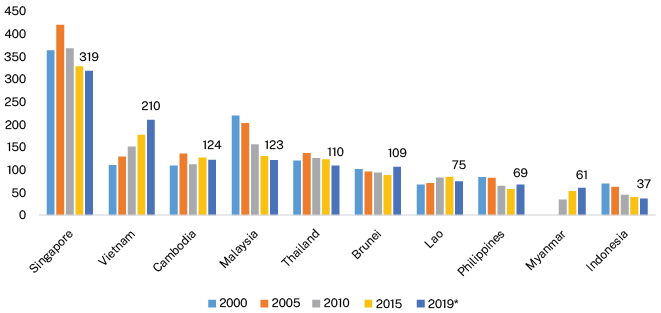
Source: World Development Indicators.
The first measure is trade openness—or the size of international trade compared to GDP. Figure 6.1 illustrates that Indonesia’s openness has been declining since the Asian financial crisis in 1997–98. In 2019, total trade as a percentage of GDP was 37 per cent, like in the early 1970s. A similar trend appears in most ASEAN countries. The only outlier is Vietnam, which successfully doubled its trade openness to 210 per cent over the last 20 years. Brunei, the Philippines and Myanmar have seen an improvement in recent years, although still less significant than that in Vietnam. Figure 6.1 also shows that Indonesia is the most closed country in the region in terms of trade openness; its economy has emerged to be more domestic-oriented over the last 20 years.
Another perspective can be derived from examining the foreign direct investment (FDI) inflow compared to the country’s GDP. This reflects the investment climate and opportunity in a country from the perspective of foreign investors. In Indonesia, FDI inflow has been relatively stagnant at 2 per cent for the last 10 years. There was a surge from 2000 to 2014 due to the commodity boom (especially palm oil and coal), but this was shortly followed by a decline. Most of Indonesia’s FDI gravitates towards natural resource-oriented sectors, while manufacturing sectors have been shrinking. There was a rise in FDI in the services sector, such as real estate and hotels, as well as in information and technology. But the country’s restrictive FDI regime still prevents the realisation of FDI’s full potential. Singapore is still the largest investor in Indonesia, while China has climbed into the top three in the last several years. Compared with other ASEAN countries, Indonesia’s FDI inflow is relatively moderate.
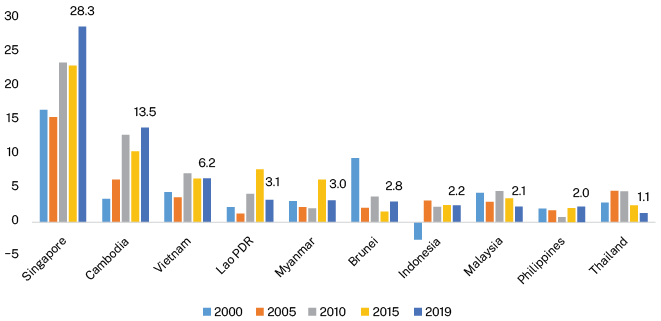
Figure 6.2: Foreign direct investment, net inflows (% of GDP)
Source: World Development Indicators.
Global value chain (GVC) participation is increasingly vital in explaining a country’s strategic position in the supply chain. Strong linkages are favourable for multinational firms to conduct business and long-term investment. These capture a country’s ability to promote international trade and maintain a hospitable investment climate. The two GVC indicators are backward and forward linkages, which show a country’s degree of participation.1 Among ASEAN countries, Indonesia’s forward linkage is quite high while its backward linkage is below average. This shows that Indonesia has limited participation in the GVC due to the low share of foreign value-added in its export products. One explanation is that Indonesia has high non-tariff measures (NTMs) and trade facilitation, especially for import products. From the GVC perspective, the Asian Development Bank (ADB 2019) explains that Indonesia’s production is more oriented towards the domestic market, using inputs obtained from the domestic economy and tending towards downstream production.
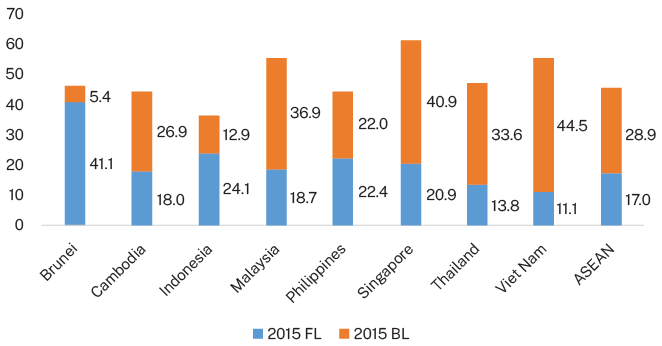
Figure 6.3: Forward and backward linkages in ASEAN countries
Source: OECD TiVA Database (2021).
It is clear that Indonesia has experienced a stagnation, if not a decline, in the measures of economic openness. Several ASEAN countries have performed better in the past 10 years or so. A strong commitment to economic openness is required to optimise the benefits of international trade, investment and the regional supply chain. However, Indonesia does not seem to be well positioned in the supply chain; instead, its economy has become more domestic-oriented in the last decade. The next section will discuss this issue from a foreign policy perspective.
An assessment of Indonesia’s foreign policy in trade and investment
One of the drivers of economic openness is unilateral trade and investment policy. Historically, Indonesia’s position towards open economic policy has swung like a pendulum. According to Pangestu, Rahardja and Ing (2015), there have been several distinct phases of Indonesia’s trade policy. The first major trade and investment policy was the introduction of the open door policy regarding foreign investment in the late 1960s to finance economic activities. The government began to liberate trade regulations quite rapidly, introducing a series of major reforms between 1966 and 1969, while introducing capital account liberalisation and unifying the exchange rate of the rupiah.
By the early 1970s, it became apparent that Indonesia preferred an import substitution policy and a more inward-looking development strategy, supported by the increase in international oil prices, which quadrupled in the mid-1970s. The oil boom that began in 1973 made the country rich enough to afford many government-led economic projects. After the fall of oil prices in the early 1980s, the government began a limited economic policy of deregulation along with tariff reductions and the removal of some non-tariff barriers (NTBs) in manufacturing sectors, especially in labour-intensive industries. By 1992, the average tariff had been reduced to 20 per cent from 26 per cent in 1986, while the incidence of NTBs fell to 5 per cent from 32 per cent. During this period, Indonesia experienced rapid growth, mostly from industrialisation. Foreign investment also surged as many economists referred to Indonesia as the next ‘Asian Tiger’.
During the Asian financial crisis in 1997–98, Indonesia pushed its reform agenda with the structural adjustment program attached to the International Monetary Fund’s lending package. The package included a gradual reduction of import tariffs, including those on sensitive products of heavy industries; the removal of NTBs and licensing for imports of many agricultural products; and liberalisation in the service sector. However, protectionist measures had returned by the early 2000s in the form of trade regulation and licensing requirements in several products such as textiles, steel, sugar and cloves. This was reflected in the increasing trend of NTMs as both nominal and effective rates increased between 1995 and 2008.
After the global financial crisis in 2007–08, the pendulum in Indonesia swung back towards inward-looking policy. Economic growth was resilient and stable due to the surge of commodity prices such as palm oil and coal. But good economic times had produced bad policies. The government enacted several laws on industry, trade and horticulture that imposed a more restrictive trade and investment regime (Patunru and Rahardja 2015). For example, Law 3/2014 on industry reflects the government’s focus on promoting industrial growth by regulation: it allowed the government to restrict the export of raw materials in order to promote domestic processing.
There has been no significant liberalising reform in Indonesia’s trade and investment policy in the past five years. Instead, populism and nationalism have been on the rise, not only in Indonesia but also around the world. Ambitions for swasembada, or self-sufficiency, translated into more protectionist and anti-import policies, especially in food products. Some examples include import licensing in the agriculture sector and local content requirements in the manufacturing sector. The restrictive investment regime also hampered service sector competitiveness. Recently, the government had a breakthrough in regulatory reform, passing the Omnibus Law, which aims to improve Indonesia’s investment climate and create more jobs.
Indonesia and economic integration initiatives
This section examines Indonesia’s commitments as a supporter of open regionalism, reflected by its participation in regional integration. Indonesia is active in pursuing economic integration agreements. However, barriers to trade and investment have not been significantly reduced, but rather transformed into burdensome regulatory constraints. This has resulted in the country becoming more inward-looking and having lower participation in the global economy.
In ASEAN, Indonesia’s involvement has contributed to economic integration among ASEAN countries. The ASEAN Economic Community (AEC) was established in 2016 as a continuation of the ASEAN Free Trade Area. The AEC reduced most barriers to trade in goods and services as well as investment. Some of the significant milestones achieved by the AEC include the ASEAN Trade in Goods Agreement, the ASEAN Multilateral Agreement on the Full Liberalisation of Air Freight Services, the ASEAN Comprehensive Investment Agreement, the ASEAN Agreement on the Movement of Natural Persons and the ASEAN Framework Agreement on Services, although the level of implementation of each agreement varies. ASEAN also actively engaged with its partners to form ASEAN+1 FTAs. Indonesia also played a pivotal role in formulating the ASEAN Outlook on the Asia-Pacific in response to former president Trump’s Free and Open Indo-Pacific Initiative. The former effectively blunted the sharp geopolitical edges on the latter, concentrating instead on economic cooperation rather than strategic competition.
Figure 6.4 shows the development of free trade agreements (FTAs) in effect in East Asia over the last 10 years. Other than a few ASEAN+1 FTAs (and AANZFTA, which includes both Australia and New Zealand), Indonesia is quite passive. Indonesia only has bilateral trade agreements with four countries: Japan, Pakistan, Chile and Australia. The most recent agreement, the Indonesia–Australia Comprehensive Economic Partnership Agreement (IA–CEPA) entered into force in July 2020. Indonesia has pursued few FTAs compared with Vietnam, who has signed FTAs with Japan, South Korea, the European Union, Chile and the Eurasian Economic Union, as well as the Comprehensive and Progressive Agreement for Trans-Pacific Partnership (CPTPP). However, Indonesia aims to conclude more agreements in 2021, for instance, with the European Union, South Korea and Turkey.
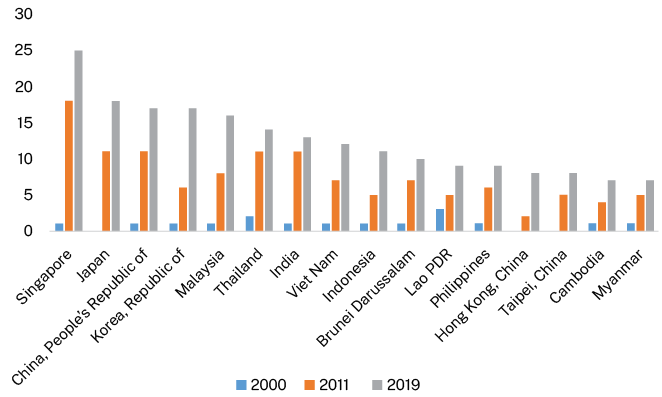
Figure 6.4: Number of FTAs in force
Source: Asia Regional Integration Center (2021).
In recent years, there has been an increasing trend towards deep trade agreements, which refers to a more comprehensive agreement regarding quality and quantity, covering not only trade but also additional policy areas such as investment, labour and environmental protection. This is because some tariffs and other trade barriers were already low. The IA–CEPA, CPTPP and RCEP are a few examples. These agreements include some traditional coverage in goods, services and investment, as well as going beyond WTO commitments in areas such as competition policy, state-owned enterprises (SOEs) and intellectual property rights. The implementation of these agreements requires commitment to further economic reform. The political cost of Indonesia’s economy is increasingly high, since all trade agreements require approval based on the Trade Law from the House of Representatives. Negotiating a trade agreement is a lengthy process and requires strong political support and strong coordination among government institutions and other stakeholders.
Security and political interests of economic policy
Conceptual framework
It may be an exaggeration to regard the division between the study of national security and economics as artificial. But it surely has never been as clear-cut as conventional wisdom suggests. Both aspects influence one another in a continuous feedback loop with various paradigms offering different lenses. This section attempts to provide a conceptual framework on how national security considerations influence economic policy, before delving into the case of Indonesia.
Various paradigms within the discipline of international relations offer diverse definitions, classifications and perspectives on national security. Realism stresses that the ultimate purpose of national security is self-preservation and emphasises the role of the nation-state and the threat of aggression from others due to existing in an anarchic international system (Walt 2010). Liberalism highlights the benefits of international cooperation through participation in international organisations, especially on economic cooperation. Constructivism asserts that national security interests are social constructs, emphasising the role of domestic identity, norms and culture in such construction (de Buck and Hosli 2020).
The interplay between the economy and national security is multifaceted and bidirectional. This is especially the case with the link between economic integration and security relationships. In one direction, a closer security relationship can lead to a closer economic relationship between states. Trade improves economic efficiency and allows resources to be utilised for national security purposes, and states are more inclined to trade with states with aligned security interests in order to prevent contributing to the military power of potential adversaries (Gowa and Mansfield 2004). In the other direction, scholars have noted that increased economic integration can lead to closer security relationships. A security alliance commitment can uphold the economic gains from increased trade and safeguard states against internal threats to the trading relationship (Fordham 2010). China’s BRI could be understood in this way. It is unlikely that it was economic concerns alone in relieving domestic overcapacity for Beijing that pushed its infrastructure companies to venture abroad.
Another way to think of how national security considerations can work their way into influencing economic policy is through the risk vector model (Retter et al. 2020). Within the paradigm-agnostic model, risk vectors are defined as ‘avenues through which national security risks in relation to crucial infrastructure, sectors and processes’ can manifest. Examples include ownership, espionage and access to sensitive information, natural resource dependence, supplier dependence, government intervention, corruption and fraud among others. These vectors stem from macroeconomic variables and socioeconomic trends that can be domestic, regional or global in scope. Examples of such variables include domestic investment and consumption, employment and FDI, with trends such as digital transformation, disinformation and political and economic paradigms of foreign states. Due to these variables and trends, and through the risk vectors, a malevolent actor can inflict harm to achieve its objectives. The existence and actions of malevolent actors transform a risk into a threat to national security. A prime example is the China–Australia trade dispute, in which Beijing allegedly banned imports of Australian barley, beef and coal after Canberra called for an international, independent inquiry into the origins of the coronavirus outbreak in Wuhan. This is a clear case of China weaponising its market access through the vector of Australian commodity exports (Laurenceson and Zhou 2022).
Dynamics of Indonesia’s interests
This section will attempt to highlight two of Indonesia’s national security interests that often influence its economic policy.
Independence and sovereignty
Sovereignty is a core concept that preconditions national security. Without an authority—usually organised as a nation-state—in a given area, considerations of the security of such an area will be rendered moot. There exist diverse historical and legal manifestations of sovereignty, but four key elements must be present: the will and capacity to exercise authority, domestic and international recognition that morphs into legitimacy, a given territory and citizens populating said territory (Biersteker and Weber 1996). Sovereignty can essentially be defined as recognised state authority over a given territory and population.
For Indonesia, there are two dimensions of sovereignty that deserve elaboration. The first is autonomy. To better understand this, it is helpful to review the foundational principles of Indonesia’s foreign policy—that is, to be free and active. Born amid the Cold War, popular wisdom dictates that ‘free’ means constant non-alignment towards any power bloc—that is, eternal neutrality. Yet, Article 3 of Law 37/100 explains that the principle refers to the ‘freedom of deciding policy on international issues and no binding itself a priori into any bloc’. This is the essence of autonomy in Indonesia’s sovereignty.
The second dimension is territorial integrity. Sovereignty entails the ability to keep the territory under a state’s control whole and intact. This was codified into Indonesian law with a clause stating that: ‘State defence is organised to defend state sovereignty, the territorial integrity of the Republic of Indonesia, and the safety of citizens from threats towards the unity of nation and state’. This is especially relevant when one considers Jakarta’s historical and ongoing challenges with separatism, for instance, with East Timor, Aceh and, presently, West Papua.
While the concept of sovereignty focuses on those two dimensions, it has evolved into various other forms. The notion of sovereignty can be found in various economic-related policies and translated into economic nationalism, economic independence and self-reliance. This preoccupation with sovereignty, especially regarding its economic aspects, can be traced back to the colonial period and the post-independence era.2 Even after four years of fighting the War of Independence, Indonesian leaders found that they had only achieved political independence, and not economic independence: most production facilities, the banking sector, trade and industry were under the control of Dutch companies (Thee 2011). This gave rise to economic nationalism in the form of acquisitions of many Dutch and foreign enterprises in the 1950s, as well as policies that favoured economic independence and self-reliance. Although the Indonesian economy later became more open, economic nationalism and independence remain key influences on economic policymaking in the country.
Regional stability
Regional stability can be understood as the external dimension of Indonesia’s national security interests. The concept can be broadly defined as the lack of conflict among states in Southeast Asia. Dewi Fortuna Anwar (2003) tabulated Indonesia’s security concerns and foreign policy outlook in a framework known as the concentric circles formula. The formula first and foremost rates the importance of countries within Indonesia’s foreign policy based on their geographical proximity. Each concentric circle represents importance in hierarchy. The first concentric circle is Southeast Asia. As the premier multilateral grouping in the region, ASEAN is consequently seen as Indonesia’s most important foreign policy relationship—or, to use Anwar’s term, ‘the cornerstone of Indonesia’s foreign policy’.
The main component of the definition of regional stability requires the absence of armed, interstate conflict and the management of great power relations in the region. In practice, this means lowering tensions between countries, not necessarily eliminating conflicts of interest, and providing a platform for great powers to remain competitively engaged for them to balance one another’s influence. Enmeshing great powers in the regional architecture centred upon ASEAN ensures that they balance one another and also allows ASEAN to preserve its autonomy (Goh 2008). The idea is for ASEAN to engage great powers in economic and defence cooperation while at the same time preserving its own strategic autonomy. Regional mechanisms and initiatives centred around ASEAN—both strategic (the East Asia Summit, the ASEAN Defence Ministers Meeting-Plus and the ASEAN Regional Forum) and economic (the ASEAN Free Trade Area, the ASEAN Plus Agreements and the RCEP)—should be understood through this lens.
Indonesia’s strong interest in maintaining regional stability comes from the realisation that the country’s economic development depends on its positive relationships with other countries in the region. While it seems quite obvious, the situation was not always like that. From the late 1950s to the mid-1960s, Indonesia’s foreign policy had two focuses: its closeness to the Soviet Union and China, and its confrontation with the Federation of Malaya. These policy stances were closely related to the anti-colonialist and independence narratives that the first president of Indonesia, Sukarno, tried to instil in his domestic constituent. However, when Suharto took over as president in 1966, Indonesian foreign policy underwent significant changes. Instead of maintaining a confrontational stance, Suharto’s New Order Regime pursued regional stability and cooperation, which were deemed necessary to support economic development. The founding of ASEAN itself in 1967 indicates the country’s eagerness for achieving regional stability. Foreign Minister Adam Malik referred to ASEAN as the ‘cornerstone’ of Indonesian foreign policy.
The underlying factors
With this conceptual framework in mind, it is useful to briefly describe the underlying external and domestic factors that weigh over Indonesian policymaking. There are two chief external factors of note. The first is the rise of China, a monumental phenomenon that has become the backdrop for many new global developments. Deng Xiaoping’s reforms in the 1980s laid the groundwork for China’s economic rise. The country’s growth and development further accelerated with China’s integration into global trade networks, starting with its accession to the World Trade Organization in 2001. China is now forecasted to overtake the US as the largest national economy in nominal GDP terms within the next few decades. In terms of Indonesia’s economic and security considerations, this presents a complication. China’s economic rise has major implications for Indonesia’s own geopolitical rise and ambitions, most notably for Jakarta in its assertiveness in the South China Sea. China has become an important trade and investment partner for Indonesia, especially in commodity exports. As the China–Australia trade dispute demonstrates, differing geopolitical interests between states with deeply interconnected economies presents an opportunity for such states to wield economic policy as an instrument of defending national security.
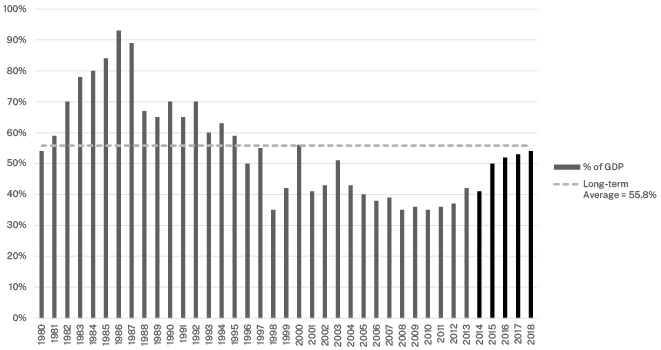
Figure 6.5: Assets of Indonesian SOEs, 1980–2018
Source: Kim (2019).
The second significant external factor is the onset of the coronavirus pandemic. Today’s global trade system relies on seamless cross-border flows of raw materials, intermediate goods and finished goods. The COVID-19 outbreak led to the implementation of quarantine measures and border closures to control its spread. This exogenous shock severely disrupted global value chains, particularly during the early stages of the pandemic (Seric et al. 2020). As countries started to feel the impact of supply disruptions due to border closures, national governments resorted to enacting protectionist measures. Calls to rethink the international outsourcing of critical goods and plans to restore production gained momentum. Such ideas would surely be welcome in Indonesia—a country with a history of justifying agricultural import bans by conflating food security with food self-sufficiency.
One notable domestic factor is the return of the prominence of SOEs in Indonesia’s economy. Indonesia’s dirigiste impulse has always been strong, especially in the early 1980s, which was a high point for the role of SOEs. Prior to the Jokowi era, the average cumulative assets of SOEs in Indonesia as a percentage of the country’s GDP was well below the historical average, and the Jokowi era can be seen as the return to the norm. The infrastructure push by President Jokowi has been mostly in the form of capital injections to state infrastructure companies, and it will likely continue to be this way. In addition to its emphasis on deregulation, other scholars have underlined the nationalist features of this trend, which Eve Warburton (2017) coined as ‘new developmentalism’. We can expect that ‘sovereignty’ and ‘independence’ will be used to justify further protectionist policies advocated by SOEs to insulate themselves from competition and to push for local champions.
How geopolitical and security interests affect foreign economic policy: Cases and analysis
Case 1: Indonesia, ASEAN and regional integration
The interplay of economics and geopolitics has emerged as one of the top risks in recent years. Trade tensions, Brexit, technology rivalry and the WTO deadlock are some examples. Most importantly, the US–China relationship has turned Asia into a battleground for competing influence. When elephants fight, it is the grass that suffers.
Indonesia and other ASEAN countries are affected by this turmoil and have raised this concern as a regional security issue. This is one of the reasons why ASEAN needs more mechanisms to keep great powers in check. Indonesia’s foreign policy has evolved to respond to the world’s new security circumstances. After becoming a democracy in 1998, Indonesia focused on pursuing a free and active foreign policy and pushing for ASEAN centrality by trying to establish an inclusive regional architecture centred on ASEAN. During Susilo Bambang Yudhoyono’s administration (2004–14), Indonesia actively used economic diplomacy and foreign economic policy to convey this message. Although it is less aggressive under President Jokowi, the use of economic initiatives to maintain Indonesia’s geopolitical interests—sovereignty and regional stability—remains in place.
The negotiation of RCEP demonstrates Indonesia’s role in, and intention to shape, regional integration in East Asia. A region-wide arrangement was in line with the economic and political interests of countries in East Asia in the late 2000s. The existing arrangement of trade in the region—the abundance of bilateral and plurilateral deals, or the ‘noodle bowl’ effect—posed challenges to the coherence of global trade agreements. There was an increasing need for deeper integration among economies in the region. Politically, deeper and wider regional cooperation is also expected to ease political tension among countries in the region and, in particular, reconcile past differences among the Northeast Asian nations (China, Japan and South Korea). Countries in the region—especially large ones like China and Japan—view FTAs as important instruments of commercial diplomacy to realise their vision of the geopolitical landscape and global strategy (Damuri 2016).
There were two regional proposals under serious discussion in the mid-2000s: the China-promoted East Asia Free Trade Area, which included ASEAN+3 (ASEAN plus China, Japan and South Korea), and the Japan-initiated Comprehensive Economic Partnership of East Asia, which included three other ASEAN partners. Competition ensued between China and Japan for taking the lead in establishing a region-wide agreement, while other countries in the region were divided between the two proposals. The rivalry continued and delayed the process of integration until 2011, when Indonesia—as the chair of ASEAN—proposed a new initiative for regional cooperation as a middle path. ASEAN and its partners adopted the proposal, known as RCEP, during the twenty-first ASEAN Summit on 20 November 2012.
By proposing RCEP, Indonesia wanted to maintain ASEAN’s centrality as a primary driving force for a regional integration process in the Asia-Pacific. It became more important in the wake of another integration process in the region: the Trans-Pacific Partnership (TPP), which began with the P4 agreement but expanded and eventually centred on US participation. Four ASEAN countries had participated in TPP negotiations and had the power to divide ASEAN’s attention in the economic integration process.
Amid the uncertainty during a global pandemic, ASEAN countries successfully concluded RCEP negotiations, but without India. The agreement is not only economically significant, but also strategic in shaping ASEAN’s approach to the new multipolar global order and leveraging the region’s dynamism. Asia has been a major beneficiary of the global trade system in the past several decades, and RCEP signals to the world that Asian countries are still open for business.
Using economic integration to support regional stability is not new to Indonesia. After the Cold War era ended in early 1990, Indonesia was worried about the relevance of ASEAN as it was primarily founded as a response to the conflicts and tensions among Southeast Asian countries in the 1960s. ASEAN needed to renew its sense of purpose and find new motives to maintain stability in the region. After the introduction of some unilateral economic liberalisation policies in the late 1980s, along with the possible deadlock of multilateral efforts, Indonesia supported Thailand and Singapore’s suggestion to form a free trade agreement among ASEAN member countries (Stubbs 2000).
The use of ASEAN as a platform for economic integration to pursue Indonesia’s vision of regional stability continued after the Asian financial crisis. Troubled by its incapacity to deal with the crisis, ASEAN decided to deepen integration processes and institutions. Launched during Indonesia’s chairmanship in 2011, ASEAN envisioned an ASEAN Community to be formed in 2020, later brought forward to 2015. One of the pillars was the AEC, which was better prepared and more extensive than the political security and sociocultural pillars. Indonesia’s then foreign minister, Hassan Wirajuda (2001–2009), affirmed that Indonesia had always provided intellectual leadership for ASEAN’s institutional evolution to better cope with extra- and intra-regional challenges (Weatherbee 2013).
One important feature of Indonesia’s initiative of regional economic integration is inclusiveness and open regionalism. The ‘Guiding Principles and Objectives for Negotiating’ the RCEP, for instance, reflects this position strongly, as has been upheld in many other economic integration agendas that Indonesia supports, such as Asia-Pacific Economic Cooperation.
Case 2: Sovereignty in Indonesia’s trade and investment policy
Although Indonesia is very active in pursuing economic diplomacy and promoting regional integration, its trade and investment policy tends to diverge from its foreign policy. As discussed in the previous section, Indonesia’s trade and investment policy tends to be more inward-looking and protectionist. While tariff rates continue to decline, other barriers to trade are still increasing. Marks (2017) shows that the nominal rate of protection and effective rate of protection increased between 2008 and 2015, notably for food and agriculture products. In 2018, 48.3 per cent of 10,826 tariff lines were subject to import restrictions and prohibitions (Ministry of Finance of Republic of Indonesia 2018). Since then, the government has tried to reduce the number of restrictions by shifting around half of them to undergo post-border inspection measures.
One explanation is that trade policy is the result of interest group actions to maximise rent-seeking opportunities from trade regulations. Through a complex bargaining process, small but concentrated and organised groups are able to lobby for greater protection for their sectors that often generate excessive profits. As mentioned by Soesastro and Basri (2005), there is evidence that the major beneficiaries of Indonesia’s protectionist measures are the capital-intensive and highly concentrated sectors. These sectors are more likely to mobilise resources to lobby for higher protection.
But this overlooks the increasing influence of democratic processes in Indonesia’s policymaking, especially in trade and investment. Trade policy instruments are the easiest and most visible action to meet the perceived needs of constituents. Damuri and Pangestu (2018) conducted a survey examining public perception on international economic policy in Indonesia and found that more restrictive and inward-looking policy may be in line with the general public’s interests. Politicians and policymakers would gain additional political support by listening to general public opinion on trade and investment policy.
The concern of maintaining sovereignty is an important factor that gives rise to inward-looking sentiment among the general public. Sovereignty is always the top security consideration, either in a narrow sense of territorial sovereignty or in a broader sense of political sovereignty. It is also reflected in international economic policy. As Reid (2018) explains, concerns over sovereignty and nationalism have deep roots in Indonesia’s history, especially during the first few years of its independence. Fear over foreign intervention and neo-colonialism remains prevalent among Indonesians, and has been used by politicians to justify further protectionist measures.
This fear is reinforced by the setbacks in Indonesia’s production sector and its inability to compete with imported products after the Asian financial crisis. The manufacturing sector grew slower than GDP and lost its competitiveness and global market share, and it was also unable to participate in the global value chains (Aswicahyono, Narjoko and Hill 2008). The agriculture sector could not produce enough to satisfy domestic demand. This, along with an import ban, resulted in increasing prices. While the problems can be traced back to the failure of economic and industrial policies, it still fuels the narrative of sovereignty and economic nationalism. Some territorial disputes with neighbouring countries lend further credence to this narrative, holding back economic relations with some partners. This can be observed in the Indonesia–China economic relationship.
Case 3: Indonesia–China economic relations and the Belt and Road Initiative
Indonesia and China resumed diplomatic ties in 1990 after suspending their diplomatic relationship for more than 23 years. The restoration improved economic relations not only between Indonesia and China but also between ASEAN and China. After the resumption of diplomatic relations, trade between Indonesia and China, which was previously virtually non-existent, grew gradually. The pace picked up after 2000 due to two major developments: the emergence of China as a manufacturing power and its accession to the WTO; and, more importantly, the establishment of the ASEAN–China Free Trade Agreement.
But many Indonesians perceive this trade agreement to be a bad deal since Indonesia has suffered increasing trade deficits. China’s exports to Indonesia have been dominated by manufactured mechanical products, such as electrical machinery, other machinery and mechanical appliances, and vehicles and parts, while Indonesia’s exports comprise mostly minerals and commodities, giving the impression that China is only interested in securing a supply of raw materials from Indonesia. Negative perceptions of China only grew stronger as Chinese FDI started arriving in Indonesia. Chinese investors are perceived as bringing low-quality investments with dirty technology and environmentally damaging operations. Along with the capital investments came foreign workers from China, generating negative sentiment and increasing social tension in regions where the investments were concentrated.
These negative sentiments have held Indonesia back from formally participating in China’s BRI. From an Indonesian perspective, the BRI arrived at a critical juncture to boost its badly needed infrastructure development. In 2018, Indonesia formally signed a memorandum of understanding on promoting cooperation on the development of Regional Comprehensive Economic Corridors. The Indonesian Government proposed 30 other projects with a total value of US$91 billion. These other projects only take part in four designated provinces. Most of them are related to the development of industrial and tourism facilities, with only a few related to connectivity infrastructure.
In addition to negative domestic sentiments about China, Indonesia is also concerned with some unresolved issues in the region that may generate direct and indirect negative impacts on regional stability and potentially also on the implementation of the BRI. One of these issues is the polemic against China’s behaviour in the South China Sea. Increasing tensions between the US and China have also contributed to Indonesia’s lack of enthusiasm in commencing its formal agreement under the BRI.
Conclusion
Indonesia’s strategic diplomacy mantra of bebas aktif can be clearly observed in its policy on economic integration. Indonesia is an active participant in, and even initiator of, regional economic integration. Indonesia started several regional integration initiatives, in particular using ASEAN as the vehicle of change, such as the AEC and the RCEP. This behaviour is rooted in the country’s strategic interest in pursuing regional stability. Economic integration has been used to pursue that strategic objective with some success. Indonesia’s proposals on strengthening strategic cooperation in the region often include an economic agenda. For instance, the ASEAN Outlook on the Indo-Pacific, which was initiated and promoted by Indonesia, emphasises stronger economic cooperation to support the maintenance of peace and security in the region.
Indonesia’s interest in regional stability cannot be separated from its other priority of maintaining independence and sovereignty. Until 1967, upholding sovereignty was done through enacting anti-colonialist narratives that often led to conflict with Western countries and neighbouring countries in the region. The rise of the New Order regime in 1966 under President Suharto placed economic development as the top priority. This required Indonesia to revive its relations with Western powers and cooperate with neighbouring countries. It shifted the attention to reginal stability to support the country’s sovereignty and independence, which led to the formation of ASEAN in 1967 and subsequent activities to facilitate stronger regional integration.
While foreign economic policy and diplomacy have been used successfully to achieve these two strategic interests, sovereignty and regional stability sometimes lead to conflicting economic policy. Indonesia is active in conducting trade agreements with various countries, including those under ASEAN initiatives, but the country’s trade and investment policy remains relatively restrictive. Various NTMs, which are not normally discussed in FTAs, are being implemented to control exports and imports, and also protect domestic industries. This inward-looking attitude often delays Indonesia’s involvement in some major economic cooperation initiatives, such as CPTPP or BRI, or the implementation of trade agreements already in force.
Indonesia should find a balance between these two strategic interests in order to effectively implement international economic policy for both foreign diplomacy and domestic economic development. This can be achieved if Indonesian policymakers and the general public can change their perceptions and interpretations of sovereignty and independence, particularly relating to economic issues. The narrative of economic independence and self-reliance is not compatible with the interdependent nature of the global economy. Further perpetuating this narrative would significantly hinder Indonesia’s economic performance and compromise its strategic position in the region.
References
ADB (Asian Development Bank). 2019. Policies to Support the Development of Indonesia’s Manufacturing Sector during 2020–2024: A Joint ADB–BAPPENAS Report. Manila: Asian Development Bank.
Anwar, D. F. 2003. ‘Megawati’s Search for an Effective Foreign Policy’. In Governance in Indonesia, Challenges Facing the Megawati Presidency, edited by Hadi Soesastro, Anthony L. Smith and Mui Ling Han, 70–90. Singapore: Institute of Southeast Asian Studies.
Anwar, D. F. 2018. ‘Indonesia’s Vision of Regional Order in East Asia amid US–China Rivalry: Continuity and Change.’ Asia Policy 13 (2): 57–63.
Asia Regional Integration Center. 2021. ‘Free Trade Agreements Database’. aric.adb.org/database/fta.
Aswicahyono, H., D. Narjoko and H. Hill. 2008. ‘Industrialization after a Deep Economic Crisis: Indonesia’. Working Papers in Trade and Development, The Australian National University. econpapers.repec.org/repec:pas:papers:2008-18.
Biersteker, T. J. and C. Weber, eds. 1996. State Sovereignty as Social Construct. Cambridge: Cambridge University Press. doi.org/10.1017/CBO9780511598685.
Damuri, Y. R. 2016. ‘RCEP Prospect and Challenges: Political Economy of East Asian Integration’. In Trade Regionalism in the Asia‐Pacific, edited by B. Sanchita and M. Kawai, 105–21. Singapore: ISEAS–Yusof Ishak Institute. doi.org/10.1355/9789814695459-010.
Damuri, Y. R. and M. Pangestu. 2018. ‘Who Is Afraid of Economic Openness? People’s Perception of Globalization in Indonesia’. In Indonesia in the New World: Globalization, Nationalism and Sovereignty, edited by A. A. Patunru, M. Pangestu and M. C. Basri, 109–25. Singapore: Institute of Southeast Asian Studies.
Damuri, Y. R., V. Perkasa, R. Atje and F. Hirawan. 2019. ‘Perceptions and Readiness of Indonesia towards the Belt and Road Initiative’. CSIS Report, Jakarta: Centre for Strategic and International Studies.
de Buck, D. and M. O. Hosli. 2020. ‘Traditional Theories of International Relations’. In The Changing Global Order, edited by Madeleine O. Hosli and Joren Selleslaghs, 3–21. Cham: Springer. doi.org/10.1007/978-3-030-21603-0_1.
Fordham, B. O. 2010. ‘Trade and Asymmetric Alliances’. Journal of Peace Research 47 (6): 685–96. doi.org/10.1177/0022343310381689.
Gindarsah, I. 2016. ‘Strategic Hedging in Indonesia’s Defense Diplomacy’. Defense & Security Analysis 32 (4): 336–53. doi.org/10.1080/14751798.2016.1233695.
Goh, E. 2008. ‘Great Powers and Hierarchical Order in Southeast Asia: Analyzing Regional Security Strategies’. International Security 32 (3): 113–57. doi.org/10.1162/isec.2008.32.3.113.
Gowa, J. and E. Mansfield. 2004. ‘Alliances, Imperfect Markets, and Major-Power Trade’. International Organization 58 (4): 775–805. doi.org/10.1017/S002081830404024X.
Kim, K. 2019. ‘Indonesia’s Restrained State Capitalism: Development and Policy Challenges’. Journal of Contemporary Asia 51 (3): 419–46. doi.org/10.1080/00472336.2019.1675084.
Laurenceson, J. and Weihuan Z. 2022. ‘Demystifying Australia–China Trade Tensions’. Journal of World Trade 56 (1): 51–86. doi.org/10.54648/TRAD2022003.
Marks, S. V. 2017. ‘Non-Tariff Trade Regulations in Indonesia: Nominal and Effective Rates of Protection’. Bulletin of Indonesian Economic Studies 53 (3): 333–57. doi.org/10.1080/00074918.2017.1298721.
Pangestu, M., S. Rahardja and L. Y. Ing. 2015. ‘Fifty Years of Trade Policy in Indonesia: New World Trade, Old Treatments’. Bulletin of Indonesian Economic Studies 51 (2): 239–61. doi.org/10.1080/00074918.2015.1061915.
Patunru, A. A. and S. Rahardja. 2015. Trade Protectionism in Indonesia: Bad Times and Bad Policy. Sydney, NSW: Lowy Institute for International Policy.
Reid. A. 2018. ‘Challenging Geography: Asserting Economic Sovereignty in a Porous Archipelago’. In Indonesia in the New World: Globalization, Nationalism and Sovereignty, edited by A. A. Patunru, M. Pangestu and M. C. Basri, 17–34. Singapore: Institute of Southeast Asian Studies. doi.org/10.1355/9789814818230-007.
Retter, L., E. J. Frinking, S. Hoorens, A. Lynch, F. Nederveen and W. D. Phillips. 2020. Relationships between the Economy and National Security: Analysis and Considerations for Economic Security Policy in the Netherlands. Santa Monica: RAND Corporation. www.rand.org/pubs/research_reports/RR4287.html. doi.org/10.7249/RR4287.
Seric, A., H. Gorg, S. Mosle and M. Windisch. 2020. ‘How the Pandemic Disrupts Global Value Chains’. Industrial Analytics Platform, UNIDO. iap.unido.org/articles/how-pandemic-disrupts-global-value-chains.
Soesastro, H. and M. C. Basri. 2005. ‘The Political Economy of Trade Policy in Indonesia’. ASEAN Economic Bulletin 22 (1): 3–18.
Stubbs, R. 2000. ‘Signing on to Liberalization: AFTA and the Politics of Regional Economic Cooperation’. Pacific Review 13 (2): 297–318. doi.org/10.1080/095127400363604.
Thee K. W. 2011. The Introduction, Evolution, and End of Colonial Extractive Institutions in the Netherlands Indies and Its Long-Term Consequences in Independent Indonesia, 1830–2000. www.yumpu.com/en/document/view/28274655/ch2thee-kian-wieintroduction-indonesiapdf.
Walt, S. 2010. ‘Realism and Security’. Oxford Research Encyclopedia of International Studies. Wiley-Blackwell.
Warburton, E. 2017. ‘Jokowi and the New Developmentalism’. Bulletin of Indonesian Economic Studies 52 (3): 297–320. doi.org/10.1080/00074918.2016.1249262.
Weatherbee, D. E. 2013. Indonesia in ASEAN: Vision and Reality. Singapore: Institute of Southeast Asian Studies. doi.org/10.1355/9789814519236.
1 Backward linkage refers to the extent of foreign value-added in production and exports, while forward linkage refers to the portion of the country’s value-added in other countries’ exports.
2 Indonesia was governed by the Dutch until 1942, when Japan came and took over the area until 1945. Indonesia declared its independence on 17 August 1945, but was subsequently involved in a war of independence with the Netherlands until 1949.
Previous