


 menu
Australian Journal of Biography and History: No. 11, 2026
Examining the life of Olive Pink through her clothing
Kristyn Harman, Paige Gleeson and Freya Harrington
Introduction
In the early decades of the twentieth century, some extraordinary encounters took place at Ooldea on the eastern edge of Australia’s Nullarbor Plain. Amateur anthropologist Daisy Bates took up residence there to work with Anangu people, among whom she became known as Kabbarli or ‘grandmother’. Bates, born in Ireland during the Victorian era, spent 40 years living among Aboriginal people in Australia’s deserts, including 16 years at Ooldea.1 In 1926, Tasmanian-born Olive Pink alighted from the Trans-Australian Express at Ooldea to take up an invitation extended 12 years earlier to stay with the enigmatic Bates, a woman with whom she had corresponded since they met at an Australian and New Zealand Association for the Advancement of Science conference.2 The older of the two women, Bates has been credited with inspiring Pink’s subsequent engagement in anthropology and activism in relation to Aboriginal people.
To draw the elusive Bates into sharper focus, Philip Jones usefully engaged with key aspects of her life using her clothing as a lens. He evocatively described Bates as a ‘frontier Mary Poppins’ who ‘materialised among “her natives” in her Victorian garb, arriving with her parasol and carpet-bag full of manuscripts and admonitions’.3 Bates would never emerge from her tent in the desert until she had adhered to what she termed the ‘simple but exact dictates of fashion’, reflecting what was current at the time she had departed Ireland—‘a neat white blouse, stiff collar and ribbon tie, a dark skirt and coat, stout and serviceable, trim shoes and neat black stockings, a sailor hat and a fly-veil’, with the addition of a dust coat and sunshade.4 Exploring the contrast between Bates’s ‘magic garb’ (as evidenced through photographs and the few surviving remnants of her wardrobe) and the people and environment within which she lived and worked at Ooldea enabled Jones to provide rich insights into the lengthy and complex association between the newcomer and the custodians of Country.
Inspired by Jones’s work, we embarked on a study of Olive Pink’s life as revealed by her surviving clothing, an undertaking motivated by the presence, at the University of Tasmania (UTAS) Library, of clothing once owned by Pink, including a lace over-dress, beaded waistcoat, short-sleeved blouse, shawl, satin sash and cravat.5 In this article, we focus on the lace over-dress. Many have supposed it was originally intended as Pink’s wedding dress for her marriage to a young man killed in World War I, and we wanted to test this theory.
We begin by briefly recapping what is known about Pink’s life. An overview of scholarly approaches to understanding Australian history and biography through clothing, textiles and material culture follows. As no textiles from Pink’s childhood wardrobe are known to have survived into the present, we draw on a rare photograph of her as a girl to gain insight into both the occasion for which she was dressed (presumably by her mother) and the socio-economic circumstances of her childhood more generally. Turning our attention to the lace over-dress, we assess and rebuff the myth concerning its supposed purpose as her wedding dress, before concluding by comparing Bates’s and Pink’s clothing to evaluate whether and to what extent the two women exhibited sartorial similarities.
The purpose of this article is to show that clothing has the capacity to provide insights into a life that may not otherwise be available to historians and biographers. We hope that our reading of elements of Pink’s life through a sartorial lens is a methodological approach that may be usefully applied to other biographical subjects, just as we have utilised and extended the approach adopted by Jones in relation to Bates.
Olive Pink: A synopsis of her life
Olive Muriel Pink was born into a comfortable, middle-class family in Hobart, Tasmania, on 17 March 1884. She is remembered as an activist, native gardener, artist and anthropologist, and, as her biographer Julie Marcus has explained, ‘for her Edwardian form of dress [and] her biting tongue’. Her lifelong interest in humanitarian activism was probably sparked by her early Quaker education and family connections in Hobart. Pink remained in Tasmania until she was 27, at which point she and her mother relocated to Perth, Western Australia. By the following decade, the 1920s, Pink was living in Sydney, where she initially taught at a private school for girls before utilising her drafting skills at the Department of Public Works. Being in Sydney provided her with unparalleled opportunities. After suffering the misfortune of being retrenched from her public service role during the Depression, Pink studied art at the University of Sydney, then anthropology under Professor A. P. Elkin. From the mid-1930s until her death at Alice Springs Hospital on 6 July 1975, Pink lived in the Northern Territory, working among Warlpiri people and establishing Australia’s first native botanical garden at Alice Springs.6
Pink rose to some prominence as a strong critic of government and mission handling of Aboriginal welfare. She also developed her own distinctive vision of how Aboriginal ‘protection’ should operate in the Northern Territory, propounding the establishment of wholly secular and segregated sanctuaries. In addition to arguing that missions had failed to ‘protect’—and had, in fact, contributed to the exploitation of Aboriginal people since European settlement—she also argued against the assimilatory impulses of Christian missionisation, which she identified as a shared aim of missions and government native affairs departments.7
Scholarship on the history of white women’s involvement in Aboriginal activism and welfare demonstrates that Pink was not alone in these views.8 Indeed, she was one of a number of white women who engaged in Aboriginal humanitarian activism and anthropological fieldwork during the interwar period in Australia. Her criticisms of government and mission native affairs policies were shared by many others who had likewise trained under Elkin. Because of such views, previous scholars have positioned Pink, anachronistically, as a progressive human rights activist.9 However, portraits of Pink as progressive and ahead of her time fail to account for her rigid and essentialised views on race, which included negative attitudes towards people of mixed Aboriginal and European heritage. Her socio-political views were complex, but were very much influenced by the era in which she lived.10
Despite spending much of her adult life living on the Australian mainland, Pink continued to identify as a Tasmanian. She thought of the island state as home. Following her death on 6 July 1975 in Alice Springs, she was interred in the Alice Springs cemetery after a ceremony that accorded with Quaker traditions.11
Examining the life of Olive Pink
The most extensive and influential account of Pink’s life is a 2002 biography by anthropologist Julie Marcus. Marcus had researched and published about Pink’s life in a number of other publications in the preceding decade, including a much briefer biography in 1991, drawing on Pink’s extensive, but dispersed written archive.12 More recently, in 2018, Gillian Ward published Olive Pink: Artist, Activist & Gardener: A Life in Flowers, an account of Pink’s life told through the lens of her botanical illustrations and paintings.
Pink’s papers, which include incoming and outgoing correspondence, drafts for newspaper articles and lectures, and drawings, are held at the Australian Institute of Aboriginal and Torres Strait Islander Affairs and the National Archive of Australia in Canberra; the University of Sydney; UTAS Library Special and Rare Collections and the Tasmanian Museum and Art Gallery in Hobart; and in the private collections of her associates. In addition, the UTAS Library Special and Rare Collections and the National Museum of Australia, Canberra, hold material collections of objects collected by or formerly belonging to Pink.
Marcus characterised Pink as a remarkably modern woman, ahead of her time and more politically progressive than her peers, drawing criticism from academics and the descendants of the Warlpiri people with whom she collaborated to undertake anthropological research.13 Such critiques invite scholars and readers to appreciate that Pink’s thinking about race was complex and as much a product of its time as other contemporaneous approaches to what was then known as ‘native affairs policy’.14
Some Warlpiri who remember Pink from their childhoods describe her behaviour towards Aboriginal people, particularly children who had both European and Aboriginal heritage, as cruel and frightening. She is said to have chased them away from her property at Alice Springs and to have occasionally shot at them with her rifle.15 Certainly, her unflattering writing on Aboriginal people of mixed descent, which is excised from Marcus’s biography, reflects the paternalistic attitudes and essentialised views on race that were current in the era in which she lived, as Russell McGregor demonstrates in his review of Marcus’s biography.16 However, Pink is also celebrated in the Warlpiri community for her role in preserving Warlpiri cultural traditions and knowledge during a period of rapid transculturation and social change, and she is respected for her crusade for Aboriginal rights to land. According to artist and Warlpiri man Neville Japangardi Poulson, Pink loved the Warlpiri people, assisted them with many problems and was the first person to fight for their land rights.17
Pink’s uncompromising political convictions exacerbated her tendency towards self-righteousness, manifesting in autocratic behaviour that resulted in many interpersonal conflicts and relationship breakdowns throughout her life.18 Despite her flaws and the contestation over her legacy, her early championing of Aboriginal land rights has captured the imagination of contemporary audiences. Popular representations of Pink, which include a 2022 opera, a 2012 stage play and a 2001 dance production, depict her as a progressive political crusader, drawing from and reinforcing Marcus’s account.19
Notwithstanding the scholarly attention devoted to Pink’s anthropology, political activism and art, no-one has used her considerable material collection to examine her life. The Olive Pink Collection held within the UTAS Library’s Special and Rare Collections includes eight items of clothing formerly belonging to, and worn by, Pink dating from the late nineteenth to the middle decades of the twentieth century. Given the contestation over Pink’s character, and the complexity of her life and legacy, we ask whether and to what extent her clothing may offer a productive new lens through which to consider her life. Further, we argue that there are aspects of Pink’s life that have remained elusive and that can begin to be understood through the embodied lens of her clothing.
Before exploring how clothing may be used as a method of discovery in biographical writing, it is useful and necessary to consider the recent development and evolution of a specifically Australian-focused scholarship of fashion history, textiles and everyday clothing. This literature provides the relevant wider context for the methodological approach we advocate as being useful in examining key moments and themes in Pink’s life and potentially the lives of other historical figures.
How have scholars looked at Australian clothing and material culture to date?
Although discourse on fashionable dress has been documented as far back as the Renaissance, it was not until the nineteenth century—with its rapid stylistic changes brought about by the Industrial Revolution—that fashion began to attract scholarly interest.20 The study of ‘dress’, referring to all forms of bodily adornment, has a long history of marginalisation in academia, stemming from assumptions about ‘fashion’, meaning ‘garments and accessories that adorn the body in a manner that reflects the “cultural construction of embodied identity”’, as mere feminine frivolity.21 Despite this, since the 1990s, dress history scholarship has flourished and expanded into the global multidisciplinary specialisation it is today.22 Arguably, it is this interdisciplinarity that gives the study of dress and fashion its breadth and strength, as well as being the source of its appearance of diffuseness, and therefore its weakness. As Yuniya Kawamura wrote in 2020: ‘Studies of fashion/dress in social sciences include anthropology, economics, history, political science, psychology, sociology, communication studies, cultural studies, media studies, and feminist studies, among others.’23 Kawamura identifies the need for distinct methodologies within the discipline, and advocates for a distinction between dress/clothing studies and fashion-ology, being the sociological investigation of fashion as ‘a system of institutions that produces the concept as well as the phenomenon/practice of fashion’.24
In the Australian context, the study of dress has had to contend with the double burden of assumptions about dress scholarship experienced internationally and those about clothing/fashion in Australia—namely, that there is a lack of style and uniqueness in Australian fashion, and, simultaneously, that Australian style is distinctly unfashionable and ‘cringe-worthy’.25 The dismantling of these assumptions began in earnest in 1994 with Margaret Maynard’s Fashioned from Penury: Dress as Cultural Practice in Colonial Australia, the first work to seriously consider nineteenth-century dress in Australia in depth from an academic viewpoint. Maynard went on to publish widely on Australian fashion, and was the first to look at regional differences in clothing within the country, focusing on her home state of Queensland.26 The slow emergence of dress history as a serious field of study was influenced by the late twentieth-century rise of women’s and gender studies, which produced scholars willing to look at a variety of forms of everyday material culture, including textiles, through the lens of gender and sexuality.27 More recent scholarship has also considered the racial and multicultural dimensions of dress in the Australian context.28
Maynard, and, later, in 2009, Juliette Peters, lamented the continued absence of dress from constructions of Australian settler history.29 Subsequently, scholarship has begun to emerge, with, for example, Lorinda Cramer publishing several journal articles exploring lived contexts that, while not unique to Australia, are nevertheless quintessentially Australian, particularly the goldfields. Cramer’s contribution ranges from sewing for children, to women’s needlework, to men sewing for themselves.30 However, compared with dress history scholarship in Europe, the discipline in Australia remains in its infancy.
What can we learn from a person’s clothing?
The interdisciplinary nature of dress studies mirrors the multitude of ways dress features across all aspects of our lives. As Jean Druesedow states: ‘Dress is so much a part of life that its cultural significance is often overlooked.’31 Yet it is the very ubiquity of clothing that allows it to shed light on the varied aspects of a person’s life, and to illuminate the cultural, economic, political and geographical context in which they lived. What makes textiles truly unique among cultural materials is their intimacy with the human body, and their ability to capture highly personal information about the wearer: studying clothing is a way of getting close to people who have gone before us.
While many garments worn by historical figures have not survived into the present, the ways in which such figures were attired during their lifetimes has sometimes been captured in textual descriptions or imagery, such as paintings and photographs. However, caution must be exercised when relying on images as representations of dress, as photographs can be altered and illustrations tend to portray an idealised version of reality. Textual evidence is similarly shaped by the views of the individual author, as well as the cultural context in which a historic piece is written. This is where object-based research can have some advantage over other modalities, as ‘ordinary objects such as clothing can be seen as “less self-conscious and potentially more truthful” about culture’.32 In demonstrating how clothing can be utilised to shed light on heretofore under-examined or misunderstood aspects of Pink’s life, we draw on a surviving garment that she wore, albeit lightly, and a rare photograph of Pink as a child wearing a dress for a special occasion.
Demystifying Olive Pink’s life through her clothing
Understanding Olive Pink’s sartorial style requires an examination of her clothing. Uncovering the influences on and meanings behind her clothing and way of dressing provides insights into the complexities of her life and character. Despite the existence of extensive, yet dispersed, paper archives of Pink’s life, including works in Pink’s own hand, very few photographs of her are available for analysis, and very little is known about her Hobartian childhood. A formal portrait of Pink taken during her childhood provides a rare opportunity to read her clothing for insight into her formative years.
Olive Pink was born into the late Victorian era of hourglass silhouettes and bustle skirts that defined women’s fashionable dress in the 1880s. As a child, she witnessed the grandeur of the International Exhibition of Industry, Science and Art. In 1894–95, an array of local Tasmanian and national exhibitors filled the specially built temporary, but impressive, buildings at the Queen’s Domain, Hobart, displaying everything from fine arts, musical instruments, pottery, geology and metallurgy, machinery, appliances and clothing, to ‘women’s industries’.33 This included needlework, knitting and crochet, hand-detailed clothing, wood working, paintings and drawings, many by children aged between 6 and 15 years old. Such an experience would undoubtedly have left an impression on a young, artistic mind such as Pink’s. Remarkably, a record of this event in her life persists in the form of a photograph taken for her entrance card (Figure 1).
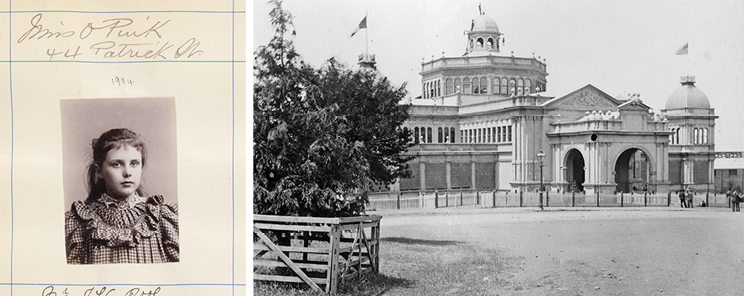
Figure 1: Photograph of Olive Pink taken for her entrance card to the International Exhibition of Industry, Science and Art, 1894 (left) and Tasmanian International Exhibition buildings, Hobart, 1894–95 (right).
Source: W. L. Beale, UTAS Library Special and Rare Collections.
Pink is pictured wearing a typical Victorian girl’s dress. The fabric appears to be a houndstooth weave and was most likely wool or a wool and cotton mix. The A-line body of the dress is pleated into the yoke, which itself is more finely pleated into the high-band collar. A white lace collar has been affixed for added interest, as was fashionable. The yoke is accentuated by a large, gathered, fabric ruffle, which would have been replicated at the calf-length hemline. Just visible behind Pink’s head is a large ribbon tied in a bow—a common accessory for girls at the time—fixing her hair in place. The apparent quality of the fabric and level of detail in the dress and lace collar, considered alongside what appears to be its slightly asymmetrical construction, suggest that the dress was either homemade from a paper pattern by a competent seamstress or bought from a local clothing store, then known as ‘drapers’.34 Given the Pink family’s faith, it is likely they would have shopped at one of the Mather family’s draperies, as they were fellow Quakers.35 Such insights suggest that Pink’s family was middle class; further, they suggest that Pink would have experienced a relatively comfortable childhood, albeit one free of extravagances due to Quaker ideals of moderate consumerism.36 As the dress was selected to be worn for a formal photograph, it was probably Pink’s finest dress. It was common practice in the nineteenth century for people to dress especially well when having their portrait taken, which could have the effect of obscuring people’s class backgrounds, though, in Pink’s case, other known details about her family confirm that they were middle class.37 As we will see in our exploration of Pink’s wardrobe in later life, Quaker beliefs about frugality, hard work and making do continued to shape not only Pink’s fashion choices, but what she chose to retain into old age. Indeed, the tempered financial habits of her Quaker upbringing are likely the reason Pink kept so much of her clothing throughout her life and why we now have such a well-preserved archive of her delicately worn attire.
Debunking the wedding dress rumour
The UTAS Library holds in its Special and Rare Collections two lace over-dresses, one of which has long been believed to have been made for the wedding of Olive Pink to Harold Southern. According to acquaintance Reg Harris:
Before the 1st World war she [Olive Pink] was engaged to Harold Southern who immediately enlisted at the outbreak of war and was a Captain at Galipolli [sic]. He was killed there in 1915.
The association of the dress with matrimony may be related to its ivory-coloured lace fabric, and is reinforced by the:
popular belief … that her wedding frock for her marriage to Captain Southern had been prepared and that she had retained it with a request she be buried in it.38
Harris searched for the dress after Pink’s death ‘but could not locate it’.39
A detailed examination of the garment (Figure 2) casts doubt on its potential use as a wedding dress. It is a cream over-dress of machine-made cotton lace. It is very simple, being primarily constructed from three rectangular lengths of fabric: two at the front, which are joined at the centre below the deep ‘V’ neckline, and one at the back, connecting to the front pieces with straight side seams. It has a single, short lapel collar, is long sleeved and has no closures, the wearer slipping it on over their head, the skirt hemline resting around the wearer’s ankles. All the seams are loosely hand sewn with colour-matched thread. There is minimal shaping, with one vertical pleat stitched in place from the proper left shoulder to the natural waist; a fold in the right shoulder seam suggests this pleat was once a pair. The sleeves have been taken in along the single underarm seam to create a more fitted shape. Four holes, their edges roughly hand stitched, sit around the wearer’s natural waist, just where the ‘V’ neckline comes to a point. These would have been used with a sash or belt to draw in the fabric around the waist, creating gentle shaping.
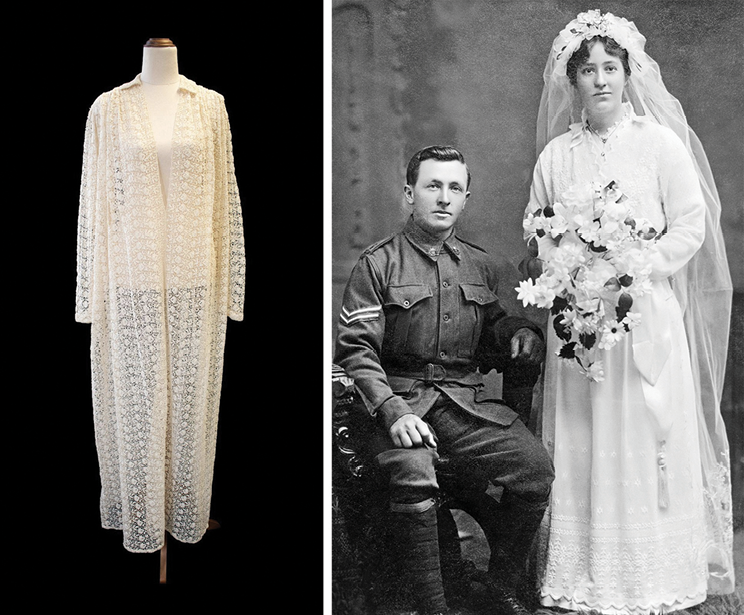
Figure 2: Olive Pink’s lace over-dress (left) and wedding portrait of Private Herbert Pollard and his wife Hilda, c. 1915 (right).
Source: Gift of the Olive Pink Estate. UTAS Library Special and Rare Collections, UTAS P6.27.127.d1 (left); Australian War Memorial (right).
Unfortunately for the veracity of the long-believed wedding story, the fabric and (lack of) pattern date the dress to between 1918 and 1920 at the earliest, and the 1930s at the latest. Coming from a middle-class family, a wedding dress made for Pink before Southern’s passing in 1915 would most likely have been made from ivory-coloured silk or a very fine white embroidered cotton. A wedding portrait of a couple from Dunolly, Victoria, c. 1915 (Figure 2), shows the latter possibility.
By the 1920s, wedding dresses made from white or cream satin, silk or crepe de chine with flounced or pleated skirts cut above the ankle became fashionable choices. Soft touches of pastel-coloured shades were sometimes added to a white gown, such as ‘pale pink, pale blue, mauve, or corn colour, with veil to match’.40 Necklines crept lower and hem lines higher. While dresses made from lace may have been favoured by some brides, ninon voile embroidered fabric was a more common choice for wedding gowns. Dresses were also often elaborately ornamented with silver embroidery, pearls and silk flowers, and paired with long tulle veils covering only the eyes, sometimes secured with a diadem or wreath of flowers, as seen in Figures 3B and 3C.41 The popular wedding fashions of the 1910s and 1920s are quite distinct from the style of the lace over-dress supposed to be Pink’s wedding gown. Figures 3A–3D demonstrate the changes in wedding dress fashion from 1920 to 1927.
Further doubt is cast on the nuptial purpose of the dress by the presence of two other garments in the UTAS Library’s Special and Rare Collections: a second almost identical dress and a cream lace, mid-twentieth-century blouse. The former indicates that the supposed wedding dress was not a one-off piece, as would be the case if it had been made for such an occasion; instead, both dresses were likely worn as day wear occasion pieces. The blouse—dating from later in Pink’s life, around the 1950s–60s—is a short-sleeved, cream lace garment, lined in the body, closing at the front with pearlescent buttons.42 It also would have been worn as a ‘nice’ piece during the day, and shows a consistency in Pink’s choice of garment fabric over time. This suggests that the two lace over-dresses were among Olive Pink’s ‘good’ clothing, their indication of minor wear being due to their infrequent use and garment care, rather than a sign that they had been intended for a wedding.
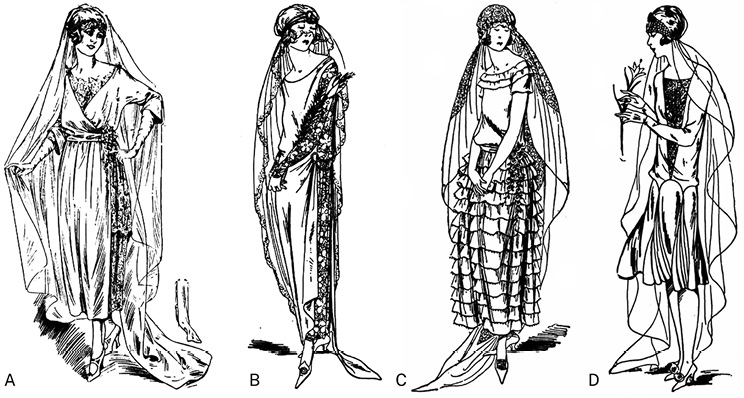
Figure 3: Illustrations of popular wedding fashions from a regular column in the Adelaide Chronicle newspaper from 1920 (A), 1923 (B), 1923 (C) and 1927 (D).
Source: Chronicle (Adelaide), 18 December 1920, 76; 14 April 1923, 59; 28 July 1923, 58; 6 August 1927, 68.
Regardless of whether a wedding dress was made, and how long Pink potentially kept it, the persistence of this story reinforces the depth of her feeling towards Southern, whom she described as a ‘dear friend’.43 It also demonstrates how evocative clothing is and its ability to hold memories. The tactile nature of clothing, and its ability to transform the body and self, make it a visceral and romantic portal to one’s past. A wedding dress holds all the dreams of a bride—for their special day, for a love story and a life story. According to Harris:
the shock [of Southern’s death] gave Miss Pink a mild heart attack. She was prescribed a tonic in 1915 and until her death continued the same prescription made up by one of our local chemists. She would take it with a small glass of St Agnes Hospital Brandy from a hip flask.44
The soft embrace of a garment can, sometimes tragically, be felt long after that of a lover—but not this dress.
Rather, Pink’s over-dress, possibly her best dress, would have been worn on formal occasions during the 1920s, a period in her life that, despite being marred by tragedy of Southern’s passing, was an exciting one. As a young woman in her 30s from the small town of Hobart recently arrived in cosmopolitan Sydney, she found employment at the Department of Public Works, took drawing classes to continue developing her skills as an artist and, most influentially in terms of the future direction of her life, became enthralled with the emerging discipline of anthropology.45 Pink’s interest in Indigenous cultures led her not only to the study of anthropology at the University of Sydney, but also to a life of activism. Her supposed ‘wedding dress’ was not a treasured but tortured relic of a lost love, but the fashionable garment of an independent, unattached, modern woman, brazenly forging an unusual path for herself in the world—one that few women of her era were able to match.
The 1920s and beyond: Nostalgic practicality
While, at first glance, the old-fashioned styles of Daisy Bates and Olive Pink may seem similar, a closer look reveals important differences in the way they dressed, as well as the role clothing played in their lives. In his chapter on Bates’s dress, Jones outlines her consistent and persistent habit of wearing of clothing from the Victorian era.46 As Bates herself insinuated, she used her old-fashioned, conservative style to differentiate herself from white women she considered to be morally ambiguous—women who were recognisable by their dishevelled appearance.47 The association between a person’s clothing and their moral character runs deep in Australian culture, particularly in regards to women, and Bates seems to have rigidly upheld this construct by managing her own image, as well as that of the Aboriginal peoples she engaged with in Central Australia.48 As many ‘frontier’ Europeans had done before her, she used clothing as a method of ‘civilising’ Aboriginal Australians.49 Bates used her clothing as an example, modelling her take on the socio-culturally approved ‘good woman’ to ‘her natives’.50
Both Bates and Pink dressed in accordance with their perceived roles, Bates as a ‘proper’ grandmother and Pink as an intrepid scientist/artist. Although Pink’s style of dress conjures images of bygone eras, it cannot neatly be characterised as deriving from any particular time period, as is the case for Bates’s attire.
While Pink’s sartorial style was not as distinct as Bates’s, there were aspects of it that persisted over time. Photographs of Pink from the 1920s to the 1930s show her in two types of dress: formal attire and fieldwork clothing. The former appears to have included a hip-length, princess seamed suit jacket with a long single collar, likely a matching skirt, and a long pale coloured necktie. A portrait taken a decade earlier shows a headband holding her hair in a faux bob, as was popular during the 1920s and 1930s, and seemingly the same jacket.
In photographs taken during research trips to Central Australia, such as Figures 4A and 4B, Pink wears a long overcoat reminiscent of an Edwardian-era driving coat, jodhpurs, a practical hat and tall leather boots. This masculine, explorer-style attire may have been chosen to signify her legitimacy as a researcher in the male-dominated field of anthropology as well as for practicality. Linking Pink’s formal and fieldwork clothing is her consistent use of a cream-coloured necktie, worn high and close-fitting on her neck, its long ends extending down her chest. Looking at photographs of her, she appears to have worn this accessory from around 1920 until old age. Even during the 1920s, the necktie would have appeared out of date; by the mid-1930s, Pink’s attire was noticeably different from the fashionably dressed women in floral dresses photographed alongside her. In the desert, a necktie would provide protection from the sun, but this does not explain her clear attachment to wearing it in other settings.
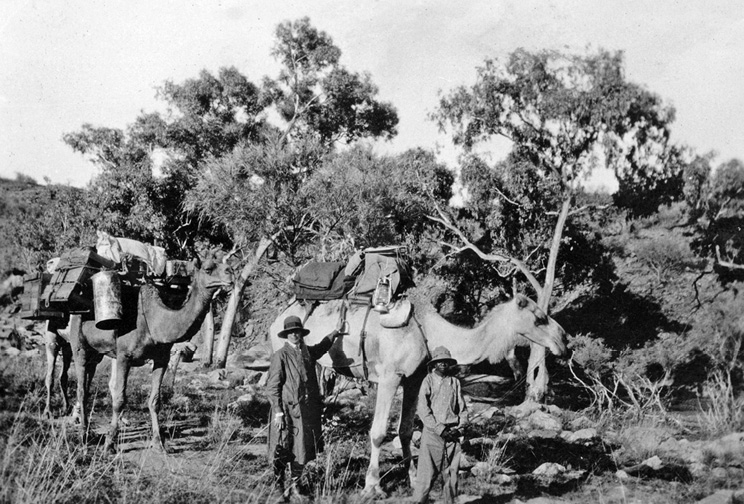
Figure 4A: Olive Pink and Jim with camels, Quart-Pot and Mangy, 1934.
Source: Gift of the Olive Pink Estate. UTAS Library Special and Rare Collections, UTAS P6.22.1.
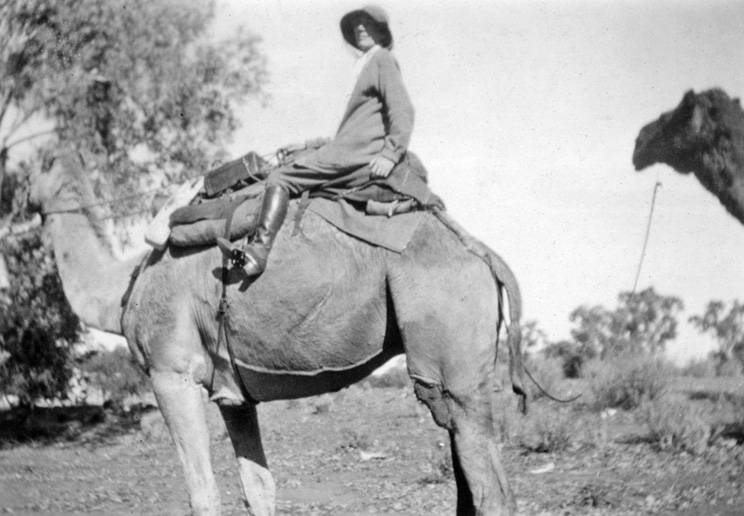
Figure 4B: Olive Pink sitting on Larry, 1934.
Source: Gift of the Olive Pink Estate. UTAS Library Special and Rare Collections, UTAS P6.22.4.
The style of dress Pink chose for her fieldwork has significant gender implications. The adoption of masculine-style clothing during this period was unusual among women, though less so among women anthropologists undertaking fieldwork in remote locations, for whom both practicality and establishing an aura of seriousness and status in a male-dominated field was important. It is a feature of how gender is expressed (and binarised) through fashion that clothing of a comfortable or practical nature is often deemed masculine, while clothing with greater emphasis on aesthetic appeal is deemed feminine. It would be easy to assume that trailblazing women who chose to pursue opportunities in a male-dominated field may have expressed feminist contrarianism by making unconventional fashion choices that embraced masculine styles. However, Pink and her contemporaries retained elements of feminine dress in keeping with contemporary gendered expectations, even while dressed for fieldwork.
Pink’s idiosyncratic style of dress set her apart from her fellow women anthropologists and she did not keep up with contemporary feminine fashion styles outside of fieldwork. But then the distinction between fieldwork and everyday life was far less defined for her than for other women in anthropology. Pink lived in the central desert for the entire second half of her adult life; by contrast, women anthropologists who undertook fieldwork in Papua New Guinea during the same era, such as Americans Margaret Mead and Hortense Powdermaker, and British-Australian Camilla Wedgewood, returned home after their fieldwork ended. In their metropolitan lives, these anthropologists adopted standard feminine styles of dress in keeping with the gendered expectations of the era; this was especially important for Mead and Powdermaker who established professional careers as academics.
In her later years, Pink seems to have combined her formal and fieldwork clothing, wearing a blouse, necktie and skirt with a khaki overcoat. Reg Harris recalls his first impression of Pink as ‘an angry lady dressed in Victorian style with flowing white dress buttoned around the neck and extending to the ankles’.51 While, from a dress history perspective, Harris’s interpretation is inaccurate, it does indicate that her simple, modest clothing was perceived as old fashioned. There are some elements of her dress that could be described as Edwardian in style: ivory blouses, dark straight skirts sitting at the natural waist, long-line jackets, broadbrimmed hats, long white dresses and high neckties. Her hairstyle also appears to have remained unchanged and, to the untrained eye, both it and her clothing could easily be mistaken as Victorian.
This choice of clothing in her middle to later years may have had a practical, material origin. Like all Australian women trained in anthropology in her era (with the notable exception of Catherine Berndt, who worked in collaboration with her husband), Pink was never able to establish an academic career and lived on an extremely limited income after her move to Central Australia. Driven as she was by her activism and vision for Aboriginal rights, she remained in Central Australia despite this. Her material conditions in Alice Springs demonstrate her commitment to a life of activism; her home, in what is now the grounds of the Olive Pink Botanic Garden, was an uninsulated tin hut that lacked modern amenities, such as a kitchen and bathroom, and exposed her to the extreme and fluctuating temperatures of the central desert. With limited means to support herself, frugality was a necessity, and acquiring new clothing was likely not a priority (nor a possibility), hence her reuse of garments long after they had fallen out of fashion.
Frugality also had a moral dimension for Pink, who was raised in the Quaker faith. Quakers view thrift and hard work as desirable personal characteristics, and they use clothing to signify and embody these beliefs.52 Pink was so committed to a worldview valuing frugality and self-sufficiency that she refused to accept the aged pension in the 1970s, despite having no alternative means to support herself. She eventually accepted an honorarium payment for her work on the flora reserve.53 In a life so intrepid, perhaps Pink was motivated to retain her garments as mementos of her earlier life—they may have served as a source of connection to the trappings of the middle-class life she had relinquished for her much more unusual, and often difficult, one. This unique combination of personal factors may explain why Pink held on to and repurposed clothing from her earlier life for so many decades, with her careful hoarding tendencies ensuring the survival of some of the more delicate and lightly worn garments represented in the UTAS Library’s Special and Rare Collections.
Conclusion
Research into the distinctive styles of Australian fashion and dress is still in its infancy. We have built on this fledgling scholarship by drawing on and analysing photographic and material evidence of Olive Pink’s clothing. Our aim was to demonstrate the usefulness of treating garments as a lens through which to investigate a biographical subject’s life, and we hope that our approach can be transferred to the exploration of other Australian lives.
We were attracted to the idea of exploring Pink’s clothing in part because of the precedent set by previous scholars, such as Philip Jones, and also because of the intimate nature of such material objects. There is something incredibly moving about handling items of clothing that once sat lightly over the skin of someone you are researching. You can sense their presence in the minutiae of tiny tears in the fabric, the stitches with which they have been carefully mended, and other signs of wear and tear. It is also possible to relate emotionally to the choices the subject made in deciding which garments to retain and which to discard.
As outlined above, a plethora of written archival evidence relating to Olive Pink and a handful of photographs have survived into the present day and have been drawn on by previous scholars to write on various aspects of her complex and fascinating life. Treating Pink’s clothing as a lens through which to consider her life has illuminated otherwise elusive or even contested elements of her life. Analysing a dress in which she was photographed as a child enabled us to draw some conclusions about her family’s situation during her formative years, a period about which seemingly little is known. Likewise, our analysis of a surviving lace over-dress allowed us to dispel a longstanding supposition that the garment had originally been intended as Pink’s wedding dress. Finally, comparing and contrasting Bates’s and Pink’s sartorial choices enabled us to highlight how each had their own distinctive style. While the women might be said to have had some elements of their lives in common, they did not share much when it came to dress.
Highlighting the sartorial significance of Pink’s clothing will, we hope, encourage other historians and biographers to consider clothing as a lens through which to investigate elements of a life that might otherwise prove elusive. Much may be learnt about a biographical subject’s life through exploring the fabric with which their body was adorned.
1 Julie Marcus, ‘Introduction’, Olive Pink Society Bulletin 10, no. 1 (1998): 4.
2 Susanna De Vries, Desert Queen: The Many Lives and Loves of Daisy Bates (Harper Collins, 2008), 210.
3 Philip Jones, Ochre and Rust: Artefacts and Encounters on Australian Frontiers (Wakefield Press, 2007), 283.
4 Jones, Ochre and Rust, 285.
5 As of October 2024, UTAS is in the process of formally accessioning several new additions to the Pink textile collection: a velvet cape, gloves and a lace collar worn by Pink during an event in Alice Springs, where she was introduced to the Duke of Kent in 1969.
6 Julie Marcus, ‘Pink, Olive Muriel (1884–1975)’, Australian Dictionary of Biography, National Centre of Biography, The Australian National University, published first in hardcopy 2002, accessed 9 February 2023, adb.anu.edu.au/biography/pink-olive-muriel-11428/text20365.
7 Paige Gleeson, ‘The Ethnology Room: Exhibiting Indigenous Material Culture at the Tasmanian Museum and Art Gallery, 1885–2021’ (PhD thesis, UTAS, 2022), 184–6.
8 See, for example: Anna Cole, Victoria Haskins and Fiona Paisley, eds., Uncommon Ground: White Women in Aboriginal History (Aboriginal Studies Press, 2005); Aileen Moreton-Robinson, Talkin’ Up to the White Woman: Aboriginal Women and Feminism (University of Queensland Press, 2000).
9 Julie Marcus, The Indomitable Miss Pink: A Life in Anthropology (LhR Press, 2001). Marcus’s scholarship on Pink has been critiqued by Geoffrey Gray and Russell McGregor for presenting an inaccurate (i.e. anachronistic) portrait of her as a progressive human rights activist, a portrait that does not take into account her views on race which were very much influenced by the historical period in which she lived. See, in particular: Geoffrey Gray, ‘Review: The Indomitable Miss Pink: A Life in Anthropology’, Australian Aboriginal Studies 1 (2002): 96–8; Russell McGregor, ‘The Clear Categories of Olive Pink’, Oceania 65, no. 4 (1994): 4–17, doi.org/10.1002/j.1834-4461.1994.tb02485.x.
10 Gray, ‘Review’; McGregor, ‘The Clear Categories’; Gleeson, ‘The Ethnology Room’, 184–90.
11 Marcus, ‘Pink, Olive Muriel’.
12 Julie Marcus, Yours Truly, Olive M. Pink (Olive Pink Society, 1991).
13 Marcus responded to some of the concerns about her representation of the complex and contested nature of Pink’s politics and character prior to the publication of her book in 2002. See: Julie Marcus, ‘Miss Pink’s Racism’, Olive Pink Society Bulletin 8, no. 1 (1996): 4–7.
14 See: McGregor, ‘The Clear Categories’, 6, 11.
15 Marcus, ‘Miss Pink’s Racism’, 5. Marcus notes these allegations against Pink in her response to criticisms of her biographical project, published after a seminar at the Institute of Aboriginal Development, Alice Springs, in 1996, during which Marcus’s celebratory feminist revisionism was criticised by some in attendance.
16 See McGregor, ‘The Clear Categories’.
17 Japangardi Poulson recalled fond memories of Pink in a 2011 interview. See: National Museum of Australia, accessed February 2021, nma.gov.au/exhibitions/warlpiri/drawings/beauty (site discontinued).
18 See, for example: Gleeson, ‘The Ethnology Room’, 185–7. This details the extreme relationship breakdown that occurred between Pink and her colleagues at the Tasmanian Museum and Art Gallery, where she worked for a brief period in the 1930s.
19 Anne Boyd, Olive Pink Opera, Desert Song Festival, Olive Pink Botanic Garden, Alice Springs, 7–8 October 2022; Christopher Raja and Natasha Raja, The First Garden (Currency Press, 2012); Tracks Dance Company, Fierce: The Story of Olive Pink, Festival of Darwin, Brown’s Mart Theatre, Darwin, 22–26 August 2001. Christopher Raja said that after reading Marcus’s biography of Pink, he aimed ‘to raise the profile of this remarkable Australian hero who was way ahead of her times and get her face on our currency’. See: Christopher Raja, ‘Olive Pink and the First Garden’, Southerly, 27 July 2011, southerlylitmag.com.au/olive-pink-and-the-first-garden/.
20 Kim Johnson, Susan Torntore and Joanne Eicher, eds., ‘Origins and Motives’, in Fashion Foundations: Early Writings on Fashion and Dress (Berg Fashion Library, 2003), 15–36, doi.org/10.2752/9780857854070/FASHFOUND0005; Yuniya Kawamura, ‘Introduction’, Doing Research in Fashion and Dress: An Introduction to Qualitative Methods, 2nd ed. (Bloomsbury Visual Arts, 2020), 1–16 (ebook), doi.org/10.5040/9781350089785.0005.
21 Charlotte Nicklas and Annebella Pollen, ‘Introduction: Dress History Now: Terms, Themes and Tools’, in Dress History: New Directions in Theory and Practice (Berg Fashion Library, 2015), 1–14, doi.org/10.5040/9781474240536-007; Lou Taylor, ‘Introduction’, in The Study of Dress History (Manchester University Press, 2002), 1–2; Ingrid Mida and Alexandra Kim, ‘Fashion Theory’, in The Dress Detective (Bloomsbury, 2015), 139 (ebook), doi.org/10.5040/9781474244015.
22 Taylor, ‘Introduction’.
23 Kawamura, ‘Introduction’, 10–11.
24 Kawamura, ‘Introduction’, 10–11.
25 Alison Carroll, ‘“Australia Has No Culture”: Changing the Mindset of the Cringe’, The Conversation, 8 November 2017, theconversation.com/australia-has-no-culture-changing-the-mindset-of-the-cringe-85995; Margaret Maynard, ‘Australian Dress: Perceptions and Stereotypes’, Journal of Australian Studies 18, no. 41 (1994): 1–11, doi.org/10.1080/14443059409387171.
26 For example, Margaret Maynard, ‘Queensland Fashion: Part One’, The Fashion Archives 1, no. 1 (2013), webarchive.nla.gov.au/awa/20150212005411/http://pandora.nla.gov.au/pan/148300/20150212-1011/thefashionarchives.org/indexeeb6.html.
27 For example, Jennifer Craik, ‘Fashion, Clothes, Sexuality’, Australian Journal of Cultural Studies 2, no. 1 (1984): 67–83. See also comments made on the topic in: Leora Auslander, ‘Deploying Material Culture to Write the History of Gender and Sexuality: The Example of Clothing and Textiles’, Clio: Women, Gender, History 40 (2014): 157–78, doi.org/10.4000/cliowgh.716.
28 Melissa Bellanta and Lordina Cramer, ‘The Comfort of Things in White Australia: Male Immigrants, Race and the Three-Piece Suit, c.1901–39’, Australian Historical Studies 54, no. 3 (2023): 483–510, doi.org/10.1080/1031461X.2022.2161587; Mary Hutchison ‘The Social Life of a Denim Jacket’, Journal of Australian Studies 35, no. 4 (2011): 475–93, doi.org/10.1080/14443058.2011.618505.
29 Juliette Peters, ‘“London, Paris, New York, and Collingwood”: Reconsidering Pre-1945 Australian Fashion’, Australian and New Zealand Journal of Art 10, no. 1 (2009), doi.org/10.1080/14434318.2009.11432604; Maynard, ‘Australian Dress’.
30 See, for example: Lorinda Cramer, ‘Where Money Is the Idol: Needlework and Genteel Identity in Gold Rush Victoria, 1851–1865’, Context 25 (2013): 8–21; Lorinda Cramer, ‘Keeping up Appearances: Genteel Women, Dress and Refurbishing in Gold-Rush Victoria, Australia, 1851–1870’, Textile 15, no. 1 (2017): 48–67, doi.org/10.1080/14759756.2016.1209876; Lorinda Cramer, ‘Busy, without Thimbles, at the Needlework: Men’s Sewing and Masculinity on the Victorian Goldfields, 1851–1861’, Journal of Victorian Culture 25, no. 2 (2020): 153–70, doi.org/10.1093/jvcult/vcz063.
31 Mida and Kim, The Dress Detective, 51.
32 Prown, cited in Mida and Kim, The Dress Detective, 87.
33 International Exhibition of Industry, Science and Art, Queen’s Domain, Hobart, Tasmania, 1894–95: Official Catalogue of the Exhibits (Exhibition Commissioners, 1894).
34 Paper patterns by pattern makers such as Madame Weigel were readily available by mail order and from haberdashery and clothing stores. See: Veronica Lampkin, Madame Weigel’s Patterns 1878–1950 (Veronica Lampkin, 2020).
35 Jennifer Clynk, ‘Faith, Fashion and Social Reform: A Family of Quaker Drapers in Colonial Hobart’ (PhD thesis, Australian Catholic University, 2014), 5.
36 Clynk, ‘Faith, Fashion and Social Reform’.
37 Joan L. Severa, Dressed for the Photographer: Ordinary Americans and Fashion, 1840–1900 (Kent State University Press, 1995).
38 Reg Harris, ‘Olive Muriel Pink’, Olive Pink Society Bulletin (1994): 9.
39 Harris, ‘Olive Muriel Pink’.
40 ‘Color in Wedding Dress’, World’s News (Sydney), 7 May 1927, 16.
41 Everyone’s (Sydney), 26 May 1920, 18.
42 Freya Harrington, ‘Report: Olive Pink’s Clothing’, Special and Rare Collections, University of Tasmania, 2021, 7–8.
43 Harris, ‘Olive Muriel Pink’.
44 Harris, ‘Olive Muriel Pink’.
45 Pink first moved from Hobart to Perth, Western Australia, with her mother in 1911, before relocating to Sydney where she lived during the 1920s and early 1930s.
46 Jones, Ochre and Rust.
47 Jones, Ochre and Rust, 288.
48 Margaret Maynard, ‘Dressing the Part: Urban Codes—Class and Gender’, in Fashioned from Penury: Dress as Cultural Practice in Colonial Australia (Cambridge University Press, 1994), 77–98.
49 Margaret Maynard, ‘On the Fringe: Clothing and Aboriginal–Colonial Relations’, in Fashioned from Penury, 59–73; Julia Martinez, ‘When Wages Were Clothes: Dressing Down Aboriginal Workers in Australia’s Northern Territory’, International Review of Social History 52, no. 2 (2007): 271–286, doi.org/10.1017/S0020859007002945.
50 Jones, Ochre and Rust.
51 Harris, ‘Olive Muriel Pink’, 7.
52 Clynk, ‘Faith, Fashion and Social Reform’, 5.
53 Harris, ‘Olive Muriel Pink’, 9.
Previous



