


 menu
Australian Journal of Biography and History: No. 11, 2026
A vessel of the earth: The craft of ecobiography
On a sharp winter’s day in Lutruwita (the name for Tasmania in palawa kani, the language of Tasmania’s First Nations peoples),1 the light falls onto Pipe Clay Lagoon, silvering the water. By the shore, a potter digs his fingers into the earth and pulls out handful of clay. It is cold, damp and sticky. He kneads it, places it into a bucket, and repeats the process with other handfuls. Back in his studio, he throws the clay onto his wheel, forms it into a vase and fires it in his kiln. The kind of clay he is using is known as ‘wild clay’—that is, ‘clays that are not commercially available. All clay, after all, is indigenous to our planet.’2 Whereas commercial clays ‘provide consistency and have been vetted by others’, wild or local clays ‘offer unique colours and other qualities a specific artist might desire in their world’.3 They also offer an opportunity to create an intimacy with one’s local environment. Woodfired ceramic artist Mitch Iburg notes of his practice that ‘there is a deeply ingrained relationship between the objects I make and the landscapes in which I live’.4
Other makers with wild clay include potter Larissa Warren who, in 2020 on Mount Tamborine on the land of the Wangeriburra people, reconnected with the craft and ceramics of women potters who used local clays in the 1940s. At this time, the community at Mount Tamborine consisted of approximately 800 residents, with little infrastructure. Finding herself similarly isolated during COVID-19 lockdowns, Warren identified with the women’s reliance on local materials, their resourcefulness, and ingenuity. Her art making drew upon the area’s deep history by including melted trachyte, a volcanic rock created by eruptions 22 million years ago.5
These craftspeople, by working with the earth, form an intimate connection with their ecosystems. Acclaimed writer of the natural world Barry Lopez describes a community of the soil in his essay ‘Effleurage: The Stroke of Fire’ (1998). Lopez recounts the processes needed to create pottery from an anagama kiln, a tubular chamber fired by burning wood, built on a slope to encourage air to reach the fire. The aesthetics of pots fired in an anagama kiln are unpredictable because of the wood firing technique. Anagama ware, Lopez writes, is ‘licked and scorched by wood flame, glazed and encrusted by wood ash’, and contrasts with ware ‘produced in tamer environments like that in an electric kiln’.6 To create the heat needed for firing, the kiln consumes a large amount of wood. Felling black locust (Robinia pseudoacacia) with Jack, the kiln’s chief coordinator, Lopez considered himself and his companion as ‘the kiln’s antennae, gathering histories human and natural embedded in the logs. The wood’s stories would debouch in the kiln. What had happened in the trees would imbue the pots.’7 The stories captured by humans and non-humans manifest in the fired vessels.
Each of these interactions between craft, soil, plants and fire demonstrate the ways that human communities interconnect with and draw upon their ecosystems to craft unique objects. The potters’ attention to local environments, and the qualities the environments impart to the clay and resulting vessels, indicate a responsiveness to the world and its influences. In the realm of life writing, ‘a general term for writing that takes a life, one’s own or another’s, as its subject’,8 the relationships between craft, community and ecosystems can be found in ecobiography, a mode that focuses on relationships between the human and non-human world. Although the term ‘ecobiography’ emerged in 1996, it has received little attention to date, reflecting the entrenched anthropocentrism of the field of life writing. In response to both this gap and my distress at the impact of climate heating and mass extinction on crucial ecosystems, I have researched and written on ecobiography in my critical writing,9 and practised the craft in my creative writing, over the past few years.10 My motivation is to draw attention to the way that ecobiography reveals the indelible connections between human and non-human, and to underscore human dependency on these connections.
In this essay, I outline the parameters of ecobiography, discussing it in terms of the relationality of life writing, and focusing on the agency of the non-human world. I then contextualise the form in terms of my work in progress, The Miniature and the Momentous, an ecobiography of nineteenth-century botanist Georgiana Molloy and the ecosystems from which she collected in south-west Western Australia. I dwell on the relationships that Molloy established with James Mangles, a botanical connoisseur to whom she sent her seeds and specimens; with the Wardandi Noongar people with whom she collected; and with the flora of south-west Western Australia, identifying how these interactions shaped her sense of self. In doing so, I illustrate how plants are integral not only to Molloy’s narrative, but also the wider world of imperial trade and exploration in the nineteenth century. Mangles established connections not only with collectors on Noongar Country, but also with Lutruwita, when he published a volume that meditated on the disappearance of John Franklin, the lieutenant governor of Lutruwita between 1837 and 1843.
While these connections occurred globally, they remain underpinned by soil, for Lutruwita and south-west Western Australia were once connected via Gondwana. The ideas that I put forth on soil, plants and writing may, I hope, also be adopted by writers and historians interested in crafting their own ecobiographies of Lutruwita.
Life writing and ecobiography
The term ‘autobiography’ emerged in the late eighteenth century, just prior to the Age of Enlightenment in Europe. This period, with its focus on science, the pursuit of reason, and the separation of church and state, was promulgated by men of property. As Smith and Watson record, autobiographies became of interest to an increasing number of readers with access to affordable books, particularly given their focus on self-interest and self-evaluation.11 It is therefore worth noting, as do Smith and Watson, the etymology of the term ‘autobiography’: ‘In Greek, autos denotes “self”, bios “life”, and graphe “writing”. Taken together in this order, the words self life writing offer a brief definition of autobiography.’12
The understanding of what autos constitutes has shifted radically since the last century. In 1956, Belgian critic Georges Gusdorf published an essay, ‘Conditions and Limits of Autobiography’, that situated life writing as a Western, Christian literary form, presenting the individual as the pinnacle of civilisation, and indubitably separate from the collective.13 In the 1980s and 1990s, scholarship by feminist and postcolonial scholars queried the scholarly focus on the individual, prompting a shift in attention to the relational in life writing, which ‘indicates how the subject is always in process and thus involved with others, not autonomous’.14
Given this context, it is not surprising that the term ‘ecobiography’ appeared in 1996, when Cecilia Konchar Farr and Philip Snyder defined it as:
a life-story constructed according to a pattern divined internally through the Self’s interaction with the external environment, especially Nature, the multiple exchanges of which (re)present a kind of ecosystem of the Self. All the various voices of the Self, conscious and unconscious, plus the environment within which and against which they speak, comprise the dynamic network of that Self’s ecosystem.15
Ecobiography reveals how a self is shaped by its environment. The body’s physical interactions influence the psyche, revealing the importance of the senses, particularly the skin, in receiving impressions from this environment.
The relationship between self and the ecosystem manifests in the term ‘ecobiography’ itself: the autos in autobiography is replaced with eco, a combining form denoting the adjective ‘ecological’ or noun ‘ecology’.16 When considering the definition of ecological—‘of, relating to, or involving the interrelationships between living organisms and their environment’17—the etymology of ecobiography becomes evident: it is a textual representation of the intertwining of human and non-human lives. For this reason, eco represents an important intervention; rather than a portmanteau that gestures to another branch of biography, the term signifies to the reader the impossibility of separating human and non-human lives.
In 1999, Paul John Eakin drew on the ideas of relationality in his book-length study of life writing, How Our Lives Become Stories. He opened his second chapter, ‘Relational Selves, Relational Lives: Autobiography and the Myth of Autonomy’, with a vignette focusing on the autobiographical remnants of Christopher McCandless, who unsuccessfully attempted to survive alone in the Alaskan wilderness and was found deceased in an abandoned bus in 1992. Among McCandless’s belongings was a photograph, later developed from a roll of film in his camera, of himself holding a goodbye note; an annotated copy of Henry David Thoreau’s Walden; a ‘mini-biography of about a hundred words, scratched in capital letters on a plywood-carved window of the bus’;18 and a journal of notes, largely centred around food consumption, kept in the two blank pages at the back of a book on edible plants.19 Initially, Eakin was moved by the ‘existential fortitude’ depicted in the photograph, and found McCandless’s story ‘edifying and heroic’.20 However the inclusion of Thoreau’s Walden, which advocated self-sufficiency and a retreat from the industrialised world, began to unsettle his perception of the story. In Walden, Thoreau captured his attempts ‘to achieve greater harmony between one’s daily activities and the ultimate truths of the universe’,21 which he advocated through simple living. In light of this, Eakin began to regard McCandless’s story as ‘a cautionary tale about a victim of fatally misguided beliefs, about someone who thought he could do without other people’.22 Eakin then uses this story to indicate that the ‘Gusdorf model’ of autobiography, which asserts that the individual is separate from the collective,23 is highly problematic. By suggesting that autobiography is ‘emphatically individualistic’, Eakin posits that the notion of the untrammelled individual subject is ‘potentially a killer’.24
Eakin’s rendition of McCandless’s story suggests that it was the lack of human contact that killed McCandless. While this was undoubtedly a contributing factor, McCandless was not alone. He was surrounded by plants, animals and air, and he must have found water.25 It was his lack of understanding of this environment that, ultimately, caused his demise. It is remarkable that a chapter on relationality, which opens with reference to a man’s death in a natural environment, does not interrogate that man’s dependence on his environment.26 The traces of the natural world appeared in the residue of his life—the book on edible plants, for example—but their entwinement in autobiography was not considered.
I provide these observations on Eakin’s relationality and Farr and Snyder’s definition of ecobiography to argue for the importance of the form as a means of highlighting our dependence on the natural world, particularly at a time in which anthropocentrism is undermining the ecosystems that sustain that life. Global heating is generating more intense weather events such as the 2019–20 Australian Black Summer bushfires, which caused the loss of at least 33 human lives, the death or displacement of 3 billion native animals27 and the destruction of 7 billion trees.28 Indeed, one of the hallmarks of the Anthropocene is ‘death on an unimaginable scale’.29 As I have argued elsewhere, at the heart of anthropocentrism lies a failure to recognise human relationships with, and dependency upon, the non-human world. If we want to have a life, it is imperative that we consider the lives in our ecosystems upon which we depend.30
In recent years, increasing environmental concerns have entwined with posthumanism—a ‘historical moment in which the decentering of the human by its imbrication in technical, medical, informatic, and economic networks is increasingly impossible to ignore’.31 I would add ecological networks to this definition, and scholars have begun to consider the way we tell stories about the lives of our non-human companions, for example in Cynthia Huff’s and Joel Haefner’s work on animalography;32 special issues in a/b: Auto/Biography on the groundbreaking work of posthumanist Donna Harraway;33 my and Gillian Whitlock’s special issue on ‘Life Writing in the Anthropocene’; and Batzke, Garrido and Hess’s edited collection Life Writing in the Posthuman Anthropocene.34 The last poses a longstanding question related to the nexus of life writing and posthumanism:
how can life writing, a genre so intimately tied to the human perspective and thus presumably human-centered qua definition, provide adequate perspectives for an age in which humanity’s self-centeredness is considered the driving force behind ecological disasters and global climate change?35
In the sections that follow, I use the example of my work in progress, an ecobiography of Georgiana Molloy, to attempt to address this question, focusing in particular on the ways that touch and intimacy with an ecosystem facilitate a shift in self. In Molloy’s case, this shift was inevitably shaped by Mangles’s imperial desires, which also touched Lutruwita through his speculation on Franklin’s expedition.
Laying the ground
Lutruwita and the south-west of Western Australia were once connected via Gondwana, when they were stitched onto the coastline of Antarctica. This facilitated the migration of the protea family, which originated in Africa 130 million years ago. It migrated into South America, then across to the Antarctic Peninsula, to which it was then attached. One part of the family, which had soft leaves, then crawled along Antarctica until it reached Tasmania. Another part, which had hard leaves, travelled along the eastern side of Antarctica into south-west Western Australia.36
The south-west region has persisted over millions of years without geological disturbance such as earthquakes, glaciation or dust storms. Without disturbance, and constant weathering from ocean winds, the soil has become limited in nutrients. It is bordered by arid regions to the north and east, and by the sea to the south and west, leading botanists Steven Hopper and Paul Gioia to describe it as a ‘relatively wet continental refuge’.37 Within the south-west itself are more island-like ecosystems. It is difficult for pollination to occur, as the islands are not linked by corridors or long-range seed or pollen dispersal. This has given rise to an incredible diversity of plant life, with 8,379 native vascular (i.e. sap-bearing) taxa recorded, of which 47 per cent are endemic.38 The region is now known as a biodiversity hotspot—an area that features at least 1,500 vascular plants and is highly threatened.
The traditional custodians of the area are the Noongar people, and their boodja (Country) extends from north of Jurien Bay inland to north of Moora and down to the southern coast between Bremer Bay and east of Esperance. It is defined by 14 different areas with varied geography and 14 dialectal groups.39 Over 45,000 years, Noongar peoples developed and refined their knowledge about their environment to sustain themselves. In 1827, this relationship was interrupted when Western Australia, the western-third of the country, was annexed for the British Crown. In 1829, a colony was established at what are now the cities of Perth and Fremantle, and the British gradually moved outwards, usurping Noongar peoples. Not only did this lead to a loss of local knowledge, but also British land management methods, such as dryland and irrigated agriculture (which necessitated tree clearing), were not appropriate for a country with a different nutrient profile and with limited rainfall. While south-west Western Australia features a high percentage of plant life found nowhere else on earth, it now also, on account of this history of tree clearing and new threats such as climate change, faces exceptional levels of extinction.40 Georgiana Molloy was one of the people involved in this destructive history, even as the plants she collected transformed her perception of the Australian environment.
Georgiana Kennedy was born in Carlisle, England, in 1805, the daughter of David Kennedy, an ambitious man who built a country house known as ‘Crosby’ 5 miles from Carlisle. In 1819, Kennedy fell from his horse and died, leaving behind debts of £11,000, five children and a widow with no means of supporting them.41 Georgiana had learnt her first lessons about plants and gardening in the walled garden of Crosby, as was expected of a young girl training to become a lady. Like other decorative arts, such as painting and flower arranging, botany was perceived as a worthwhile pursuit for women, particularly as it combined leisure and learning. It encouraged women to go outdoors, ‘collecting plants, creating herbaria, learning some botanical Latin, reading handbooks about Linnean systematics, taking lessons in botanical illustration, using microscopes to study plant physiology, and writing introductory botany books’.42
As the Kennedy children grew up, their mother moved the family to Rugby for her sons’ education; however, due to friction with her mother and sister, Georgiana ventured north to stay with her friends the Dunlops, who lived near Glasgow. At 24, with options for her future narrowing, she married John Molloy, a friend of her mother’s and a soldier who fought in the Napoleonic Wars. She agreed to sail with him to the fledgling colony of Swan River (now Perth) in south-west Western Australia.
When Molloy and her husband arrived in 1830, they found that most of the land had been allocated, so they sailed south to Tallinup, or what the settlers named Augusta. A few days after their arrival, Molloy unexpectedly gave birth to her daughter without any medical help, as she wrote to her friend Frances Birkett:
I suffered 12 hours and had no medical man near me there being none within some hundred miles, when at a loss what to tell my female servant I referred to the Encyclopedia, & in this state poor Baby was born.43
Twelve days later, the baby died. It was, Molloy wrote to her friend, ‘a dismal beginning’.44
Molloy went on to raise a family with her husband, but had little domestic help in what, to her, would have been primitive conditions. She bore another two daughters and a son, and moved with her family north to Undalup/Busselton, near Geographe Bay. In 1836, when he was 19 months old, Molloy’s son fell into a well and drowned. This prompted what Molloy described as a ‘dangerous illness’,45 most likely a nervous breakdown, which was no doubt linked to the death of her first child.
Just prior to this event, at the end of 1836, Molloy received a letter from Captain James Mangles (1786–1867), a botanical connoisseur in London. A member of the Royal Society for scientists, Mangles had connections with the Loddiges nurserymen of Hackney in London and with Joseph Paxton, gardener at Chatsworth and designer of the Crystal Palace for the 1851 Great Exhibition. He had entered the navy at age 14 and had reached the position of officer by the time he left in 1815.46 Upon his return from travels through the Middle East, he introduced his cousin Ellen to his friend James Stirling. Stirling, who was smitten, married Ellen when she came of age. When Stirling was appointed governor of the new colony of Western Australia, Ellen travelled with him. In 1831, Mangles also sailed to Perth to visit his cousin and friend. During this sojourn he made contact with George Fletcher Moore, an early colonist, and later requested him to collect specimens and seeds.47 Through Ellen Stirling, he expanded his network of collectors to include Molloy and her neighbour Mrs Bull. He also dealt with James Drummond, the colony’s official gardener and a commercial collector.
Molloy had travelled to Australia with the intention of collecting, packing a hortus siccus, a book into which specimens were fastened for identification purposes. Her brother George had been ‘anxious to employ me as a collector also’, she wrote to Mangles,48 but amid the labour of raising children, creating a garden and feeding her family, she did not have time to search for flowers and seeds. In her first, brief letter to Mangles, she complained that ‘all my former pursuits have necessarily been thrown aside (by the peremptory demands of my personal attention to my children and domestic drudgery)’.49 However, a year later, after her son drowned, she wrote: ‘Since my dear Boy’s death I have, up to the present time, daily employed myself in your service.’50 The bush became a solace for her grief, and when she began to venture into it to collect plants, her perception of her surroundings began to shift. As with the potters moulding wild clay into art, her sense of touch played a central role in the transformation of her relationship to her ecosystem.
Tactile relations
Mark Paterson notes that ‘the haptic is traditionally associated with closeness and proximity, denoting contiguity and contact’. while the optic ‘is supposedly associated with distance and transcendence’.51 It is significant, given this context, that Molloy relied heavily on touch to conduct her collecting, and that this facilitated her intimacy with plants. Two and a half years after her arrival at Augusta, she described the bush to her sister in a letter as the ‘unbounded limits of thickly clothed dark green forests where nothing can be described to feast the imagination’.52 As many trees in the south-west Western Australian bush are tall, Molloy’s description suggests that she was standing back to capture them in her view. As she ventured into the bush and began collecting for Mangles, she was forced to look not up but down, scrutinising the plants closely to identify them. She wrote to Mangles that ‘in our impervious Bush it is really difficult to find out what you are in quest of, the numberless specimens of flowers of the same colour with different leaves’.53 To remedy this problem, she took her daughters collecting with her, explaining to Mangles that ‘their eyes being so much nearer the ground they have been able to detect many minute specimens and seeds I cou’d not observe’.54 As Molloy indicates with the word ‘minute’, many flowers in south-west Western Australia, like those in arid conditions, are small to aid with water retention.55 Molloy found them frustrating to collect, as she explained to Mangles: ‘I quarrel much with their excessively minute corrollae [petals].’ She also wrestled with the techniques of placing the tiny, collected seeds into bags, and pressing and arranging the small flowers. When trying to press flowers from the Asteracae family, she ‘was constrained to adhere to the paper, [but] they began to curl up the instant I took off the pressure’,56 indicating the focus needed to attend to the fiddly process. In another letter to Mangles, written eight years after she arrived at Augusta, she mused: ‘I long to see again a large flower.’57
As Molloy touched the plants she collected and prepared for sending to Mangles, the environment of south-west Western Australia began to actively transform her perception. Many plants in the region have highly specific relationships with pollinators such as bees (native and European), flies, birds and non-flying mammals like honey possums.58 The endangered dwarf hammer orchid, Drakaea micrantha, for example, releases pheromones that trick the Zeleboria thynnine wasp into thinking that the plant is female. In attempting to copulate with the plant, the wasp becomes coated in pollen. When it flies to another plant, it transfers the pollen and fertilises the plant.59 Molloy, in responding to the visual and tactile qualities of the flora, became educated in the specific characteristics of several species. After a year of collecting in the area, she announced to Mangles:
I have no hesitation in declaring that were I to accompany the box of Seeds to England, knowing as I do, their situation, time of flowering, soil and degree of moisture required with the fresh powers of fructification they each possess—I should have a very extensive conservatory or conservatories of none but plants from Augusta.60
The alteration in her perception, from considering the bush an impenetrable mass, to understanding the requirements for specific plants’ survival, demonstrates the transformative qualities of the specific environment of south-west Western Australia.61 The plants, soil and pollinators elicited a responsiveness that may not have occurred in another environment.
It was not only observation and tactility that prompted this alteration, however, but also being touched. Writing about ‘skin knowledge’, a translation of the words ichi una from the Cashinahua of Eastern Peru, David Howes elucidates ‘a longstanding philosophical tradition of attributing some form of intelligence to the sentient body’ that stretched back to antiquity.62 He describes how our skin not only feels but also becomes marked by the land and the weather. The body both enters into a dialogue with its surroundings and is imprinted by it. Over the 17 years that she lived in Australia, Molloy’s body would have been marked indelibly by her surroundings. In the abundant sunshine, pale skin would have spotted and freckled like foxed paper. There might have been scars from cuts made while gardening. Her nails would have broken, dirt collecting beneath them. Splinters would have threaded through her palms. Molloy did not seem to mind—in fact, she felt the opposite. She wrote to Mangles:
The season is most delightful & inexpressibly inspires me with my pleasant and consonant work—I should like nothing better than to kindle a fire & stay all night as I should be ready for my work early in the morning without again coming so far, or effecting any collection.63
Her observation that her surroundings ‘inexpressibly’ inspired her, together with her desire to stay in her environment overnight, indicates the positive sensations she derived from the plants, soil and air, and the way her body in turn generated a responsiveness. Catriona Mortimer-Sandilands, who uses the porosity of skin as a metaphor for the interconnection of humans and environment, observes that:
Focusing ecological attention on the skin forces us to pay bodily attention to the complex physiological and social relations by which our bodies bleed into the world, and the world into us.64
Yet, while touch facilitated Molloy’s intimate relationship with her ecosystems, it was not touch alone that prompted her passionate identification with the botany of the regions. Writing also played a critical role in the alteration of her self.
Scratching
Cultural historian Constance Classen has noted that:
[The] etymological meaning of the verb to write is to scratch. This makes writing like an inscription on skin (for what do we scratch more frequently?)—an analogy supported by the fact that the parchment once used for writing in Europe was made out of animal skins.65
When Molloy began writing to James Mangles about the plants she collected, the tone of her letters transformed. Where she had written to her mother about her children and surviving in the colony, to Mangles she penned lines such as:
I beheld a Tree of great beauty … the flowers are of the finest white, and fall in long tresses from the stem, some of its pendulous blossoms, are from three, to five, fingers in length, and these wave in the breeze like Snow wreaths.66
This description, with its attention to the colour, length and weight of the flowers, suggests that Molloy spent some time examining and meditating upon the plant, and considering the metaphors that she could use to convey its beauty to Mangles. Her use of anthropomorphisation through the comparisons to ‘tresses’ suggests a blurring of human and non-human, evoking Sandilands’s observations on the blurring of human and environment.
Mangles provided an opportunity for Molloy to exercise her creativity, and her long letters, totalling approximately 27,000 words over six years, illustrate the significance of their literary liaison. When she first arrived in the colony, she explained to him:
Nothing was to be heard of but Beef and Pork;—I sought in vain for any one to speak to on the natural productions of the County—the only two persons I met with to take any interest in my pursuits were Dr Johnson of the ‘Sulphur’ who was fond of flowers and curious about collecting seeds, and a Mr Thompson fond of preserving Birds, he had been in Paris, and gave a treatise on the act of skinning and preserving Birds.67
Mangles offered Molloy the opportunity to learn about the ‘natural productions of this Country’,68 for which she was unerringly grateful, writing: ‘I never met with any one who so perfectly called forth and could sympathise with me in my prevailing passion for Flowers.’69 Her use of the phrase ‘called forth’ indicates how Molloy was affected, or touched, by Mangles from a distance. Jennifer Fisher, writing on the affective qualities of visual art, notes how, while the visual ‘gives trajectories—sightlines—between the viewer and the surfaces of art, the haptic defines the affective charge—the felt dimensionality—of a spatial context’.70 In Molloy’s instance, Mangles’s ‘call’ took her into her surroundings and facilitated her increasing closeness with plants, which in turn ignited her imagination.
Although women were permitted to learn about botany in its polite forms, they were, with the exception of Margaret Cavendish who attended in 1667,71 generally unable to be members of the Linnean Society, and did not have the authority to name plants.72 Undeterred, Molloy developed her own system, and gave each specimen and its seed a number. She asked Mangles to:
oblige me by sending me the names of the different flowers according to their numbers; I have kept the numbers of each, and the duplicates of most of the Specimens that I might have the satisfaction of hearing some name attached to them.73
This facilitated a relationship to the plants that was intimate and creative. For example, so as to help Mangles picture one of the plants in its natural environment, Molloy wrote:
No 67 is very elegant, of uncommon foliage, the color of its blossoms a bright reddish lilac and very viscous; the plant with small white pendulous blossoms tipt with red is particularly beautiful and more like the flower of a dream.74
The lack of correspondence between number and plant facilitated Molloy’s attentiveness to the plant’s morphology, as well as her engagement with the plant’s potential for symbolism. Unlike Molloy’s first perceptions of the bush, which emphasised its monotony, her later descriptions focused on individual plants and their defining features.
At the same time, aware of the British and European fascination with Australian botany, Molloy’s writing mirrors that of botanical connoisseurs who wrote about plants to increase their buying potential for consumers. Part of the excitement around plants at this time stemmed from the flourishing interest in botany and scientific exploration prompted by the Enlightenment, but within aristocratic circles, exotic plants were also a currency that bought prestige.75 Molloy mirrored this language on numerous occasions, for example ‘plant No. 55 is described as a most beautiful deep claret color, very unlike any shade ever met with in flowers’.76 Phrases such as these highlight the uniqueness of the specimens, enhancing their exoticism for potential consumers. Molloy’s sense of acquisitiveness reached fever pitch when she wrote to Mangles: ‘I discovered a plant I have been almost panting for, a very small neat white blossom, on a furze looking Bush.’77 Her ‘scratching’ in this instance reveals her implication in colonial botany, the global trade in plants that arose from, and in tandem with, European voyages, trade and exploration.78 Colonial profits were derived from the cultivation and marketing of plants, and depended on knowledge about reproducing those plants.79 Molloy’s delight in her botanical activities80 was inevitably underwritten by the desires of empire and this, in turn, impacted on the traditional custodians of the land on which she trespassed.
Local and global relations
When Molloy sent her first set of specimens to Mangles in 1837, he passed them to John Lindley, professor of botany at University College London. Lindley in turn gave them to George Bentham, president of the Royal Society and secretary of the Royal Horticultural Society, to divide into sets. In 1840, Lindley published A Sketch of the Vegetation of Swan River, a volume ‘based largely’ on Molloy’s first collection, sent to Mangles in 1838.81 However, Lindley never acknowledged her efforts with a name. Specimens of Molloy’s held in Kew Gardens show this overwriting, with the phrase ‘Vasse River Mrs Molloy’ next to ‘Lindley 1841’ (Figure 1).
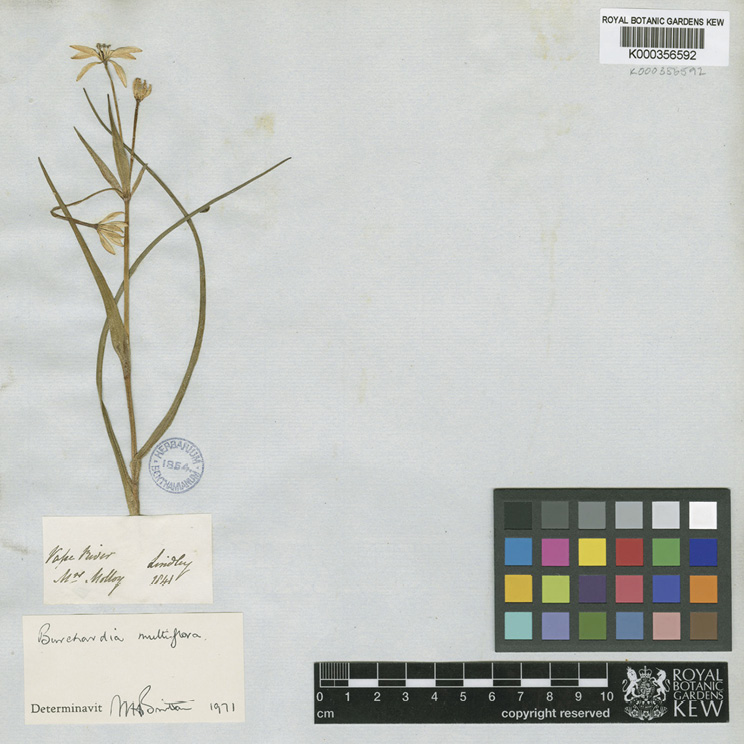
Figure 1: Burchardia multiflora.
Source: Royal Botanic Gardens, Kew (species.data.kew.org/species/urn:lsid:ipni.org:names:532310-1).
Despite never having seen the plants in their habitat, Lindley and Bentham named them according to the Linnean system of classification. For example, the banded greenhood orchid was named Pterostylis vittata by Lindley in A Sketch of the Vegetation of Swan River, overwriting the Noongar name of ‘kararr’.82 By erasing the names given to places and plants by Aboriginal people, and replacing them with new names, the British attempted to claim the country for their own. As cultural anthropologist Veronica Strang has noted in Uncommon Ground, naming ‘humanised’ the landscape for Europeans and imprinted their identity onto the land. This brought it, as Strang writes, ‘into their perceived sphere of control’,83 the emphasis here being on the word ‘perceived’.
Molloy sometimes travelled with Noongar guides who knew what plants she wanted and where to find them. She also, as she wrote to Mangles in 1840, ‘was surprised during my illness to receive a nosegay from a Native who was aware of my floral passion’.84 First Nations guides have been recognised as intermediaries in collecting for reasons of diplomacy, interest and strategy,85 challenging the idea of the collector or explorer as a lone actor.86 Molloy’s relationships with Noongars through these plants show, to use the words of Noongar writer Kim Scott, their ‘confidence, their inclusiveness and sense of play, and their readiness to appropriate new cultural forms—language and songs, guns and boats—as soon as they became available’.87 Molloy was influenced by her relationships with Noongar guides, being receptive to their names for plants. She refers to one of them as a danja and thought it was a hakea, although it turned out to be Xylomelum occidentale, or the Western woody pear.88
While Molloy’s gender prohibited her complete participation in the process of renaming, by supplying Mangles with specimens, she was nevertheless implicated in colonialism. So too was her husband John Molloy, who was government resident and responsible for laying out the land in the settlement. Further, John Molloy, together with his neighbours the Bussells, led a massacre of Wardandi Noongars in 1843, an event described in official accounts in vague terms that has alternately been covered up and uncovered in various historical accounts, including some of the biographies of Georgiana Molloy.89 While the soil of south-west Western Australia, which Molloy described to Mangles on 25 January 1838 as ‘black mould in general, with only occasionally a mixture of sand’, engenders a remarkable diversity of plant life, and prompted a lively and creative literary response from Molloy, it must not be forgotten that it also absorbed the blood from massacres. Part of Molloy’s self—and indeed the selves of all settlers—was shaped by colonial and linguistic violence.
Such influences were not confined to south-west Western Australia. Molloy’s contemporary, Louisa Ann Meredith (1812–1895), emigrated to Lutruwita in 1840 from Britain. A published author, she continued to write and publish once in Lutruwita, writing about plants in Some of My Bush Friends in Tasmania: Native Flowers, Berries, and Insects, Drawn from Life, Illustrated in Verse, and Briefly Described (1860). Her husband, like John Molloy, was actively involved in the dispossession of palawa people from Lutruwita. Yet Meredith’s writing signals her ignorance of the genocide unfolding around her. She was both ‘partially open to understanding new and exotic species of plants and animals’ and ‘deeply complicit in shutting out and shutting down other perspectives’.90
A century after Meredith set sail from Birmingham, Winifred Mary Curtis, who studied and won prizes in botany, chemistry, maths and physics from University College London, also set out for Lutruwita from Britain. Curtis was only the second woman to become a member of the academic staff at the University of Tasmania and wrote the six-volume The Endemic Flora of Tasmania (Rossiter). These women, in being influenced and enraptured by plants, point to the way that story and non-human elements such as soil and plants shape who we are.
Non-human storytelling
On 22 June 1840, Molloy wrote to Mangles:
when I sally forth either on foot or Horseback, I feel quite elastic in mind and Step; I feel I am quite at my own work, the real cause that enticed me out to Swan River.
Molloy’s use of the word ‘entice’ reveals the agency of plants. Many humans in Western culture tend not to notice plants, both because of the apparent homogeneity of their leaves (which, as noted above, Molloy struggled with) and because plants do not move fast and are generally non-threatening; therefore, the brain does not expend much energy in noticing them.91 There is also a cultural bias in plants in Western culture. Botany is not always taught in biology, and animals are sometimes used as examples of universal biological concepts such as evolution.92 Scholars have termed this phenomenon ‘plant awareness disparity’ (which replaces an earlier term, ‘plant blindness’, because of its ableist associations). The phrase highlights how people ‘do not notice plants in their environment as often as they do other organisms’.93 It also suggests that plants can be brought into focus, as they were for Molloy through her acquaintance with the flora of south-west Western Australia, as well as other plant enthusiasts who have been attracted by their aesthetic qualities.
For example, Lechenaultia biloba, the blue Leschenaultia, which is endemic to south-west Western Australia, captivated gardeners in England. In 1840, nurserymen at James Veitch’s nursery in Exeter grew the plant from seeds collected by Molloy’s contemporary James Drummond (who also collected for Mangles on occasion). A year later, Mangles’s acquaintance Joseph Paxton, to whom he sent Molloy’s seeds, published an illustration, based upon a specimen grown by Veitch, and a description in his Magazine of Botany.94 The plants were advertised for 20–30 shillings, the equivalent of four days labour for a skilled tradesman. The plant was a popular specimen for the following few decades and is one of the most popular varieties in cultivation in Western Australia—a testimony to its charisma and programming for survival.
The connective capacity of plants is also evident in the links it created between England and Lutruwita. Molloy wrote to and collected for Mangles between 1837 and 1843—the years that John Franklin was lieutenant governor in Lutruwita. Mangles and Franklin may appear to be unrelated figures living at opposite sides of the globe, but they are connected. In 1845, Franklin departed in the ships Erebus and Terror to find the North-West Passage and disappeared. Rescue expeditions were sent out for years but found few traces of the missing men (see Claydon’s chapter in this issue).
In 1852, Mangles published Papers and Despatches Relating to the Arctic Searching Expeditions of 1850–51–52, Together with a Few Brief Remarks as to the Probable Course Pursued by Sir John Franklin, a collection of ephemera relating to the lost expeditions. It included letters to newspapers and public figures from Lady Jane Franklin, and Captain William Penny, who voyaged in search of the lost ships; lists of animals available to eat in the Arctic regions; accounts of lost Russian sailors living off animals when shipwrecked in the polar regions; letters to and from the Royal Geographical Society; a map and index to the region where Franklin disappeared; a list of vessels engaged in the searches for Franklin; and Mangles’s own musing that, based on the information he had compiled:
it is not so unlikely an event as at first blush it seems, that Franklin may have succeeded in passing the 170th meridian of west longitude, whilst far to the north of Behring’s Strait, and be even now wedged up somewhere above the continent of Asia; or, not impossibly, that of Europe.95
If this were true, Mangles reasoned that Franklin would not be in want of sustenance, as shown by the lists of birds and animals in the region. In doing so, he neatly summarised the absorbing ‘Arctic Question’ of 1850–52, namely whether Franklin might be trapped in an open polar sea (i.e. a sea free of pack ice) or whether long-term survival was possible at a high latitude.
Mangles put the collection together to capitalise on the interest in Franklin’s fate. He was one among many enthusiasts and serious scholars who postulated that the theory of the open polar sea ‘offered the key to a hydrographic system of the world’.96 He drew on earlier publications, such as his 1848 Synopsis of a Complete Dictionary, Graphical, Descriptive and Identical of the Illustrated Geography and Hydrography of ... England and Wales, Scotland and Ireland, in which he proposed a method of charting waters to avoid shipwrecks and ‘arrest a fearful loss of human life’.97 He included this method of charting in his Papers and Despatches, maintaining that through his proposed scheme of ‘Universal Illustrated Geography and Hydrography’:
no more difficulty would be experienced in ascertaining the precise position of any required place in the world, generally, than is here encountered by discovering—by means of the Keys, Beechey Island Cape Herschel, Cape Sir John Franklin, or any other point included in our Arctic List.98
Mangles’s attempts to know and quantify the world through charts and mapping contrast with Molloy’s intimate encounters with plants on Noongar Country.
In focusing so fervently on the loss of human life, it is easy to forget about the trees that were harvested for the ships Erebus and Terror. The timber from these trees met with Antarctic waters in 1840 after departing from this state’s shores. They then met with Arctic waters five years later. While history remembers the expedition leaders, James Clark Ross and John Franklin, it is also true that their history could not have been written without the trees that carried them.
In her biography of Jeanne Barret, In Search of the Woman Who Sailed the World, Danielle Clode, on visiting the harbour at Saint-Malo, France, was drawn not to the new, gleaming ships, but to the ships that ‘stand out, like an old growth of trees in a plantation, against a monocultured forest of silver “radio masts”’.99 Once, she continued, this forest:
would have been a veritable ecosystem of ocean-going, coastal and riverine vessels, all grown from oak, hemp and cotton, all built for war, trade and survival, and all curved into exquisite shapes by the pressures of the water and wind that powered them.100
History is made from the non-human world as much as the human, and these ships powered the story of John Franklin, as well as the stories written about him. Likewise, my story of Georgiana Molloy would not exist without the plants that changed her life. Writing ecobiography reminds us that our historical narratives are indubitably entwined with the natural world.
Conclusion
Like Lopez’s imaginary antennae, reaching out into the storied lives of the natural world around him, Georgiana’s receptiveness to her surroundings pulled the unique and exquisite flora of south-west Western Australia into her writing, and into herself. Through her sensitive finger pads, she came to know, adore and depend upon plants for creative and intellectual nourishment. It is worth returning, by way of conclusion, to Lopez’s essay, ‘Effleurage: The Stroke of Fire’. The term ‘effleurage’ means to massage a limb through long, stroking movements. Lopez refers to it in the context of the communal kiln when he watches Jack, the kiln’s custodian, ‘run his hand over its heated flanks, a light stroke, the way a man might massage the swollen belly of a pregnant woman’.101 The word recalls potters at work, their hand shaping vessels on a turning wheel, while Lopez’s reference to pregnancy recalls the vessel for life itself. His words are a reminder of the manifold sources that sustain and nourish humans and non-humans, all drawn from an earth that has sustained our ancestors for millions of years.
With this in mind, future writers may wish to look to crafting ecobiographies specific to Lutruwita, perhaps exploring how particular plants and soil types influenced the lives of women such as Louisa Ann Meredith and Winifred Mary Curtis. With the humans and non-humans under immense pressure from global heating, rising seas and mass extinctions, stories that highlight humans’ interdependency with the natural world are now more urgent than ever.
1 As per the guide prepared by the Tasmanian Aboriginal Centre, palawa kani should be written in lower case.
2 Dean Adams and Josh DeWeese, foreword to Wild Clay: Creating Ceramics and Glazes from Natural and Found Resources, by Matt Levy, Takuro Shibata and Hitomi Shibata (Bloomsbury Publishing, 2022), 7.
3 Adams and DeWeese, foreword, 7.
4 M. Weiss, Handbuilt: A Potter’s Guide: Master Timeless Techniques, Explore New Forms, Dig and Process Your Own Clay (Quarto Publishing Group, 2018), 19.
5 Larissa Warren, ‘Wild Women, Wild Clay: Women Potters of Tamborine Mountain 1940–1980’, Journal of Australian Ceramics 59, no. 3 (2020): 67.
6 Barry Lopez, About This Life: Journeys on the Threshold of Memory (Kopf, 1998), 148.
7 Lopez, About This Life, 148.
8 Sidonie Smith and Julia Watson, Reading Autobiography: A Guide for Interpreting Life Narratives, 2nd ed. (University of Minnesota Press, 2010), 4.
9 See Jessica White, ‘Edges and Extremes in Ecobiography: Amy Liptrot’s The Outrun’, in Life Writing in the Posthuman Anthropocene, ed. Ina Batzke, Lea Espinoza Garrido and Linda M. Hess (Springer, 2021), 97–121, doi.org/10.1007/978-3-030-77973-3_4; Jessica White, ‘Botanically Adrift: Writing Ecological Estrangement in Two Trees Make a Forest: On Memory, Migration and Taiwan’, Tamkang Review 51, no. 2 (2021): 5–62, doi.org/10.6184/TKR.202106_51(2).0003; Jessica White, ‘From the Miniature to the Momentous: Writing Lives through Ecobiography’, Auto/biography Studies 35, no. 1 (2020): 13–33, doi.org/10.1080/08989575.2020.1713587; Jessica White, ‘“I Felt This Landscape Knew I Was There”: The Lake’s Apprentice and Ecobiography’, in Offshoot: Contemporary Life Writing Methodologies and Practice, ed. Donna Lee Brien and Quinn Eades (UWA Publishing, 2018), 121–34.
10 Jessica White, Silence Is My Habitat: Ecobiographical Essays (Upswell, 2025).
11 Smith and Watson, Reading Autobiography, 2.
12 Smith and Watson, Reading Autobiography, 1.
13 Smith and Watson, Reading Autobiography, 201.
14 Smith and Watson, Reading Autobiography, 217.
15 Cecilia Konchar Farr and Phillip. A. Snyder, ‘From Walden Pond to the Great Salt Lake: Ecobiography and Engendered Species Acts in Walden and Refuge’, in Tending the Garden: Essays on Mormon Literature, ed. Eugene England and Lavinia Fielding Anderson (Signature, 1996), 198.
16 Oxford English Dictionary, s.v. ‘eco- (comb. form)’, December 2024, doi.org/10.1093/OED/9898304226.
17 Oxford English Dictionary, s.v. ‘ecological (adj.)’, July 2023, doi.org/10.1093/OED/9552491394.
18 Paul John Eakin, How Our Lives Become Stories: Making Selves (Cornell University Press, 1999), 45, doi.org/10.7591/9781501711831.
19 Eakin, How Our Lives, 45.
20 Eakin, How Our Lives, 44–5.
21 David Henry Thoreau and Jacob Schmitt, ‘Walden: Or, Life in the Woods’, in Autobiography and Memoir, ed. Thomas Riggs (St James Press, 2013), 233.
22 Eakin, How Our Lives, 44–6.
23 See Smith and Watson, Reading Autobiography, 201.
24 Eakin, How Our Lives, 47, 49.
25 A footnote of Eakin’s refers to Jon Krakaeur’s Into the Wild, which suggests that McCandless was highly successful at foraging and possibly mistook the wild sweet pea for the wild potato, with fatal results (Eakin, How Our Lives, 46). However, organic chemist Thomas Clausen, based at the University of Alaska Fairbanks, proved in 1997 that Krakauer’s hypothesis was incorrect. See Dermet Cole, ‘Krakauer’s Wild Theory on McCandless Gives Short Shrift to Science’, Anchorage Daily News, 18 September 2013, adn.com/commentary/article/krakauers-wild-theory-mccandless-gives-short-shrift-science/2013/09/18/.
26 Eakin gestures to the significance of the natural world in life writing through mentions of Ulric Neisser’s notion of the ‘ecological self’, a self ‘perceived with respect to the physical environment; ‘I’ am the person in this place, engaged in this particular activity’ (Eakin, How Our Lives, 36); however, he does not delve deeply into the implications of this for the field of life writing.
27 World Wildlife Fund, ‘Australian Bushfire Fund Final Report’, World Wildlife Fund, 4 April 2022, worldwildlife.org/publications/australia-bushfire-fund-final-report.
28 Georgina Reid, ‘Seven Billion Burnt Trees’, Wonderground, 13 February 2020, wonderground.press/botanica/seven-billion-burnt-trees/.
29 Stuart Cooke, ‘Writing toward and with: Ethological Poetics and Nonhuman Lives’, Auto/Biography Studies 35, no. 1 (2020): 63–79, doi.org/10.1080/08989575.2020.1713589.
30 White, ‘From the Miniature’, 2020.
31 Cary Wolfe, What Is Posthumanism? (University of Minnesota Press, 2010), xvi.
32 Cynthia Huff and Joel Haefner, ‘His Master’s Voice: Animalographies, Life Writing, and the Posthuman’, Biography 35, no. 1 (2012): 153–69, doi.org/10.1353/bio.2012.0006.
33 Cynthia Huff, ‘Situating Donna Haraway in the Life-Narrative Web’, Auto/Biography Studies 34, no. 3 (2019): 375–84, doi.org/10.1080/08989575.2019.1664167.
34 Ina Batzke, Lea Espinoza Garrido and Linda M Hess, Life Writing in the Posthuman Anthropocene (Springer International Publishing, 2021), doi.org/10.1007/978-3-030-77973-3.
35 Batzke et al., Life Writing, 1.
36 Byron B. Lamont, Tianhua He, Lynne A Milne and Richard M. Cowling, ‘Out of Africa: Linked Continents, Overland Migration and Differential Survival Explain Abundance of Proteaceae in Australia’, Perspectives in Plant Ecology, Evolution and Systematics 62 (2024): 125778, doi.org/10.1016/j.ppees.2024.125778.
37 Stephen D. Hopper and Paul Gioia, ‘The Southwest Australian Floristic Region: Evolution and Conservation of a Global Hot Spot of Biodiversity’, Annual Review of Ecology, Evolution and Systematics 35, no. 1 (2004): 623, doi.org/10.1146/annurev.ecolsys.35.112202.130201.
38 Paul Gioia and Stephen D. Hopper, ‘A New Phytogeographic Map for the Southwest Australian Floristic Region after an Exceptional Decade of Collection and Discovery’, Botanical Journal of the Linnean Society 184, no. 1 (2017): 8, doi.org/10.1093/botlinnean/box010.
39 South West Aboriginal Land and Sea Council, ‘Connection to Country’, Kaartdijin Noongar—Noongar Knowledge, accessed 29 April 2023, noongarculture.org.au/connection-to-country/.
40 Norman Myers, Russell A. Mittermeier, Cristina G. Mittermeier, Gustavo A. B. da Fonseca and Jennifer Kent, ‘Biodiversity Hotspots for Conservation Priorities’, Nature 403, no. 6772 (2000): 853, doi.org/10.1038/35002501.
41 Bernice Barry, Georgiana Molloy: The Mind That Shines (Redgate Consultants, 2015), 44.
42 Ann B. Shteir, Cultivating Women, Cultivating Science: Flora’s Daughters and Botany in England, 1760–1860 (John Hopkins University Press, 1996), 36.
43 Georgiana Molloy to Frances Birkett, 15 April 1831, Papers of the Kennedy Family of Crosby-on-Eden, 1827–1837, DKEN 3/28/9, Cumbria Archive Centre.
44 Georgiana Molloy to Frances Birkett, 15 April 1831.
45 Georgiana Molloy to James Mangles, September 1838, James Mangles Letter Books, ACC479AD, Battye Library, State Library of Western Australia (hereafter Letter Books).
46 William Lines, An All Consuming Passion: Origins, Modernity and the Australian life of Georgiana Molloy (Allen & Unwin, 1994), 219.
47 Lines, An All Consuming Passion, 222.
48 Molloy to Mangles, 31March 1837, Letter Books.
49 Molloy to Mangles, 31March 1837, Letter Books.
50 Molloy to Mangles, 25 January 1838, Letter Books.
51 Mark Paterson, The Senses of Touch: Haptics, Affects, and Technologies (Routledge, 2007) 84.
52 Georgiana Molloy to Elizabeth Besley, 7 November 1832, Papers of Georgiana Molloy, ACC 3278A, J. S. Battye Library.
53 Molloy to Mangles, 25January 1838, Letter Books.
54 Molloy to Mangles, 25January 1838, Letter Books.
55 Liz Cameron and Peter Geelan-Small, ‘Adaptations of Australian Plants in Extreme Conditions’, Australian Plants Society NSW, 16 July 2024, resources.austplants.com.au/stories/adaptations-of-australian-plants-in-extreme-conditions/.
56 Molloy to Mangles, 25January 1838, Letter Books.
57 Molloy to Mangles, 25January 1838, Letter Books.
58 Mark C. Brundrett, Philip G. Ladd and Greg J. Keighery, ‘Pollination Strategies Are Exceptionally Complex in Southwestern Australia—a Globally Significant Ancient Biodiversity Hotspot’, Australian Journal of Botany 72, no. 2 (2024): 2–3, doi.org/10.1071/BT23007.
59 Björn Bohman, Monica M. Y. Tan, Ryan D. Phillips, Adrian Scaffidi, Alexandre N. Sobolev, Stephen A. Moggach, Gavin R. Flematti and Rod Peakall, ‘A Specific Blend of Drakolide and Hydroxymethylpyrazines: An Unusual Pollinator Sexual Attractant Used by the Endangered Orchid Drakaea micrantha’, Angewandte Chemie International Edition 59, no. 3 (2020): 1124–28, doi.org/10.1002/anie.201911636.
60 Molloy to Mangles, 25 January 1838, Letter Books.
61 Nor was this transformation a purely nineteenth-century phenomenon. One hundred and forty years after Molloy complained to her sister about the monotony of the Australian bush, Western Australian scientist George Seddon, originally from Victoria, wrote in his foreword to Sense of Place (1972) that: ‘The country was all wrong … All the plants scratched your legs. The jarrah was a grotesque parody of a tree, gaunt, misshapen, usually with a few dead limbs.’ Gradually, however, he ‘came to understand the land better’, signifying the careful attention that the Western Australian environment can elicit.
62 David Howes, ‘Skinscapes: Embodiment, Culture, and Environment’, in The Book of Touch, ed. Constance Classen (Berg, 2005), 33.
63 Molloy to Mangles, [1840], Letter Books.
64 Catriona Mortimer-Sandilands, ‘Eco Homo: Queering the Ecological Body Politic’, Social Philosophy Today, 19 (2004): 33, doi.org/10.5840/socphiltoday20031915.
65 Constance Classen, ‘Fingerprints: Writing about Touch’, in The Book of Touch, ed. Constance Classen (Taylor & Francis Group, 2005), 6.
66 Molloy to Mangles, 14 March 1840, Letter Books.
67 Molloy to Mangles, 20 January 1841, Letter Books (original emphasis).
68 Molloy to Mangles, 31 January 1840, Letter Books.
69 Molloy to Mangles, 31 January 1840, Letter Books.
70 Jennifer Fisher, ‘Relational Sense: Towards a Haptic Aesthetic’, Parachute 87 (1997): 6.
71 Emma Wilkins, ‘Margaret Cavendish and the Royal Society’, Notes and Records of the Royal Society of London 68, no. 3 (2014): 245–60, doi.org/10.1098/rsnr.2014.0015.
72 Shteir, Cultivating Women, 56.
73 Molloy to Mangles, 25January 1838, Letter Books.
74 Molloy to Mangles, 21 November 1838, Letter Books.
75 Beth Fowkes Tobin, Colonizing Nature: The Tropics in British Arts and Letters, 1760–1820 (University of Pennsylvania Press, 2005): 181.
76 Molloy to Mangles, 21 November 1838, Letter Books (original emphasis).
77 Molloy to Mangles, [1840], Letter Books.
78 Londa Schiebinger and Claudia Swan, ‘Introduction’, in Colonial Botany: Science, Commerce, and Politics in the Early Modern World, ed. Londa Schiebinger and Claudia Swan (University of Pennsylvania Press, 2005), 2.
79 Londa Schiebinger and Claudia Swan, eds., Colonial Botany: Science, Commerce, and Politics in the Early Modern World (University of Pennsylvania Press, 2005), 2.
80 Molloy was not paid for her collecting, as it was not seemly for a woman of her class to receive payment. Instead, Mangles sent her and her family gifts, such as green silk, a microscope for her husband and books for their children. Commercial collectors such as James Drummond were paid for their botanical collections.
81 John Ryan, ‘Sifting Horticulture from Botany: John Lindley’s A Sketch of the Vegetation of the Swan River Colony (1840)’, Australian Garden History, 23, no. 1 (2011): 11.
82 Vivienne Hansen and John Horsfall, Noongar Bush Tucker: Bush Food Plants and Fungi of the South-West of Western Australia (UWA Publishing: 2019), 48.
83 Veronica Strang, Uncommon Ground (Berg, 1997), 217.
84 Molloy to Mangles, June 1840, Letter Books (original underlining).
85 Shino Konishi, ‘Bennelong and Gogy: Strategic Brokers in Colonial New South Wales’, in Brokers and Boundaries: Colonial Exploration in Indigenous Territory, ed. Tiffany Shellam, Maria Nugent, Shino Konishi and Allison Cadzow (ANU Press, 2016), 16, doi.org/10.22459/BB.04.2016.02.
86 Tiffany Shellam, Maria Nugent, Shino Konishi and Allison Cadzow, ‘Brokering in Colonial Exploration: Biographies, Geographies and Histories’, in Brokers and Boundaries: Colonial Exploration in Indigenous Territory, ed. Tiffany Shellam, Maria Nugent, Shino Konishi and Allison Cadzow (ANU Press, 2016), 1–2, doi.org/10.22459/BB.04.2016.01.
87 Kim Scott, That Deadman Dance (Picador, 2010), 398.
88 White, ‘From the Miniature’, 25.
89 Jessica White, ‘“Paper Talk”: Testimony and Forgetting in South-West Western Australia’, Journal of the Association for the Study of Australian Literature 17, no. 1 (2017): 1–13.
90 Philip Hutch and Elaine Stratford, Landscape, Association, Empire: Imagining Van Diemen’s Land (Palgrave Macmillan, 2023), 191.
91 James H. Wandersee and Elizabeth E. Schussler, ‘Preventing Plant Blindness’, American Biology Teacher 61, no. 2 (1999), 84, doi.org/10.2307/4450624.
92 Kathryn M. Parsley, ‘Plant Awareness Disparity: A Case for Renaming Plant Blindness’, Plants, People, Planet 2, no. 6 (2020): 598, doi.org/10.1002/ppp3.10153.
93 Parsley, ‘Plant Awareness Disparity’, 600.
94 Joseph Paxton, Paxton’s Magazine of Botany and Register of Flowering Plants 8 (1841): 152.
95 James Mangles, Papers and Despatches Relating to the Arctic Searching Expeditions of 1850–51–52, Together with a Few Brief Remarks as to the Probable Course Pursued by Sir John Franklin (Francis and John Rivington, 1851), 46.
96 Michael Robinson, ‘Reconsidering the Theory of the Open Polar Sea’, in Extremes: Oceanography’s Adventures at the Poles, ed. Keith R. Benson and Helen M. Rozwadowski (Science History Publications: 2007), 16.
97 James Mangles, Synopsis of a Complete Dictionary, Graphical, Descriptive and Identical of the Illustrated Geography and Hydrography of … England and Wales, Scotland and Ireland (no publisher, 1848).
98 Mangles, Papers and Despatches, 3.
99 Danielle Clode, In Search of the Woman who Sailed the World (Picador, 2000), 84.
100 Clode, In Search, 84.
101 Lopez, About This Life, 147.
Previous



