


 menu
The Doubters' Dilemma
4
Some Detective Work: Comparing Committed Students, Quitters and Doubters
The ANU case study has provided a great deal of univariate, bivariate and multivariate data. However, we believe that the primary contribution of this case study to the broader field of research on retention in L&C courses is in the detailed and robust characterisation of three groupings—which we view as archetypes—of L&C students, derived from the Canonical Discriminant Analysis of the data (as described in Chapter 3). In this chapter, we focus on detailing the characteristics of these archetypes—Committed Students, Doubters and Quitters—and explore how these groups differ from one another across a range of demographic, attitudinal and education variables. We also consider variables that distinguish between any two of the three groups in terms of students’ motivations for continuing or discontinuing studying a language. This will allow us to show how we have understood the implications of these archetypal groupings of our L&C students at ANU—a finding we hope future research will confirm is generalisable across the sector. In Chapter 5, we will explain our hypothesis that the existence of these archetypes can best be understood in the context of a construct related to language capital as a form of social capital, but first we must explain in detail the salient characteristics of these three archetypes.
4.2. A detailed interpretation of the cross-tabulated variables that characterise Committed Students, Doubters and Quitters
In this section, we reconceptualise and extend the analysis reported by Martín and Jansen (2012) to present a thorough description of the cross-tabulated variables relevant in characterising the three groups of students identified in Chapter 3. To avoid extraneous detail, and having already shown that the variables are statistically significant in the Discriminant Analysis that identified the three groups, we will dispense with the need to re-establish the statistical significance of correlations of each individual variable with the variable that defines the three groups of students, as elaborated in Chapter 3, section 3.4.3.
The variables we consider in this section involve (1) general basic characteristics, such as the student’s year of study, their age and nationality. Then we investigate (2) the degree of freedom in their studies; (3) their perceptions about being forced to study or discontinue a language; and (4) their reasons for studying a language. We then explore factors such as students’ exposure to languages through (5) the language background of their family and peers, and (6) their own language learning. This is followed by students’ (7) perceptions of difficulty of language study and sense of progress; (8) perceptions of workload with respect to the four basic language skills; and (9) perceptions of teachers and the learning environment. Finally we look at (10) the effects of students’ grades/marks, and explore other factors that differentiate only pairs of the groups under analysis, namely reasons for continuing with language study (11), and reasons for discontinuing language study (12). The latter involve a re-analysis of the factors explored by Jansen and Schmidt (2011). In all cases, we have excluded ‘not applicable’ answers.1
For consistency and readability, in Figures 4.1 to 4.13 the three groups being characterised (Committed Students, Doubters and Quitters) in Table 3.VI are presented in the same order on the horizontal axis, with the names and values of the relevant variables in the upper right corner of each figure. The labels under the bars in the figures correspond to the values of the ‘propensity to discontinuation’ variable defined in Table 3.VI, as follows: Committed Students (did not think of discontinuing and continued), Doubters (thought of discontinuing but continued) and Quitters (discontinued). Percentages have been used instead of actual values to facilitate comparisons among the three groups. For each variable, or set of variables, we describe the contrast among the three groups, if any, and highlight prominent group characteristics. (In Chapter 5 we will summarise all the characteristics of these three student archetypes, first on the basis of the prominent characteristics, then on the basis of additional relevant characteristics that contribute to a fuller differentiation of the three groups. Readers who would prefer to understand the characterisation before seeing the detailed analyses may skip straight to Chapter 5.)
4.2.1. Student characteristics
As expected, those students who discontinued L&C studies (Quitters) are those who have been at ANU for longer (Figure 4.1.a). This implies that some of them have discontinued L&C studies because they have completed their language major or have completed their studies altogether: the category ‘fourth year or later year (including postgraduate)’ shown in black in Figure 4.1.a thus includes those who have completed their ANU degree and answered the questionnaire. We also include here those students who discontinued because their degree does not allow for many electives, as usually electives are not always available in the early years, and those who attended just one or two L&C courses near the end of their degree (identified as ‘Late Starters’), who would also be included as Quitters. A similar situation is found in the case of students’ age (Figure 4.1.b): those who have discontinued L&C studies are older than those who have continued.
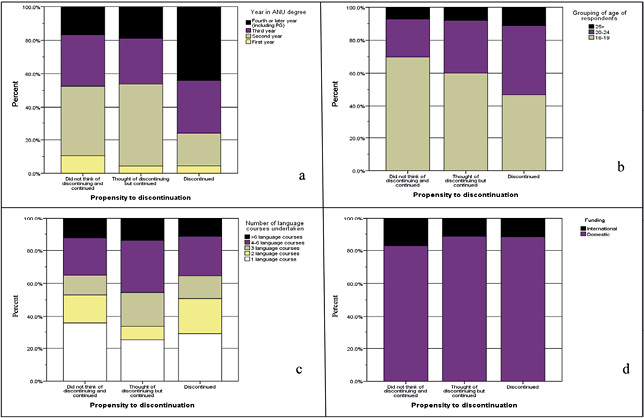
Figure 4.1. Basic characteristics—Student characteristics
Source: Phase 2 Questionnaire Data.
Figure 4.1.c tells an interesting story. The group of Doubters (i.e. those students who have doubts about continuing their language study) includes a larger proportion of students who have completed three or more language courses than the other two groups. This shows that retention is not only an issue for Beginner students. There is a large proportion of students who doubt whether they will continue L&C studies at the stage when they have to decide whether or not to complete the L&C major, or, if they have already completed a major, to complete extra courses out of interest, or to qualify for Honours. Notably, there is a large proportion of students who had only completed one course at the time of the data collection among the Committed Students (Figure 4.1.c), with some 40 per cent of those that quit having completed more than four L&C courses. This confirms our characterisation of the Quitters described above, namely that some simply discontinued because they could not study languages any longer because the degree did not allow them to do so or they had completed the degree (Reluctant Quitters). In addition, we note that there is a higher proportion of international students among the Committed Students than among the Quitters and Doubters (Figure 4.1.d).
4.2.2. Freedom to study languages
In general, students who have less compulsion to study languages quit more frequently, although some 35 per cent of Quitters discontinued even though they were enrolled in degrees which require compulsory language study (Figure 4.2.a). This could suggest that some students began to study more than one language towards a major and later discontinued studying one of them, or that they changed degrees to avoid compulsory L&C studies, or that they chose different majors within degrees with less strict language compulsion. (In relation to the latter, there were at the time ‘escape routes’ for students studying the BA International Relations, allowing them to substitute a language major for an international communication major, the latter only requiring four language courses plus linguistic courses.)
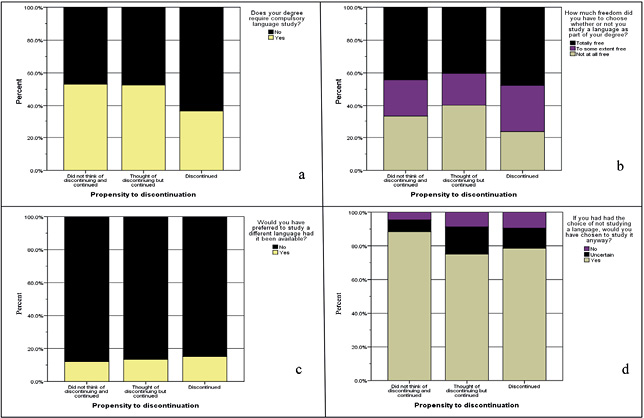
Figure 4.2. Basic characteristics—Freedom to study languages
Source: Phase 2 Questionnaire Data.
Figure 4.2.b shows that the proportion of those who are, to some extent or entirely, free to study a language or not is highest among the Quitters, and lowest among the Doubters, with the latter reporting the highest proportion. The lack of availability of the language that students really wanted to study appears not to have been an issue for any of the groups, even though the figure is slightly higher for the Quitters (Figure 4.2.c): this is not surprising given that ANU teaches the greatest diversity of languages of any Australian university (Nettelbeck et al., 2007; Dunne and Pavlyshyn, 2012).
Students were asked whether they would have studied a language even if they had had the choice of not studying one. The difference between Committed Students and the other two groups is clear, with some 90 per cent of the Committed Students reporting that they would have studied a language anyway as opposed to around 75 per cent in the other two groups (Figure 4.2.d). The Doubters are those who proportionally report most often that they would not have studied it, or are uncertain.
4.2.3. Perceptions of being compelled to study, or to discontinue studying, a language
Figure 4.3 reports students’ perceptions of being compelled or forced to study a language or to discontinue it. When the question is asked in general, that is, when students are asked if there is anything that requires them to study a language, there are no big differences between the groups, although Doubters express more uncertainty about the question (Figure 4.3.a). There are not big differences either in the proportion of each of the groups reporting that they are studying more than one language (Figure 4.3.b). However, when a question is asked about the importance of being discouraged to study a language, it is clear that for Committed Students this is not very important, but that it is for Doubters, and even more so for Quitters (Figure 4.3.c). Quitters are also most likely to report that other study commitments are more important (Figure 4.3.d).
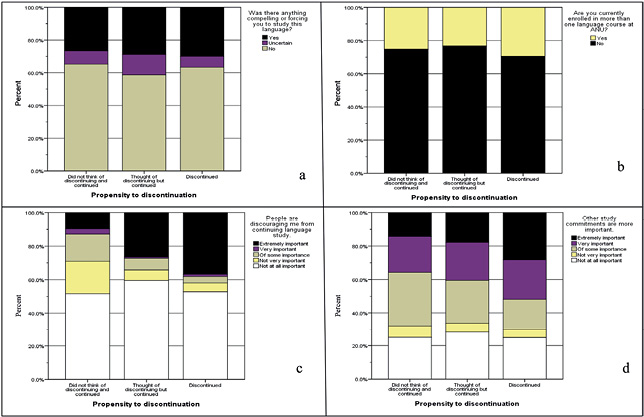
Figure 4.3. Basic characteristics—Perceptions of being forced to study or to discontinue studying a language
Source: Phase 2 Questionnaire Data.
4.2.4. Reasons for studying the language
We also explored the reasons respondents gave for studying the language they had chosen (Figures 4.4 and 4.5). Quitters rate studying a language ‘in order to complete their degree’ as slightly less important than the other two groups (Figure 4.4.a): this is surely connected with the relative freedom to study a language that Quitters tended to report (Figure 4.2). A very high proportion of students in all three groups report that to ‘travel or to live or work in a country where the language they are studying is spoken’ is very important (Figures 4.4b and 4.4.c). This contrasts with a less prominent proportion of students declaring ‘employment reasons’ as very important (Figure 4.4.d). Overall, Committed Students rate this set of reasons as more important than Doubters, and Doubters, in turn, rate them more important than Quitters (Figure 4.4).
Committed Students were more likely to rate the reason that they were ‘studying their chosen language to help them with other studies’ higher than the other two groups (Figure 4.5.a). This could be a reflection of their rating more highly other reasons such as ‘to communicate with native speakers of the language’, ‘interest in the history and culture of the language being studied’ and ‘interest in understanding people and cultures outside their own’ (Figures 4.5.b–d).
4.2.5. Family and peers
The ‘importance of having a family background in the language’ is reported as more pertinent by Committed Students, while Doubters had the highest proportion of ‘not applicable’ answers to the relevant question (Figure 4.6.a). When ‘family encouragement to study the language’ is explored, there are mixed results, but the proportion of Committed Students reporting that this is ‘very important’ or ‘extremely important’ is higher than for the other two groups, while for the Doubters it is the lowest (Figure 4.6.b). This is surely connected with the relative knowledge of languages in the students’ families and peer groups (Figures 4.6.c and 4.6.d). Knowledge of languages is likewise more prominent in the families and peer groups of Committed Students.
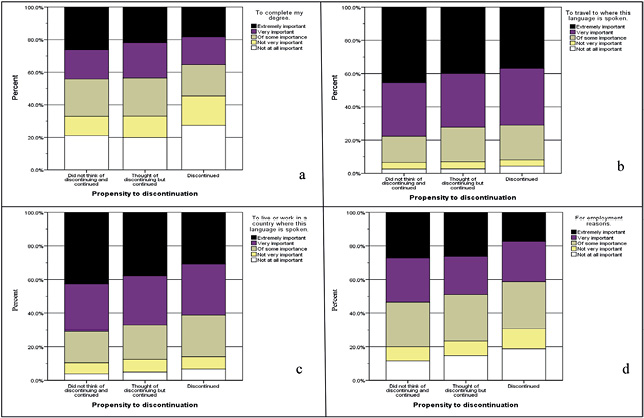
Figure 4.4. Reasons for studying the language 1
Source: Phase 2 Questionnaire Data.
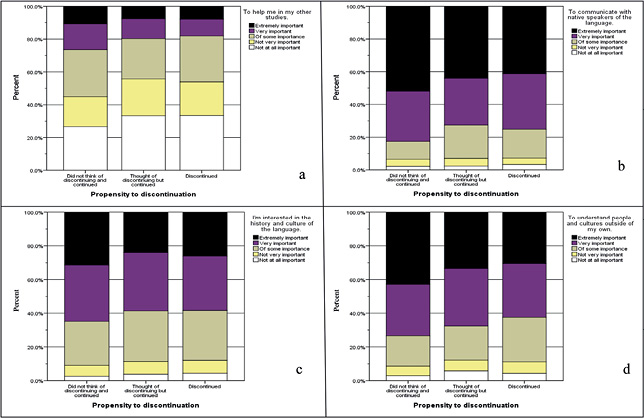
Figure 4.5. Reasons for studying the language 2
Source: Phase 2 Questionnaire Data.
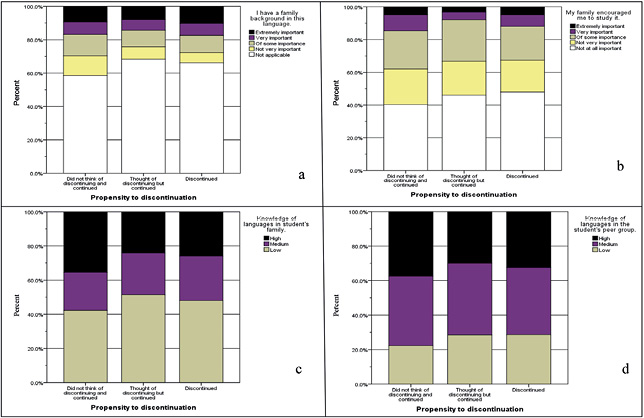
Source: Phase 2 Questionnaire Data.
4.2.6. Previous exposure to language learning
Previous exposure to language learning is reported in Figure 4.7. There is a higher proportion of Quitters who have been exchange students (Figure 4.7.a), probably reflecting that these students either completed their majors overseas (if they did their exchange as university students), or that they completed this exchange before entering university, and thus are likely to belong to the group of Advanced Starters. Among the Quitters in this group are also included exchange students to ANU, who are likely to have quit because they had to go back to study in their own university. The ‘importance of having studied the language before’ is lowest for Doubters (Figure 4.7.b). There are considerable differences between the three groups in ‘how rewarding’ they found studying languages before entering university: 60 per cent of Committed Students describe the experience as ‘extremely’ or ‘very rewarding’, while more than 50 per cent of Doubters report the experience to have been only ‘somewhat’ or ‘not very rewarding’, or ‘not rewarding at all’ (Figure 4.7.c). A similar pattern is found in regard to the importance of having ‘spent some time in the country where the language being studied’, reported less frequently as important by Doubters (Figure 4.7.d).
4.2.7. Perceptions of difficulty
The perception of ‘how difficult it is to study languages’ is reported in Figures 4.8 and 4.9. Doubters report the highest proportion (almost 60 per cent) of students finding the process ‘more difficult than expected’ (Figure 4.8a). ‘Learning grammar’ in particular is perceived as ‘more difficult than expected’ by more than 50 per cent of the Doubters, while a much lower proportion of Committed Students report that ‘overall course difficulty’ and ‘learning grammar’ are ‘more difficult than expected’ (Figures 4.8.a and 4.8.b). Nearly 40 per cent of Committed Students report that they have ‘learned more than they expected’ about the ‘culture associated with the language’ they were learning, while Doubters show the highest proportion of students who report that they learned ‘less’ or ‘much less than expected’ about culture (Figure 4.8.c). Committed Students are most prominent in reporting that they learnt to write the language better than expected (Figure 4.8.d).
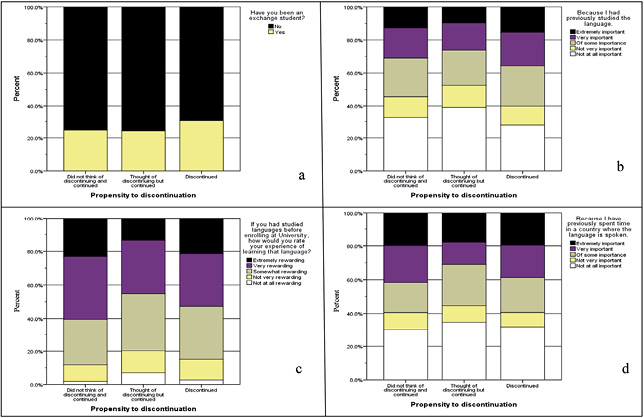
Figure 4.7. Previous exposure to language learning
Source: Phase 2 Questionnaire Data.
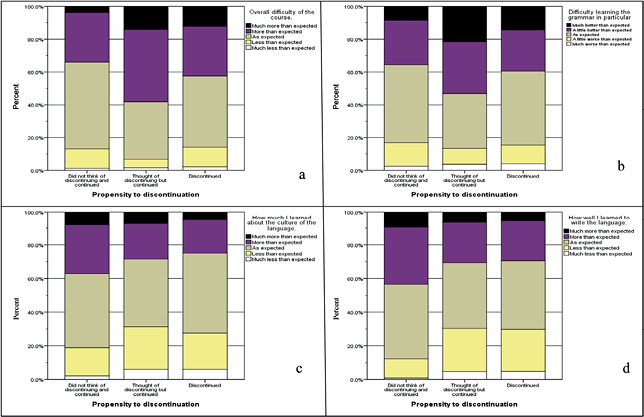
Figure 4.8. Perceptions of difficulty of language studies
Source: Phase 2 Questionnaire Data.
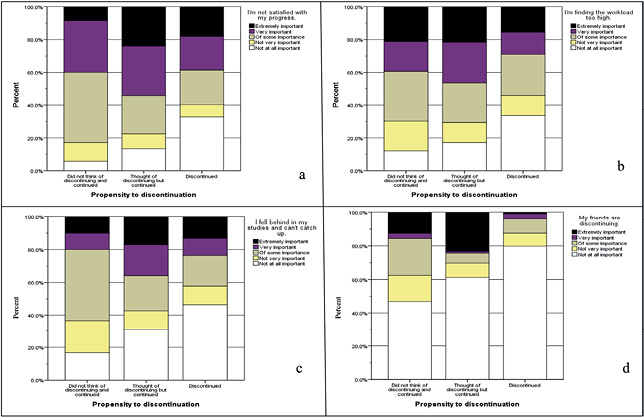
Figure 4.9. Difficulties in the language learning process
Source: Phase 2 Questionnaire Data.
A higher proportion of Doubters than the other two groups report serious problems regarding progress in their language studies (Figure 4.9.a), and especially the feeling that they had ‘fallen behind in their language studies and could not catch up’ (Figure 4.9.c). Doubters are also substantially more affected by their friends discontinuing language studies than Committed Students and Quitters (Figure 4.9.d). More than 40 per cent of Doubters also have the perception that the workload associated with language learning is too high (Figure 4.9.b; further explored below and in Figure 4.10).
4.2.8. Perceptions of workload
The perception of workload associated with learning the four basic language skills is reported in Figure 4.10, with a breakdown in terms of reading (Figure 4.10.a), writing (Figure 4.10.b), speaking (Figure 4.10.c), and understanding (Figure 4.10.d). For all four aspects, a higher proportion of Doubters report that the workload involved is ‘more’ or ‘much more’ than they expected.
4.2.9. Perceptions of teachers and the learning environment
Students’ perceptions of language teachers are reported with regard to teachers’ knowledge (Figure 4.11.a), teaching skills (Figure 4.11.b), advice and feedback received (Figure 4.11.c) and approachability and availability (Figure 4.11.d): in all cases, teachers are consistently perceived more positively by Committed Students than by Doubters, and more positively by Doubters than by Quitters.
The same pattern is found in the context of students’ perceptions of learning environments, with Committed Students consistently perceiving this as better than Doubters, who in turn perceive learning environments better than Quitters (4.12.a and 4.12.b). Notably, Committed Students report having more ‘support from fellow students’ than both Doubters and Quitters (Figure 4.12.c), which suggests that Committed Students cluster in class activities and group work, and this may extend to social activities outside class. Committed Students are also considerably more worried than Doubters and Quitters about the size of language classes (Figure 4.12.d).
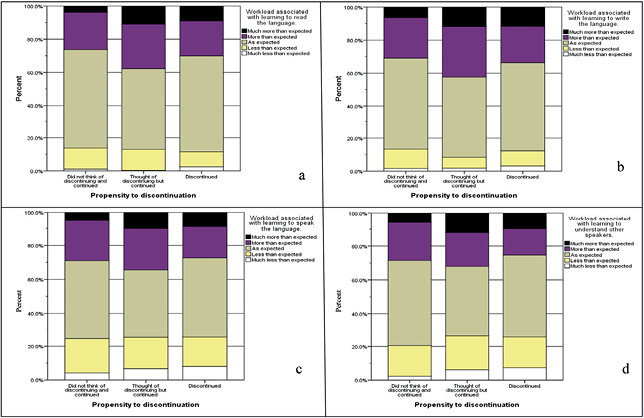
Figure 4.10. Perception of workload in learning the four basic skills
Source: Phase 2 Questionnaire Data.
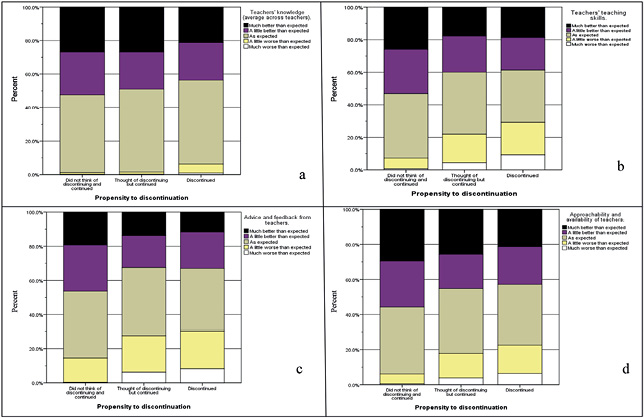
Figure 4.11. Perception of teachers
Source: Phase 2 Questionnaire Data.
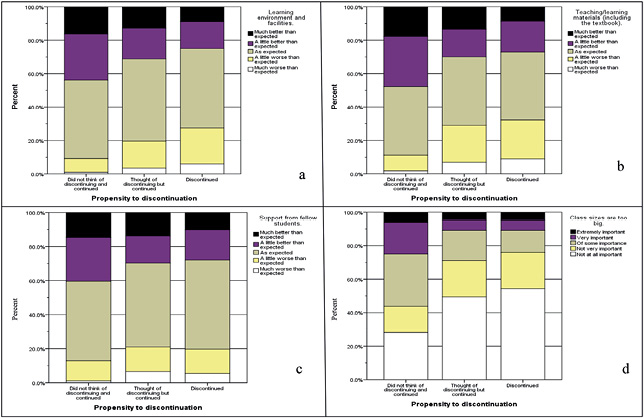
Figure 4.12. Perception of the learning environment
Source: Phase 2 Questionnaire Data.
4.2.10. The effect of grades/marks
The impact of grades obtained in L&C courses as a possible reason to discontinue, or to seriously consider discontinuing, those courses is reported in Figure 4.13, with Figures 4.13.a and 4.13.b pertaining to the reasons students indicated as to why they had discontinued or were planning to discontinue the study of a second language. No group reported thinking that the L&C course in which they had enrolled was going to be an easy subject (Figure 4.13.a). ‘Not obtaining good grades’ was more of a concern for Committed Students than for Doubters and Quitters, but no less than 30 per cent of Doubters were ‘very’ or ‘extremely concerned’ about the grades they were achieving (Figure 4.13.b).
When the actual grades obtained in language classes are considered, we find an interesting correlation between ‘average grade obtained in language courses’ and ‘propensity to discontinue studying languages’: the averages of Committed Students are systematically higher than those of Doubters, and those of Doubters are systematically higher than those of Quitters (Figure 4.13.c). The effect is most pronounced when we consider the maximum grade obtained in L&C courses attended: almost 90 per cent of Committed Students have in the past obtained a Distinction or High Distinction in a L&C course, but this proportion is considerably lower for Doubters and Quitters (Figure 4.13.d).
4.2.11. Reasons for continuing to study the language
Figures 4.14 to 4.16 present additional reasons for continuing language studies: as these questions were not asked in the questionnaire for discontinuing students (i.e. Quitters), this data shows only the contrast between Committed Students (did not think of discontinuing and continued) and Doubters (thought of discontinuing but continued). Committed Students are more likely than Doubters to report that they think that ‘knowing more than one language’ is important, although it is very important for both groups (Figure 4.14.a). The data confirm what we already know from the previous data analysis, namely that Committed Students are more likely than Doubters to i) report that they enjoy learning the language (Figure 4.14.b); ii) feel that they are progressing well in their language learning (Figure 4.14.c); and iii) report that the workload of learning a language is manageable (Figure 4.14.d).
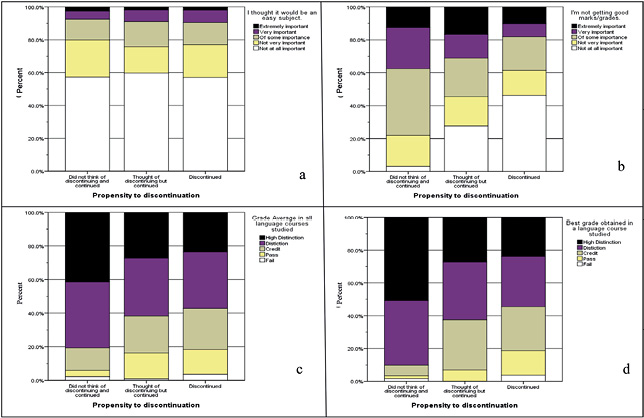
Figure 4.13. The effect of grades/marks
Source: Phase 2 Questionnaire Data.
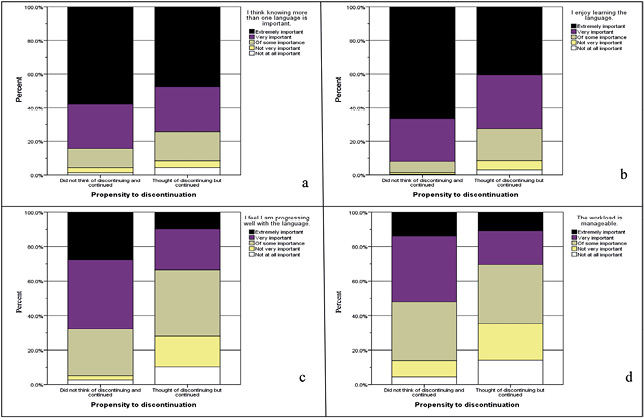
Figure 4.14. Reasons to continue studying the language 1
Source: Phase 2 Questionnaire Data.
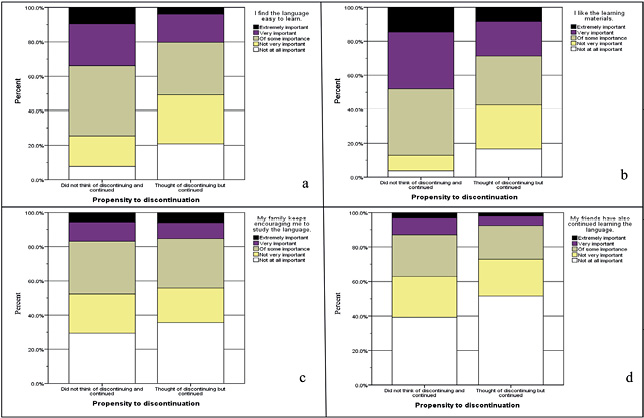
Figure 4.15. Reasons to continue studying the language 2
Source: Phase 2 Questionnaire Data.
Committed Students find their language of study ‘easier to learn’ than Doubters (Figure 4.15.a). A similar pattern is found in responses other questions such as ‘I like the learning materials’ (Figure 4.15.b); ‘my family keeps encouraging me to study the language’ (Figure 4.15.c); and ‘my friends have also continued learning the language’ (Figure 4.15.d), although the last two reasons are less obviously different.
Committed Students are more likely to report that they ‘need to use the language they are studying in their work’ (Figure 4.16.a). Doubters are more likely to report that they ‘keep studying a language because there are no better study alternatives available’ to them (Figure 4.16.b) and that it ‘would be a shame to give up language studies at the stage they are at’ (Figure 4.16.c). This could mean that Doubters are already committed to completing a major or a degree that requires language study, and that they will continue in spite of not being satisfied with their language learning experience.
As expected, the main contrast between Committed Students and Doubters are their plans for future language studies: Committed Students are considerably more likely to report that they want to complete a major in the language, or to go on and do Honours in the language, while more than 40 per cent of Doubters report that they are planning to complete only two years of study in the language, or just complete the course in which they were presently enrolled (Figure 4.16.d). This confirms the status of Doubters as students ‘at risk of discontinuing’.
4.2.12. Reasons for discontinuing to study the language
In the questionnaire for Continuing students, those who reported that they were considering discontinuing L&C studies (Doubters) were asked to consider additional reasons not previously explored. The same questions were asked of Discontinuing students (Quitters), and shown in Figures 4.17 to 4.20 (variables not previously shown in Figures 4.1 to 4.13). The figures, then, present only the contrast between Doubters (thought of discontinuing but continued) and Quitters (discontinued). In regards to questions relating to difficulties with L&C studies (Figure 4.17), Doubters are more likely than Quitters to report that they are ‘finding the course too difficult’ (Figure 4.17.a); that they are ‘finding the workload too high’ (Figure 4.17.b); and that it worries them that other students seem to speak better’ than they do (Figure 4.17.c).
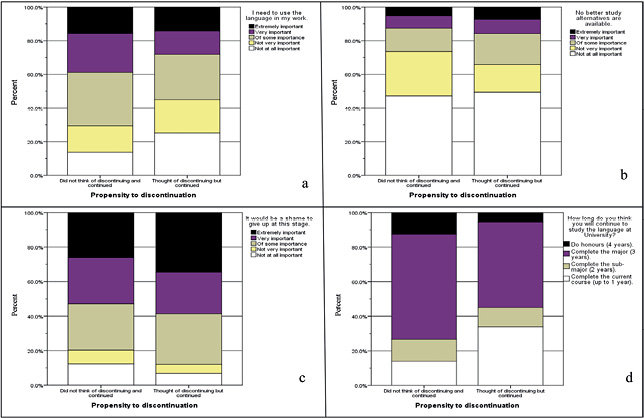
Figure 4.16. Reasons to continue studying the language 3
Source: Phase 2 Questionnaire Data.
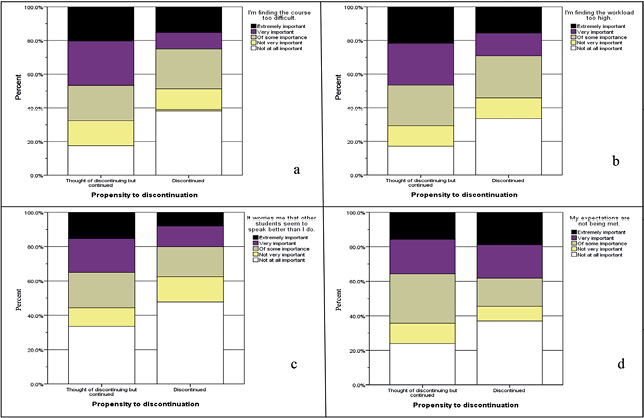
Figure 4.17. Reasons to discontinue 1
Source: Phase 2 Questionnaire Data
For the reason ‘my expectations are not being met’, we find mixed results (Figure 4.17.d): Quitters are as likely as Doubters to consider this reason as ‘very important’ or ‘extremely important’, but Doubters are more likely to consider this reason ‘of some importance’ (that is, they are less likely than Quitters to consider this reason as ‘not very important’ or ‘not at all important’). This distribution reflects not only the ambivalent situation of Doubters, but also their relatively lesser freedom to quit L&C studies.
In regard to questions relating to negative perceptions of language learning (Figure 4.18), Doubters are more likely than Quitters to report that they are ‘not enjoying the course content’ (Figure 4.18.a); that they don’t like ‘the way the language is taught’ (Figure 4.18.b); that they consider that ‘not enough time is spent speaking the language’ (Figure 4.18.c); and that they ‘feel uncomfortable speaking the language in front of others’ (Figure 4.18.d). The response that ‘not enough time is spent speaking the language’ (Figure 4.18.c) confirms a finding made by Nettelbeck et al. (2009, 19) that suggested that students are interested in learning to speak the language but that teachers offer other types of content rather than speaking practice. Overall, the data in Figure 4.18 strongly encourages a reconsideration of the particular needs of Doubters with regard to L&C curricula.
In terms of questions related to practical and external reasons for discontinuing language studies (Figure 4.19), Quitters are more likely than Doubters to report ‘timetable clashes’ as a reason for discontinuing L&C studies (Figure 4.19.a). This also reflects Quitters’ relatively higher freedom to study or not to study a language, and the already explored perception that ‘other studies’ are more important to them (Figure 4.3.d). ‘Paid work commitments’ appear to be equally important reasons for discontinuing for both Quitters and Doubters (Figure 4.19.b), whereas ‘financial reasons’ seem to be slightly more important for Doubters (Figure 4.19.c). Other external reasons, such as ‘problems with daily travel’, seem to be of relatively little importance for the two groups (Figure 4.19.d), and the same is true for reasons such as ‘family commitments’ or ‘health issues’ (explored in the data, but not shown here).
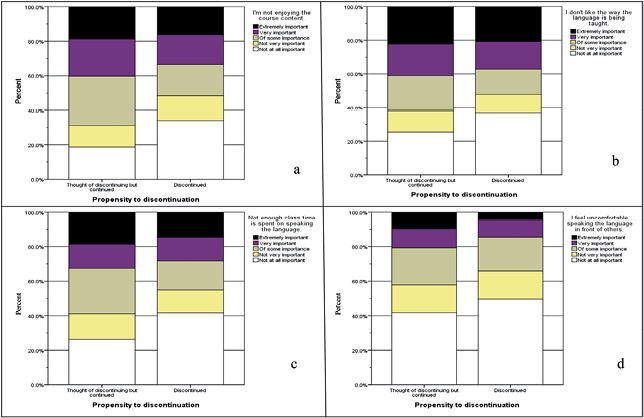
Figure 4.18. Reasons to discontinue 2
Source: Phase 2 Questionnaire Data.
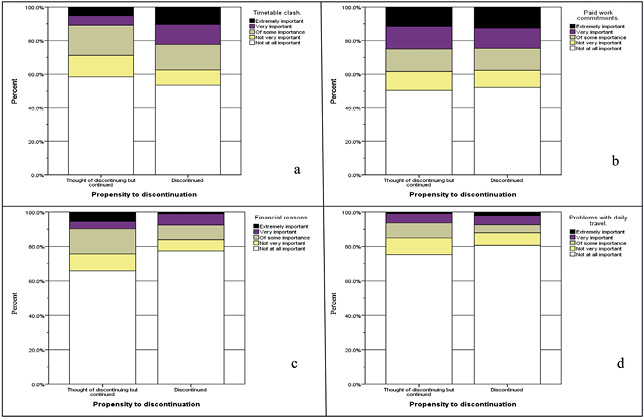
Figure 4.19. Reasons to discontinue 3
Source: Phase 2 Questionnaire Data.
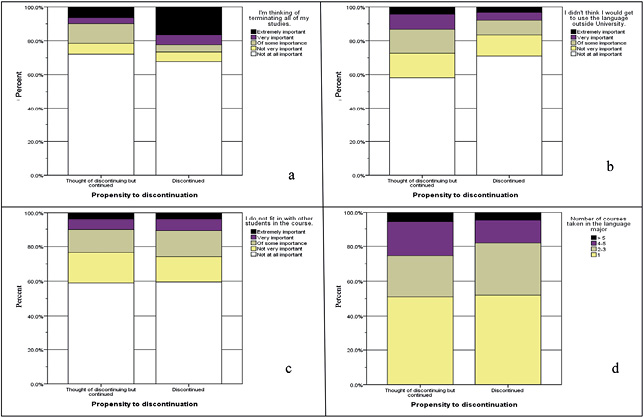
Figure 4.20. Reasons to discontinue 4
Source: Phase 2 Questionnaire Data.
Affective reasons for discontinuing were also explored (Figure 4.20). Quitters are more likely to report that they were ‘thinking of terminating their university studies’ as a reason for discontinuing L&C studies (Figure 4.20.a), but the latter could, for some, be a simple consequence of approaching the end of their degree. Doubters are slightly more likely than Quitters to perceive that they ‘would not use the language outside university’ (Figure 4.20.b).
Doubters and Quitters do not differ in their reported perception that they ‘don’t fit with other students in the class’ (Figure 4.20.c), but this perception is of ‘some importance’ or ‘very important’ for more than 20 per cent of both groups, again pointing to the need to examine L&C curricula to accommodate both groups effectively. Finally, when the numbers of courses completed in the language major are compared in Figure 4.20.d, we confirm that Doubters stay longer in the major than Quitters, and that the risk of discontinuation in Language & Culture courses is not restricted to the initial years of language learning, as the bulk of the per cent difference between Doubters and Quitters is found in the period between two and four language courses being completed. When contrasted with Figure 4.16.d, this reflects the pressure on Doubters to complete the language major.
In this chapter we have presented a detailed analysis of the characteristics of the three groups of students we identified in the Discriminant Analysis carried out in Chapter 3. This detailed analysis forms the basis of the characterisations of the three groups that we present in Chapter 5, although the student characteristics are presented in a different order to that followed in this chapter to allow for a more coherent characterisation of the groups under analysis. In Chapter 5 we will also introduce the concept of language capital and illustrate how it can be used to explore students’ perceptions about learning the spoken language, as the latter proved a key differentiating characteristic between Doubters and Quitters.
1 Except in Figure 4.6.a, where this is relevant.
Previous



